SEO title: Custom Clear Plastic Boxes | PET Folding Packaging
Meta description: Plan custom clear PET folding boxes with practical guidance on sizing, artwork, sample approval, food-contact documentation, and project-specific quotes.
Custom Clear PET Folding Boxes provide transparent packaging for product presentation. Start with your product dimensions, loading arrangement, artwork, and destination market; then confirm the construction through a physical sample. Thickness, closures, printing, minimum order quantity, price, and production time require a project-specific quotation and approval.
For retail brands, packaging buyers, and growing product businesses: this format is worth evaluating when customers need to see a cosmetic container, gift, accessory, or packaged confectionery before buying. The intended role is a folding presentation box—not a rigid storage cabinet, molded clamshell, or permanent acrylic display case.
The purchasing problem: an opaque carton conceals the product, but a poorly specified transparent box introduces different problems. Excess space allows movement; an overly tight fit complicates loading; artwork can obscure the display area. Scratched panels or a closure that will not stay seated can undermine the presentation you intended.
The practical solution: develop the box around the actual product and packing process. Compare a loaded sample, not just an empty mockup. Agree on visible quality, closure behavior, and transit protection before committing to production, so approval covers both shelf appearance and everyday handling.

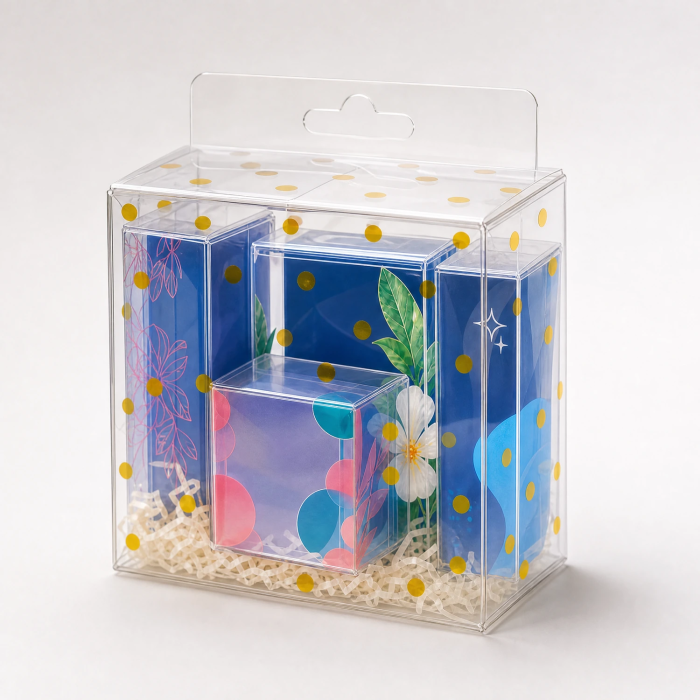
Images illustrate proposed packaging and evaluation scenarios; they are not photographs of verified production, approved samples, or completed tests.
Explore the buying guide
What makes this a PET folding box? ↑
The confirmed product identity is Custom Clear PET Folding Boxes, under Custom Boxes → Custom Plastic Boxes, with provisional reference NSKU-801-01. PET identifies the material family; folding identifies the construction. Neither term establishes a particular thickness, closure design, recycled percentage, or food-contact status.
In this packaging category, plastic sheet is cut and creased into a carton-style structure. The distinction between sheet-based cartons and other clear packaging formats is illustrated by clear folding box construction[1]. That industry reference explains the format; it does not establish manufacturing capabilities for this product.
Keep molded trays, injection-molded containers, and fabricated acrylic cases separate when comparing quotations. Their tooling, assembly, and shipping arrangements are not interchangeable. A tray proposed inside a folding box is an additional component requiring its own material, fit, and cost approval.
| Specification field | Current position | Required purchasing detail |
|---|
| Product and material family | Clear PET folding box | Confirm the exact sheet grade in the quotation |
| Dimensions | No product-specific dimensions supplied | Internal length × width × height in mm; identify external dimensions separately |
| Sheet thickness and unit weight | Not supplied | Quoted thickness in mm and sample weight in g |
| Closure, printing, and inserts | Not verified options | Proposed construction, artwork, and component list |
| MOQ, price, and production time | No confirmed values supplied | Quantity per design, USD pricing, and an explicitly defined production schedule |
| Performance and compliance | No product-specific evidence supplied | Applicable documentation, test plan, and approval records |
This specification table separates the confirmed identity from open purchasing decisions. Published figures for other suppliers, shoe organizers, or acrylic display boxes cannot fill these gaps.
How do you specify fit and readable presentation? ↑
Measure the product at its widest and tallest points, including caps, handles, wrapping, and other protrusions. State the intended orientation and whether an insert, card, or protective layer will accompany it. Product measurements and finished box measurements should remain separate fields.
- Define the internal space. Use length × width × height in mm and label the dimensions as internal.
- Describe loading. Explain which opening the packer will use and whether the product must slide, tilt, or be positioned in an insert.
- Agree on clearance. Do not automatically apply a generic allowance; confirm the required clearance and manufacturing tolerance through sampling.
- Check the assembled pack. Confirm removal, closure engagement, product movement, and front-facing orientation.
Capacity, load-bearing suitability, and the number of products that fit are determined by physical dimensions, the loaded configuration, and sample validation. A photograph showing several items is not an approved packing capacity.
Readability needs a separate check. View the filled sample against the actual product colors and under intended display lighting. Confirm that product information remains legible, the branding does not conceal important features, and any barcode is tested in its final location rather than approved only on a flat artwork file.

Which surface and closure details deserve sampling? ↑
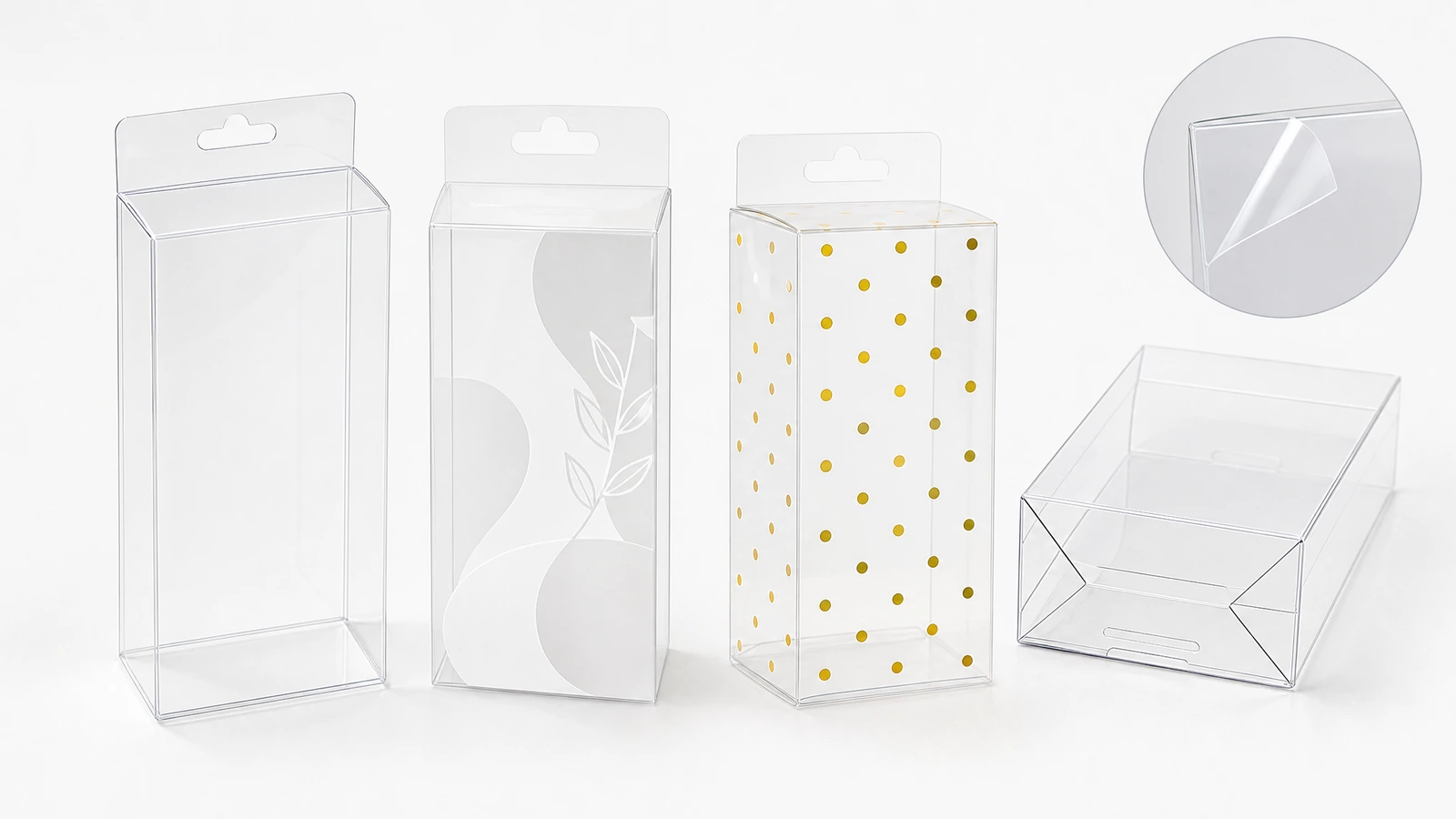
Start with the display area. Identify panels that should remain transparent and areas where branding or a backing card may be appropriate. Printing, white ink, foil decoration, and protective film are requests for feasibility review—not confirmed options for this provisional product.
For closure selection, ask to examine the proposed tuck or locking arrangement, including the rear-facing flap where relevant. Check whether it interferes with loading, catches the product, or changes the visible silhouette. Do not substitute a magnetic door or rigid hinge simply because it appears in reviews of transparent storage containers.
Evaluate the finish after folding and handling. Inspect for scratches, haze, whitening at creases, and print damage near bending areas. If removable film is proposed, include removal in the packing trial and inspect the exposed surface afterward. Protective film should not be presented as proof that the finished box is scratch-resistant.
Long-term clarity also requires evidence. No anti-yellowing lifetime, outdoor-use rating, or measured optical performance has been supplied. If sunlight exposure or extended storage matters, specify the intended conditions and request a relevant test rather than relying on “crystal clear” as a durability guarantee.
How do you prepare artwork for a transparent surface? ↑
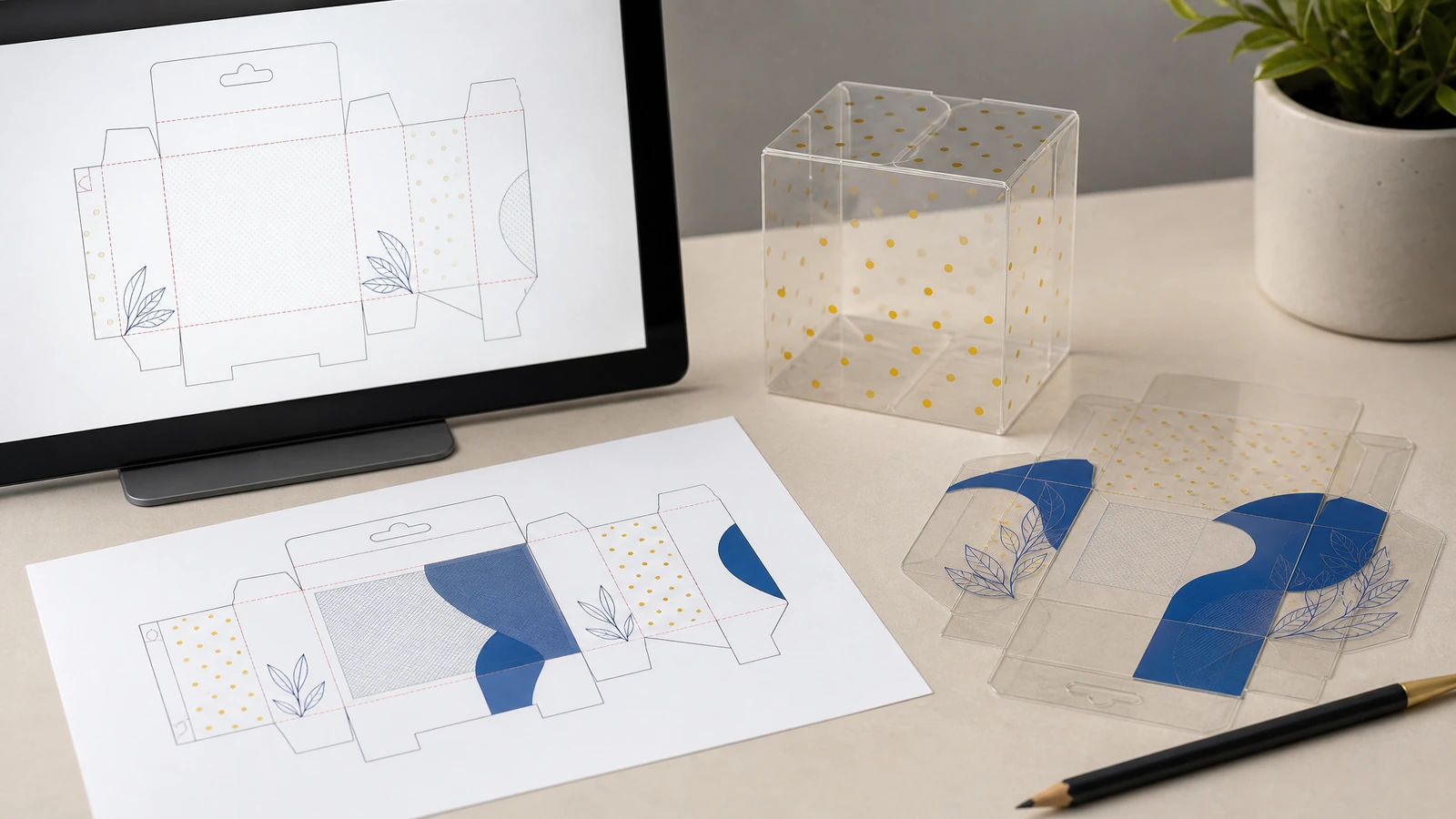
Use the approved structural drawing as the artwork reference. A graphic positioned on an approximate rectangle cannot establish where it will sit after folding. Keep the current drawing and artwork revision together so a late size change does not leave obsolete graphics in production.
- Identify functional areas: show cutting lines, creases, joining areas, and closure zones separately from printed artwork.
- Define visibility: mark transparent areas and any proposed opaque backing or white-ink areas.
- Confirm orientation: check which panel becomes the front and how text appears when the box is assembled.
- Review production requirements: obtain the selected process requirements for artwork files, bleed, and reproduction limits.
- Approve physical appearance: assess color and legibility with the intended contents inside.
Transparent packaging makes the background part of the design. A logo that looks distinct on a white screen may become difficult to read against a dark or patterned product. Evaluate the complete presentation before adding more ink coverage, which may reduce the visibility that motivated the format.
What should happen before production approval? ↑
A useful approval sequence connects the commercial quotation to the physical sample. It should not allow an attractive rendering to stand in for a fit test or let an unprinted prototype establish final print quality.
- Freeze the brief: product measurements, intended use, destination, order quantity, and number of artwork versions.
- Review the proposal: sheet specification, dimensions, closure, printing, inserts, packing method, and separately identified charges.
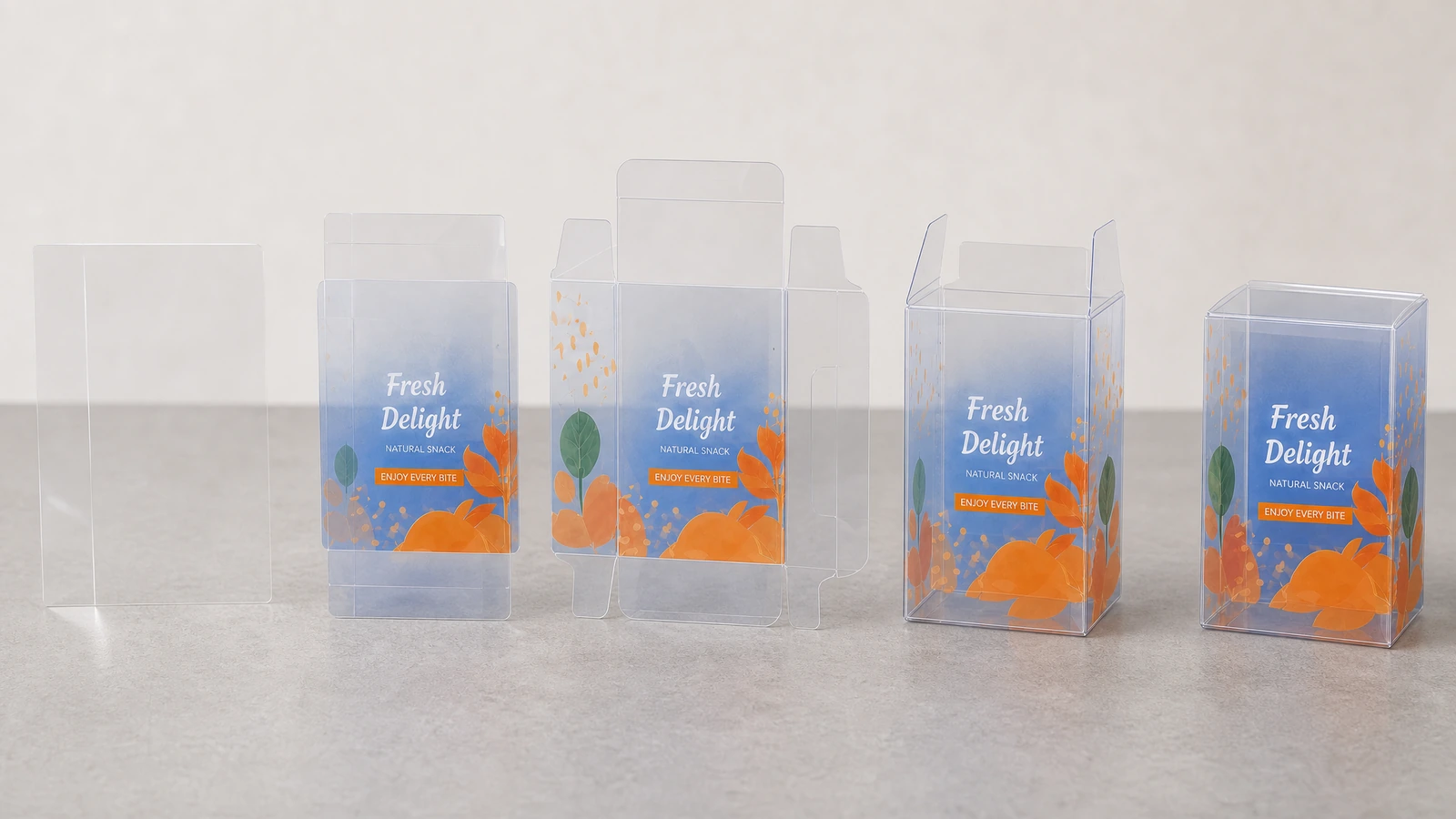
- Evaluate a structural sample: assemble and load it using the intended packing method.
- Evaluate the decorated sample: inspect appearance, readability, folding behavior, and surface condition.
- Record approval: retain the accepted sample, drawing revision, artwork revision, and agreed inspection criteria.
The proposed manufacturing route may include printing, cutting, creasing, joining, and packing, depending on the approved design. The supplier must confirm the actual sequence and feasibility. No equipment list, production capacity, or factory-specific process performance is established here.
Ask the quotation to distinguish sample preparation, approval time, production, and transportation. Confirm whether durations use calendar or business days and what event starts the production clock. A required arrival date is a planning input, not evidence that the schedule can be met.
How do you turn quality expectations into acceptance checks? ↑
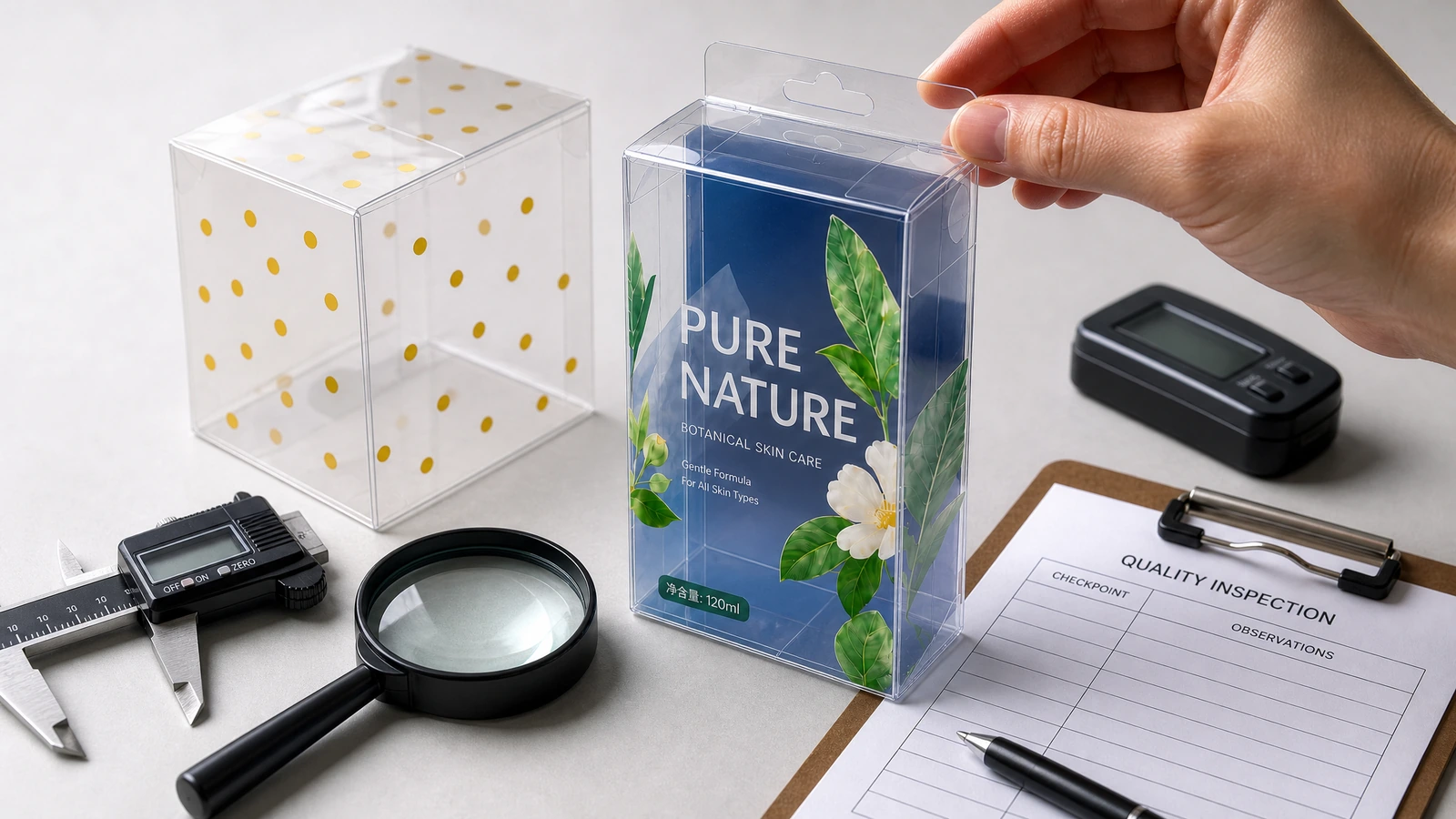
Replace “good quality” with observable criteria. Agree on what will be inspected, how it will be assessed, and which defects require rejection or correction. The checklist below is a proposed acceptance framework; it does not report completed testing.
| Inspection area | Suggested method | Approval record |
|---|
| Dimensions and fit | Measure the assembled sample and load the actual product | Agreed dimensions, tolerance, orientation, and clearance |
| Visible surfaces | Inspect panels under agreed lighting and viewing conditions | Reference photographs and agreed scratch, haze, and contamination limits |
| Creases and closure | Fold, load, close, and reopen the proposed structure | Accepted folding behavior and closure engagement |
| Print and decoration | Compare the physical proof and assess adhesion using an agreed method | Approved appearance and test conditions |
| Distribution protection | Evaluate the complete loaded shipping arrangement | Selected protocol, acceptance criteria, results, and configuration |
Inspection limits must be agreed before production. No dimensional tolerance, opening-cycle count, compression limit, or allowable defect rate should be inferred from this checklist.
For distribution testing, ASTM D4169[2] provides a framework for evaluating shipping units against distribution hazards. Select the appropriate protocol and edition for the actual route. Mentioning the standard does not mean this product has passed it or that every shipment requires the same test sequence.
Assess the product, presentation box, inserts, cushioning, and outer carton together. An empty box test cannot establish protection for a loaded configuration. Any required drop, vibration, or compression performance remains pending testing.
Which packaging route fits your buying priorities? ↑
Compare alternatives by the job they must perform, not by transparency alone. The relevant decision may be custom sizing versus a stock format, or a folding presentation box versus a durable display case.
| Route | Reason to evaluate it | Main purchasing boundary |
|---|
| Custom PET folding box | Product-specific presentation and layout | Requires approved dimensions, construction, and samples |
| Stock clear box with label or insert | Branding without a fully custom box structure | Available dimensions may constrain fit and presentation |
| PVC folding box | An alternative material for a separately quoted design | Review material appearance, intended use, and recovery route |
| PP packaging | Applications prioritizing heat-related requirements or flexibility | Different appearance and application-specific validation |
| Fabricated acrylic case | A separate route for rigid display requirements | Different construction, cost, weight, and shipping considerations |
| Thermoformed packaging | Product-contoured tray or enclosure requirements | Separate tooling and fit assessment; not the same folding-box specification |
These are comparison routes, not an available-options catalog. Obtain like-for-like quotations that identify all components and approval requirements before comparing unit prices.
Material appearance can differ: Printex’s PET and PVC comparison[3] describes a possible tint difference. Judge proposed materials through physical samples rather than applying a universal clarity or cost ranking.
For temperature-sensitive applications, Inline Plastics’ PET and PP guidance[4] distinguishes their general priorities. This PET folding product has no verified microwave, hot-fill, freezer, or temperature rating.
For smaller projects, a stock format with added branding deserves a separate quotation. ClearBags’ custom-box guidance[5] illustrates that purchasing approach. It is not evidence of this product’s MOQ or service availability.
Compare total project cost: development, cutting or setup charges, printing, inserts, protective materials, freight, and applicable import charges. Separate one-time charges from repeat-order pricing. Combining artwork versions should not be assumed to eliminate setup costs.
What evidence supports food-contact and environmental claims? ↑
First establish whether food touches the box directly or remains inside another package. Record food type, contact duration, and intended temperature conditions. The FDA food-contact framework[6] addresses material components and intended use; a resin name alone does not establish suitability.
For relevant polyethylene phthalate polymers, 21 CFR 177.1630[7] specifies conditions rather than blanket approval of every finished PET box. Request documentation covering the proposed grade and relevant additives, inks, adhesives, or coatings, with supporting testing where applicable.
No food-contact declaration, recycled-content evidence, or chemical test report has been supplied for this product. Treat food-safe, BPA-free, PFAS-free, and recycled-content statements as documentation requests, not established selling points. If rPET is proposed, verify both the claimed content and suitability for the intended application.
Recycled content and recyclability answer different questions: what the package contains and whether an appropriate recovery route exists. Confirm acceptance of the finished format in the destination market. Do not infer compostability, universal curbside acceptance, or a lower environmental footprint from PET identity.
For European destinations, review the EU packaging framework[8] against the packaging category and intended market placement. Do not turn general regulatory targets into a claim that this unfinished specification is compliant.
For California, evaluate producer obligations through CalRecycle’s packaging EPR guidance[9]. Packaging design, reporting responsibilities, and environmental labeling require separate review; a material substitution does not by itself resolve them.
How do you plan shipping and repeat orders? ↑
Distinguish delivery of empty boxes from delivery of finished retail packs. If flat packing is proposed, confirm bundle protection, assembly instructions, and the receiving team’s loading process. If boxes arrive assembled, obtain the corresponding carton arrangement and freight quotation.
For finished goods, specify how clear panels will be protected from rubbing and how the contents will be restrained. Cushioning and outer-carton requirements depend on physical dimensions, the loaded configuration, and sample validation. Do not treat the presentation box as an independently verified shipping container.
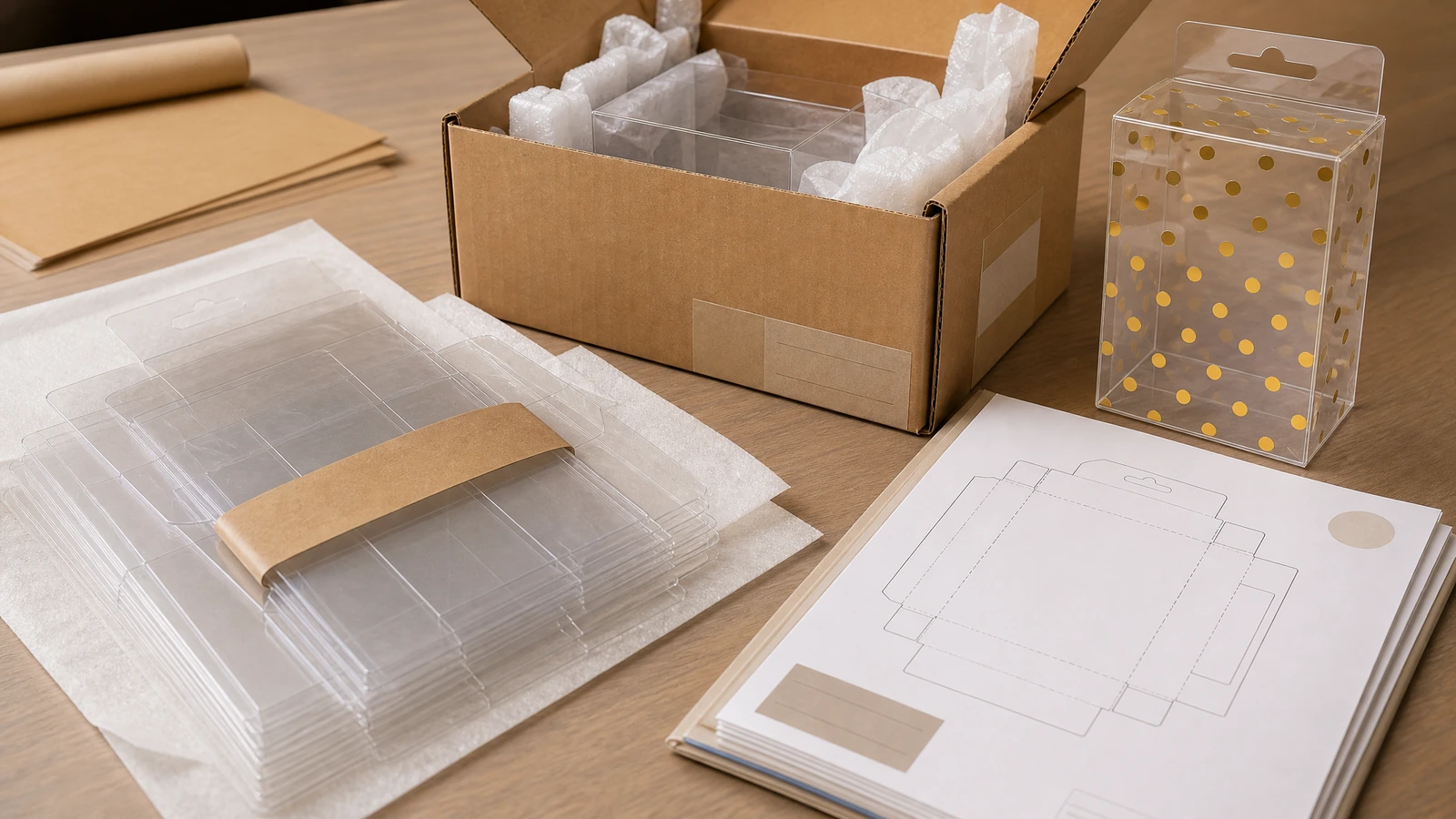
Retain the accepted sample alongside the drawing, artwork, material specification, and packing instructions. For repeat orders, identify any change in product dimensions, inserts, printing, or shipping route before reusing an approval. Resolve damage-reporting evidence and replacement terms in the purchase agreement rather than assuming an unstated guarantee.
Key takeaways for a better purchasing decision ↑
- The confirmed format is a clear PET folding box. Evaluate it as presentation packaging, not as a rigid organizer or molded container.
- Fit and usable capacity require loaded samples. Physical dimensions, loading arrangement, and sample validation determine suitability.
- Commercial and performance values remain open. Obtain product-specific MOQ, production time, thickness, unit weight, pricing, and test evidence.
- Historical recycling data is not a recovery guarantee for this box. — 13.6% of U.S. plastic containers and packaging generated in 2018 was recycled (Source[10]).
- Approve the complete specification. A drawing, decorated sample, inspection criteria, and shipping configuration provide a clearer purchasing basis than generic material claims.
Move forward with a defined packaging brief ↑
The right transparent folding package starts with a clear definition of what must remain visible, how the product will be loaded, and what evidence is required before purchase. That approach keeps appearance, handling, compliance, and commercial terms connected to the same approved design.
Request a project-specific quote for NSKU-801-01 with your product dimensions, intended contents, quantity per design, artwork, destination, and required arrival date.




The information below is required for social login
Sign In
Create New Account