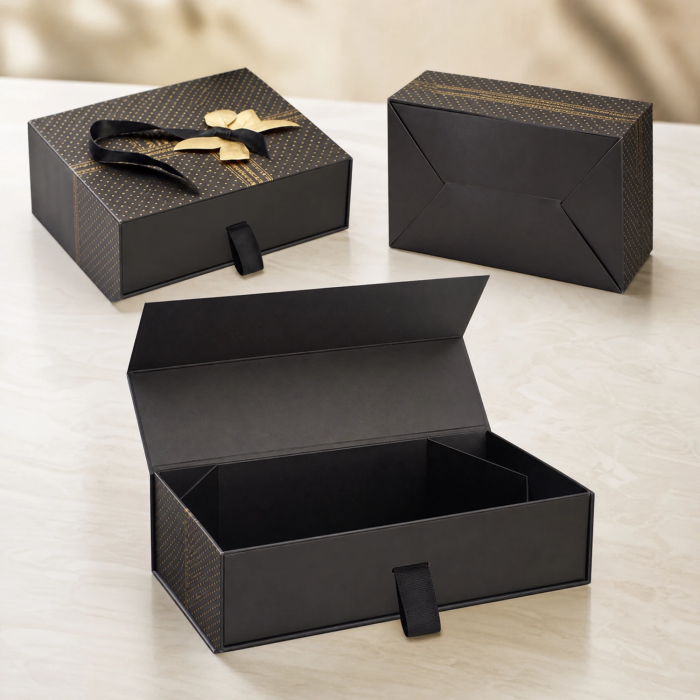
Custom Collapsible Magnetic Gift Boxes combine a fold-flat structure with a magnetic lid for branded gift presentation. Specify the internal fit, printed finish, insert and shipping protection together, then validate the loaded sample before production. Pricing, minimum order quantity, production timing and performance require project-specific confirmation.
For brand buyers and gifting teams: This format is worth considering for cosmetics, jewelry, accessories, corporate gifts and PR presentations where the packaging is part of the experience. The purchasing decision starts with how the recipient will open the gift—and how your team will store, assemble and dispatch it.
A beautiful exterior cannot compensate for a lid that sits unevenly, an insert that allows movement or a box that arrives with damaged corners. These problems can create repacking work, replacement costs and an opening experience that falls short of the product inside.
The practical solution is to develop the presentation and delivery system together. Begin with the real contents, establish the assembled fit, compare finishing samples and approve the complete shipping configuration. That turns an attractive packaging idea into a specification that purchasing, design and fulfillment teams can evaluate.
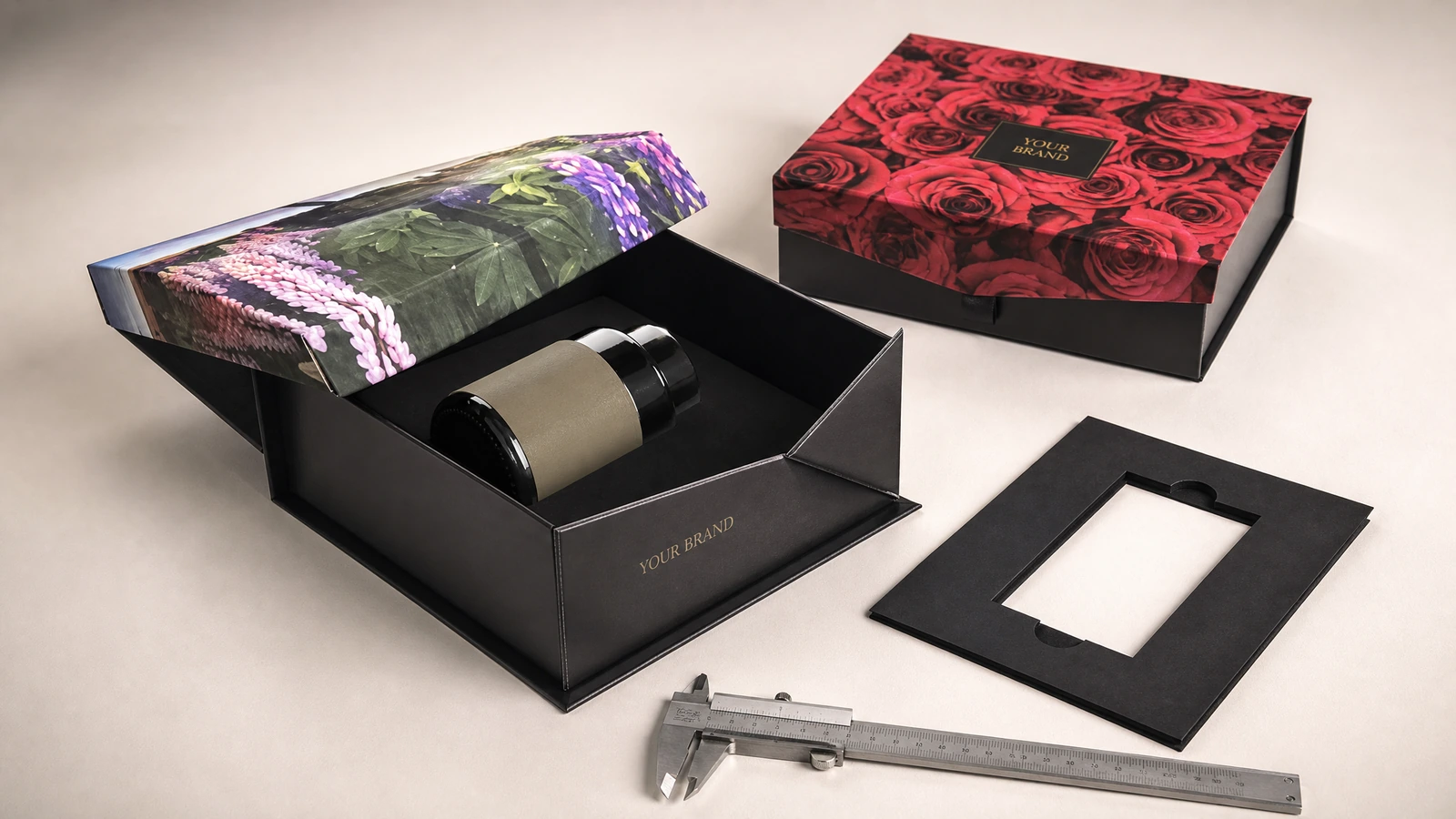
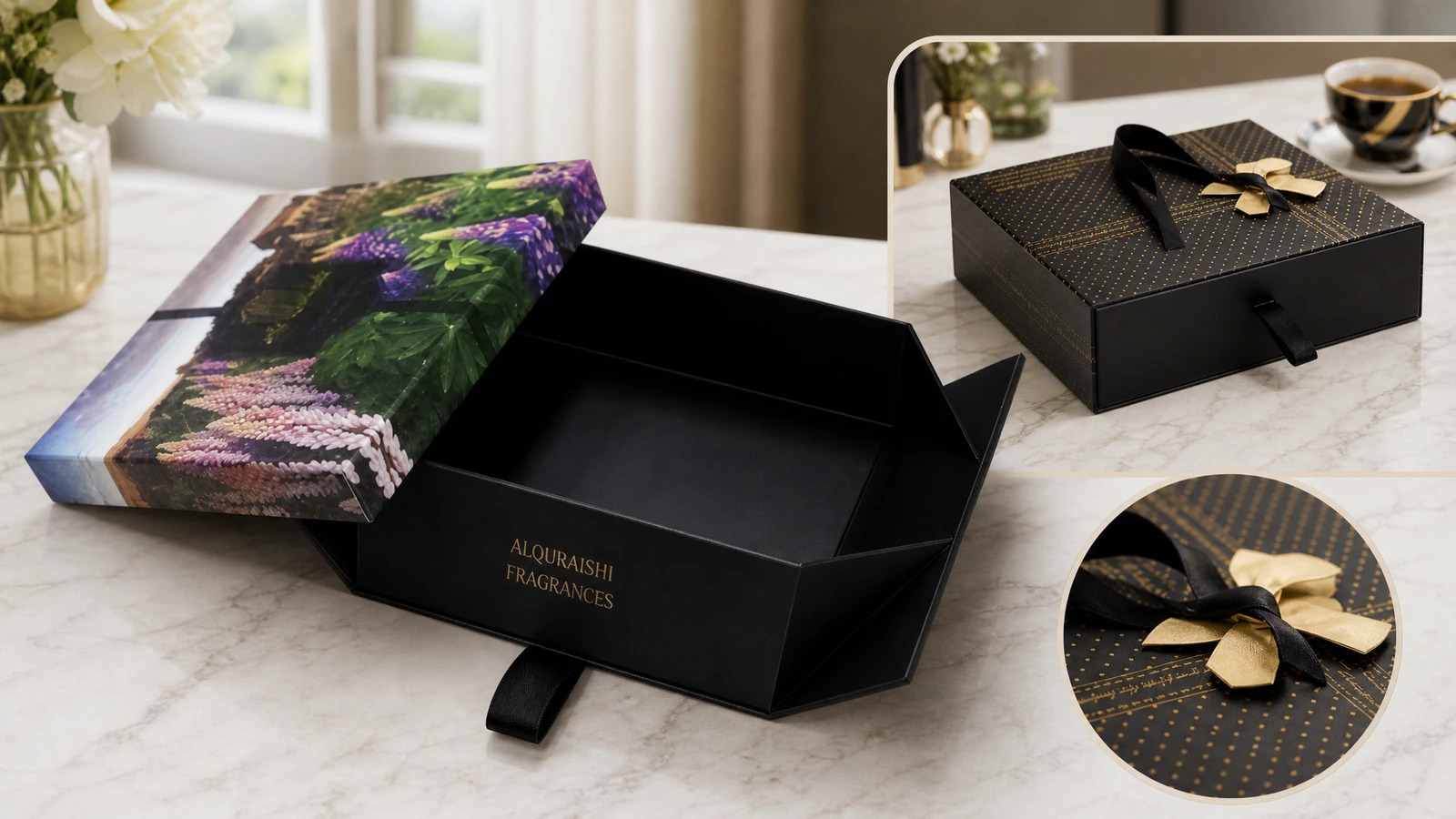
Images illustrate design and inspection concepts, not verified production samples. Materials, finishes, contents and configurations shown require quotation and sample approval.
Explore the product and buying guide
What makes this a collapsible magnetic gift box? ↑
The defining combination is a body designed to fold flat and a lid held closed magnetically. Once assembled, it provides a structured presentation rather than the flexible shape of a gift bag. “Collapsible” describes the construction; it does not establish a tested load rating or transport-protection level.
As an external construction reference, MILO Group describes rigid-board magnetic boxes with magnets concealed beneath the wrap and offers a flat-fold format among its magnetic box structures[1]. Its materials and manufacturing claims belong to that supplier, not automatically to this product.
Also distinguish shipping flat from repeatedly folding flat after use. An assembly method that fixes the corners with adhesive may not be intended for repeated disassembly. Confirm the proposed construction before planning returns, event breakdown or repeated flat storage.
How do you specify the right size and presentation? ↑
Start with the actual items in their intended arrangement. Include their existing containers, protective wrapping, printed cards and any decorative material. A measurement of the main product alone does not define the space needed by the complete gift.
Keep product dimensions, usable internal dimensions and assembled external dimensions separate. The internal measurement governs fit; the external measurement helps determine the shipping carton. Insert walls and clearances must be accounted for rather than assumed to disappear inside the stated box size.
| Specification field | How to record it | What approval should establish |
|---|
| Contents | Item list and individual L × W × H in mm | The complete intended arrangement fits |
| Usable internal space | L × W × H in mm, with measurement points identified | Insert and contents do not obstruct closure |
| Assembled exterior | L × W × H in mm | The protective shipping pack accommodates the box |
| Loaded weight | Measured in g or kg, with contents identified | The proposed structure is evaluated under the intended load |
| Insert layout | Cavity arrangement and removal access | Contents remain positioned and can be removed conveniently |
| Visible artwork | Logo and message locations on the assembled sample | Text is readable and correctly oriented |
Use the same measurement convention throughout the quotation and approval documents. Capacity, supported weight and the number of items that fit are determined by physical dimensions, loaded configuration and sample validation; no universal capacity is established for this product.
Review the opened presentation as well as the closed box. A lid message should face the recipient correctly, while the insert should leave access for removing the gift. If a product container changes later, repeat the fit check instead of assuming that the previous cavity remains suitable.
Which finishes and closure details should you compare? ↑
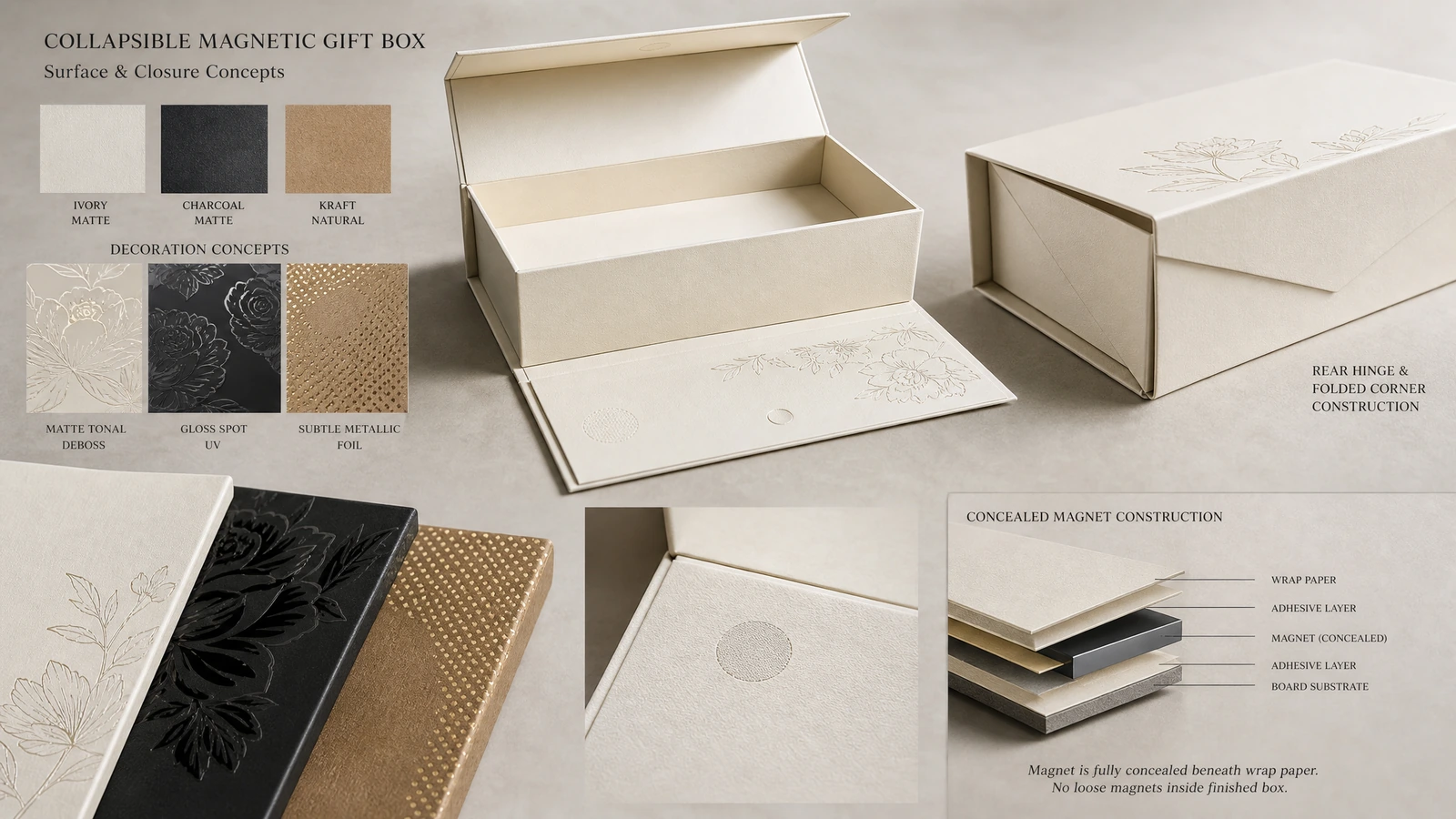
Treat board, wrap, decoration and closure as related decisions. A finish chosen for appearance must also work across folds, edges and the magnetic flap. Board thickness and paper weight are separate specifications; record them separately rather than using either as a shortcut for overall quality.
For the closure, evaluate alignment and opening effort together. RichPack’s design guide discusses the importance of the relationship between the lid, magnets and surrounding structure in magnetic closure design[2]. A stronger magnet specification alone does not demonstrate satisfactory operation in the finished box.
Evaluate appearance through physical references. Gift Box Market shows UV printing, foil stamping and printed ribbon in its decoration examples[3]. These establish possible design directions, not confirmed options for this SKU.
- Matte, gloss or tactile appearance: compare samples under the lighting in which the gift will be presented.
- Printed color or foil: assess contrast, small details and placement on the actual wrap.
- Paper or foam insert: compare positioning, removal access, appearance and disposal implications.
- Closure and rear construction: inspect the magnetic flap, hinge, folds and corner assembly; do not assume a separate rear clasp is included.
How should artwork be checked before sampling? ↑
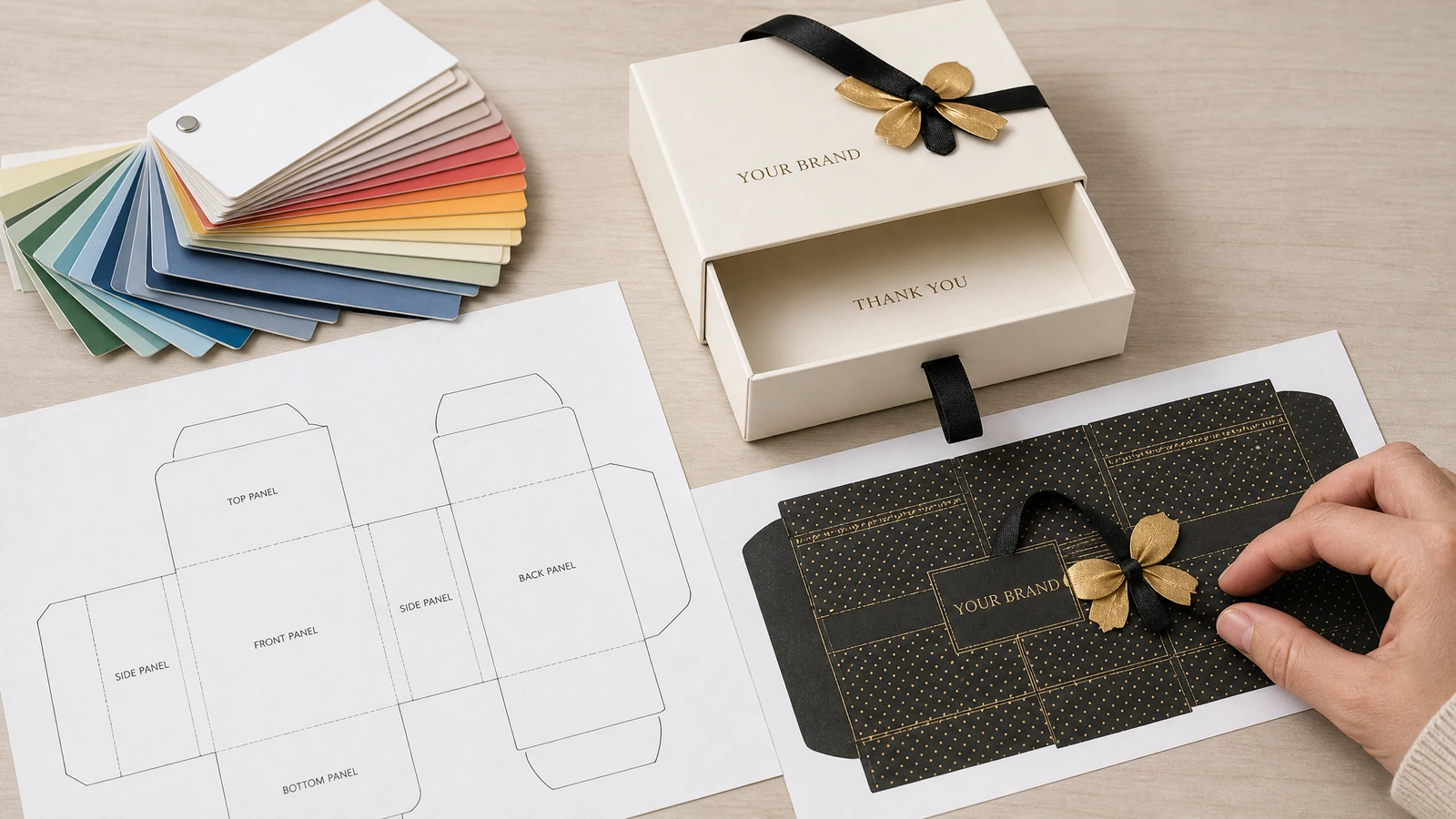
Check artwork against the agreed structure, not a generic box template. The dieline should distinguish the lid, base, side panels, folds and assembly areas. Confirm the supplier’s file requirements before preparing production artwork; do not import unexplained bleed or clearance values from another project.
- Confirm orientation. Identify which surfaces face outward and which message appears when the lid opens.
- Separate visual treatments. Identify printed graphics, foil areas, embossed details and other requested finishes clearly.
- Review folds and edges. Check that important text and logos are positioned appropriately around structural transitions.
- Agree on color references. Record the intended print method and physical color reference where relevant.
- Inspect a physical result. Use the sample to evaluate readability, finish and assembled alignment that a screen preview cannot demonstrate.

Keep the approved artwork revision attached to the sample record. If the structure changes after artwork approval, review the affected panels again. A correct flat drawing is not sufficient when its relationship to the assembled box has changed.
What should happen between the brief and production? ↑
Use the following as a proposed approval sequence, not a claim about a particular factory’s equipment or operating procedure. Its purpose is to make decisions visible before the full order is committed.
- Freeze the brief. Record contents, quantity, presentation requirements, destination and required arrival date.
- Review the structure. Establish usable dimensions, fold-flat construction, insert layout and magnetic closure arrangement.
- Review materials and artwork. Identify the proposed board, wrap, decoration and print files.
- Evaluate the sample. Assemble it, load the actual contents and review appearance, operation and handling.
- Approve the production reference. Record accepted details, outstanding changes and the inspection criteria.
- Confirm the delivery configuration. Agree on flat packing, protection, carton information and shipment arrangements.
The industry process described in the research includes printing and finishing, board cutting and grooving, magnet placement, wrapping, assembly and insert preparation. The actual sequence depends on the approved construction. None of those process descriptions establishes this product’s production capacity or lead time.

A quotation should distinguish sample preparation, revisions, production and transport rather than combining them into an ambiguous delivery estimate. Identify what must be approved before each stage starts and whether the stated timing uses working days or calendar days.
Which quality checks belong in sample approval? ↑
Inspect the complete loaded sample, not only an empty display box. Agree on test conditions and acceptance criteria before testing so that a favorable photograph or informal demonstration is not mistaken for a repeatable result.
| Check | Proposed method | Acceptance record |
|---|
| Dimensions and fit | Measure agreed points and load actual contents | Measurements, tolerances and fit observations |
| Closure operation | Inspect alignment and opening effort in the loaded configuration | Agreed method, observations and any measured force in N |
| Repeated opening | Open and close using an agreed cycle count | Count, conditions and changes to hinge or closure |
| Assembly integrity | Inspect corners, adhesive areas, folds and wrapped edges | Photographs and accepted defect boundaries |
| Appearance | Compare printing and finish with the approved physical reference | Color, registration and surface observations |
| Distribution performance | Evaluate the loaded gift box inside its shipping configuration | Applicable procedure, pack description and results |
These are proposed checks, not published test results. Opening-cycle targets, dimensional tolerances, cosmetic limits and closure-force criteria remain to be agreed and tested. A magnet pull measurement must identify the method; it is not automatically a box load rating.
For transport assessment, ISTA emphasizes selecting the appropriate procedure for the intended distribution test[4]. Ask the testing provider whether ISTA 3A suits the planned parcel shipment. Do not describe the product as tested or certified without the corresponding report.
Which packaging route fits your purchase? ↑
Compare structures against the job they must perform. PakFactory distinguishes flat-shipping collapsible designs from non-collapsible alternatives in its magnetic packaging range[5]. That is a useful structural distinction, not proof that either option meets your particular protection requirements.
| Route | When to consider it | Main purchasing trade-off | What to verify |
|---|
| Custom collapsible magnetic box | Branded presentation with flat storage before assembly | Assembly work and fold construction become part of fulfillment | Loaded fit, corner integrity and packing configuration |
| Non-collapsible magnetic box | Presentation supplied in an assembled form | Assembled dimensions affect storage and transport planning | Complete landed cost and tested protection |
| Stock magnetic gift box | An existing size and appearance fit the project | Less control over structure and available decoration | Usable dimensions, availability and customization limits |
| Drawer-style gift box | A sliding reveal better suits the presentation | Tray fit and removal replace magnetic closure as key checks | Retention, opening effort and delivery protection |
| Standard folding carton | The brief does not require magnetic presentation | A different structure and opening experience | Fit, appearance and suitable protective packaging |
This comparison is a decision framework, not a price or durability ranking. Obtain quotations against the same contents, order quantity and destination before deciding which route offers better value.
Stock alternatives are a genuine purchasing route: Uline lists folding magnetic gift boxes in its stock gift-box catalog[6]. Compare the restrictions of an existing format with the development work of full customization; another supplier’s availability or terms do not establish this product’s MOQ or timing.
How do you control delivery costs and reorders? ↑
Separate the presentation box from its shipping protection. The magnetic lid should not be assumed to replace a protective outer carton. Review surface protection, corner protection and insert retention as part of the complete delivery pack.
Request carton dimensions, quantity per carton and gross weight for the proposed flat-packed configuration. Use those figures to compare freight quotations. A fold-flat design does not establish a fixed percentage saving, and reduced packed volume does not translate automatically into the same reduction in transport charges.
- Product cost: distinguish the box, insert, printing and requested finishes.
- Development charges: identify sampling, tooling and artwork-related charges separately.
- Fulfillment work: account for assembly, loading, checking and protective packing.
- Delivery cost: clarify freight, customs, duties and final delivery inclusions.
- Exceptions: agree on evidence and remedies for damage, shortages or nonconforming goods.

For reorders, retain the accepted sample, artwork revision, material description, insert layout and inspection record. Confirm changes before authorizing another run. Reusing the product name alone does not communicate every detail needed to reproduce the approved presentation.
What should responsible packaging claims cover? ↑
Separate material sourcing, reuse and recyclability. FSC provides a framework for responsible forest sourcing[7]. If certification is required, request documentation applicable to the proposed supply. No FSC certification or certified material is confirmed for this product.
A paper-based appearance is not enough to justify a whole-box recycling claim. Assess magnets, adhesives, films and inserts together with the intended collection system. Ask whether components can be separated, and avoid describing the complete construction as universally recyclable or biodegradable without supporting evidence.
Reuse is also an intended-use question rather than a guaranteed environmental outcome. A recipient may keep the box, but that possibility does not establish its service life or a measured reduction in waste.
For child-related applications, determine the applicable requirements rather than applying a toy standard to every gift box. The CPSC’s toy-safety guidance[8] concerns toys and their applicable requirements; it does not certify this packaging. Magnet containment requires review for the actual intended use.
Likewise, specifying packaging for wrapped food does not establish suitability for direct food contact. Identify the contact surfaces, intended contents and destination requirements before selecting materials or making compliance claims.
What are the key purchasing takeaways? ↑
- Purchase usable fit, not a nominal size. — Record product, internal and external dimensions separately in mm.
- Approve appearance and operation together. — Evaluate artwork, folds, inserts and closure in the loaded sample.
- Compare the complete delivered package. — Include development, assembly, protective packing and delivery costs.
- No product-specific commercial or performance values are established here. — MOQ, unit weight, price, production timing and test results require quotation, measurement or testing.
- EU packaging planning must use the applicable PPWR timetable. — General application date: 12 August 2026 (Source[9]). Check the provisions relevant to the project rather than treating that date as a universal deadline for every requirement.
Build your quotation around the complete package ↑
Custom magnetic gift boxes are most useful when their presentation, assembly and delivery requirements are resolved together. The collapsible format provides the design direction; the approved specification and loaded sample establish what should actually be produced.
Send your product dimensions, loaded weight, target quantity, artwork, insert requirements, destination and required arrival date for a project-specific quotation.




The information below is required for social login
Sign In
Create New Account