Custom hinged tin boxes combine a permanently attached lid, printable metal surfaces, and reusable storage value. They suit gifts, confectionery, tea, cosmetics, stationery, collectibles, and other products that benefit from frequent access and a presentation-led unboxing experience. Size, coating, hinge type, inserts, compliance, MOQ, price, and production time remain subject to quotation, sampling, and application-specific testing.
Who Benefits Most from Custom Hinged Tin Packaging? ↑
These boxes are primarily considered by brand owners, packaging buyers, private-label sellers, product developers, and promotional-gift teams that want the package to remain useful after the original product is removed. Typical applications include chocolates, candies, tea, coffee, cosmetics, jewelry, stationery, card games, collectibles, mints, seasonal gifts, and compact product kits.
The attached lid is especially useful when customers will open the package repeatedly. Unlike a loose lid, it cannot be set aside and misplaced during ordinary use. When fully opened, it can also expose the contents in an organized, presentation-friendly way. That makes the format relevant to retail gift sets, curated collections, portable organizers, and products presented inside a fitted insert.
However, suitability is not determined by the product category alone. Internal capacity, load quantity, insert fit, opening clearance, and closing performance must be confirmed with the actual product in a physical sample. Any claimed capacity, weight tolerance, or number of items that fit must be determined by real dimensions, loaded condition, and sampling verification.
What Packaging Problems Can a Hinged Tin Solve—and What Can It Not Solve? ↑
Problem: Paper gift boxes may be vulnerable to visible corner wear, compression, humidity, or handling damage, while loose-lid containers can interrupt the user experience when the cover is misplaced. Brands may also spend heavily on decorative packaging that customers discard immediately.
Agitation: These weaknesses become more expensive when a product depends on premium shelf presentation. A dent, loose hinge, scratched print area, difficult closure, or poorly fitted insert can make an otherwise valuable product feel inconsistent. For tea, powders, spices, or aroma-sensitive goods, another risk is assuming that a secure-looking metal lid automatically provides an airtight barrier.
Solution: A properly specified hinged tin can provide a durable outer structure, an attached cover, broad branding surfaces, and a reusable afterlife. It should nevertheless be treated as a designed packaging system rather than a generic metal box. The hinge, front closure, inner coating, insert, primary barrier, artwork, packing method, and inspection plan all need to match the application.

Table of Contents
What Is a Custom Hinged Tin Box? ↑
A custom hinged tin box is a formed metal container with a lid mechanically connected to the body. The common industry term “tin box” usually refers to a box made from tin-coated steel rather than solid tin. Electrolytic tinplate requirements for sheets and coils are defined in ISO 11949:2016[1].
The steel core contributes rigidity, while the tin coating, lacquers, and decorative layers support corrosion control and print presentation. Final material thickness, temper, coating system, and construction must be selected for the box dimensions, forming method, contents, distribution conditions, and target market. No particular gauge or coating is confirmed for this provisional SKU; each remains a quotation and sample-approval item.
Customization may involve dimensions, shape, artwork, CMYK or spot-color printing, embossing, debossing, gloss or matte varnish, metallic effects, internal trays, dividers, foam, or other inserts. Existing tooling may reduce development work, while a new size or unusual geometry may require new tooling. A customization guide from TDTIN[2] describes shape, volume, closure, printing, coating, and inserts as connected decisions rather than isolated options.
How Should Size and Artwork Readability Be Specified? ↑
Begin with the physical product—not a visual guess. Record the maximum length, width, and height of the product in its final sale condition, including any pouch, wrap, leaflet, accessory, or insert. If several pieces will be packed together, test the complete loaded arrangement. Clearance must account for the rolled edges, hinge movement, lid depth, insert walls, and the way workers will load the product.
Specify whether each requested measurement is internal or external. Confusing the two can produce a tin that looks correct on a drawing but cannot accept the product after forming and assembly. For an irregular item, provide a physical sample or accurate three-dimensional data. Capacity, load quantity, and fit must always be determined by real product dimensions, loaded condition, and sampling verification.
Artwork readability also changes with size and forming. Small legal text, fine lines, barcodes, and QR codes should not be placed across rolled edges, corners, embossing, hinge areas, or other distorted zones. The approved dieline should identify print-safe areas, structural seams, and areas where graphics may shift during forming. Barcode and QR-code readability should be checked on the finished physical sample rather than only on a flat proof.
Which Finishes, Inserts, Hinges, and Closures Should You Compare? ↑
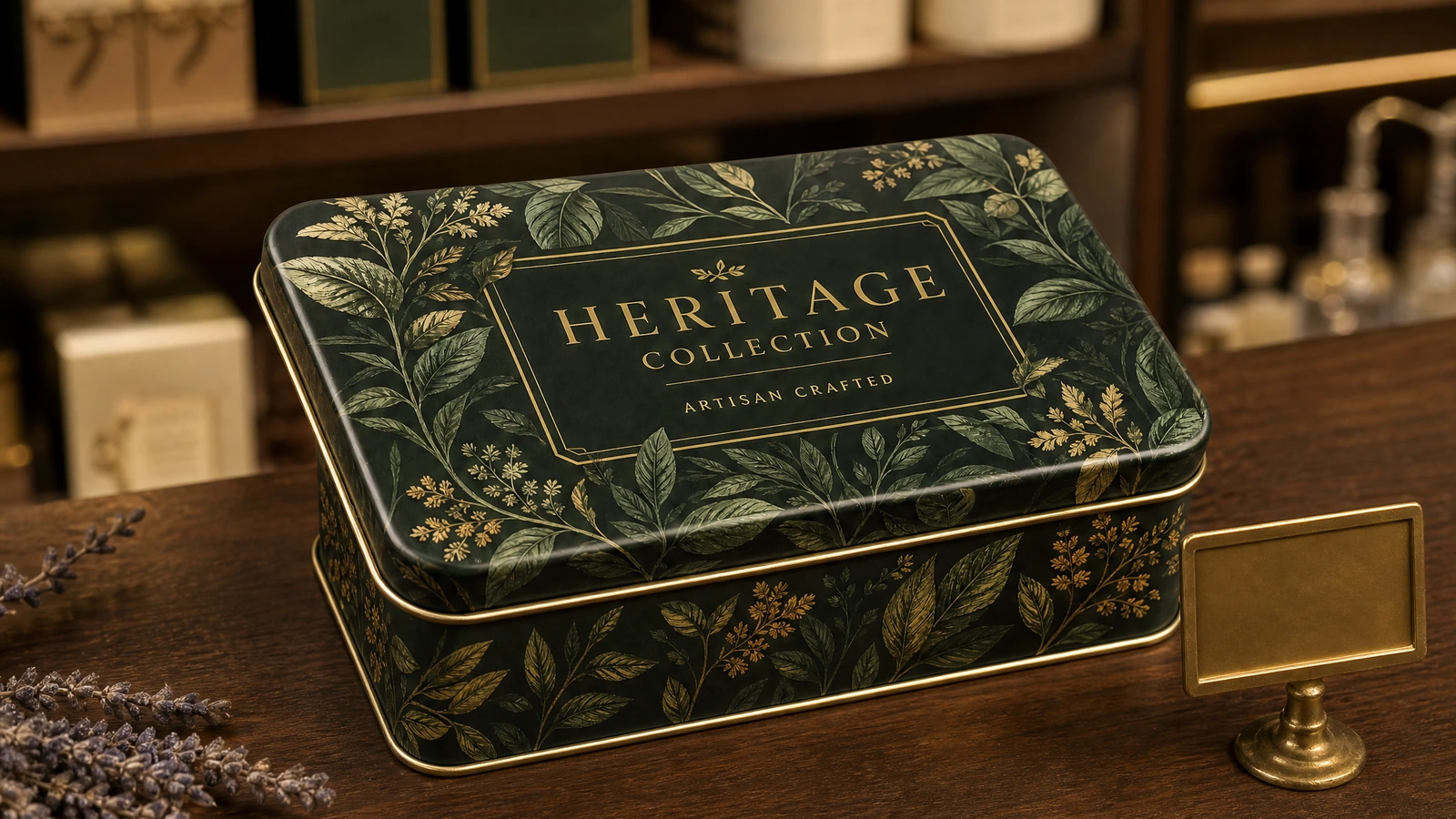
Surface design should support both appearance and handling. Offset printing can cover broad decorative areas, while spot colors may be considered when brand-color control is important. Gloss and matte varnishes alter both appearance and perceived texture. Embossing or debossing can add tactile hierarchy, but artwork must be adapted to the formed relief. Premium treatments such as foil or spot effects should be quoted and sampled because feasibility depends on the artwork, construction, and production method.
Internal components can organize products and protect decorated surfaces from direct contact. Options may include trays, dividers, foam, or other fitted structures. The correct solution depends on product dimensions, fragility, food-contact status, loading method, and recycling objectives. An insert must be tested inside the assembled tin with the real product; an attractive rendering is not proof of fit.
Hinge selection directly affects the opening experience. Industry technical guidance distinguishes lower-complexity window hinges from metal wire or bar hinge arrangements. Window hinges may be less able to hold a medium or large lid upright, while a metal wire hinge may provide better lid support but involve additional tooling, components, assembly, and cost. These trade-offs are explained by TINSPKG’s hinged-lid technical page[3].
The front closure needs equal attention. A closure that is too tight frustrates users; one that is too loose may open during handling or transit. Buyers should define the desired opening behavior, whether the lid should remain upright, and how the box will be used after purchase. These requirements should be locked with an approved physical sample.
How Should Artwork and Product Requirements Be Preflighted? ↑
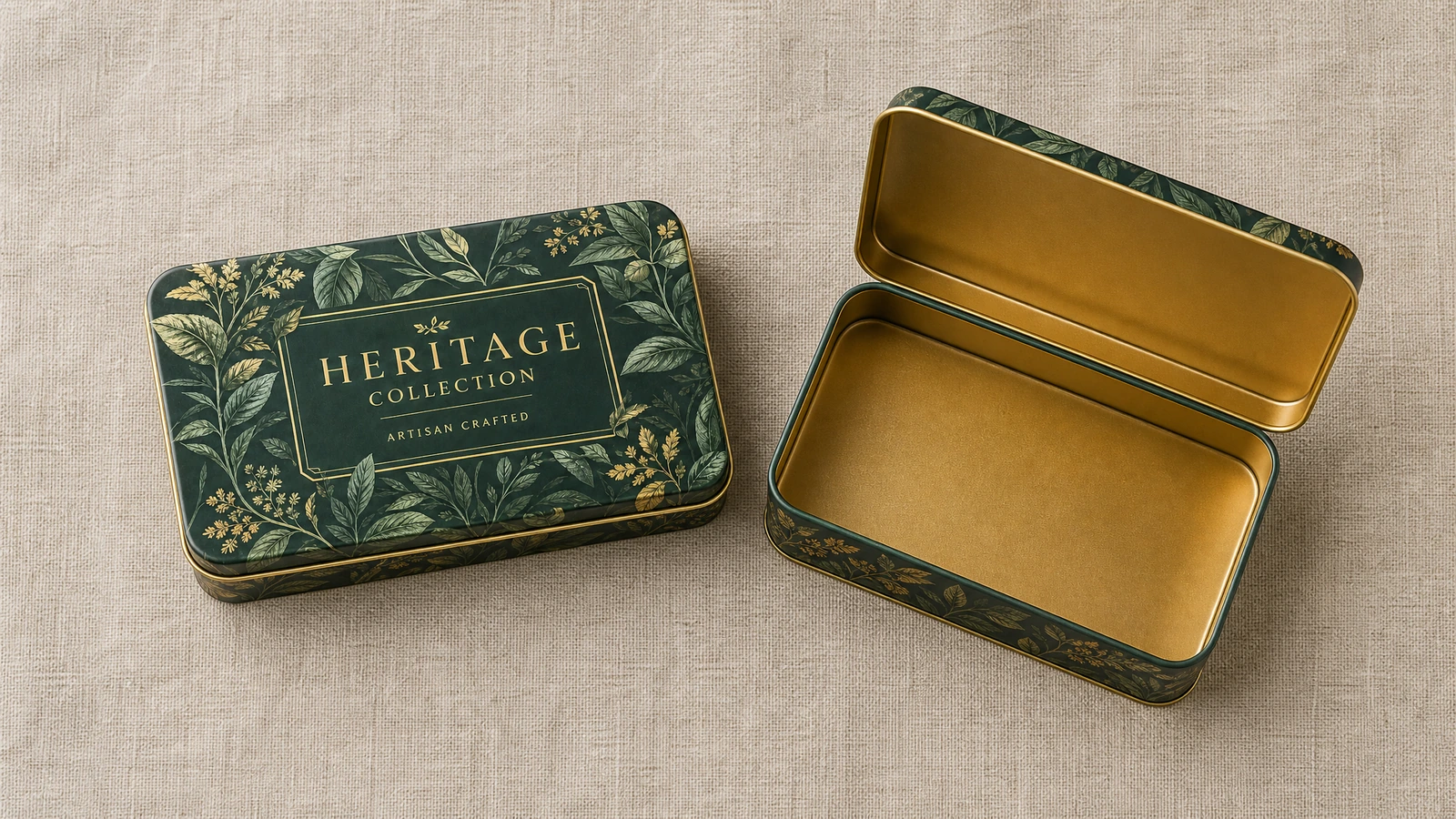
A reliable preflight begins with one controlled specification. It should identify the product, requested internal and external dimensions, shape, lid construction, hinge behavior, closure feel, print process, colors, finish, coating, insert, packing configuration, destination market, and whether any surface will contact food, cosmetics, or another regulated product.
- Confirm the use case. State whether the tin is decorative outer packaging, direct-contact packaging, a reusable storage item, or part of a multi-layer system.
- Provide actual product dimensions. Include the final pouch, wrap, leaflet, accessories, and loaded arrangement.
- Select a structural route. Compare an existing tool with new tooling, then confirm the hinge and closure behavior required.
- Map the artwork. Keep critical text and scannable codes away from bends, rolled edges, hinge zones, and embossed areas.
- Define color references. Identify CMYK values, spot-color references, and any approved physical color standard.
- Identify compliance needs. Declare contents, contact conditions, destination markets, and required documentation before coating selection.
- Approve a physical pre-production sample. Verify fit, appearance, opening action, coating, inserts, packing, and required tests before mass production.
Digital renderings are useful for alignment but cannot establish hinge feel, surface durability, actual color under changing light, or fit with the loaded product. The pre-production sample should become the agreed reference for production and inspection.
How Does the Custom Hinged Tin Production Workflow Proceed? ↑
After the specification and pre-production sample are approved, a typical manufacturing sequence includes printing and protective coating, sheet cutting or slitting, stamping and forming, hinge assembly, cleaning, packing, final inspection, and shipment. The detailed sequence can change when a design includes embossing, multiple formed components, windows, trays, or other accessories.
A published overview of the standard flow—printing and coating, cutting, forming, assembly, cleaning, packing, and final quality control—is available in the tin box manufacturing process guide[4].
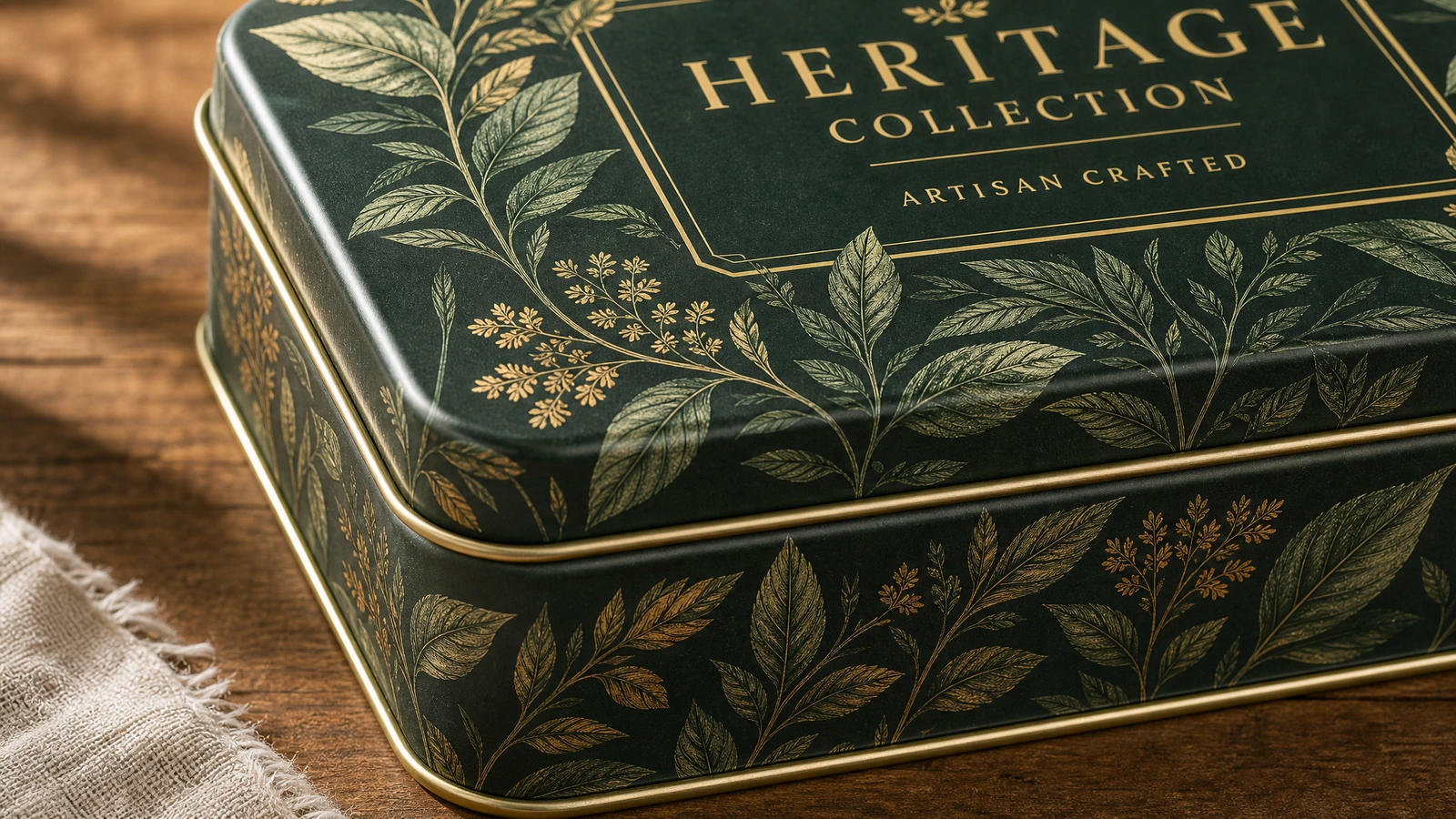
Printing normally occurs while the metal is flat. A protective varnish is then used to help preserve the decorative layer through forming and use. During cutting and stamping, the process must control burrs, deformation, and damage to printed surfaces. Assembly must align the lid and body while maintaining the agreed opening and closing action. Cleaning should remove manufacturing debris or residues before the tins enter their final packing configuration.
No production duration is confirmed for this product. Timing must be quoted after the size, tooling route, printing, finishing, sample requirements, order quantity, packing, inspection, and shipping method are known.
How Should Finished Hinged Tins Be Tested and Accepted? ↑
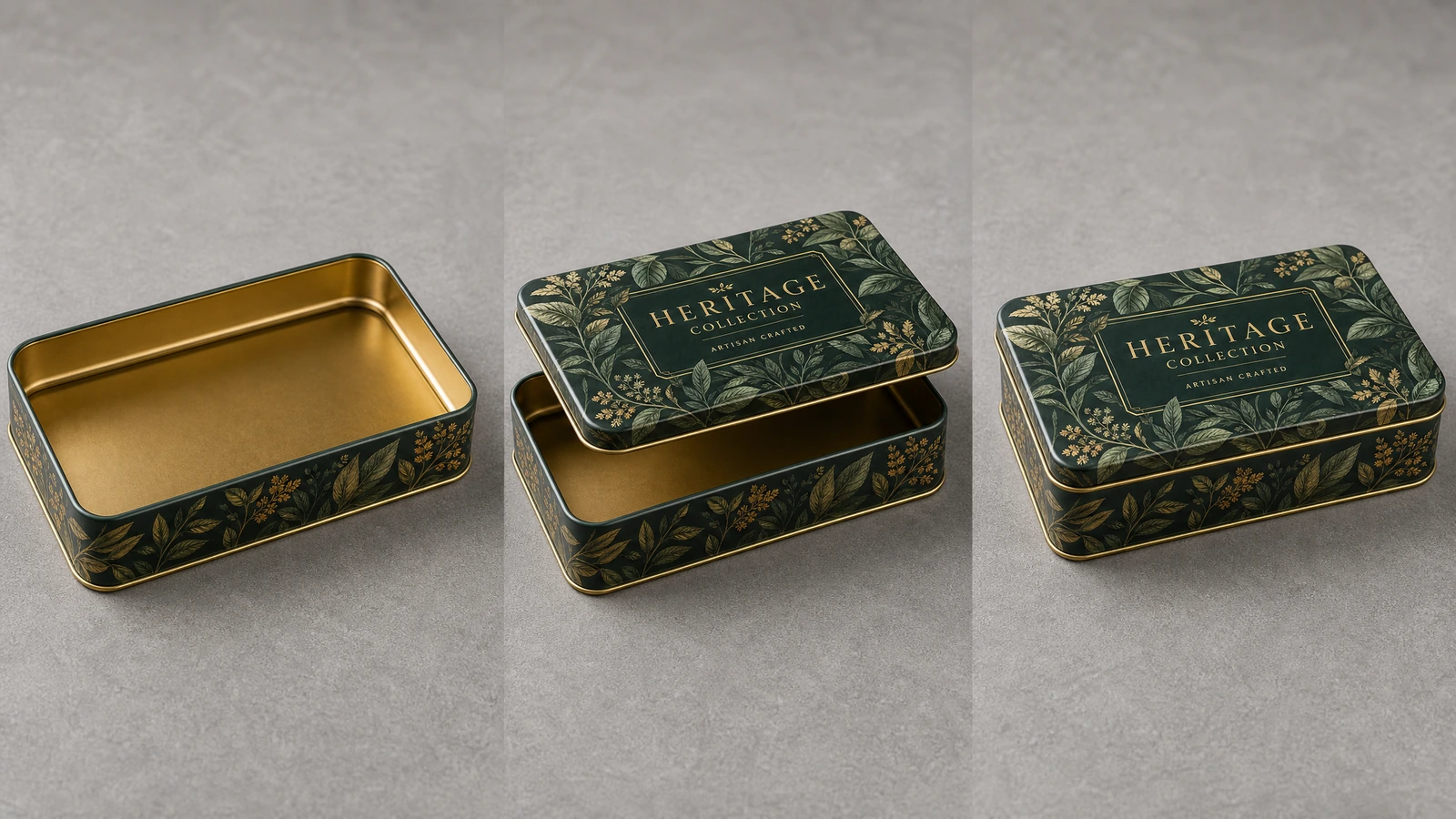
Inspection should focus on the failure modes that matter to the buyer, not merely whether a box exists. The approved sample, drawing, artwork, color reference, packing specification, and agreed defect criteria should form the acceptance baseline.
- Dimensions and fit: Check the assembled tin and test the real product, insert, and loaded configuration.
- Hinge alignment: Inspect looseness, distortion, inconsistent opening, and whether the lid performs as approved.
- Closure action: Confirm that opening is neither excessively difficult nor loose enough to release unintentionally.
- Edges and burrs: Inspect rolled edges, stamped areas, and accessible surfaces for sharp points.
- Appearance: Check dents, scratches, rust spots, print shift, color variation, coating damage, and contamination.
- Print adhesion: Use an agreed adhesion or compatibility test appropriate to the coating and expected exposure.
- Distribution performance: When relevant, define vibration, drop, compression, or stacking tests for the packed cartons.
- Repeat-use behavior: Establish an application-specific opening-cycle test rather than assuming durability from appearance.
For direct food contact, coatings must be evaluated against the actual food type and intended conditions. U.S. rules for resinous and polymeric food-contact coatings are set out in 21 CFR 175.300[5]. Compliance is not established by calling a generic tin “food grade”; it requires the correct material and coating documentation for the intended conditions.
BPA and alternative can-coating systems require equally careful review. The FDA’s BPA food-contact information[6] explains that substances migrating from packaging into food are subject to the applicable food-contact authorization framework. Buyers should therefore request relevant declarations and testing rather than relying on an unsupported label.
How Do Hinged Tins Compare with Alternative Packaging Formats? ↑
| Option |
Primary Strength |
Important Limitation |
Best-Fit Buying Situation |
| Hinged tin |
Attached lid, wide opening, reusable presentation, durable outer structure |
Requires hinge and closure control; standard versions are not automatically airtight |
Premium gifts, repeat-access products, collectibles, organized sets |
| Slip-lid tin |
Simple metal construction and broad printable surfaces |
Separate lid can be misplaced; opening experience differs |
Products where an attached lid is unnecessary |
| Sliding tin |
Compact access and distinctive movement |
Usually favors rectangular formats and may offer limited display access |
Mints, compact accessories, or portable small items |
| Screw-top tin |
More deliberate closure and potential for enhanced sealing design |
Slower opening and typically constrained to compatible shapes |
Balms, waxes, or products requiring a different closure concept |
| Paper gift box |
Lightweight construction and flexible short-run presentation options |
More vulnerable to moisture, crushing, edge wear, and early disposal |
Cost-sensitive or short-life promotional packaging |
| Plastic rigid box |
Low weight, product visibility where transparent, and flexible molding |
Different perceived value and end-of-life considerations |
Visibility, weight, or efficiency-led applications |
The decision should follow the required user interaction and barrier function. A hinged tin is strongest when presentation, repeated opening, and reuse matter. It should not be selected as the sole moisture or aroma barrier without testing. Technical guidance states that standard sliding and hinged tins are not normally airtight; sensitive products may need a sealed pouch or dedicated primary container inside the decorative tin, as explained in this hinged-versus-sliding tin comparison[7].
What Should a Buyer Confirm Before Requesting a Quotation? ↑
A useful request for quotation should include the intended product, destination market, requested internal dimensions, target shape, order quantity, artwork status, printing colors, finish, hinge behavior, front closure, insert, individual protection, carton requirements, and expected shipping route. Direct-contact applications should identify the contents and contact conditions so that the coating and documentation can be assessed.
MOQ, tooling cost, unit price, production time, unit weight, carton dimensions, and freight are not confirmed for this provisional SKU. Each must remain a quotation item until the structure, material, quantity, decoration, packing, and delivery terms are defined. An existing tool may change the commercial result, but it still requires fit verification with the real product.
Packaging for shipment should reduce metal-to-metal abrasion and carton movement. The appropriate use of paper, bags, layer pads, dividers, or cushioning depends on the finish and distribution risk. Overpacking should also be reviewed against environmental objectives. Before approving the final pack, test whether finished tins arrive without dents, scratches, unintended opening, or coating damage.
Reorders should refer back to the approved sample, revision-controlled artwork, structural drawing, color reference, inspection criteria, and packing specification. Metal packaging can still experience corrosion or migration problems if coatings are damaged or poorly matched to the contents; a scientific review of metal packaging discusses corrosion, coatings, and potential migrants in more detail through the peer-reviewed metal packaging review[8].
What Are the Key Purchasing Takeaways? ↑
- The attached lid is the defining user-experience advantage. It supports repeated access and presentation, but hinge alignment and closure force must be approved on a physical sample.
- A standard hinged tin should not be presumed airtight. Aroma- or moisture-sensitive contents may require a tested sealed inner pouch or another primary barrier.
- Food-contact suitability is application-specific. Coatings, inks, documentation, migration conditions, and the actual contents must be evaluated before a compliance claim is made.
- Fit cannot be approved from nominal dimensions alone. Capacity, load quantity, and insert performance must be determined by actual product dimensions, loaded condition, and sampling verification.
- Recyclability data needs a clearly identified material and year. — The U.S. EPA estimated that 1.6 million tons, or 73.8%, of steel packaging generated in 2018 was recycled (Source[9]).
- The hinged-lid tin market has a published long-term growth forecast. — Future Market Insights estimated USD 6.8 billion in 2025 and projected USD 9.8 billion by 2035, a 3.7% CAGR (Source[10]).
- EU packaging requirements have entered their general application phase. — Regulation (EU) 2025/40 entered into force on February 11, 2025 and applies generally from August 12, 2026 (Source).
- Commercial terms remain project-specific. MOQ, price, production time, unit weight, tooling, testing, packing, and freight must be confirmed by quotation after the specification is complete.
How Should You Move from Concept to a Production-Ready Tin? ↑
The safest path is to define the actual product and market first, select the structure second, and approve evidence before mass production. A successful hinged tin is not merely a decorated metal shell: it is a coordinated system of dimensions, hinge behavior, closure force, coatings, artwork, inserts, primary barriers, inspection criteria, and transit protection.
Send your product dimensions, quantity, destination market, artwork, finish preferences, and contact-use requirements to request a project-specific quotation and sample plan.




The information below is required for social login
Sign In
Create New Account