SEO title: Custom Paper Tube Packaging | Two-Piece Telescoping Boxes
Meta description: Specify two-piece paper tube boxes for candles, cosmetics and gifts. Compare fit, finishes, sampling, quality checks and shipping before requesting a quote.
Custom two-piece telescoping paper tube boxes pair a cylindrical body with a removable overlapping lid. For candles, packaged cosmetics and gifts, start with product fit, opening feel and artwork placement—then confirm materials, protection, order terms and delivery through a project-specific quote and physical sample.
For brand founders, packaging buyers and product teams: this format is worth evaluating when presentation matters beyond the first purchase. Consider a candle jar revealed beneath a lift-off lid, a skincare bottle held in a fitted insert, or a gift presented without a conventional folding carton. Each application needs its own fit and protection assessment.
A polished exterior cannot compensate for an uncomfortable opening. A loose lid, rattling bottle or scuffed printed surface can undermine the experience you intended. Discovering those problems after filling also creates extra handling, replacement packaging and launch uncertainty.
The practical solution is to approve the package as a system: product, insert, tube body, lid and shipping carton. This page covers Custom Two-Piece Telescoping Paper Tube Boxes within Custom Boxes / Custom Paper Tubes, under provisional reference NSKU-795-01. Dimensions, material specifications, certifications, MOQ, production time, unit weight and performance results remain unconfirmed for this product.

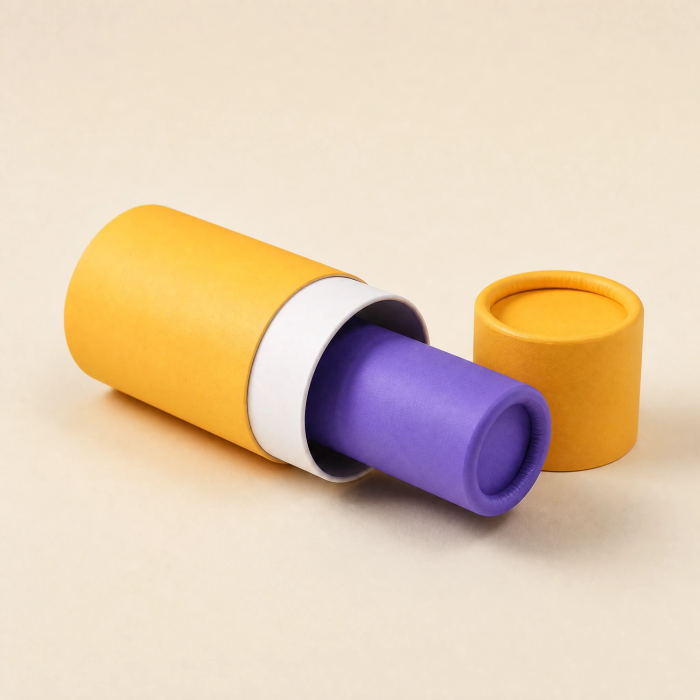
Illustrative application concept; depicted products and configurations require physical fit validation.
Explore the buying guide
What makes this a two-piece telescoping box? ↑
The defining feature is the relationship between the body and removable lid: the lid overlaps the body and slides off to reveal the contents. “Two-piece telescoping” describes the opening structure, not a verified wall thickness, winding method or material grade. Those construction details belong in the approved specification.
This is not a push-up dispenser, threaded container or industrial mailing tube. A project requiring direct dispensing, a specialized locking mechanism or shipment without an outer carton needs a separate structural assessment rather than an assumption that all cylindrical packages behave alike.
Separate presentation from product containment
For a sealed skincare bottle or candle jar, evaluate the tube as secondary packaging around the primary container. For tea, coffee or other dry goods, determine whether a sealed inner bag is needed before selecting the exterior. Roastar’s paper tube product guidance[1] illustrates this distinction by discussing protective bags alongside its tubes; its food-grade and recycling claims apply to its own configuration, not automatically to this product.
Capacity, supported load and the number of items that fit must be determined from actual product dimensions, loaded condition and sample validation. A photograph of a filled tube is not a capacity specification or proof of transport protection.
How do you specify fit and readable artwork? ↑
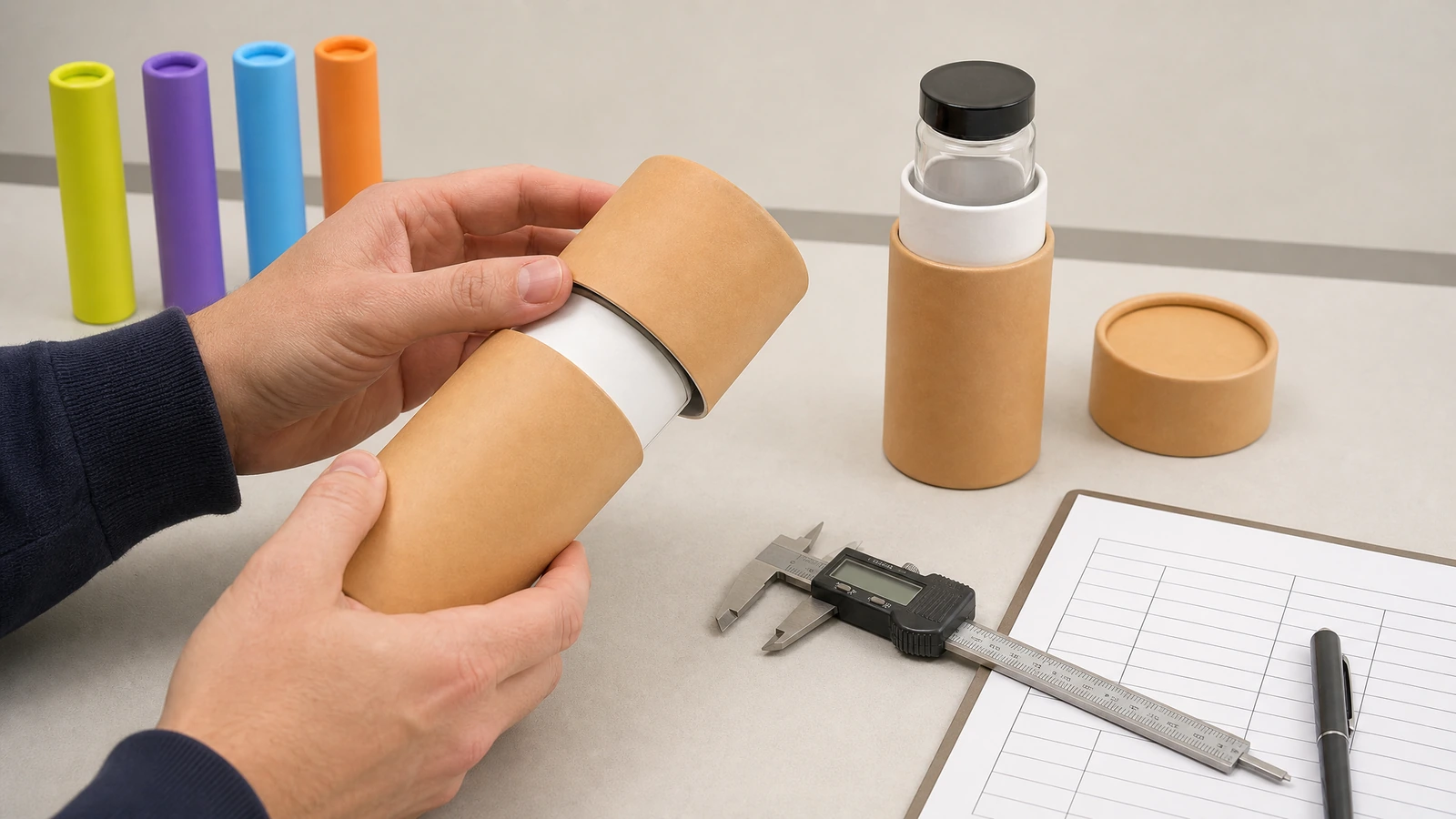
Begin with the complete product in its saleable condition. Include the widest closure, label, protective wrapping and any components packed alongside it. Record dimensions in millimeters and mass in grams, then distinguish the usable internal space from the finished external envelope.
| Specification field | What to provide or confirm | Approval purpose |
|---|
| Product envelope | Maximum width or diameter and total height, in mm | Establish the actual object that must enter and leave the tube |
| Usable internal dimensions | Internal diameter and usable height, in mm; pending sample approval | Account for the insert, wrapping and clearance |
| Finished external dimensions | Closed overall diameter and height, in mm; pending drawing | Check shelf position, storage and shipping-carton fit |
| Lid relationship | Overlap depth and intended opening feel; pending sample | Balance access with closure retention |
| Loaded condition | Product mass in g, orientation and insert arrangement | Define the configuration to assess during handling tests |
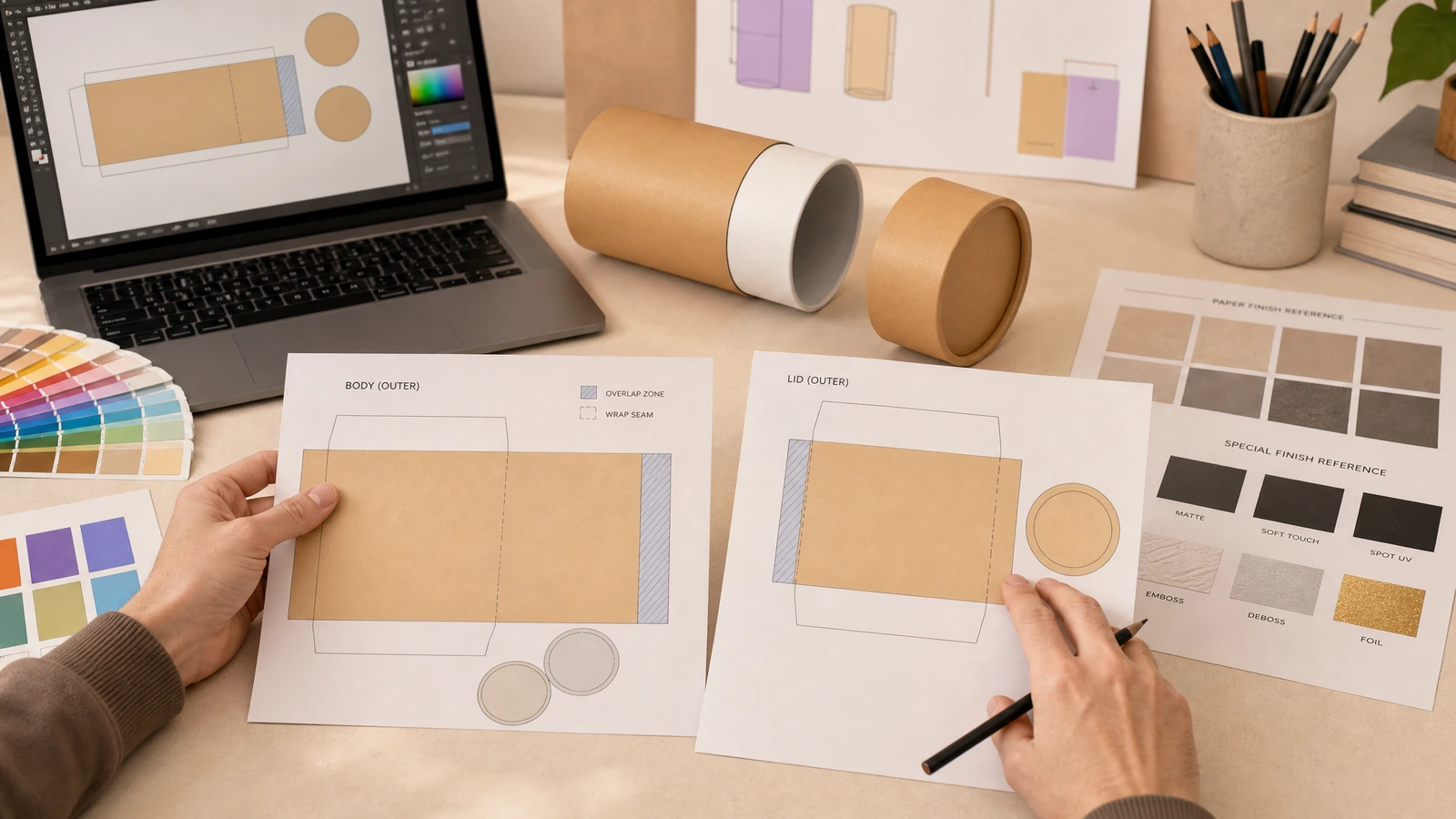
| Artwork area | Body and lid templates, seam positions and hidden areas | Keep essential information visible after assembly |
These fields are a specification framework, not advertised size limits. Do not substitute external dimensions for internal fit, or apply a universal clearance allowance without testing the actual product and insert.
Opening feel also needs physical review. Paper Tube Co.’s cap-fit explanation[2] describes how paper and storage conditions can affect tension fit. For your project, agree acceptable opening and retention behavior instead of relying on “snug” as the entire acceptance criterion.

Review artwork with the lid closed and removed. Important text should not disappear beneath the overlap, and a graphic crossing the body and lid should be evaluated for assembly alignment. Readability must be judged on the curved physical surface, not only on a flat screen preview.
Which surfaces and closure details deserve sampling? ↑
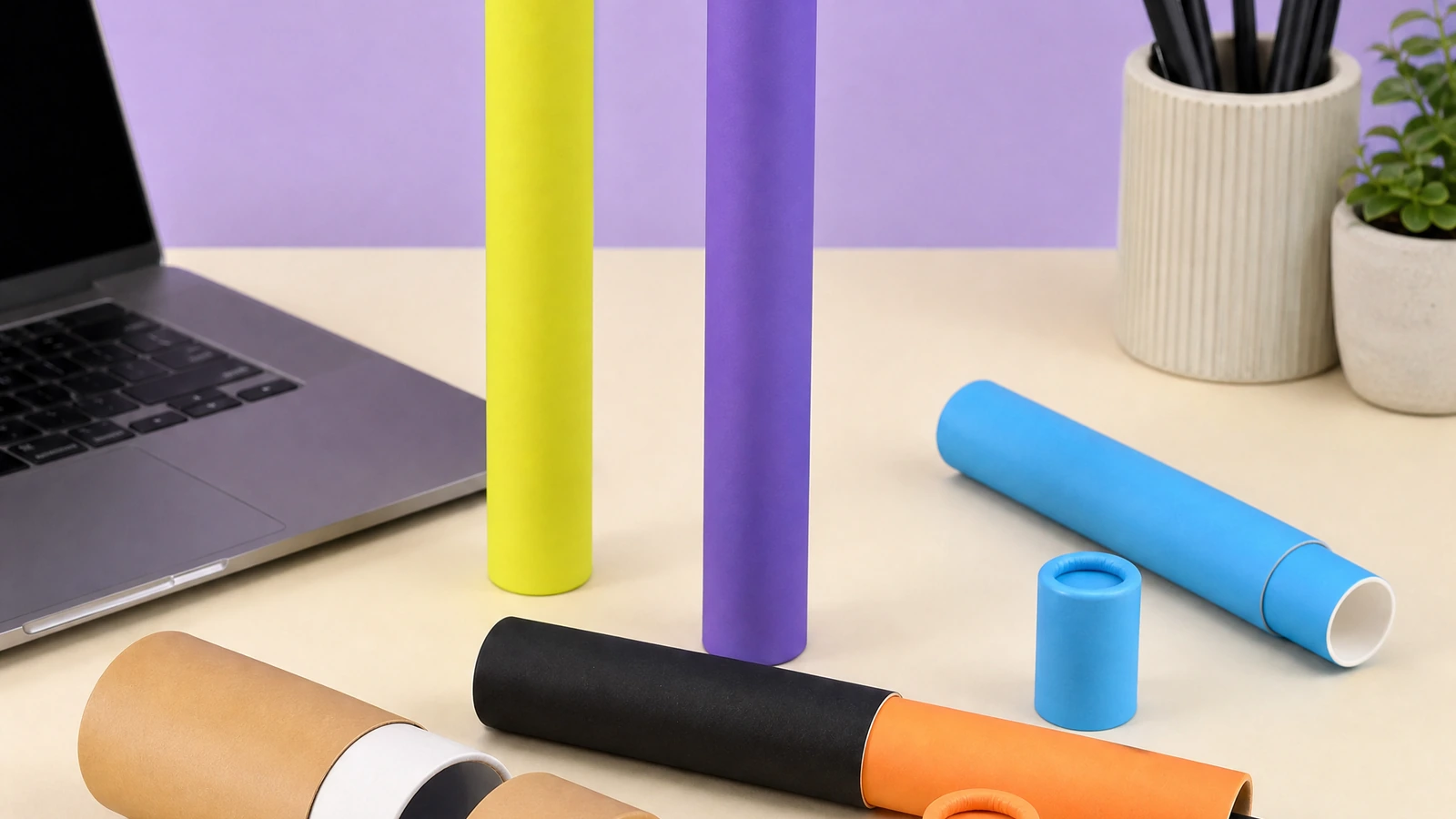
Kraft appearance, printed white wraps, matte or gloss treatments, foil details, embossing and spot effects are useful directions to discuss. They are quotation candidates, not a confirmed option list for NSKU-795-01. Request a sample showing the proposed paper, decoration and finish together.
Compare the appearance at the seam, exposed rim and overlapping lid area. A finish that looks attractive on a flat swatch may need further review where the lid slides over the body. Specify acceptable scuffing, glue visibility and edge appearance on the approved sample.
Back-clasp hardware is not part of this telescoping product concept. The relevant closure decisions are lid overlap, contact surfaces and any separately specified seal label. A decorative seal does not establish airtightness or child resistance; neither property is verified for this product.
Keep sourcing claims separate from disposal claims
FSC certification concerns responsible sourcing and chain-of-custody processes, as explained in FSC’s paper and packaging guidance[3]. If certification is required, request documentation for the proposed supply and confirm the applicable claim before approving artwork. No FSC certification is established here for this product.
Likewise, “paper-based” does not establish universal recyclability, compostability or a particular carbon reduction. Assess the complete construction, including wraps, coatings, adhesives, liners and inserts, against the intended recovery route. More barrier protection can introduce a material-separation tradeoff.
Define the food-contact boundary
For direct contact with aqueous or fatty foods, 21 CFR 176.170[4] addresses relevant paper and paperboard components under specified conditions. It is not a blanket approval for every paper tube or food application. Define food type, contact conditions and the complete material system before requesting supporting documentation.
Standard paper construction should not be treated as waterproof. If moisture, grease or oxygen protection matters, specify the required barrier function and request compatibility and performance testing. A proposed liner alone is not evidence of shelf life.
What should artwork preflight resolve? ↑
Approve structure before finalizing artwork. Changing diameter, lid depth or wrap construction after design approval can alter the visible area and seam relationship. Work from the project’s actual body and lid templates rather than adapting a visually similar supplier’s file.
- Geometry: confirm which file belongs to the body and which belongs to the lid.
- Placement: identify overlap zones, seams and areas hidden when closed.
- Legibility: inspect small text and fine details at intended printed size.
- Color: document the intended process or spot colors and the physical approval reference.
- Special finishes: identify foil, embossing or spot-treatment areas separately.
- Claims: remove unsupported certification marks, performance claims and disposal promises.
- Version control: record the approved artwork revision against the matching structural drawing.
A digital proof can resolve content and placement questions. It cannot establish lid friction, surface feel or finished color on the selected paper. Keep those decisions assigned to the physical sample rather than treating an approved PDF as approval of every production characteristic.
How should sampling and production approval work? ↑
Use staged approval so each decision has a clear reference. The sequence below is a proposed purchasing workflow, not a claim about an existing factory process or guaranteed turnaround.
- Submit the application brief. Include the product, dimensions, loaded mass, quantity by design, destination and required arrival window.
- Review the proposed structure. Confirm the two-piece construction, internal fit, insert concept and shipping constraints.
- Evaluate a structural sample. Load and remove the real product; assess closure feel, movement and exposed edges.
- Approve decoration. Check the printed sample against the artwork and selected finish references.
- Freeze the pre-production reference. Record the drawing, materials, artwork revision and acceptance criteria together.
- Authorize production against agreed terms. Confirm inspection, packing and shipment requirements before release.

Separate sample preparation, approval time, production, inspection and transport in the schedule. A quoted manufacturing duration is not an arrival date. Changes to artwork, materials or structure should receive an updated schedule rather than silently inheriting the original estimate.
No product-specific MOQ, production time or unit weight has been supplied. Request MOQ in pieces, production time with a clearly defined starting point, and unit weight in grams for the approved configuration. These fields remain quotation or measurement items.
Which quality checks protect the purchase? ↑
Turn subjective expectations into observable checks. “Premium quality” should become agreed limits for appearance and function, supported by a reference sample and recorded inspection conditions. The sampling plan, defect categories and acceptance thresholds must be agreed for the order.
| Check | What to examine | Evidence to request |
|---|
| Dimensions and fit | Internal space, closed dimensions and product insertion | Measurements against the approved drawing |
| Opening and retention | Removal effort, unintended separation and repeated-use behavior | Recorded method, agreed cycles and observed results |
| Appearance | Print alignment, color, glue traces, scuffing and edge finish | Inspection photographs and reference-sample comparison |
| Assembly integrity | Base attachment, wrap adhesion and deformation | Defined handling checks and defect records |
| Environmental response | Fit and appearance after relevant storage exposure | Temperature, relative humidity, duration and observations |
| Distribution protection | Loaded tube, insert and outer carton together | Test configuration, procedure and acceptance results |
No numerical pass limits or successful test results are established for this SKU. Record the proposed criteria before testing so a favorable-looking sample does not replace a reproducible acceptance decision.
For distribution planning, Westpak’s ASTM D4169 overview[5] describes evaluating shipping containers and systems against distribution hazards. Discuss an appropriate procedure for the actual route and complete loaded package. Mentioning the standard does not mean this tube has passed it or that every order requires an identical test sequence.
Material-level compression or paper-core measurements answer different questions from complete-package transport testing. Do not borrow an industrial core’s load rating for a decorated retail tube. For fragile contents, protection remains dependent on actual dimensions, loaded condition and sample validation.
Which packaging option fits your buying priorities? ↑
Compare alternatives by the job they must perform. Winding method, opening structure and barrier construction are different specification axes; they should not be treated as mutually exclusive product categories or ranked by a single unsupported strength score.
| Option | Priority it addresses | Main purchasing tradeoff | What to verify |
|---|
| Two-piece telescoping paper tube | Cylindrical presentation and removable-lid opening | Closure fit and empty-package storage volume | Product fit, finish and packed shipping dimensions |
| Folding carton | Flat storage before assembly | Different presentation and assembly requirements | Protection, assembly effort and total delivered cost |
| Stock tube with a custom label | Branding around an existing size | Less freedom over product fit and proportions | Size availability, label placement and replenishment |
| Barrier-lined composite container | Specified moisture, grease or oxygen protection | Additional material and recycling complexity | Contact suitability, sealing method and barrier results |
| Push-up paper tube | Dispensing a compatible solid formulation | Different mechanism and formulation requirements | Filled-product dispensing tests; outside this product identity |
Choose the two-piece format when its presentation and opening experience justify the space and specification work. Choose a different structure when flat storage, direct dispensing or a validated barrier system is the primary requirement.
Compare complete quotations, not headline unit prices
Custom Paper Tubes’ pricing guidance[6] states that customization affects packaging cost. That supports requesting an application-specific quotation, not copying another supplier’s price into this product listing.
Ask quotations to distinguish the tube, insert, decoration, setup, samples, testing, outer cartons and freight. Record exclusions and delivery terms. Compare identical quantities and artwork counts so an apparent saving is not simply an omitted component or a different shipping scope.
How do you control shipping and repeat-order risk? ↑
Rigid tubes do not store flat like unassembled folding cartons. Review carton dimensions and warehouse space early rather than assuming low individual weight means inexpensive delivery. Freight should be calculated for the proposed packing arrangement and destination.
A useful external example is Smurfit Westrock’s Lismore tube redesign[7], where tube height was adjusted to preserve compatibility with existing shipping cases. The purchasing lesson is to assess the retail package and logistics together; the case does not establish equivalent environmental or shipping results for this product.
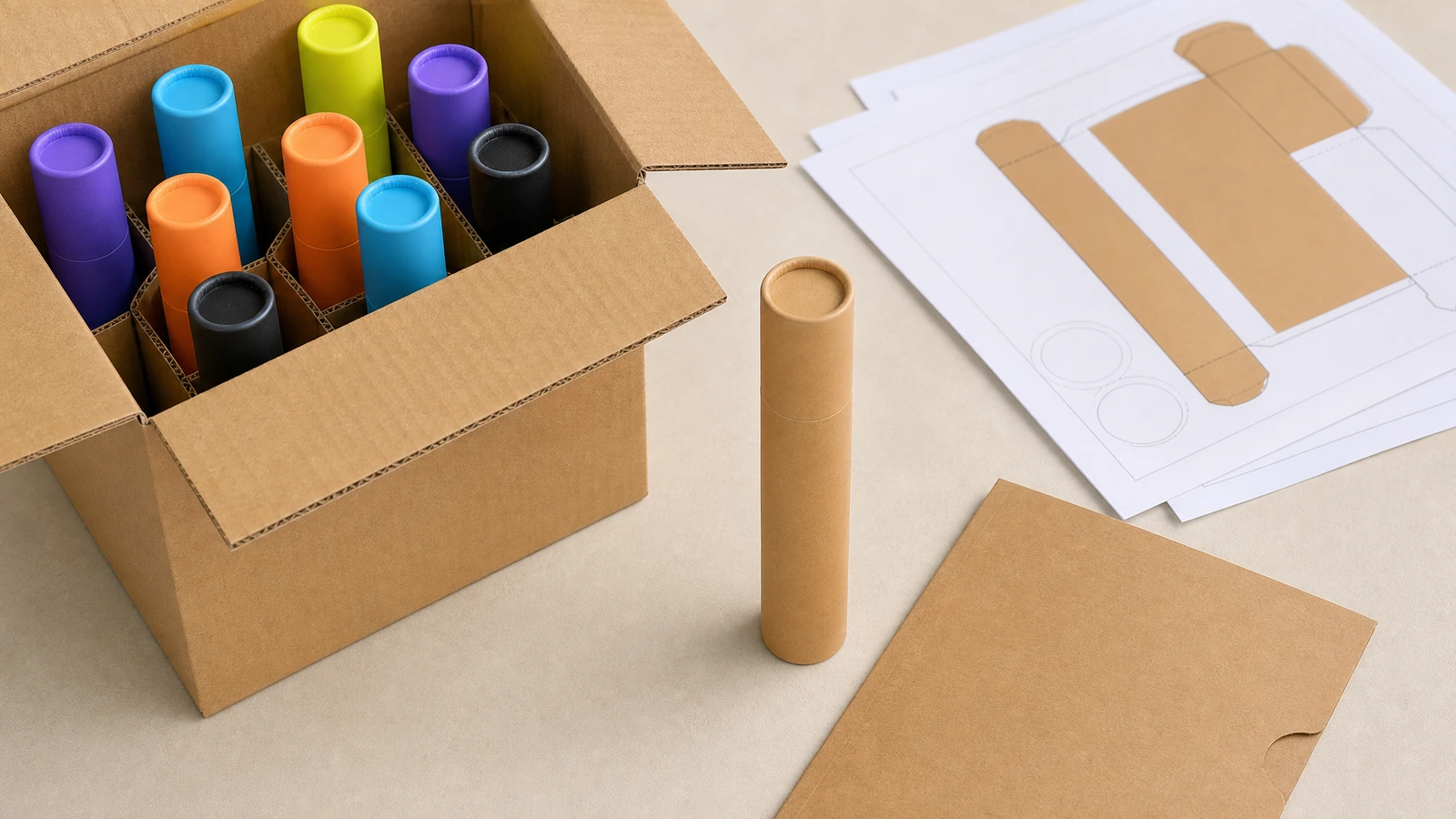
For fragile items, evaluate a protective outer carton and suitable internal restraint. Test for movement, lid displacement and surface contact under the intended packed condition. The number of tubes per carton must be determined from actual dimensions, loaded condition and packing-sample validation.
For repeat orders, retain the approved sample, drawing, artwork and packing specification. Identify which changes require reapproval, especially paper, finish, insert or closure changes. Agree how defects are reported, what evidence is needed and how replacement or other remedies will be handled.
What should you take into the sourcing decision? ↑
- Approve the physical experience before volume. — Internal fit, lid feel and printed appearance belong in sample approval.
- Compare delivered configurations. — Include inserts, finishing, inspection, packing and freight rather than comparing tube-only prices.
- Keep performance claims evidence-specific. — Food contact, barrier protection, recycling and transport suitability need support for the selected construction.
- Include the EU packaging timetable when selling into Europe. — PPWR generally applies from 12 August 2026; individual obligations have their own implementation schedules (Source[8]).
Paper construction alone does not demonstrate regulatory compliance. Keep the destination market, intended contact use, material documentation and recovery instructions attached to the sourcing brief. That makes compliance review a defined purchasing task rather than a decorative claim added at artwork approval.
Turn your product brief into a sample-ready specification ↑
A two-piece telescoping tube should make the product easy to present, remove and handle—not simply look attractive in a rendering. The strongest purchasing decision connects the approved sample to measurable specifications, realistic order terms and a tested packing arrangement.
Request a project-specific quote for NSKU-795-01 with your product dimensions, loaded mass, quantity by design, artwork, destination and required arrival window.




The information below is required for social login
Sign In
Create New Account