Custom rigid gift boxes combine a separate lift-off lid and formed base for a considered product presentation. Specify the usable interior, product support, printed wrap and opening fit together, then validate a physical sample before approving production. Pricing, minimum order quantity and delivery timing require a project-specific quotation.
For brand teams and gift buyers: This two-piece format is a candidate for cosmetics, jewelry, accessories and corporate gifts when presentation matters alongside practical product handling. A retail display, an employee welcome gift and a mailed product launch need different insert layouts, artwork priorities and transit protection.
A beautiful box can still disappoint if the product moves inside, the lid binds or the printed finish arrives scuffed. These problems leave buyers choosing between repacking, accepting compromised presentation or delaying a launch. Start with the packed product and acceptance criteria—not just an attractive reference photograph—to turn the design into a purchasing specification.
Product reference: Custom Rigid Two-Piece Gift Boxes. Category: Custom Boxes / Custom Gift Boxes. Provisional reference: NSKU-726-01. Material combinations and finishes below are specification candidates, not confirmed production capabilities. Images are illustrative concepts rather than factory photographs or test evidence.

Explore the buying guide
What defines a two-piece rigid gift box? ↑
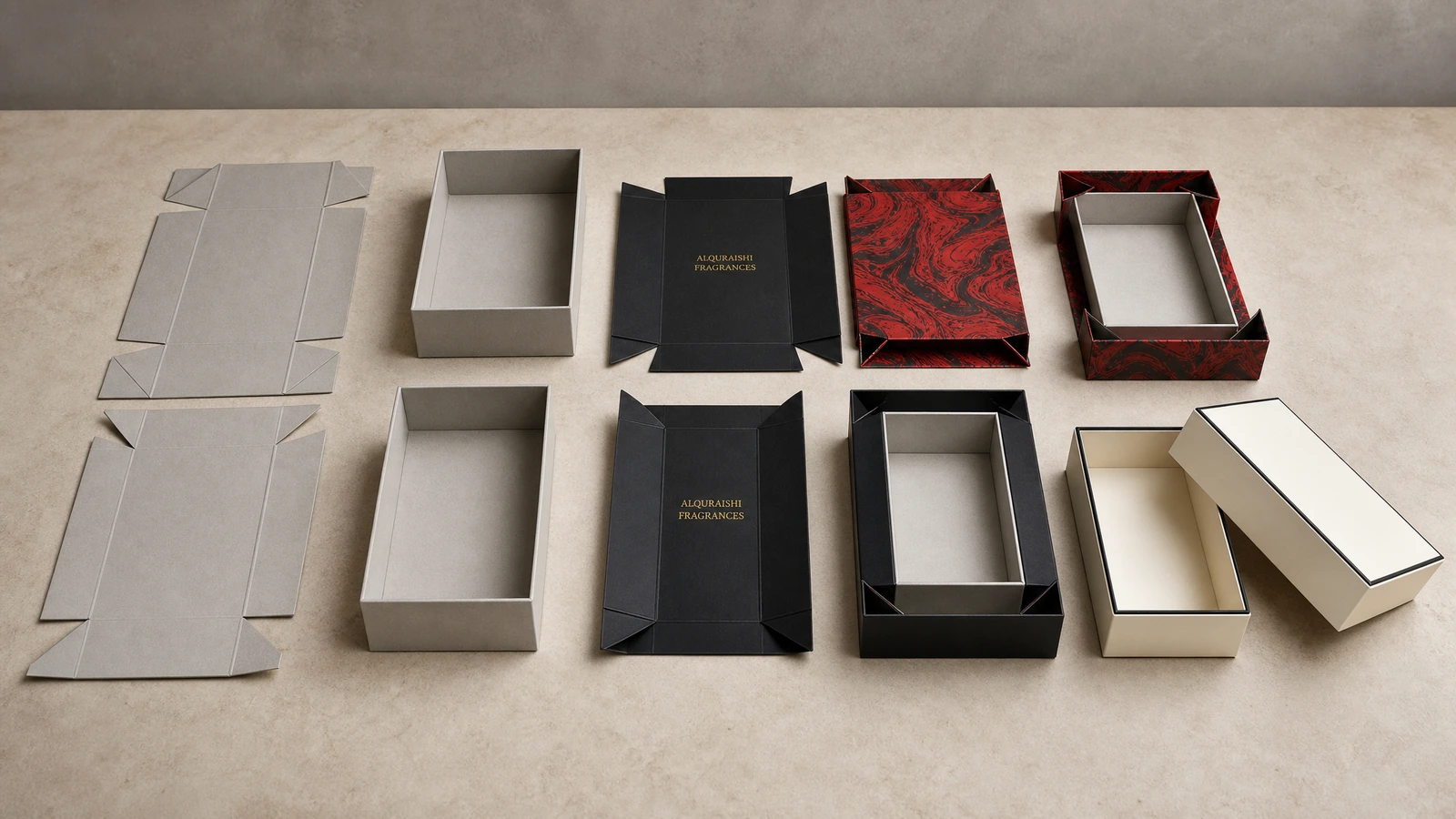
A two-piece box has a removable lid and a separate base. Its formed walls remain three-dimensional during normal use, unlike a conventional folding carton supplied flat. The wider category is also called set-up packaging; PakFactory’s rigid-box guide[1] describes the thick board and decorative wrapping that distinguish this construction.
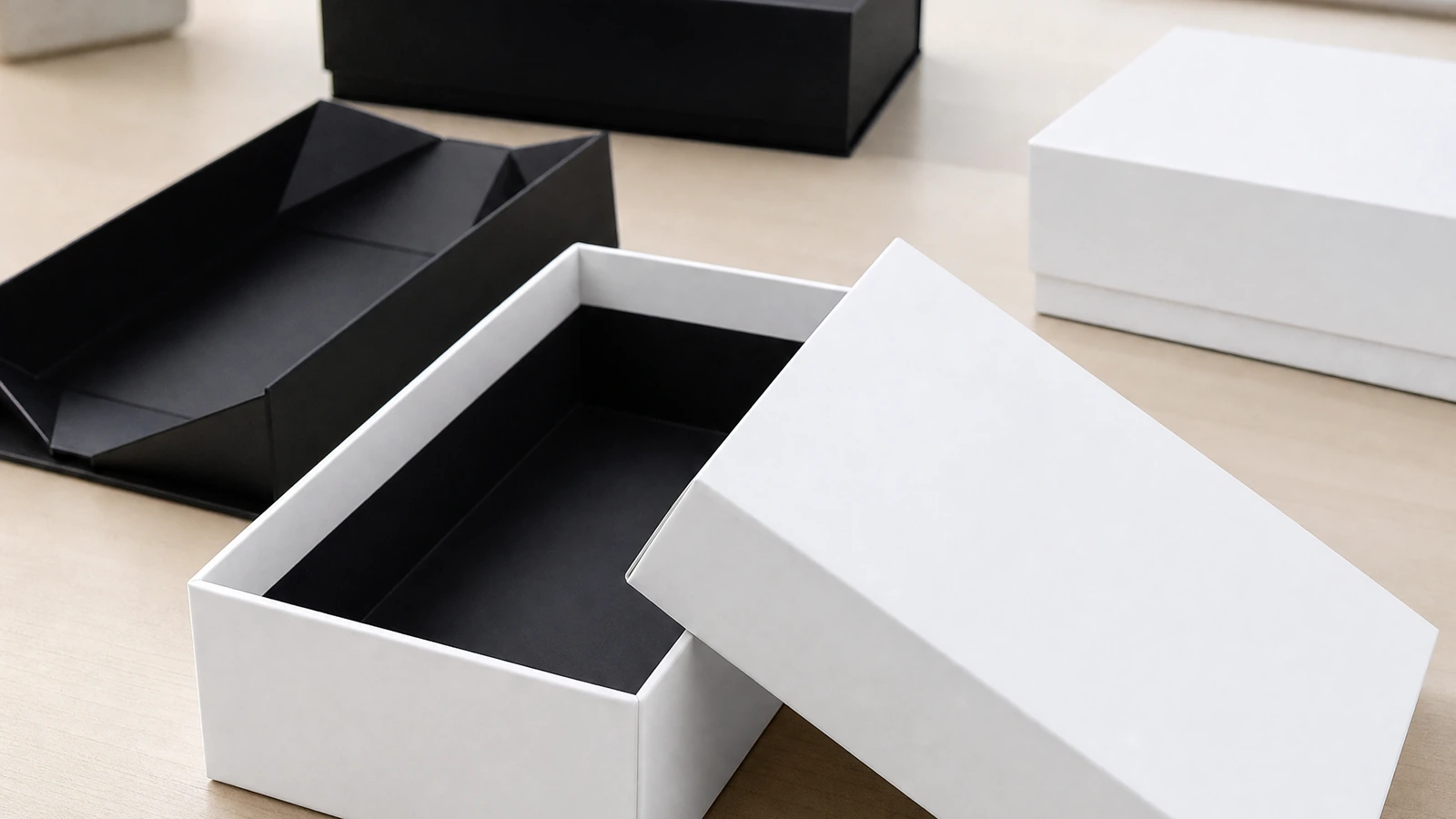
The product identity here is specifically lid-and-base—not a hinged magnetic box, drawer box or collapsible format. A request for magnets or flat-pack construction changes the structural brief and should be evaluated separately. Do not assume those features come with this product because they appear in broader gift-box search results.
The buying opportunity is a deliberate reveal: the recipient removes the lid and sees an organized presentation underneath. Whether that experience justifies the packaging investment depends on the product, sales channel and budget. Neither a premium appearance nor a substantial feel establishes a tested load rating or guaranteed sales improvement.
How do you specify usable dimensions and readable artwork? ↑
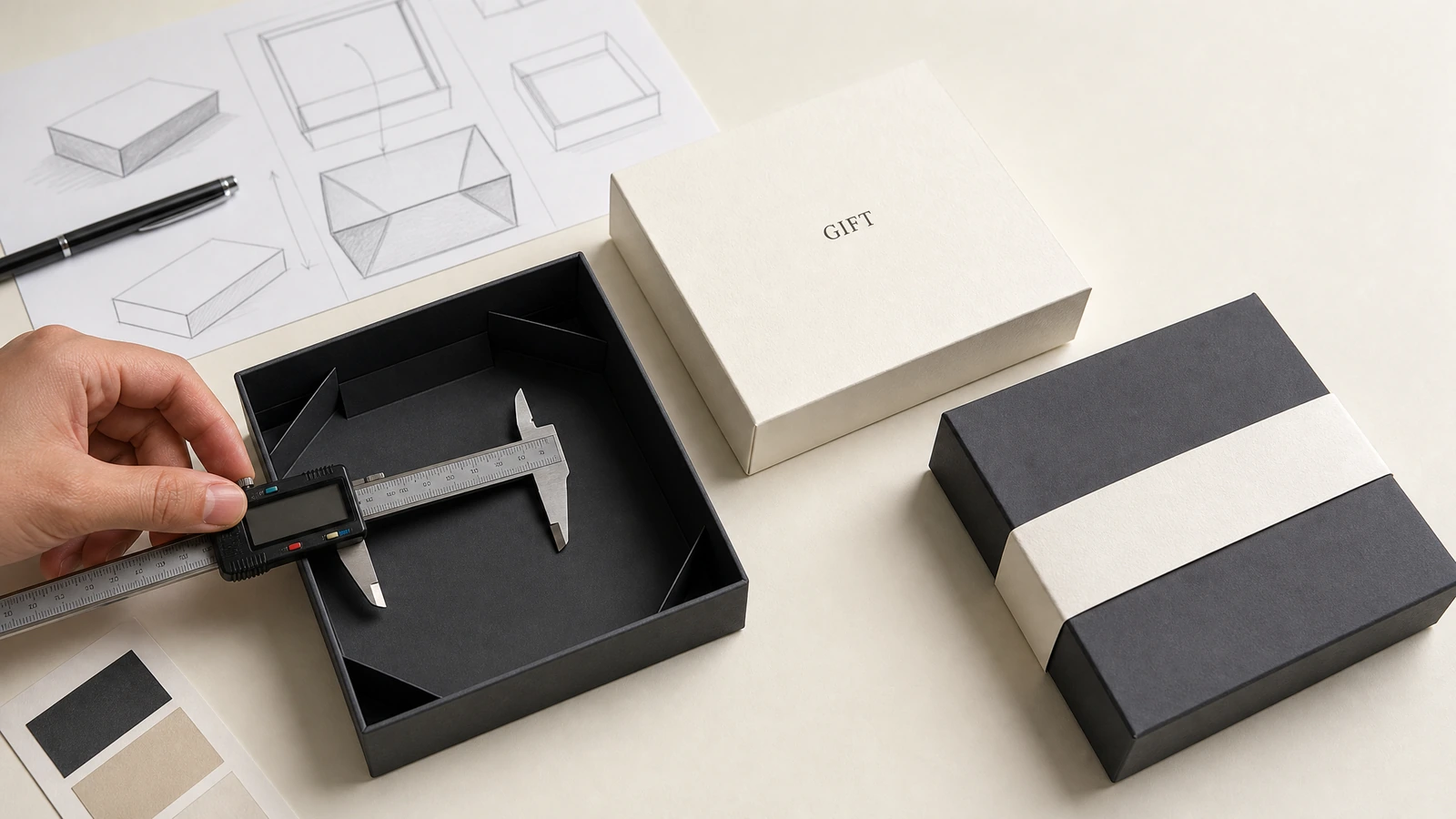
Measure the actual product in its intended packed condition, including caps, accessories, protective wrapping and any accompanying card. State internal and external dimensions separately as length × width × height in mm. If working from inch measurements, retain a clearly labeled reference and agree which unit controls production.
The usable interior is not simply the exterior minus a guessed allowance. Board, wrapping, the insert and lid engagement all affect the finished fit. Capacity, supported weight and the number of products accommodated must be determined by physical dimensions, loading configuration and sample validation.
| Specification field | What to record | How to approve it |
|---|
| Product envelope | Widest, longest and tallest points in the packed state | Check the actual product, not only a catalog drawing |
| Usable interior | Clear space after the insert and wrapping are installed | Load the physical sample completely |
| Lid engagement | Coverage depth and intended opening feel | Check seating and removal without forcing the lid |
| Product access | Removal space and access around fragile features | Rehearse unpacking with the intended contents |
| Artwork visibility | Logo, product information and text placement | Inspect the assembled sample with the lid closed and open |
These fields separate display size from working space. A layout can look generous while leaving insufficient room to remove a product; a lid can also conceal text that appeared unobstructed on a flat proof. Set project-specific dimensional tolerances rather than importing a competitor’s stated tolerance.
Industry material references include greyboard in the 1.5–3 mm range, as shown in LuxoPack’s published material examples[2]. This is comparison context, not an available thickness range or performance specification for NSKU-726-01. The proposed board must be quoted and assessed with the final dimensions and loaded sample.
Which finishes and closure details belong in the brief? ↑
Describe the visual result before selecting a long list of processes. A restrained logo treatment, a textured wrap or a contrasting interior may address the design goal without combining every decorative option. Candidate treatments from the research include printed paper, specialty paper, matte or gloss finishes, soft-touch lamination, foil, embossing, debossing and spot UV. Availability and compatibility require confirmation.
Ask for proposed finishes to be assessed on the intended substrate. A screen cannot establish paper texture, gloss, foil appearance or resistance to handling marks. Where color matters, supply the brand reference and approve a physical printed sample; a Pantone reference is a communication aid, not a promise of identical appearance across different papers and finishes.
For this construction, closure means the relationship between the lift-off lid and base. There is no confirmed back clasp, hinge or magnetic fastening. If a ribbon or other accessory is requested, define its purpose and price separately instead of treating it as part of the base specification.
Specify the insert alongside the exterior. Paperboard, foam and fabric-lined arrangements appear in the research as alternatives, but each needs its own fit and material assessment. The relevant questions are whether the product stays positioned, whether contact surfaces are suitable and whether removal feels comfortable.
How should artwork pass preflight before sampling? ↑
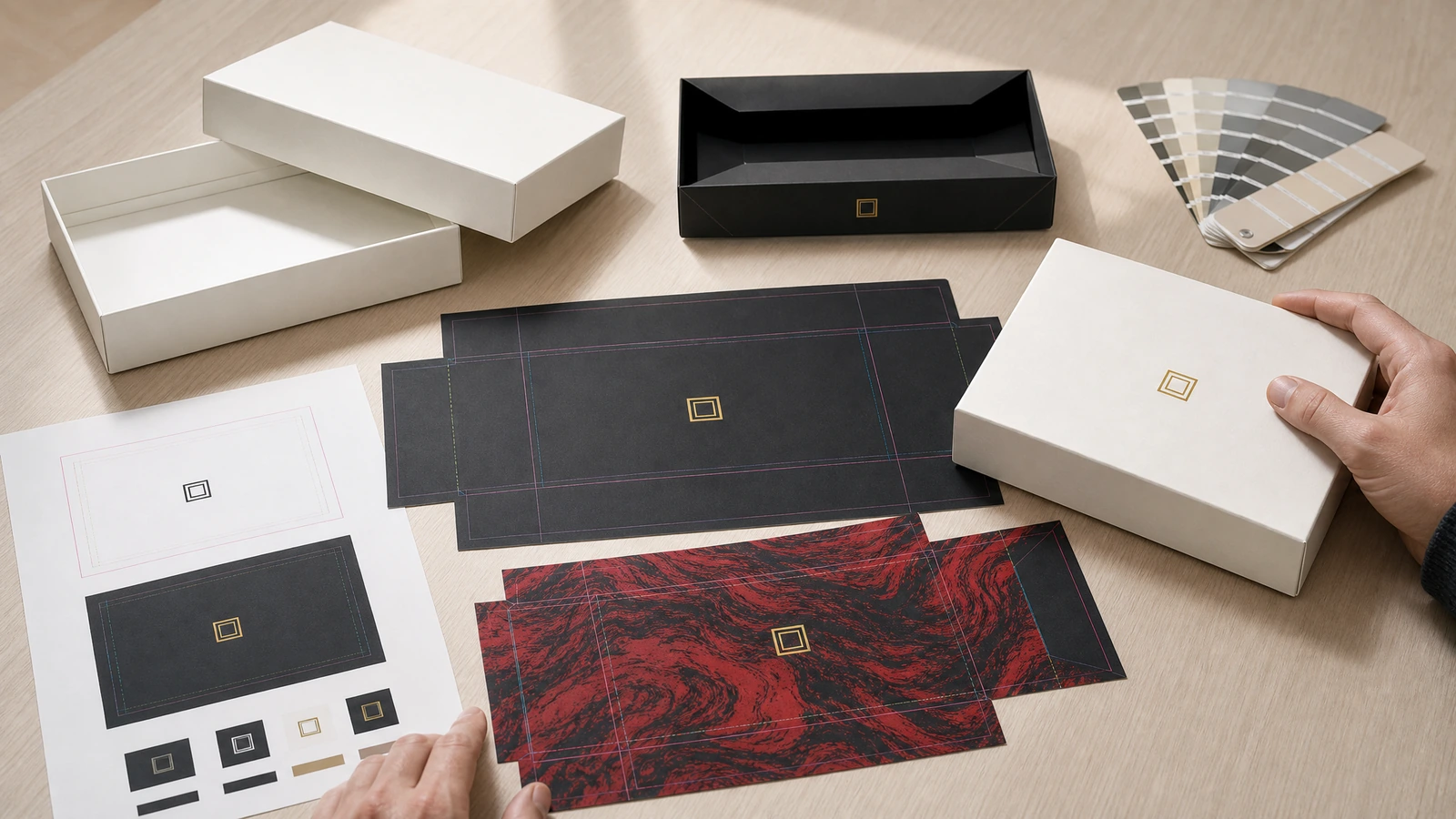
Prepare artwork on the approved structural dieline rather than a similar-looking template. The file needs to account for wrapping, turn-ins, corners and the relationship between lid and base. Keep important text and logos clear of areas that will fold, disappear inside or become difficult to align.
- Structure: Match the dieline revision to the quoted dimensions and insert arrangement.
- Brand assets: Provide the vector logo and agreed color references.
- Print layout: Confirm bleed, safe areas and visible panel boundaries with the supplier.
- Finishing: Identify foil, embossed, debossed or spot-treated areas separately.
- Reading: Check text orientation, contrast and visibility on the assembled box.
- Approval: Record which file revision is authorized for the sample.
A digital mockup can clarify placement, but it cannot approve lid resistance, product support or paper feel. Keep structural approval and print approval distinct until both are represented in a final sample. If the sample uses a different material or production method, document what remains unverified.
What should happen between sampling and production? ↑
A useful industry process reference connects engineering, board cutting, grooving where required, printing, wrapping and assembly. ePackFactory’s manufacturing overview[3] explains how these stages affect fit and appearance. It is a process reference, not evidence of the equipment or production capacity behind this product listing.
- Freeze the brief. Record the contents, dimensions, quantity, artwork, material preferences, delivery destination and required arrival date.
- Confirm the proposal. Review the structure, material specification, insert and itemized quotation together.
- Approve the sample. Assess loading, opening, finish and artwork using the actual product.
- Retain the reference. Identify the approved sample and associated files so production has an agreed comparison point.
- Release production. Confirm outstanding commercial conditions and the schedule before authorizing manufacture.
- Inspect and dispatch. Review the agreed inspection evidence and packing configuration before shipment.
Schedule sample preparation, revision rounds, bulk production and transport separately. Confirm what starts each clock and whether the quoted duration uses business days or calendar days. An estimated production completion date is not the same as an arrival commitment.
No verified MOQ, sample duration, production time, unit weight or manufacturing capacity has been supplied for this product. These remain quotation or measurement items. A competitor’s published schedule cannot establish this project’s delivery date, particularly when materials, finishes or sample revisions differ.
Which inspections protect the approved result? ↑
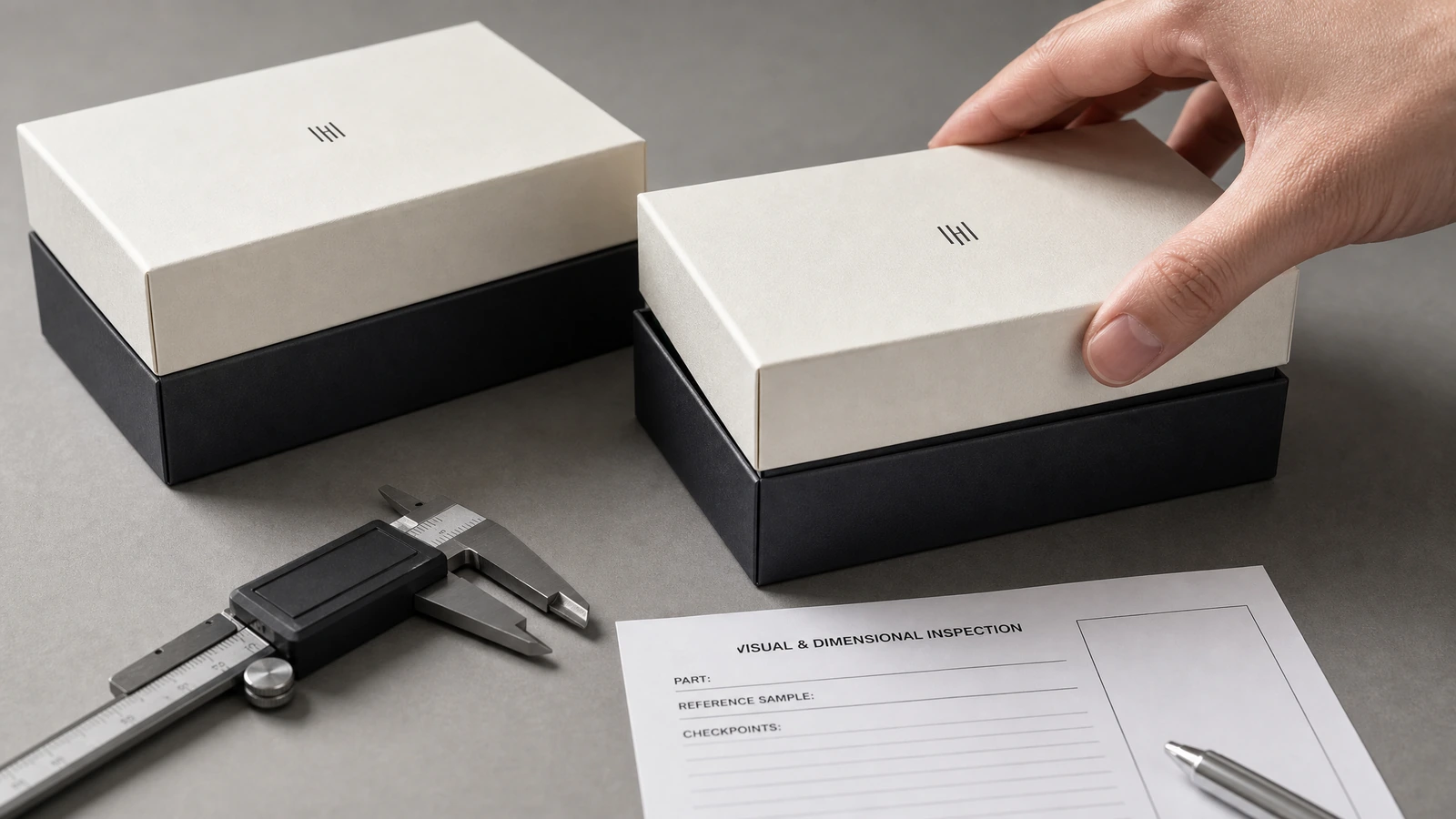
Turn “good quality” into observable acceptance criteria. Compare finished pieces with the approved sample for dimensions, lid seating, corner alignment, wrapping, visible glue, wrinkles, exposed board, surface marks and print appearance. Check the insert with the intended contents rather than inspecting an empty box alone.
| Inspection area | Check | Evidence to agree |
|---|
| Geometry and fit | Internal space, lid alignment, opening and closing | Measured results against agreed tolerances |
| Workmanship | Edges, corners, adhesive, wrapping and cleanliness | Photographs and defined acceptable/unacceptable examples |
| Print and finish | Color appearance, logo registration and handling marks | Comparison with the approved physical reference |
| Loaded arrangement | Product movement, contact points and removal | Assessment of the complete packed sample |
| Transport system | Outer carton, cushioning and packed-product condition | An agreed test plan and results where testing is commissioned |
Agree the sampling method, defect classifications, acceptance limits and corrective action before production. An AQL-based inspection is a sampling arrangement, not a guarantee that every piece is defect-free. No defect rate, drop-test pass rate or compression result is established for this product.
For transport validation, ASTM D4169[4] provides a framework for evaluating shipping units against distribution hazards. Have the testing provider select a suitable protocol for the actual route and complete packed system. Referencing a standard does not mean this box has been tested or certified.
Record the configuration used in any test: actual contents, insert, outer packaging and loading condition. Without that connection, a report may not describe the configuration being purchased. Changes to those components should trigger a review of whether existing evidence still applies.
Which packaging option fits your buying priorities? ↑
Compare formats around the job they must perform. A gift box prioritizes presentation, while a transport package must address distribution conditions. If warehouse space or parcel delivery dominates the brief, evaluate alternatives before investing in decorative treatments.
| Option | Buying priority | Main trade-off | Required check |
|---|
| Two-piece rigid box | Lift-off presentation and formed structure | Assembled volume affects storage and freight | Loaded fit, opening feel and outer protection |
| Folding carton | Flat storage and a lighter packaging format | Different construction and presentation feel | Product support and packing requirements |
| Collapsible rigid box | Reduced storage volume before assembly | Assembly and closure introduce different requirements | Assembled sample and structural integrity |
| Corrugated mailer | A distribution-oriented packaging format | Different visual and tactile presentation | Suitability for the contents and shipping route |
This is a selection framework, not a tested performance ranking. None of these formats automatically qualifies for a particular product weight or transport condition. For fragile contents, evaluate the complete protective arrangement rather than choosing solely by board thickness.
For comparable quotes, hold dimensions, quantity, materials, print, finishes and inserts constant. Ask suppliers to separate tooling, sampling, revisions, assembly, protective packing and freight. Confirm the shipping basis and any excluded import-related charges instead of treating a headline unit price as the delivered cost.
MOQ is also a cash and storage decision. A lower unit price at a larger quantity is useful only if the stock can be used and stored economically. Request the quantity you need and clearly separated alternative quantities, without assuming that low-MOQ claims for other box styles apply here.
How do shipping and repeat orders affect total cost? ↑
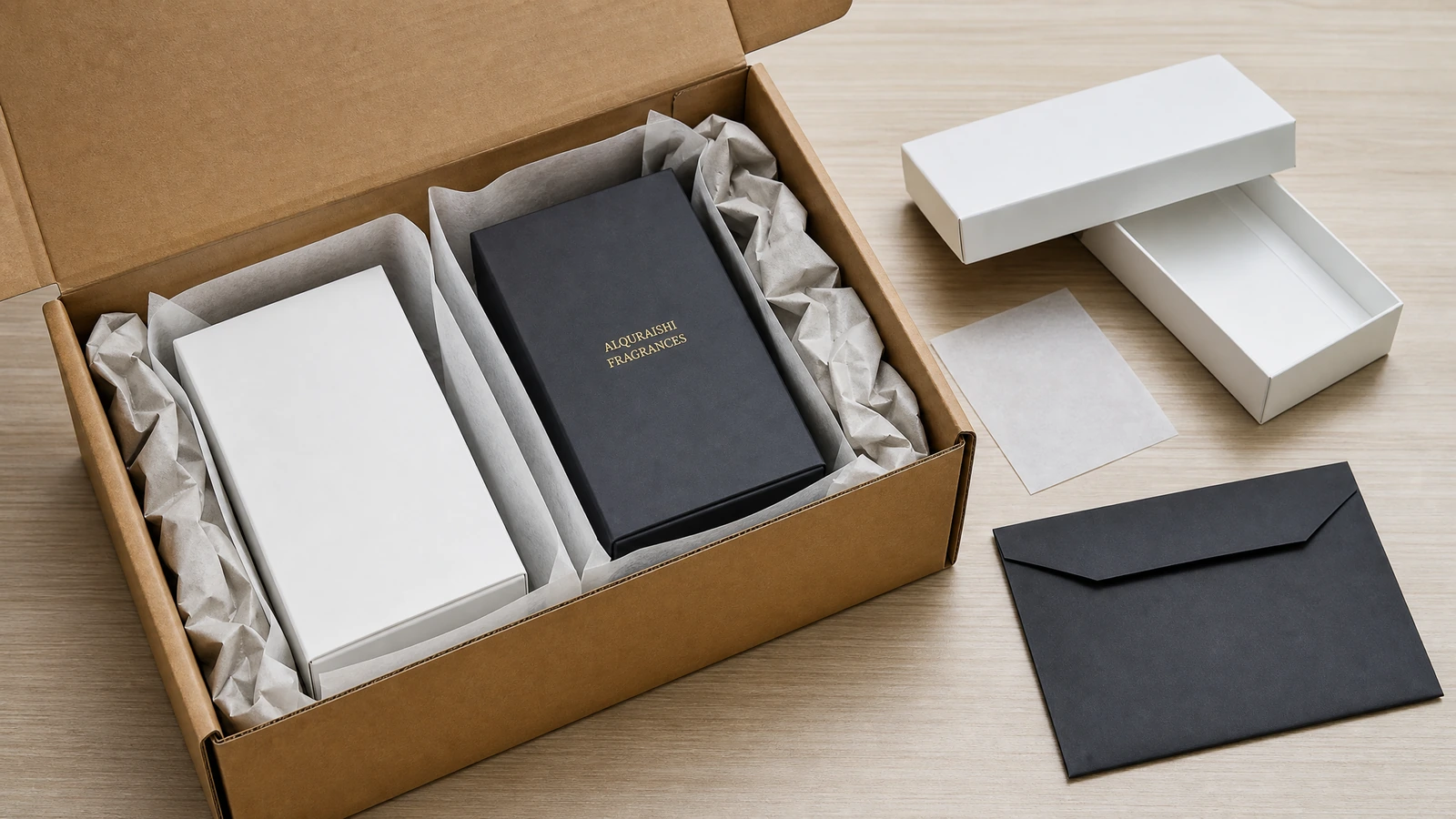
Do not treat a decorative rigid box as a ready-to-mail shipping container. As a concrete supplier example, Packwire’s rigid-box specification[5] expressly identifies the need for an outer box. For this project, outer packaging and cushioning remain part of the shipping brief to validate.
Ask for the proposed master-carton dimensions, gross weight, packing arrangement and total shipment volume. Assembled boxes occupy space even before products are loaded, so freight comparisons need the packing configuration rather than only the empty-box unit price. Do not assume lids and bases can be nested without affecting surfaces or fit.
Include protection against scuffing, corner damage and moisture exposure in the packing discussion. At receipt, record packaging condition and representative defects before discarding transport materials. Agree the evidence required for a claim and the remedy process in advance; no automatic refund or replacement policy is established here.
For repeat orders, retain the approved sample, artwork revision, material specification, insert drawing and inspection criteria. Confirm any change in paper, finish or component availability before release. A repeat purchase should reference the approved specification, not rely solely on an earlier photograph or invoice description.
What evidence supports material and labeling claims? ↑
Separate responsible sourcing from recyclability. FSC’s paper and packaging guidance[6] addresses certified forest-based materials. No FSC certification has been verified for this product. If certification is required, request documentation covering the proposed supply and claim before including certification language or marks in artwork.
Assess the whole finished pack when considering recycling language: board, wrap, coatings, adhesives, inserts and accessories. Paper-based construction alone does not establish local acceptance. Confirm component separation and destination recycling arrangements rather than printing an unrestricted “recyclable,” “biodegradable” or “eco-friendly” claim.
For food gifts, distinguish an outer presentation box holding sealed products from materials intended to contact food. 21 CFR Part 176[7] addresses paper and paperboard components for food-contact uses. Define the intended contact and conditions, then obtain appropriate material documentation. This listing makes no food-contact suitability claim.
For US retail applications, NIST’s labeling guidance[8] identifies product-dependent requirements concerning identity, responsibility and quantity. Have the responsible brand team determine the applicable label content and units before approving the layout. A gift-box format does not by itself establish compliance for its contents.
For other destinations, include packaging, labeling and environmental requirements in the brief and verify applicability to the finished pack. Avoid blanket “compliant” or “PPWR-ready” wording without a documented assessment of the relevant obligations.
What should buyers take away? ↑
- Specify the correct structure. This product is a separate lift-off lid and base; magnetic and collapsible formats require a different assessment.
- Approve fit with the actual contents. Usable space and loading suitability depend on dimensions, packing arrangement and physical sampling.
- Compare complete purchasing costs. Separate the box, insert, setup, sampling, protective packing and transport charges.
- Make quality review observable. Agree tolerances, workmanship examples, inspection arrangements and remedies before production.
- Keep claims tied to evidence. Certification, food-contact suitability and transport performance remain unconfirmed unless supported for the specified configuration.
Build the quotation around your actual product ↑
The strongest brief connects the intended presentation with usable dimensions, product support, finish priorities and the delivery route. That gives the quotation a defined scope and the sample a practical job: demonstrating whether the proposed package works for your product before a bulk commitment.
Request a project-specific quote for NSKU-726-01 with your product dimensions, packed weight, required quantity, artwork, insert needs, delivery destination and target arrival date.




The information below is required for social login
Sign In
Create New Account