SEO Title: Custom 3D Rubber Fridge Magnets | Molded Soft PVC
Meta Description: Plan custom 3D rubber fridge magnets with molded soft PVC artwork, sample approval, backing selection, packaging, and clear wholesale quotation requirements.
Custom 3D rubber fridge magnets turn logos, landmarks, and illustrated characters into molded soft PVC designs with raised detail and a magnetic backing. Specify the artwork, finished dimensions, intended surface, and packaging together; approve a physical sample before treating appearance, holding performance, or delivery timing as confirmed.
For museum shops, destination retailers, promotional distributors, and brand teams, the opportunity is a recognizable object rather than another printed message. A landmark silhouette can represent a trip; a shaped logo can become a branded gift. Both depend on a design that remains clear at its actual finished size.
The problem begins when an attractive rendering becomes the entire purchasing specification. It cannot establish whether lettering stays readable, the relief matches expectations, or the backing suits the intended refrigerator. Discovering those differences after production can mean rejected stock, replacement costs, and a missed launch.
The solution is to connect the creative brief to an approval checklist: material identity, relief geometry, color reference, magnetic construction, sample inspection, and packing requirements. This page explains those decisions without treating another supplier’s prices, test results, or certifications as specifications for this product.
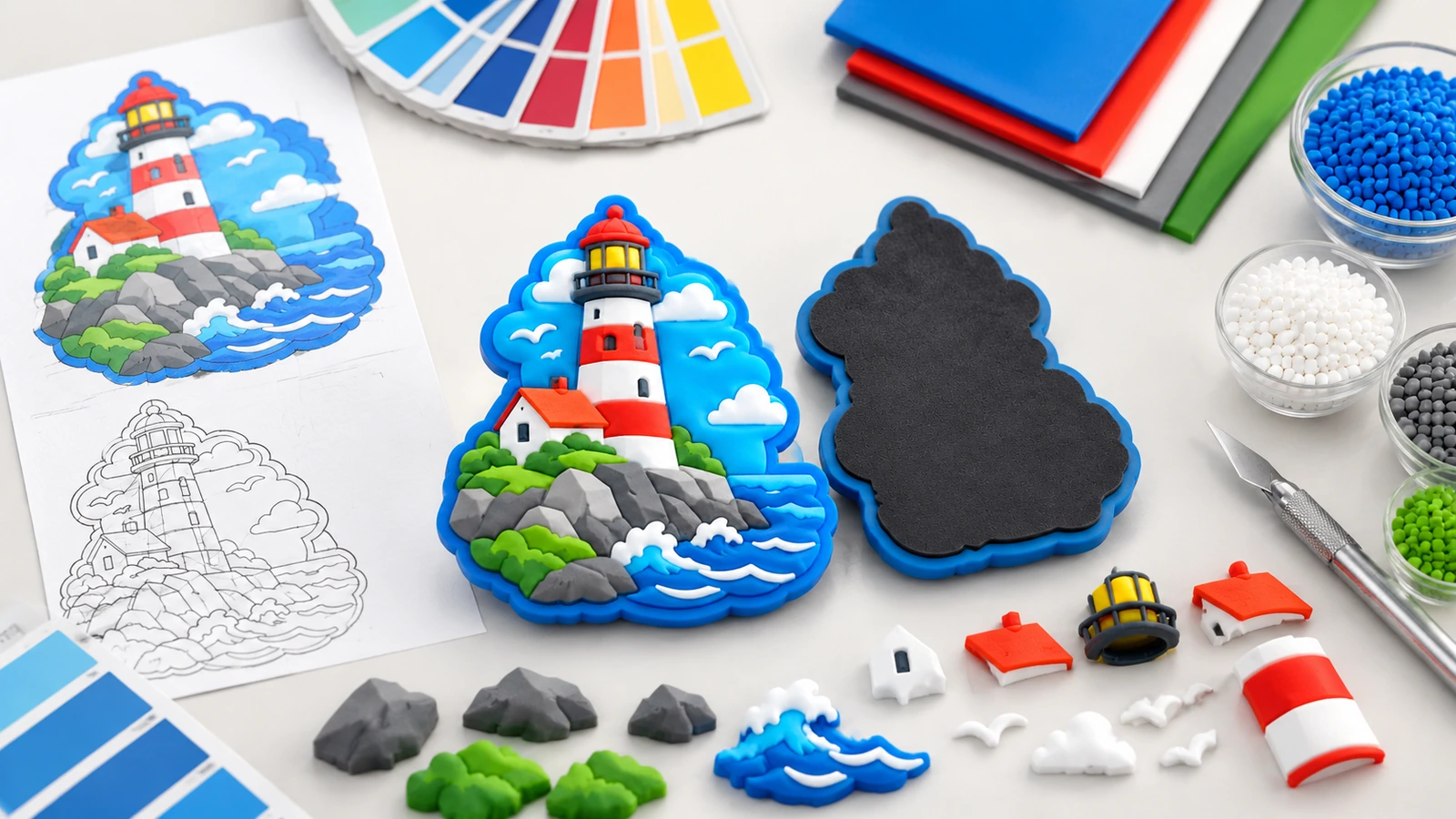
Application concept: destination souvenirs and branded gifts. Illustrations do not establish an approved design, supplied packaging, or tested performance.
Product buying guide
What makes this a molded soft PVC magnet? ↑
The product identity is Custom 3D Molded Soft PVC Fridge Magnets, within Custom Magnets and Custom Rubber Fridge Magnets. “Rubber” describes the familiar buying category here; the specified decorative material is soft PVC. It should not be relabeled as silicone, natural rubber, or an entirely magnetic molded compound.
Separate the decorative body from the magnetic component. The front creates the shape and raised detail. The backing supplies attachment to a suitable surface. Flexible magnetic sheet and localized hard magnets are construction options discussed in the supplied research, but neither is a confirmed backing specification for this provisional product.
Also distinguish layered relief from rounded sculpture. A design can have raised, flat-topped areas without resembling a fully modeled miniature. Side-view drawings and a physical sample should settle what “3D” means for the order, including recessed lines, rounded contours, and the relationship between foreground and background.
| Specification field | Current product position | Required purchasing decision |
|---|
| Decorative material | Molded soft PVC | Confirm the formulation and any destination-specific material requirements |
| Product reference | Provisional SKU NSKU-742-02 | Associate the final artwork and sample revision with the order |
| Dimensions and thickness | No product-specific values supplied | Specify width, height, decorative-body thickness, and magnetic thickness in mm |
| Magnetic construction | Not confirmed | Review backing material, coverage, position, and attachment method |
| Commercial terms | No verified MOQ, price, or production time supplied | Obtain a quotation for the actual design and quantity |
| Unit weight and performance | No measured values supplied | Measure the sample and agree on the required tests |
These fields prevent an illustrative design from becoming an accidental specification. Dimensions, backing details, and commercial terms remain quotation or sampling items unless confirmed for the selected configuration.
How should size and readable detail be specified? ↑
Start with the finished object, not the packaging. Record the maximum width and height, identify the measurement points on an irregular outline, and show the decorative profile separately from the backing. A single thickness figure can conceal whether it describes the PVC body, the magnetic sheet, or the assembled item.
Then rank the visual content. A destination name, recognizable silhouette, and main logo may matter more than secondary ornament. Review lettering, narrow gaps, small islands of color, and projecting details at actual size. Where detail becomes unclear, simplify the artwork or discuss a larger format before approving tooling.
For telephone numbers, dense schedules, photographs, or QR codes, compare molded relief with a printed format. Do not assume that a design legible on a monitor will remain readable—or scannable—on a small, textured surface. Include the intended viewing or scanning task in sample acceptance.
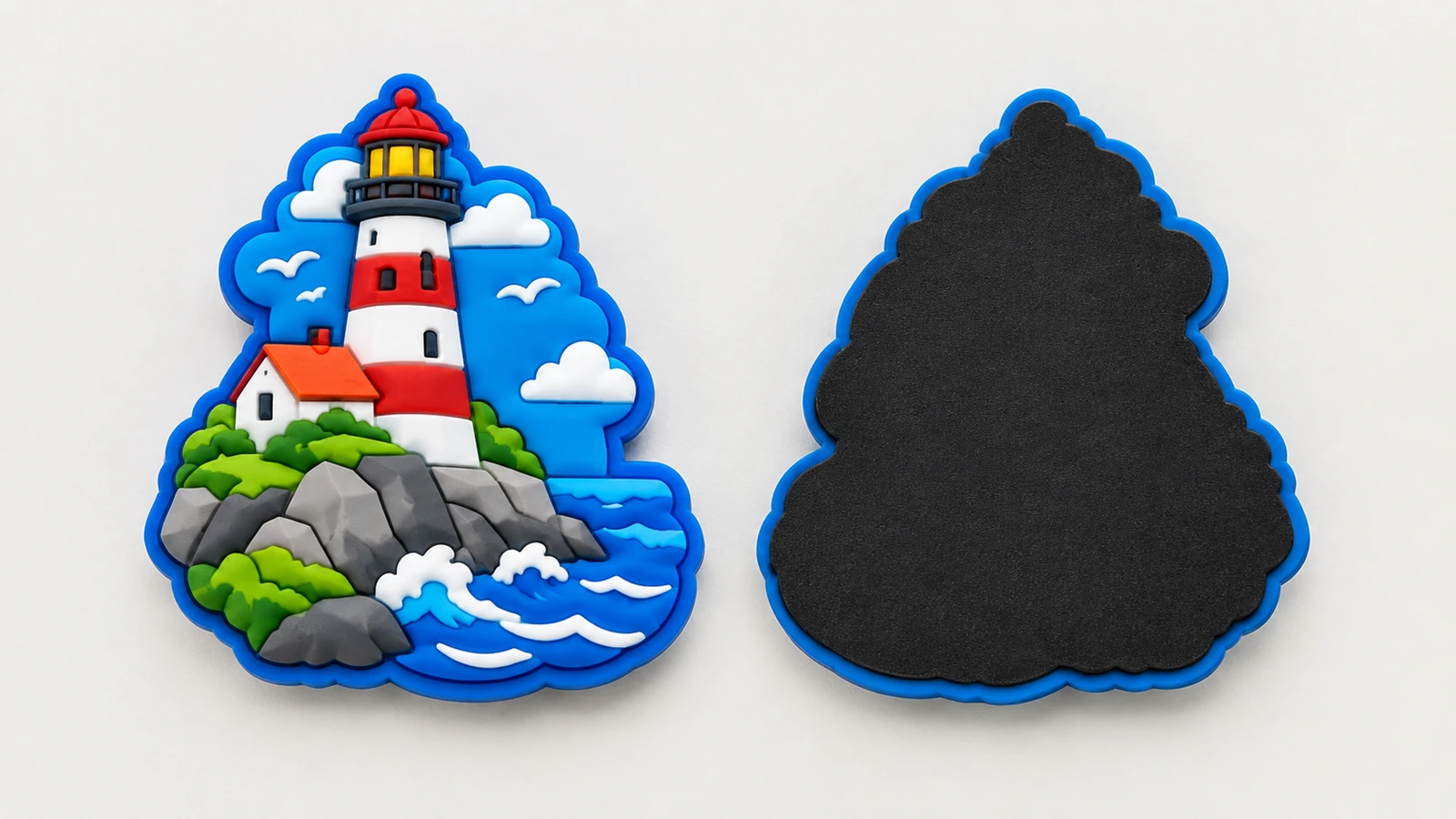
Size-review concept: compare the finished outline, raised lettering, and side profile without assigning an unverified standard size.
Which surface and backing decisions matter? ↑
Confirm the display surface before choosing the backing. Stainless steel is not a universal compatibility claim: alloy and finish affect attachment. Whirlpool explains these differences in its guidance on stainless-steel magnet compatibility[1]. Check the appliance instructions first, then test an allowed surface with the proposed sample.
Attachment and finish protection are separate questions. GE advises against magnets on its Black Stainless and Fingerprint Resistant Stainless refrigerator doors because they can damage the finish, even where attachment is possible. Its appliance-finish guidance[2] is a reason to avoid blanket “scratch-free” claims.
For backing selection, review contact area, the weight and profile of the decorative body, and how the magnet is secured. An embedded hard magnet is not automatically the better option: its retention, exposed contact surface, and potential detachment require separate assessment. Nor does thicker flexible sheet alone establish finished-product performance.
Any paper-holding capacity depends on physical dimensions, loading conditions, and sample validation. A component’s perpendicular pull rating cannot establish how many sheets the finished magnet will retain on a vertical, coated refrigerator door.

Construction comparison only. Backing availability, attachment design, and suitability require confirmation for the order.
How do you prepare artwork for sampling? ↑
A useful artwork package makes the intended result understandable without relying on verbal interpretation. Supply the source artwork, finished outline, color references, and a description of which elements should be raised or recessed. Identify any supplied image as either a design reference or an approved production file.
- Define geometry: show front, reverse, and side views, including the intended backing position.
- Separate color areas: identify the target colors and agree on the physical reference used for approval.
- Check small features: flag fine lettering, narrow borders, and details that need a feasibility review.
- Distinguish molded and printed elements: do not assume a photographic gradient can be reproduced as molded color blocks.
- Identify the revision: connect the drawing, proof, and sample to the same approved artwork version.
If printing forms part of the proposed construction, confirm its resolution, registration, and any required bleed with the selected process. Do not apply a generic printing specification to every molded design. A digital proof can resolve layout decisions; it cannot verify color in the material, feel, magnetic performance, or attachment strength.
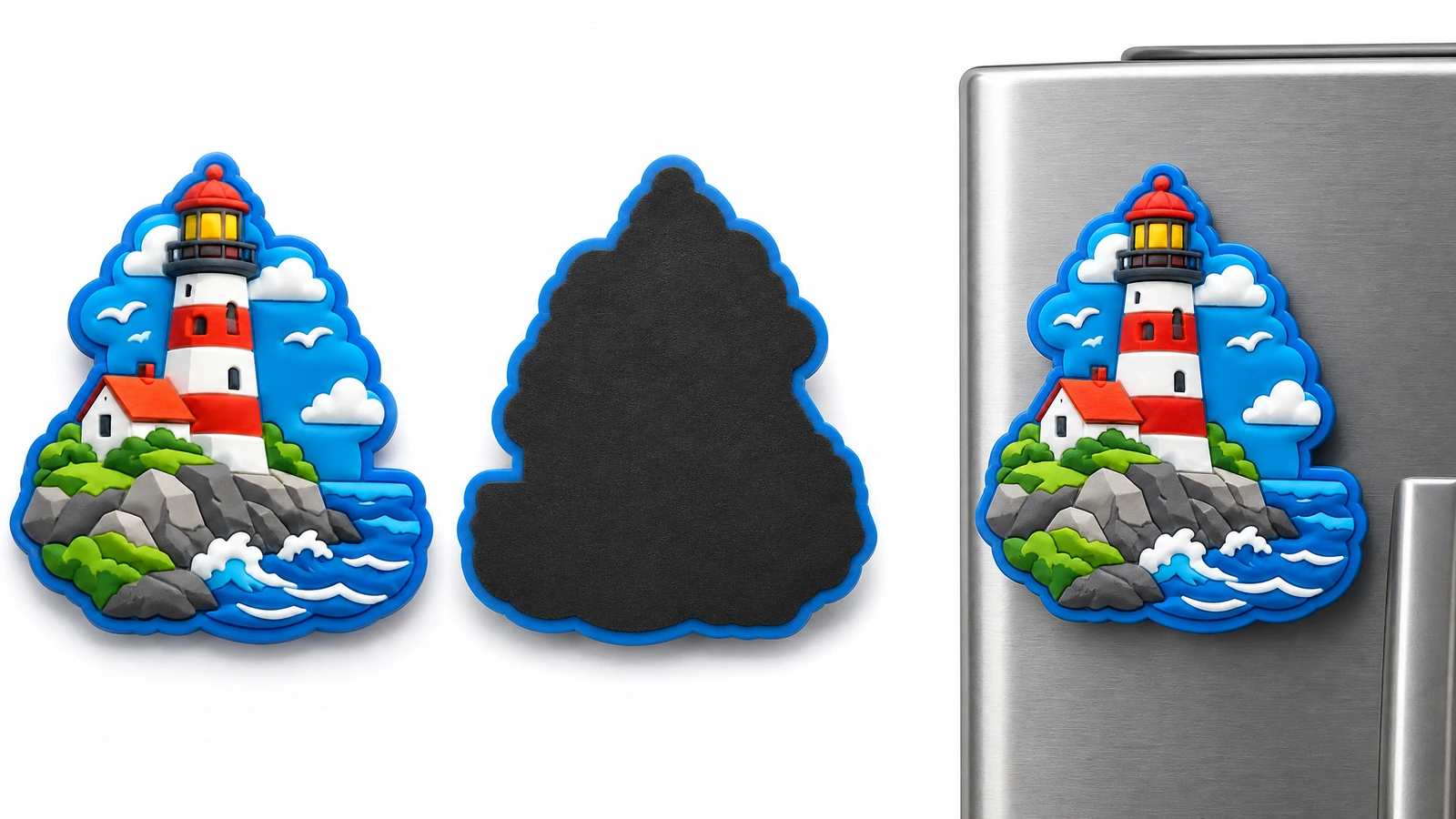
Preflight concept: artwork, color references, and profile drawings describe the intended sample rather than certify its result.
What should happen before production approval? ↑
The supplied research describes a general sequence of mold preparation, colored PVC placement, heat forming, finishing, magnetic assembly, inspection, and packing. This is a process overview, not a statement about a particular factory’s equipment, capacity, or operating parameters.
- Review feasibility. Resolve the outline, relief, color separation, and backing proposal before treating the design as production-ready.
- Confirm quotation scope. Identify tooling, sampling, product cost, packaging, testing, and freight separately, including which items are excluded.
- Approve the physical sample. Compare its appearance, dimensions, and assembled construction with the agreed drawing and references.
- Record acceptance criteria. Define allowable variation and unacceptable defects, rather than relying on “good quality” as the instruction.
- Release the approved configuration. Make the signed sample and matching documentation the reference for production and subsequent inspection.
Keep sample preparation, revisions, testing, production, and transport as separate schedule items. The quotation should identify what starts each period: artwork approval, payment, sample approval, or another agreed milestone. An event deadline requires a delivery plan, not simply a manufacturing estimate.
No sample turnaround or production duration has been verified for this product. Another supplier’s published schedule cannot establish availability for this design. Ask the quotation to account for mold changes, repeat color sampling, and any required third-party testing.

Generic process illustration, not documentation of a verified factory or production line.
How should samples and shipments be inspected? ↑
Agree on the inspection method before bulk production. Appearance, attachment, and magnetic performance are different acceptance categories. A clean-looking front does not demonstrate that the backing is secure; successful attachment without a load does not establish note-holding performance.
| Inspection area | Suggested check | Evidence to record |
|---|
| Dimensions and relief | Measure the agreed points and compare the side profile with the approved sample | Measurements in mm, drawing revision, and photographs |
| Color and readability | Compare physical references and read critical text at finished size | Reference identity and the agreed visual acceptance conditions |
| Assembly | Inspect edges, glue residue, backing lift, gaps, and loose components | Defect photographs and results of agreed retention checks |
| Magnetic use | Test on the intended permitted surface with the actual proposed load | Surface, loading arrangement, orientation, and observed slipping or detachment |
| Handling and packing | Inspect for deformation, tearing, scuffing, and pressure marks | Sample condition and packing configuration |
This is a proposed acceptance framework, not a completed test report. Define sample quantities, test duration, handling cycles, allowable tolerances, and pass/fail criteria for the actual purchase; none has been established here.
For durability claims, test the assembled product rather than borrowing a temperature range or service life from a raw magnetic material. PVC, bonding, decoration, and backing all need consideration. Without supporting evidence, do not describe this item as dishwasher-safe, outdoor-rated, permanently fade-resistant, or suitable for high-temperature locations.
Keep care instructions conservative and specific to the approved construction. Establish a cleaning method, avoid unapproved heat and prolonged exposure, and stop using an item if its magnetic component loosens. Agree on the reporting window and remedies for nonconforming goods before shipment.

Inspection setup concept. No holding capacity, bond strength, or passing result is represented.
Which safety documents belong in the buying brief? ↑
Specify the destination market, intended users, sales channel, and whether the item is designed or marketed for play. A soft body or souvenir label does not establish safety. Conversely, toy requirements should not be presented as automatically applying to every adult promotional magnet.
For U.S. toy projects, identify the applicable requirements under ASTM F963 as incorporated through 16 CFR Part 1250, including relevant magnetic and mechanical provisions. The CPSC toy-safety guidance[3] explains why product classification and applicable sections must be determined rather than inferred from a supplier’s badge.
Chemical documentation also needs the correct scope. CPSC identifies a 100 ppm total-lead limit in accessible components of children’s products in its total-lead guidance[4]. Surface coatings require a separate applicability review; one material report should not be assumed to cover every component.
For children’s toys and child-care articles, specified phthalates are restricted above 0.1% (1,000 ppm) in accessible plasticized components, as explained in CPSC phthalates guidance[5]. This is a regulatory boundary, not a test result or “phthalate-free” claim for the product.
For European distribution, include review of applicable general product safety, traceability, and chemical requirements, with toy assessment where relevant. Request reports matching the material, construction, and intended product—not an unrelated sample. No product certification, food-contact status, recycled-content percentage, or recyclability claim is established here.
How do packaging and repeat orders affect cost? ↑
Choose packaging for the distribution task. Individual bags, backing cards, and retail boxes appear as options in the research; availability and pricing require confirmation. A souvenir-shop presentation and a bulk promotional shipment may need different identification, protection, and handling arrangements.
Review the packed sample for pressure on raised features, rubbing between pieces, and clarity of product identification. If magnets form a coordinated series, document the assortment and design references. Packing quantities and carton fit depend on the physical dimensions, loading arrangement, and packing-sample validation—not a generic carton-capacity claim.
Compare quotations on the same basis: quantity per design, tooling, sampling, decoration, backing, packaging, testing, freight, and any excluded import charges. Confirm the currency and shipping terms. A low unit price is not a landed-cost comparison when the included services or construction differ.
For repeat orders, retain the approved artwork, sample, colors, and backing specification. Ask about tooling retention, ownership, reuse conditions, and charges before assuming a reorder avoids setup costs. Changes to formulation, magnetic assembly, or packaging should be reviewed against the original approval rather than silently treated as equivalent.
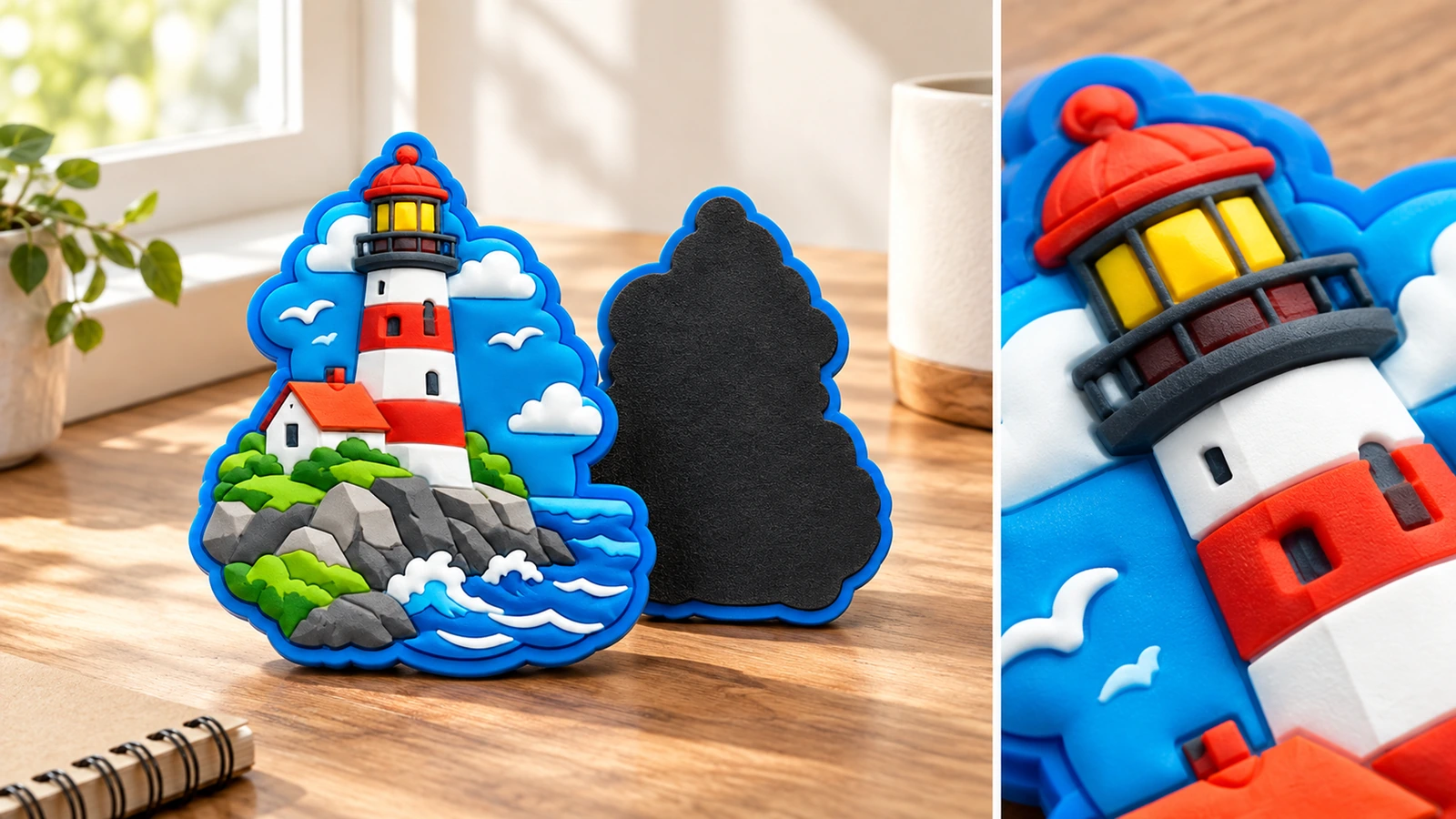
Packaging concept only; pack counts, carton dimensions, and shipment weights require a confirmed configuration.
When is molded PVC the right choice? ↑
Choose the construction around what the recipient needs to recognize or use. Molded relief supports shaped artwork; printed formats support different visual tasks. Comparing those purposes is more useful than declaring one material universally better.
| Product route | Best reason to consider it | Trade-off to resolve |
|---|
| Molded soft PVC | Raised logos, character outlines, and landmark designs | Tooling, small-detail reproduction, relief approval, and backing selection |
| Printed flexible magnet | Photographs, contact information, calendars, and detailed graphics | No equivalent sculpted relief; assess print protection and magnetic performance separately |
| Silicone molded magnet | A project that specifically requires silicone rather than PVC | Verify actual material identity, tooling terms, and suitability; do not inherit PVC specifications |
| Resin or domed magnet | Glossy presentation or a miniature-style decorative object | Assess weight, breakage exposure, attachment, and protective packing |
| Metal magnet | A metallic or commemorative appearance | Review edges, finish, weight, magnetic assembly, and total delivered cost |
These are selection directions, not verified offers for alternative products. Price rankings can change with size, design complexity, quantity, and packing. Compare like-for-like quotations instead of importing a public marketplace price into the specification.
What should buyers remember? ↑
- Specify the body and backing separately. Soft PVC describes the decorative component; the magnetic assembly still needs confirmation.
- Approve the object, not just its rendering. Finished-size lettering, relief, color, and assembly belong in physical sample review.
- Holding performance remains a sample-validation item. Physical dimensions, loading conditions, and the actual permitted display surface determine the result.
- Covered loose or separable small magnets must meet the U.S. magnetic-flux limit. — Less than 50 kG²·mm² for magnets fitting the small-parts cylinder in products covered by the rule (Source[6]). Scope depends on intended use; toys covered by the toy standard follow that separate route.
- Commercial promises require a product-specific quotation. MOQ, production time, unit weight, and test results have not been verified for this configuration.
Ready to define your custom magnet? ↑
A useful purchasing brief connects the visual idea to the finished item: artwork, dimensions, quantity per design, intended surface, destination market, packaging, and required delivery date. It gives the quotation and sample review a shared basis without promising untested performance.
Request a project-specific quote for NSKU-742-02 with your artwork and purchasing brief.





The information below is required for social login
Sign In
Create New Account