Custom center seal pouches are flat flexible packages with a longitudinal back seam and transverse end seals. Specify the pouch dimensions, film structure, artwork, and filling conditions together to evaluate product protection, production compatibility, and cost before approving an order.
For food brands, purchasing teams, and contract packers: this format deserves consideration when packaging snacks, confectionery, spices, and other dry products for carton distribution or flat display. Start with the product and filling method—not a generic bag size or an unsupported shelf-life promise.
A pouch that looks right can still be wrong for the job. Powder trapped in a seal, artwork hidden behind the back seam, or film that behaves differently on the filling line can turn an apparently economical purchase into rejected packs and delayed deliveries.
The practical solution is a shared specification: define the usable dimensions, select a candidate laminate, check the artwork around every seal, and validate filled samples before committing to production. This makes the quotation a comparison of equivalent packaging rather than unrelated prices.
On this page
What makes a center-seal flat pouch different? ↑
Custom Center-Seal Flat Pouches belong to Custom Flat Pouches within Custom Plastic Bags. Their defining feature is the longitudinal seam on the back. Once filled and closed, the pouch can develop a pillow-like profile; it is not a bottom-gusseted stand-up pouch.
Related purchasing terms include back-seal pouch, pillow pouch, and fin-seal pouch. These names overlap, but they do not replace a construction drawing. In particular, fin seal and lap seal describe different ways of joining the film at the back.
A fin seal joins the inner sealing surfaces and leaves a projecting or folded fin. A lap seal joins an inner surface to an outer surface, requiring compatible sealable surfaces. This distinction is described in fin and lap seal construction guidance[1]; neither construction name alone guarantees stronger seals.
The back seam leaves the front without a longitudinal seal, while the reverse needs deliberate artwork placement. Ingredients, instructions, and codes should remain readable after the seam is formed—not merely on a flat artwork preview.
Also distinguish the purchased item from the finished package. A premade pouch is filled through its designated opening. Rollstock is formed, filled, and sealed on suitable equipment. A drawing of the same finished pillow shape does not make those supply formats interchangeable.
How do you specify dimensions, materials, and artwork? ↑
Start with the contents and distribution conditions
Record the product form, intended net weight, bulk density, oiliness, powder content, and any sharp edges. Add filling temperature, target shelf life, storage conditions, transport route, and whether vacuum or modified-atmosphere packing is intended. These details establish what the packaging must withstand.
Keep target performance separate from demonstrated performance. Shelf life is a requirement to validate with the product and finished pack, not a property established by calling a laminate “high barrier.” Liquid, retort, sterile, or other specialist applications require a separate suitability assessment.
Measure usable space, not just the outside rectangle
Specify external width and length in millimeters, total film thickness in micrometers, and the proposed seal widths on a drawing. Identify the filling opening and the area reserved for final closure. These details prevent different suppliers from quoting different usable pack sizes under the same nominal dimensions.
Capacity, load suitability, and item count depend on actual product dimensions, the loaded condition, and sample validation. Lightweight, bulky contents and dense granules cannot be assigned the same capacity simply because the outer pouch dimensions match.
| Specification field | What to record | What remains subject to approval |
|---|
| Dimensions | External width and length in mm; filling opening | Usable volume and filled shape |
| Film | Layer sequence and total thickness in μm | Barrier, sealing, and handling performance |
| Seams | Fin or lap construction; seal locations and widths | Compatibility with material and equipment |
| Artwork | Front, back, seam exclusions, and code positions | Readability and print approval |
| Commercial terms | Quantity per design, delivery destination, and print route | MOQ, price, and production schedule |
This is a specification framework, not a published capability range. No product-specific factory measurements, MOQ, production time, unit weight, certification, or test results are established for this item in the available information. Those fields require a quotation, sample approval, or supporting documentation.
Select a candidate laminate by protection needs
PET/PE, PET/VMPET/PE, and PET/AL/PE appear in the supplied research as material routes for flexible packaging. They are candidates for discussion, not confirmed options or performance specifications for this product. The precise structure must address moisture, oxygen, light, and physical handling together.
| Candidate structure | Reason to evaluate it | Decision boundary |
|---|
| PET/PE | A transparent laminate route for suitable dry-product applications | Do not assume adequate protection for oxygen-sensitive or long-shelf-life contents |
| PET/VMPET/PE | A metallized barrier route where transparency is unnecessary | Metallization is not equivalent to an aluminum-foil layer |
| PET/AL/PE | An opaque foil-laminate route for demanding protection requirements | Assess cost, handling, and end-of-life limitations |
| Mono-material PE route | A possible route toward a compatible recycling stream | Validate sealing and barrier performance; verify collection eligibility separately |
Material names do not establish oxygen transmission rate or water vapor transmission rate. Request OTR in cm³/(m²·24 h), with the pressure basis stated where applicable, and WVTR in g/(m²·24 h). Each result needs its test method, temperature, humidity, and tested structure. Unmatched conditions make numerical comparisons unreliable.
Foil and metallized candidates also require heating-use restrictions; they must not be presented as microwave-ready. A transparent appearance, higher thickness, or metallic finish is not a substitute for a suitable material specification.
Choose the surface and back-seal configuration together
Matte and gloss are appearance directions to assess on samples. The back seam is the structural closure detail—not a clip, clasp, or detachable fastener. Review the folded seam profile alongside the proposed finish so the reverse remains practical to handle and read.
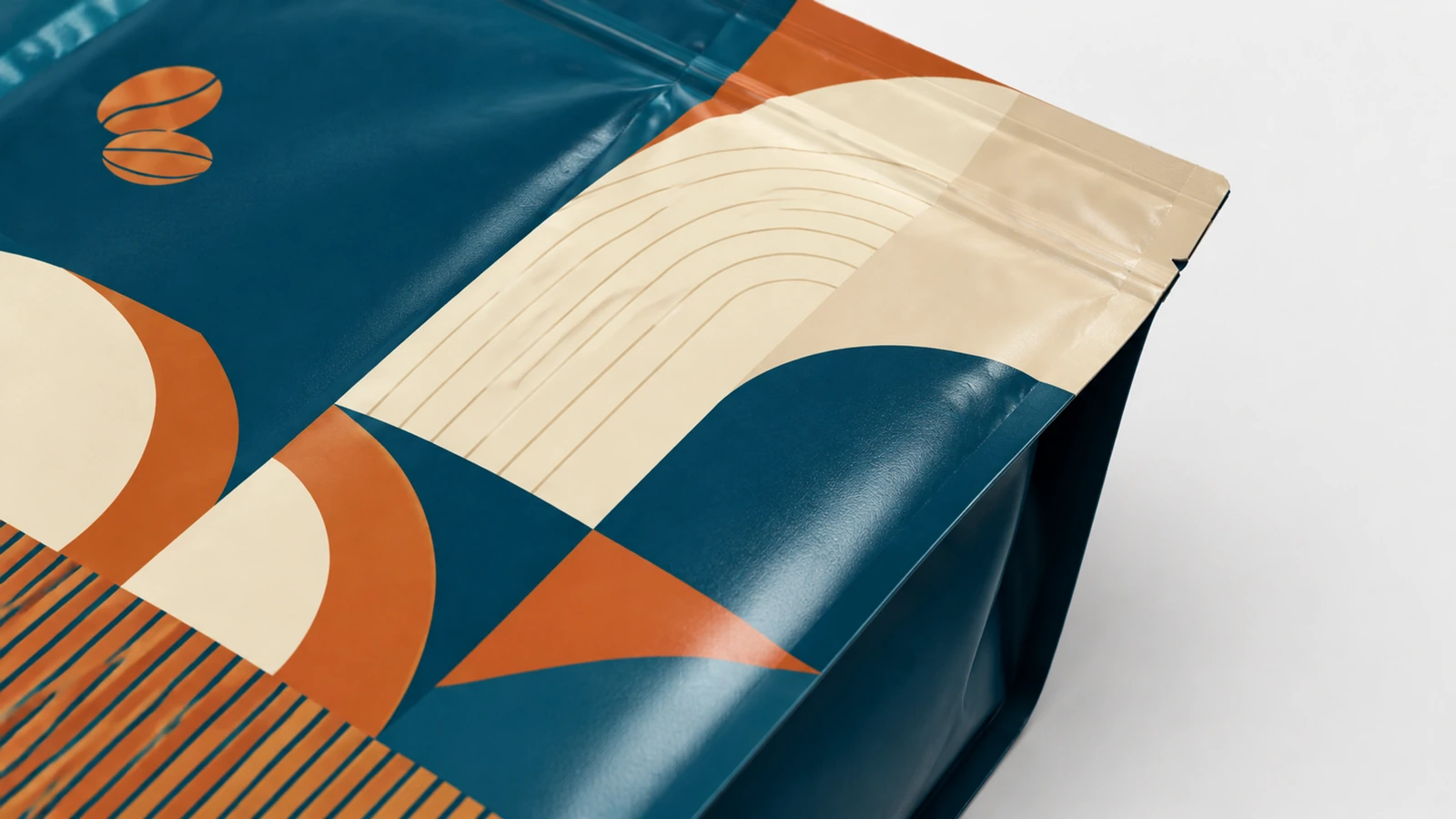
Tear notches and hanging holes need positions that preserve the required sealed area. A zipper or valve is not a default feature of this flat-pouch specification. If repeat opening or degassing is essential, assess the construction and manufacturing route before adding the feature to artwork.
Preflight the file against the actual pouch drawing
Place essential copy away from the back seam, end seals, cut edges, and opening features. Check orientation after forming, rather than reviewing only the unfolded file. A clear front panel does not compensate for a barcode or ingredient statement obscured on the reverse.
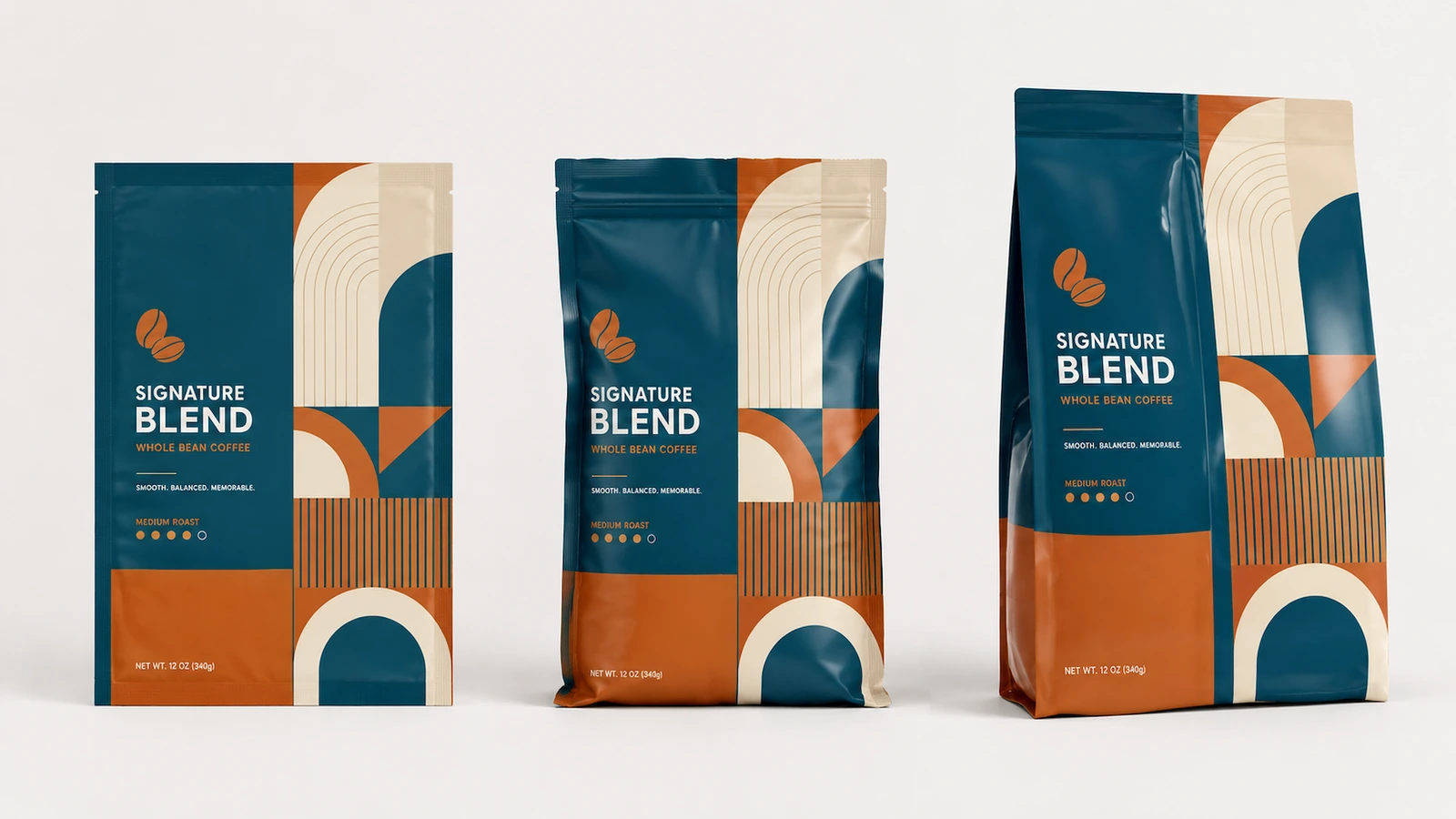
Separate graphic approval from functional approval. A digital proof can confirm copy and layout, but it does not establish the final film feel, filled shape, seal performance, or appearance under actual lighting. Retain the approved artwork version and identify which physical sample it accompanies.
How do samples become an approved packaging specification? ↑
Establish the filling and sealing route before production
For premade bags, confirm how the filling opening will be closed. For rollstock, supply the equipment requirements, including web and roll specifications, sealing arrangement, and intended operating conditions. Compatibility with vertical or horizontal form-fill-seal equipment must be demonstrated on the proposed material.
Trial the candidate structure using temperature, pressure, and dwell time or line speed as a coordinated set. Record the acceptable operating window, not just one successful setting. A change in laminate or seal construction requires review rather than automatic reuse of the previous settings.
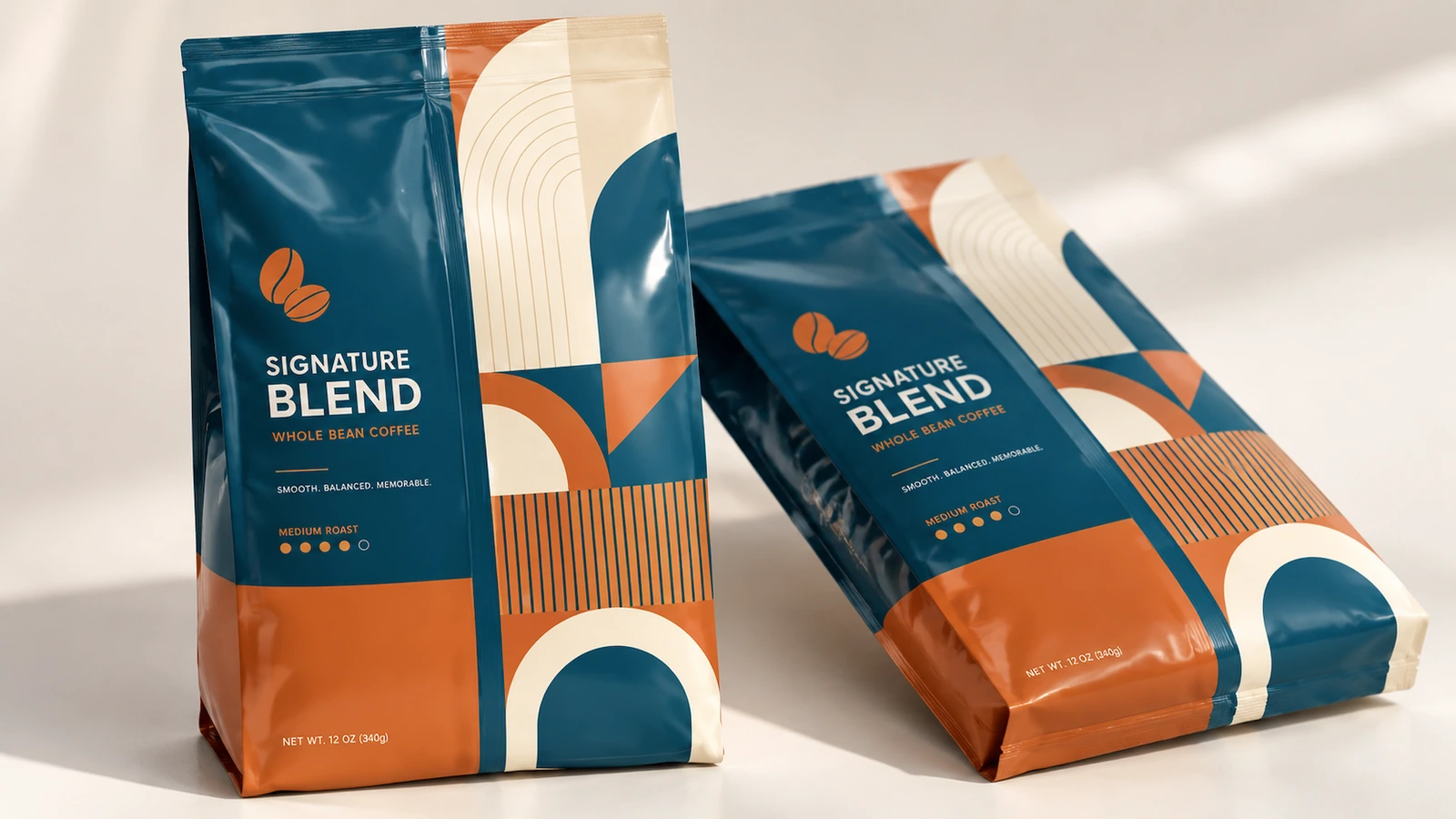
The proposed route should identify printing, lamination where required, curing where applicable, pouch forming or roll finishing, and inspection. These are planning stages, not a statement of this product’s factory equipment or capacity. Production scheduling must include the approved process rather than starting and ending at printing.
Inspect the seam intersections and the complete package
The back seam meets the transverse seals at junctions that deserve targeted inspection. Wrinkles, contamination, and local thickness changes can interrupt sealing. Center-seal troubleshooting guidance[2] identifies these junctions and product dust as practical failure concerns; this is process guidance, not a test report for the offered item.
Do not treat a visually closed pack as proof of leak integrity. Likewise, a strong strip of seal does not rule out a hole elsewhere in the pouch. The acceptance plan should distinguish appearance, seal strength, leak integrity, and resistance to distribution stresses.

| Check | Method or approach to specify | Important limitation |
|---|
| Seal strength | ASTM F88/F88M; report specimen width, results, and failure mode | Strength alone does not establish freedom from leaks |
| Leak integrity | ASTM D3078 for suitable headspace-containing packs, or an appropriate alternative | Method suitability and detection limits must match the package |
| Internal-pressure gross leaks | ASTM F2096 where applicable | A destructive test, not an automatic inline inspection claim |
| Burst resistance | ASTM F1140 or F2054, with fixture and conditions identified | Results depend on the chosen setup |
| Dye penetration | Assess ASTM F3039 for nonporous packaging | Do not substitute a porous-medical-packaging method without checking scope |
| Transport stress | Filled-pack handling, stacking, and drop evaluation; altitude conditioning where relevant | Conditioning alone is not a leak test |
Set pass/fail criteria for the actual application before testing. The DLA packaging quality specification[3] illustrates how a procurement document links seal examination and strength requirements. Its military-food requirements are not universal acceptance limits for commercial center-seal pouches.
Agree the sampling plan and retain the tested structure, batch reference, equipment settings, and results. If samples fail, resolve the observed failure before authorizing the same construction for production. A generic quality certificate cannot replace evidence tied to the proposed pack.
Match food-contact documentation to the intended use
For US food applications, request documentation addressing the relevant materials and intended food-contact conditions. 21 CFR 177.1520[4] covers specified olefin polymers subject to its provisions; citing it does not establish that an entire printed laminate complies for every food, temperature, and contact duration.
Review the relevant layer, adhesive, coating, and ink documentation rather than accepting an unrestricted “FDA approved pouch” claim. If a facility certificate is supplied, check its current validity and scope separately. No factory certification or product-specific food-contact approval is asserted here.
Verify recycling language before printing it
A mono-material design does not automatically qualify for curbside collection. How2Recycle’s Store Drop-off guidance[5] distinguishes eligible film packaging from materials accepted in most curbside programs. Confirm the complete pack and collection route before approving a recycling statement; this page does not establish label eligibility for this product.
Preserve the approved specification through shipping and reorders
Agree packing orientation, carton loading, and protection against compression or puncture. Evaluate the filled product in its intended shipping arrangement. Carton quantities and load limits depend on actual dimensions, the loaded condition, and sample validation; an empty-bag photograph cannot establish them.
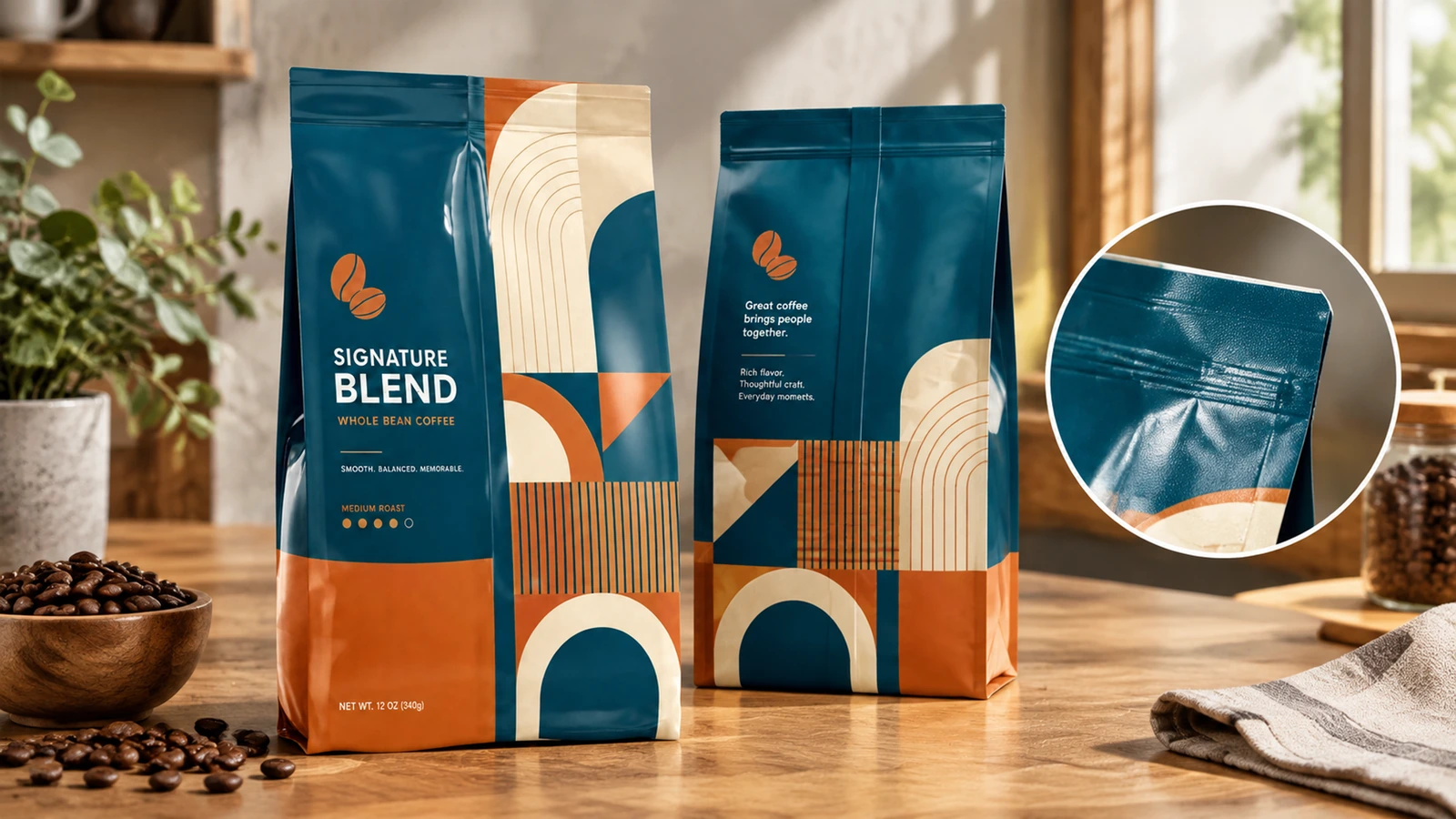
For a repeat order, identify the approved dimensions, laminate, artwork revision, seam geometry, and acceptance criteria. Review any proposed substitution before release. For a complaint, retain affected packs and their batch details so leakage, delamination, puncture, and print defects can be investigated separately.
Which pouch and purchasing route fit your priorities? ↑
Compare the format before comparing price
| Format | Priority it can address | Trade-off to evaluate |
|---|
| Center-seal flat pouch | Dry-product packing with a clear front panel and straightforward pillow geometry | Back-seam layout and limited self-standing presentation |
| Three-side-seal pouch | Flat presentation and small-format portions | Usable space, filling access, and application-specific sealing |
| Side-gusset pouch | Additional volume and a different filled profile | More complex folds and local sealing requirements |
| Stand-up pouch | Upright retail presentation and potential repeat-opening features | Different construction, material use, and filling requirements |
This comparison identifies design priorities, not guaranteed rankings for price, strength, or leak resistance. A liquid-sensitive application needs validated material and sealing choices regardless of format. A requirement for reliable upright display may justify changing the pouch rather than trying to make a flat pillow pack behave like a stand-up bag.
Separate print economics from material performance
Digital printing is a route to investigate for pilots, frequent artwork changes, and multiple designs. Gravure is a route to compare for sustained quantities where setup costs can be spread across the run. Neither process establishes barrier performance, and availability for this item remains subject to quotation.
Ask for quantity per design, setup or cylinder charges, sampling charges, and repeat-order terms separately. A lower unit price can be misleading when it requires more printed inventory than the launch can use. Compare the complete order commitment, not only the quoted price per pouch.
Separate sample approval, artwork approval, production, and transport in the schedule. Manufacturing time is not delivery time to a US warehouse. No fixed MOQ, price, production duration, or delivered lead time is published for this item without an item-specific quotation.
What should guide your purchasing decision? ↑
- Define the supply format before requesting prices. Premade pouches and form-fill-seal rollstock require different purchasing specifications.
- Keep performance requirements measurable. Dimensions, barrier conditions, sealing tests, and acceptance criteria belong in the approved specification.
- Check the applicable market before approving packaging. — EU packaging rules entered application on 12 August 2026, including food-contact packaging PFAS restrictions (Source[6]). US documentation alone does not establish EU compliance.
- Require product-specific commercial confirmation. MOQ, production time, unit weight, and tested performance remain unverified for this item; competitor specifications are not substitutes.
Turn your packaging brief into a comparable quotation ↑
The useful starting point is a defined product, filling route, and distribution requirement. From there, dimensions, artwork, candidate materials, and acceptance checks can be evaluated together. This keeps the purchasing decision focused on a package that fits the application rather than a photograph or an isolated low price.
Request a quotation for Custom Center-Seal Flat Pouches with your product details, target dimensions, quantity per design, filling method, artwork, and delivery market.




The information below is required for social login
Sign In
Create New Account