Custom flat mylar pouches combine a lay-flat format with custom printing and a heat-seal closure. They suit sample packs, single-use portions, and boxed products where freestanding display is unnecessary. Specify the usable dimensions, laminate, artwork, and filling conditions before ordering; capacity, barrier performance, and product compatibility require sample validation.
Product: Custom Printed Flat Heat-Seal Mylar Pouches
Category: Custom Plastic Bags > Custom Mylar Pouches
Product reference: NSKU-798-01
Where does flat packaging fit your product? ↑
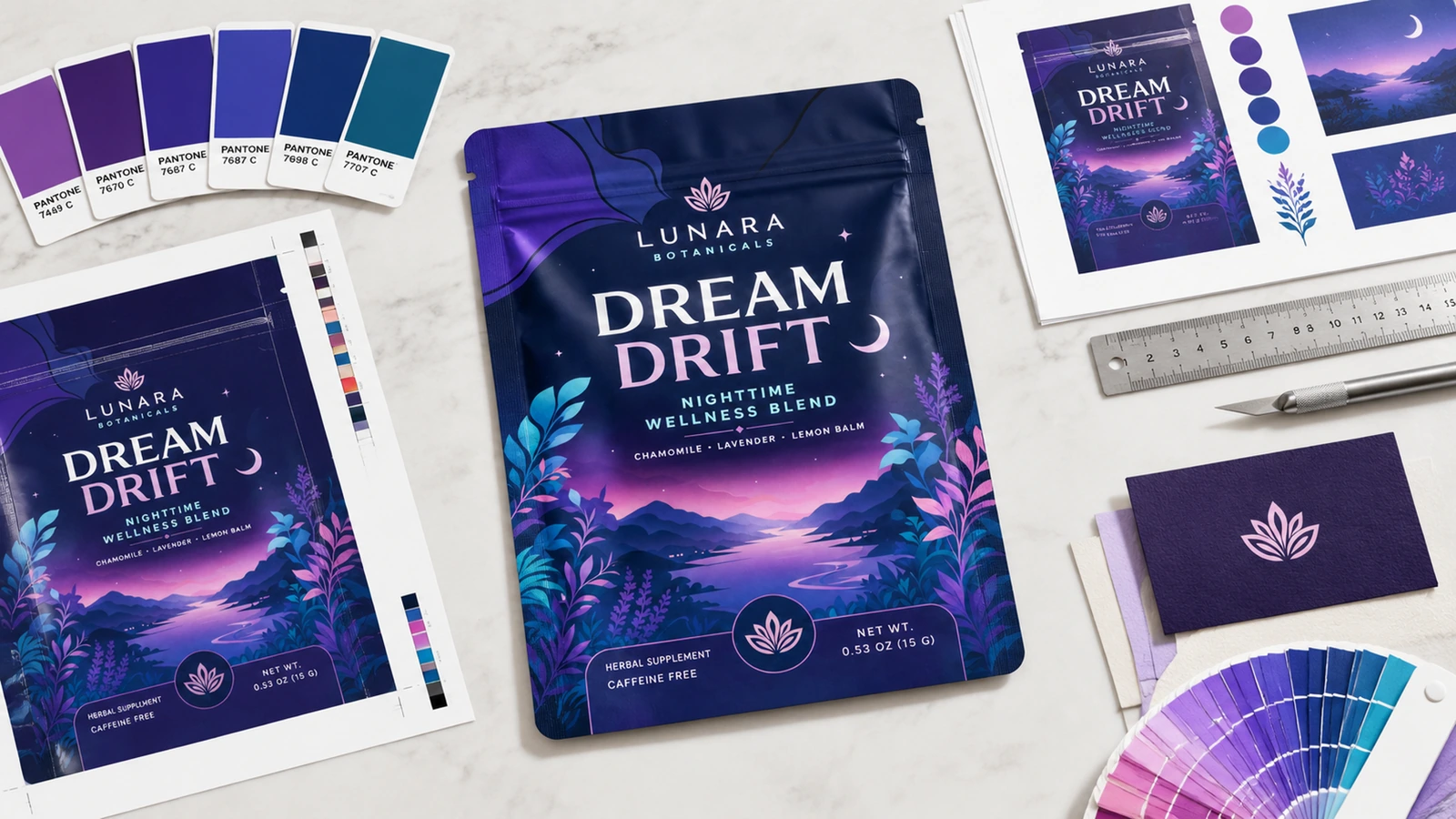
For a tea sampler, spice trial pack, or subscription-box insert, packaging needs to communicate the product clearly without adding an unnecessary standing base. A flat pouch is a format to evaluate when customers receive the product inside another package or use the contents in a single serving.
Start with how the package will be sold and handled. A pouch traveling inside a protective carton has different requirements from one hanging on a retail display. A powder needs a clean filling and sealing area; a brittle snack also needs protection against crushing. The same printed appearance does not make those applications interchangeable.
- Samples and trial packs: evaluate the opening, usable cavity, and room for essential product information.
- Single-use portions: consider whether a straightforward heat seal avoids an unnecessary reclosure feature.
- Boxed or DTC products: assess the filled pouch together with its shipping carton and protective materials.
- Retail hanging displays: review a proposed hanging feature against the sealed product cavity and opening path.
The costly mistake is approving an attractive design before confirming that the product fits. Seal allowances can reduce usable space, small text can become difficult to read, and powder trapped across the sealing area can compromise the closure. Discovering these issues after printing creates packaging waste and delays the launch.
The practical solution is to approve the package in stages: establish the use case, test physical fit, select a documented material structure, and then release the artwork. This separates appearance from performance and gives each purchasing decision a clear acceptance point.
Explore specifications, sampling, and purchasing decisions
What exactly is a flat heat-seal Mylar pouch? ↑
A flat pouch has no expanding bottom gusset intended to make it stand upright. Three-side-seal construction is a common version, leaving an opening for filling and final sealing. It is different from a flat-bottom pouch, which is a box-shaped format with additional panels and a standing base.
“Mylar” is frequently used in packaging descriptions, but the name alone does not identify the complete laminate. A purchasing specification should state the actual layers rather than treating the product name as proof of oxygen resistance, moisture protection, or food-contact suitability.
Structures discussed for this category include PET/PE, PET/VMPET/PE, and PET/AL/PE. These describe different material combinations: VMPET is metallized polyester, while AL denotes an aluminum-foil layer. They are candidates for technical review, not confirmed material options or tested specifications for this product reference.
Likewise, a flat format does not establish a shelf-life period. Product sensitivity, filling conditions, seal integrity, handling, and storage all need consideration. A material description is the starting point for validation, not a substitute for it.
How do you establish usable size and readable artwork? ↑
Record the external width and height separately from the usable internal cavity. Sealed edges, the final closure area, and any additional opening features occupy space. The artwork boundary is another separate measurement: content that physically fits on the film may still sit too close to a cut or seal.
Use a filled sample rather than choosing a pouch from a photograph or a generic gram-size chart. Capacity, supported load, and the number of items that fit depend on the actual product dimensions, loaded condition, and sample validation. Products of equal weight can occupy very different volumes.
| Specification field | What to record | Approval check |
|---|
| External dimensions | Width × height in mm, with inches if needed | Confirm the measurement convention on the drawing |
| Usable cavity | Space remaining inside the proposed seals and closure | Fill with the actual product |
| Filling allowance | Unfilled space needed to keep the final seal clean | Test the intended filling operation |
| Artwork area | Trim, bleed, safe zones, and feature positions | Review front and reverse panels at actual size |
| Filled configuration | Product arrangement and resulting pouch shape | Check packing, opening, and shipping fit |
This separates three easily confused decisions: buying the right external size, obtaining enough internal room, and preserving readable printed information. No capacity or load rating is established for this product until the filled configuration has been checked.
Give the reverse panel the same attention as the front. Ingredients, directions, warnings, and barcode areas should remain readable without crossing a seal or opening feature. Confirm the available space before compressing the text to fit an already-approved design.
Which material and closure details belong in the specification? ↑
Choose the laminate around the contents rather than around a silver appearance. A metallized film and a foil laminate can look similar while having different barrier behavior. Request the proposed layer sequence, individual layer information where relevant, and total laminate thickness for one pouch wall.
Keep thickness units consistent. 1 mil equals 25.4 μm. Also clarify whether a measurement refers to one wall or both sides of a flattened bag. Thickness can inform handling and material selection, but it does not independently establish puncture resistance or storage life.
| Candidate structure | Reason to evaluate it | What remains to be established |
|---|
| PET/PE | A transparent or basic laminate approach | Whether its measured barrier meets the product’s needs |
| PET/VMPET/PE | A metallized barrier-layer approach | Actual transmission results and resistance to handling damage |
| PET/AL/PE | An opaque aluminum-foil barrier approach | Laminate integrity, flex-related damage, and sealing compatibility |
These are material families, not a price list or a performance ranking for supplied goods. Final selection requires a quote, supporting documentation, and testing of the proposed construction. A clear window also changes the barrier arrangement and should be assessed as part of the complete package.
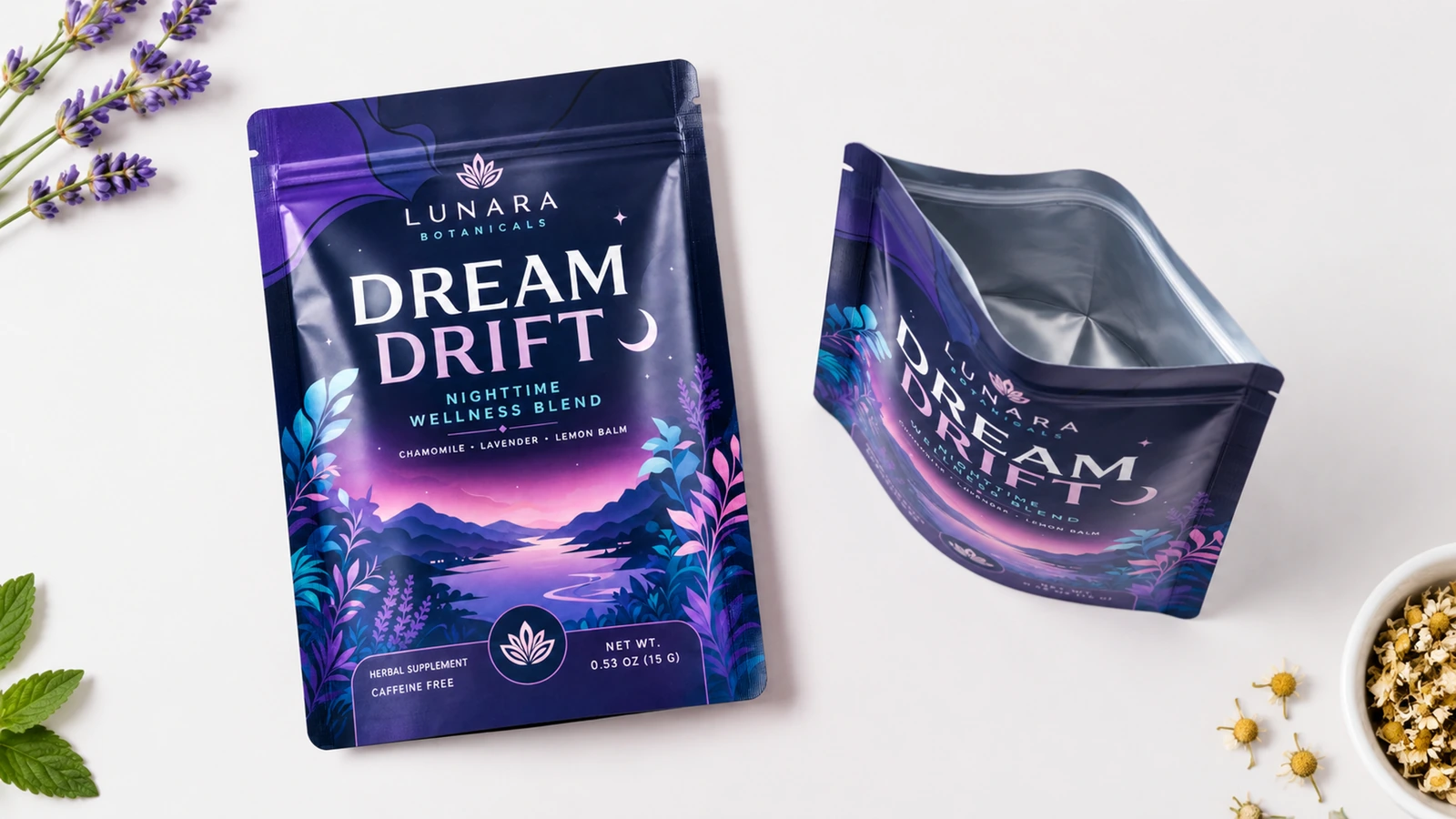
For single-use applications, evaluate heat sealing without assuming a zipper is necessary. If reopening is required, specify that separately: a zipper provides reclosure convenience but should not be treated as evidence of the unopened package’s seal integrity. Tear notches and hanging holes also need position checks against the sealed cavity.
Matte, gloss, and other surface treatments are appearance requests to discuss during quotation. Review their effect on color, readability, and scuffing through samples. They are not confirmed options for this product, and a surface finish does not establish food-contact compliance or barrier performance.
How should artwork and compliance documents be checked? ↑
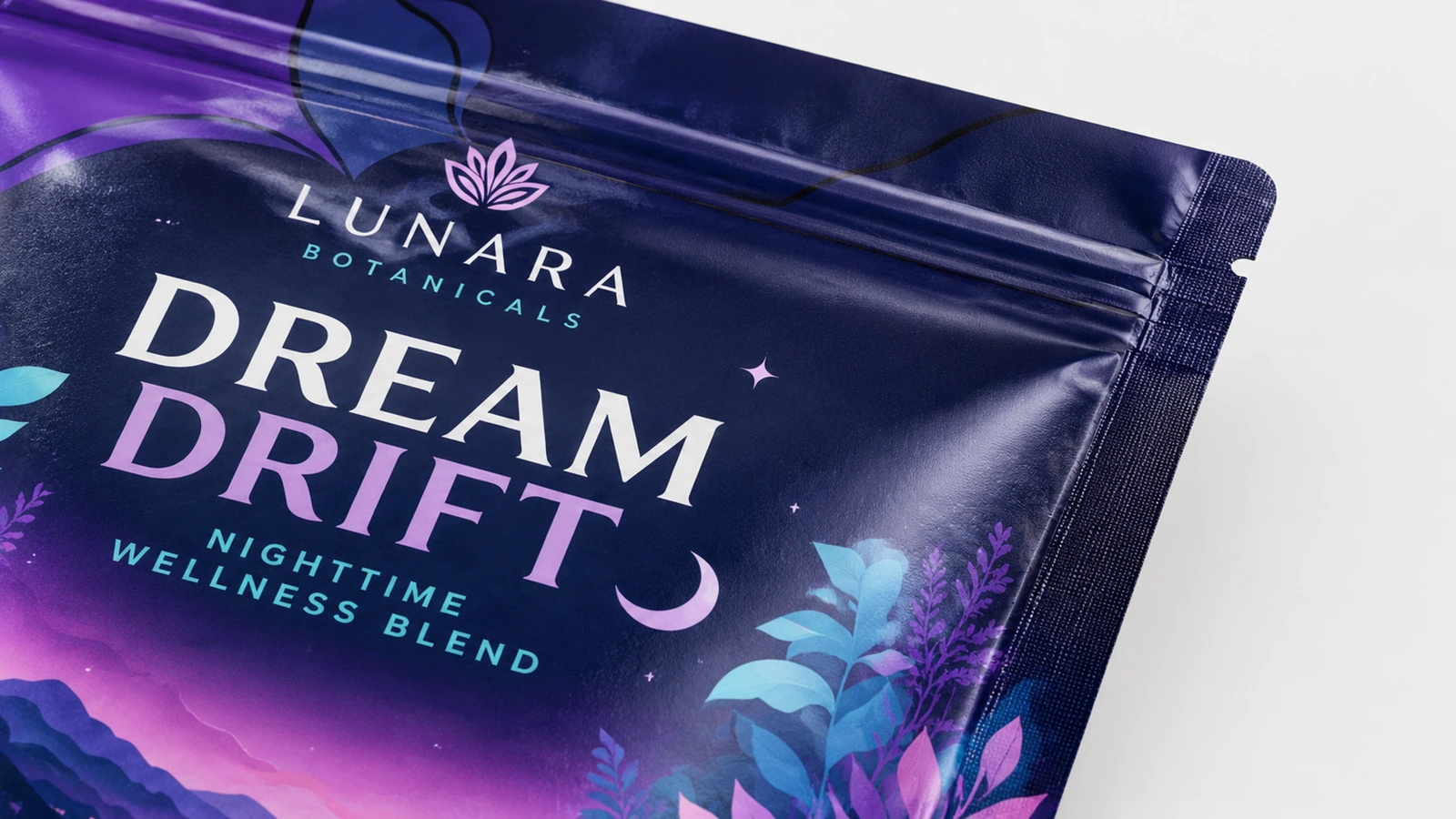
Build the print file on the approved pouch drawing. Check front-to-back orientation, bleed, seal exclusions, and the location of every opening feature. Supply suitable vector artwork where available and identify brand color references before proofing, rather than relying on a screen image as the production target.
A digital proof helps check wording and placement. Where color is important, a physical reference on the proposed substrate gives a more useful approval basis. Agree how differences will be judged, such as comparison with the signed sample under an agreed light source or a documented color tolerance.
Food-contact review must match the actual contents and operating conditions. The FDA distinguishes food types and conditions such as room-temperature storage, hot filling, and reheating; these are not interchangeable uses. Match the proposed documentation to the relevant food types and conditions of use[1].
- Material identity: documentation should identify the proposed laminate and applicable components.
- Intended use: check coverage for the food type, contact temperature, and contact duration.
- Supporting evidence: request relevant compliance statements and migration or other test documentation where applicable.
- Artwork control: keep the approved revision, color reference, and pouch drawing together.
A quality-management certificate does not replace product-specific food-contact evidence. Likewise, a “food grade” label alone does not establish the suitability of inks, adhesives, and the contact layer. No certification or compliance status is confirmed here for the proposed pouch.
Do not extend a dry-product packaging approval to boiling, retort processing, sous-vide, or microwave use. Those applications require a separately evaluated construction and supporting evidence. If child-resistant packaging is required, obtain evidence covering the complete proposed configuration rather than assuming a zipper provides that function.
How do you move from sample approval to production? ↑
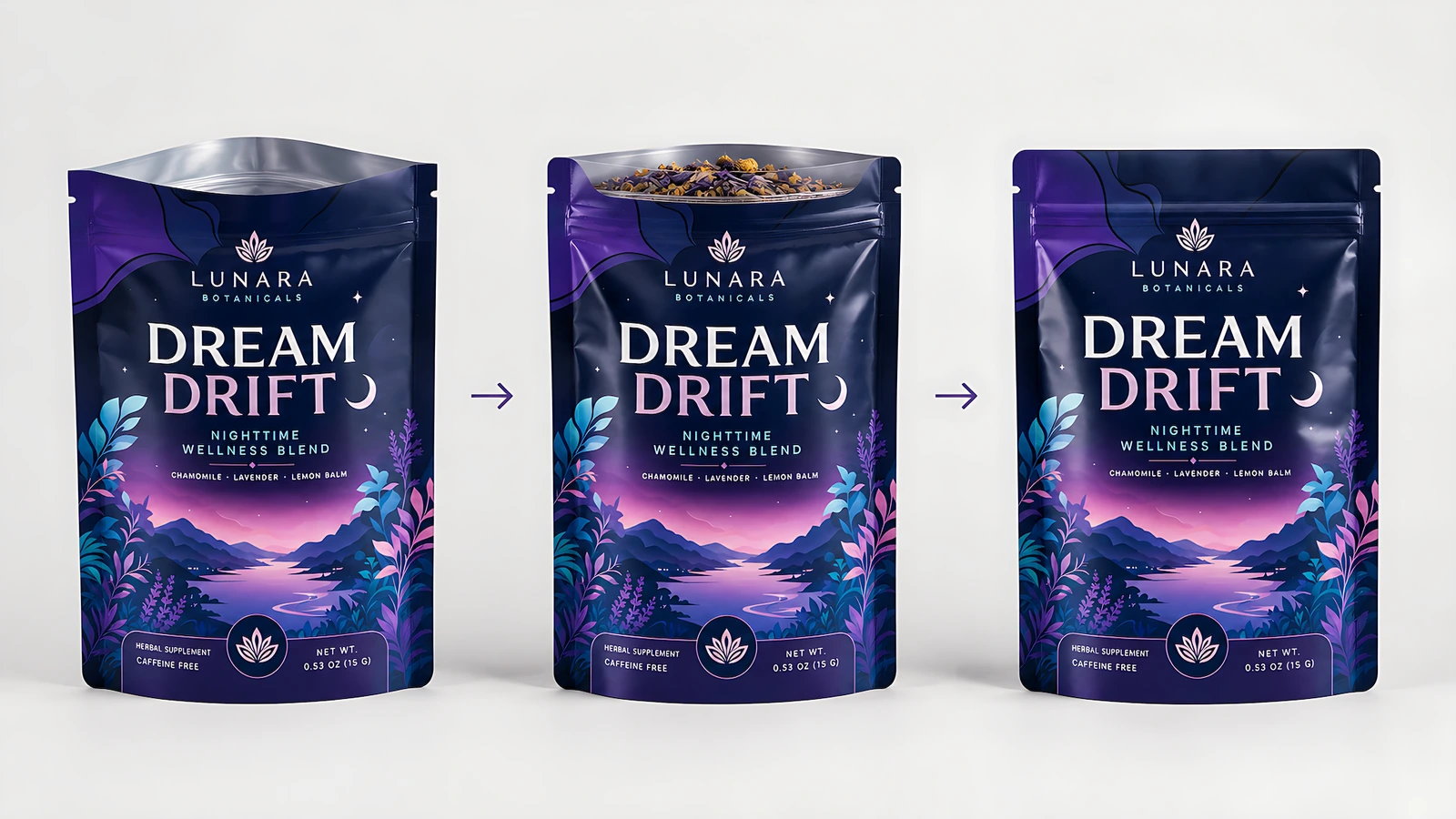
A useful sampling sequence answers a different question at each stage. Physical fit should be settled before artwork release; sealing compatibility should be established before production packaging is accepted. An empty display mockup cannot answer either question for a filled product.
- Freeze the application brief. Record product form, intended use, destination market, storage conditions, and the required opening experience.
- Check the physical sample. Fill it with the actual product and assess the opening, cavity, closure allowance, and external packing fit.
- Trial the proposed laminate. Use the intended sealing equipment and establish suitable temperature, time, and pressure settings.
- Approve the appearance. Confirm the drawing, artwork revision, substrate, finish, and color reference.
- Agree acceptance criteria. Define checks, sampling, documentation, and the response to a failed result.
- Release the specified order. Tie production approval to the signed specifications rather than a generic pouch description.
Print method is a separate commercial decision. Digital printing is a route to evaluate for shorter runs and multiple designs; plate- or cylinder-based production may suit stable repeat demand. Neither route is confirmed for this product until quoted, and the chosen method should not be used to infer laminate performance.
Keep the schedule in separate parts: artwork approval, sampling, production, and shipping. Ask what starts each stage and whether revisions change the timing. MOQ, production time, unit weight, and price require a product-specific quotation or measurement; none is established for this product reference.

What should quality acceptance actually measure? ↑
Start with observable defects: incorrect dimensions, visible laminate separation, damaged edges, print misalignment, contamination, and unusual internal odor. Visual inspection is useful, but it cannot establish the absence of microscopic leaks or replace measured barrier results.
Seal-strength testing measures the force needed to separate a sealed specimen. Record specimen width, test setup, and failure mode so results can be interpreted consistently. The ASTM F88 seal-strength method[2] is a measurement method, not a universal minimum strength requirement for every pouch.
Agree the acceptance value for the actual application. A seal that peels apart and a sample whose film tears are different outcomes. Also assess seal integrity separately: a strength measurement alone does not demonstrate that no leak channel exists. Select an integrity method suitable for the nonporous laminate and filled-package configuration.
| Check | Record to request | Interpretation boundary |
|---|
| Seal strength | Method, specimen width, force, and failure mode | Not proof of leak-free performance by itself |
| Oxygen transmission | OTR in cm³/(m²·24 h), method, and test conditions | Do not compare reports with mismatched conditions |
| Water-vapor transmission | WVTR in g/(m²·24 h), method, and test conditions | Not a finished-product shelf-life guarantee |
| Print and laminate integrity | Agreed adhesion, rubbing, and delamination checks | Assess the approved construction and finish |
| Filled-package handling | Drop, compression, or puncture checks as appropriate | Use representative contents and shipping protection |
ASTM D3985 and ASTM F1249 are referenced methods for OTR and WVTR respectively. Require the laboratory to identify the method used, temperature, humidity, and relevant gas conditions. No measured transmission value or test pass is claimed for this pouch.
For powders, inspect the sealing area after representative filling. For oily or chemically challenging contents, include compatibility and laminate-integrity assessment. A short storage observation can identify early problems, but it cannot establish a much longer shelf life without an appropriate validation program.
Which packaging and purchasing route fits your order? ↑
Compare packaging formats against the selling environment before comparing unit prices. A flat pouch cannot provide a standing base simply because it uses a high-barrier material. Conversely, a standing format does not establish stronger oxygen or moisture protection.
| Route | Best reason to evaluate it | Trade-off to resolve |
|---|
| Custom printed flat pouch | Samples, single-use packs, and boxed products | No freestanding base; filled fit and protection need checking |
| Stand-up pouch | Upright retail presentation | A different construction, footprint, and quotation |
| Flat-bottom pouch | Box-like presentation and additional panels | More complex forming and artwork requirements |
| Stock pouch with a label | Testing a product before committing to custom printing | Limited format choices and an additional labeling operation |
This is a format comparison, not a guarantee that one route will always cost less. Compare equivalent dimensions, laminates, quantities, print coverage, and delivery terms. The suitability of a stock pouch also depends on its documented material specification, not on whether branding is printed or applied as a label.
For a useful commercial comparison, separate pouch price from setup, sampling, freight, and destination charges. State the quantity for each design, not just the combined order. Multiple versions can change production economics even when they share the same dimensions.
Ask how defects, shortages, wrong artwork, and transport damage will be handled. Written acceptance and remedy terms make quotations more meaningful than a low headline price attached to an unspecified construction.
How do you protect delivery and simplify repeat orders? ↑
Review empty-pouch packing and filled-product shipping separately. For incoming packaging, define how designs and batches will be identified and kept apart. At receipt, reconcile quantities and artwork versions before releasing the pouches to the filling operation.
For outgoing goods, evaluate the pouch inside its actual shipping pack. Flexible film is not a rigid crush barrier. Sharp particles, tightly packed cartons, and repeated bending can create handling risks that an empty-pouch inspection will not reveal.
Keep a reorder record containing the approved drawing, laminate specification, thickness convention, artwork revision, color reference, closure details, and acceptance results. Retained samples and batch identifiers help distinguish a production change from a filling or distribution problem.
A repeat order should reference that approved configuration. Changes to the product formulation, film, finish, closure, or filling conditions should trigger a targeted review rather than being treated as an identical reorder. Reconfirm the commercial schedule as well; previous delivery timing is not a standing commitment.

What should you remember before requesting a quote? ↑
- Select the format around the selling environment. Flat packaging suits applications that do not require a freestanding base; protection and display remain separate decisions.
- Approve usable space, not just external dimensions. Capacity, load, and item count depend on actual product dimensions, loaded condition, and sample validation.
- Compare documented constructions. Match layer sequence, thickness, transmission-test conditions, and intended-use documentation before comparing price.
- Keep unverified commercial terms open. MOQ, production time, unit weight, and pricing are not confirmed for this product reference.
- Recyclability claims need evidence of an appropriate recovery route. — 16 CFR 260.12 addresses collection access and components that impede recycling (Source[3]). Do not label a multilayer pouch curbside recyclable simply because an individual layer is recyclable.
If a mono-material alternative is proposed, treat it as a separate specification requiring barrier, sealing, and local collection review. Neither a material change nor a recycling symbol establishes equivalent protection or actual recyclability for this product.
Start with a specification that can be checked ↑
The right custom printed flat heat-seal pouch starts with the contents and finishes with an approved, traceable specification. Physical sampling resolves fit; documented materials address intended use; agreed testing defines acceptance. Printing then supports a package whose requirements have already been made clear.
Request a product-specific quote for NSKU-798-01 with your product details, proposed dimensions, quantity per design, artwork, destination, and required delivery date.




The information below is required for social login
Sign In
Create New Account