Custom printed zipper stand-up pouches are resealable, gusseted flexible bags printed with your own artwork. Choose the printing route by quantity per design. Choose the film structure by how sensitive your product is to oxygen and moisture. Release each lot only after seal-strength, leak, and fill tests on real product.
Who Orders Custom Printed Zipper Stand-Up Pouches, and at What Stage? ↑
End consumers rarely search for this category. The buyers are mostly people who run a brand or buy its packaging. The largest group is founders and operators of small food, coffee, tea, snack, supplement, and pet-treat brands that sell direct-to-consumer, on Amazon, or into regional retail. Many of them also handle design and filling. A second group is hobby roasters and farmers-market sellers who need a few hundred bags. A third group is growth-stage brand managers and packaging buyers who are moving from short digital runs to repeat production and need specification sheets, compliance documents, and on-time delivery. All three groups weigh the same four questions, in roughly this order: Can you produce my quantity? Does the barrier suit my product? Will the color match my design? Will the order arrive when promised?
Quantity is usually the first obstacle. In March 2026, a small food brand owner described the best US quote they had found on Reddit r/ecommerce[1]: "500 units per design," with pricing that "only started to look sane once I hit around 1k." Satisfied customers run into the same limit. One reviewer on Trustpilot[2] wrote that they wanted to release limited flavors and collaborations but "don't want to print 1,000 bags for them." For this reason, this page treats the minimum order per SKU as a core planning variable.
Why Do Printed Pouches Fail After the Artwork Is Approved? ↑
Problem. Most buyers start with the logo, but the failures that drive returns usually start in the seals. Aro Packaging[3] states that "seal failure is the single most common cause of leaking pouch packaging." The same source explains that bottom-gusset seals must fuse through several film thicknesses at once, so those zones are prone to incomplete fusion. Granular product can then sift slowly out of the bottom corners.
Agitate. A seal failure can cost far more than the pouches themselves. In a Florida case, a supplement brand sued its pouch suppliers over protein-powder pouches. Internal records quoted in the complaint said the "burst failure is located in the heat-seal area." After the 2024 jury verdict, the plaintiff's counsel reported a $15.4 million judgment, according to PricePlow[4]. Sizing mistakes are just as permanent. StandUpPouches.net[5] warns that "3 oz" describes weight, not pouch capacity. Powders, liquids, and solids of the same weight need different volumes, and a printed run cannot be resized after production.
Solve. The fix is to make decisions in the right order:
1. Lock down the product's real conditions of use.
2. Choose the film and closure based on data.
3. Design on the converter's current dieline.
4. Approve physical samples filled with real product.
5. Release each lot against written seal and leak criteria.
The sections below cover each of these checkpoints. Supplier price, MOQ, and lead-time ranges are labeled as published supplier statements, not industry standards. Our own MOQ, lead time, and unit price are quoted per SKU after we review your specification.
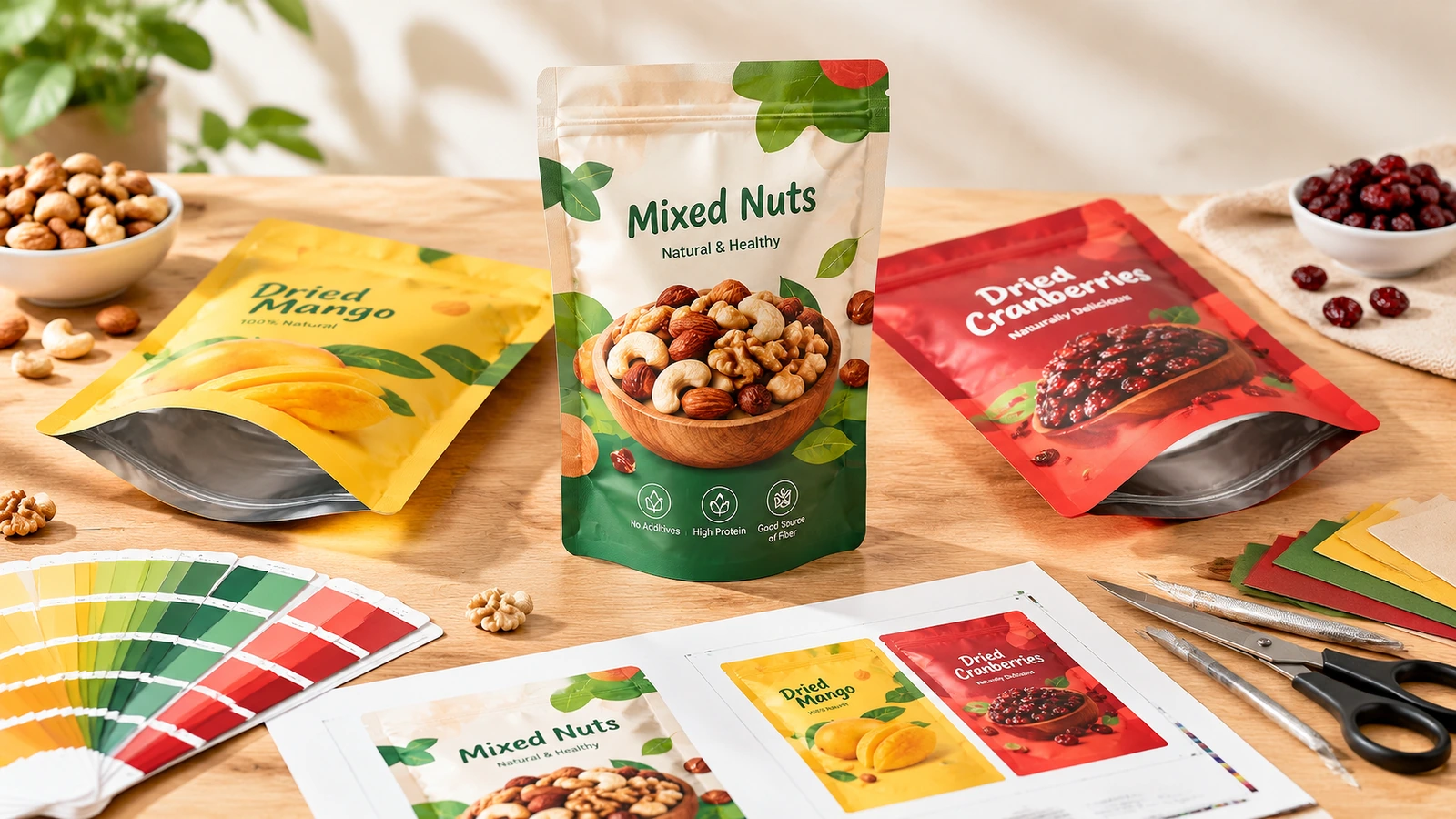
Table of Contents
What Exactly Is a Custom Printed Zipper Stand-Up Pouch? ↑
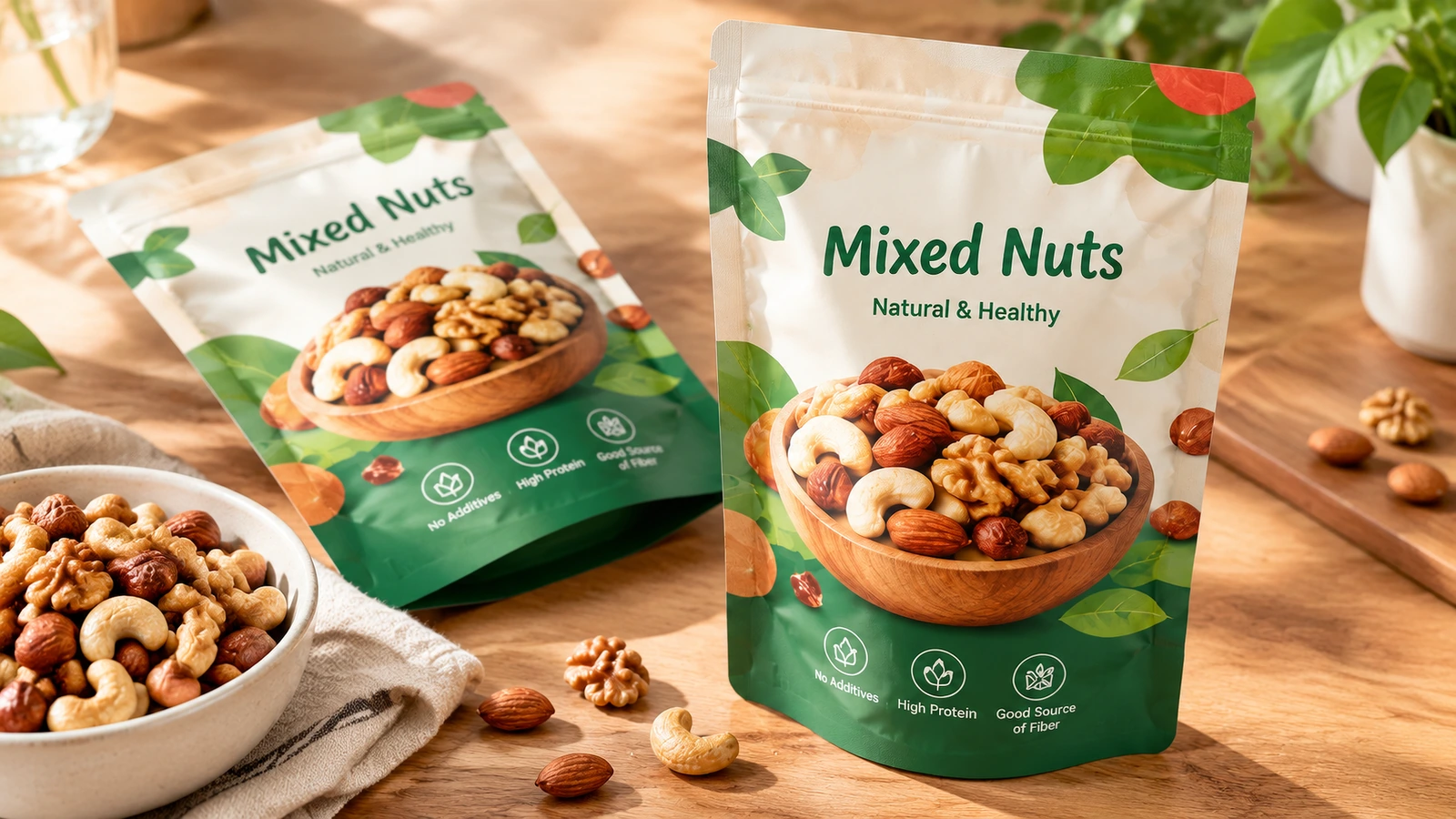
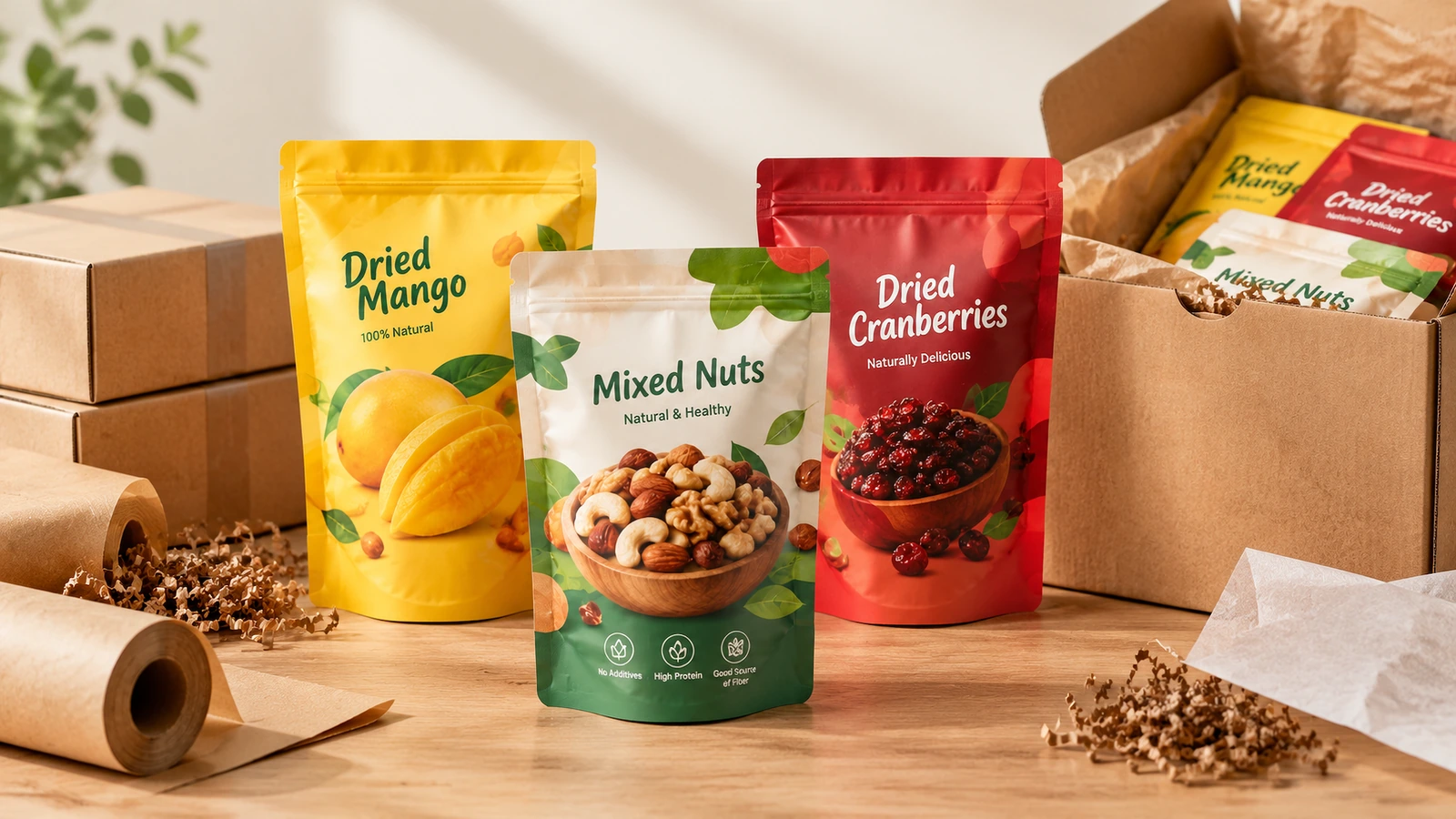
A custom printed zipper stand-up pouch is a gusseted flexible bag. Once filled, it stands on its bottom fold, which is usually a K-seal or a plow bottom. It is printed edge to edge with your artwork and has a reclosable zipper. A typical laminate splits the work across three layers:
Outer layer: carries the print, often PET.
Barrier layer (optional): metallized PET, aluminum foil, or EVOH.
Inner layer: forms the heat seal, usually PE.
A kraft paper exterior changes the look and feel, but the paper itself provides no barrier. Stand-up pouches are a mature, large category. Research and Markets[6] valued the global market at $30.6 billion in 2025, with the US at $9.5 billion, and projected a 7.1% CAGR through 2032. Other analysts publish very different baselines, so treat any single figure as one firm's definition of the category.
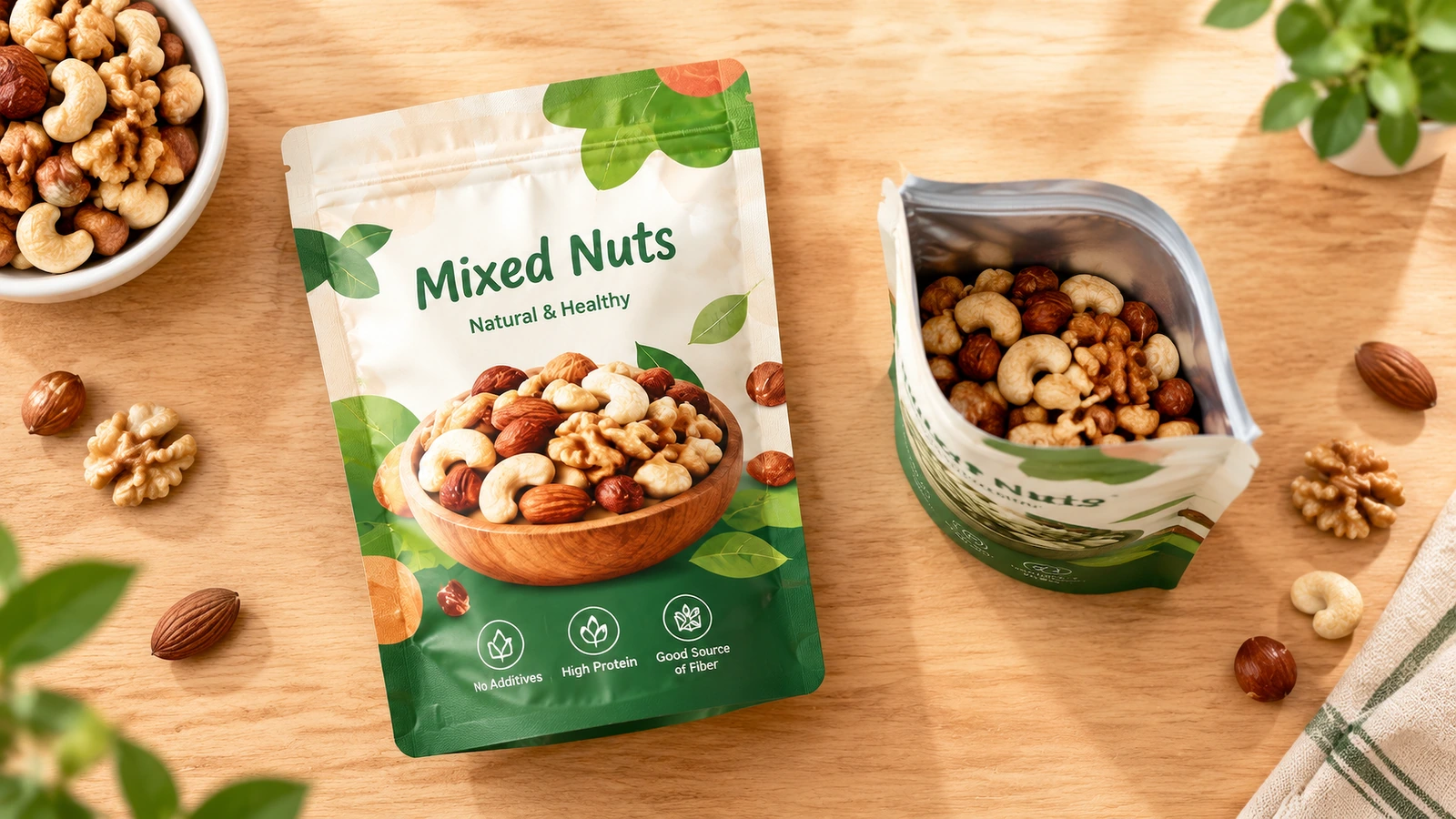
The zipper is both the main convenience feature and the main structural weak point. StandUpPouches.net[7] calls zippers "the weakest link in stand up packaging." Because the zipper is heat-sealed into the pouch, leaks are more likely around the zip tape. BS Flexpack[8] adds a rule for the filling line: never run a sealing jaw over the zipper. Doing so produces a false seal and a damaged track in one pass. The same source notes that typical specifications place the zipper about 30–35 mm below the top edge.
Several options change the dieline and the cost, so they must be decided before artwork starts:
Basic features: tear notches and hang holes.
Coffee: one-way degassing valves for fresh-roasted coffee.
Large pouches: slider zippers.
Regulated products: child-resistant zippers.
Display: clear windows.
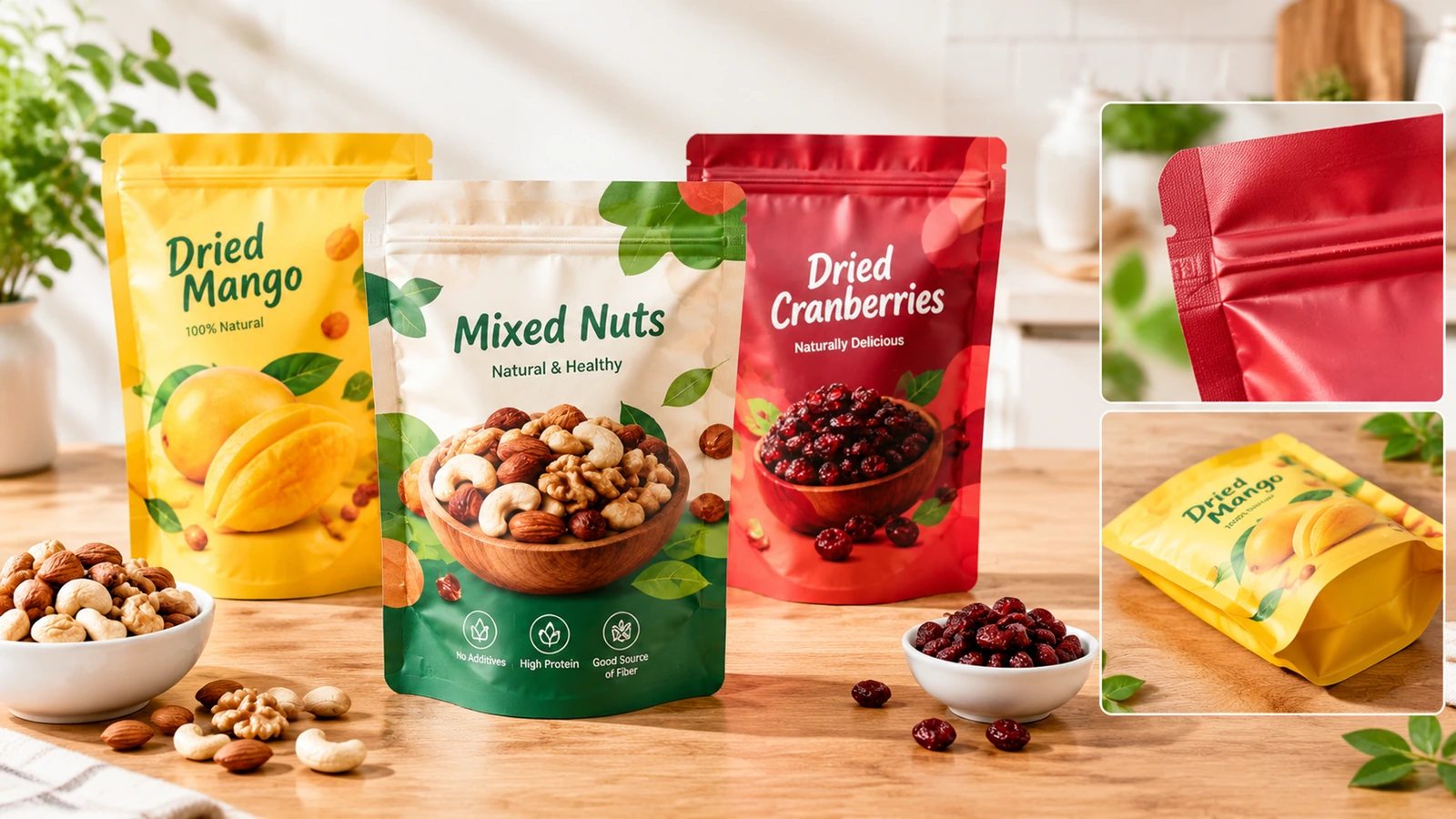
Surface finishes: matte, gloss, soft-touch, or metallic.
A surface finish changes shelf appearance, but it does not change the barrier.
How Do You Specify a Pouch That Survives Filling, Shipping, and the Shelf? ↑
Step 1: Write down the product's conditions of use before the design
Start with a one-page specification that covers:
Product category and net weight.
Bulk density or fill volume.
Oil or flavor content.
Whether the product releases gas (fresh coffee does).
Fill temperature.
Target shelf life.
Sales channel: DTC, ambient retail, or frozen.
Filling method: hand fill, VFFS, or premade-pouch filler.
Without real-product data or accelerated aging data, no one should promise a shelf life such as "12–18 months." Supplier shelf-life figures are based on their own material comparisons, not on your product.
Step 2: Size the pouch with real product, not an ounce label
Three things are determined by the actual pouch dimensions, how full the pouch is, and sample testing: capacity, standing stability, and how well the product fits under the seal. A catalog ounce rating cannot replace that test.
Oversized pouch: the gusset does not open fully, and the pouch slumps on the shelf.
Undersized pouch: product pushes into the seal area.
Measure the approved sample with calipers. Fill it to target weight with your actual product. Then stack it to check that it stays upright and the gusset stays intact.
Step 3: Choose the film structure from measured barrier data
Ask the converter for two figures for the exact laminate you are buying:
OTR: oxygen transmission rate.
WVTR (or MVTR): water vapor transmission rate.
Each figure must state the temperature and humidity of the test. According to AMETEK MOCON[9], ASTM D3985 measures oxygen transmission under dry conditions, and ASTM F1927 measures it at controlled relative humidity. Neither standard sets a pass limit. Your specification sheet does. Oily snacks, protein powder, and coffee usually need metallized, foil, or EVOH layers. Any unusual condition, such as high acid, high fat, or freeze-then-reheat, needs sample filling and testing before you commit.
Step 4: Build artwork only on the current production dieline
Request the converter's live dieline for your exact size, structure, and features. As Pouchespack[10] explains, dimensions are measured from the manufacturing edges, not estimated from a mockup. Confirm whether the valve position is measured to its center, its edge, or its flange. The zipper profile, the top edge of the pouch, and the consumer tear line are three separate lines.
Prepare the file as follows:
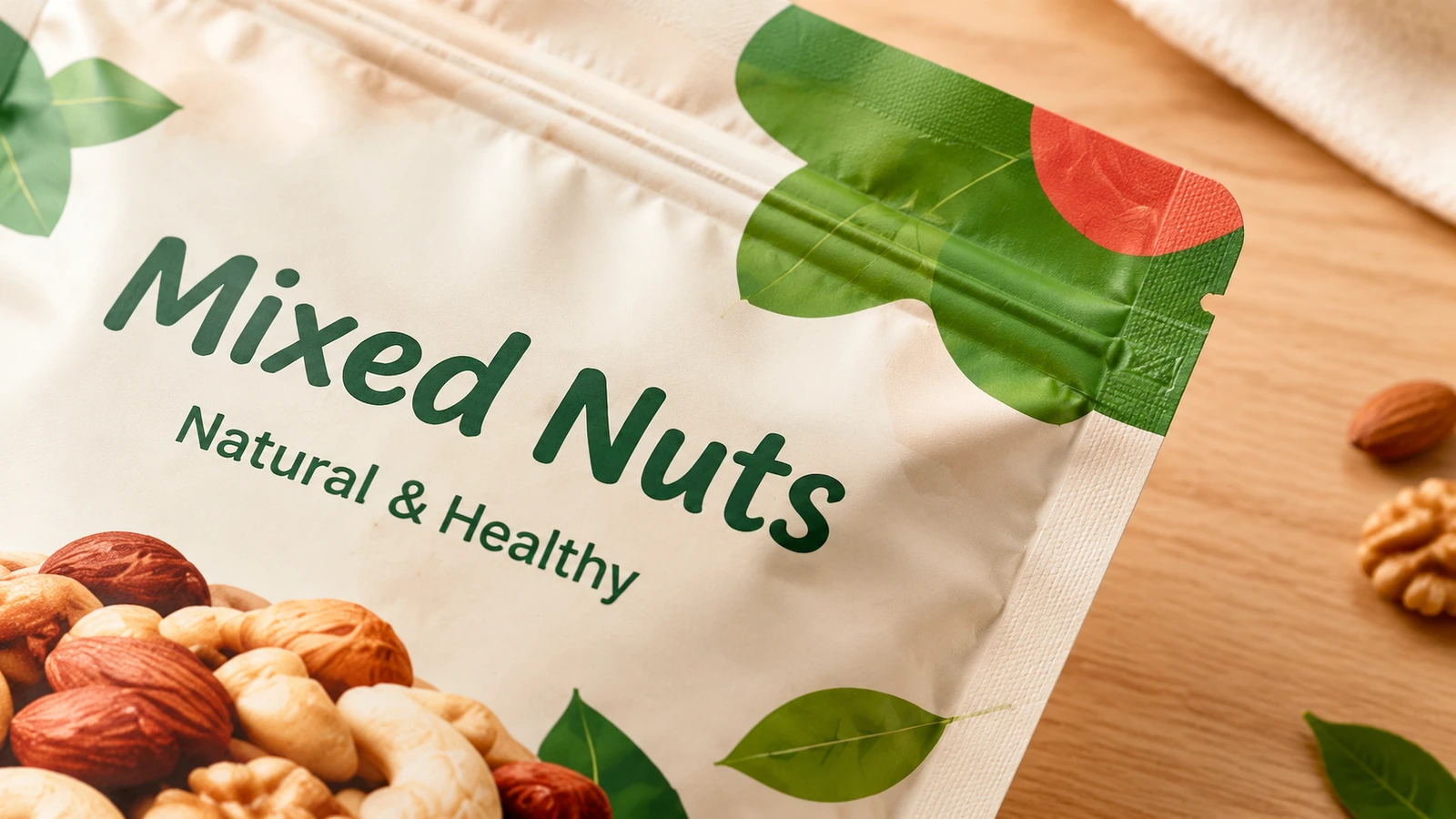
Extend bleed to the full dieline. A common requirement is about 1/8 inch, but follow the converter's dieline.
Keep text, barcodes, and logos out of the seals, zipper band, valve, hang hole, and date-code area.
Convert fonts to outlines.
Supply raster images at 300 dpi.
Separate spot colors, white ink, and varnish onto their own layers.
Also note that the bottom gusset folds under the pouch once it is filled, so a logo centered on the flat artwork will sit higher on the standing pouch. If you change supplier, size, or features, every previous dieline becomes invalid.
Step 5: Approve physical samples in a set order
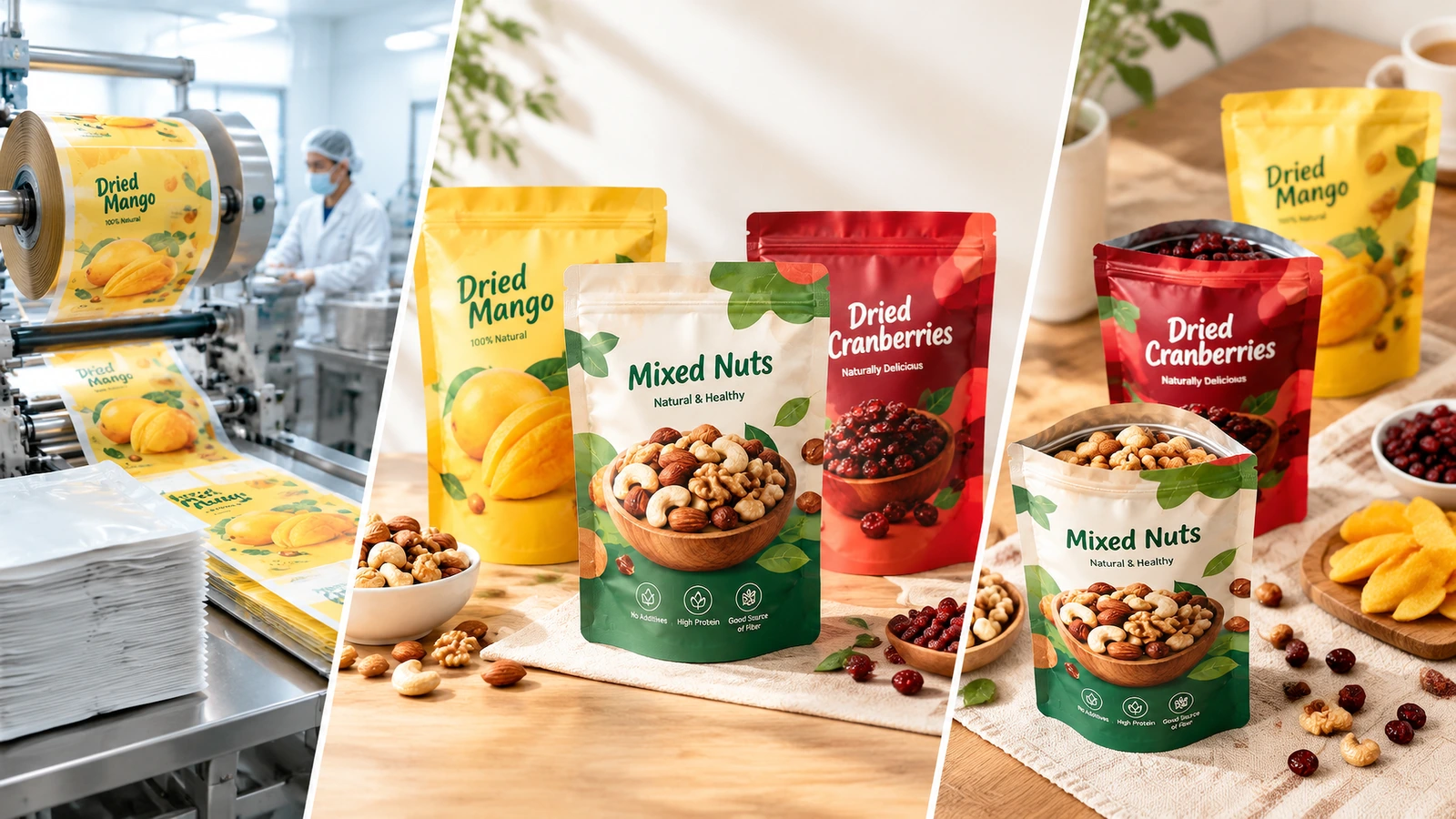
Approve samples in this sequence:
1. Digital proof: checks layout and the position of each feature only.
2. Blank or stock-structure sample: checks filling, standing, sealing, and drop handling.
3. Printed color proof: checks color, since a screen cannot show the final result.
4. Machine trial: real product sealed on your own equipment.
The first-order lead time starts at proof approval, not at the inquiry date. If a supplier commits to a color tolerance, write that tolerance into the purchase order.
Step 6: Release each lot against written test criteria
Seal strength should be measured under ASTM F88/F88M-23[11], the current edition, which replaced F88/F88M-21. The method measures the force needed to separate a heat seal and records how the seal failed. It confirms that the sealing process is consistent, but it does not test whether the whole package is leak-free. Seal strength can pass in the lab and still fail on your filler if temperature, line speed, or powder on the seal area differ. That is why the machine trial in Step 5 is mandatory.
| Check | Method | Write into the purchase order |
|---|
| Seal strength | ASTM F88/F88M-23 | Sample count, seal locations (top, side, below zipper), minimum and maximum force, failure mode, grip setup |
| Leak integrity | Whole-pouch dye or vacuum leak test | Allowed leak rate per lot; rejection and replacement terms |
| Dimensions | Calipers against the approved dieline | Width, height, and gusset tolerance |
| Fill and stand | Real product at target weight | Pouch stands after stacking; gusset corners intact |
| Color | Signed physical proof | Accepted variation measured against the proof, not a screen |
| Laminate and odor | Visual and smell inspection | No blistering, whitening, or off-odor; quarantine rule for suspect lots |
This table turns general quality goals into terms both sides can verify. A minimum seal force keeps the pouch closed, and a maximum keeps it easy for customers to open. Seal locations matter because the gusset corners and zipper ends are where stress concentrates. Rejection terms matter because the delivery date is not the time to start negotiating who covers a failed lot.
Step 7: Collect the document package with every order
Request the following from the supplier:
The laminate structure.
A food-contact compliance declaration that cites the applicable sections of 21 CFR[12] or a Food Contact Notification.
Lot numbers that trace back to film rolls and print jobs.
Print and conversion dates.
Migration or heavy-metal test results, if your retailer requires them.
A factory-level ISO 9001 or BRCGS certificate covers the plant's management system. It does not automatically mean a specific pouch meets your retailer's specification.
Which Printing Route and Film Structure Fit Your Order Stage? ↑
The printing method determines your minimum order, lead time, and how freely you can change the design. Published figures vary widely by supplier. ePac's online shop[13] lists a 500-pouch total minimum, with at least 100 per SKU and 15 business days from artwork approval. The StandUpPouches.net FAQ[14] states that 1,000 digitally printed pouches cost "more than a $1.00 a piece." It lists gravure minimums of 2,500–5,000 and plates at about $225 per color, reusable for 18–24 months. Cubit Packaging[15] quotes gravure plates at $500–$2,000 per color.
| Route | Published minimum | Published lead time or cost signal | Best fit |
|---|
| Stock blank pouch plus labels | Case quantities | Ships from stock; reprinting a label changes the variant | Recipes or net weights still changing; market tests |
| Digital (ePac) | 500 total; 100 per SKU | 15 business days from approval; no plate fees | Several flavors, seasonal SKUs |
| Digital (StandUpPouches.net) | About 1,000 on average | More than $1.00 each at 1,000 units | First retail launch; artwork still evolving |
| Gravure (StandUpPouches.net) | 2,500–5,000 | About $225 per color for plates | Locked design, repeat orders |
| Gravure (Cubit) | 5,000+ suggested | $500–$2,000 per color for plates | Volume SKUs that need tight spot-color control |
Compare total order cost, not unit price alone. At 5,000 units, gravure plate costs may not yet be paid off. Gravure becomes clearly cheaper only once a design is final and you reorder it regularly. Changing the artwork means making new plates. These figures are each supplier's own published statements. They exclude freight, duties, and sampling, and they conflict with one another. Use them as a budget range, then confirm with a written quote.
| Film structure | Supplier-stated barrier | Supplier-stated shelf life | Unit price at 5,000 (Cubit) |
|---|
| PET/PE | Basic | 6–12 months | $0.15–$0.22 |
| PET/MPET/PE | Medium | 12–18 months | $0.20–$0.30 |
| PET/AL/PE | High (foil) | 18–24 months | $0.22–$0.35 |
| Nylon/PE | Puncture resistant | 12 months | $0.25–$0.38 |
| Kraft/PE | Basic | 6–12 months | $0.18–$0.28 |
Cubit's reference pouch is a 6×9+3 inch pouch. In its pricing guide, Cubit says that choosing PET/PE instead of foil saves 25–35% when maximum barrier is not needed. It prices a zipper at an extra $0.02–$0.04 per unit and foil at an extra $0.03–$0.05 per unit. These shelf-life figures come from supplier experience. They are not a legal shelf life for any food, so confirm them with measured OTR and WVTR values and fill tests on your own product.
A practical way to stage orders follows the cash you have and the number of SKUs you sell:
Validate: use stock pouches with labels, or a short digital run.
Launch: order roughly 500–2,000 pouches per main design.
Scale: move to gravure once the design is final and monthly sales are stable.
A brand owner in the same Reddit thread described one generic pouch with flavor labels used to reach a 1,000-unit minimum. They called it "not ideal, but way better on cash." Compare 8–12 weeks of expected sales for each flavor against its MOQ before committing to a separate printed design per SKU.
Which Compliance and Sustainability Claims Will Hold Up? ↑
The FDA does not issue an "FDA approved pouch" certificate for ordinary food pouches. Food-contact plastics must meet the relevant 21 CFR sections, most often part 177 for polymers, or be covered by a valid Food Contact Notification. The supplier's declaration must also match your food type, temperature, and contact conditions. Inks, adhesives, and zippers each fall under different provisions.
Environmental wording carries legal risk too. The FTC Green Guides[16] (16 CFR Part 260) require a recyclability claim to reflect recycling access that ordinary consumers actually have. EcoEnclose[17] offers a useful example of honest wording. It promotes recycled content but states that its metallized and EVOH PCR pouches "are not thin-film recyclable" and are "designed for the landfill." Claiming recycled content is not the same as claiming the pouch is recyclable. Never print "recyclable" on a PET/AL/PE laminate.
State and export rules are tightening. CalRecycle[18] announced that California's SB 54 permanent regulations took effect on May 1, 2026, with producer registration due by June 1, 2026. Recycling Today[19] summarizes the 2032 targets: single-use packaging sold in California must be 100% recyclable or compostable, 65% must actually be recycled, and use must fall by 25%. For exporters, EU Regulation 2025/40 (PPWR) applied generally from August 12, 2026, according to LabelProfi[20]. PPWR Connect[21] notes that a 7-micron aluminum foil layer "instantly disqualifies" a laminate from polyolefin film recycling. PPWR does not apply to US-only sales. It becomes relevant if you export to the EU or a retailer copies EU specifications into your US order.
What Should You Remember Before Requesting a Quote? ↑
- The minimum per SKU shapes cash flow more than the unit price does. — US short runs began to price sensibly at around 1,000 units per design (Source)
- Digital short runs avoid plate fees and allow multiple SKUs. — 500 total, 100 per SKU, 15 business days from approval at ePac's online shop (Source)
- Gravure lowers unit cost only after plates are paid off on repeat orders. — $0.22–$0.35 per unit for 5,000 PET/AL/PE zipper pouches; plates $500–$2,000 per color (Source)
- Seal strength must be tested to a named standard, not judged by eye. — current edition ASTM F88/F88M-23 (Source)
- Foil laminates cannot be sold as film-recyclable. — a 7-micron foil layer disqualifies polyolefin recycling (Source)
- California packaging EPR is now in force. — regulations effective May 1, 2026 (Source)
- The category is large, but analysts' figures differ. — $30.6 billion global market in 2025 per one report (Source)
How Do You Turn Your Spec Sheet into an Accurate Quote? ↑
A reliable custom printed zipper pouch is the result of decisions made in order, not a catalog pick. Define the product's conditions of use. Size the pouch with real product. Choose the barrier based on measured OTR and WVTR. Design on the live dieline. Approve filled samples. Write seal-strength, leak, dimension, and color criteria into the purchase order. We quote MOQ, production time, structure, and price per SKU only after reviewing that information, and anything we cannot yet confirm is listed as pending sampling or testing. Send us your one-page specification sheet and target fill weight to request a quote.




The information below is required for social login
Sign In
Create New Account