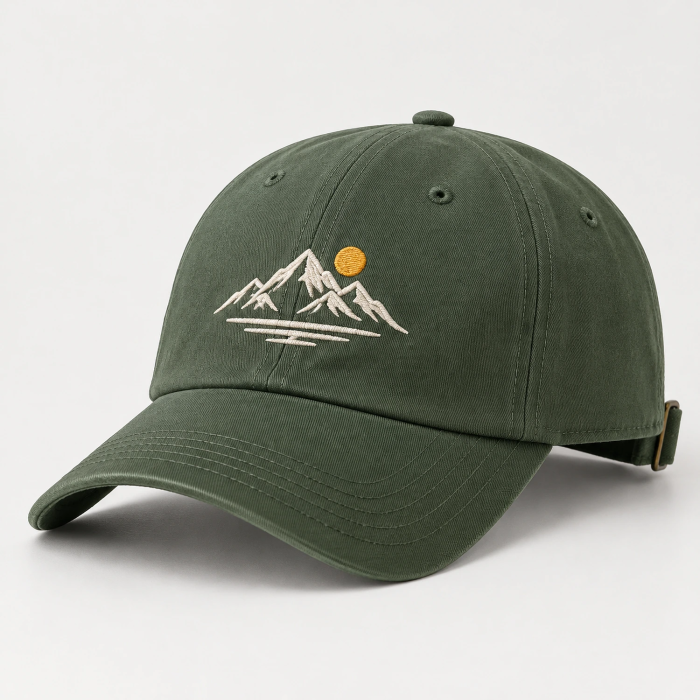
Custom embroidered 6-panel baseball caps carry your logo stitched directly into the crown with polyester thread on a cap frame. For clean, wearable results, keep the front design inside a roughly 4 × 2 inch window and letters at least 6 mm tall. Approve a physical sew-out on the final blank before bulk production starts.
Who Orders Custom 6-Panel Embroidered Caps, and Why? ↑
The person placing the order is rarely the only person wearing the cap. The most common buyers are office managers, marketing staff, and purchasing leads. They order caps for onboarding kits, client gifts, trade shows, and field crews. Coaches, booster clubs, and league volunteers order for a season. Small apparel labels and venues order merch drops. Individuals order one to five caps for weddings, reunions, or a test piece before a company order. Each group asks different questions. Every group still needs the same three things: a readable logo, a consistent batch, and delivery before a fixed date.
Caps carry real weight in promotional budgets. PPAI reports that caps and hats rose from 7.2% of U.S. promotional product distributor sales in 2023 to 9% in 2024. Total industry sales that year reached $26.78 billion, according to the PPAI 2024 Sales Volume Report[1]. Execution matters as much as quantity. In a 2025 survey of 1,000 U.S. consumers, 57% said they remembered a brand because its logo was clear. More than 60% said they would reject an item immediately if the material or craftsmanship was poor (PPAI Research, "The 5-Second Impact"[2]). For a cap, that means a sharp logo on a well-built blank.
Why Do Embroidered Cap Orders Go Wrong, and How Do You Prevent It? ↑
Problem. The complaints buyers leave are rarely "the thread was the wrong color." The most common gap is between the approved proof and the cap that arrives. One verified reviewer wrote that "the font was much smaller than the proof that I approved, and they refused to re-make it or refund me" (Trustpilot, customlids.com[3]).
Agitation. Batch problems are harder to fix. One brand owner reported that "the samples were great but the full run has misalignments everywhere." The order ended with a refund instead of usable stock (Reddit r/streetwearstartup[4]). Event buyers get hit hardest by late surprises. One buyer was told two days before delivery that the "art was too fine for embroidery," and then that the cap was out of stock (Shopper Approved review[5]). Dense stitching can also ruin the cap itself. Another reviewer called a batch "unwearable" because the embroidered front had "caved in" (Trustpilot, embroideryinc.com[6]).
Solution. Each of these failures has a checkpoint that would have caught it before production. The quote for NSKU-776-01 is built around those checkpoints. A readability preflight happens before payment. A physical sew-out is made on the final blank before the file is locked. Stitch count, positions, and decoration type are listed in writing. Tolerances and remake triggers are agreed before bulk production. MOQ, unit price, and lead time depend on your artwork, blank, and quantity, so they are confirmed in the quote and at sampling rather than promised in advance.
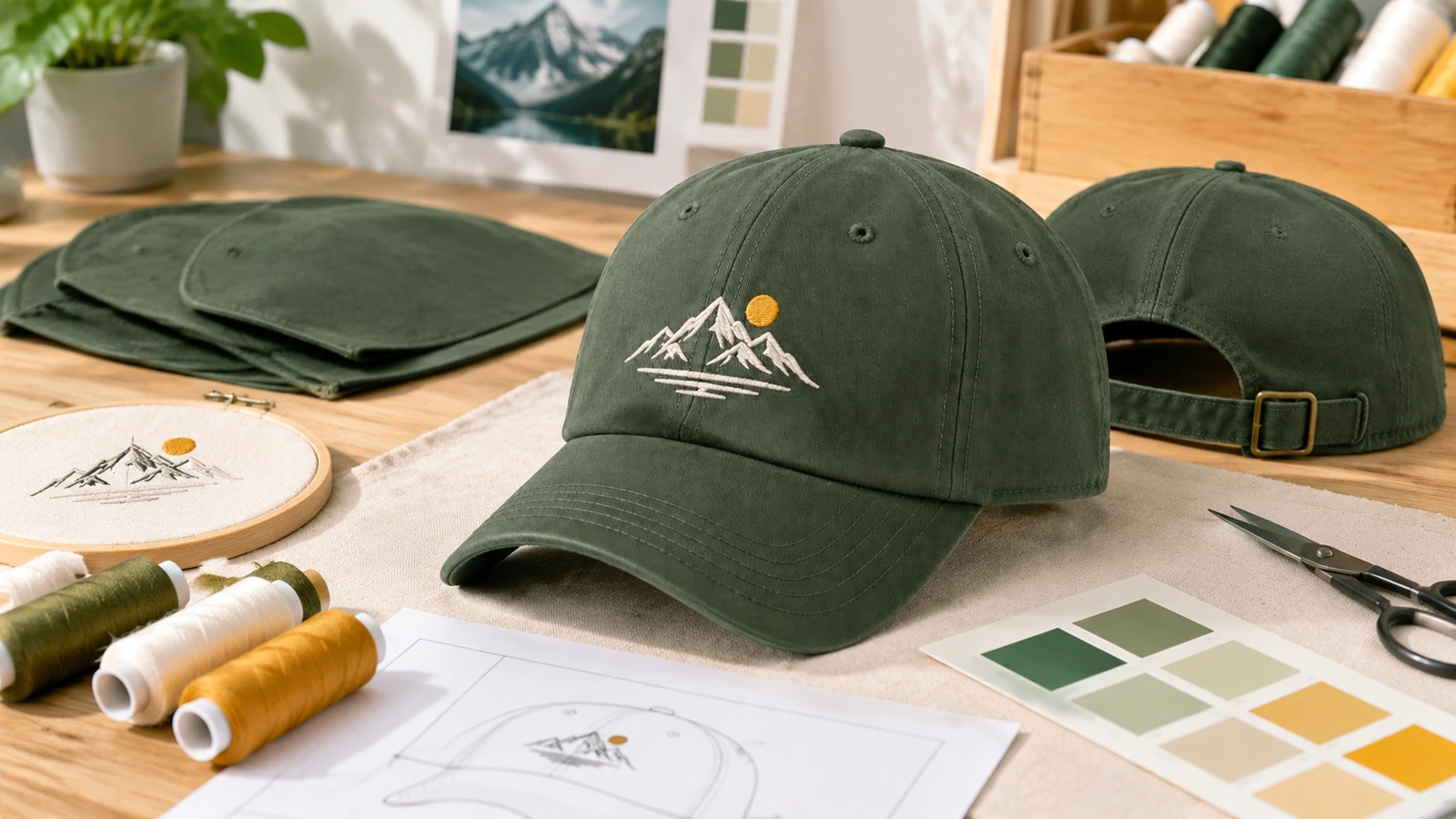
Table of Contents
What Exactly Is a Custom Embroidered 6-Panel Cap? ↑
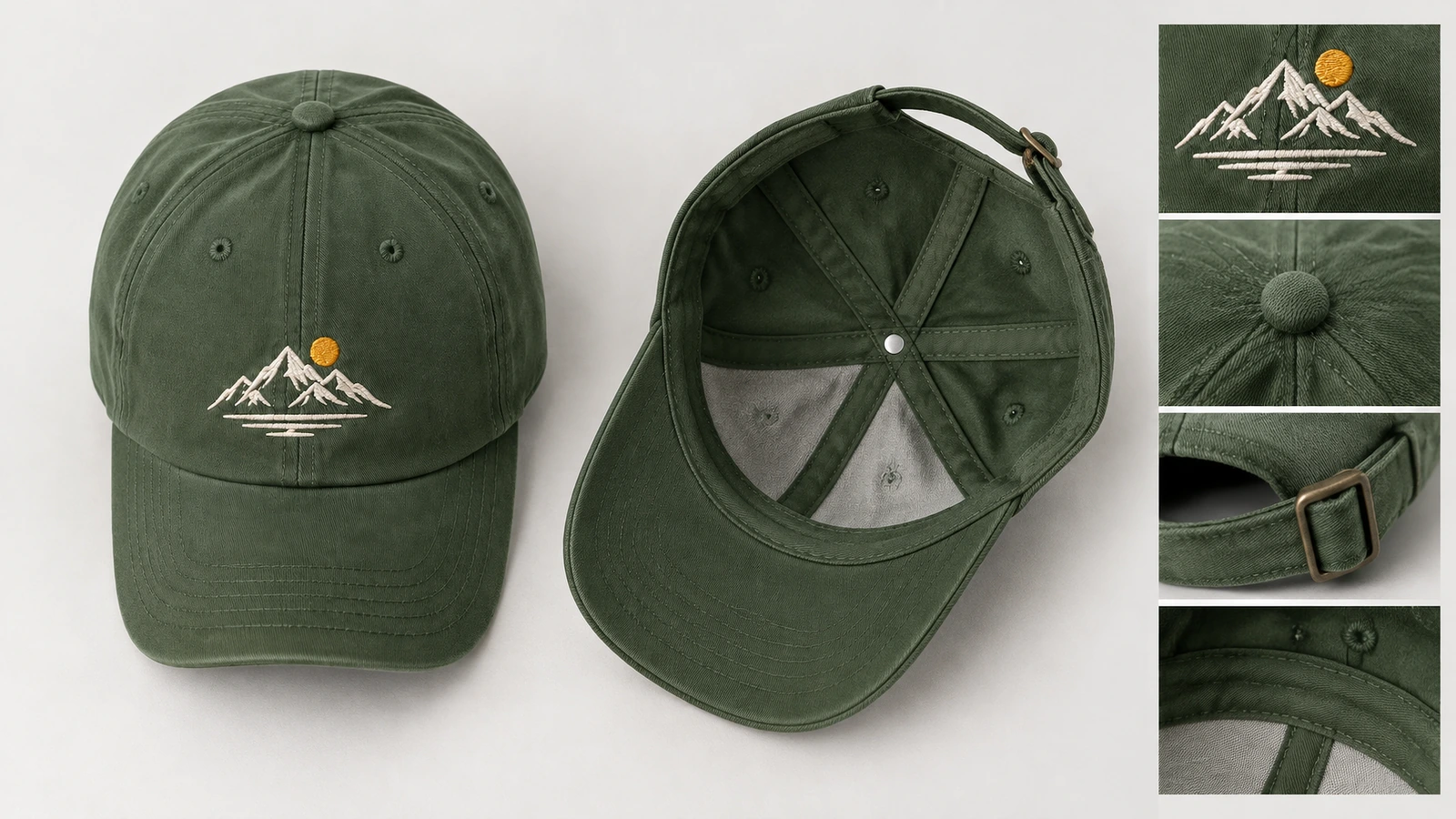
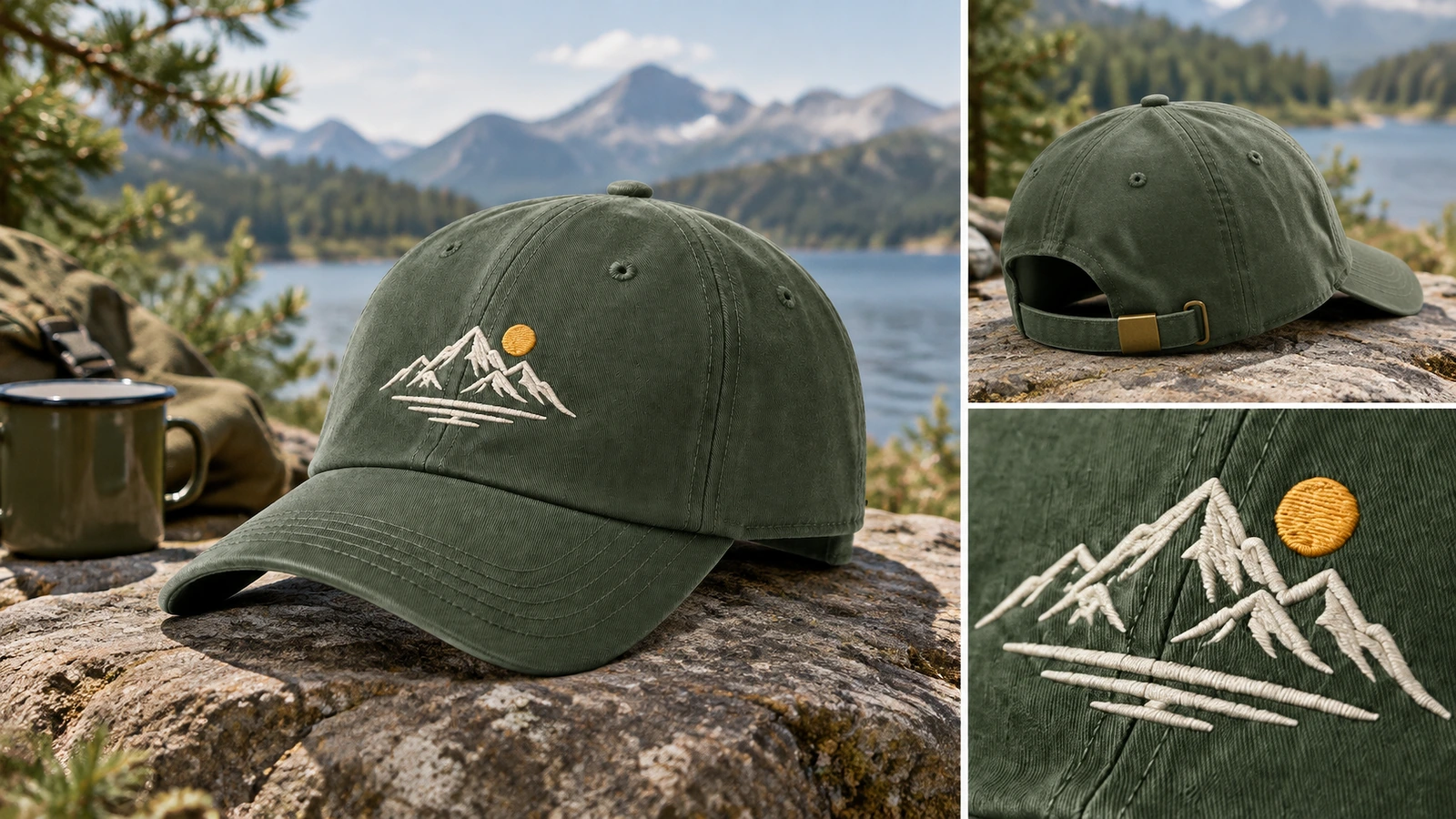
A 6-panel baseball cap has six fabric gores sewn into a crown, with a center seam running from front to back. Structured versions use a stiff buckram backing behind the two front panels. Unstructured "dad hat" versions are soft and follow the head. Custom embroidery means the logo is digitized into a stitch file, the cap is clamped on a cap frame, and thread is sewn directly through the front panel. It is not a printed or glued layer. Custom Ink calls embroidery "the gold standard for most custom hats" because it gives "a durable 3D texture that looks professional." The same guide reserves screen printing for colorful, detailed art on foam-front truckers (Custom Ink hat customization guide[7]).
The stitchable area is smaller than most buyers expect. Queensboro states that "the space we can stitch on a hat is smaller: 4 inches wide by 2 inches high." Logos taller than 2 inches may need to be reworked (Queensboro product page[8]). Digitizers give a similar range. AA Creative Embroidery recommends a standard cap-front area of about 57 × 102 mm and a minimum letter height of 6 mm. It also warns that "below 6mm, letter gaps close up" (AA Creative cap digitizing tips[9]). For 3D puff, Headwind Group puts the minimum stroke width at about 0.2 in (5 mm). It also notes that puff files cannot reuse flat-embroidery files and that soft caps are poor puff candidates (Headwind Group puff guide[10]).
| Parameter | Common practice reference | Status for NSKU-776-01 |
|---|
| Front embroidery window | About 4 in × 2 in (≈57 × 102 mm) | Confirmed on the physical sample |
| Minimum letter height | 6 mm (0.25 in) | Checked at file preflight |
| 3D puff stroke width | About 5 mm minimum; structured caps only | Separate puff sample required |
| Fill density | 65–75 SPI (supplier convention) | Written on the quote |
| Front stitch count | About 5,000–8,000 for a 2–2.5 in logo | Quoted from your digitized file |
These figures are trade conventions from decorators and digitizers. They are not ASTM or ISO standards, so the binding values for your order are the ones measured on your approved sew-out. The density and stitch-count ranges come from Arklavo's buyer guide. The guide says 65–75 SPI is its own cap-frame standard, that density below about 60 SPI tends to show fabric, and that density above about 80 SPI can dent structured fronts (Arklavo bulk buyer guide[11]).
How Do You Order Caps That Match the Approved Proof? ↑
Step 1: Choose the crown structure and closure before the artwork
The blank decides what the embroidery can do. Text-heavy or dense logos belong on a structured crown with a backed front, because soft fronts can sink under needle pressure and distort letters. Unstructured caps suit small, simple marks. Specify the crown profile, visor curve, color, and closure (snapback, fabric strap, or stretch fit) on the quote. Every option is confirmed on the sample rather than assumed. Inspect the closure as closely as the logo. One verified review read: "The hat looked awesome but the strap broke when I put it on" (Epic Sports reviews[12]).
Step 2: Preflight the file as a cap file, not a shirt file
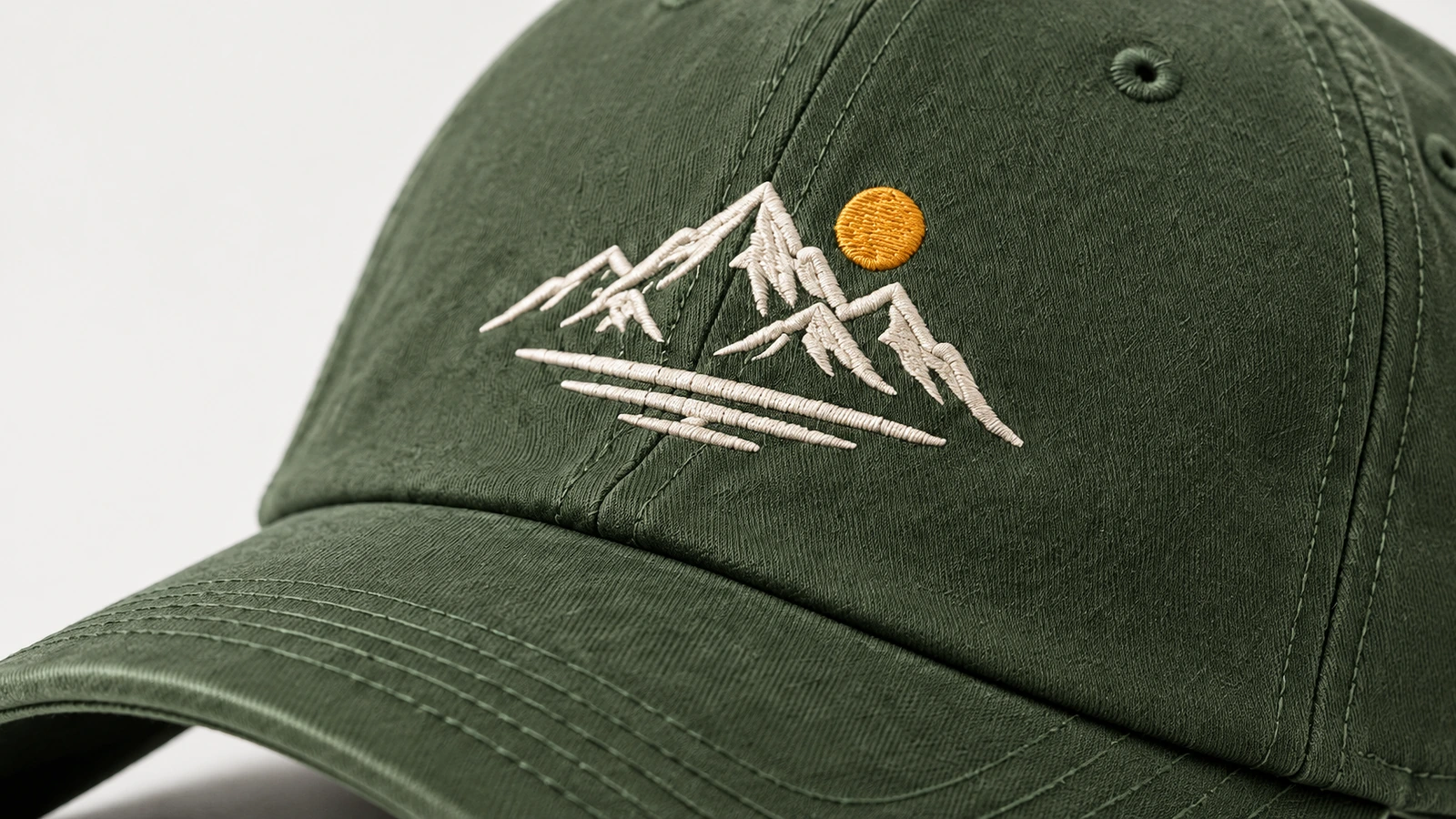
Send vector art or high-resolution artwork. The preflight then checks four things: letter height, line thickness, gradients, and colors that must map to stock thread instead of screen RGB. A file made for flat garments will not work on a curved crown. Cap digitizing must run "center-out, bottom-up," and stitches shorter than about 1.5 mm can "drill through the backing like a bit." Pull compensation of about 0.30–0.45 mm is typical (Sassy Digitizing cap settings[13]). Fine outlines, photo detail, and tiny taglines get flagged here, before you pay, instead of two days before your event.
Step 3: Use stitch count and positions as the quote gate
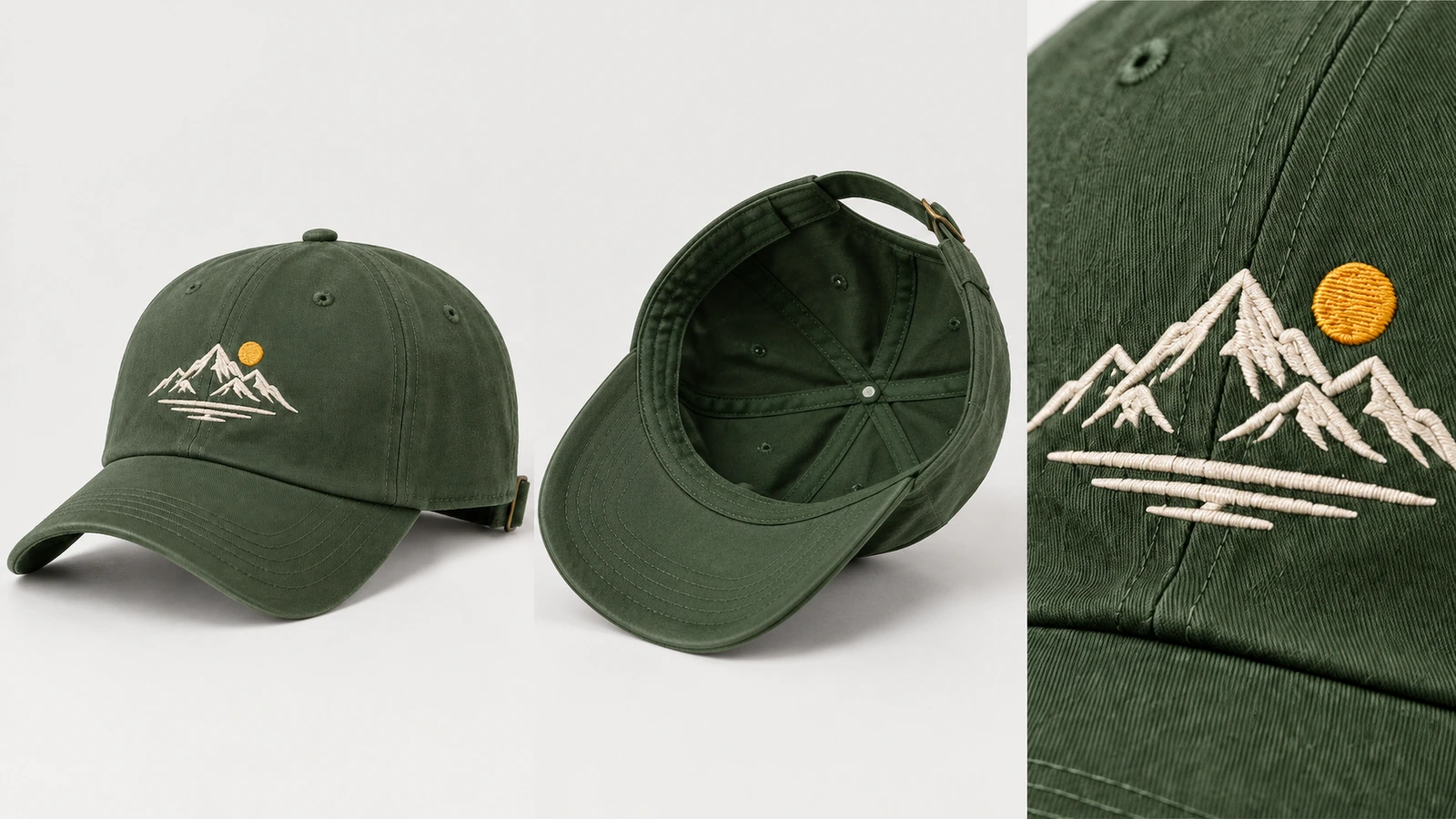
A single "embroidery price" hides the factors that actually drive cost. A transparent quote lists stitch count, SPI, the number of positions, any puff, and the digitizing fee. Cap America's published contract rates show how this works. Its rate for a 5,000-stitch design is $7.70 per piece at 24+ units. Every additional 1,000 stitches adds $0.80, and each extra location adds $4.50. The same page allows 2% spoilage on flat embroidery and 10% on 3D (Cap America contract decoration[14]). If you need an exact final count, order overage by size. Your own quote for NSKU-776-01 is priced from your digitized file rather than from these reference rates.
Step 4: Approve a sew-out, then lock the file
A screen mockup cannot show thread sheen, edge sharpness, or how a letter sits across the center seam. The sample must use the final blank, final thread, final backing, and final frame. Garment Decor describes the sequence as review and digitize, sew a physical sample, lock the file once the client approves, then run production. It notes that "once the sample is approved, the file is locked and production runs" (Garment Decor process[15]). Any later change to color or text counts as a new version. Plan for that if your date is fixed. Custom Ink advises ordering 3–4 weeks ahead for fixed-date events, compared with about two weeks for standard delivery (Custom Ink hats guide[16]).
Step 5: Run production on cap frames with the approved settings
Bulk production must use the same blank, SPI, frame type, and thread codes as the approved sample. Changing any of them invalidates the approval. The front is centered on the seam line, and dense stacks of stitches directly on the seam ridge are avoided, because that is where curved crowns shift and needles deflect.
Step 6: Inspect against four gates before packing
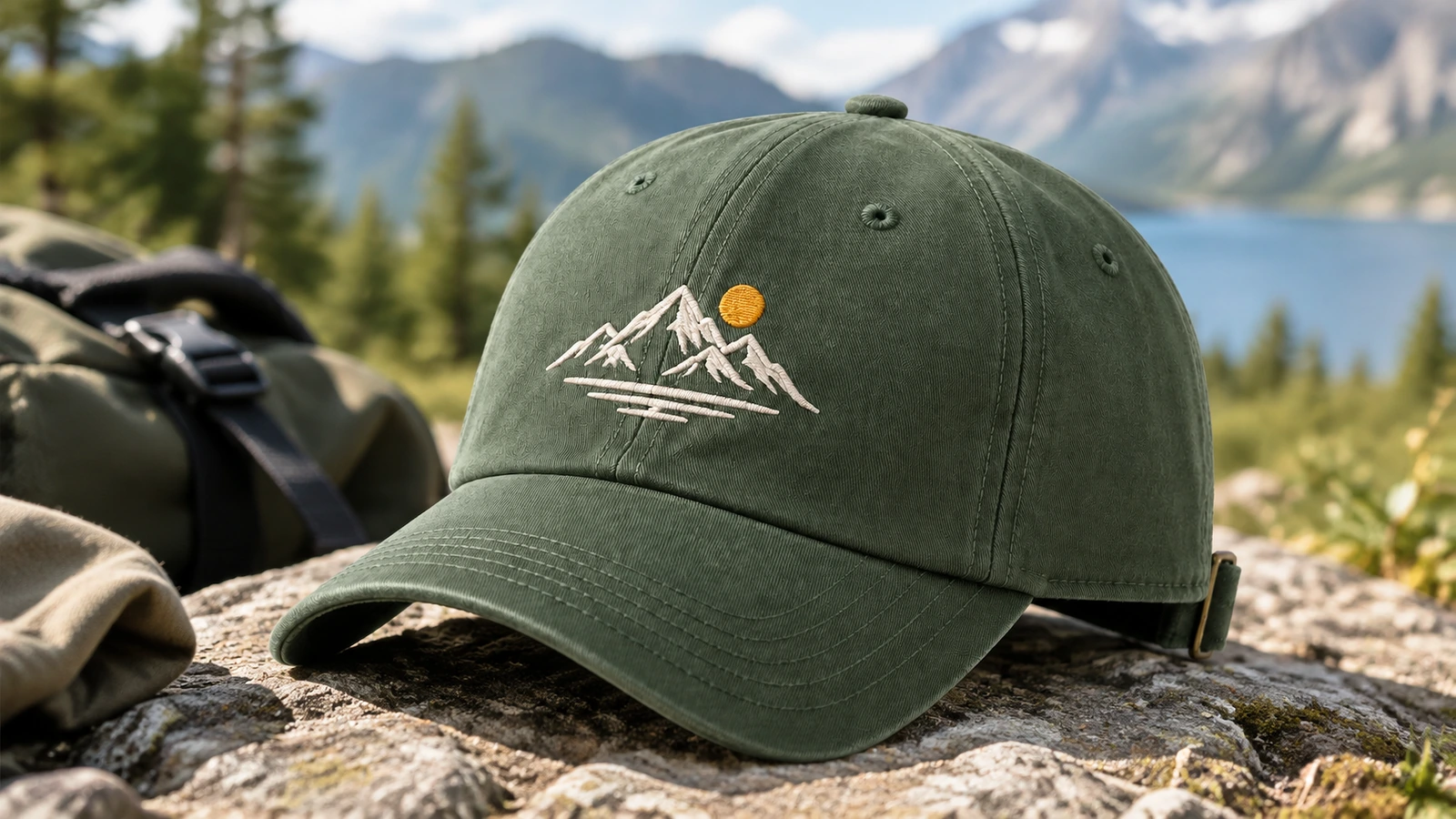
AceAccessory's inspection framework covers four areas. The first is front-logo density and edge quality. The others are straight structural seams, clean interior taping, and even visor stitching. Inspectors also look for floats, puckering, and skipped stitches (AceAccessory inspection guide[17]). A quick tactile check helps too. Drag a thumb across the logo; it should feel like solid coverage, not fabric texture.
| Inspection gate | Pass condition | Reject signal |
|---|
| Logo placement | Centered and level versus the approved sew-out | Tilted or offset logo, or one that varies cap to cap |
| Coverage and edges | Solid fill, crisp edges, no backing showing | Exposed fabric, fraying, or puff foam visible at sides |
| Front panel shape | Crown holds its shape around the logo | Caved, puckered, or rippled front |
| Construction | Straight seams, symmetric visor, clean taping | Lopsided crown, warped brim, loose threads |
| Closure and fit | Closure works; correct size sent | Broken strap or wrong size |
Agree on this checklist in writing before production, along with the measurable tolerances for placement and size. The approved sew-out photo then becomes the reference in any dispute. Without that photo, "within specification" stays undefined.
Step 7: Pack for shape, ship, and set up the reorder
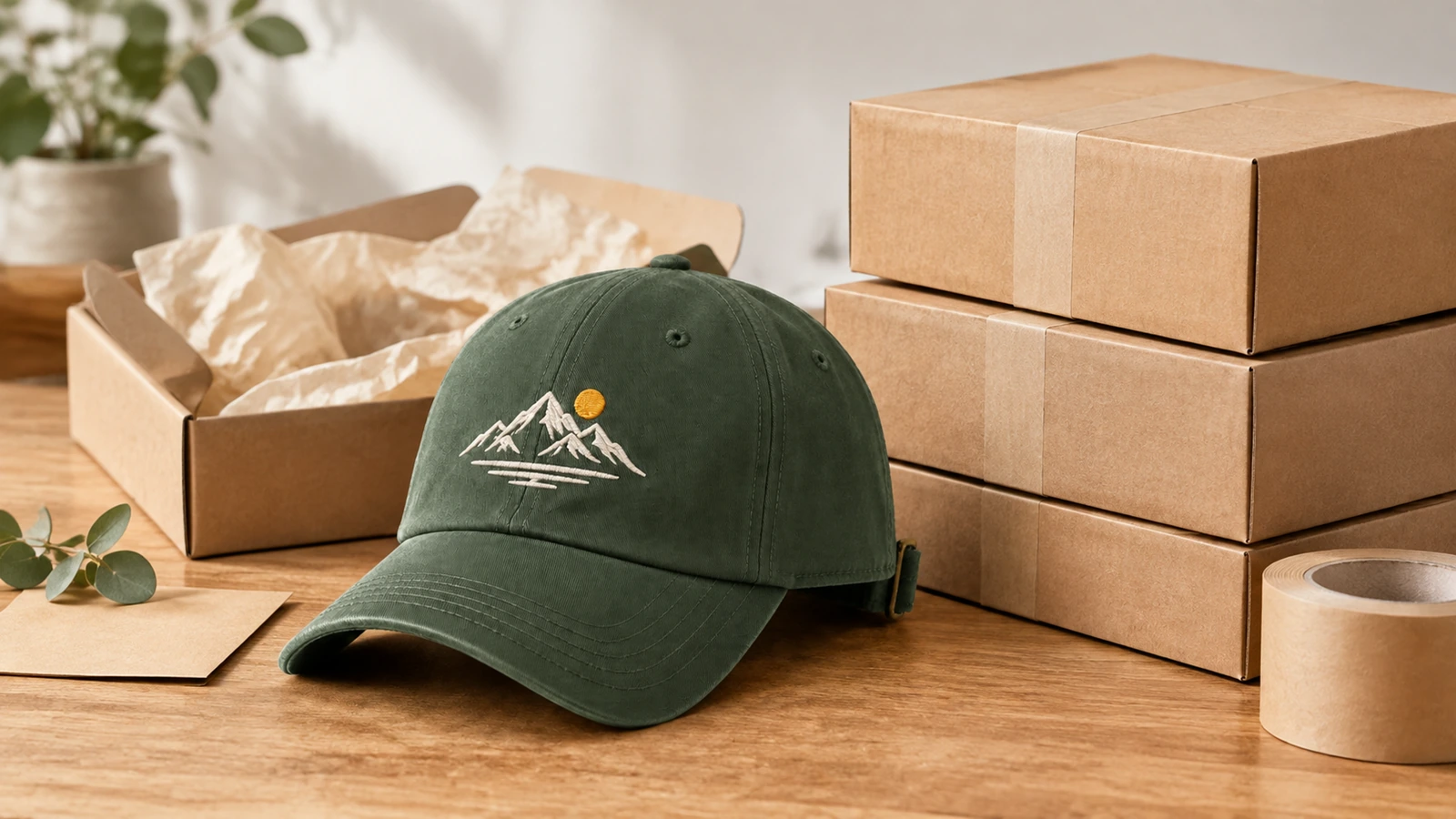
Embroidery can pass inspection and still arrive ruined. One UK buyer reported that 9 of 12 caps arrived "absolutely filthy… just shoved into a cardboard box" (Trustpilot, capscompany.co.uk[18]). Caps should be nested or supported so the crowns are not crushed. The number of caps per carton and the shipping weight depend on the approved blank and the packed dimensions, so both are confirmed after sampling. Include care guidance with the shipment. Eagle Ridge Apparel warns: "Never machine wash a structured hat unless the care label explicitly says you can — the brim will warp" (Eagle Ridge care guide[19]). For reorders, archive four items: the stitch file, the thread codes, the blank style number, and the sew-out photo. A repeat run can then match the first batch without a new approval cycle.
Which Decoration Method and Supply Route Fits Your Order? ↑
| Method | Best for | Limits | Durability note |
|---|
| Flat embroidery | Company logos, team marks, everyday wear | No gradients or photos; small text blurs | Thread locked into the fabric; holds fine detail best |
| 3D puff embroidery | Bold block letters on structured crowns | Fine strokes sink into foam; separate file needed | Raised surface can crush under pressure and heat |
| Embroidered patch | Detailed art; one mark across several cap styles | Extra production step; longer timing | Sewn-on patches hold better than heat-applied ones |
| Screen print / DTF | Full-color art on foam-front truckers | Curved 6-panel fronts resist flat printing | Can crack or fade sooner than thread |
For a 6-panel cap meant to be worn for a season or longer, flat embroidery is the default choice. Puff makes sense only when the lettering is bold and the crown is structured. Patches fit art that is too detailed to stitch directly. Printing fits short-lived, full-color event pieces on foam-front truckers. The routing logic follows the Custom Ink and Headwind guidance cited above.
| Supply route | Published minimum | Published timing | Watch-outs |
|---|
| Print-on-demand embroidery | No minimum | About 2–7 business days | Quality varies by supplier; order a sample first |
| Online designer platform | Many styles 12; some none | About 2 weeks standard | Proofs are mostly on-screen |
| Stock-blank decorator | 24 pieces on most in-stock styles | 7–10 working days after sample approval | Rush surcharges; spoilage allowances |
| Overseas full-custom OEM | Often around 100 per design | Samples 18–25 days; bulk about 45–50 days | Ocean freight, duties, and inspection risk fall on the buyer |
| NSKU-776-01 (this product) | Quoted per artwork, blank, and quantity | Confirmed at quote and sampling | Sew-out approval is required before bulk production |
The reference figures come from each provider's own published policies. Printful lists no minimum and roughly 2–7 business days for made-to-order hats, with a possible one-time digitizing fee (Printful hat embroidery[20]). Custom Ink's figures appear in the hats guide cited in Step 4. Cap America's FAQ sets 24 pieces for most in-stock and domestic styles and 72, 144, or 576 pieces for custom overseas programs. It quotes 7–10 working days after sample approval for in-stock embroidery (Cap America FAQ[21]). JoinTop's planning ranges are about $7–9 EXW per cap at 100 pieces and $5–7 at 500+. Those prices exclude shipping and duty, so they are not landed prices (JoinTop guide[22]). Never compare an EXW factory price with a delivered, decorated retail price.
Which U.S. Rules and Sourcing Checks Apply? ↑
Standard adult caps sit outside several apparel rules, but the exemptions are narrow. The clothing flammability standard excludes "hats, provided they do not constitute or form part of a covering for the neck, face, or shoulders." Caps with neck flaps therefore lose the exemption (16 CFR § 1610.1[23]). The Textile Fiber Products Identification Act exempts fiber products incorporated in headwear from fiber-content labeling. Any fiber claim you do make, such as "100% cotton," must still be truthful (FTC Textile Act text[24]). If you disclose fiber, ornamentation covering no more than 15% of the surface can be excluded with the phrase "exclusive of decoration" (16 CFR § 303.12[25]). Caps for children 12 and under are children's products under CPSIA. They need a separate testing and certification path and should never share a spec sheet with adult promotional caps.
Imported cotton caps also carry supply-chain risk. DHS lists apparel and cotton products as high-priority sectors under the Uyghur Forced Labor Prevention Act. Goods made wholly or partly in Xinjiang, or by listed entities, face a rebuttable presumption of forced labor and can be detained (DHS UFLPA FAQ[26]). Ask for fiber-to-finished-cap traceability records, not just a country-of-origin statement. Chemical certifications have limits as well. OEKO-TEX STANDARD 100 covers only the certified article and supply-chain stage, and its revised rules take effect 2026-06-01 (OEKO-TEX STANDARD 100[27]). A certified fabric does not make a finished cap certified. No certification is claimed for NSKU-776-01 unless documents are supplied with the quote.
Key Takeaways for Cap Buyers ↑
- Caps are a growing share of promotional budgets. — 9% of $26.78B U.S. distributor sales in 2024 (Source)
- Logo clarity drives recall; poor craftsmanship drives rejection. — 57% recall via clear logos; 60%+ reject poor quality (Source)
- Design to the cap window, not the business card. — About 4 in × 2 in front area (Source)
- Small text needs a hard floor. — 6 mm minimum letter height (Source)
- Fixed-date orders need buffer time. — Order 3–4 weeks ahead of the event (Source)
- Standard hats are outside the clothing flammability rule. — Exempt unless covering neck, face, or shoulders (Source)
Ready to Turn Your Logo Into a Sew-Out? ↑
A good embroidered cap order is decided before the first needle drops. That means the right crown for the design, a file built for a curved panel, a quote that names stitch count and positions, and a physical sample that becomes the binding reference. The quote for NSKU-776-01 confirms MOQ, unit price, and lead time against your actual artwork and quantity, and production waits until you approve the sew-out on the final blank. Send your logo file and target delivery date to request a quote and sew-out for NSKU-776-01.




The information below is required for social login
Sign In
Create New Account