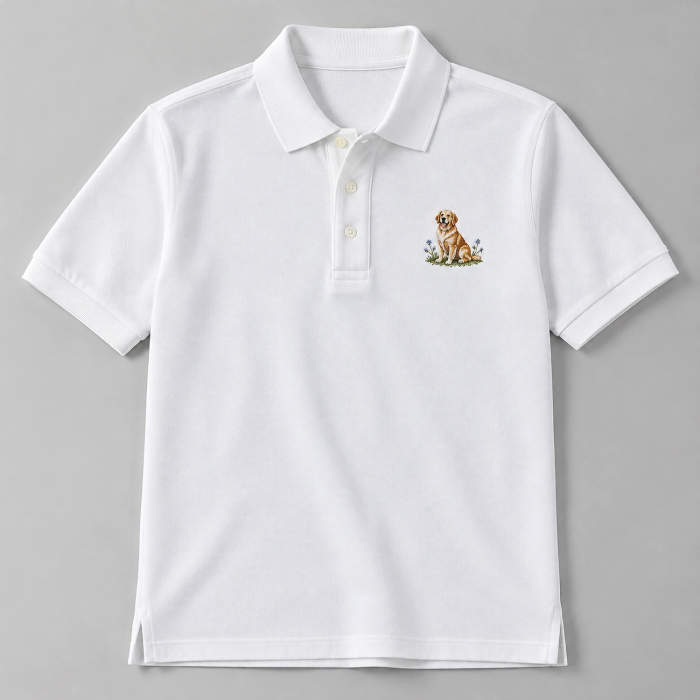
Custom embroidered polo shirts on a cotton piqué base (SKU NSKU-752-01) put a stitched left-chest logo on a stable knit. That knit resists puckering better than thin jersey or stretch polyester. Before bulk production, approve the digitized proof, stitch count, measured placement and a physical sample. Your written quote confirms the minimum order, the lead time and the fabric weight.
Who Orders Embroidered Piqué Polos, and Where Are They Worn? ↑
The person who places the order is usually not the person who wears the shirt. Typical buyers are owners, office and operations managers, HR leads and event coordinators. They outfit 5–50 people in client-facing, low-abrasion roles such as sales, reception, clinic front desks, real estate, service counters, hospitality and golf volunteering. Lands' End Business[1] describes the appeal directly: "embroidered polo shirts give your logo a polished, professional presence that printed alternatives simply cannot match." It also warns that "a uniform program falls apart when half the staff can't find their size."
Three usage patterns shape most orders:
- A Monday-to-Friday uniform. The shirts face weekly laundering for months.
- A small pre-event batch. The delivery date is fixed and the budget is tight. In one nonprofit buyer's thread[2], a single polo came to $63.12 shipped after a $29 setup fee and an $8 decoration fee. The buyer said a higher price would push them to a sticker or a pin instead.
- A pilot of roughly ten shirts. The buyer uses it to vet a supplier before committing to a uniform program of 200 or more pieces.
Apparel is the largest promotional category. It made up 26.6% of 2024 US distributor sales in the PPAI estimate[3], so expect many vendors and wide differences in quality. NSKU-752-01 is scoped for office, service and event roles. It is not jobsite workwear, and it is not a designer-label polo with personalization added.
Why Do So Many Logo Polo Orders Disappoint After Delivery? ↑
Problem. Complaints rarely fault the thread alone. Most of them blame the blank shirt or the logo placement. One verified buyer of a performance piqué polo[4] wrote: "It's so thin that the custom embroidered logo causes ripples in the shirt around the logo." Another product reviewer[5] praised the stitching. That same reviewer called the medium "wide, baggy," with oversized sleeve holes.
Agitation. These mistakes are costly because personalized garments are usually final sale. Lands' End labels customized polos "Made Just For You" and says it is "unable to accept returns[6]." One buyer who planned to scale to 200+ garments reported[7] that "the embroidery started falling out of a brand new, unwashed garment." Timing adds to the damage. An order placed around Christmas 2025 arrived on January 20, 2026[8], "almost a month" later, and its thread colors did not match.
Solution. The fix is a process. Every NSKU-752-01 quote includes:
- a cotton piqué base;
- a digitized proof that shows stitch count and measured placement;
- a physical sample before bulk production;
- written acceptance criteria for position, thread color and wash performance.
The minimum order quantity, production time and fabric weight are not published here. Your written quote states them, and the sample verifies them.
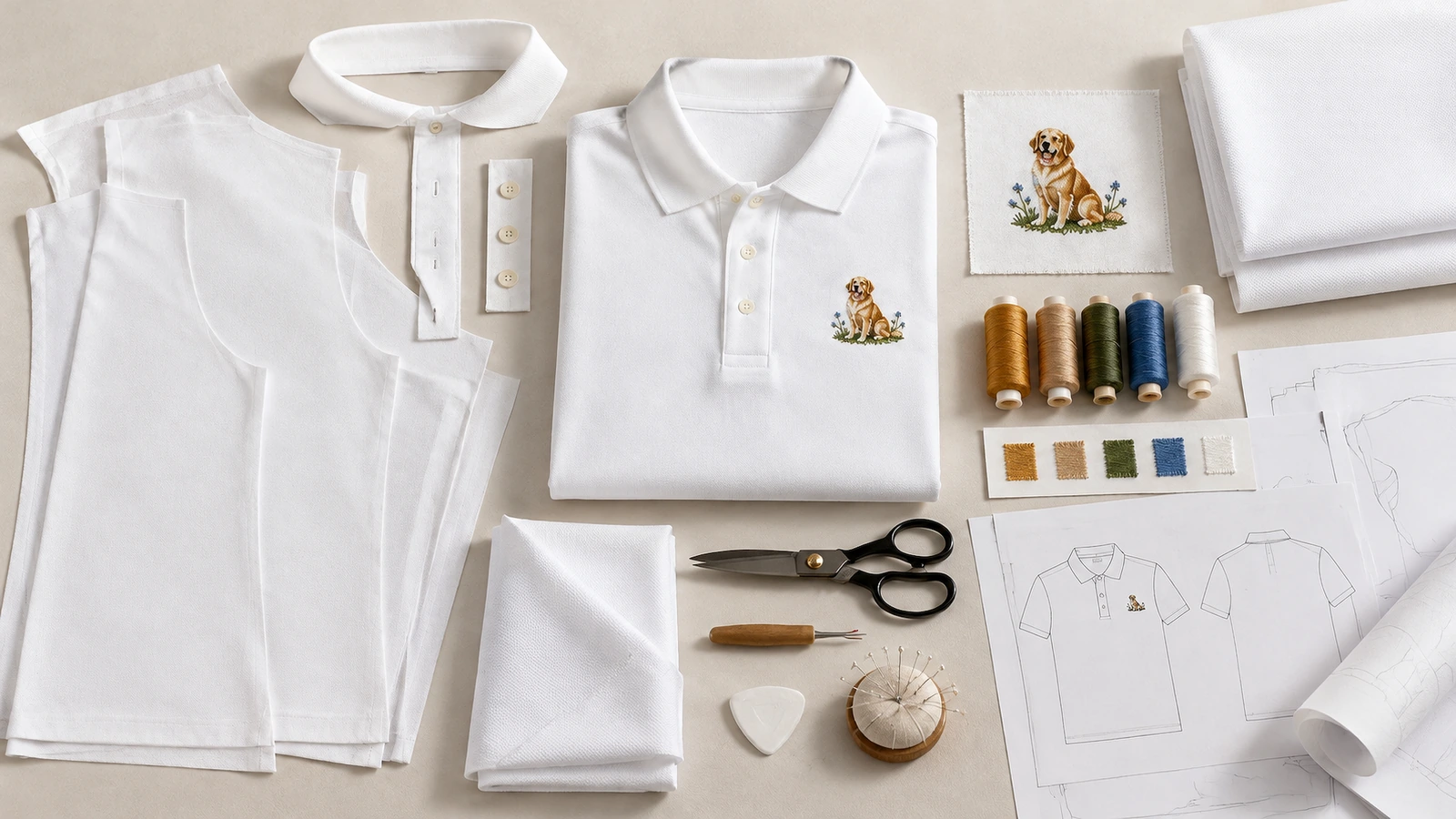
Table of Contents
What Exactly Is a Custom Embroidered Cotton Piqué Polo? ↑
Piqué is a knit with a raised, textured structure. That structure gives the needle more to grip than flat jersey does. Embroidery stitches thread directly into the fabric, so the logo has dimension and will not crack the way ink can. Price depends on stitch count, not on the number of colors.
The Custom Ink polo guide (2026-07-22)[9] gives these benchmarks:
- A standard left-chest logo runs 5,000–10,000 stitches. It adds about $7.50–$12 in decoration cost per shirt, plus a one-time digitizing fee of $25–$150.
- "Pique knits (180–220 GSM) are the standard for corporate wear." Jersey polos under 150 GSM "typically cannot" carry heavy embroidery.
- Lettering smaller than 0.2 inches (about 5 mm) becomes illegible once stitched.
Experienced decorators also cap stitch density. Queensboro[10] limits logos to 11,000 stitches. It notes that "embroidery remains an art, not a science," and says it sometimes simplifies details or resizes text before production. No federal rule sets a minimum stitch density for polos. Your purchase specification is what defines quality.
| Fabric | Embroidery fit | Typical use |
|---|
| Cotton piqué, ~180–220 GSM | Excellent, stable base | Corporate uniforms |
| 65/35 poly-cotton piqué, ~5 oz | Excellent; resists wrinkles and fading | High-volume staff wear |
| Performance polyester, ~3.8–4.0 oz | Usable with reduced density | Golf, outdoor, hot climates |
| Jersey knit | Poor; dense stitching sags | Better suited to print |
| Double piqué, ~220–250+ GSM | Excellent; takes high stitch counts | Heavier uniforms |
These ranges summarize the Custom Ink guide. They are not lab results for this SKU. Your quote states the exact GSM of NSKU-752-01, and the sample confirms it. If your logo exceeds about 10,000 stitches, choose a heavier base or a smaller design rather than adding stitches.
How Do You Order Embroidered Polos That Pass Inspection? ↑
Use the seven checkpoints below. Each one produces something you can verify before money is spent on bulk production.
Step 1: Size the logo for readability and placement
Start with the logo, not the shirt. Remove taglines with letters under 0.2 inches tall. Send gradients and photographic art to a print method. Then fix the left-chest coordinates.
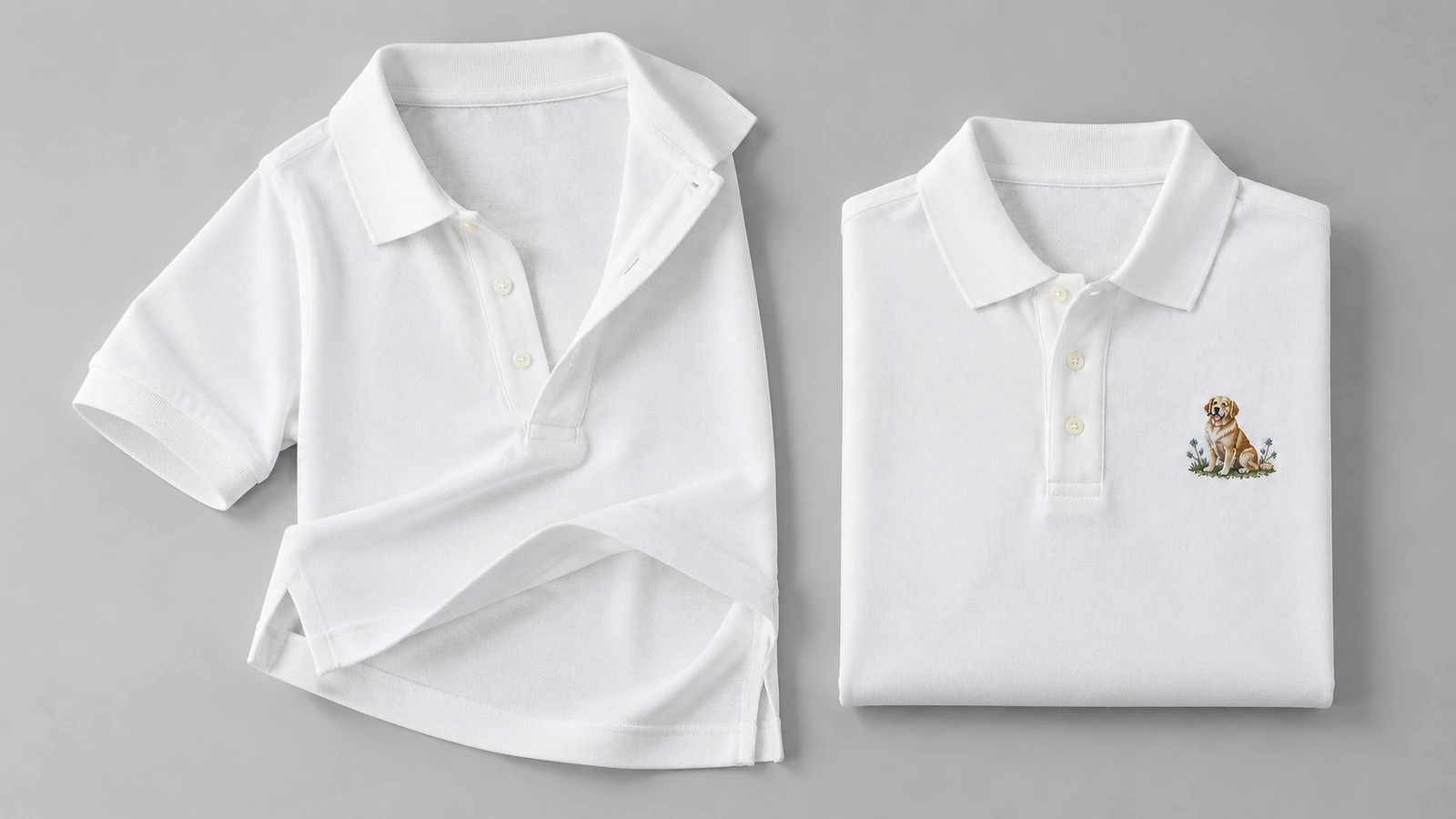
| Source | Left-chest position | Logo size |
|---|
| Custom Ink | Design center 7–9 in below left shoulder seam | 3–3.5 in wide |
| SewFlow[11] | 7–10 cm below shoulder seam | 80–100 mm wide |
| Queensboro | Left or right chest; maximum two locations per item | Max 4 × 4 in; sleeve max 3 × 3 in |
Choose one standard and write it into the contract. Placement errors are common. Reviewing a family-business uniform, one embroiderer[12] warned: "these logos are too low - they're going to be sitting right on top of the breast instead of just above." Women's and youth cuts have narrower shoulders. They need their own coordinates rather than the men's 7–9 inch rule.
Step 2: Match the fabric surface and backing to the design
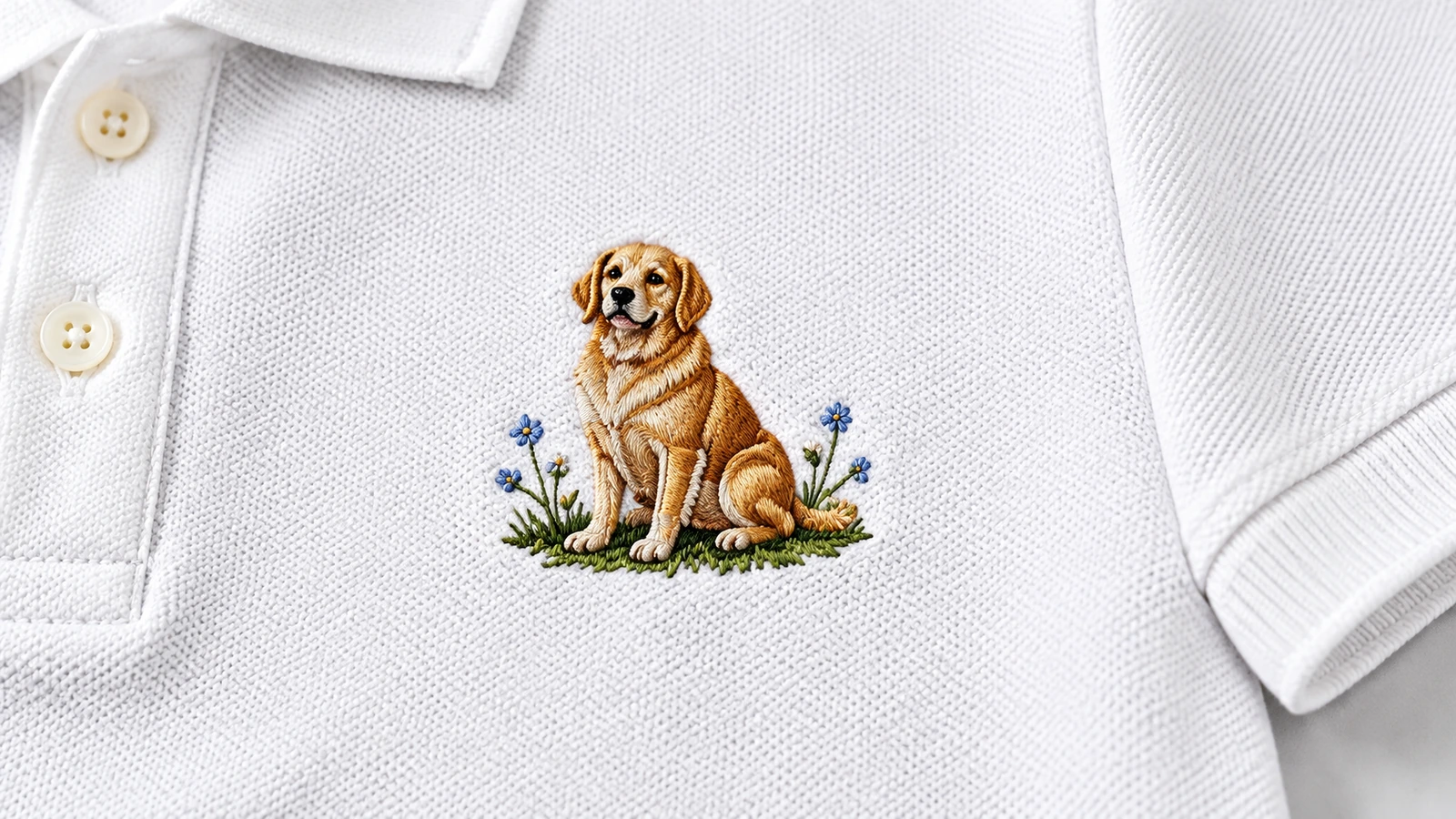
Quality Logo Products[13] attributes puckering to three causes: excess thread tension, uneven stitch spacing, and soft, thin fabric. It also advises: "If you're set on using a lightweight and/or stretchy fabric, emotionally prepare yourself to surrender some of the detail in your design."
SewFlow recommends:
- a medium cutaway stabilizer of about 2 oz;
- a second light cutaway layer for dense logos on thin piqué;
- no tearaway backing on knits, because removing it distorts the fabric;
- a 75/11 embroidery needle for mid-weight polos.
When you receive the sample, turn it inside out. Trimmed backing edges should sit flat and should not scratch skin.
Step 3: Preflight the artwork file
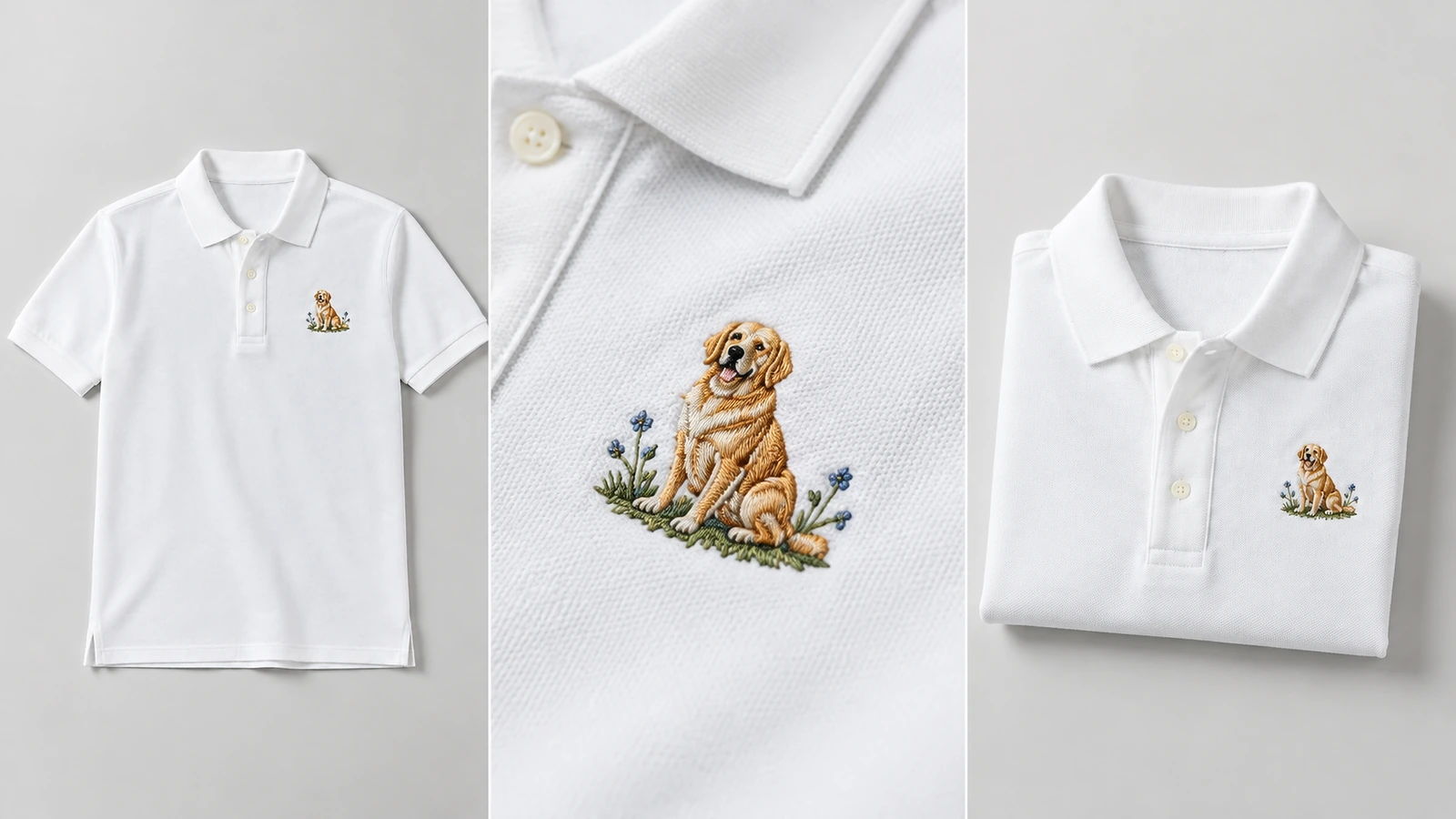
File format. Send vector artwork (AI, EPS, SVG or PDF). If you only have a raster image, supply it at 300 DPI or higher at the stitched size. Custom Ink notes that typical 72–96 DPI web images blur.
Stitch types. The digitizer assigns satin stitches to narrow letters and borders, fill stitches to larger areas, and run stitches to fine lines. Expect to approve changes such as deleted micro-text, enlarged letters or fewer colors.
Thread colors. Colors are matched from a thread chart, not printed Pantone ink. Confirm thread numbers in writing; "close to navy" is not a specification.
File storage. Archive the approved stitch file (DST, PES or similar) together with the garment style and thread numbers. Every reorder then runs from the same file.
Step 4: Approve a proof, then a physical sample
A digital proof cannot show puckering. Physical samples usually carry a fee: Stitch America[14] charges $125 per design and refunds it on a later order of at least 12 pieces. For NSKU-752-01, sample cost and timing are quoted per design.
Measure the sample's chest, body length and armhole against the size chart. Wash it once, then release bulk production. Write "fit approved per sample" into the purchase order so fit is settled before the full run is stitched.
Step 5: Run production from the approved settings
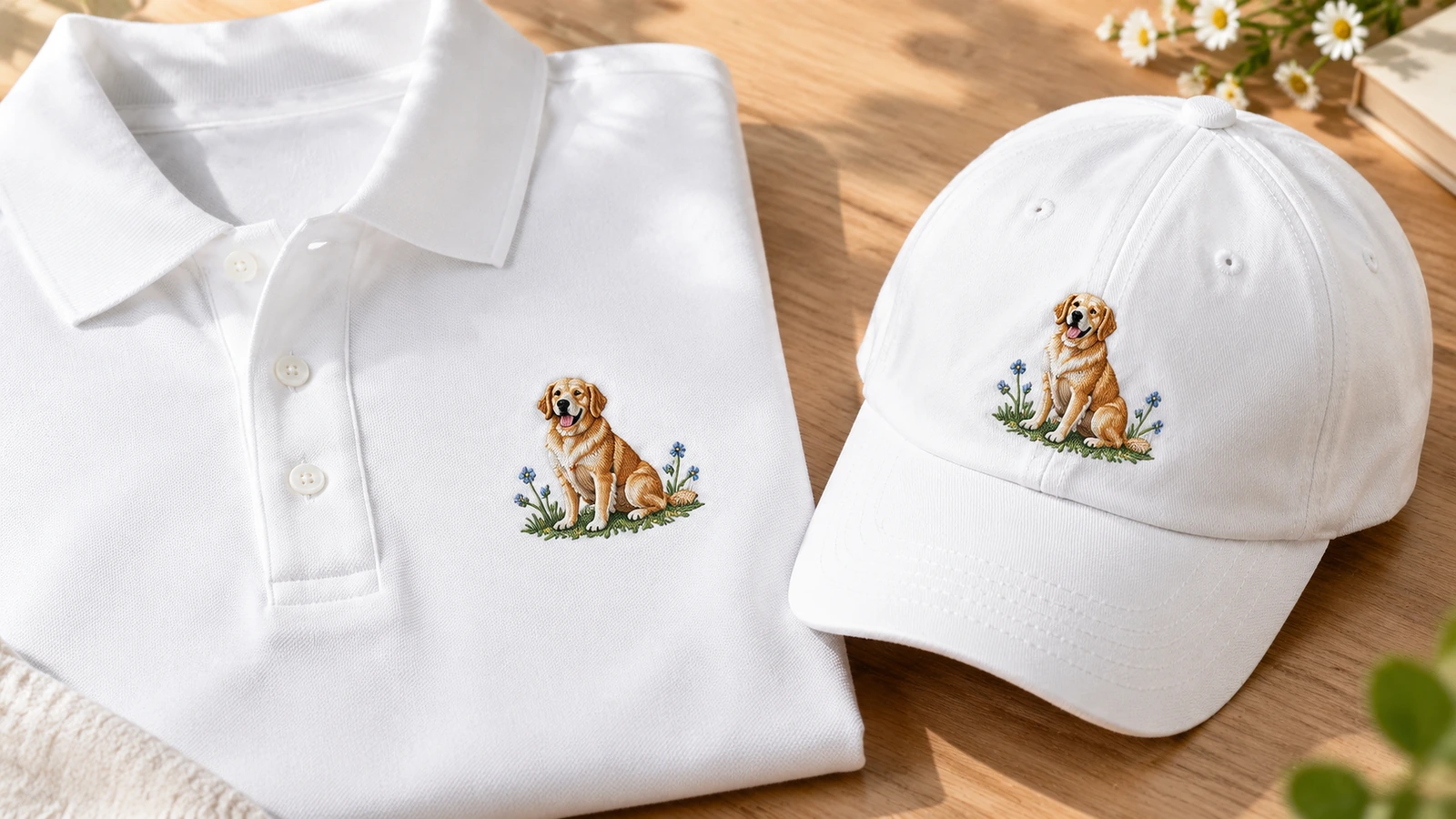
Garments should be hooped taut but not stretched. Stretched fabric relaxes after unhooping and ripples around the logo. Use a placement fixture for each size instead of eyeballing every shirt. Stop the line if the first piece deviates from the proof.
Approvals take longer than machine time. SWAGO's breakdown[15] puts typical turnaround for 50 polos at 7–14 business days after design approval and payment. A simple text logo of 3,000–6,000 stitches takes about 5–10 minutes per piece on the machine. Count lead time from proof approval, and list any days spent waiting for your approval separately.
Step 6: Inspect against written criteria
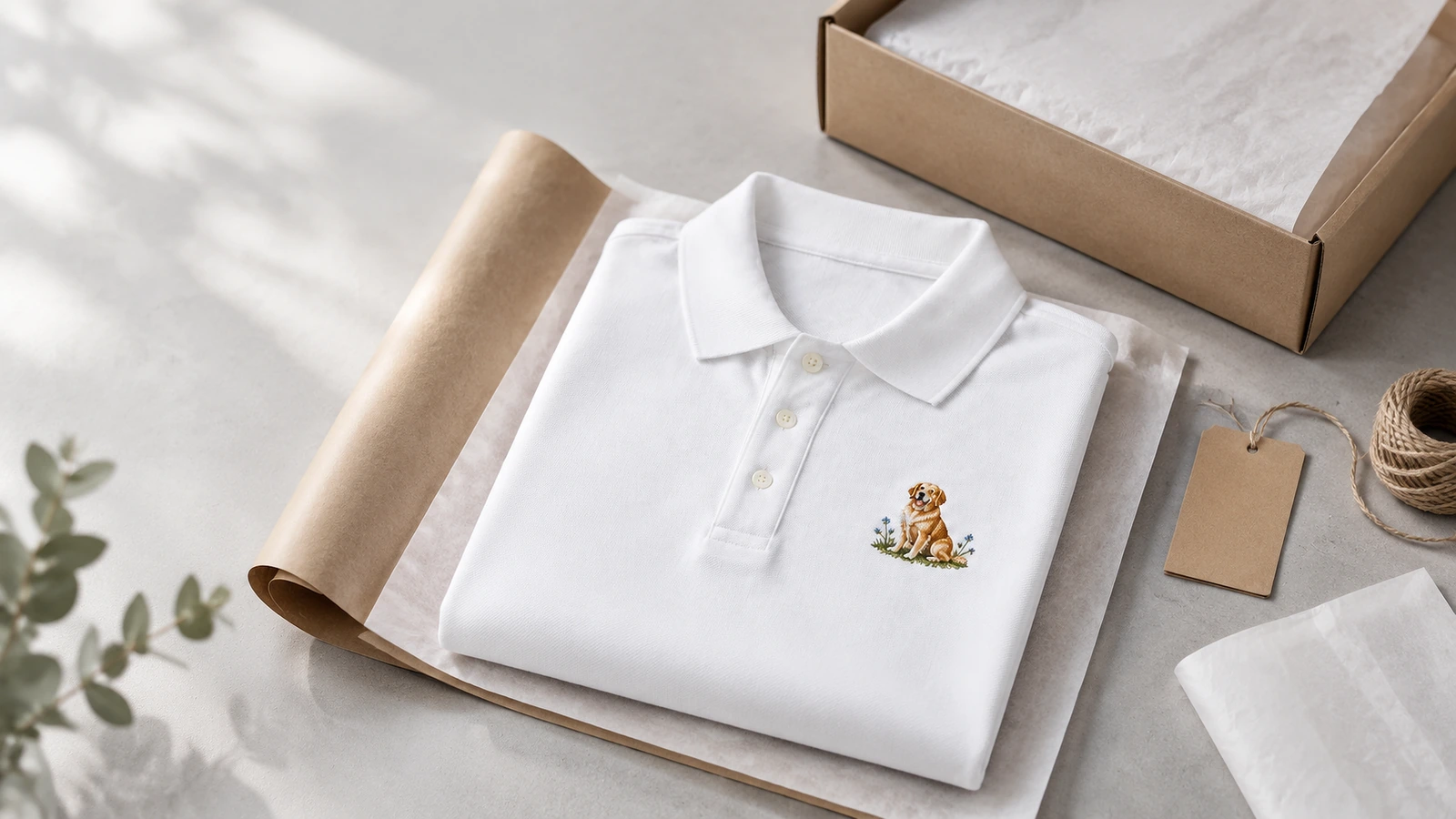
Inspect every first article and a sample of the bulk run for:
- logo position within the agreed tolerance;
- no holes and no thread build-up;
- a flat placket and collar;
- trimmed jump stitches.
Wash durability needs a named test method; the word "colorfast" alone is not enough. AATCC[16] publishes reproducible laundering procedures and test methods such as TM61 and TM135. It does not set how many washes an embroidered logo must survive. State the method, the condition (for example TM61-2A) and the pass level in your purchase order.
Misplaced logos, wrong thread colors and broken stitches qualify for a free remake. Fit complaints raised after you have approved the sample do not.
Step 7: Pack, ship and plan the reorder
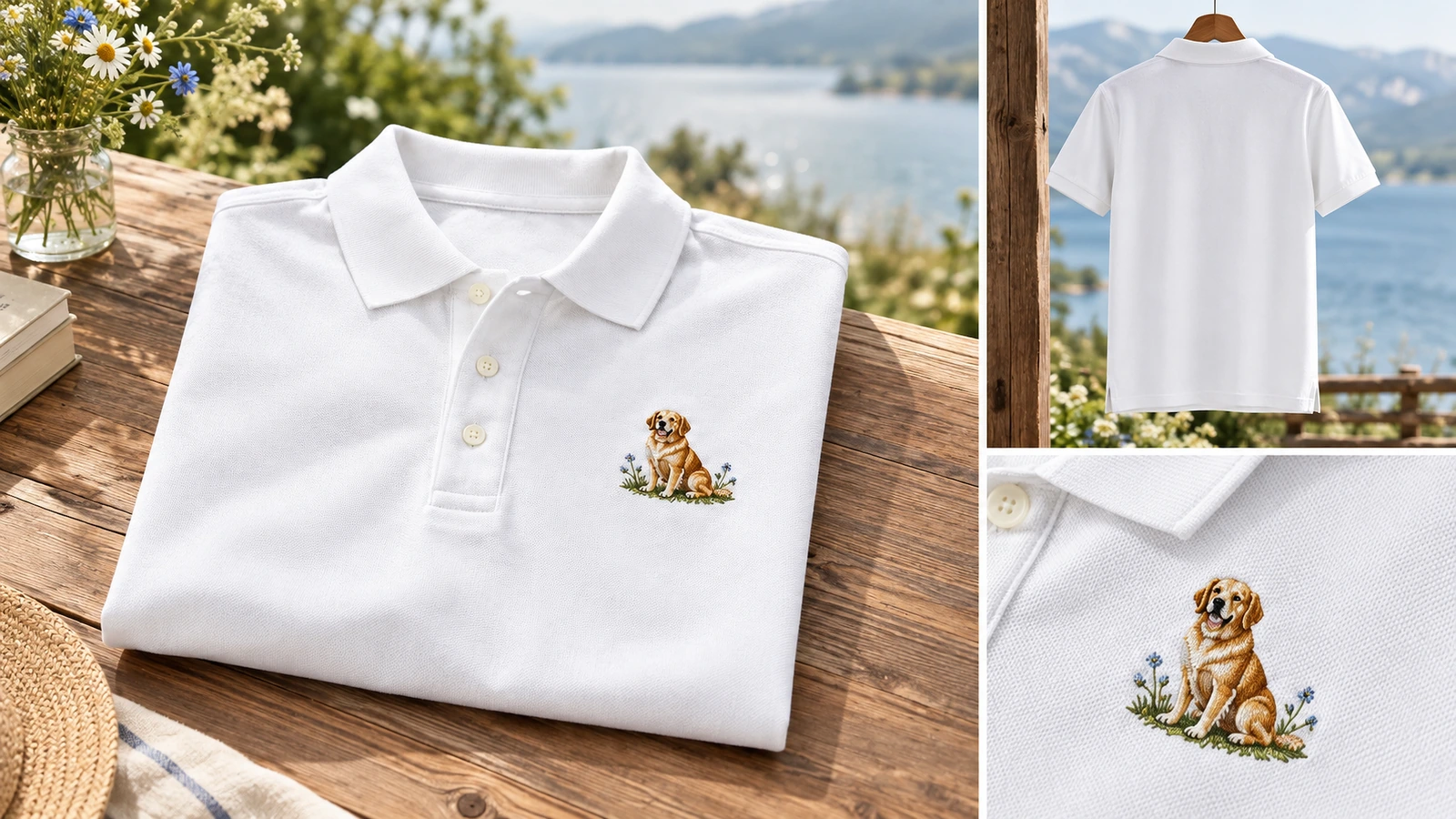
Ask for cartons labeled by size and, for uniform programs, by employee or location. Packed weight and carton dimensions depend on the final fabric, size mix and folding. They are confirmed on the quote and the shipping notice, not assumed in advance.
For reorders, settle four items in writing:
- who owns the stitch file;
- the thread numbers;
- the garment style and color code;
- the substitution rule if a color is discontinued.
Lands' End Business says it keeps its most-used uniform colors in stock so that the next quarter's reorder matches. That is a useful benchmark to raise with any supplier.
Embroidery, Screen Print or DTG: Which Method Fits Your Logo? ↑
| Method | Cost signal | Best for | Main limitation |
|---|
| Embroidery | ~$7.50–$12 per left-chest logo, plus $25–$150 digitizing | Small, solid-color logos; daily uniforms | Fine text, gradients and large fills pucker or lose detail |
| Screen print | 4-color: ~$12.47/pc at 1–11 pcs; ~$2.44/pc at 1,000+ | Large, bold, multi-color art at volume | Costly in small runs; looks less formal |
| DTG / heat transfer | Queensboro AP3 catalog: printed first piece $6.95 vs embroidered $7.95 | Gradients, small text, single pieces | Holds up less well to washing and abrasion than stitching |
The embroidery and screen-print figures come from the Custom Ink guide. That guide also says embroidery holds up through commercial laundering on textured piqué far better than screen print. The DTG comparison comes from the Queensboro AP3 3.0 page[17]. It describes embroidery as a "Classic professional look – best for logos with minimal text and solid colors" and routes fine detail to print. If your artwork depends on gradients, choose print rather than forcing it into thread.
How Do Supplier Pricing Models Change Your Real Unit Cost? ↑
| Model | Public example | Minimum | What to watch |
|---|
| Per-stitch decoration + digitizing | Custom Ink | Embroidered styles often 6–12 pcs | Digitizing works out to ~$5/pc at 10 pcs and ~$0.50/pc at 100 |
| One-time setup fee | Corporate Casuals[18]: $35 | No minimum | Setup fee sits outside the headline price |
| Embroidery included up to a stitch cap | Stitch America[19]: up to 12,500 stitches | 12 pcs or $300+; below that, $125 setup (credited later) | Stitches above the cap are billed extra |
| Free setup with a piece minimum | ePolos[20] | 12 pcs per logo; styles can be mixed | No option below 12 pieces |
| No minimum + small-order fee | ThreadLogic[21] | None; $65 fee on orders under $400 | The fee can approach the cost of a shirt |
Compare total cost, not headline price. Break every quote into three lines: blank shirt, setup or small-order fee, and shipping.
Lead times also follow different rules. Custom Ink quotes about two weeks with free standard shipping. Lands' End quotes five to seven business days of processing plus carrier transit. The Queensboro AP3 page quotes about 8 business days to ship, adds 2–3 days for new artwork, and offers no rush service.
Duties now matter as well. The USTR forced-labor Section 301 action[22] added 10% or 12.5% tariffs on 60 economies from July 24, 2026. Embroidering a shirt in the US does not change where the blank was made. A quote should therefore name its duty basis, meaning the country of origin and the entry date, rather than promise a fixed duty-paid price.
Which US Labeling and Safety Rules Apply to Embroidered Polos? ↑
Flammability. Clothing textiles fall under 16 CFR Part 1610. The CPSC clothing guidance[23] explains that the rule sorts fabrics into three classes by burn speed, and that Class 3 fabric may not be used in clothing. Manufacturers or importers issue a General Certificate of Conformity for non-exempt adult apparel. Children's apparel also requires third-party testing.
16 CFR 1610.1[24] exempts plain-surface fabrics of 2.6 oz/yd² (88.2 g/m²) or more from testing. This is an exemption condition, not an automatic pass for every piqué. Confirm with the supplier how the specific fabric qualifies.
Fiber and origin labels. 16 CFR 303.16[25] requires fiber names and percentages, the manufacturer's name or RN number, and the country of origin. Under 16 CFR 303.33[26], US-made goods that use imported fabric need qualified wording such as "Made in USA of imported fabric." An imported blank embroidered in the US cannot be labeled "Made in USA" without that qualifier.
Care labels. Under the Care Labeling Rule[27], the care label must be permanent and stay legible for the product's useful life. If the embroidery changes how the shirt should be washed, the instructions must cover the finished garment.
OEKO-TEX. OEKO-TEX certification is voluntary. From June 1, 2026, OEKO-TEX renewals[28] require certificates from direct suppliers. A certificate for the blank shirt does not cover thread or backing added later. NSKU-752-01 claims no certification on this page. Certificates and test reports apply only when your quote lists them.
Key Takeaways for Polo Buyers ↑
- A stable piqué base carries left-chest embroidery better than thin jersey. — 180–220 GSM piqué vs. jersey under 150 GSM (Source)
- Tiny text does not survive stitching. — minimum letter height of 0.2 in (~5 mm) (Source)
- Stitch count drives embroidery cost. — 5,000–10,000 stitches ≈ $7.50–$12 decoration per shirt (Source)
- "No minimum" can still carry a fee. — $65 on orders under $400 (Source)
- Import duty depends on where the blank was made. — 10% or 12.5% Section 301 rates from 2026-07-24 (Source)
- The flammability test exemption depends on fabric weight. — 2.6 oz/yd² (88.2 g/m²) for plain-surface fabrics (Source)
Ready to Approve a Sample Before You Commit? ↑
Custom embroidered polo shirts succeed when four things are decided in writing before stitching starts: the fabric, the stitch count, the placement and the inspection criteria. NSKU-752-01 pairs a cotton piqué base with a measured proof, a physical sample and written acceptance terms. Minimum order, production time and fabric weight are confirmed in your quote rather than promised up front. Send your vector logo, size breakdown and event or rollout date to request a written quote and sample for NSKU-752-01.




The information below is required for social login
Sign In
Create New Account