Custom trucker caps are mesh-back snapback caps decorated with your logo by direct embroidery, a sewn patch, or printing. The right method depends on four things: the front panel (structured twill or foam), how detailed the logo is, the quantity, and the deadline. Before production starts, put the decoration method, finished size, placement, and thread colors into a written proof and approve it.
Who Orders Custom Trucker Caps, and What Does Each Buyer Need? ↑
Search results for custom trucker caps are mostly decorator storefronts. That tells you what searchers are doing: they are comparing options before they commit to an order. Three buyer groups appear again and again, and each one measures success in a different way.
Businesses and institutions buy caps for staff, sales teams, trade shows, and client gifts. The person who approves the order is usually an owner or a marketing lead, not the person who wears the cap. Success means employees actually wear it and the order arrives before the event. Volumes run from a few dozen caps to thousands. One Bare Bones Broth buyer described ordering 2,000 custom foam trucker hats for internal and sales teams through Anthem Branding[1].
Event and gift buyers usually order 10 to 100 caps for weddings, golf trips, bachelor parties, relay races, or fantasy leagues. Their main question is whether guests will wear the cap again. A wedding planner on r/BigBudgetBrides[2] wrote that she gets "mobbed" whenever she hands trucker hats out. The same thread advises leaving off last names and wedding dates so guests keep wearing the cap afterward.
Creators and micro brands include bands, festival vendors, hat bars, and independent labels. They tend to test one sample or a small batch first and reorder later. Patch style, foam-front looks, and margin matter more to them than corporate durability. All three groups end up asking the same four questions: minimum quantity, wash durability, lead time, and proof accuracy. This guide answers them in that order.
Why Do Custom Cap Orders Go Wrong, and How Do You Prevent It? ↑
The most common failure is not a bad factory. It is an unchecked gap between the on-screen mockup and the sewn cap. One print-on-demand seller on r/printful[3] received a trucker with these problems:
The thread color was far lighter than intended, loose strings hung on the front, and the logo was "way smaller" than in the mockup. Part of the cause was the seller's own choice of a fluorescent color that the machine could not stitch.
The gap gets expensive when nobody treats the proof as a contract. A verified Trustpilot review[4] of a patch-hat decorator, dated February 2026, reads: "The product doesn't match the proof and they will not refund or remake." Foam fronts carry a second trap. In a May 2026 r/printondemand thread[5], sellers report peeling artwork and transparent PNGs that printed as a solid white box. When a wedding or tournament date is fixed, there is rarely time to redo an order.
The fix is a process. The same Printful seller resized the file and switched to the platform's own thread colors, and reported that the second cap "came PERFECTLY" in a follow-up post[6]. The steps are:
Choose the blank by its front panel. Preflight the file against thread and seam limits. Approve a proof that names the method, size, placement, and colors. Sample first if the logo is new. Inspect the delivery against that proof.
Table of Contents
What Is a Custom Mesh-Back Trucker Cap? ↑
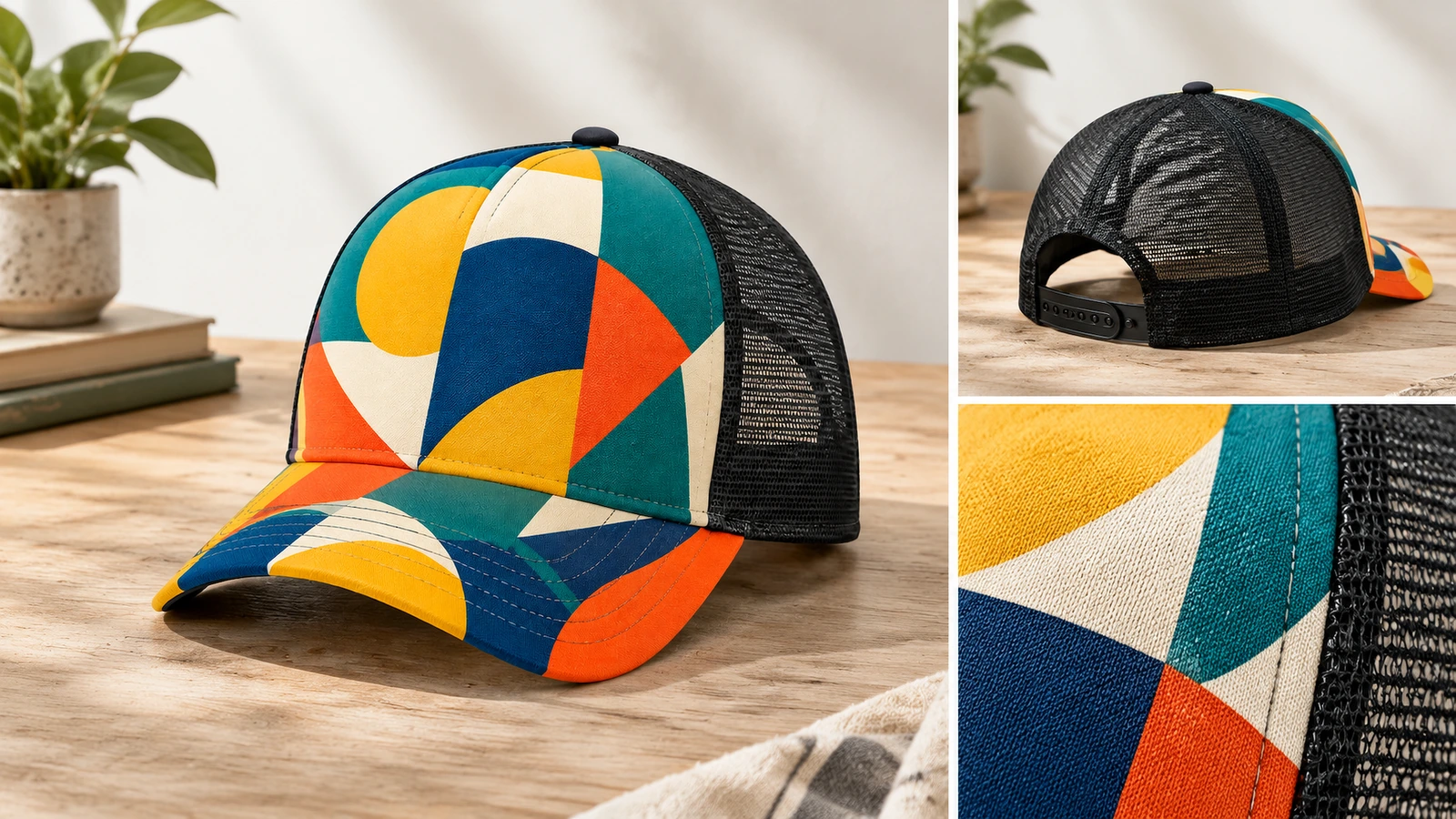
When buyers ask for a trucker cap, "they generally are wanting a mesh-back, snapback hat," as Broken Arrow Wear[7] puts it. The benchmark blank is the Richardson 112. According to the Richardson 112 spec page[8], it has:
Six panels, a mid profile, a pre-curved bill, a 60% cotton / 40% polyester twill front, a 100% polyester mesh back, and a Softsnap closure.
Fronts come in two families:
Foam fronts are typically 3–5 mm thick, light, and easy to print on. Low-grade foam can yellow under UV light, so ask for UV-stable material (Sino Finetex[9]).
Structured twill fronts are backed with buckram, which holds stitches flat. A T-Shirt Elephant review[10] reports that the 112 front handles up to 10,000 stitches without puckering when backing and hooping are correct. It also notes that the six-panel center seam runs through the embroidery area. Five-panel fronts remove that seam and suit wide patches (JoinTop[11]).
| Front or panel construction | Best-suited decoration | Watch-outs |
|---|
| Structured cotton/poly twill, 6-panel | Flat embroidery, leather or woven patch | Center seam crosses the logo; keep fine text off it |
| Structured twill, 5-panel | Wide embroidery, large patches | Confirm a seamless front on the spec sheet |
| Polyester foam front | Screen print, heat transfer, DTF | Stitches can sink into foam; low-grade foam may yellow |
| Mesh side and back panels | Small flat embroidery only | No puff, dense fill, or heavy patches |
The mesh row matters most when a buyer asks for extra decoration on the back. Mesh has no backing, so it "normally stays blank or carries small flat embroidery only." By contrast, a high-crown structured front can carry bold 3D puff logos up to about three inches (Clothing Brand Owners[12]). These are guidance figures from a design guide, not lab-tested limits. Your sample confirms what works on your blank.
Adjustable does not mean universal. The 112 is still sold in Youth, SM, MD-LG, and XL snap lengths. One size guide calculates its OSFM range at roughly 22.0–24.25 inches of head circumference (Outer Wings[13]). Sizes can also drift between batches. An Opentip review[14] reported three black caps arriving smaller than the same style in other colors. Order by head circumference, and measure one cap per color before you hand them out.
Readability is also a sizing problem. For a 112 front, Battle Born Clothing[15] recommends keeping the design within about 2–2.25 inches tall and 4.5 inches wide, which clears the top seam and the bill. Thin outlines, tiny text, and small mascots lose definition when shrunk into that zone, especially on foam.
How Do You Order Custom Trucker Caps Without Rework? ↑
Step 1: Match the front surface and closure to the logo
Start from the artwork, not the price. Text and solid shapes suit embroidery on structured twill. Gradients and photos do not. As Wholesale Caps[16] notes, artwork with gradients or photographic elements "doesn't translate well to thread." For that kind of artwork, choose a patch or a print. On foam, Broken Arrow Wear[7] recommends DTF printing and excludes foam truckers from its embroidery offer.
Next, choose the back. Plastic snaps are standard and adjust to fit most adult heads. The T-Shirt Elephant review[10] calls plastic snaps less premium than leather straps and notes that mesh backs are a poor choice for cold weather. For our Custom Mesh-Back Trucker Caps, we confirm front material, mesh color, and closure options on the written quote and the sample. We do not promise them on this page.
Step 2: Preflight the artwork file
Send vector artwork (SVG, AI, EPS, or PDF) where possible. Catalyst Caps[17] says a high-resolution PNG works for most logos. Before you request a proof, run five checks:
- Map every color to the decorator's thread chart. Neon and fluorescent tones may not stitch.
- Set a minimum letter spacing so narrow letters, such as an "i" beside a "d," do not merge.
- Keep fine text and small details off the six-panel center seam.
- For print, flatten transparent backgrounds so no white box appears.
- Confirm the finished logo width and height in inches against the front safe zone.
Digitizing fees vary. Some decorators include digitizing in the price. Embroidery Inc[18] charges a one-time $30 for new logos and waives it on orders of 12 caps or more. Ask whether the digitized file stays on record for reorders.
Step 3: Approve a written proof, then a sample
There are two kinds of proof. A digital mockup shows placement. A sewn proof shows how the thread actually sits on the cap. Embroidery Inc, for example, stitches the design on a real cap and sends a photo, usually within 24 to 48 business hours. CapsToYou[19] states the standard plainly: "What you approve in the proof is what you can expect to receive across the entire order."
Make the proof specific enough to enforce. JoinTop[11] advises fixing the "logo method, artwork version, size, placement, and clear space" before sampling. Also add the blank style and color, the thread or patch colors, and the closure type. Request a physical sample for first orders or complex logos. Sampling time and fees for our caps depend on your configuration; we state them on the quote.
Step 4: Inspect the delivery against the proof
| Check | Method | Reject or escalate if |
|---|
| Logo size and placement | Measure against proof dimensions | Visibly smaller or off-center versus the proof |
| Thread or patch color | Compare to the approved chart in daylight | Shade differs from the approved color |
| Stitch finish | Inspect the front and trim points | Loose threads, puckering, merged letters |
| Patch or print attachment | Check edges and the decoration type | Lifting edges, or a print supplied instead of a patch |
| Fit by color and batch | Measure circumference at the same snap setting | Sizes differ between colors or cartons |
| Closure and mesh | Cycle the snap; tug the mesh lightly | Broken snaps, torn or loose mesh |
Before you pay, agree in writing on the inspection sample size and the remake terms. Print failures show up quickly. A verified Custom Ink product review[20] from September 2025 reads, "Logo peeling off, no time to fix." Keep the approved proof file and order number, so any claim compares the cap to a signed document rather than to memory.
Step 5: Plan delivery, packaging, and reorders
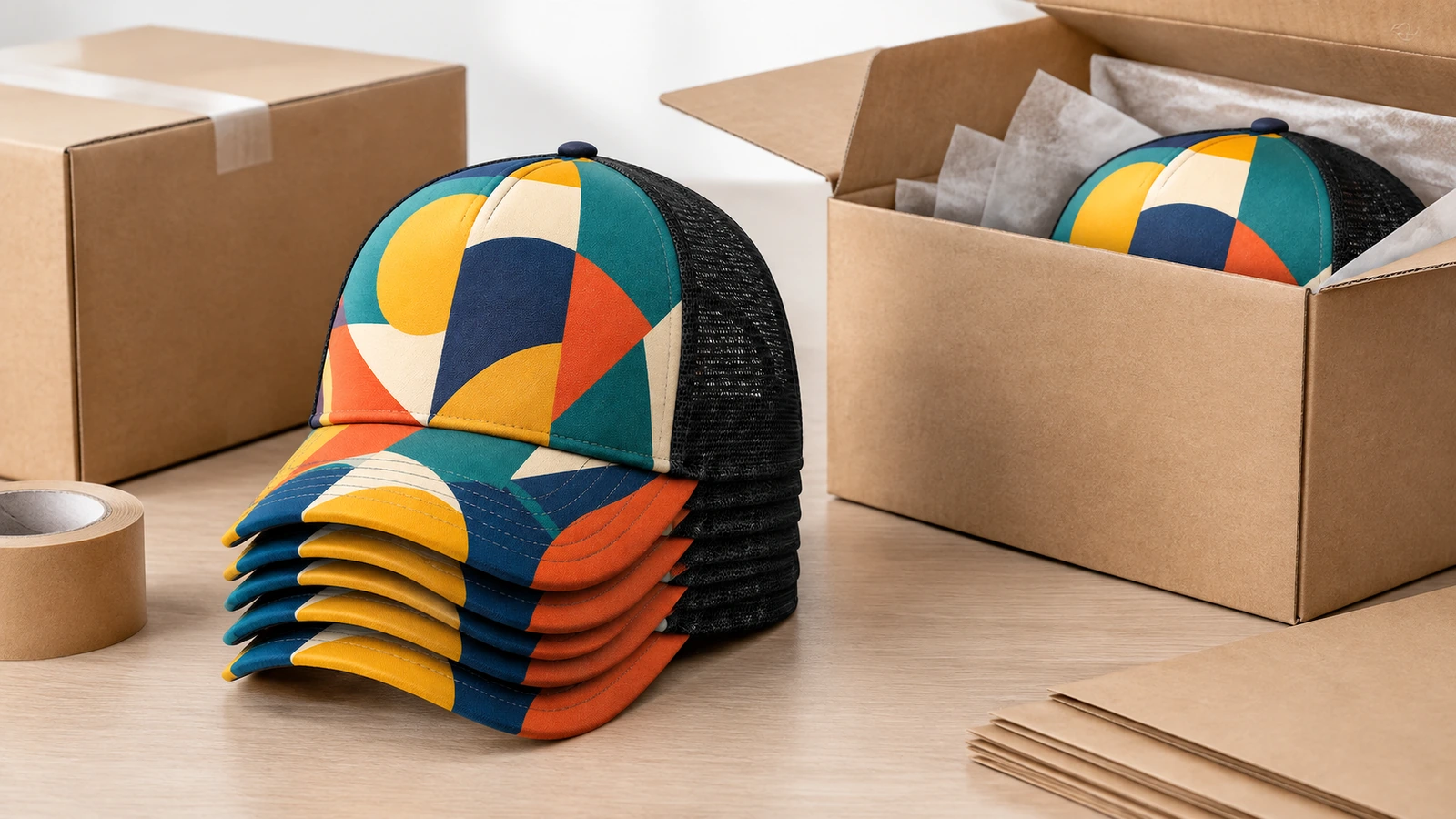
Lead time starts at proof approval, not at your first inquiry. Add time for proof rounds, blank availability, and shipping. Then build in a buffer of at least three to four weeks before a fixed event date. Pack the caps so the crowns are not crushed in transit. We confirm the packing method, carton count, and unit weight for our caps on the quote and with the sample.
For reorders, archive the digitized file, thread codes, blank style number, and a photo of the approved proof. Buyers comparing decorators on r/RunYourBusiness[21] ranked "consistent reorders" alongside quality and price. They also argued that embroidery is "more cost-effective in the long run" because it survives wear better, even though it costs more upfront.
Which Decoration Method and Ordering Route Fit Your Budget? ↑
The prices below come from published buying guides and decorator pages. They include the blank and one front decoration. They exclude rush fees, shipping, and extra decoration locations. Treat them as 2026 benchmarks, not as quotes.
| Method | Published price signal | Best for | Main risk |
|---|
| Direct embroidery | About $9–$12 per cap at 50 units on a mid-range blank; Richardson 112 adds about $3–$5 (Arklavo[22]) | Text or solid-shape logos; caps washed often | Gradients, photos, and tiny text fail |
| Sewn patch (woven, leather, PVC) | Roughly $2–$4 more than direct embroidery (Arklavo[22]) | Fine detail, retail look | Longer lead time; a "patch" may turn out to be printed |
| Heat transfer or DTF print | About $7–$10 at 50 units; about $3–$5 at 500 (Arklavo[22]) | Photos, gradients, foam fronts | Shorter wear life; risk of peeling |
| 3D puff embroidery | Quoted per design | Bold, thick lettering on structured fronts | One user reports it "doesn't work well on trucker caps" (r/printondemand[23]) |
The pattern is consistent. Print wins on cost and image detail. Embroidery wins on wear life. Patches win on retail feel, at a premium. A cheap print on a foam front is fine for a one-day giveaway, but staff caps worn every week justify embroidery on a structured blank. Puff is worth testing only with a sewn sample, because practitioners report mixed results on curved trucker fronts.
| Ordering route | Published minimum | Published timing | Fits |
|---|
| No-minimum local embroidery | 1 cap (Embroidery Inc[18]) | Sewn photo proof in 24–48 business hours | Samples, very small teams |
| US decorator | 36 embroidered, 25–50 patch (CapsToYou[24]); 12 per style at Wholesale Caps[16] | Standard orders ship in 2–6 weeks (CapsToYou) | Teams, events, staff |
| Patch specialist | 24 caps (Custom Patch Hats[25]) | 2–6 weeks after payment | Patch-led brand merchandise |
| Branded full-custom import | 144 per style and color (Anthem[1]) | Samples 15–20 business days plus air freight; bulk about 30–35 days plus shipping | Large runs on a custom blank |
Minimums and timing shift with the decoration method. Patches take longer because the patch has to be made first. Import pricing also moves with tariffs; Anthem[1] notes that duty changes require requotes. For our Custom Mesh-Back Trucker Caps, the MOQ, sampling time, and production time are set on a written quote for your configuration. We do not publish fixed figures until they are verified.
What US Labeling and Safety Rules Apply to Custom Caps? ↑
Fiber content. Headwear generally sits outside the FTC Textile Rules (16 CFR Part 303[26]). Two exceptions apply. Wool hats fall under the Wool Rules. And any fiber claim, such as "100% cotton front," brings the full fiber-content disclosure requirements back into play. Describe materials accurately, or leave fiber claims off entirely.
Care labels and flammability. The Care Labeling Rule defines textile wearing apparel so that it excludes "hats or other articles used exclusively to cover or protect the head" (16 CFR §423.1[27]). That makes care instructions on adult caps voluntary. Fabrics for excluded hats are also outside the main clothing flammability requirements, provided the invoice and recordkeeping conditions are met (16 CFR §1610.36[28]).
Children's caps. Caps designed primarily for children 12 and under are children's products. They need tracking labels, certification, and third-party testing (CPSC tracking label guidance[29]).
Origin claims. A cap sewn in the US from imported fabric should say "Made in USA of imported fabric," not a plain "Made in USA" (16 CFR §303.33[30]). Any colorfastness or UV claim needs a verifiable lab report behind it. Confirm the specifics with compliance counsel before you print labels or listings.
Key Takeaways: What Should Cap Buyers Remember? ↑
- The US headwear category that custom caps sit in is growing. — USD 7.8 billion in 2025, projected to reach USD 12.7 billion by 2033 at a 6.4% CAGR (Source)
- Caps, including trucker styles, are the largest headwear segment. — 37.9% of global headwear revenue in 2025 (Source)
- Custom demand peaks in gift season. — Etsy "custom trucker hat" averages about 14,800 monthly searches and peaked near 22,200 in November 2025 (Source)
- Logo size must respect the front safe zone. — about 2–2.25 in tall and 4.5 in wide on a Richardson 112 (Source)
- Adult hats are excluded from the federal care-label rule. — 16 CFR §423.1 definition excludes hats (Source)
What Is the Smartest Next Step for Your Cap Order? ↑
Good custom trucker caps come from decisions made in the right order:
First, choose the front panel that suits your logo. Second, preflight the file against thread and seam limits. Third, approve a proof that names the method, size, placement, and colors. Fourth, sample when the design is new. Finally, inspect the delivery against the signed proof.
Price, minimum, and lead time follow from those choices, not the other way around. Send us your logo file, target quantity, and in-hands date to request a written quote and proof for our Custom Mesh-Back Trucker Caps.




The information below is required for social login
Sign In
Create New Account