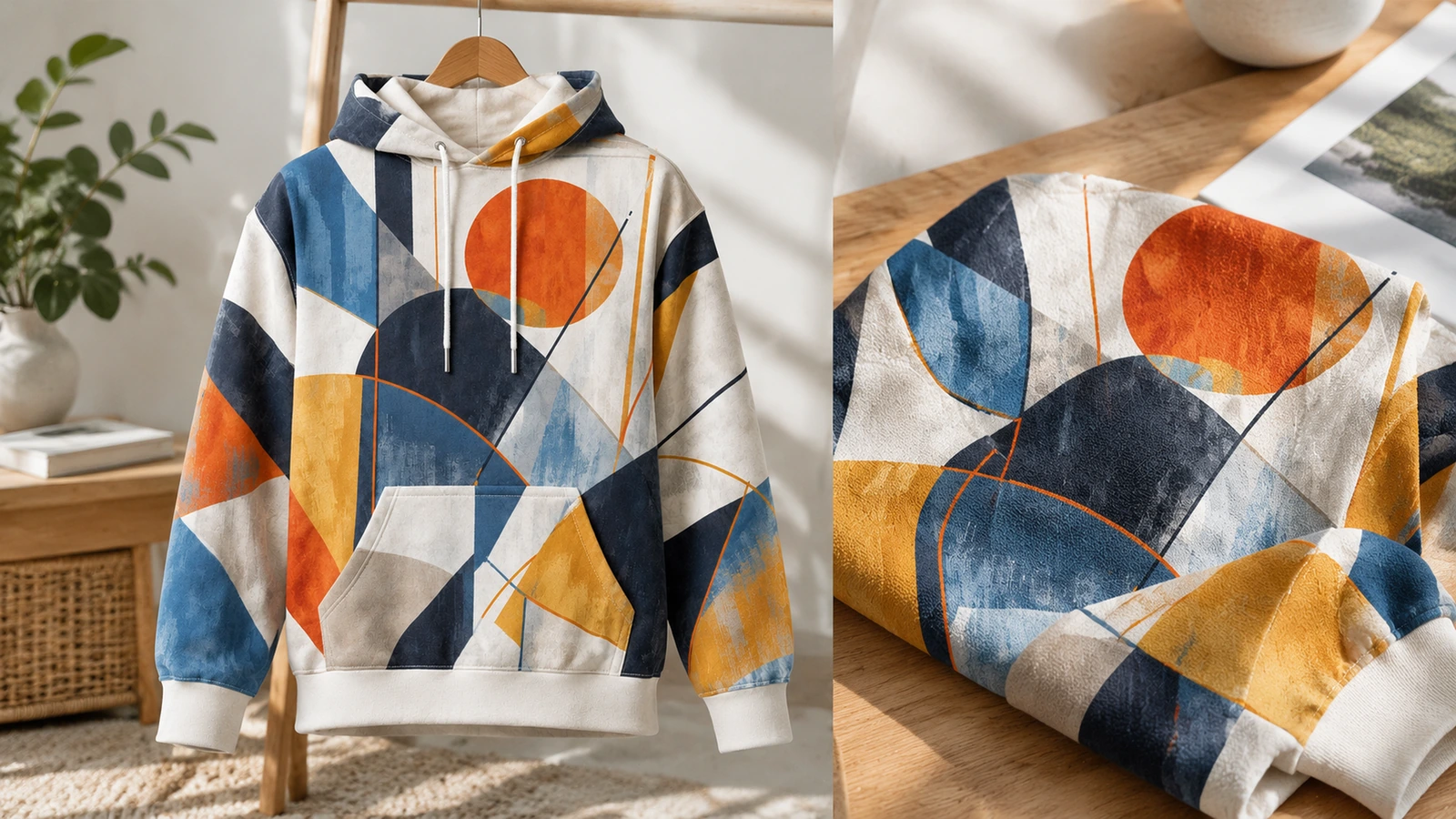
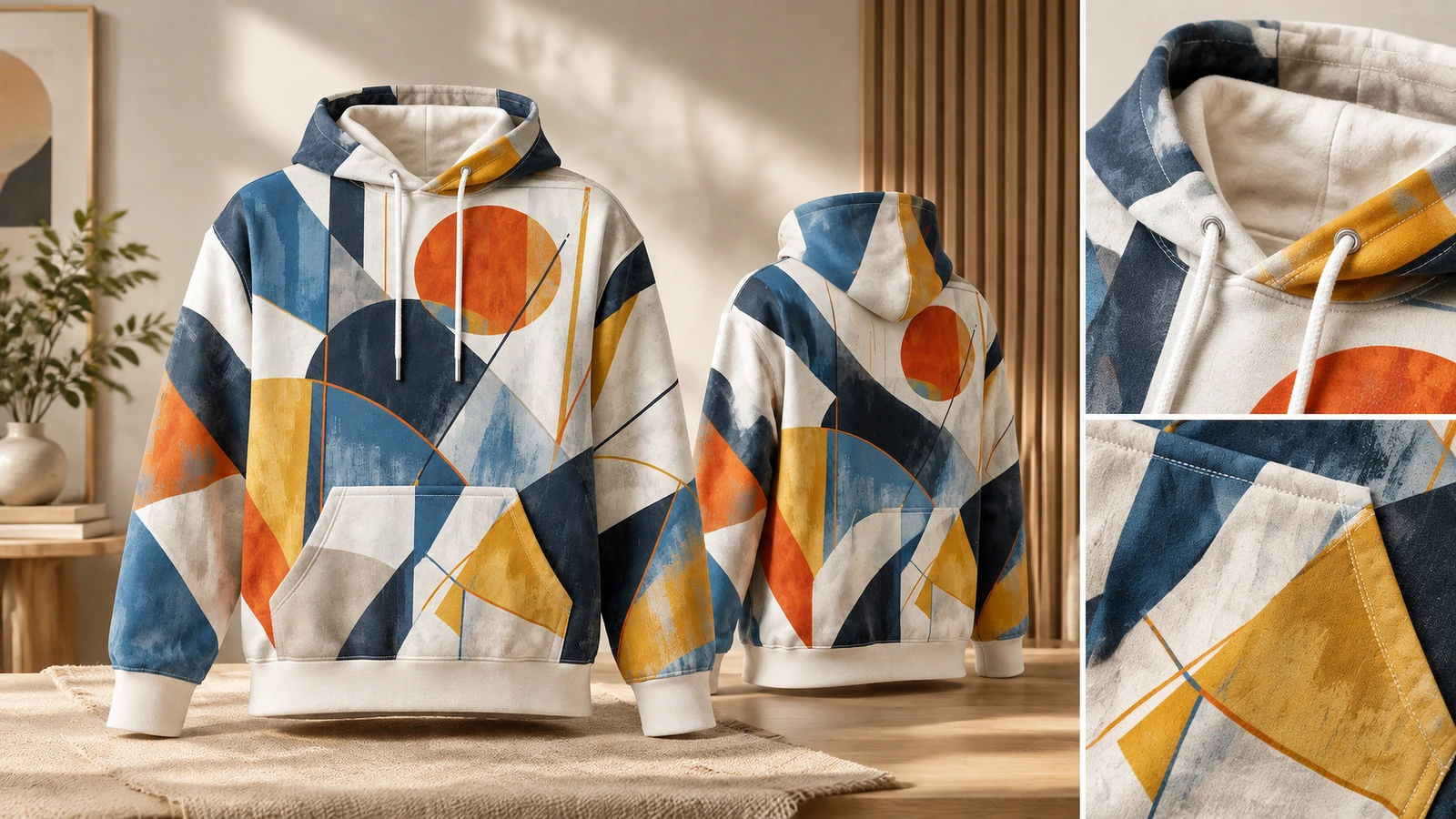
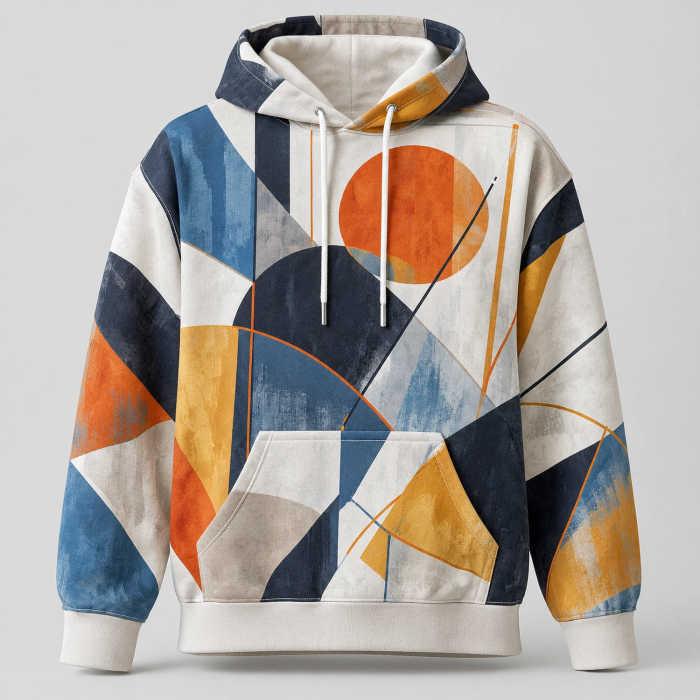
A custom printed pullover hoodie has an uninterrupted front panel, so full-chest graphics can sit alongside back, sleeve, and hood placements. Most orders succeed or fail on four choices made before production: the decoration method, the blank's weight and fabric face, a signed physical sample, and a written standard for wash and size acceptance.
Who this page is for. It covers four kinds of buyer. Coaches, PTA volunteers, and club advisors order mixed-size spirit wear. HR and office managers build onboarding kits. Site supervisors want a small chest logo on heavier fleece. Creators sell limited merch drops. Each group needs a different blank and decoration, so this page compares routes instead of pushing one. In group orders, sizing is the most common source of friction, as noted in the Custom Ink bulk hoodie guide[1]. Collecting sizes is therefore part of the job, not an afterthought.
The problem: most hoodie complaints start after the box is opened. A pullover can pass a first look and still fail later. In one print-cracking case study[2], a back print developed fine cracks in its heaviest ink zones after washing, and the cracks widened when the panel was stretched. A verified buyer review[3] reported that the blue in the delivered design was "dulled down quite a few shades." The same buyer said the front graphic was "shrunken almost by half" compared with the template they submitted.
Why it hurts: group orders are tied to fixed dates, so there is rarely time to reprint. Cheap blanks add another way to fail. One wholesale blank guide[4] gives an example of smalls shrinking 4% while XLs shrink 7%, which breaks the size curve after the first wash. Those figures illustrate the problem and are not a lab standard. Bulk production can also drift away from an approved sample if it uses a fabric lot that shrinks differently, as described in this shrinkage explainer[5].
The fix: treat the hoodie as a specification, not a mockup. For SKU NSKU-753-01, the minimum order quantity, production time, and blank weight are not published in advance. They appear on your written quote and are confirmed on a signed physical sample. Wash durability stays a pending test item until that sample has been laundered and graded. The sections below explain how to set each requirement.
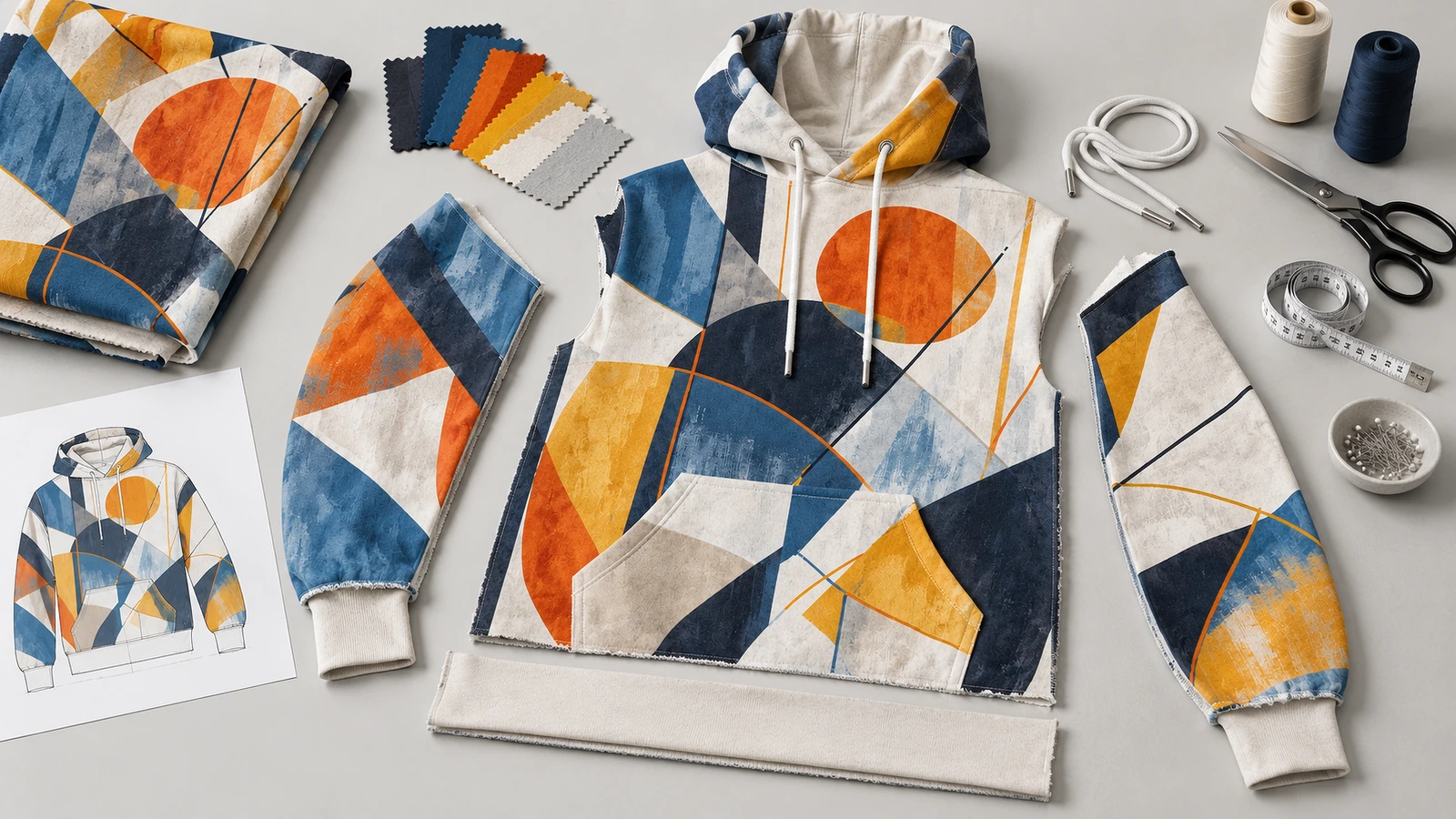
Table of Contents
What Is a Custom Pullover Hoodie, and When Is It the Wrong Choice? ↑
A pullover hoodie has no center-front zipper, so the whole front panel is one continuous print surface. The Custom Ink hoodies guide[6] (May 2026) calls pullovers "the most popular choice across all order types" because the uninterrupted front gives the most design space. On a full-zip, the zipper runs through any front graphic, so artwork moves to the left chest or the back. The same guide says custom hoodies on its site typically cost $20 to $45 per piece. It places budget 50/50 pullovers at about $20–$28 for large events and schools.
A zip or quarter-zip is the better choice when wearers layer over collared shirts or take the garment on and off all day. A pullover does not solve that. Some searches are really for branded workwear, such as a Carhartt hoodie with a small logo, and that is a different purchase. Carhartt's Brand Your Gear rules[7] require 6 units with the same fabric, logo area, and logo file. Logos are capped at 3.25 inches wide.
Which Decoration Method Fits Your Artwork, Quantity, and Fabric? ↑
Choose the method from the artwork, not from the equipment. Photos and gradients rule out embroidery. Small left-chest logos suit it. Artwork with few colors on larger runs suits screen printing. Custom Ink's printing-methods guide[8] recommends DTG for photos on cotton-face fleece and DTF for full color on any fleece, including dark colors.
| Method | Best fit | Published minimum | Watch-outs |
|---|
| Screen printing | 1–6 spot colors, larger runs | About 12–24 pieces | Setup cost per color; heavy ink zones can crack when stretched |
| Embroidery | Left-chest logos, uniforms | About 12–13 pieces | About 15 thread colors; no photos or gradients; best on 8 oz+ fleece |
| DTG | Photos, very small runs | 1 piece | Needs cotton-face fleece; colors look dull on dark fabric without an underbase |
| DTF | Full color on dark or poly-blend fleece | 1 piece | White underbase gives truer color; the film-like hand is less soft than screen print |
These minimums come from one supplier's May 2026 guidance. They are not an industry rule. A June 2026 decoration-methods guide[9] puts embroidery at about $6–$8 more per location than print. It also notes that high-pile fleece and sherpa cannot be screen printed cleanly. Combining methods is common, for example an embroidered chest logo with a screen-printed back.
Placement decides whether a design reads well from a distance. Front print areas usually run about 10–12 inches wide by 12–14 inches tall, and a left-chest mark is about 3.5–4 inches square, according to Custom Ink's sweatshirt sizing guide[10]. Its screen-printing do's and don'ts[11] advise printing above the kangaroo pocket, not across it, and keeping artwork about two inches from structural seams. Fine text near the pocket opening is the first detail to lose legibility.
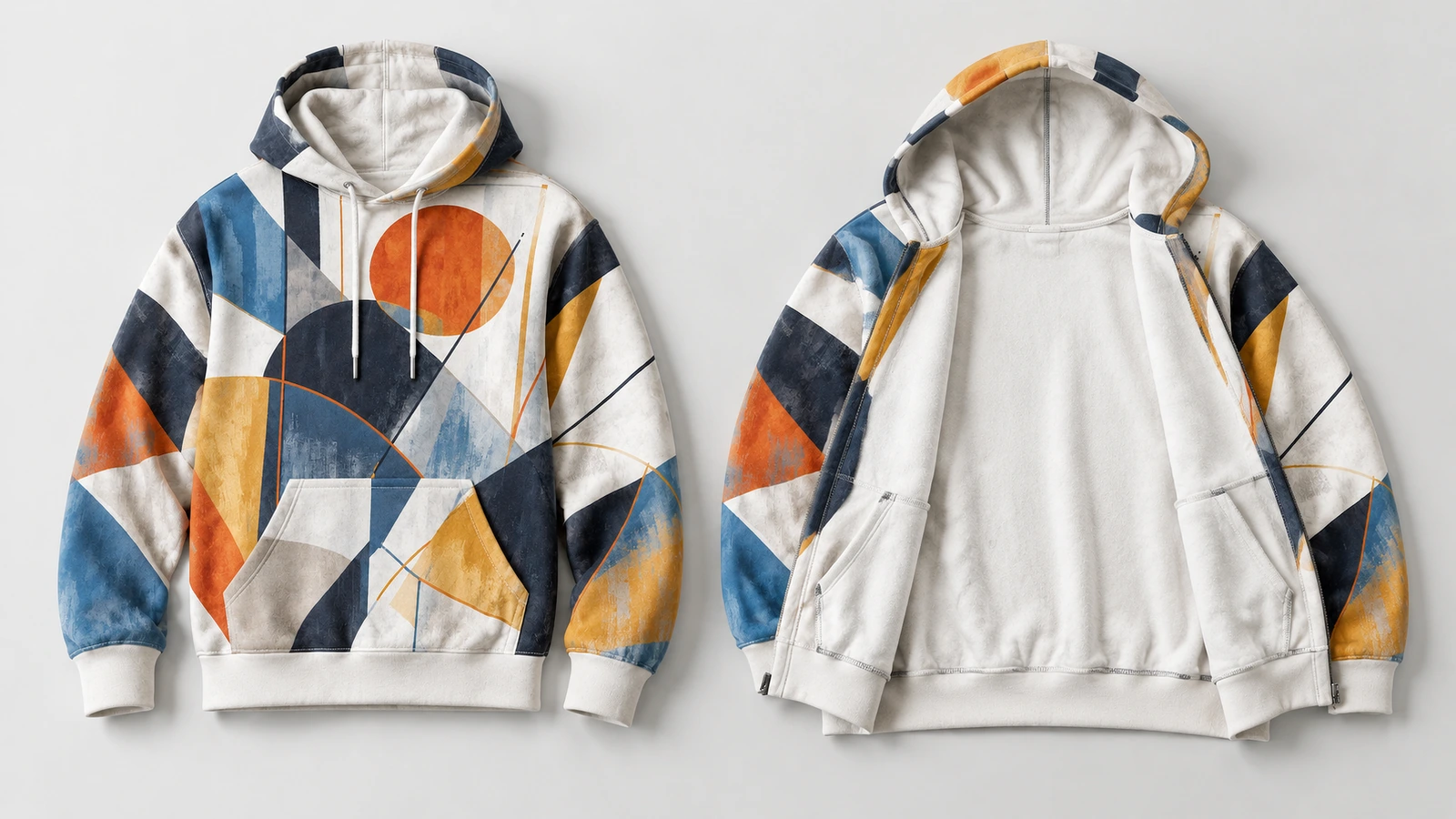
How Do Blank Weight and Fabric Face Change the Print? ↑
Put the weight in oz/yd² and the cotton/poly ratio in writing. Words like "heavy" or "premium" on their own are not specifications. The tiers below summarize published blank examples.
| Tier | Example blanks and weight | Typical use |
|---|
| Budget, about $20–$28 | Gildan Midweight 50/50 at 8.0 oz; Hanes EcoSmart at 7.8 oz (Custom Ink) | Large events, school groups, screen-printed spirit wear |
| Mid, about $28–$38 | Independent SS4500 at 8.5 oz, cotton-face yarn (Custom Ink) | Staff wear, DTG on cotton face |
| Gift, about $38–$45+ | Comfort Colors 1567 at 9.5 oz; Sport-Tek F281 at 12.0 oz (Custom Ink) | Client gifts, cold outdoor use, embroidery |
Prices are one platform's May 2026 guidance and move with quantity and decoration. Spec pages from the blank maker are the most reliable source. Gildan's 18500 page[12] lists 8 oz/yd² and names screen print, embroidery, heat transfer, appliqué, and DTG as compatible decorations. Gildan's own pages state the fiber ratio differently by color, so quote the page for the exact color you are buying.
Fabric face matters as much as weight. DTG needs a cotton face. Dark or poly-rich fleece shows truer color with DTF. Printers also report that the same style can vary by country of production. In one r/SCREENPRINTING thread[13], half of one style's batch had a smooth print surface. The other half was fluffy enough to shift on the press. For this reason, the sample and the bulk order should use the same blank, color, and lot wherever possible.
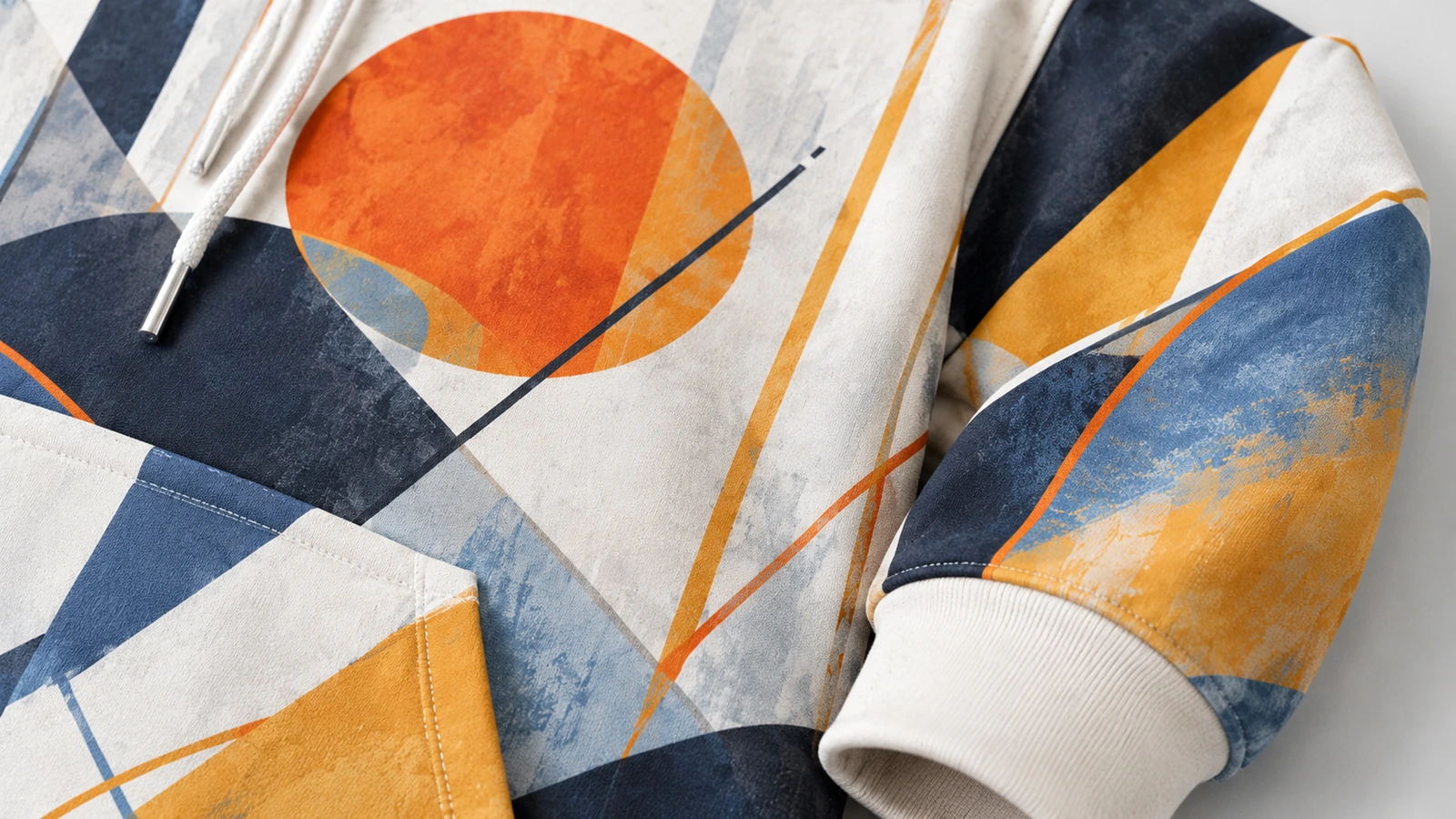
How Do You Order Custom Pullover Hoodies Without Surprises? ↑
Step 1: Preflight the artwork and rights
Send vector files for screen printing and embroidery, and high-resolution images for DTG or DTF. Embroidery artwork must be digitized and should not be sent straight from a print file. If the design uses a university, league, or trademarked mark, upload written authorization before you pay. BBB complaint records[14] include homecoming and memorial designs that were cancelled after the customer had already been charged.
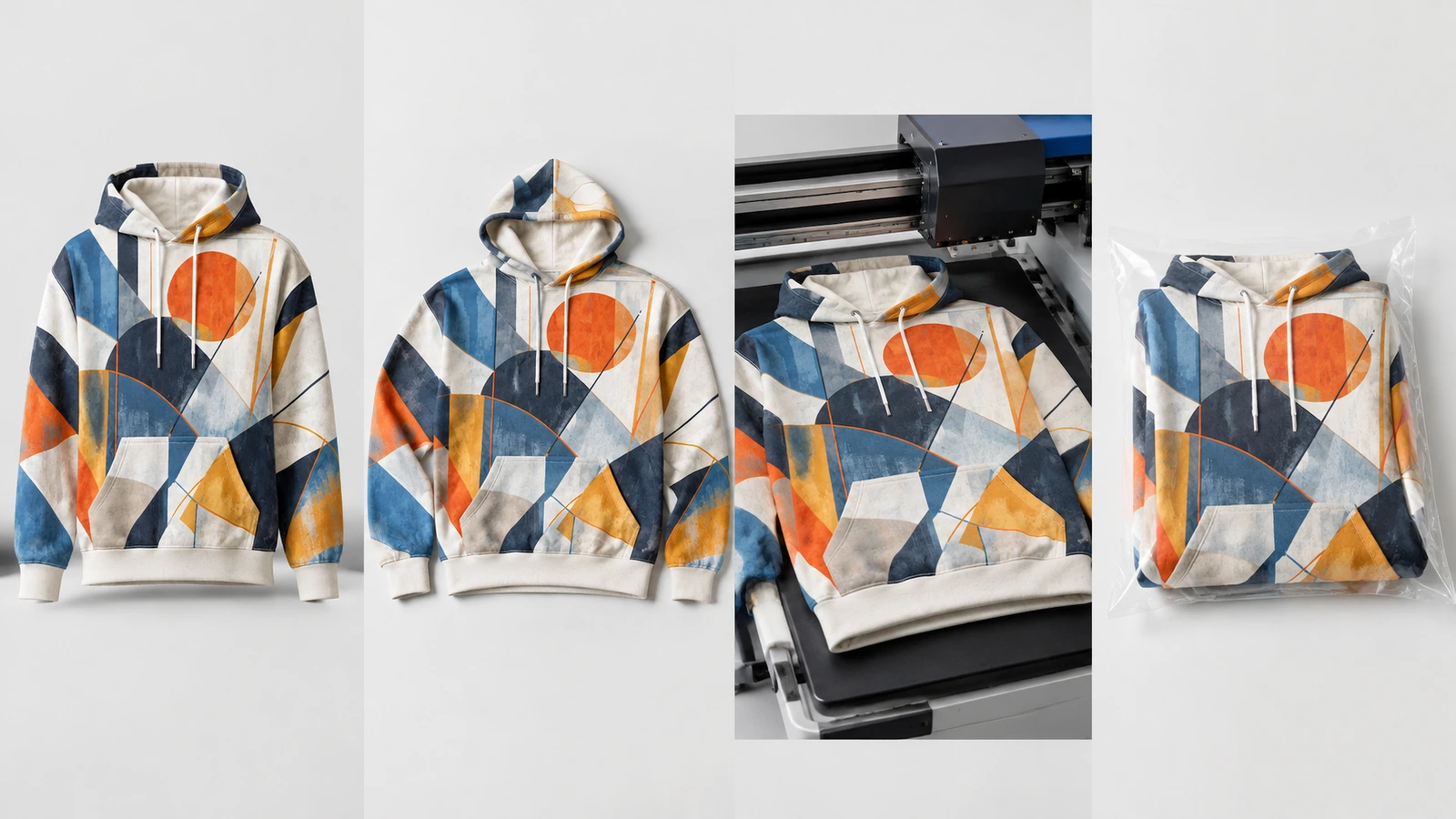
Step 2: Lock the method and blank in writing
The order should name the method, the Pantone or thread colors, and the placement dimensions. A request for "full color print" is not specific enough. Small runs are the most likely to be switched to a different method. RushOrderTees says true screen printing[15] typically needs at least 15 units per unique color, and smaller orders usually go to HD Digital. Its order-process page[16] says that only orders of 16 or more pieces can choose proof approval. Smaller orders and reorders are approved automatically. It also warns that a reorder's "print method used may differ from the original order."
Step 3: Approve a physical sample
Record the blank brand and color, the weight, the method, the print position, and the ink or thread colors on the sample. This sample becomes the color master for the whole order, because screens shift color. Count proof-approval days separately from production days. Production time for NSKU-753-01 is set on the quote and starts after you approve the sample.
Step 4: Control production variables
According to this cracking explainer[17], cracking can trace back to curing temperature, heat-press settings, uneven adhesive powder, or ink quality. Hot washes and high-heat drying make it worse. This manufacturing walkthrough[18] lists drawcords, pocket fabric, and woven labels as key trims. It recommends writing reinforcement such as double-needle seams into the tech sheet rather than agreeing it verbally.
What Should You Check Before Accepting the Bulk Order? ↑
Agree on the acceptance criteria before production starts. If you wait until delivery, the discussion becomes a negotiation.
| Check | How to test | Acceptance basis |
|---|
| Placement | Measure against the proof with a ruler and photograph on delivery day | Maximum offset in mm written into the order |
| Color | Compare with the signed physical sample, not a screen | The sample is the master standard |
| Dimensions | Measure chest, length, and sleeve for each size | Written tolerance; ±1.5 cm is one supplier's internal reference, not ASTM |
| Wash durability | Accelerated laundering test plus five home washes, checking for cracking and peeling | Grade agreed in advance; pending sample test |
| Sampling | AQL 2.5 inspection | Lot size and accept/reject numbers stated in the QC agreement |
Name a test method for wash durability rather than accepting a marketing line. Under AATCC TM61[19], one 45-minute accelerated test roughly approximates five typical home launderings, and results are graded on a grey scale where 5 means no change. TM61 is voluntary and does not grant market entry. For comparison, Real Thread[20] says its water-based prints feel smooth "on wash number fifty." That is a seller claim, not a published lab report. Three Layer's guide adds a simple rule: if a decoration cracks, peels, or puckers after five washes, the problem will be worse at scale.
Which US Rules Apply to Fleece Pullovers? ↑
Clothing textiles fall under 16 CFR Part 1610. CPSC guidance[21] names fleece as a raised-surface fabric and lists unlined hoods as exposed parts. This means the exemption for plain fabrics of 2.6 oz/yd² and heavier does not carry over to fleece. Under 16 CFR 1610.4[22], a raised surface is Class 1 if its burn time is over 7.0 seconds. Class 3 fabric may not be used in clothing. The amended standard in Federal Register 2023-23388[23] took effect on April 22, 2024. Non-exempt adult apparel needs a General Certificate of Conformity. Sizes intended mainly for children 12 and under also need third-party testing, a Children's Product Certificate, and permanent tracking labels[24].
Labels are a separate requirement. Under 16 CFR 303.16[25], the label must list each fiber at 5% or more by weight in order of predominance, along with the manufacturer's name or RN and the country of origin. 16 CFR Part 423[26] requires regular care instructions at the point of sale. If you switch from a 50/50 blank to a 60/40 blank, the label must change too. Sales into California also need a separate Prop 65 review of inks and trims. Do not advertise a hoodie as flame resistant unless you have a test report on that finished batch.
How Do Supplier Routes Compare on Minimums, Price, and Fit? ↑
| Route | Minimum | Price signal | Best for |
|---|
| Custom Ink | None on select styles; screen and embroidery about 12–24 | $20–$45 per piece, decoration included (guide) | Group orders where each member pays separately |
| RushOrderTees | No minimum for print; 6 for embroidery[27] | Six-unit test in 2024: $40.08–$171.10 per unit[28] | Deadline-driven orders |
| UberPrints | None for digital; 12 for many screen-printed styles | 100 pieces: $21.04 Gildan Heavy Blend, $38.15 Independent heavyweight[29] | Single pieces and photo designs |
| Real Thread | 20 units; standard turnaround about 10 business days plus shipping | No public unit price | Soft-hand, water-based brand reorders |
| Carhartt Company Gear | 6 units; up to 2 locations; about 30 business days[30] | Price driven by the premium blank | Work crews, small logos |
| NSKU-753-01 (this page) | Stated on your written quote | Quoted by method, color count, and quantity | Teams and companies that need a signed sample |
Only compare rows on the same terms: the same blank, method, quantity, and shipping. Custom Ink's range includes decoration. Carhartt's price comes mostly from the garment itself. The RushOrderTees figures come from a 2024 test and are not current prices. Carhartt's FAQ also says it provides no physical embroidery samples and that setup fees are not refunded if a logo is rejected. Demand for higher-end finishes is real: Custom Ink's own 2026 survey found that 53% of swag buyers were very or extremely interested in embroidery. Because Custom Ink ran the survey itself, read that figure as vendor research.
What Drives Landed Cost and Reorder Consistency? ↑
Imported blanks change the cost math. As of October 1, 2026, one reading of the tariff schedule by this HTS tool[31] puts cotton knit pullovers under HTS 6110.20.20 with a 16.5% MFN rate. For a China-made cotton pullover, its example totals 36.5% once the 12.5% forced-labor surcharge effective July 24, 2026 is added. Its polyester example totals 52%. Confirm with a customs broker before you buy. For context on the wider market, PPAI[32] estimates that US promotional distributor sales reached $27.1 billion in 2025, up only 1.3%. In its words, many distributors "sold more but made less." Expect suppliers to list rush fees and decoration upgrades separately rather than bundling them.
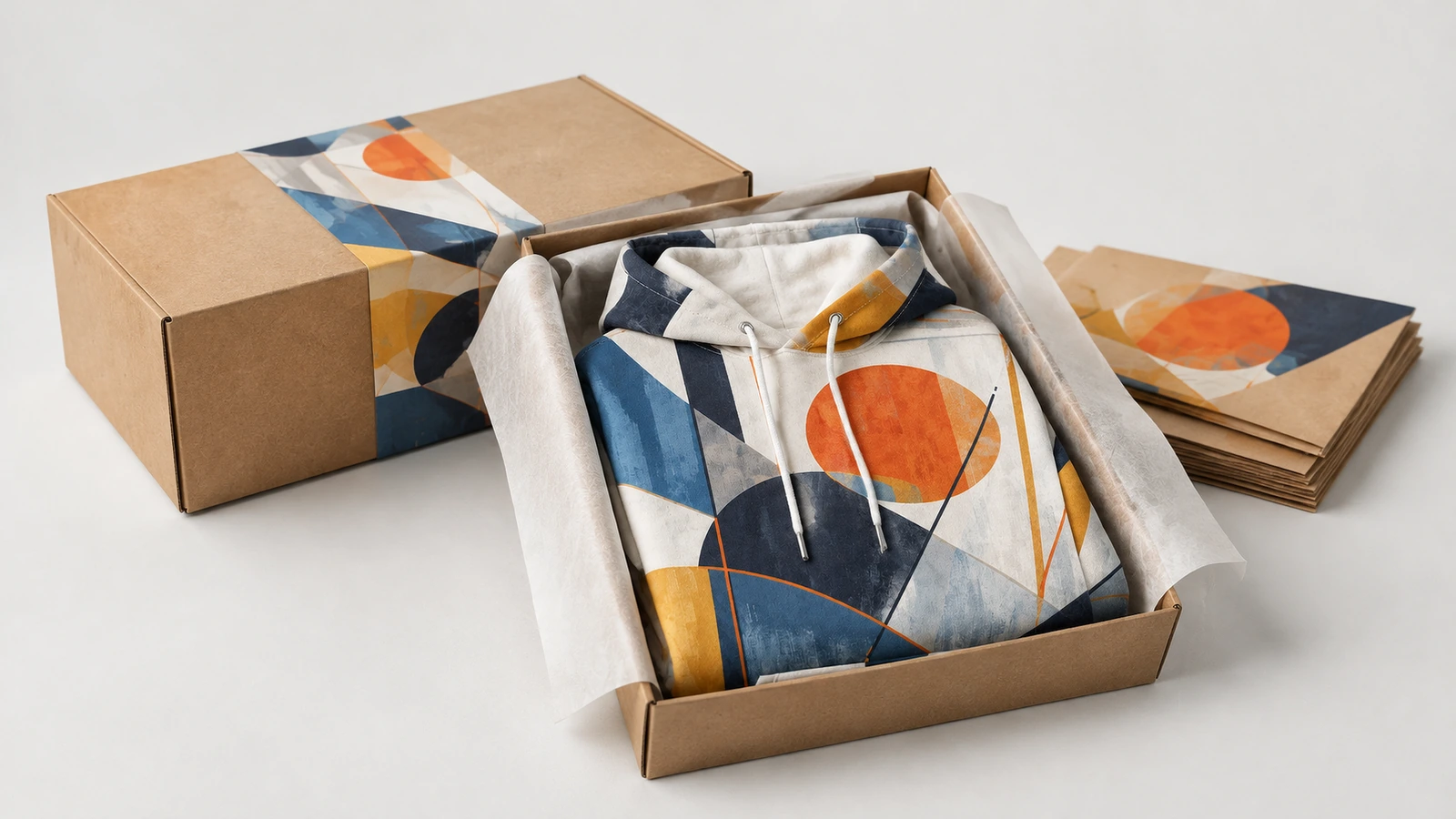
A consistent reorder starts with how the first order is packed. Ask for each piece in its own polybag and cartons marked with style, color, and size so that sizes can be distributed without sorting. Keep the signed sample as the master for future runs. When you reorder, specify the same blank, the same color, and the same method. Small reorders are the ones most likely to be quietly switched to digital printing.
Key Takeaways: What Matters Most Before You Order ↑
- Pullovers offer the largest uninterrupted print area at accessible prices — $20–$45 per piece typical (Source)
- Screen printing pays off with volume and few colors — about 12–24 piece minimums, 1–6 spot colors (Source)
- Small runs may switch to digital print — true screen printing typically needs about 15 units per unique color (Source)
- Fleece is a raised-surface fabric under 16 CFR 1610 — Class 1 requires a burn time over 7.0 seconds; Class 3 is banned (Source)
- Wash claims need a named test — one 45-minute TM61 test ≈ five home launderings (Source)
- Imported blanks change landed cost — 36.5% total duty example for China-made cotton, October 2026 (Source)
- The promo market is growing slowly — $27.1 billion in 2025 US distributor sales, +1.3% (Source)
Ready to Spec Your Pullover Run? ↑
A pullover order that turns out well is one that was specified first. That means choosing the method from the artwork and the blank by weight and fabric face, signing a physical sample, and agreeing on wash and size acceptance before production begins. For NSKU-753-01, the MOQ, production time, and blank weight are all confirmed in writing on your quote, and wash results are reported after the sample is tested. Send your artwork, quantity by size, and in-hands date to request your written quote today.




The information below is required for social login
Sign In
Create New Account