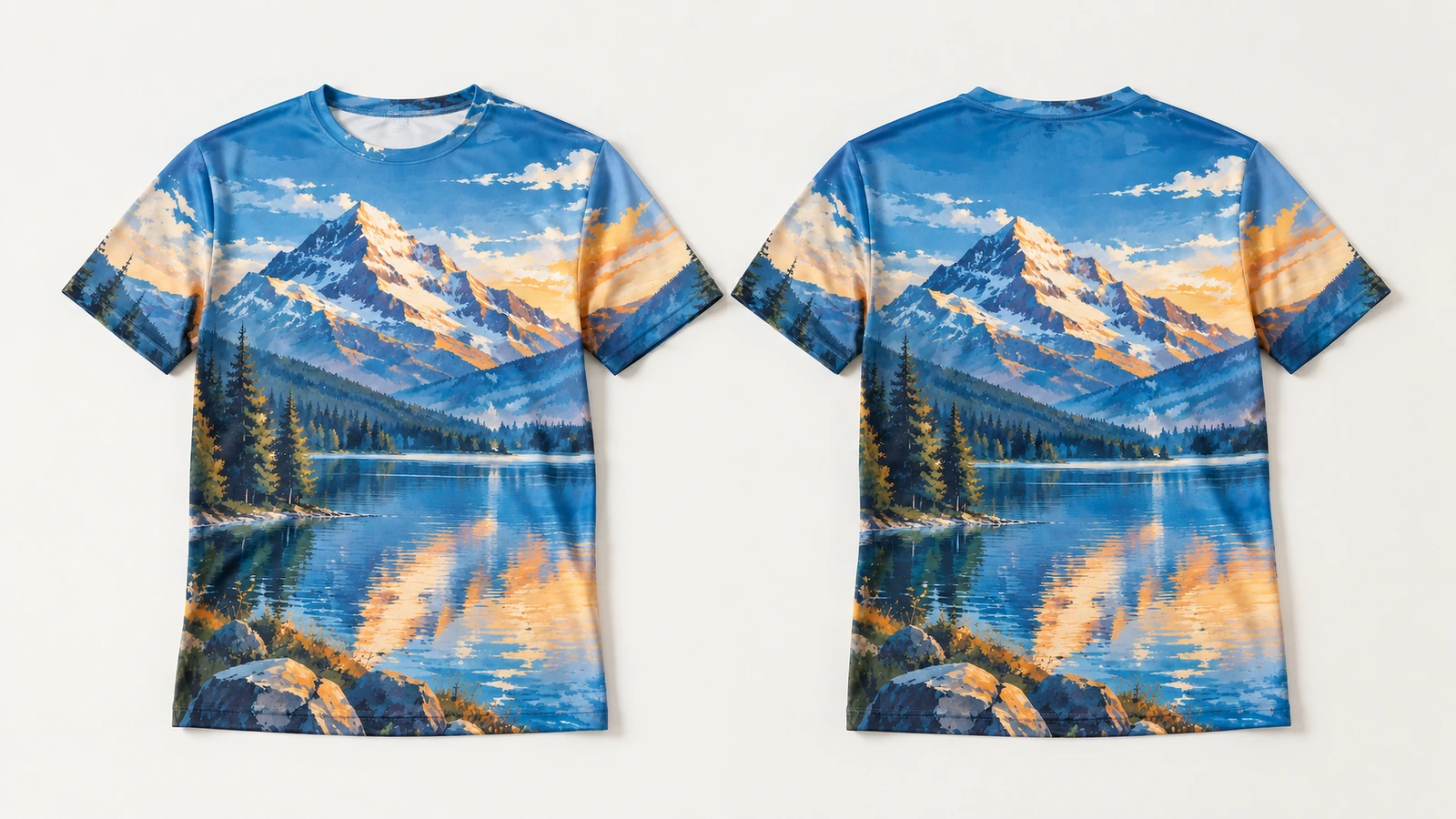
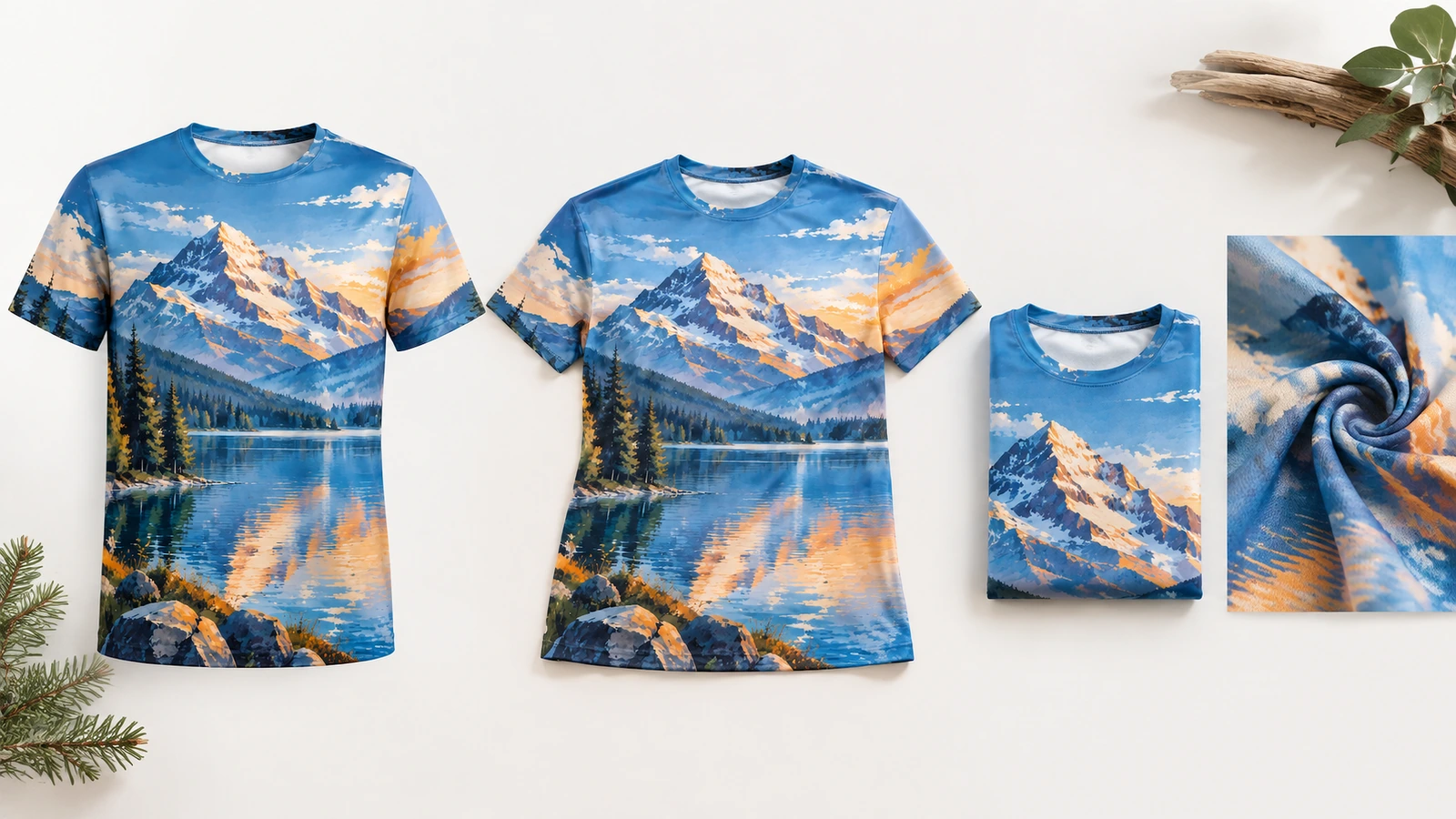
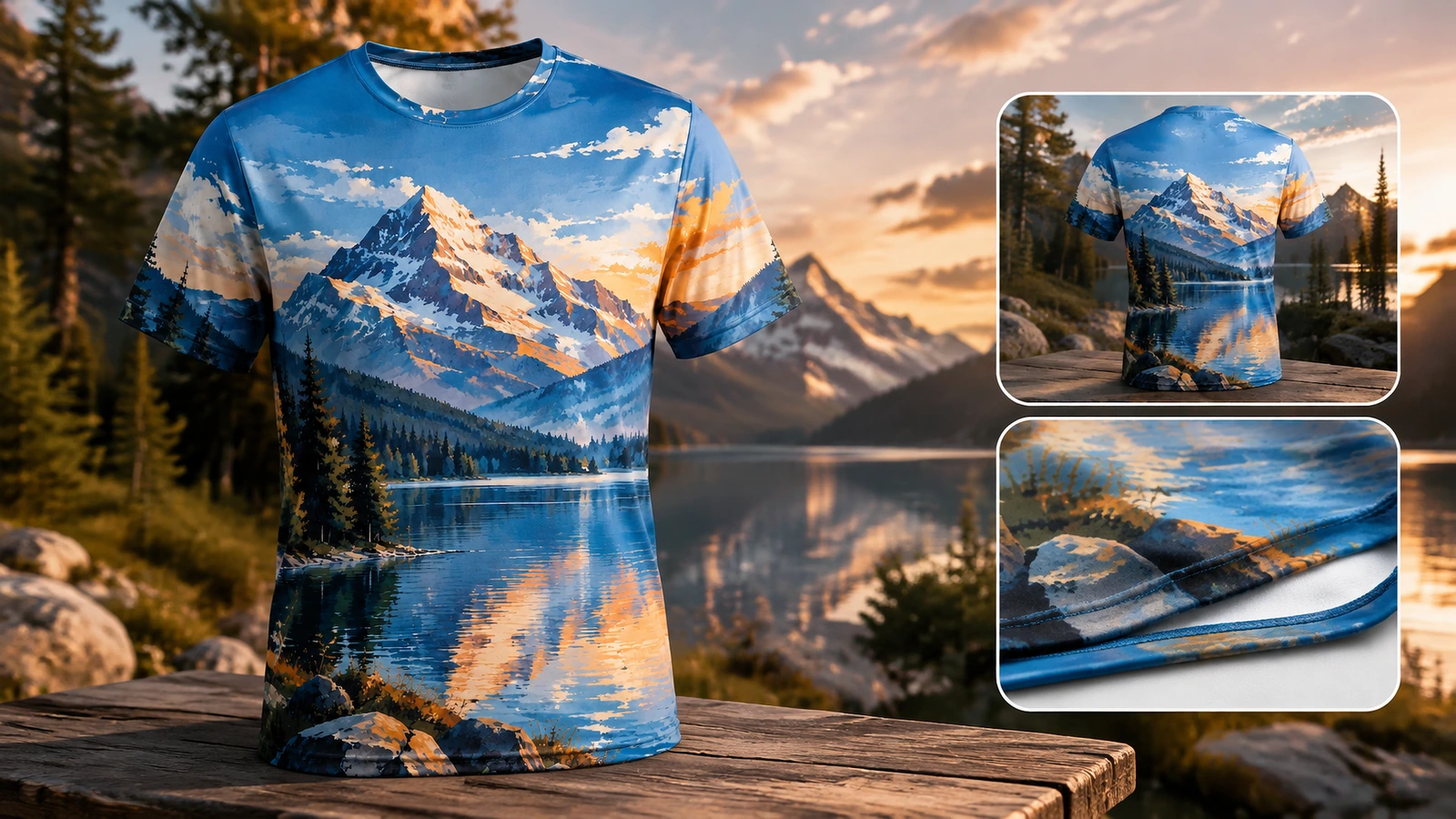
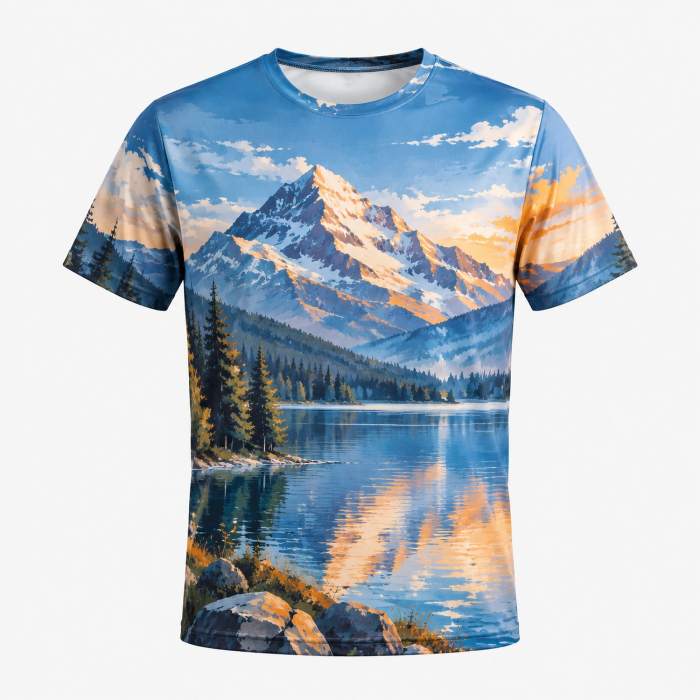
Custom sublimation T-shirts are polyester tees whose artwork is heat-transferred as dye vapor into the fibers. Because there is no ink layer on the surface, full-color, edge-to-edge designs have nothing to crack or peel. The method works only on white or light high-polyester fabric. It cannot print white ink, and it does not work on dark shirts or cotton.
Who Orders Custom Sublimation T-Shirts, and for Which Jobs? ↑
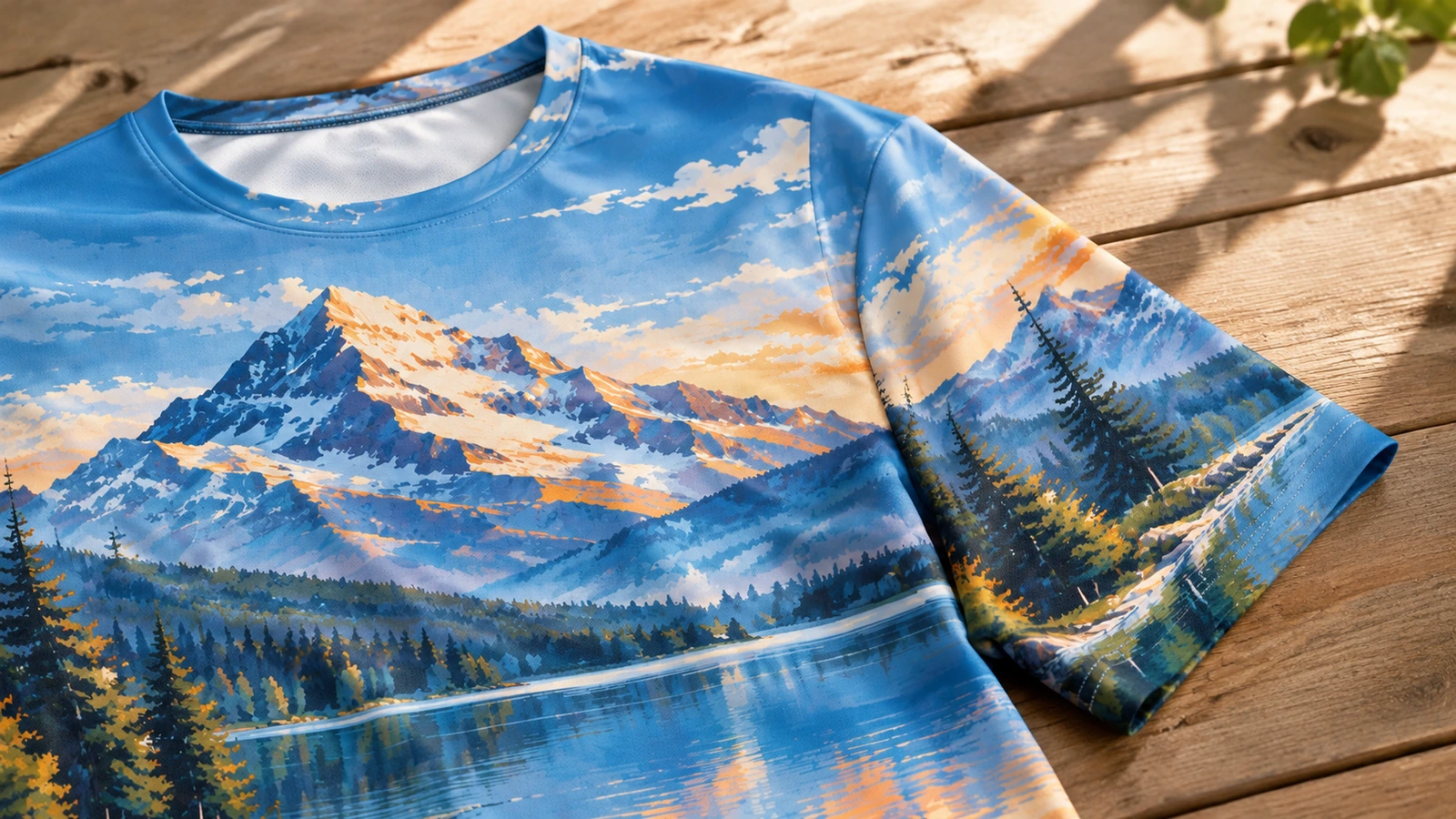
Most buyers of the Custom All-Over-Print Polyester T-Shirt (provisional SKU NSKU-777-02) are not hobbyists shopping for a heat press. There are three main groups. Team managers, coaches and league operators need names, numbers and full-color crests on lightweight training shirts. School activity directors order spirit, field-day and fundraiser tees in school colors. Marketing, HR and event leads dress staff for charity runs, company leagues and trade shows. Print shops and small brands also buy finished all-over-print tees to resell. PW Consulting, citing Impressions Magazine, puts sports and athletics at about 50.41% of 2025 global dye-sublimated apparel revenue. It puts personalized fashion near 27.65% and corporate and promotional use near 21.94% (PW Consulting market report[1]). Those figures describe the whole apparel category, not search share, but they match who actually places these orders.
These buyers share a short list of requirements. They want youth and adult sizes in one order, and easy fill-in orders later in the season. Colors must match existing team gear. The in-hand date cannot move, because the season or event will not.
This page does not serve someone who wants a single soft, cotton-feel tee with a photo on a black shirt. That job belongs to DTG or DTF, which are covered in the comparison below.
Why Do So Many Sublimated Tees Disappoint After Delivery? ↑
The problem usually starts with the blank shirt, not the artwork. Sublimation dye bonds only with polyester. On a 50/50 cotton-poly shirt, the polyester fibers take color while the cotton fibers stay essentially undyed. Washing does not strip the print so much as reveal the blank cotton underneath, which looks like fast fading (Subligenius blend analysis[2]). Jennifer Maker sets a practical floor: T-shirts should be 65% polyester or more[3] to retain sublimation ink. A shirt that looked perfect off the press can turn grey after its first wash, and the team blames the printer.
The damage cannot be reworked, because the dye becomes part of the fiber. A visible press mark or scorched area around an otherwise perfect design ruins the whole shirt (Bubbakins Blanks[4]). One manufacturer on Reddit reported faint ghost images, offset by 2–3 mm, on roughly 15–20% of its output (manufacturing QC thread[5]). Comfort and fit complaints add to the risk. One review of a sublimated V-neck said it "does not breathe well and traps all of the heat" and "runs very small" (Shopper Approved review[6]). For a roster with a fixed first-game date, any of these failures means reordering under deadline.
The fix is to run sublimation as a controlled process with written boundaries. NSKU-777-02 is specified as an all-over-print polyester tee. Every order follows four checkpoints: first, confirm fiber content and base color; second, preflight the artwork at full print size; third, lock a press recipe on a physical sample; and fourth, release bulk production only after that sample is washed and inspected.
Fabric weight, exact blend, MOQ and lead time are not claimed on this page. They are confirmed in your written quote and proven on your pre-production sample.
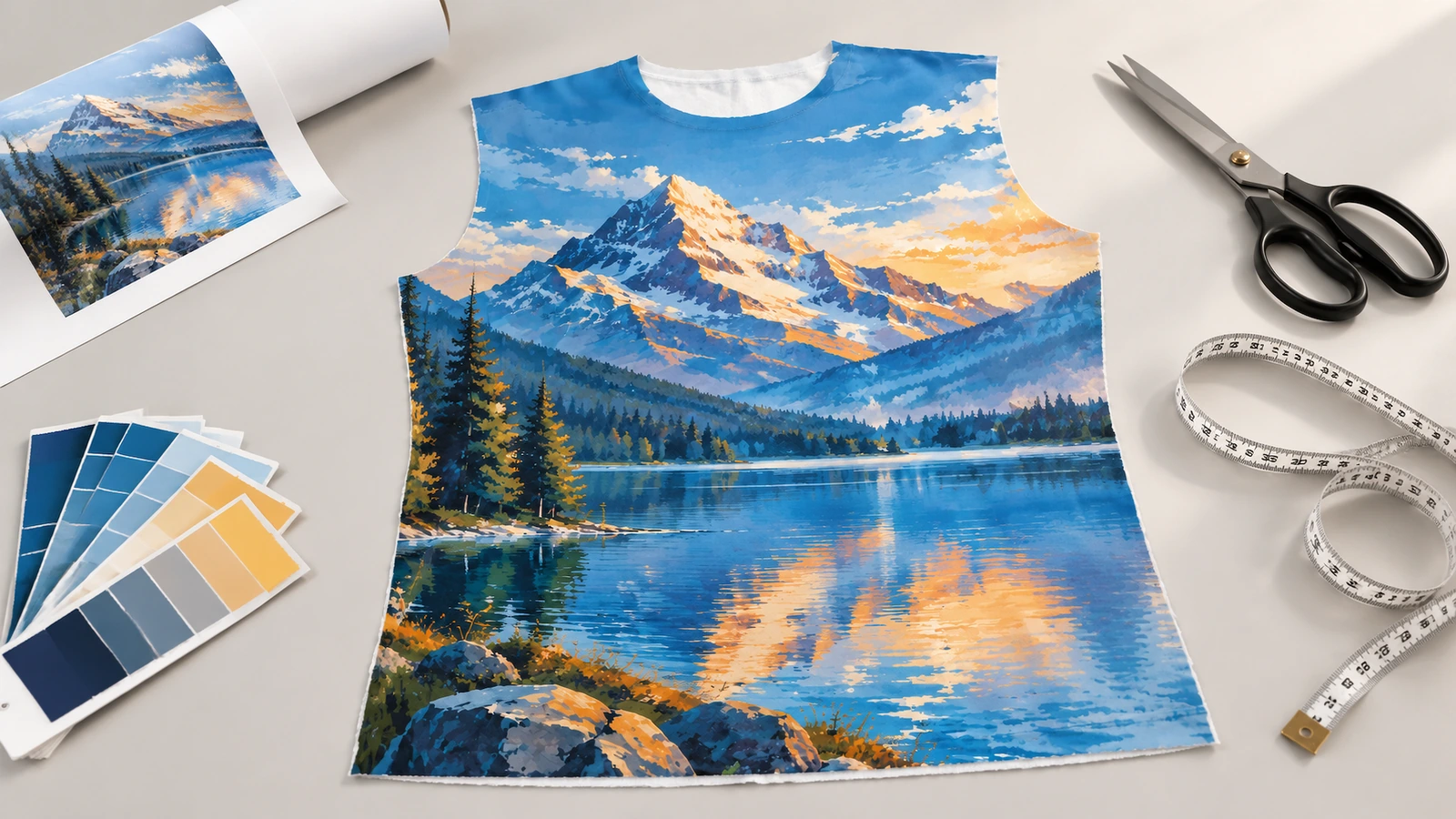
Table of Contents
What Exactly Is an All-Over-Print Polyester Sublimation Tee? ↑
Dye sublimation works in two stages. First, disperse dye is printed onto transfer paper. Then heat and pressure turn that dye into a gas, which enters the polyester fiber. LogoSportswear describes the polyester molecules opening under heat so the gas can penetrate, which is why the design becomes part of the fabric. The same page states the limits plainly: its sublimation tees come only in white and "cannot be used for designs that require white printing" (LogoSportswear guide[7]). Anything white in your artwork simply shows the base fabric.
"All-over print" adds a construction choice, and there are two ways to do it:
- Cut-and-sew all-over print: fabric panels are printed before sewing, so color runs seam to seam. Elevation Sports warns that sublimating an already-sewn shirt leaves ghosted white seams[8].
- Spot sublimation on finished blanks: a separate model that is growing. On March 6, 2026, STAHLS' Fulfill Engine launched spot sublimation on 100% polyester Vapor Apparel garments (PRINTING United release[9]).
Your quote should name which method applies, because the two look different at the seams and underarms.
| Fiber content | Expected print result | Fit for a bright custom order? |
|---|
| 100% polyester, white or light | Sharpest detail, strongest saturation | Yes, the default choice |
| 65–80% polyester | Usable; saturation roughly 15–25% lower | Only if lighter color is accepted |
| 65/35 polyester-cotton | Intentionally faded, vintage look | Vintage-style designs only |
| 50/50 polyester-cotton | Washed-out and muted | No |
| 100% cotton | Dye does not bond and washes out | No; use DTG, DTF or screen print |
| Dark fabric, any blend | Image can almost disappear | No |
The 100%, 65/35 and dark-fabric rows come from VistaPrint's 2026 guide[10]. The 65–80% and 50/50 rows come from Alpha Print Supply[11]. In practice, choosing a blend below 65% polyester is a style decision, not a cost saving. Check the fiber label before you approve the artwork.
Market data reflects the same dependence on polyester. Mordor Intelligence gives polyester a 64.71% revenue share of dye sublimation substrates in 2025 (Mordor Intelligence[12]). Grand View Research, as reported by The Cannata Report, values dye sublimation printing at USD 16.4 billion in 2025 and USD 28.0 billion by 2030, an 11.3% CAGR (Cannata Report[13]). Other firms publish different totals because they mix printing-market and apparel-market scopes, so treat any single figure as directional.
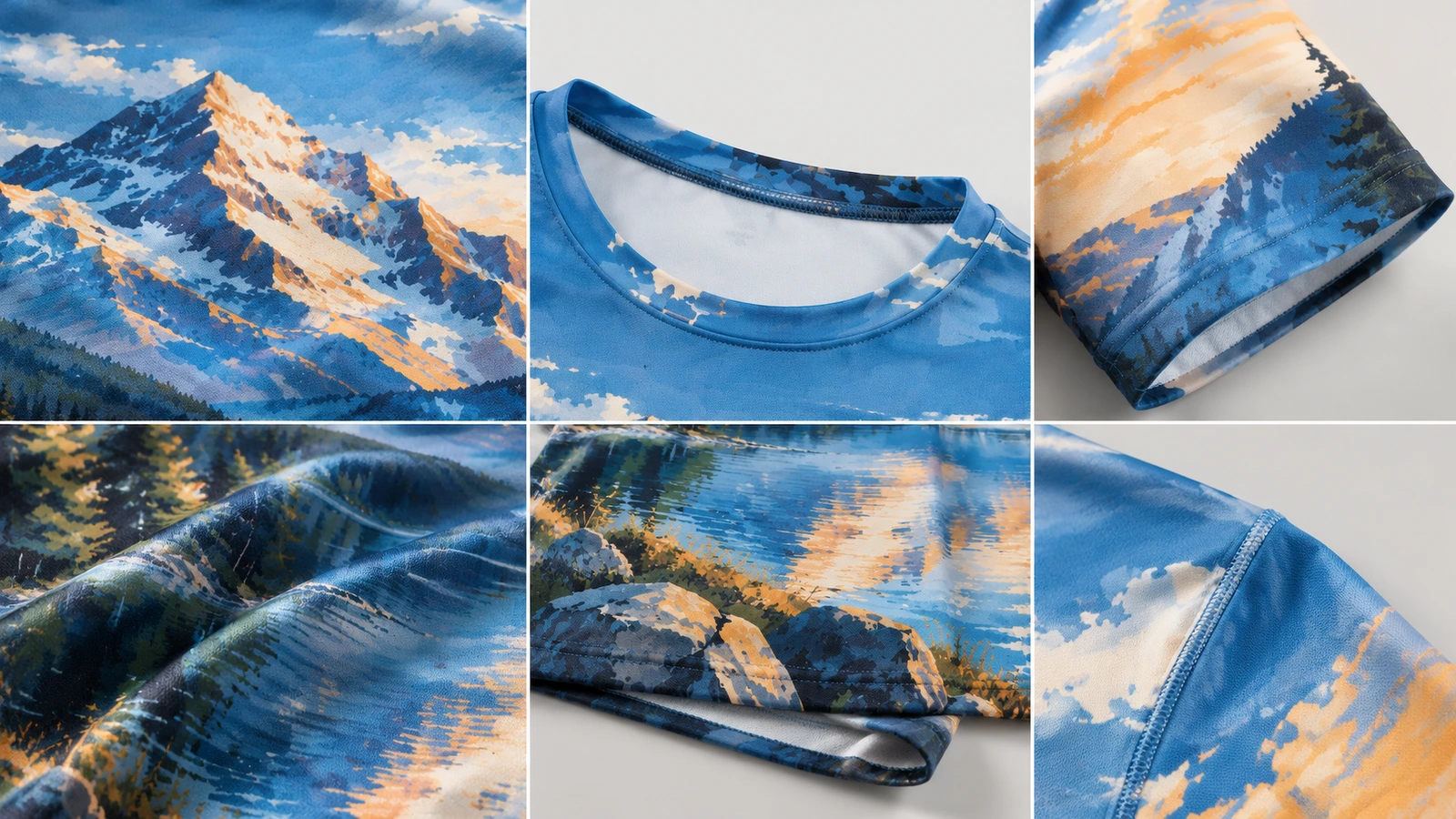
Readability is the other design boundary. With no white ink, light lettering placed over a light area of the print disappears. A low-resolution logo stretched to all-over scale looks pixelated. Check the contrast and size of names, numbers and sponsor marks at full print size, not as a thumbnail.
How Does an Order Move From Artwork to Approved Bulk? ↑
Step 1: Confirm the blank, surface and back-neck label
Start with the fiber content, fabric weight and base color stated on the quote. Then decide on neck labeling, which carries two legal requirements:
- Fiber content: US apparel must list each fiber present at 5% or more, by generic name and weight percentage, in order of predominance, under 16 CFR 303.16[14].
- Youth sizes: these are children's products. They need a CPSC tracking label[15] that is visible, legible and permanently affixed where practicable. It must identify the manufacturer or private labeler, the production location and date, and the batch.
Choose between a sewn label and a printed back-neck tag early, because a printed tag also sits inside the press area.
Step 2: Preflight the files at print size
Every file should meet four requirements. Raster art must be at least 300 DPI at final size, and logos and type must be vector. The design is mirrored, because the transfer paper is pressed face down. Color is proofed with the printer's recommended ICC profile, not judged on an uncalibrated screen.
Production must also use dedicated sublimation ink and paper. HTVRONT notes that regular ink will not gasify or bond[16]. Reject low-resolution uploads before printing, not after.
Step 3: Lock a press recipe on your actual blank
| Substrate | Temperature | Time | Pressure |
|---|
| Polyester fabric, standard sublimation paper | 400°F (about 204°C) | 35–45 s | About 40 psi, medium |
| Vapor Apparel-type polyester garments | 380–390°F | 45–55 s | About 40 psi, medium |
Sawgrass says these settings "should serve only as a starting place" (Sawgrass press settings[17]). Actual results depend on the blank, a calibrated press and test pressing. The standard routine is to pre-press for 3–5 seconds to remove moisture, tape the transfer in place, add protective paper to prevent ghosting, and let the garment cool before peeling.
Blends that contain spandex need their own test before bulk production.
Step 4: Wash-test and inspect the sample before bulk
Judge the sample after washing, not fresh off the press. Wash it about five times alongside an unwashed twin, then compare saturation, edges and feel. For laboratory evidence, three test methods apply:
- Wash colorfastness: AATCC TM61[18] is the accelerated laundering method. One 45-minute test approximates five typical home launderings.
- Heat migration: AATCC TM117 and TM133[19] assess dry-heat dye migration at about 180°C. This checks whether dye moves under heat; it does not predict how many washes a print will survive.
- Shrinkage and skew: garment dimensional change after home laundering is measured with AATCC TM150-2025[20].
For NSKU-777-02, these results are still to be tested on your pre-production sample. No grades are claimed here.
Visual inspection should check for ghosting, yellowing, box-shaped press marks at the paper edge, lint specks, white seams and missing underarm color. It should also confirm placement against the approved mock-up. A recurring defect stops the line until the paper, press or recipe is corrected. A second press usually blurs the image rather than fixing it.
Sublimation, Screen Print, DTG, DTF or Embroidery: Which Fits Your Order? ↑
| Method | Best fabric | White ink on dark shirts | Feel and durability | Best fit |
|---|
| Sublimation | White or light polyester, about 65–100% | No | No hand feel; dye inside fiber | Team, event and all-over designs |
| Screen print | Cotton, blends, polyester | Yes | Surface ink; very durable when cured | Larger solid-color runs |
| DTG | Mainly cotton | Yes, with pretreatment | Soft; fades sooner with hot washing | Small cotton orders, photos |
| DTF | Cotton, polyester, blends | Yes | Film layer; large prints feel plastic | Dark or mixed-fabric short runs |
| Embroidery | Most fabrics | Thread color | Among the most durable | Chest logos, names, uniforms |
Rally Towels' 2026 decision guide finds screen printing cheapest and most durable for orders of 50+ pieces with 1–6 colors. It also notes that sublimation does not crack or peel because the design is dyed into the fabric (Rally Towels guide[21]). T-Shirt Envy reports DTG prints visibly fading after about 25–35 washes in its own testing. That is a self-reported figure, not a standards result (T-Shirt Envy[22]).
Choose sublimation when all of these are true: the shirt is white or light polyester, and the design needs gradients, photos or unlimited colors with no hand feel. Switch methods in these cases:
- Cotton or dark shirts: use DTG or DTF.
- Large solid-color runs: use screen printing.
- Small logos that will go through industrial washing: use embroidery.
Do not buy sublimation expecting cotton softness. If feel matters, test a softer high-polyester blend on a sample before you commit to the order.
What Should Your Quote and Sample Confirm Before You Pay? ↑
| Checkpoint | What to request | Status for NSKU-777-02 |
|---|
| Fiber content and weight | Label-ready percentages; oz/yd² or g/m² | Confirmed in quote |
| Print method | Cut-and-sew all-over or spot on finished blank | Confirmed in quote |
| MOQ and price breaks | Per-design and per-size minimums in writing | Quote-dependent |
| Lead time | Separate proof, sample and ship dates | Set after artwork approval |
| Wash and colorfastness | Five-wash comparison; AATCC TM61 if required | To be tested on sample |
| Compliance documents | Flammability position, OEKO-TEX certificate number, youth tracking label | To be confirmed per order |
Every "pending" status is deliberate. None of these values is supplied on this page, so none should be assumed. Ask for the proof, sample and ship dates to be written separately, because file approval plus a washed sample often takes longer than the printing itself.
Adult apparel falls under the 16 CFR 1610 flammability standard. CPSC notes that plain-surface fabrics weighing 2.6 oz per square yard (88.2 g/m²) or more are exempt from testing, regardless of fiber (CPSC guidance[23]). Confirm the actual fabric weight and finish before relying on that exemption. If you require OEKO-TEX STANDARD 100, verify the certificate number. The 2026 regulations became mandatory for all certifications on June 1, 2026, and they tightened acceptance of wet processes such as printing (OEKO-TEX 2026 rules[24]). A certificate covers harmful substances; it does not grade wash durability.
Care affects durability as much as printing does. Printable Press estimates that a well-made print on 100% polyester, washed cold on a gentle cycle, can last 50–100+ washes without significant fading. Lower-polyester blends or hot washes may fade within 10–20 washes (Printable Press fading guide[25]). Its care guide[26] recommends turning shirts inside out, washing cold, and avoiding bleach, fabric softener and dryer sheets. Print these instructions on the care label and the packing slip.
For reorders, file the approved sample, press recipe and final artwork version under one order reference. Request a size set before a large roster order, because sport fits can run small. Packing by size or by player name speeds up distribution. Confirm the packing method and carton marks in the quote.
What Are the Key Takeaways Before You Order? ↑
- Sublimation needs a high-polyester blank — 65% polyester minimum, 100% for best color (Source)
- Mid-polyester blends lose saturation — about 15–25% lower at 65–80% polyester (Source)
- Press settings are a starting point, not a spec — 400°F, 35–45 s, about 40 psi (Source)
- Wash colorfastness can be lab-tested — one 45-minute AATCC TM61 test ≈ 5 home launderings (Source)
- The sublimation printing market is still growing — USD 16.4B (2025) to USD 28.0B (2030), 11.3% CAGR (Source)
- Fabric weight affects flammability testing — exemption at 2.6 oz/yd² (88.2 g/m²) for plain-surface fabrics (Source)
- Verify OEKO-TEX certificates under the new rules — 2026 rules mandatory from June 1, 2026 (Source)
Ready to Spec Your Custom Sublimation T-Shirts? ↑
Sublimation is the right method for full-color designs with no hand feel on light polyester, where cracking and peeling must be avoided. It is the wrong method for cotton, dark shirts or white lettering. NSKU-777-02 is offered on those terms. Its blend, weight, MOQ and lead time are written into your quote, and bulk production follows a pressed, washed and inspected sample. Send your artwork, size breakdown and in-hand date to request a quote and a pre-production sample.




The information below is required for social login
Sign In
Create New Account