Custom 3D puffy sticker sheets are printed vinyl or PET films laminated over a soft, compressible core and kiss-cut on a shared backing. The result is a raised logo or character you can squeeze. They work best on packaging seals, gift boxes, brand merch and collector sheets with flat or gently curved surfaces. Tight curves, journal interiors and machine-sorted mail are better served by flat vinyl.
Who Orders Custom 3D Puffy Sticker Sheets, and for What? ↑
Three buyer groups search for this product, and their needs differ. The first group is brand and packaging buyers, including small brand owners, packaging designers, e-commerce operators and gifting teams. They want a tactile logo on cosmetic jar seals, beverage bottles and caps, toys, stationery and collector packs, which is the use list published by PuffSticker[1]. Their questions are practical: can the sticker be sampled first, will it hold on a box or bottle, and will the thickness survive the curve?
The second group is illustrators, convention sellers and small merch shops. They need low minimums, mixed designs and specialty effects that still leave room for a retail margin. Published minimums are inconsistent even within one vendor: Vograce lists its 3D puffy sheets at 10 pieces per design on its English product page[2] and at 50 per design on its German page. Parents and journalers make up the third group. They mostly buy ready-made packs, and their feedback is a warning about fit. After months of use, one r/hobonichi user[3] found it "more and more difficult to write on the pages… even though they are WILDLY cute."
Demand for collectible 3D stickers is real. NHK WORLD[4] reported on 2026-05-31 that Q-lia had shipped 22 million Bonbon Drop stickers between September 2025 and the end of March 2026. In the US, ASInsight[5] estimates that the top 50 Amazon "puffy stickers" listings sold 1,203,150 units, about $11.16 million, in the 12 months to July 2026. The wider personalized sticker market was valued at USD 4.84 billion in 2025, according to Towards Packaging[6]. None of these figures measures the custom puffy segment itself. Treat them as a signal of direction, not as a forecast for your order.
Why Do Puffy Sticker Orders Fail After a Great-Looking Proof? ↑
Problem. A puffy sticker is thicker and heavier than flat vinyl. That added mass "works against the bond every time the substrate flexes or the temperature swings," according to Polinal[7]. Retail data shows the same pattern. The Amazon review summary for one 3D puffy pack[8] records 234 mentions of stickiness: 154 positive and 80 negative. Heat makes the problem worse. One process explainer[9] says polyurethane foam starts to soften above 120°F (49°C), and that repeated folding cracks the core.
Agitate. For a brand, each mistake is costly. One US specialist publishes these terms: custom samples cost $250–$300 per design, the minimum is 250 pieces per design, and production plus delivery takes 18–20 business days from proof approval (PuffSticker). A wrong color or a liner that will not release can waste that budget. On Trustpilot[10], a buyer of 12,000 two-inch rounds said peeling even one sticker was "very difficult," and another reported prints "substantially darker than the original file." Foam stickers can also come apart in layers. In one r/nostalgia thread[11], a user remembered that "the picture would ALWAYS fall off… just a foam outline."
Solve. The fix is a process, not a promise. Confirm that the surface can take a raised sticker. Write the full layer stack into your request for quote (RFQ). Preflight the artwork. Approve a proof against agreed tolerances. Then test peel strength and lamination before shipment. For NSKU-621-01 Custom 3D Puffy Sticker Sheets, MOQ, lead time, core thickness and unit price are set in your written quote and confirmed at sampling. This page does not promise them in advance.
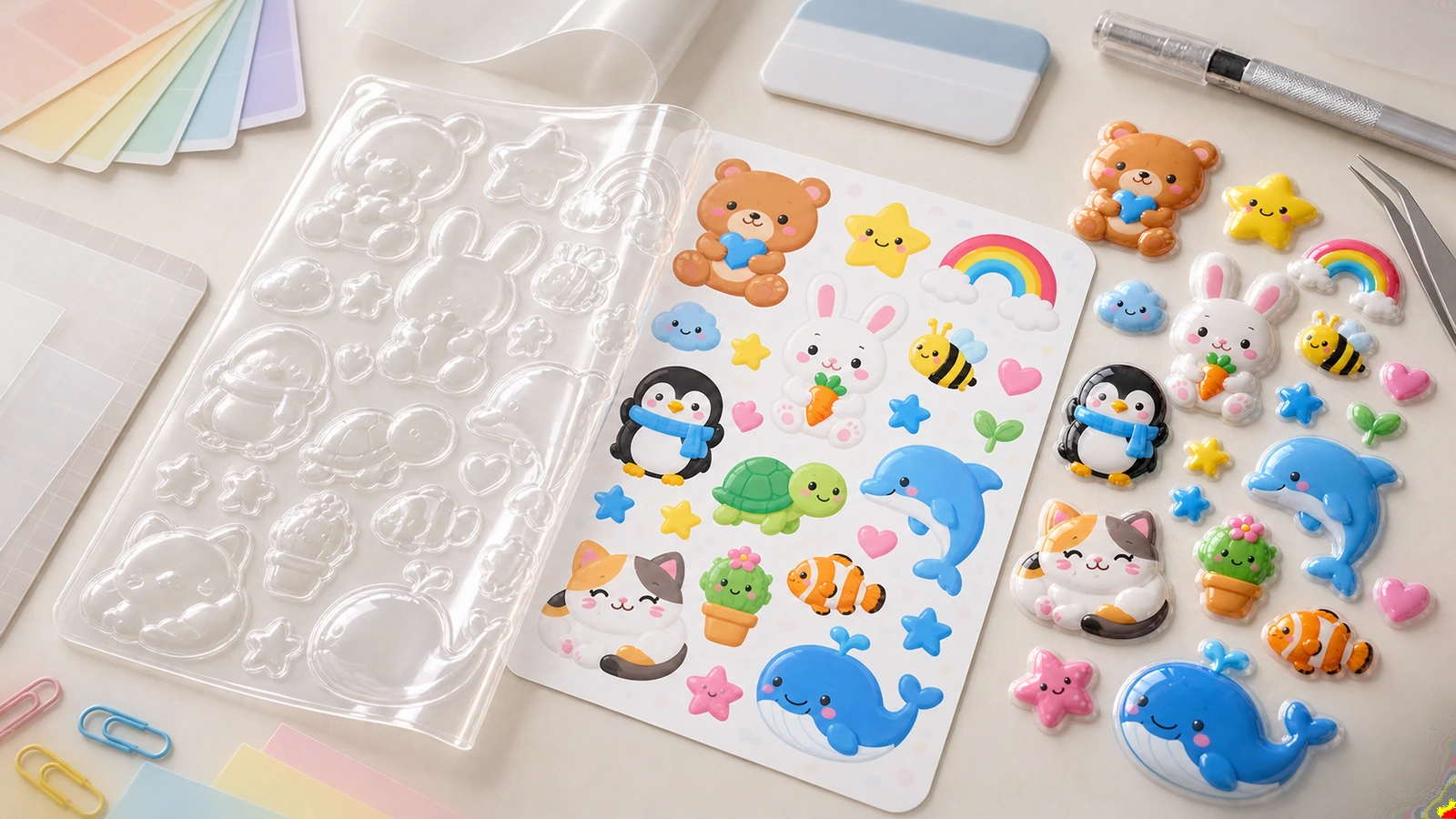
Table of Contents
What Is a Custom 3D Puffy Sticker Sheet, Layer by Layer? ↑
A custom 3D puffy sticker sheet holds several raised stickers on one shared backing, cut with a kiss cut (through the sticker but not the liner). PuffSticker's construction guide[12] describes five layers: a protective film, printed vinyl or PET, a foam or PU core, an acrylic adhesive and a silicone release liner. Its comparison chart puts raised height at 1–3 mm. In that guide's words, "the surface has a slight give." That compressibility is what separates a puffy sticker from a hard epoxy dome.
Suppliers do not measure "thickness" the same way. JJC[13] lists a 0.4 mm standard thickness in PVC. custompuffystickers.com[14] lists 0.8–2 mm. PuffSticker's foam line[15] offers EVA cores of 1, 2 or 3 mm. Some suppliers quote total height and others quote only the core, so every RFQ should give a value in millimeters and say which layer it measures.
| RFQ field | Ranges seen in public specs | Confirm at sample |
|---|
| Raised height | 0.4 mm to 3 mm, measured differently by each supplier | Total vs. core measurement |
| Core material | EVA foam, PU/vinyl cushion, PVC foam, sponge | Named material, not just "puffy" |
| Top film | Vinyl/PVC or PET, CMYK print | Lamination bond to core |
| Adhesive | Permanent acrylic; removable optional | 24-hour hold on your real surface |
| Finish | Gloss, matte, soft-touch; foil, holographic, glitter add-ons | Color contrast after lamination |
| Piece size | About 0.75–8 in per side for foam | Legibility of the smallest detail |
| Sheet format | Kiss-cut, up to about 40 pieces per sheet | Spacing, liner peel |
| Artwork | AI, EPS, PDF, SVG or PSD; 300 DPI | Cut line and bleed |
Use this table as an RFQ checklist, not as a product specification. The middle column compiles public pages from PuffSticker, JJC, Vograce and custompuffystickers.com. The right column lists what should be fixed in writing before mass production. Values for NSKU-621-01 are confirmed per order through quotation and sampling.
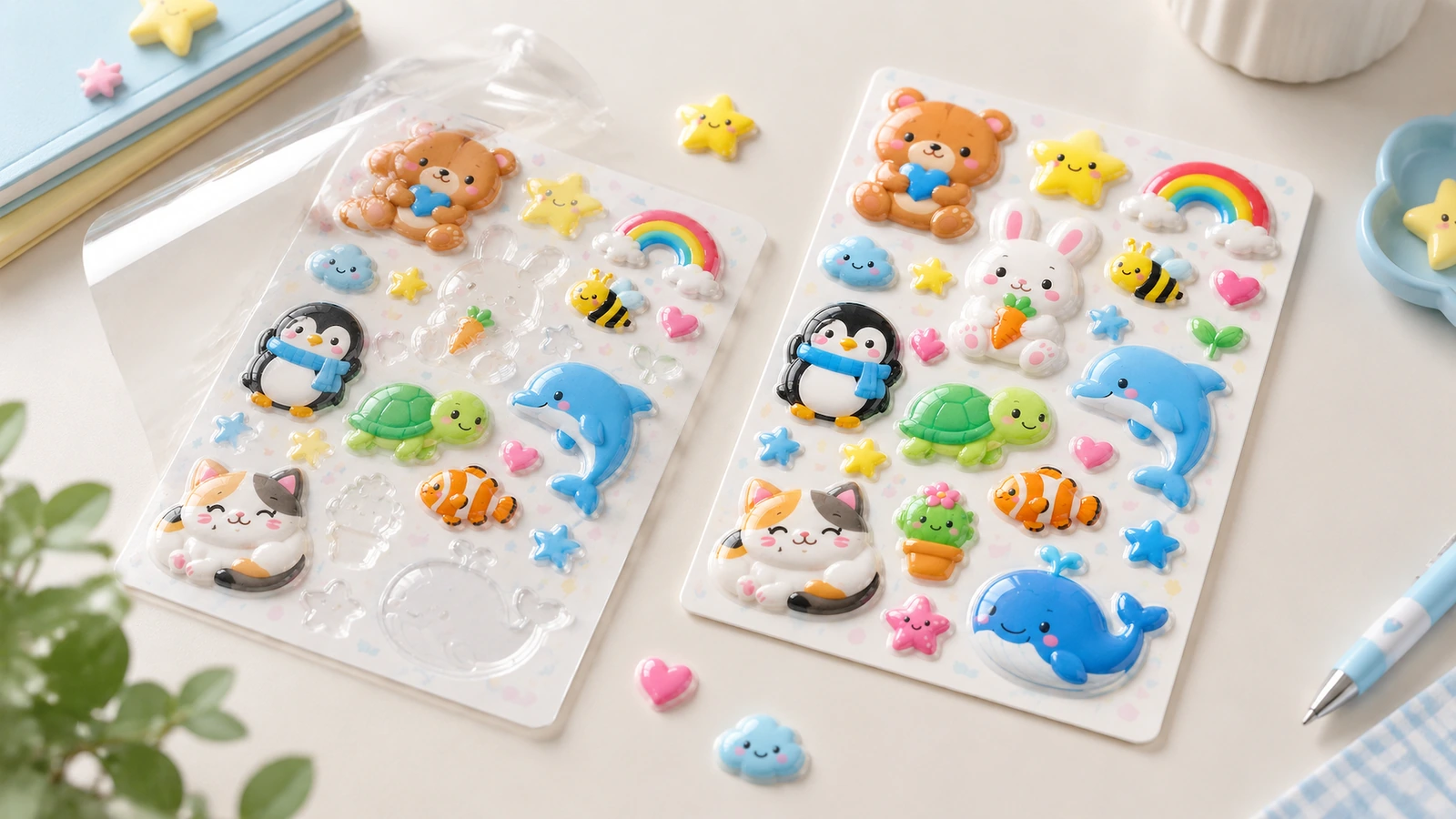
Size drives readability. Fine lines and details smaller than about 0.75 in tend to blur on a thick core, so complex portraits usually suit a thinner puffy build or flat vinyl. Surface curvature is the other limit. PuffSticker's category page[16] says small and medium pieces can go on gently curved bottles and tumblers, and states: "For tight curves we recommend flat vinyl stickers." The same page caps kiss-cut sheets at about 40 pieces on a backing of up to 8.5×11 in.
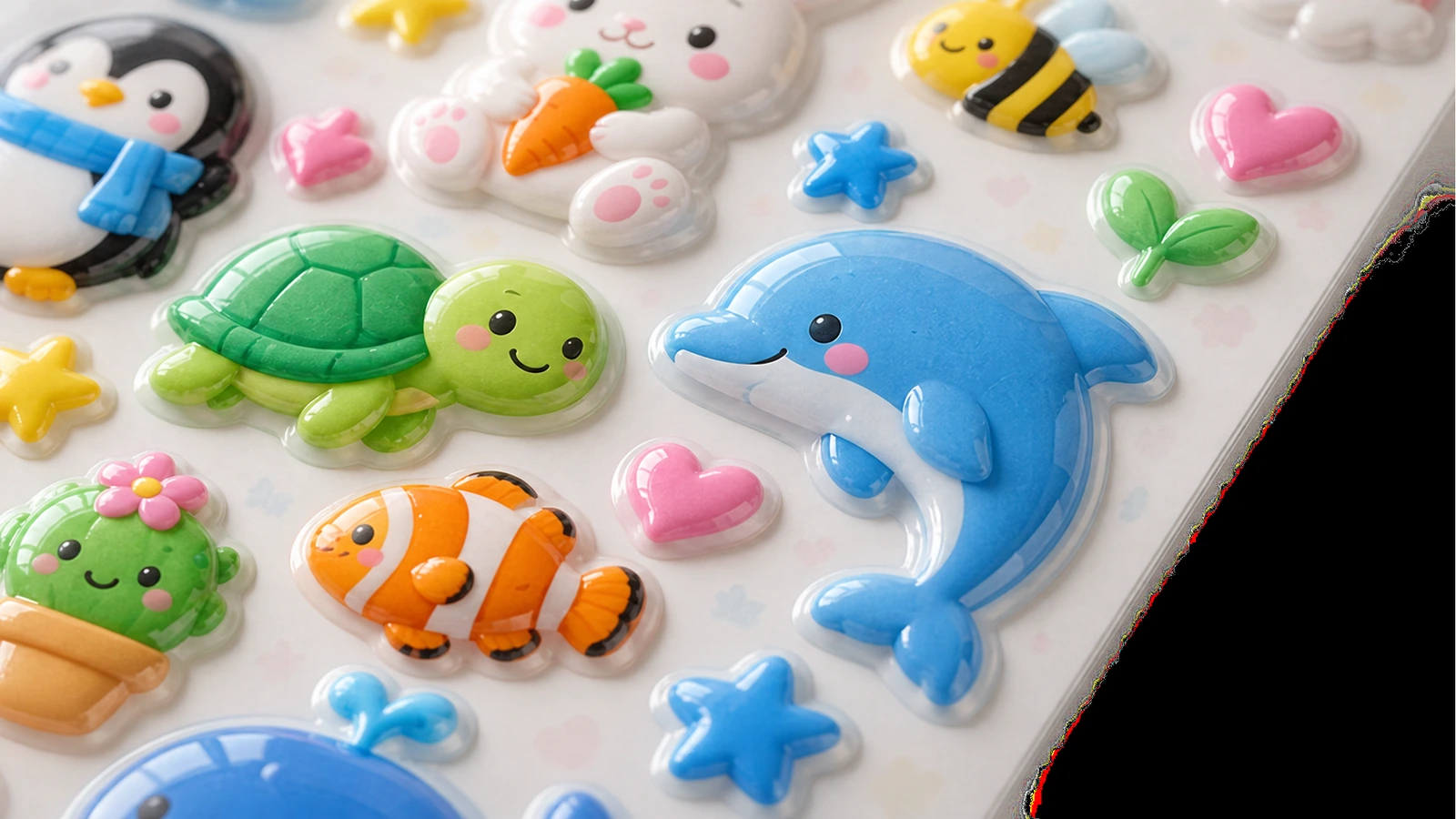
Finish and adhesive choices change both how the sticker feels and how it fails. A vinyl-top puffy is rated "High" for water resistance on PuffSticker's chart, while EVA foam is rated "Medium" (PuffSticker). The liner matters as much as the face. If people will apply the stickers by hand in bulk, ask the supplier about back-slit or easy-peel liner options.
How Do You Order Puffy Sticker Sheets Without Wasting a Sample Budget? ↑
Step 1: Qualify the surface before the design
Packaging seals, gift boxes and collector sheets suit a 1–3 mm raised sticker. Journal interiors and postcards do not. On the r/postcrossing forum[17], the top-voted reply warns: "They'll stick in machines and catch on other post." For tight-radius bottles, switch to flat vinyl.
Step 2: Lock the material stack in the RFQ
Name the top film, the core (EVA, PU/vinyl or PVC foam), the adhesive type and the liner. If the face is soft PVC, ask for an adhesive that resists plasticizer migration. Bostik[18] notes that migrating plasticizers cause embrittlement, distortion and shrinkage. Ask for the bond strength between the face and the core, not just initial tack. That bond is what prevents the "foam outline" failure described above.
Step 3: Preflight artwork and color
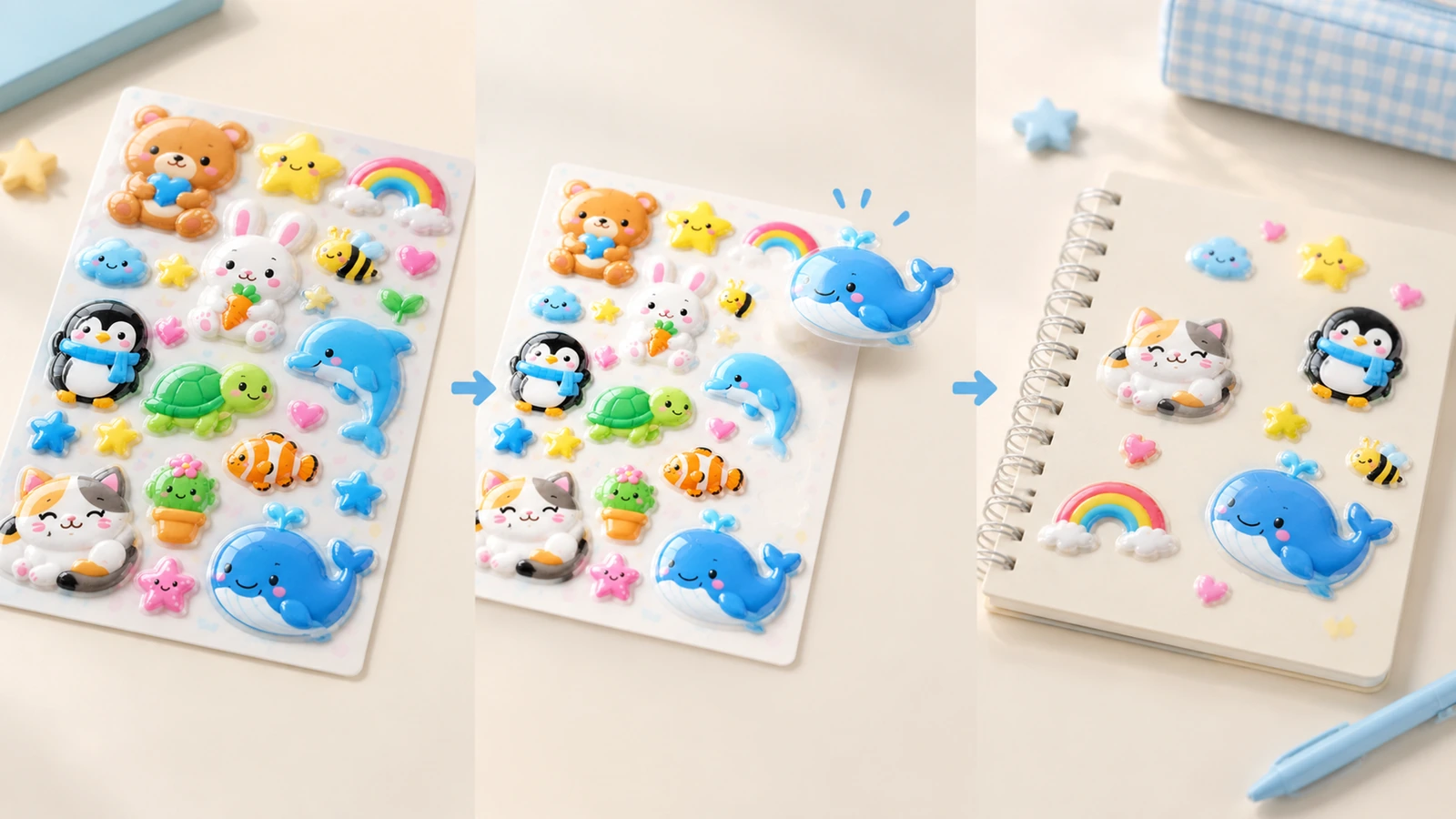
Send vector AI, EPS, PDF or SVG files. Raster art should be at least 300 DPI. Vograce's puffy page asks for PSD files in CMYK at 300 DPI or at least 1000 px, with about 1.2 mm of bleed outside the cut line, at least 5 mm between pieces, and a stated cutting tolerance of ±1.2 mm (Vograce). Give Pantone references for key brand colors, and list spot white, foil and glitter as separate items. A screen proof is not a color sample, because the core and the laminate both flatten contrast. Agree an acceptable batch color variance in writing.
Step 4: Approve the proof, then freeze it
Proof approval usually starts production. StickerGiant[19] states that once you approve, your order "moves straight into production and cannot be changed or canceled." Write the cut lines, color tolerance and quantity variance (±%) into the approval email.
Step 5: Quote and sample with real benchmarks
| Quantity (1×2 in, 1 mm foam) | Total price | Unit price |
|---|
| 250 pcs | $680.00 | $2.72 |
| 500 pcs | $890.00 | $1.78 |
| 1,000 pcs | $1,390.00 | $1.39 |
These are PuffSticker's public foam prices from its foam page (about 2026-09-30) for one locked specification. The 2 mm and 3 mm cores and quantities of 2,500 or more are quoted separately. The same domain also shows inconsistent terms: its legacy puffy page[20] lists a 500-piece MOQ and 20–24 business days. Always work from the quote for the specific SKU. Small US runs cost dollars per piece, not the cents per piece you see on retail packs. Rush service, spot colors, foil, unusual shapes and air freight all add cost. The realistic total timeline is file approval plus sample shipping plus approval time plus production plus international transit.
Step 6: Control production with named tests
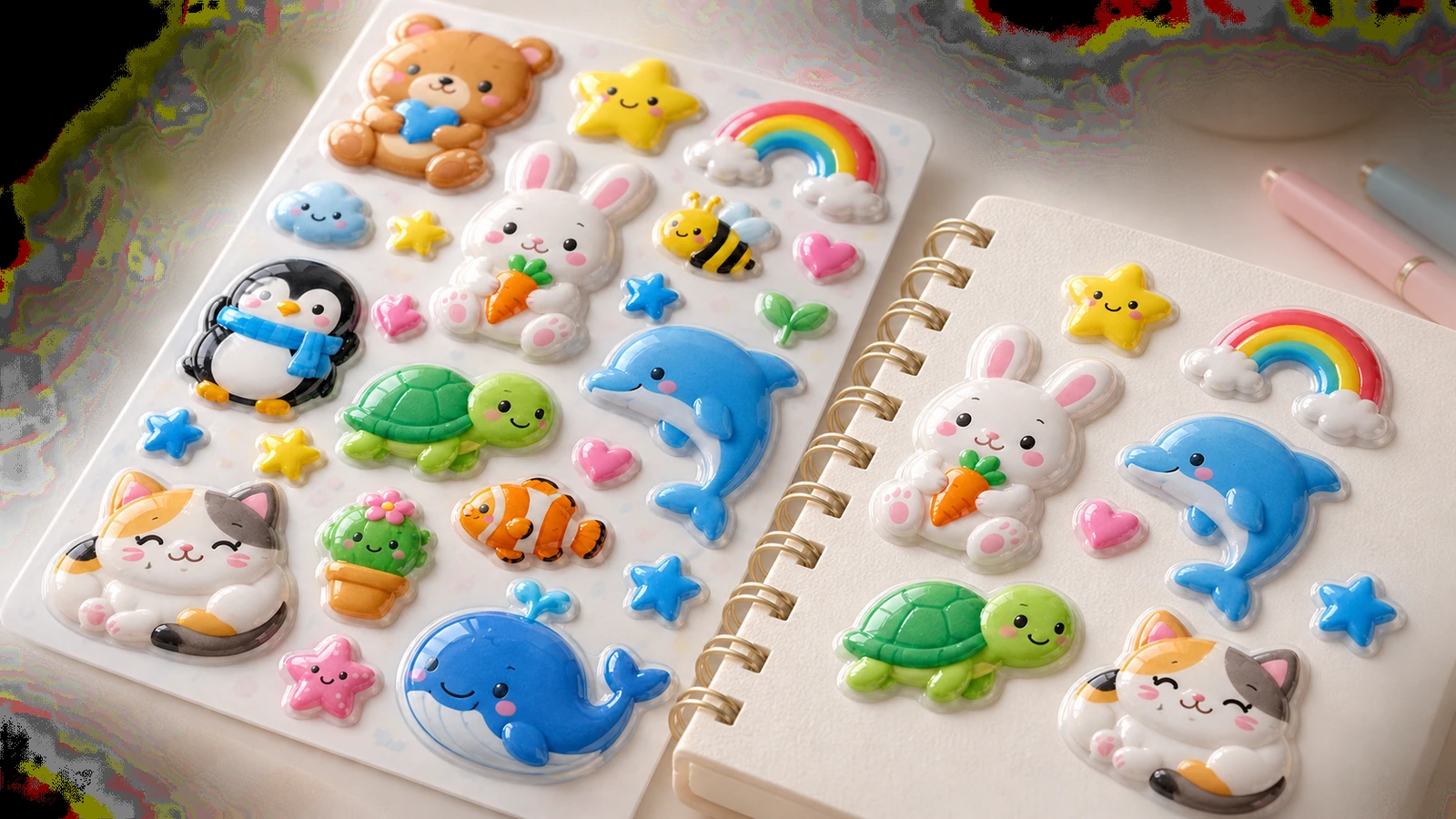
Lock the approved file, cutting die, core thickness and adhesive batch. Ask for checks at four stages: incoming materials, in-process, final and outgoing. Puffy stickers have no dedicated ISO or ASTM standard, so borrow the pressure-sensitive label framework that GMS Industries[21] maps to FINAT and ASTM methods: peel, loop tack, shear, release force and die-cut accuracy.
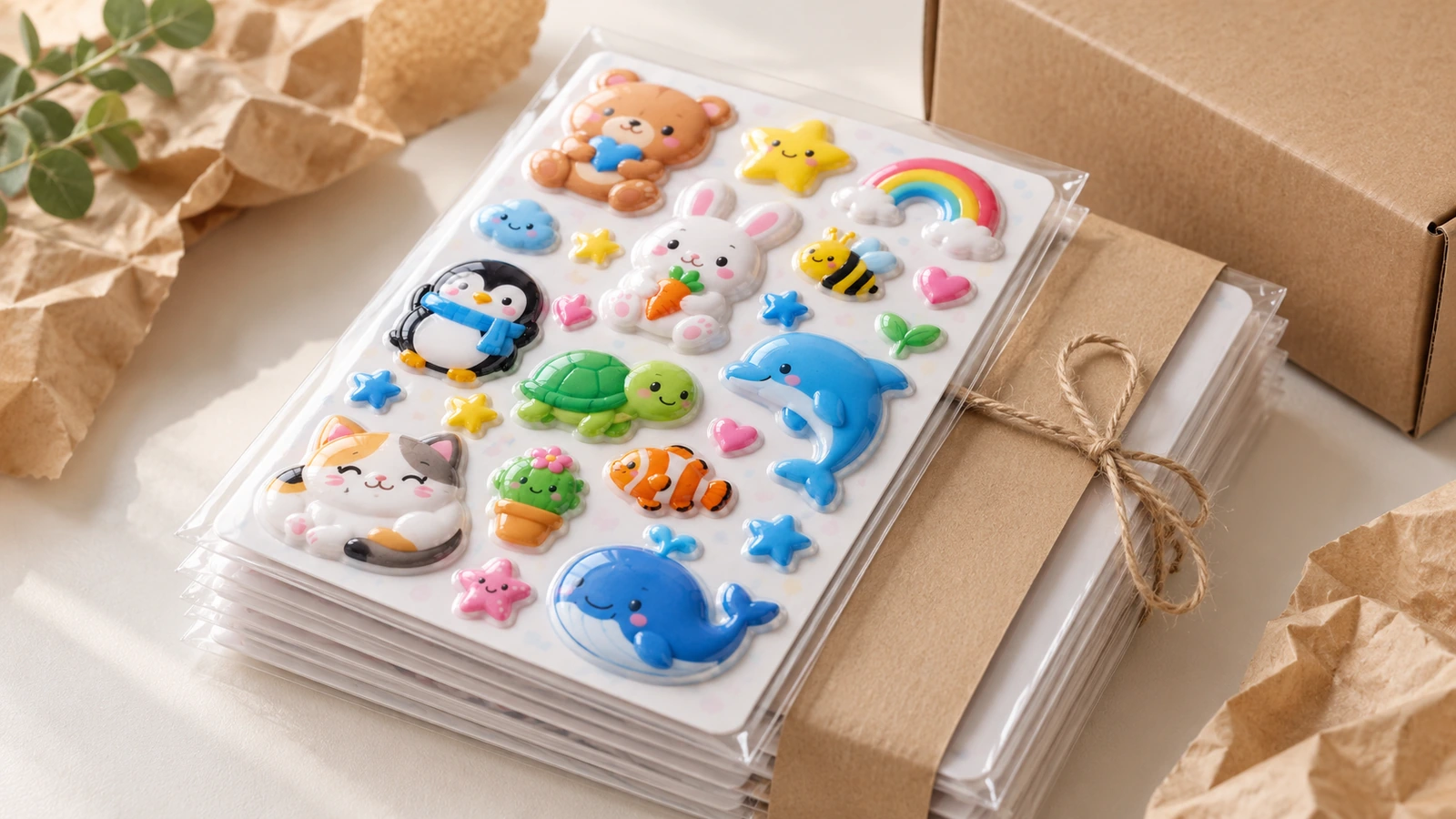
Any water claim needs evidence. Avery Dennison[22] selects adhesives using 4-hour water immersion and ASTM G155 weathering. StickerNation[23] suggests a 24-hour soak, then checking for ink bleed, blistering and edge lift before an abrasion test. Pay particular attention to the edges: the cut edge exposes the core, and that is where water gets in.
Step 7: Pack, receive and reorder
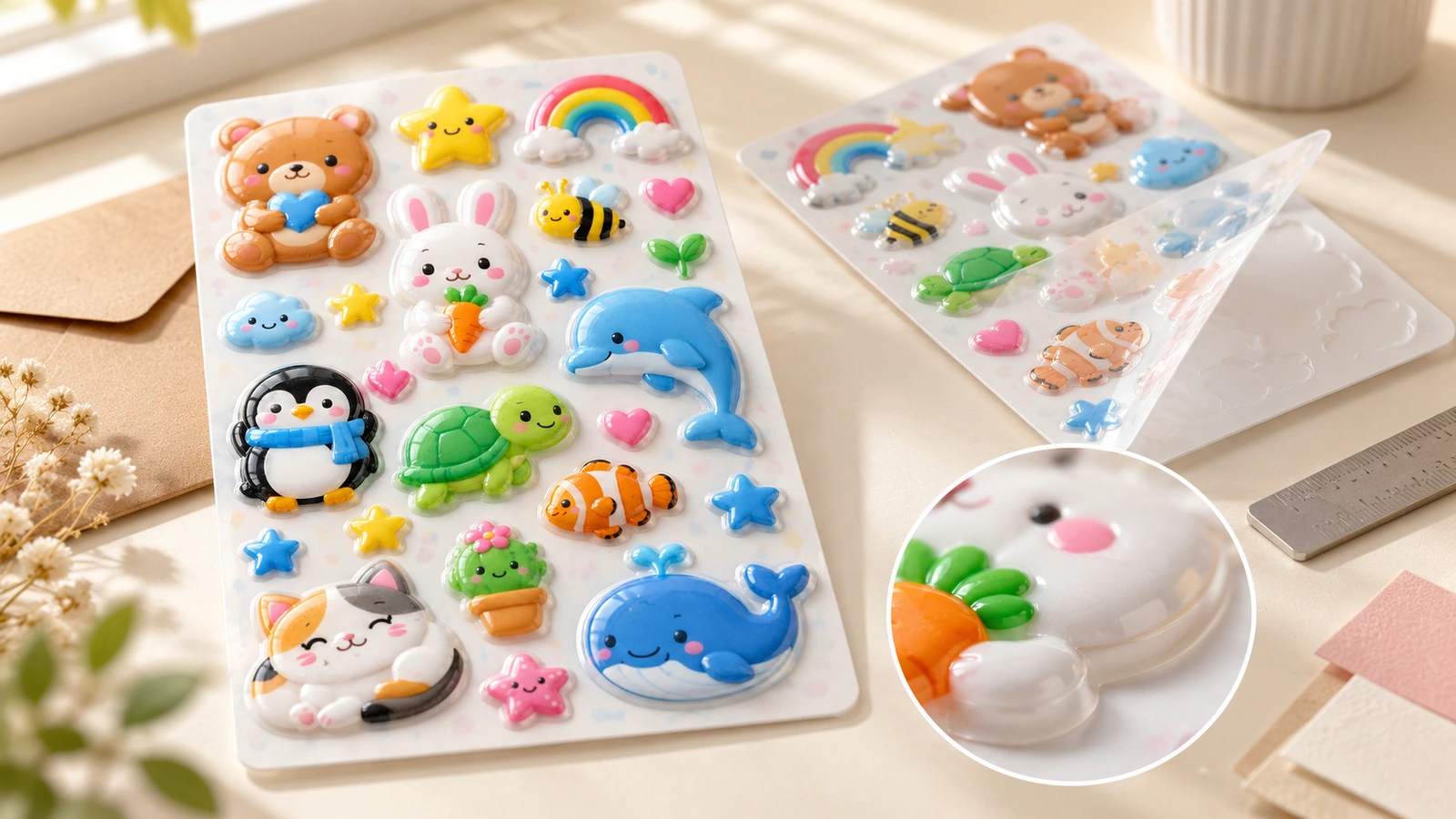
Pack 100–500 sheets per bag so the thick stickers do not leave pressure marks on each other. Inspect the outer cartons before you sign for delivery. Then sample-check for delamination, stringy cut edges and liners that are hard to peel. Claim windows are short: PuffSticker allows 7 days after receipt to report damage or misprints (PuffSticker), so confirm your supplier's window before ordering. Keep the approved sample and the batch numbers so that reorders match the first run.
Puffy, Foam, Epoxy Dome or Flat Vinyl: Which Fits Your Use Case? ↑
| Option | Feel / height | Supplier water claim | Public entry point | Best fit |
|---|
| Puffy (PU/vinyl top) | Soft, compressible, 1–3 mm | High (vinyl top) | $680 / 250 pcs | Brand merch, packaging seals |
| EVA foam | Spongy, 1/2/3 mm core | Medium | $680 / 250 pcs | Craft kits, event giveaways |
| Epoxy / dome | Hard clear dome, does not compress | Very high | Quote only | Bottles, nameplates, outdoor |
| Creator puffy sheets | Kiss-cut sheets | Not stated | 10 or 50 pcs/design (pages conflict) | Artist alley, small drops |
| Flat die-cut vinyl | Flat, no raise | Waterproof, UV claims | No minimum; 4–10 days | Tight curves, outdoor, bulk |
The first three rows come from PuffSticker's comparison chart. The creator row reflects Vograce's product pages. The flat vinyl row comes from StickerYou's die-cut FAQ[24]: "There is no minimum… Printing, cutting, and shipping… only 4-10 days." Do not read the gap between $0.55 vinyl and a $2.72 puffy piece as a quality ranking. Thickness and minimum order quantity explain most of the price difference.
Epoxy and polyurethane domes are not interchangeable either. Polinal[25] argues that epoxy "yellows quickly under light" and is brittle, while polyurethane stays clear and flexible. This is a materials supplier's view, not independent testing. For puffy builds, PuffSticker's legacy page says they "are water-resistant and can handle light outdoor exposure, but they're best suited to indoor or short-term outdoor use" (PuffSticker). Print Reviewer[26] explains that "waterproof" means the face resists water and the ink does not bleed. It does not mean UV, heat or abrasion resistance. Unless a specific SKU has its own test report, do not borrow outdoor lifespans or dishwasher claims from flat vinyl.
What Paperwork Do Children's Puffy Stickers Need in the US? ↑
| Rule | Limit | Applies to | Authority |
|---|
| Phthalates (CPSIA §108, 16 CFR 1307) | 0.1% each of 8 phthalates | Accessible plasticized parts of children's toys and child care articles | CPSC phthalates[27] |
| Total lead (15 U.S.C. §1278a) | 100 ppm, accessible component | Children's products | CPSC lead[28] |
| Toy safety (16 CFR 1250) | ASTM F963-23 | Toys manufactured on or after 2024-04-20 | CPSC toy safety[29] |
| Children's Product Certificate | Third-party, CPSC-accepted lab | Products designed for children 12 and under | CPSC (rows above) |
These rules apply when the product is designed or intended for children 12 and under. A brand seal for a skincare jar usually falls outside toy rules. A sheet marketed as "kids' crafts" falls inside them. Soft cores are where the risk sits. A 2026 Chinese e-commerce sampling republished by eco.gov.cn[30] found phthalate exceedances in 16 of 20 children's stickers. Every exceedance was in the 3D soft-plastic body, and the paper flat stickers passed. That was a single 20-sample check, not an industry census. Still, "non-toxic" on a sales page is not a certificate. Request lab reports whose report numbers, materials and batch match your order. Do not present EN 71 as a US mandatory certification.
Key Takeaways for Puffy Sticker Buyers ↑
- Public puffy pricing is dollars per piece, not cents — $680 for 250 pcs, or $2.72 each, at 1×2 in and 1 mm (Source)
- Specialist sampling is a real line item — $250–$300 per design, then 18–20 business days from proof approval (Source)
- Children's soft plastic parts face a strict phthalate cap — 0.1% for each of 8 phthalates (Source)
- Toy-marketed sheets must meet the current toy standard — ASTM F963-23 for toys made from 2024-04-20 (Source)
- Retail demand for puffy stickers is steady — 1,203,150 units in 12 months to July 2026, Amazon US top 50 (Source)
- NSKU-621-01 terms are fixed in writing per order — MOQ, lead time and unit weight are confirmed in your quote and sample
Is a Custom Puffy Sticker Sheet Right for Your Next Run? ↑
Choose a puffy sheet when touch is the selling point and the surface is flat or only gently curved, such as box seals, jar lids, mailers and collector sheets. Choose flat vinyl for tight curves, long outdoor exposure or postal use. Choose epoxy when you need hard, water-resistant clarity. Whichever you pick, get four things in writing before you pay: thickness in millimeters, the named core and adhesive, the color and cutting tolerances, and test results for peel and lamination. Ready to start? Send your artwork, target surface, sheet size and quantity to request a written quote and sample plan for NSKU-621-01 Custom 3D Puffy Sticker Sheets.




The information below is required for social login
Sign In
Create New Account