Custom acrylic mirror stickers are self-adhesive PMMA mirror decals cut to a logo, a set of letters or any outline you supply. They are lighter than glass and far harder to shatter. Their reflection, however, can only be as flat as the surface underneath. Specify at least 1–2 mm thickness, a smooth rigid substrate and an acrylic-safe adhesive, and accept the order against photos of the actual reflection.
Who Orders Custom Acrylic Mirror Decals, and What Do They Need?↑
Two very different buyers type the same search. The first is a brand, retailer, salon or event planner. This buyer wants a logo, monogram or run of letters cut from mirrored acrylic for a feature wall, a window backdrop or a pop-up display. The second is a renter, parent or home-gym owner. This buyer wants a shatter-resistant reflective surface that goes up without drilling. Both groups care about the outline, but usually only the second group expects a usable reflection.
A third group arrives here by mistake: buyers who want printed chrome-look stickers for packaging, giveaways or QR-code business cards. Those products are metallized PET labels, not acrylic. Reviewers on StickerApp's mirror sticker reviews[1] praise exactly that use. One reviewer also notes the artwork looked "a bit offset" when the mirror layer covered only part of the design. If you need a small logo label for a jar, choose a printed mirror sticker. This page covers rigid PMMA decals, product reference NSKU-635-01.
Rooms designed for children need a specific caution. "Shatterproof" is a common selling point, yet an Amazon review summary for an acrylic playroom mirror[2] records complaints about sharp edges, heavy distortion and cut fingers. Write the edge finish into the specification. Do not assume it will be safe by default.
Why Do So Many Mirror Stickers Disappoint After Installation?↑
The mirror coating is rarely the cause. The cause is that a thin plastic sheet copies whatever lies beneath it. One verified buyer of 12-inch self-adhesive acrylic tiles wrote that after installation they looked "like funhouse mirrors," with a clear image only within 2 to 3 feet. The comment appears in the Amazon listing's reviews[3]. A third-party digest of marketplace reviews by Accio[4] groups the negative themes as image distortion (about 34.2%) and poor adhesion (about 26.3%). Read those shares as a review summary, not as a laboratory failure rate.
The problems then compound. Adhesive that holds on day one can lift within weeks in a humid bathroom, or it can grip so hard that it tears paint on removal. Home-media guide Magicbricks[5] rates bathrooms as unsuitable and says decorative mirror stickers begin losing clarity and grip after roughly 1–2 years. That figure is an editorial estimate, not a test result. The face is also softer than glass. A US buyer of hexagon decals on Amazon[6] wrote that "it scratches easily" and that wiping dust leaves marks. The same page carries a blunter warning: "IT WILL NOT STICK IF THE WALL IS NOT FLAT."
Reviews of a popular mirrored acrylic HOME letter set follow the same split. Buyers praise the look, then report letters cracking while being peeled from the sheet, paint coming away when a piece was repositioned, a missing letter, and a "dirty" haze that turned out to be the protective film. None of these complaints is exotic. Each one traces back to a specification the buyer never saw.
The fix is a written specification. A stronger adjective in the listing does not help. Choose thickness for the viewing distance, prepare a flat rigid substrate, and use an acrylic-safe adhesive. Then accept the order against agreed reflection photos, not a studio render. The sections below turn those steps into an order checklist.
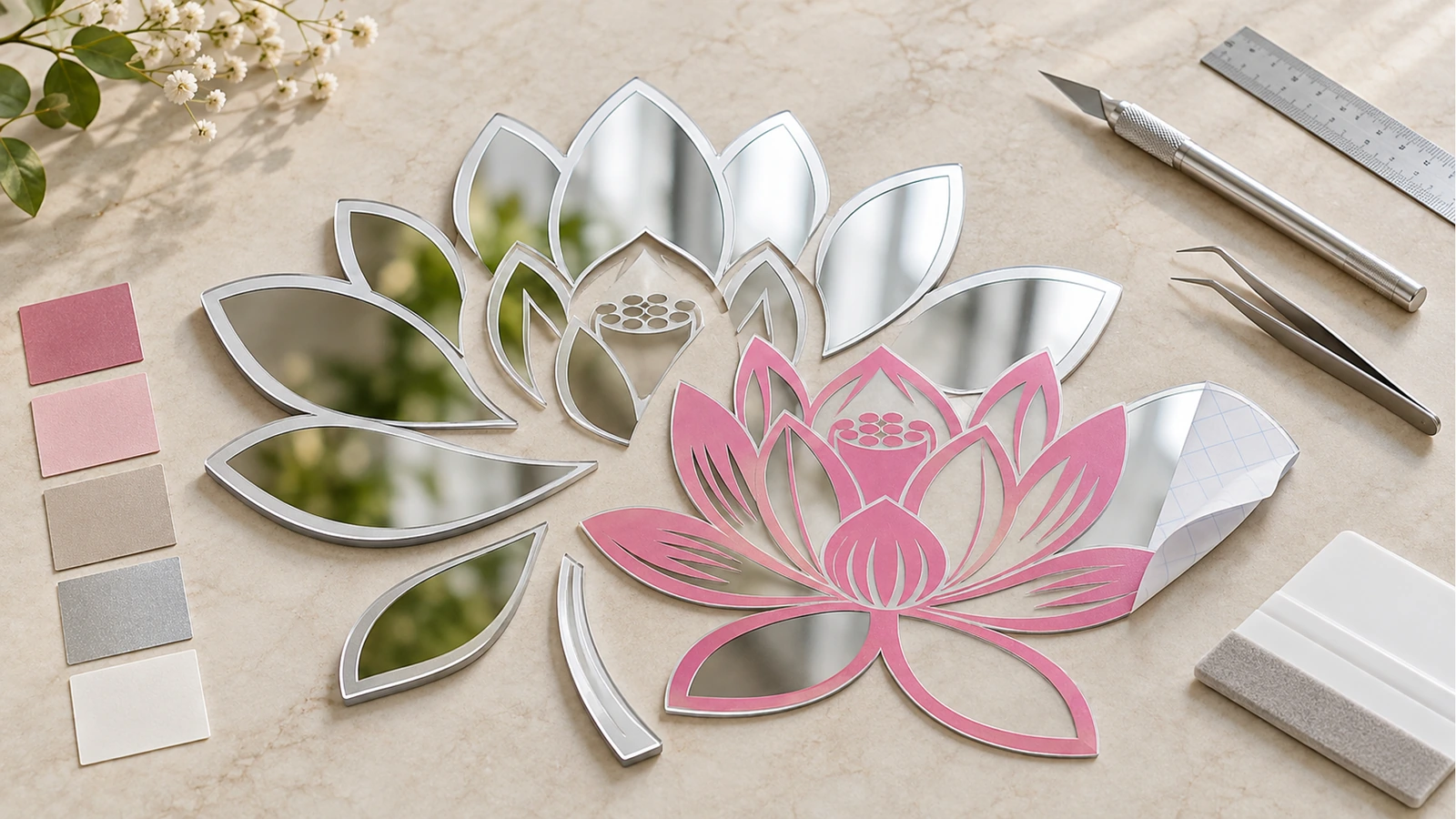
Table of Contents
What Exactly Is a Custom Self-Adhesive Acrylic Mirror Decal?↑
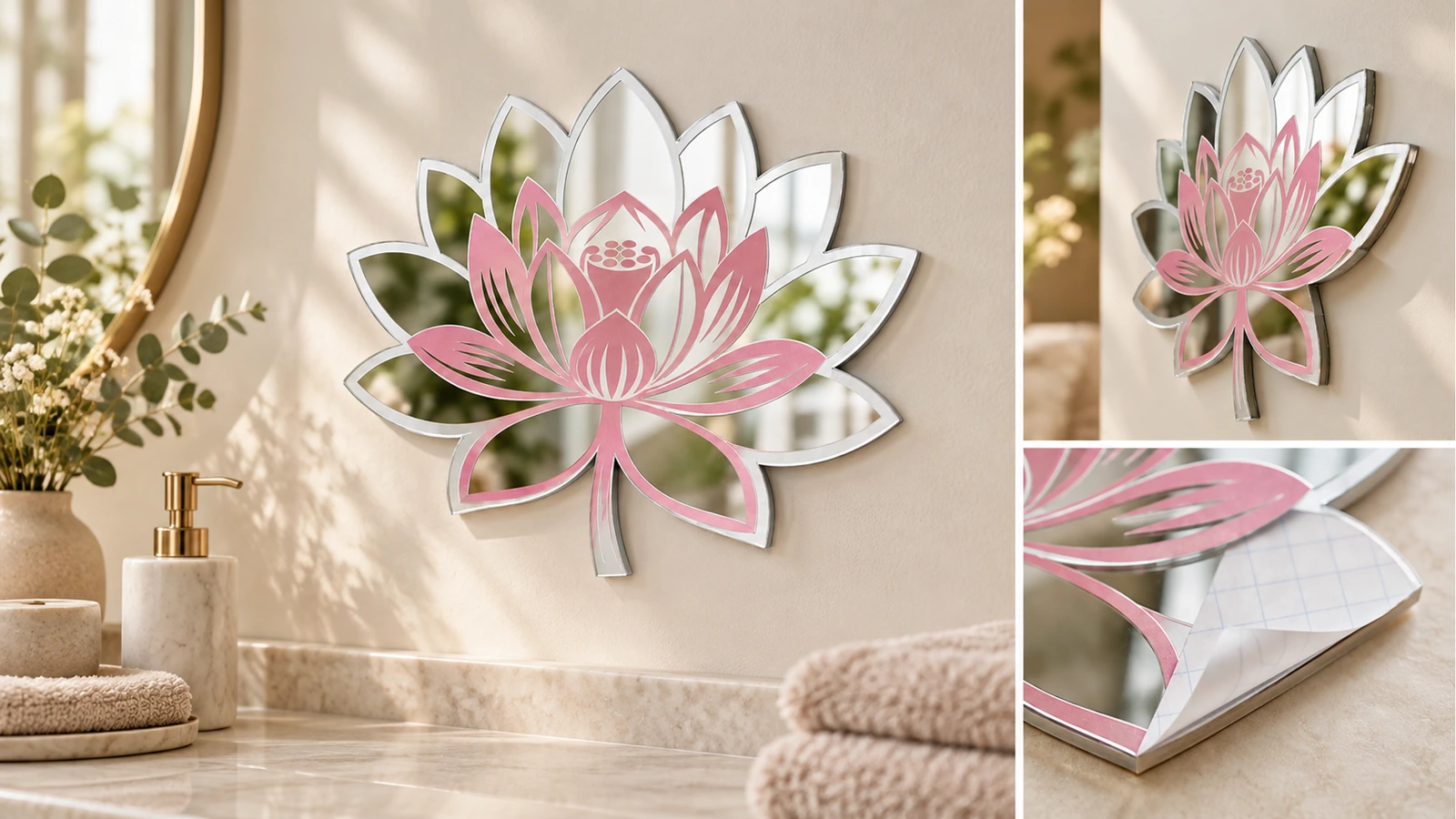
The decal starts as PMMA (polymethyl methacrylate) sheet. Aluminum is vacuum-deposited on the back face, and a paint or adhesive layer is added to seal that metal film. The sheet is then cut to your outline and supplied with a mounting adhesive and a front protective film. Manufacturer Feilong Acrylic[7] describes this sequence and warns that "even small defects in the aluminum coating can cause reflection issues." The same source lists scratches, warping, slightly lower optical clarity than silvered glass, and backing delamination as the material's known weaknesses.
Published performance figures describe the sheet, not every finished decal. Plaskolite's FABBACK fabrication guide[8] gives reflectivity of approximately 85–90% over 400–700 nanometers and about half the weight of glass. The same guide also says the material "should not be used for precise image reflection." On thickness, ISO 7823-1[9] covers cast PMMA sheet from 1.5 to 25 mm. A decal thinner than 1.5 mm therefore cannot automatically claim conformity. Treat supplier claims such as ISO 9001, SGS or RoHS as seller statements until a certificate or report number is provided.
How Do You Specify a Custom Order That Actually Reflects Well?↑
Make five decisions in order. Each one removes a failure mode that real buyers have reported.
Step 1: Decide whether the reflection matters
Tag every request as either "decorative sheen" or "functional reflection." Decorative sheen covers logos, letters and geometric accents viewed from across a room. Functional reflection covers uses such as a child's activity mirror or a dance corner. Functional jobs need more thickness and a backing board. Precise grooming, full-length posture checks and security viewing should move to glass, and the order record should say so.
Step 2: Match thickness to size and viewing distance
Plaskolite puts it plainly: visual distortion "is a function of viewing distance and material thickness." The guide adds that correct installation and sufficient thickness "can reduce visual distortion but may not eliminate it." Use the bands below as a starting point.
| Thickness | Typical use | Distortion risk |
|---|
| Under 1 mm | Tiny accent pieces only | High; warps and almost always distorts |
| 1–2 mm | Letters, icons, cabinet accents | Moderate; requires a smooth surface |
| 2–3 mm | Light signage, small indoor displays | Lower; balances rigidity and weight |
| 3–5 mm | Retail display, wall mirrors, safety-mirror uses | Low when mounted on a flat backing |
| 6 mm and above | Large or high-traffic public panels | Lowest; heavier and more costly |
The bands combine two industry sources. The Joybuy buyer's guide[10] calls sheet under 1 mm "highly prone to warping" and treats 1–2 mm as the usual compromise on smooth substrates. The OLFA thickness guide[11] maps 3–5 mm to retail display and safety mirrors. These are application recommendations, not ASTM or ISO grades. Large single pieces belong at the upper end of each band, and small letters can sit lower.
Step 3: Choose the substrate and adhesive together
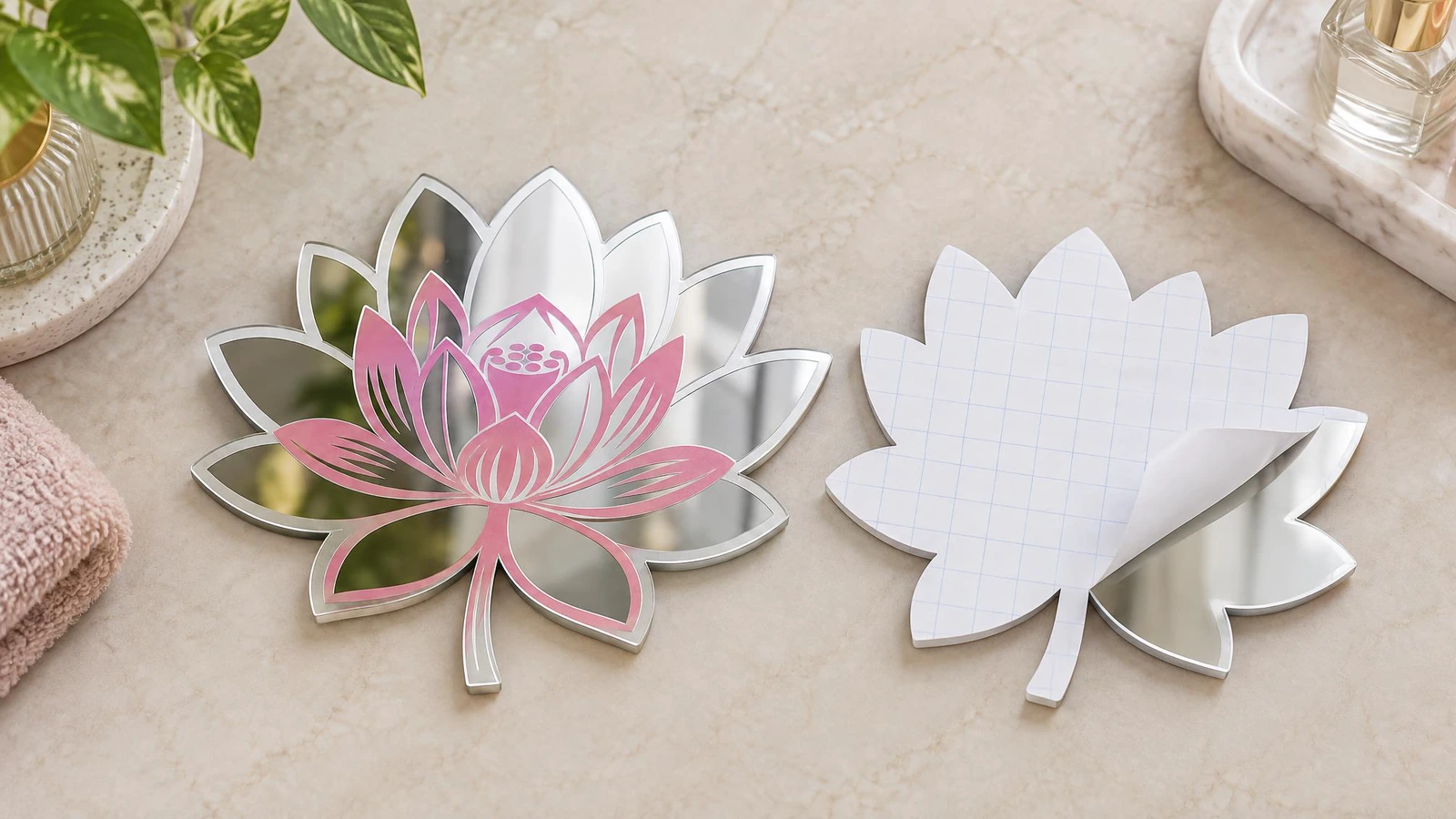
Thin acrylic takes on the shape of the wall. Mirrorank[12] summarizes it as "Thicker is flatter. Adhesive-mounted acrylic follows every dip." Plaskolite recommends roughly 1/4-inch hardboard or 1/2-inch MDF as backing. Textured latex paint, wallpaper and unleveled drywall should get a backing panel before any functional mirror is applied. If a customer insists on a textured wall, record the order as decorative, with no reflection promise.
Installer guidance from Delvie's Plastics[13] is specific. Use only adhesives made for acrylic mirror, and reject products with 5% or more solvent such as toluene, ketones or hexane. Test on scrap pieces at least 72 hours in advance. Run vertical beads 5–6 inches apart, starting about 3 inches from the edges, and mount within 10 minutes. Do not apply adhesive below 60°F. Ceiling and overhead installation is not recommended without edge-engaging frames or mechanical fastening.
Pre-applied tape suits decorative pieces. Doors and other surfaces that vibrate need a separately tested adhesive or mechanical support. Removable and permanent adhesives should be sold as separate SKUs, because one listing cannot honestly promise both "stays up" and "won't harm paint."
Step 4: Preflight the artwork file
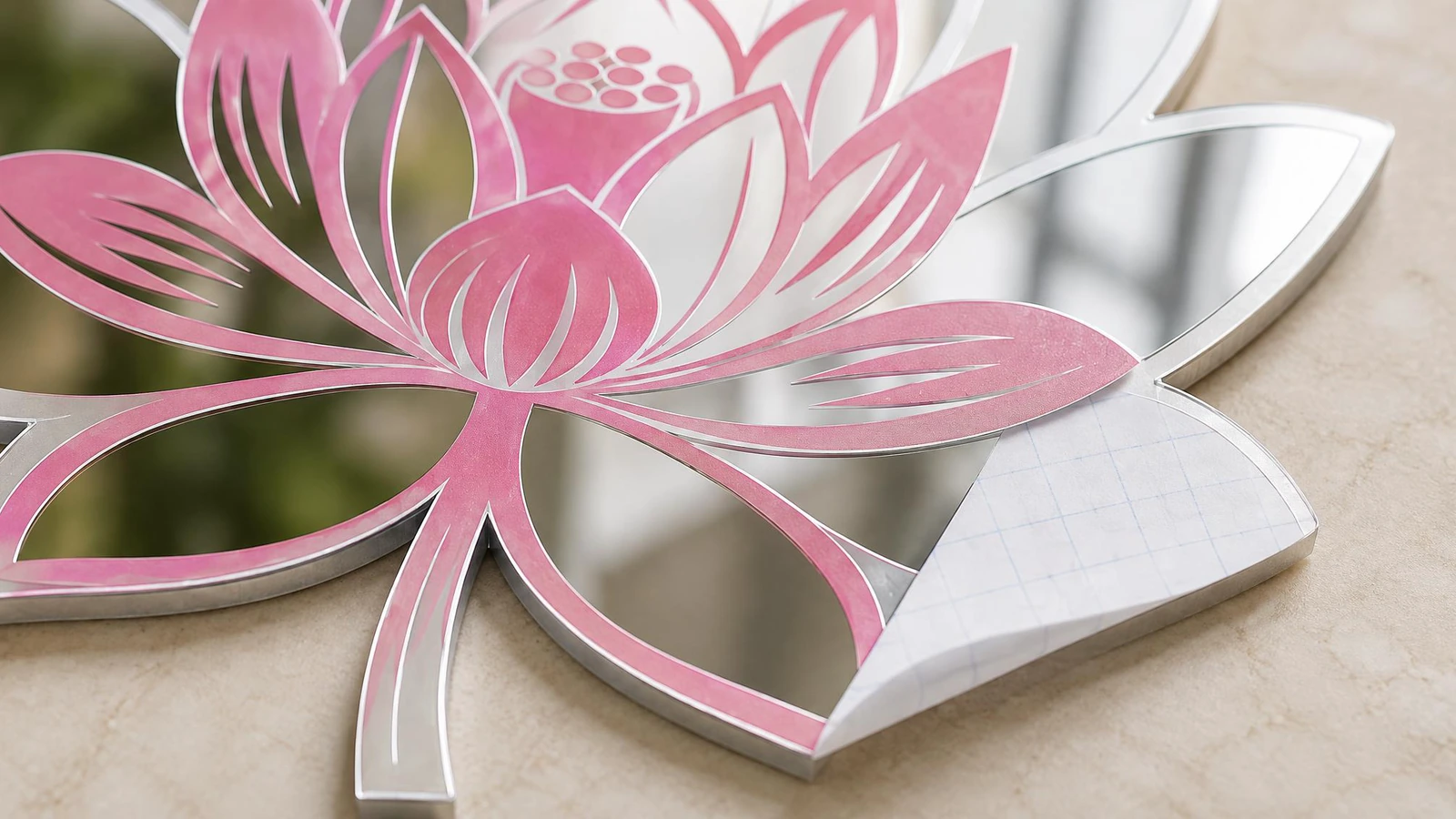
Supply a closed vector outline, such as DXF, at 1:1 scale, and mark which face is the mirror side. One reviewer of the letter set above received an "E" with the reflective layer where the adhesive should have been. That is an orientation error a marked proof would have caught. Thin strokes, small enclosed shapes and tight inner corners are fragile. Reviewers describe butterfly pieces that tore and letters that cracked while being lifted from the sheet. Minimum stroke width and inner radius are therefore confirmed on the proof, not assumed in advance.
For cutting precision, Grandview Acrylic[14] cites about ±0.1 mm for CO2 laser cutting of thin sheet and about ±0.05 mm for CNC. Grandview recommends cutting mirror-side down with the protective film in place. These are one manufacturer's figures. The tolerance that applies to your order must be stated on your own quote.
Step 5: Put every variable into the RFQ
| Field | What to specify | Why it matters |
|---|
| Use case | Decorative sheen or functional reflection | Sets thickness and backing |
| Thickness and tolerance | Nominal mm with a stated tolerance | Directly drives distortion |
| Sheet grade | Cast or extruded | Affects processing stability and price |
| Color | Silver, gold, rose gold or other | Changes perceived reflection |
| Adhesive | Pre-applied or separate; removable or permanent | Determines hold and wall damage |
| Environment | Dry indoor, humid, or outdoor | Humid rooms need sealed edges |
| Artwork | 1:1 closed vector, mirror side marked | Prevents reversed or fragile parts |
| Mounting surface | Smooth wall, glass, or backing board | Limits achievable flatness |
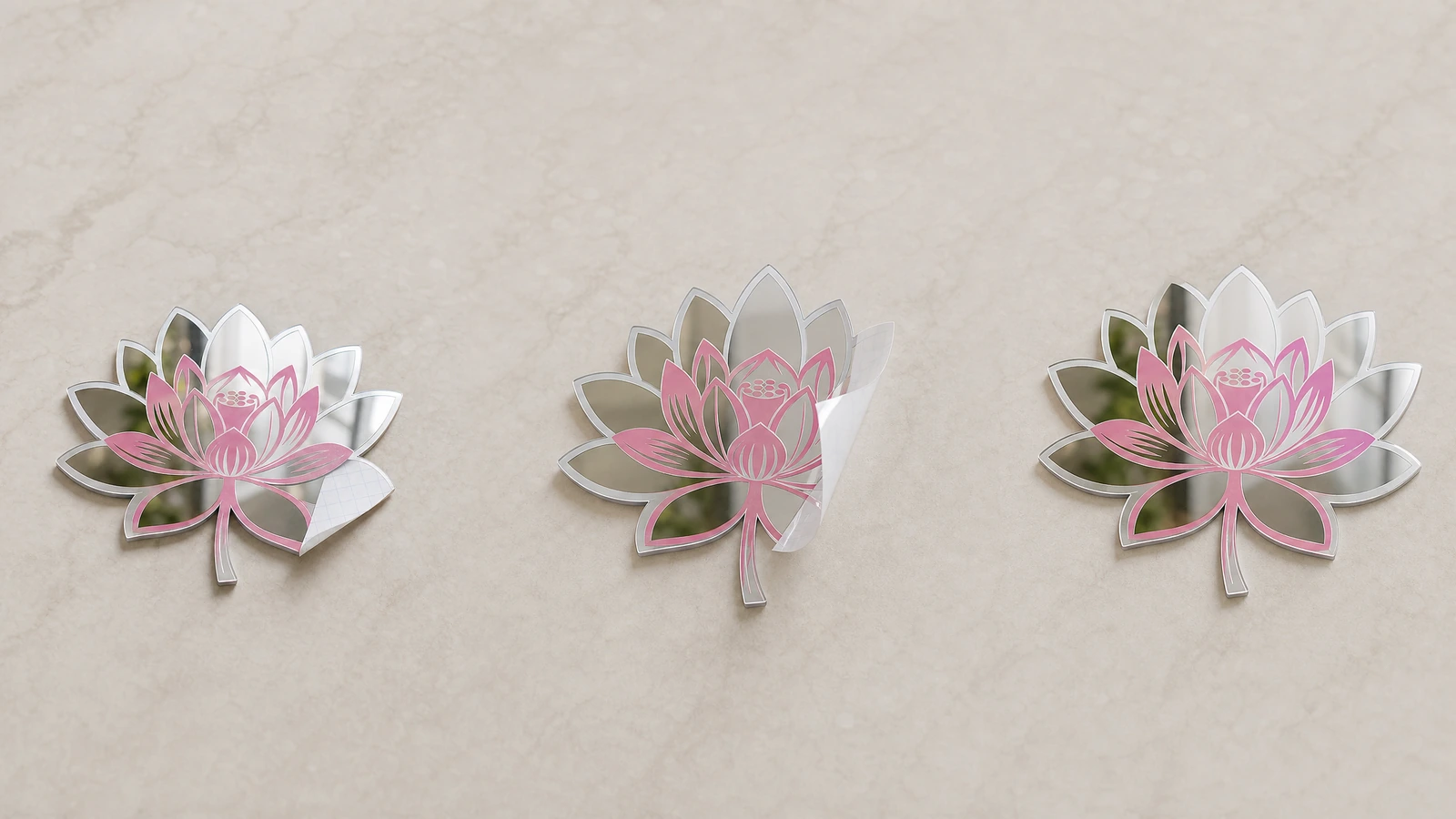
Feilong advises buyers to ask about thickness, cast versus extruded grade, coating, backing, tolerance and packaging. The table turns that advice into fields a quote must answer. For tolerance, Acme Plastics[15] describes nominal thickness tolerance of about ±10% and warns that large unsupported pieces give a "fun-house" reflection. MOQ, unit price, unit weight and lead time for NSKU-635-01 are quoted against your drawing. They are not published here until sampling confirms them. Any sample schedule must include the 72-hour adhesive compatibility window.
What Happens During Production, Inspection and Shipping?↑
A typical sequence runs as follows: clean the sheet, vacuum-metallize, seal the back coating, cut with the protective film on, finish the edges, laminate the adhesive, inspect, and pack with the front film still in place. Heat bending changes the reflection, so formed shapes should be excluded from reflective jobs unless a trial has been approved. Never ask the factory to scuff the back for better grip. The coating is extremely thin, and back-side scratches show through on the face.
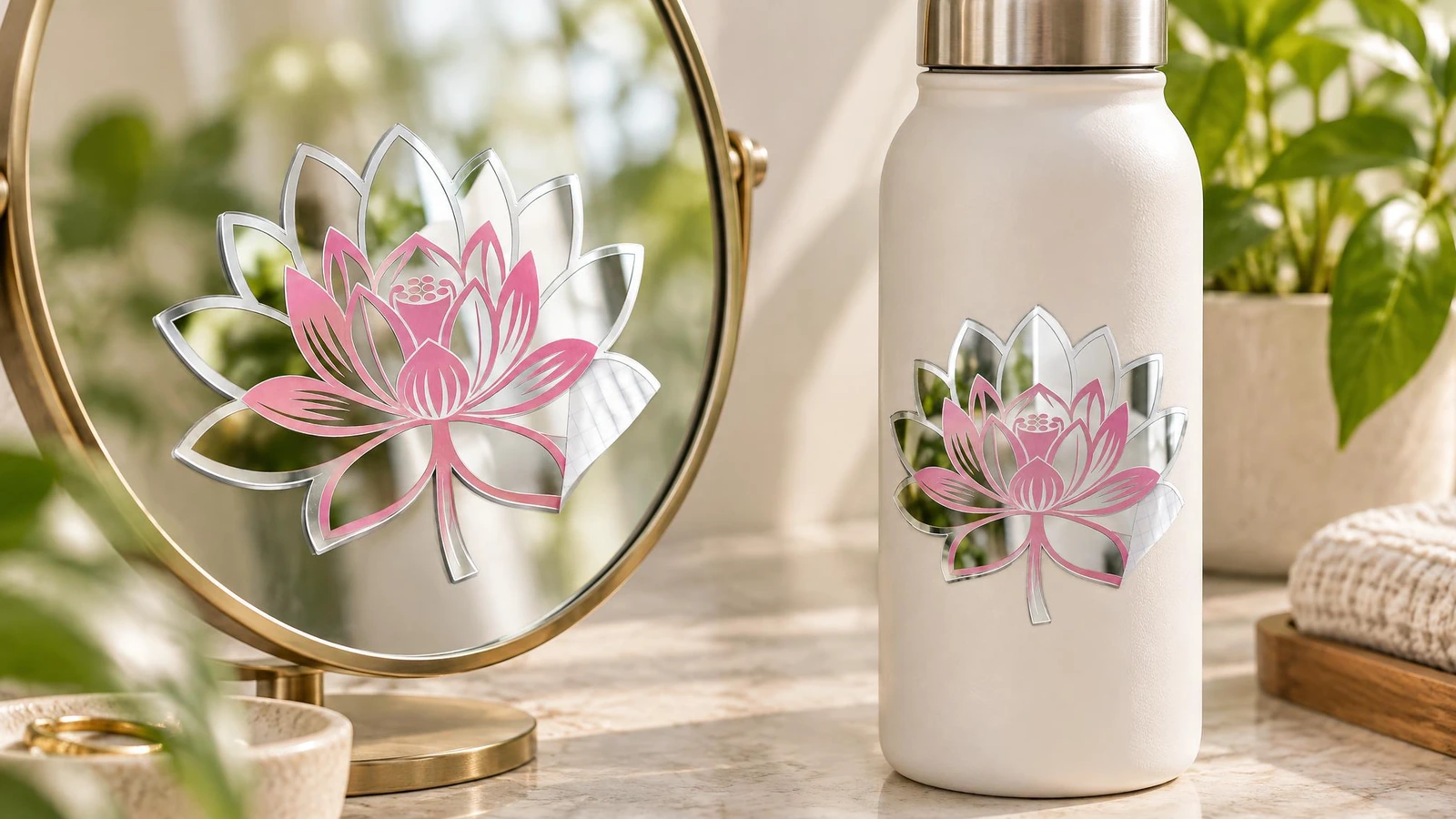
Agree on acceptance tests at sampling. Without factory test data, these are pending items, not results. Photograph each sample's reflection at 1 m and 3 m while it is mounted on a flat board. Inspect the coating for pinholes, light leaks and streaks. Run a finger along every edge for burrs and sharp points. Check letter orientation and piece count against the drawing. Open a sealed pack and note any odor; one Amazon reviewer reported a chemical smell strong enough to cause a headache. After 72 hours on the agreed substrate, confirm there is no lifting and no new distortion. Humidity resistance and paint damage on removal from painted drywall remain open test items, and no result is claimed for them.

Pack decals flat with the mirror face inward, keep them away from heat, and include a moisture barrier. Reviews of the letter set mention mold and mildew in packs that had evidently been wet in transit. A thin sheet bent during shipping cannot be pressed flat again on site. Print the installation order on the pack: clean the substrate, position the piece, press it down, and peel the face film last. Hazy or blue film is protection, not a defect.
For care, First Surface Mirror[16] specifies mild soap and a damp soft cloth, with no window sprays or scouring compounds. It rates continuous service up to 160°F, so keep decals away from heaters and ovens. For repeat orders, keep the approved proof, thickness, color, adhesive type and photo set on file so later batches can be matched.
Acrylic Decal, Printed Sticker, Film or Glass: Which Fits Your Project?↑
| Option | Construction | Strength | Main limit |
|---|
| Custom acrylic mirror decal | Metallized PMMA, cut to shape, adhesive-backed | Light, shatter-resistant, any outline | Follows wall texture; scratches |
| Printed mirror sticker | Metallized PET/PP, white ink, laminate, die-cut | Logos, QR codes, chrome look | Not a functional mirror; registration risk |
| Peel-and-stick mirror film | Aluminized PET film on a roll | Lowest cost, removable | Weakest image and lifespan |
| Rigid cut-to-size acrylic sheet | 3 mm or thicker PMMA panel | Flatter, can be drilled and framed | Heavier; needs fixings |
| Glass mirror tile | Float glass with silvered back | Sharpest image when flat | Heavy; breaks into shards |
Costs and lifespans vary by product type. A buying guide from Alibaba[17], with prices stated "as of 2024," puts thin PET film at $0.50–$2 per sq ft with a 1–3 year life. It puts rigid acrylic mirror at $2–$5 per sq ft with a 5–7 year life. These are buying-guide ranges, not accelerated-aging results. StickerApp[18] claims up to 2–4 years outdoors for its metallized PET with glossy laminate. That claim applies to printed stickers and cannot be transferred to wall decals. Feilong's 5–15 year indoor estimate for acrylic mirror is likewise a manufacturer narrative. Impact claims of "10 times" or "17 times" stronger than glass come from sheet marketing under differing conditions. Do not apply them to a 1 mm decal.
In practice, choose the acrylic decal when the outline is the point and weight or breakage is the main worry. Choose a printed sticker when the job is branding at hand-held size. Choose glass when someone will rely on the reflection every day. Film is only for short-term decoration.
Which Safety and Compliance Claims Should You Verify?↑
California Proposition 65 can apply to mirrored acrylic. In a 25 August 2025 statement, ACRYLITE[19] lists its Reflections mirror products as requiring a "clear and reasonable" warning when sold in California, while some plain extruded sheet needs none. That conclusion does not transfer automatically to other resin suppliers. Each supply chain needs its own assessment against the sheet's SDS.
Marketing language triggers obligations. According to the CPSC[20], products designed primarily for children 12 or younger require third-party testing and a Children's Product Certificate. Words such as "nursery" or "toy" can move a decal into that category. Conversely, 16 CFR Part 1201[21] governs architectural glazing such as doors and shower enclosures. Claiming that a bedroom decal "passes 1201" overstates its scope. The First Surface Mirror sheet data also describes acrylic mirror as a combustible thermoplastic that is not recommended for exterior use, and it notes that applicable building codes should be followed.
Key Takeaways for Buyers↑
- The upstream mirror sheet market is large, but it is not a sticker market — USD 1.6 billion in 2024, projected USD 3.2 billion by 2034 (Source)
- Narrower acrylic mirror estimates are an order of magnitude smaller — USD 456.4 million in 2025, 5.6% CAGR to 2032 (Source)
- Thickness is the first defense against the funhouse effect — sheet under 1 mm almost always distorts (Source)
- Adhesive must be tested before mounting — under 5% solvent, at least 72 hours on scrap pieces (Source)
- Heat limits placement — continuous service up to 160°F (Source)
- Commercial terms for NSKU-635-01 depend on your drawing — MOQ, production time and unit weight are confirmed at quotation and sampling
Ready to Turn Your Outline into a Mirror Decal?↑
A custom acrylic mirror decal succeeds when the specification matches the job. That means the right thickness for the viewing distance, a flat rigid substrate, an acrylic-safe adhesive, a preflighted vector file and acceptance photos agreed before production. It fails when a render promises glass-like reflection on a textured wall. Treat it as a lightweight, shatter-resistant, shape-free reflective element, and write its limits into the order rather than leaving them for a review to discover. To start, send your 1:1 vector file, target size, intended use and mounting surface to request a sample quote.





The information below is required for social login
Sign In
Create New Account