Custom leather sticker labels made from PU imitation leather add a tactile, leather-look logo to boxes, jars, bottles, notebooks and other hard goods. You peel them off a liner and stick them on. Because the face material is polyurethane rather than animal hide, US copy must disclose it as imitation leather. Adhesion, heat and wash behavior depend on your surface, so they are confirmed by sampling on your actual substrate before bulk production.
Who Buys Adhesive PU Leather Logo Labels, and Where Do They Go? ↑
Demand for leather-look stickers splits into two groups. An analysis of marketplace listings by Accio[1] found that wholesale (B2B) buyers look for customizable, high-quality adhesive labels for branding, packaging and product decoration. Consumer-marketplace demand leans toward personalizing cars and electronics. This page is written for the first group.
The first group covers several kinds of buyer. Small apparel and bag brands want a branded detail on a hang-box or accessory. Crochet, knitting and rattan-bag makers want a maker's mark without extra sewing. Packaging teams decorate gift boxes, jars, bottles, shoe boxes and notebooks. Flat or gently curved packaging is where peel-and-stick PU fits most naturally. Public wholesale listings show embossed, foil-stamped PU bottle labels at roughly $0.08–$0.25 each with 1,000-piece minimums, in an Alibaba showroom page updated 2026-09-30[2]. Those figures are third-party reference listings, not this product's price. Your unit cost depends on size, decoration and quantity, and is set at quotation.
Why Do Leather-Look Stickers Disappoint After the First Month? ↑
The problem: A leather-look label can look premium on the day it arrives and still fail within weeks. One collector bought stickers that the seller said would hold on leather-type binders. The buyer then reported that "they're all lifting up at the bend"[3]. Care products make adhesion worse. A leatherworker warned that "conditioner will emulsify almost any glue used by stickers"[4].
Why it hurts: The material itself can also break down. A PU production guide from Chief Labels[5] explains that cheap polyurethane uses low-grade plasticizers. These leach out under high heat and leave the material "incredibly brittle." The guide adds that a weak bond between the PU and its backing causes delamination.
Adhesive leather skins show the same layer failure. One owner found the leather "quite detached from the 3M paper"[6], with air bubbles in between. Readability can fail too. A four-star Amazon reviewer[7] warned that a dark tag on a dark project means "you're not gonna be able to see the writing." Each of these failures ends in a reprint, a refund, or a brand mark that looks cheaper than the product it sits on.
The solution: Write the specification first. Define the target surface, and match the adhesive and decoration to the flex, heat and cleaning that surface will see. Design for contrast. Then approve a sample that has been tested on your own substrate before any bulk order. The sections below walk through each decision.
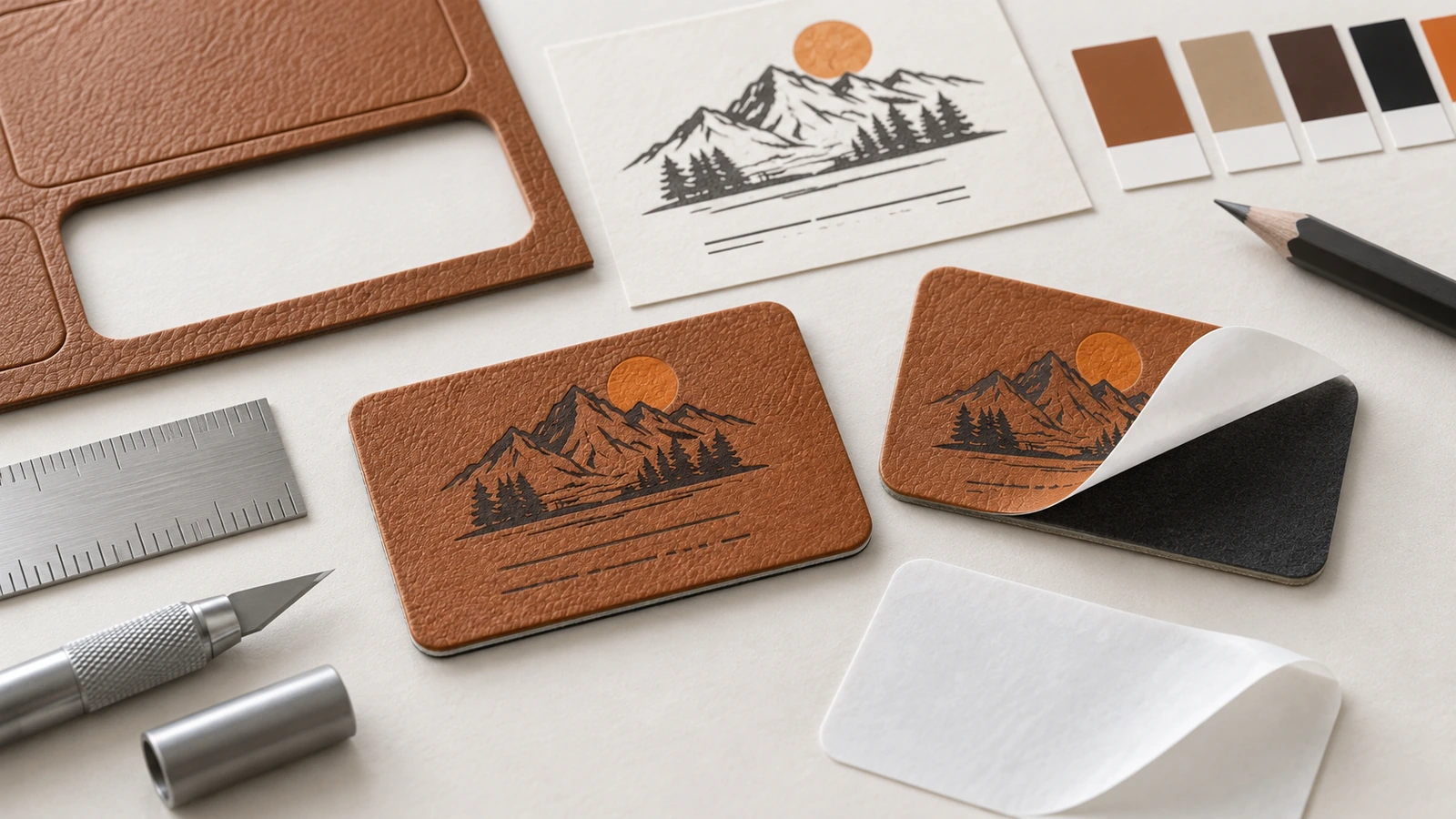
Table of Contents
What Is an Adhesive-Backed PU Leather Label, Exactly? ↑
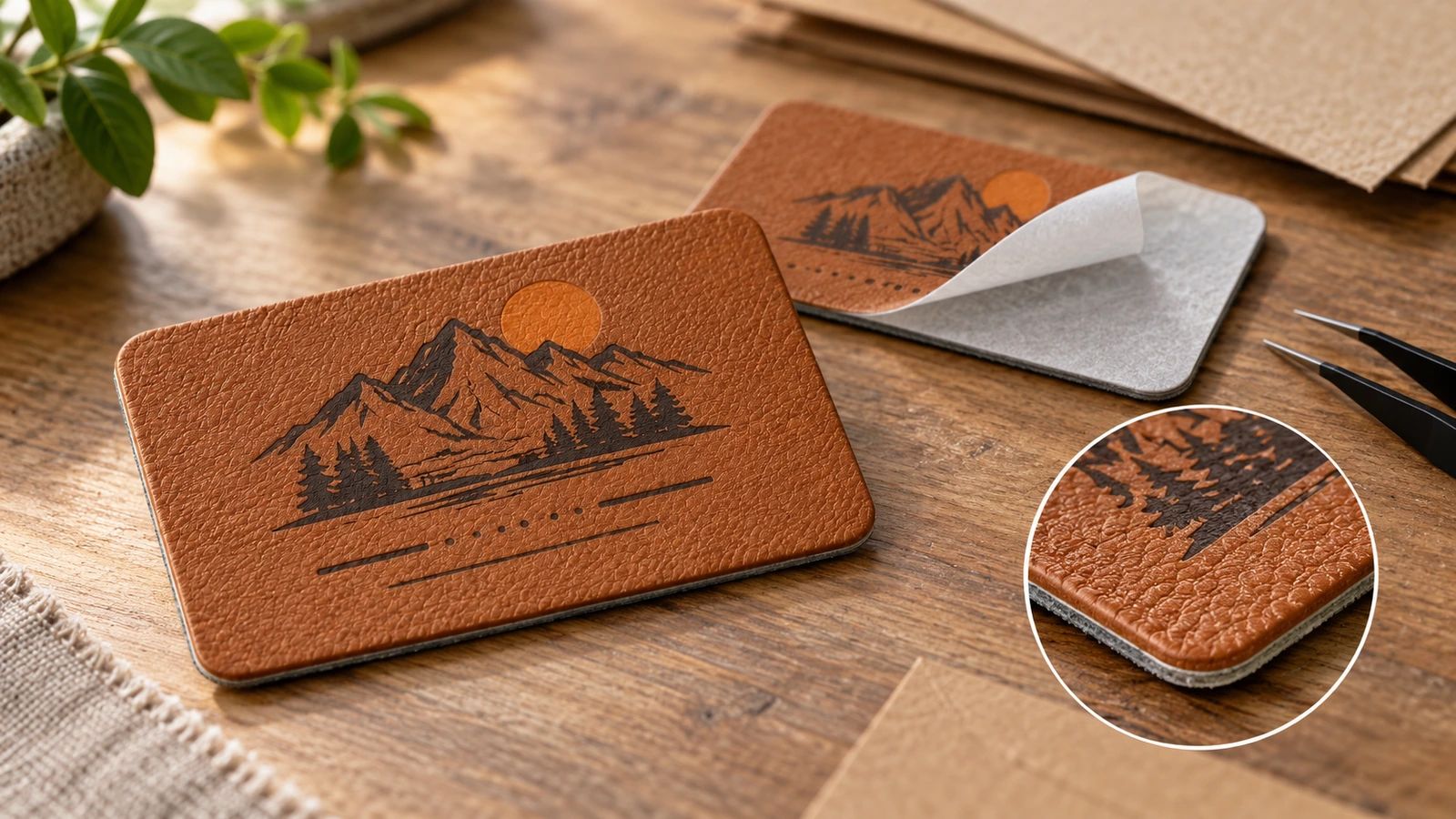
This product (provisional SKU NSKU-634-01) is a layered construction with four parts:
- A fabric base coated with polyurethane, which forms the leather-look face.
- Your logo, applied to that face.
- A pressure-sensitive adhesive layer.
- A release liner that carries the label until you apply it.
A manufacturer's comparison from Kunshuo[8] describes PU labels as a "polyurethane (PU) coating on a fabric base." It says they hold color and thickness more consistently from batch to batch than hide, and are easier to match to Pantone. It also notes that PU is "usually better for laser engraving because its uniform surface allows finer details and cleaner lines." Genuine leather, by contrast, typically embosses deeper.
Naming is a legal matter in the US, not a stylistic choice. The FTC Guides at 16 CFR Part 24[9] call it deceptive to use the unqualified term "leather" for a product that is not made of leather in all substantial parts. When a non-leather material looks like leather, the Guides say that fact should be disclosed, with examples such as "Not leather," "Imitation leather" or "Simulated leather." Section 24.3 also restricts words like "waterproof" and "scuffproof." For that reason, this label is described as PU imitation leather on quotes, invoices and packing lists, and your retail copy should do the same. Writing "vegan leather" on its own does not replace a composition disclosure.
For a reference point on thickness, trims supplier Acctrims[10] says faux leather "is generally made 1.2mm thick" and "is not resistant to high temperatures and chemical corrosion." Thickness, surface grain and color for your order are confirmed on the quotation and the physical proof. No fixed thickness is published for this SKU.
How Do You Specify a Label That Stays Readable and Stays Put? ↑
Three decisions determine most outcomes: size and contrast, surface and attachment, and file preparation. Settle each one before you ask for a price. Otherwise, quotes from different suppliers will not describe the same product and cannot be compared.
Step 1: Set size and readability
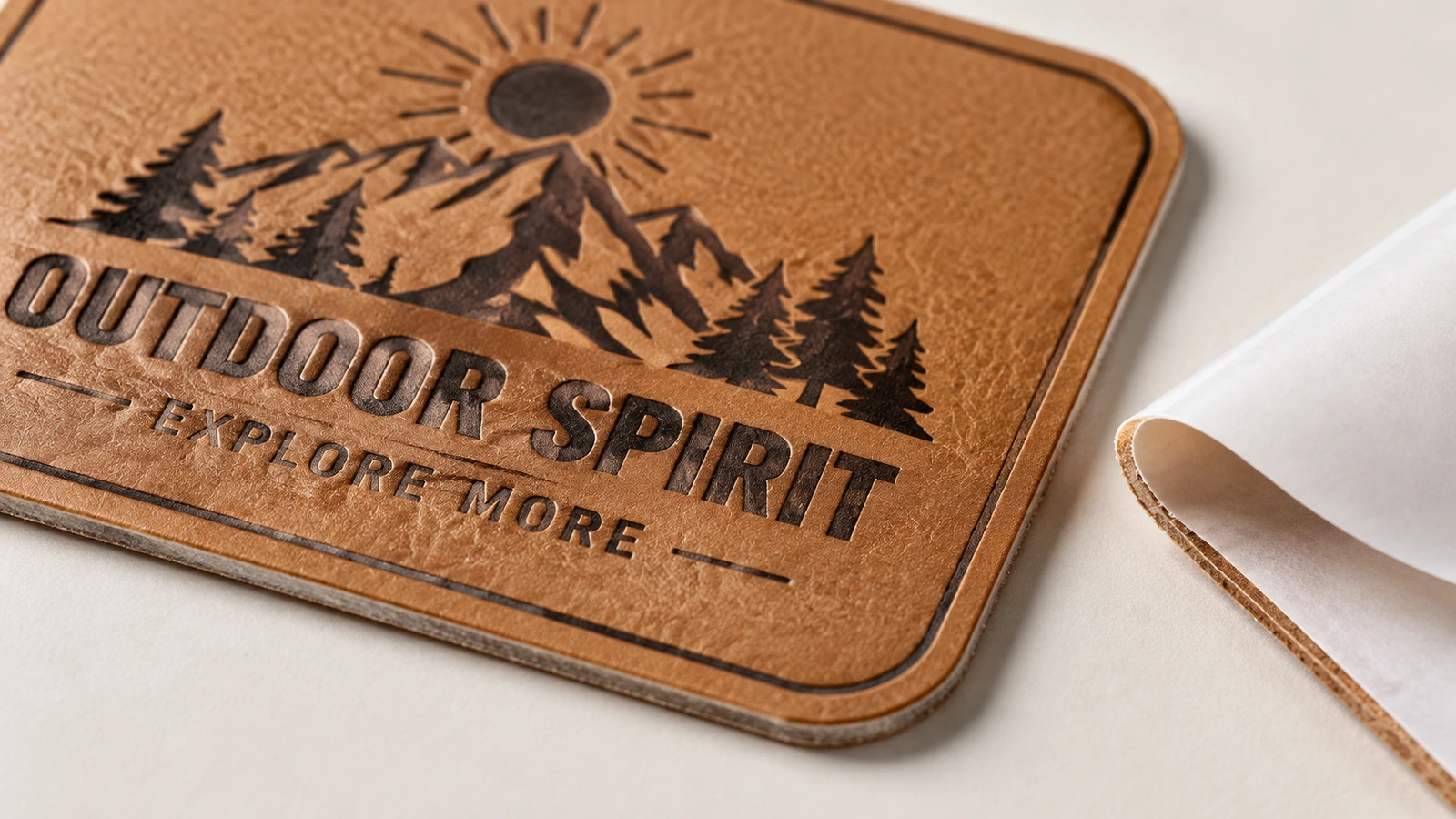
A logo can lose detail when it is pressed into leather-like material. A heat-press quality guide from Doylabel[11] warns that when lines are too thin, "the mold simply cannot transfer them clearly." The results are missing or merged lines and "tiny text that becomes unreadable." Excess heat or dwell time can also burn the surface, add unwanted gloss or make it brittle.
Simplify the mark for small formats. For dark PU, choose a light foil or a light print color rather than a tone-on-tone deboss. For scale, published case sizes from Cusmytrims[12] include a 1.2 mm PU label at 38.2 × 25.8 mm and a 1.6 mm PU label at 45 × 40 mm. Your minimum line weight and text height are confirmed on the proof, not assumed in advance.
Step 2: Match attachment to the surface
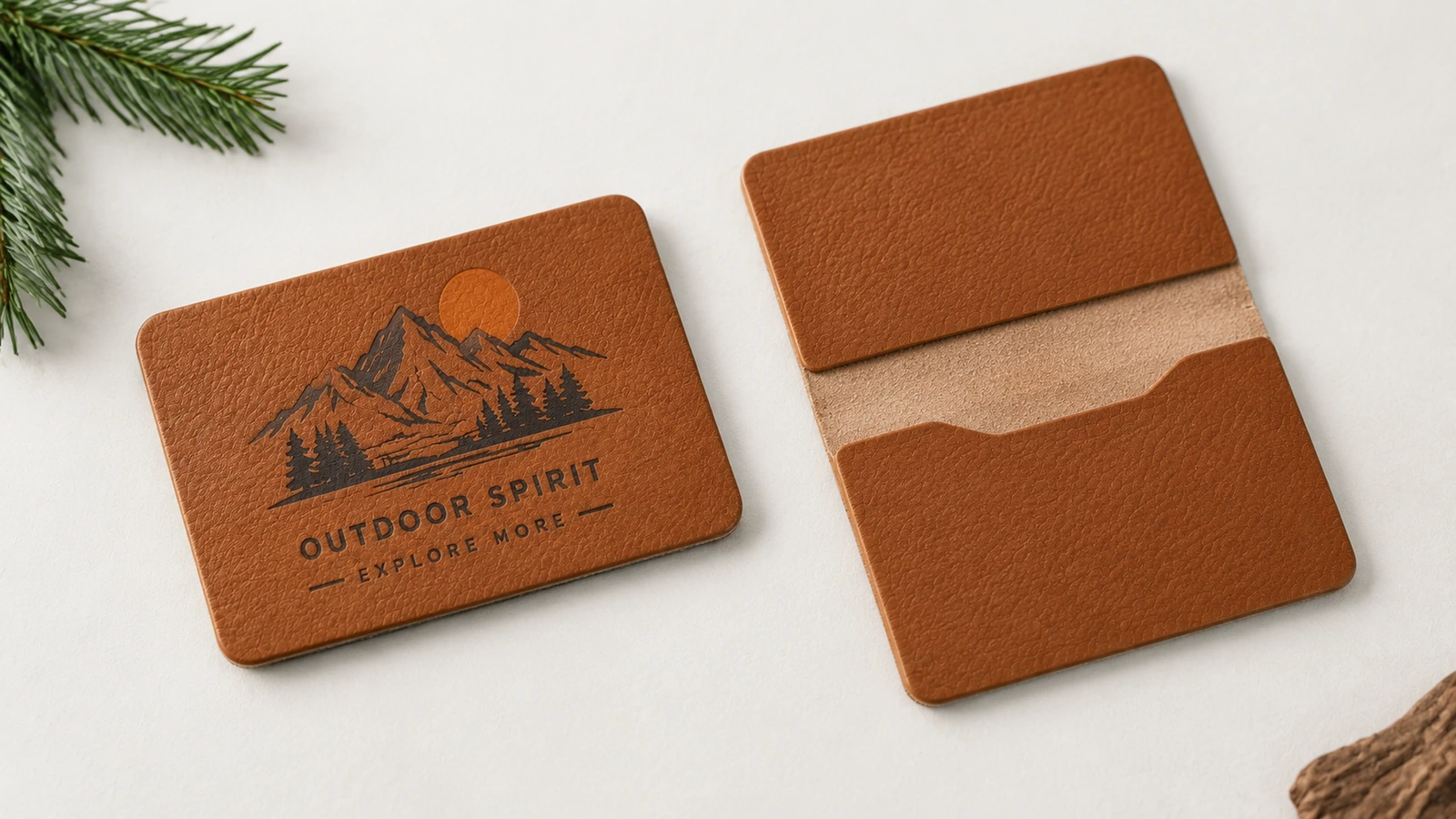
Adhesive choice depends on the surface. A Leather Advice guide[13] notes that standard paper or cheap vinyl stickers "rarely hold well on leather." It also notes that strong adhesives "may pull off the surface finish or leave marks" when removed. Use the table below to decide whether a pressure-sensitive adhesive is the right method for your application.
| Surface / use | Suggested attachment | Main risk to test |
|---|
| Flat, rigid packaging (boxes, jars, bottles) | Pressure-sensitive adhesive (this SKU) | Edge lift on textured paper or coated board |
| Curved or flexing areas (binders, bag panels) | Adhesive only after a trial on the actual part | Lifting at bends; adhesive left behind on removal |
| Hats and low-wash items | Heat-activated adhesive | Heat marks; bond weakening after heat |
| Garments laundered regularly; children's textiles | Sewn or riveted label instead | Adhesive failure in washing; legal permanence |
The table follows a rule of thumb from New York Custom Labels[14]: "Heat-press for fast application on hats and low-wash pieces; sew-on for anything laundered regularly." Cusmytrims lists sewing, Velcro and 3M self-adhesive as backing options. This SKU ships adhesive-backed. If your product is laundered often, ask whether a sewn construction suits it better, rather than relying on glue. In every case, apply the label to a surface that is clean, dry and free of oil, conditioner and wax.
Step 3: Preflight your artwork file
Send vector artwork. Acctrims asks for "CDR, ESP, AI, or PDF format." Before you send the file:
- Convert all text to outlines.
- Draw the die-line on its own layer.
- State Pantone references for the PU color and any foil.
- Mark which areas are debossed, foiled or printed.
Also say whether you want labels kiss-cut on a sheet or a roll. Cut depth matters here. Sticker It[15] explains that when a cut is "too deep, essentially cutting into the backing paper," the liner tears as you peel. Thicker leather-look materials need their cut depth checked on the sample.
How Are the Labels Produced, Inspected and Shipped? ↑
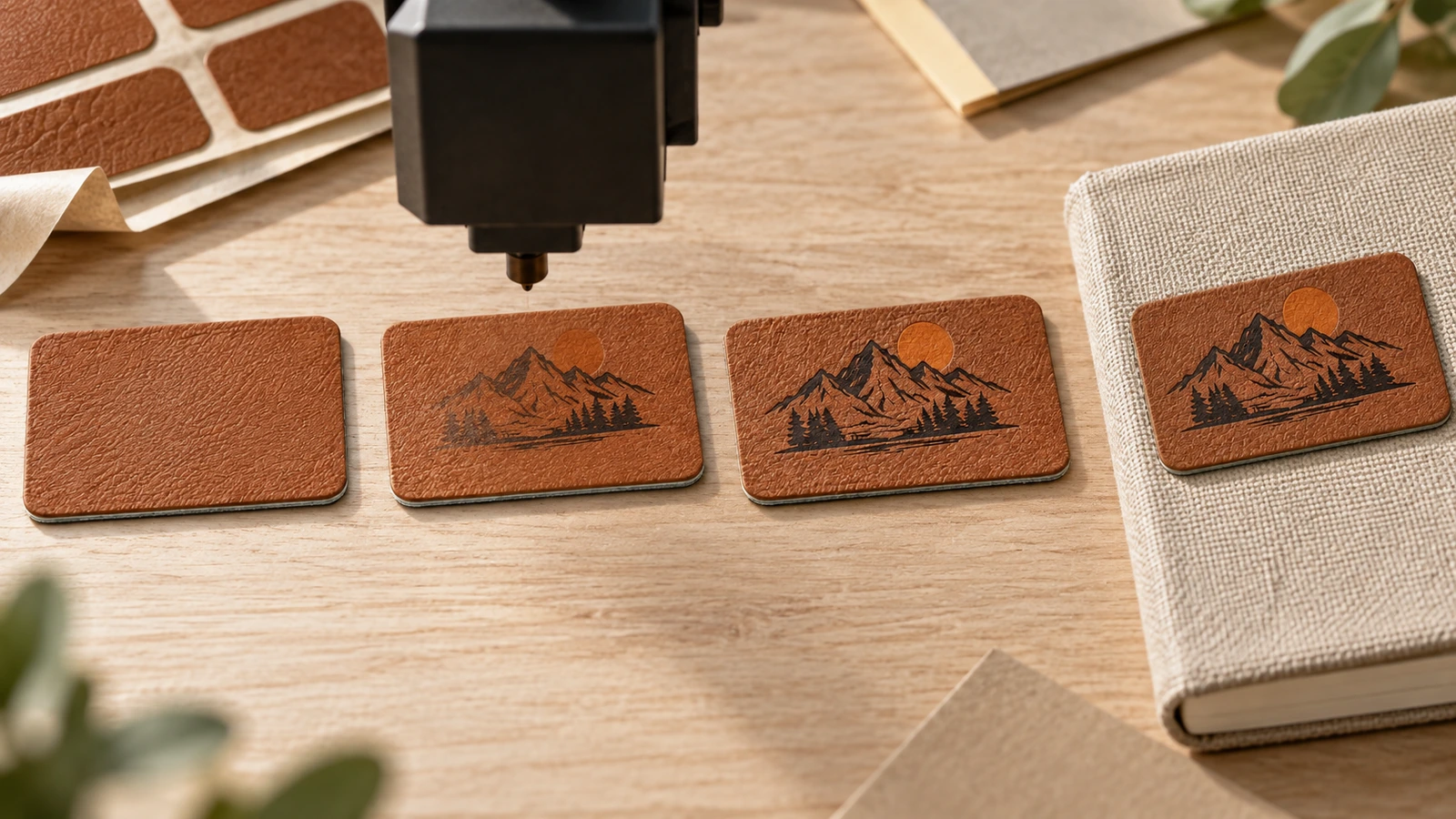
Kunshuo outlines the typical PU label route: base fabric, PU coating, embossing, surface treatment, logo application, then die-cutting. An adhesive label adds two steps: laminating the pressure-sensitive adhesive, and kiss-cutting the label on its liner. Orders move from digital proof to a physical pre-production sample to bulk production. Sample and bulk lead times depend on tooling, foil and quantity. They are stated on your quotation, and no standard lead time is published for this SKU.
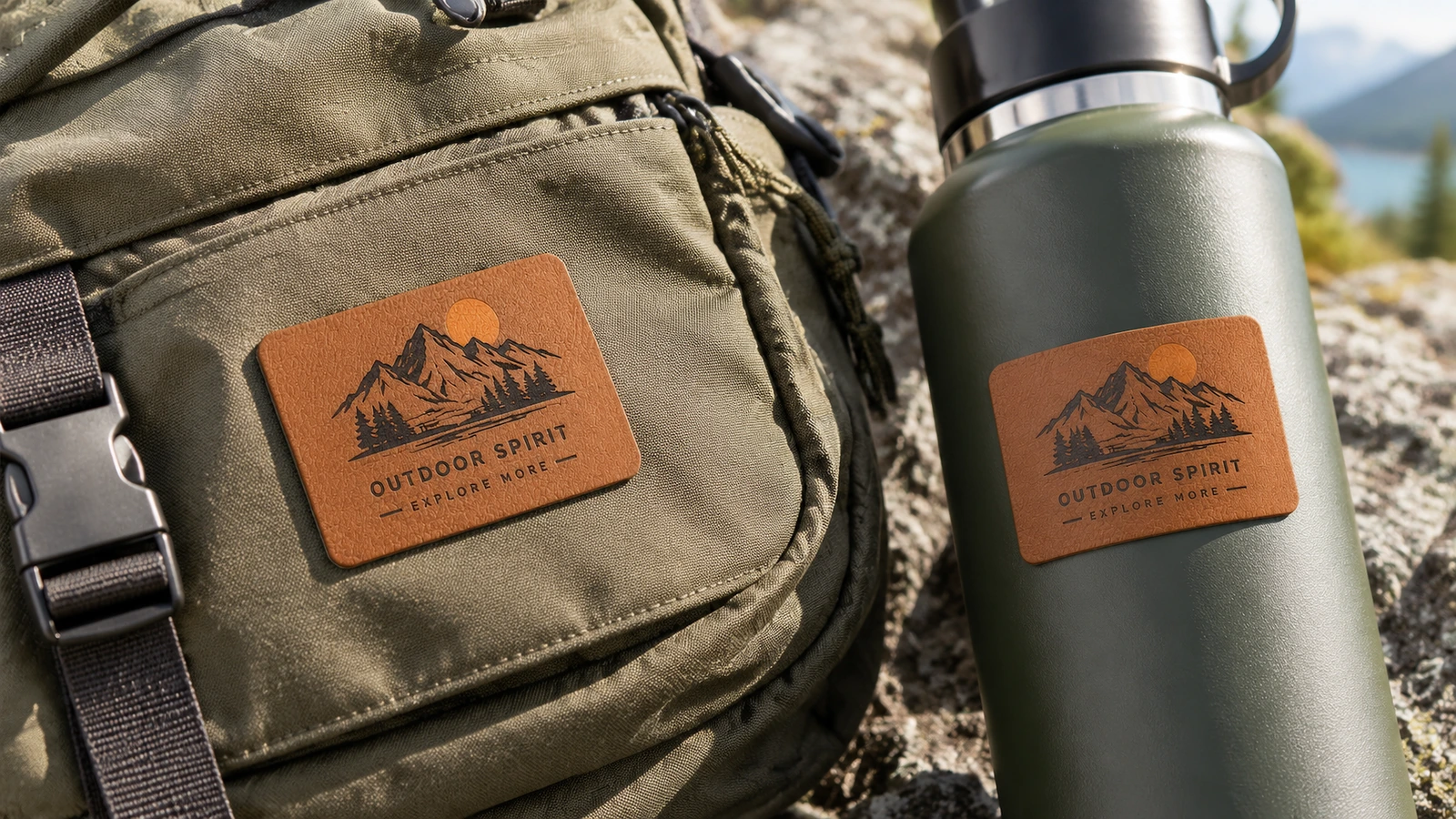
Agree on acceptance checks before bulk production begins. The table lists the checks that answer the failure modes described earlier.
| Check | Method | Accept when |
|---|
| Material naming | Review the quote, invoice and packing list | Material reads "PU imitation leather"; no unqualified "leather" |
| Logo legibility | Compare against the signed sample under the same light | No broken, merged or burned lines |
| Color | Pantone reference plus the signed sample | Within the tolerance agreed at sampling |
| Peel adhesion | Apply to your substrate; peel method such as ASTM D3330, with an agreed dwell time | No edge lift; values recorded during testing |
| Layer bond | Flex the applied label at a bend | No separation or bubbles between PU and adhesive |
| Liner release | Peel a sample of labels from each sheet or roll | Labels lift cleanly; liner not cut through |
Numeric pass thresholds for peel strength, color difference and dwell time are not pre-published. They are set during sampling on your surface and written into the order. If you plan to make any wash claim, test finished items rather than loose label pieces, using ISO 6330 laundering with ISO 105-C06 color fastness. If you will not commission that testing, make no wash claim.
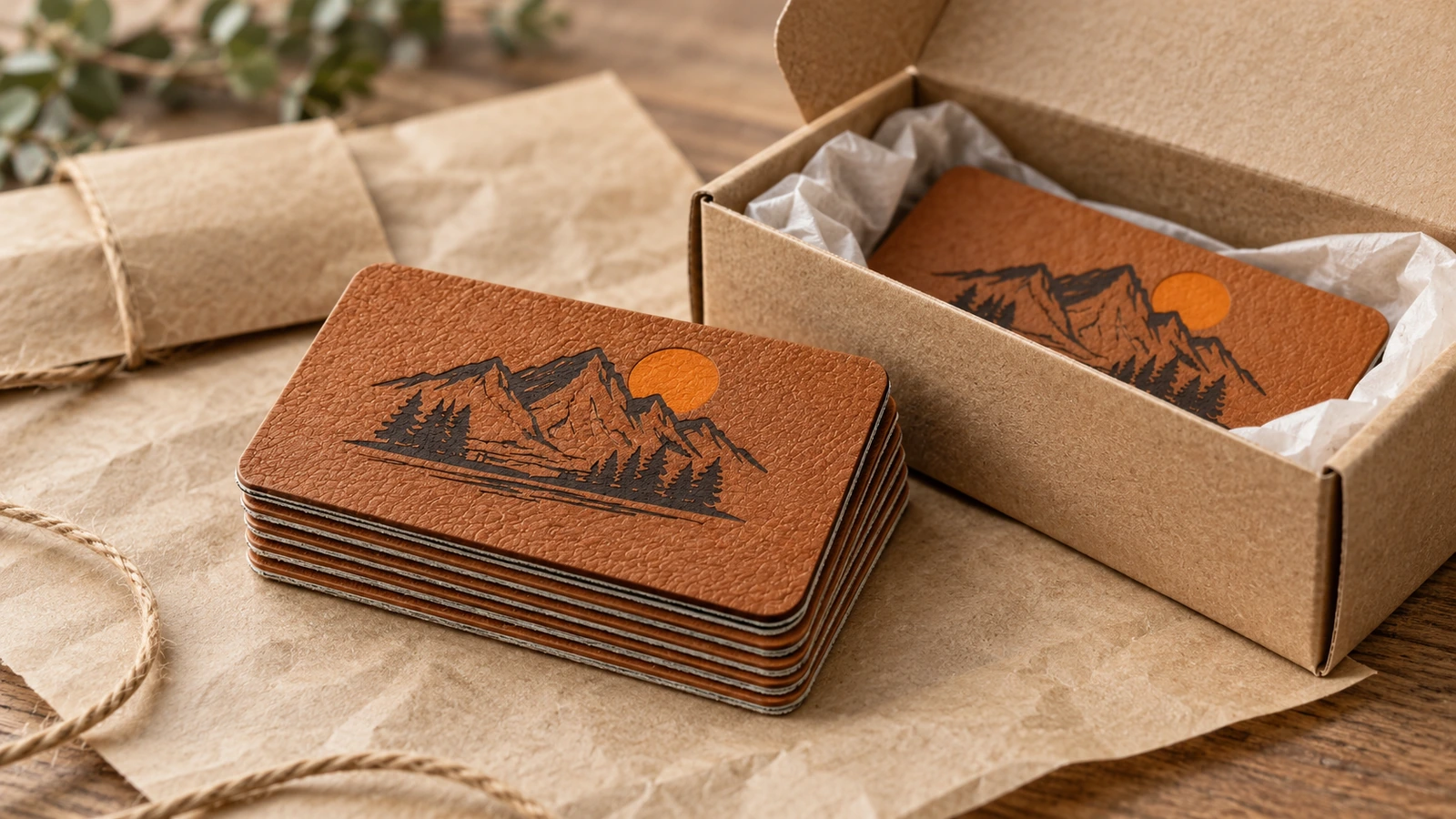
Keep labels flat and away from heat in storage, because heat can reactivate adhesives and dry out PU. For imports into the US, 19 CFR 134.11[16] requires foreign articles, or their containers, to show the English name of the country of origin "legibly, indelibly, and permanently." Whether that marking belongs on the label or on the packaging is decided case by case, so confirm it with your customs broker. For reorders, keep the signed sample, the file version and the batch record together, so the next run is matched against a physical reference rather than memory.
How Does PU Adhesive Compare With Genuine, Paper and Vinyl Labels? ↑
| Option | Washing | US naming | Best fit |
|---|
| PU imitation leather, adhesive-backed | One supplier rates its PU labels washable to 30°C (86°F) Wunderlabel[17] | Must disclose non-leather | Packaging, hard goods, low-wash accessories |
| Genuine leather, sewn or riveted | Listed as not washable by the same supplier | "Leather" allowed | Premium bags, hats, denim |
| Washable paper leather (e.g., WunderPap) | To 60°C (140°F) | Not leather | Workwear and jeans that are washed often |
| UV-laminated vinyl sticker | Weather resistance claimed | Never "leather" | Flat full-color graphics |
For budgeting, PB-Patch[18] puts genuine leather labels at about $0.5–$3 per piece and PU at about $0.1–$0.8. These are supplier ranges, not a market price. The same Wunderlabel listing names PU's drawbacks honestly: it "may show wear (peeling, fading, cracking) over time." Choose genuine leather when you want patina and a premium story and can accept natural color variation. Choose PU adhesive labels when you need consistent color, fine detail and quick application to packaging. Choose paper leather for garments that see hot washes. Vinyl answers a different need, full-color graphics, and should never be marketed as leather.
What Should Your RFQ Include to Get a Comparable Quote? ↑
| Field | What to state |
|---|
| Material | PU imitation leather; face color as a Pantone reference |
| Size and shape | Dimensions in mm and the die-line file |
| Logo process | Deboss, foil, print or laser; feasibility confirmed on the proof |
| Substrate | Photo and a physical sample of the surface the label goes on |
| Quantity tiers | Your target quantities; MOQ confirmed at quotation |
| Timeline | Your in-hand date; sample and bulk lead times quoted per order |
| Claims | Every claim you intend to print, so each one can be tested or removed |
The claims row is there for compliance as well as clarity. For products designed mainly for children aged 12 and under, LegalClarity[19] explains that "hangtags and adhesive stickers are not considered permanent for fabrics." Tracking information on children's textiles therefore needs a sewn-in label, not this product. In the EU, from 2026-09-27, displaying sustainability labels "not based on a certification scheme" is a prohibited practice under Directive (EU) 2024/825, as summarized by USB Certification[20]. Unless you hold qualifying evidence, leave "eco leather" off both the label and the listing.
Key Takeaways Before You Order ↑
- PU labels must be disclosed as non-leather in US copy — 16 CFR Part 24 examples: "Not leather," "Imitation leather" (Source)
- Faux leather tolerates limited heat — generally 1.2 mm thick and not resistant to high temperatures (Source)
- PU costs less than genuine leather — about $0.1–$0.8 vs $0.5–$3 per piece (Source)
- Fashion is a niche within pressure-sensitive labels — about 6.4% of a $72.4 billion market in 2025 (Source)
- Unverified EU green labels are now prohibited — Directive (EU) 2024/825 applies from 2026-09-27 (Source)
Ready to Sample Your Custom Leather Sticker Labels? ↑
Adhesive PU labels succeed when the surface, adhesive, contrast and naming are decided before production rather than after a complaint. MOQ, unit price, thickness and lead time for this SKU are confirmed per order, and performance is verified on a sample applied to your own substrate. Send your vector logo, target size, a photo of the surface and your quantity tiers to request a quotation and a pre-production sample.




The information below is required for social login
Sign In
Create New Account