Custom adhesive stencils are cut, pressure-sensitive film masks that stick directly to the work surface, so paint cannot creep under the edge. They suit one-off or short-run lettering, logos and curved objects. If one design must be painted hundreds of times, rigid Mylar or metal is usually the better buy.
Who Orders Custom Adhesive Stencils, and for Which Projects? ↑
Most buyers are not professional sign painters. They are people with a single project that has to look store-bought on the first attempt. Public buyer reviews of one single-use adhesive vinyl stencil product[1] show the typical range. One reviewer stenciled a grandson's name on a toy chest as a Christmas gift. Another sized gold leaf on two boat transoms and reported "sharp lines with no bleeding under stencil." Other common projects are wood signs, family location walls, motorcycle tanks, leather jackets and shuffleboard tables.
A second, smaller group buys for business. In a 2021 ASI Central interview[2], a stencil supplier's CEO said that "typically, people aren't using our stencils to create art, but to promote their business, company or event." The examples given were fan face painting at a Super Bowl and coding-symbol stencils handed out at an Adobe event. These buyers have fixed event dates. They often supply logos that are not stencil-ready, and large graphics may need to be split into aligned panels. They also want pricing that scales with quantity.
Both groups share the same core requirement. The mask has to seal on the first application, release cleanly, and hold the details shown on the approved proof.
Why Do Stenciled Edges Still Bleed, Lift or Tear—and What Fixes It? ↑
The problem. Loose stencils leave small gaps between the template and the surface. One supplier's help center states plainly that "one of the most significant issues with stencil usage is paint bleed"[3]. Spray adhesive can close those gaps, but it often leaves gummy residue on the finished piece.
Why it gets worse. Stronger adhesive does not solve the problem. One wall-lettering buyer wrote that "when we peeled off the stencil, it took three large chunks of my wall with it"[4]. That turned a lettering job into a repaint. Reuse is also commonly overestimated. A supplier tutorial says adhesive stencils are designed for 1–3 uses[5], and calls lost adhesion after the first use "normal." A buyer who budgets for ten applications ends up paying a much higher cost per use than planned.
The fix. Our Custom Self-Adhesive Vinyl Stencil Masks (SKU NSKU-693-02) treat each order as an engineering decision rather than a simple sticker print, in four steps:
- Match film gauge and tack level to your substrate before anything is cut.
- Preflight the artwork for islands and bridges.
- Get written approval of a proof.
- Ship the masks flat.
Exact film thickness, tack grade, maximum size, lead time and minimum quantity are confirmed on your quote. Expected reuse is not promised until a sample has been tested on your actual surface.
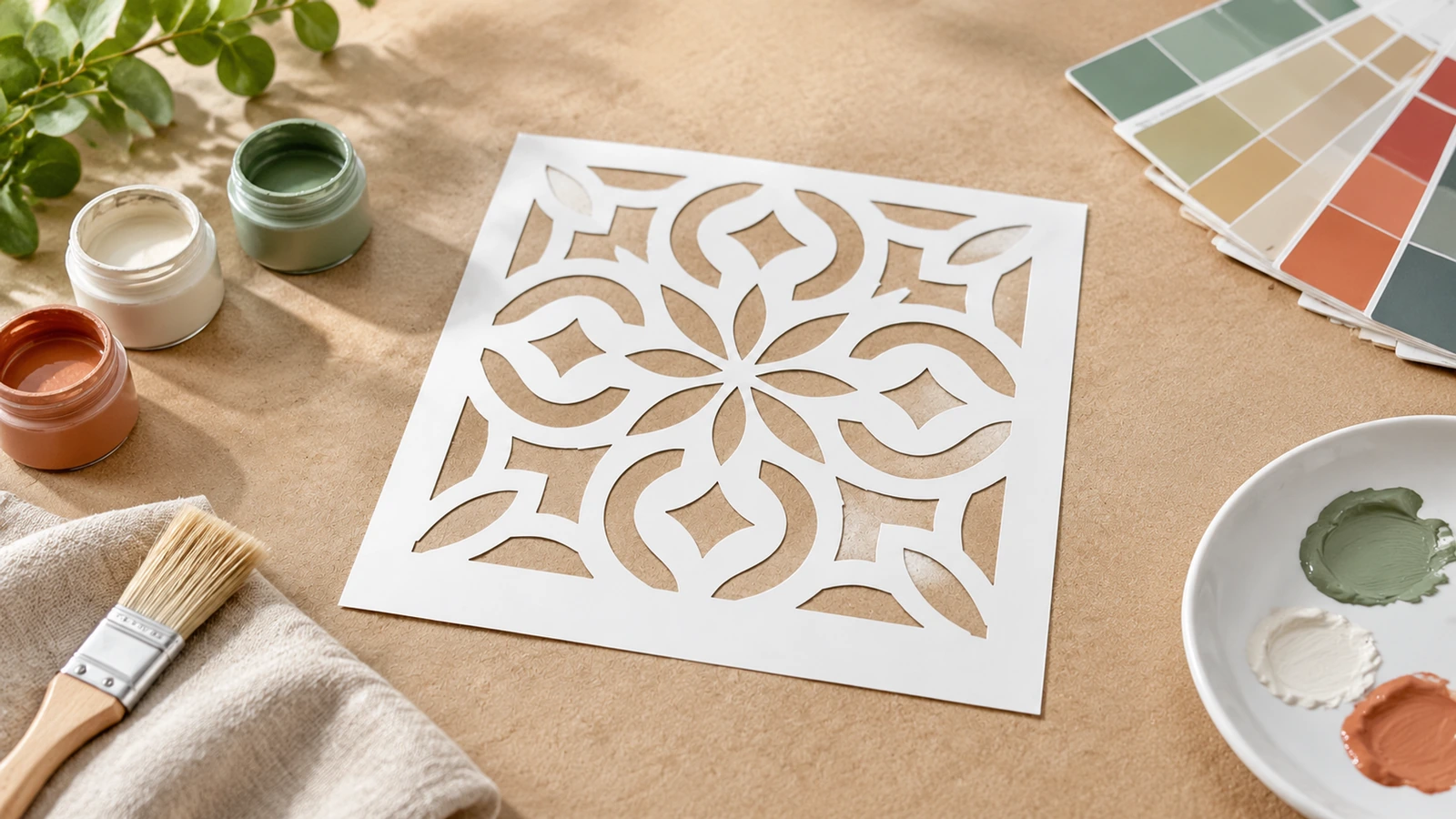
Table of Contents
What Is a Custom Self-Adhesive Vinyl Stencil Mask? ↑
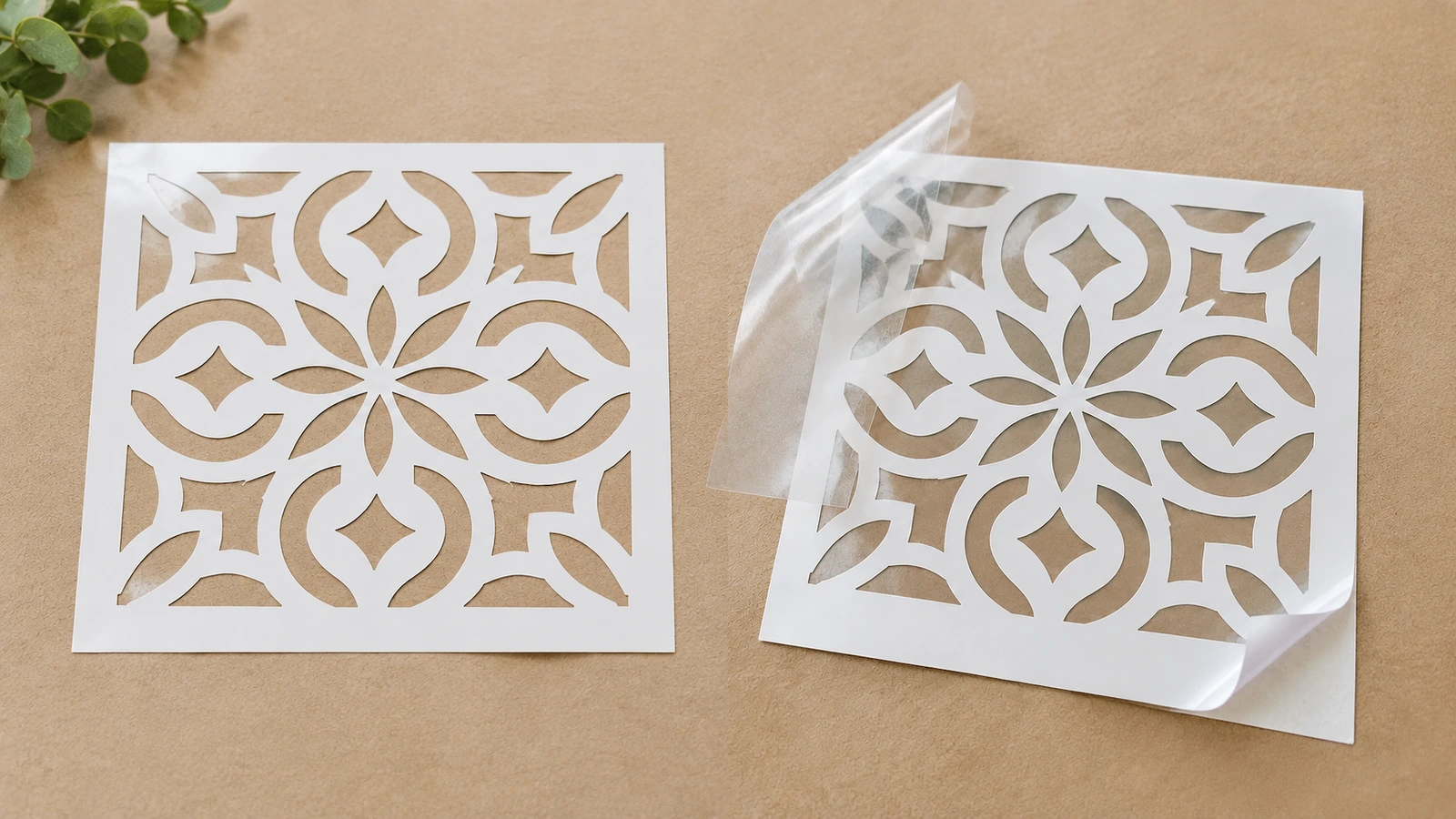
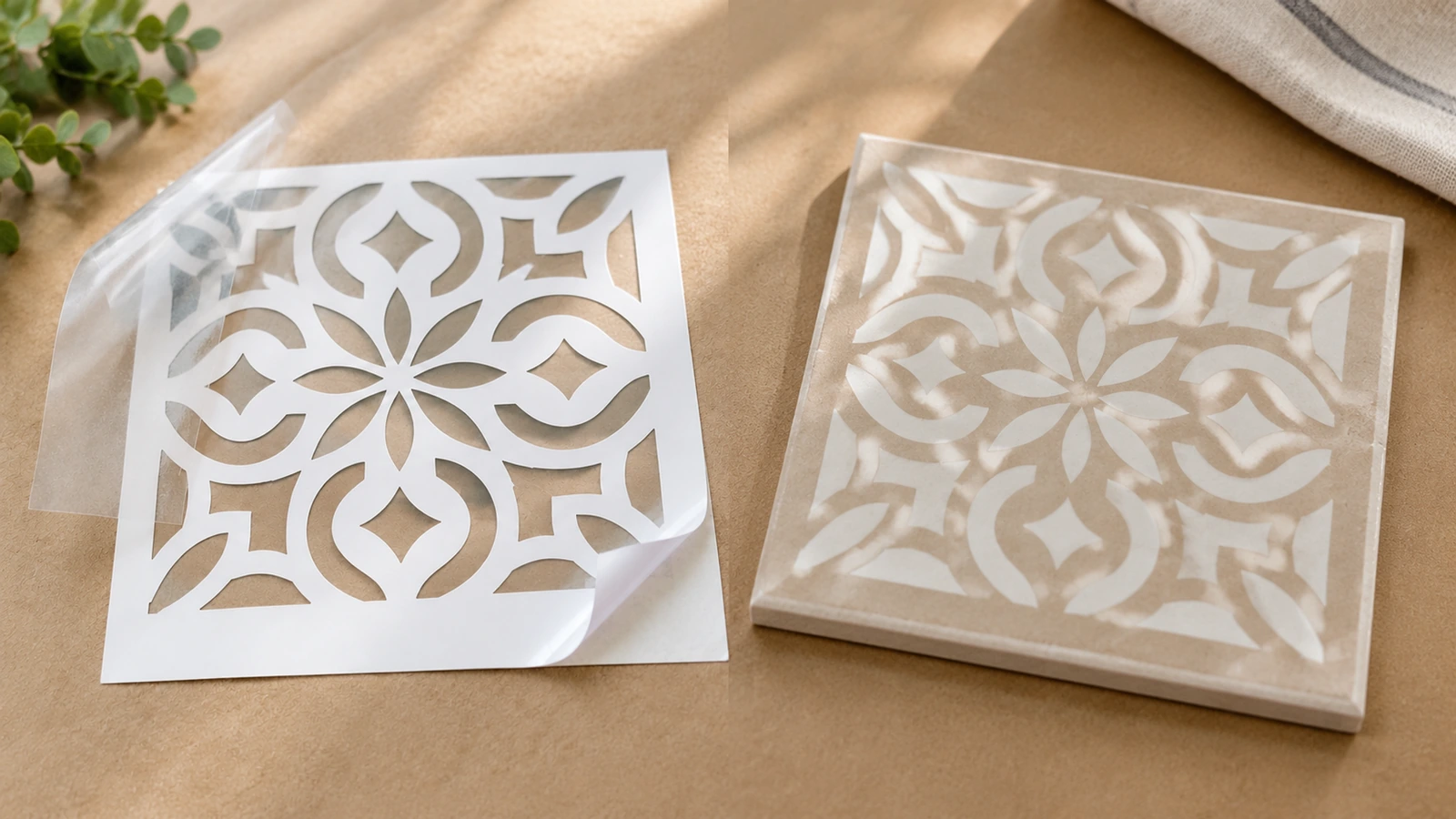
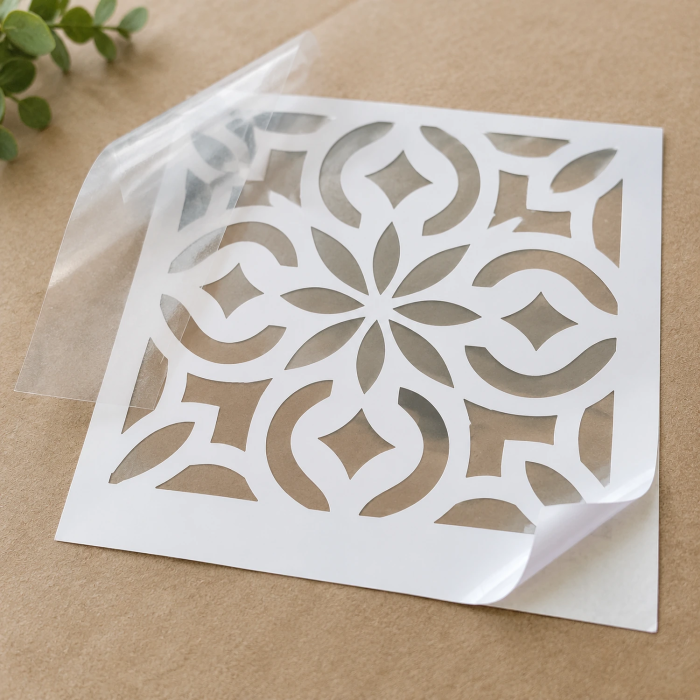
A stencil mask has three layers:
- A release liner on the back.
- A cut film coated with removable pressure-sensitive adhesive.
- For loose lettering, a transfer tape on the front that holds the letters in register.
The default format is a negative stencil, where paint passes through the cut-outs. A stencil mask is not a decal. One vinyl supplier recommends "stencil vinyl not decal vinyl"[6] for paint work. Its reasoning is that a removable water-based adhesive will not damage the surface underneath, while decal vinyl uses a permanent acrylic adhesive that bonds strongly.
| Film type (market reference) | Adhesive | Published reuse claim | Best fit |
|---|
| 3 mil PVC stencil masking film[7] | Removable water-based acrylic; 1.37 lb/in to steel after 24 h (FINAT TM-1) | Not stated in datasheet | Smooth, flat, rigid substrates |
| 3.0 mil translucent stencil vinyl[8] | Light tack, clean removal | One-time, short-term | Paint and spray masking |
| 5 mil adhesive-backed plastic[9] | Self-adhesive | 5–12+ uses, depending on adhesive cleanliness | Drums, pipes, roll or brush work |
| ~7 mil tack-backed polyethylene[10] | Tacky backing | Single-use or light reuse | Curved surfaces, very crisp edges |
| Letter vinyl with transfer tape[11] | Self-adhesive, waxy liner | Single use | Bridge-free lettering on signs and walls |
Read the table as a map of the options on the market, not as our specification. Specifications are not consistent even within a single brand. The same seller's FAQ[12] guarantees its 7 mil matte adhesive for a single use only, while its product page claims 4–5 uses. Your NSKU-693-02 quote will list one gauge, one tack grade and one reuse expectation. The reuse figure stays marked "pending test" until a sample has been tried on your surface.
Size and readability
Letter height and sheet width set practical limits. A market single-use letter stencil starts at 1.5 inch letter height, priced from $1.03. It is not recommended for text wider than 36 inches, because the film becomes too floppy to handle. That product page shows 4.8/5 from 78 reviews. Another supplier's FAQ cuts adhesive shapes within 28 × 96 inches and splits anything larger into multiple pieces.
For our masks, the maximum single-sheet size and the minimum stroke width depend on the film you choose. Both are confirmed on the proof. Thin serifs, tight counters and long, narrow panels are the first features to tear or wrinkle. If a design depends on them, ask for a test strip before full production.
Surface and backing options
| Surface | Expected result | Main risk | What to request |
|---|
| Smooth sealed paint, glass, metal | Best edge seal | Over-tack lifting soft coatings | Low-to-medium tack; corner test |
| Curved bottles, mugs, drums | Conforming film seals well | Wrinkles at tight radii | Thinner gauge; relief cuts shown on proof |
| Raw softwood | Usable with care | Fiber pull, grain bleed | Light tack, per substrate guidance[13] |
| Textured walls, concrete | Higher bleed risk | Paint creeps through texture | Smooth base required per Concrete Network[14] |
| Fresh latex wall paint | High risk | Wall paint lifts with mask | Full cure first; lowest tack; test panel |
| Cold or polymer parts | Corners lift | Poor wet-out on cold, oily parts | Warm the part; keep fingers off adhesive, per coating users[15] |
The pattern across these rows is simple. Pressure-sensitive adhesive only seals well on clean, dry, relatively smooth surfaces. Textured walls, raw wood and cold metal fall outside the default conditions for success. Low-surface-energy plastics such as PP and PE, silicone, and oily parts also fail often. Treat any of these as a test-first order, and do not expect a guarantee of zero bleed.
How Do You Brief, Proof, Inspect and Apply Your Stencil Mask? ↑
Step 1: File preflight
Send vector artwork (SVG, AI, EPS or PDF) with all fonts converted to outlines. Photos and low-resolution PNG files cannot be used directly as cut paths. Preflight answers one key question: should the closed shapes in letters like O, A and 8 be held by bridges, or carried bridge-free on transfer tape?
Specialist cutters describe the same routine. They "add necessary bridges to hold stencil elements in place, and send you a proof to approve before cutting"[16].
Very small features carry a real production risk. One maker noted that tiny cut pieces "stick to the cutting blade and will inevitably be lost"[17]. Our preflight flags islands and strokes that fall below the minimums for your chosen film. Those minimum values are set by sample cuts, not by assumption.
Step 2: Proof approval and production
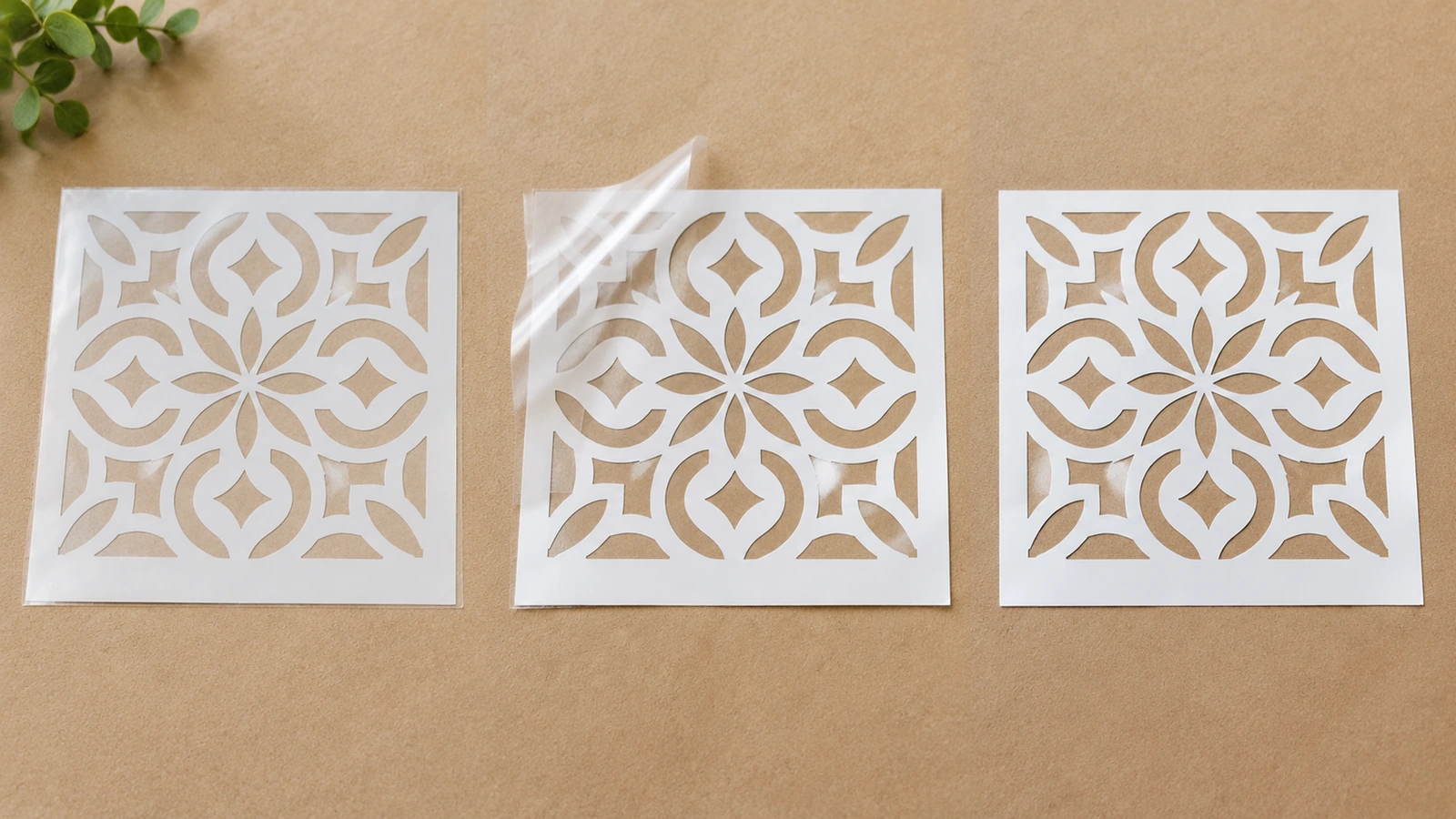
Production starts only after you approve a digital proof in writing. The proof's version number must match the cut file. Cutting settings are chosen for the specific film you ordered, and finished masks stay on their liner so they cannot stick to themselves in transit.
Lead time for NSKU-693-02 is stated on your quote. As a market reference only, one US supplier publishes proofs within 2–4 business days and shipping within 2 business days of approval[18]. If your project is tied to an event date, say so at the briefing stage so the proof schedule can work back from it.
Step 3: Inspection on arrival
| Check | Method | Accept when |
|---|
| Dimensions | Measure key features against the approved proof | Within the tolerance stated on the order, set after sample measurement |
| Cut completeness | Backlight the sheet; check islands, counters, bridges | No missing islands unless agreed on the proof |
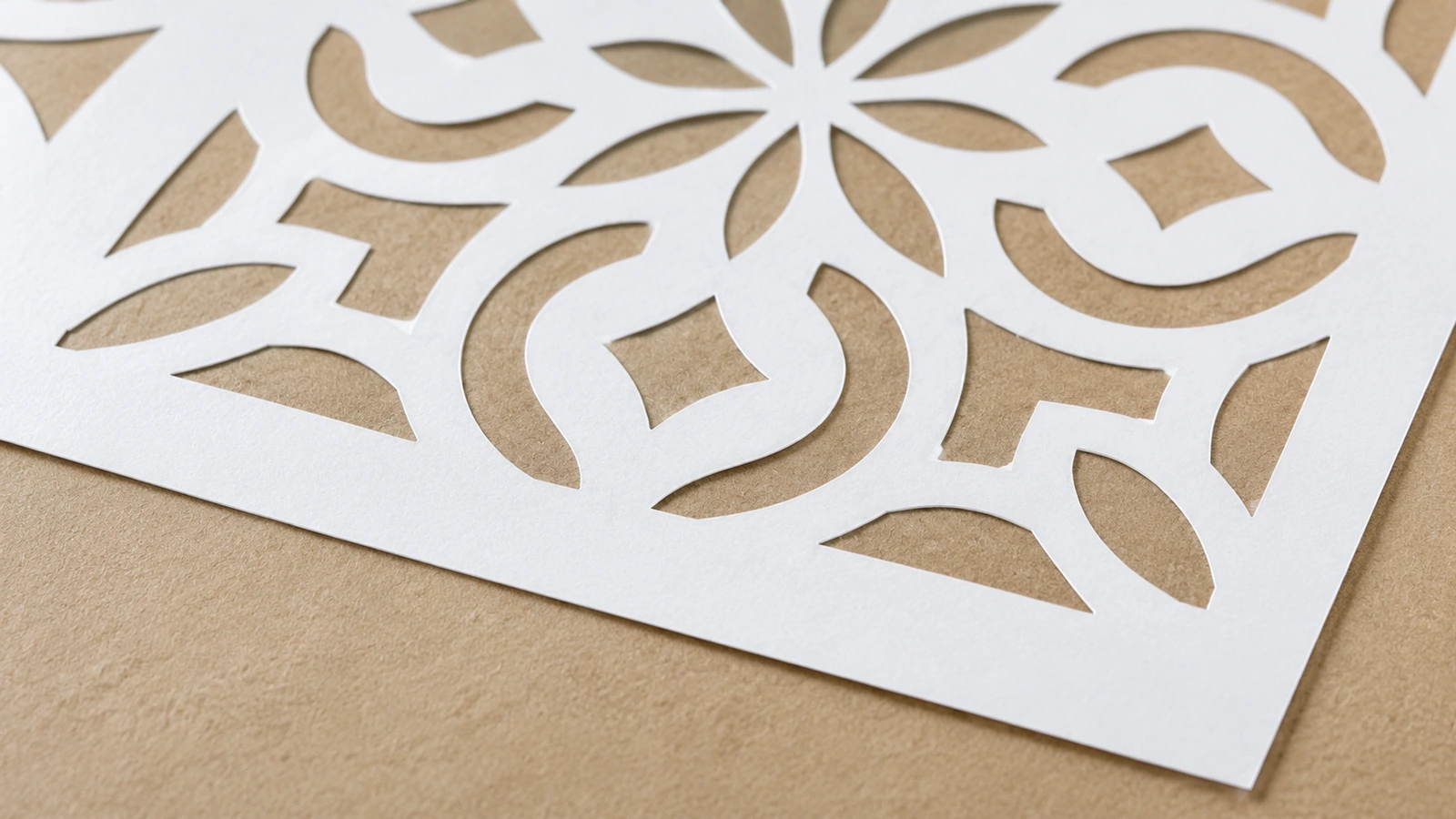
| Edge quality | Inspect curves and corners under magnification | No chips, nicks or ragged edges |
| Flatness | Lay the sheet on a flat table | No creases or fold lines |
| Tack and release | Peel the liner; apply a test corner to scrap substrate | Firm seal, clean release, no visible residue |
Run these checks before paint day. Fixing a defect costs nothing at this stage, while the same defect found on the wall costs you the whole project. The film maker may supply peel data, often reported using the FINAT TM-1 method shown in the ORAMASK 813 datasheet. That number describes the film itself, not your painted wall, so the scrap-corner test is still required. For multi-panel orders, count the pieces and check the panel numbers against the proof.
Step 4: Application and removal
The routine below follows a supplier's published technique:
- Clean the surface and let it dry fully. Dust, oils or moisture prevent adhesion.
- Peel the liner slowly from one corner. Position the mask first, then press, because "the adhesive grabs immediately."
- Burnish every cut edge with a squeegee or card. Any gap lets paint seep underneath.
- Spray in short bursts from 10–15 inches away. Several thin coats work better than one heavy coat.
- Peel at a low angle once the paint has set but before it is fully hard.
- For a second color layer, wait until the first is completely dry. The adhesive can pull up wet or tacky paint.
Professional masking film also has temperature limits. The ORAMASK 813 datasheet lists a minimum application temperature of 50°F and rules out wet application. On fabric, dab the paint on rather than brushing back and forth.
Adhesive Mask, Mylar or Metal: Which Stencil Should You Buy? ↑
| Option | Reuse (supplier claim) | Edge seal | Bridges | Choose when |
|---|
| Single-use letter vinyl + transfer tape | Single use | Built-in | Not needed | One sign or wall, no touch-ups wanted |
| Adhesive film, 5–7 mil | 1 guaranteed; up to 5–12 claimed | Built-in | Usually for islands | Curves, fabric, a few repeats |
| Masking film roll, 3 mil | Not stated | Built-in | You decide | You own a cutter |
| 10–14 mil Mylar | 15–25+; up to thousands | Tape or spray needed | Required | Repeated runs, solvent cleaning |
| Steel or aluminum | Marketed as unlimited | None; rigid | Required | Industrial, long-life marking |
| Permanent decal vinyl | Not a stencil | Strong bond | — | Avoid for paint masks |
The decision comes down to how many times you will apply the stencil and how much edge sealing you need. Mylar is solvent-proof and is rated for a minimum of 15 to 25 applications[19] with typical use and proper cleaning. One seller markets 14 mil Mylar for "hundreds to thousands of uses"[20]. The trade-off is that loose Mylar needs tape or spray adhesive to hold it down, and closed letters need bridges that must be touched up afterward. Choose an adhesive mask when crisp edges on the first application matter more than how long the stencil lasts.
Published prices are hard to compare directly. A per-character listing starts at $1.03 for 1.5 inch letters (Craftcuts). A whole-sheet listing starts standard custom work, including adhesive stencils, at $45.99 (Stencil Stop FAQ). NSKU-693-02 is quoted by size, design complexity, film type and quantity. To compare options fairly, divide the price by the number of applications you realistically expect from each.
Compliance and claim boundaries
We found no ASTM or ISO standard written specifically for adhesive stencils. ASTM D7932-17(2023) covers printed pressure-sensitive labels[21], not paint masks, so we do not claim conformance to it.
Two other rules apply only in specific cases. Pressure-sensitive adhesive that touches food directly falls under 21 CFR 175.125[22]. A standard stencil mask is not "FDA approved," and food-decoration uses need written confirmation from the film supplier. Environmental claims fall under the FTC Green Guides[23]. Because a mask is a composite of film, adhesive and liner, we make no unqualified "recyclable" claim.
Packaging, shipping and reorders
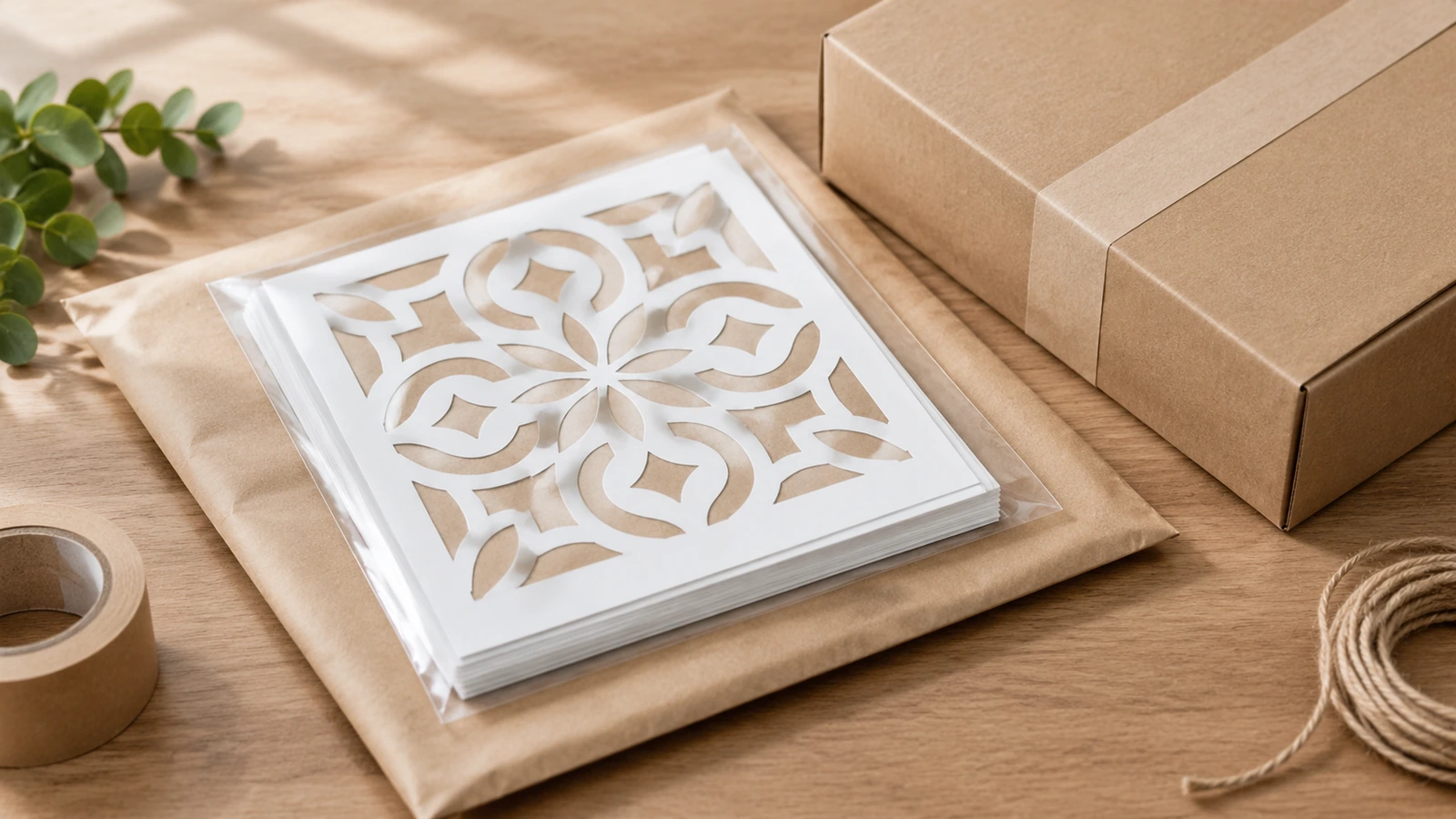
Damage in transit is a documented failure point. One reviewer of a competing product said a stencil "arrived folded up… seams and creases that made it unusable"[24]. Our masks ship flat or rolled, never folded, and the packing format is confirmed on the quote. Report any damage with photos as soon as the parcel arrives.
To reuse a mask, store it flat on its original liner or on wax paper. To reorder, quote the approved proof version so the next batch is cut from the same file with the same film settings.
What Should You Remember Before Ordering? ↑
- Adhesive masks are short-life tools, not durable templates. — 1–3 designed uses (Source)
- Written guarantees can be lower than marketing claims. — 7 mil adhesive guaranteed for a single use (Source)
- Professional masking film publishes measurable tack data. — 1.37 lb/in to steel, FINAT TM-1 (Source)
- Mylar wins when the same design repeats many times. — minimum 15–25 applications (Source)
- The adjacent film market is growing, but it is not a stencil-specific figure. — printable self-adhesive vinyl films USD 5.10 billion by 2030, 6.4% CAGR (Source)
Ready to Get a Proof for Your Stencil Mask? ↑
A good stencil mask is decided before cutting starts: the film is matched to your surface, the artwork is preflighted, and the proof is approved in writing. Once those are right, application is the easy part. Send your vector file, the target surface, your paint type and the number of applications you expect. We will return a quote that states the film gauge, tack grade, size limits and lead time, along with a digital proof.
Request your custom stencil mask quote and proof today.




The information below is required for social login
Sign In
Create New Account