Custom anodized aluminum asset tags carry asset numbers, serials, and barcodes that must stay scannable for as long as the equipment is in service. Their real durability depends on three choices you can write into a purchase order. The first is whether the image sits inside the anodic layer or on top of it. The second is how the tag is attached. The third is how the barcodes are graded before release.
Who buys custom aluminum asset tags, and where do they end up? ↑
The highest-value buyers are marking, configuration, and quality engineers at defense and aerospace contractors. They order by standard number and substrate rather than by "metal sticker." Photosensitive anodized aluminum is specified by Boeing, Airbus, Lockheed Martin, NASA and the U.S. Department of Defense[1] for nameplates, barcode labels, and maintenance schematics. These tags go on aircraft panels, shipboard location plates, and vehicle data plates, where an unreadable tag means a failed inspection.
The second group is energy, offshore, and heavy-equipment OEMs that need a unique panel set or serialized barcode on every machine. A Seatrax project engineer called waiting and paying for stainless "inconvenient and extremely expensive." The Seatrax offshore crane case study[2] reports that photosensitive aluminum averaged about 30% less than etched-and-filled stainless while still resisting UV, salt spray, hydraulic fluid, and solvents.
The third group is facilities, fleet, school, and IT teams ordering hundreds to thousands of tags for laptops, network gear, and vehicles. One K-12 administrator on r/k12sysadmin[3] reported that students had picked the corners off thin anodized tags within two years. Another user in the same thread runs 0.75 × 1.5 in tags fleet-wide. Garden plant markers and DIY laser blanks are a different job and are outside the scope of this page.
Why do aluminum asset tags fail before the asset does? ↑
Problem. Most failed aluminum tags are still on the asset and still legible to the eye. The scanner is what gives up first. Metal Marker notes that surface-printed ink lasts roughly 1–3 years outdoors[4]. Once the ink wears off, "you're left with a blank tag."
Agitation. A well-imaged plate still fails if the bond lets go first. A summary of U.S. Navy environmental testing attributed some failures to adhesive detachment[5] after about six months of desert exposure, with roughly 4,367 MJ/m² of cumulative solar radiation. Detroit Name Plate describes two further field patterns. Adhesive edges lift on compressors and rotating machinery. Aluminum mounted on dissimilar metals in saltwater or road salt suffers galvanic corrosion that hides text under white oxide[6]. Thin foil fails in its own way: Strong Asset Tags describes foil tags that tore into pieces[7] when students peeled them off Chromebook lids. Facilities teams then pay twice, because fading print makes barcodes unscannable[8] and missing tags drop assets out of the register.
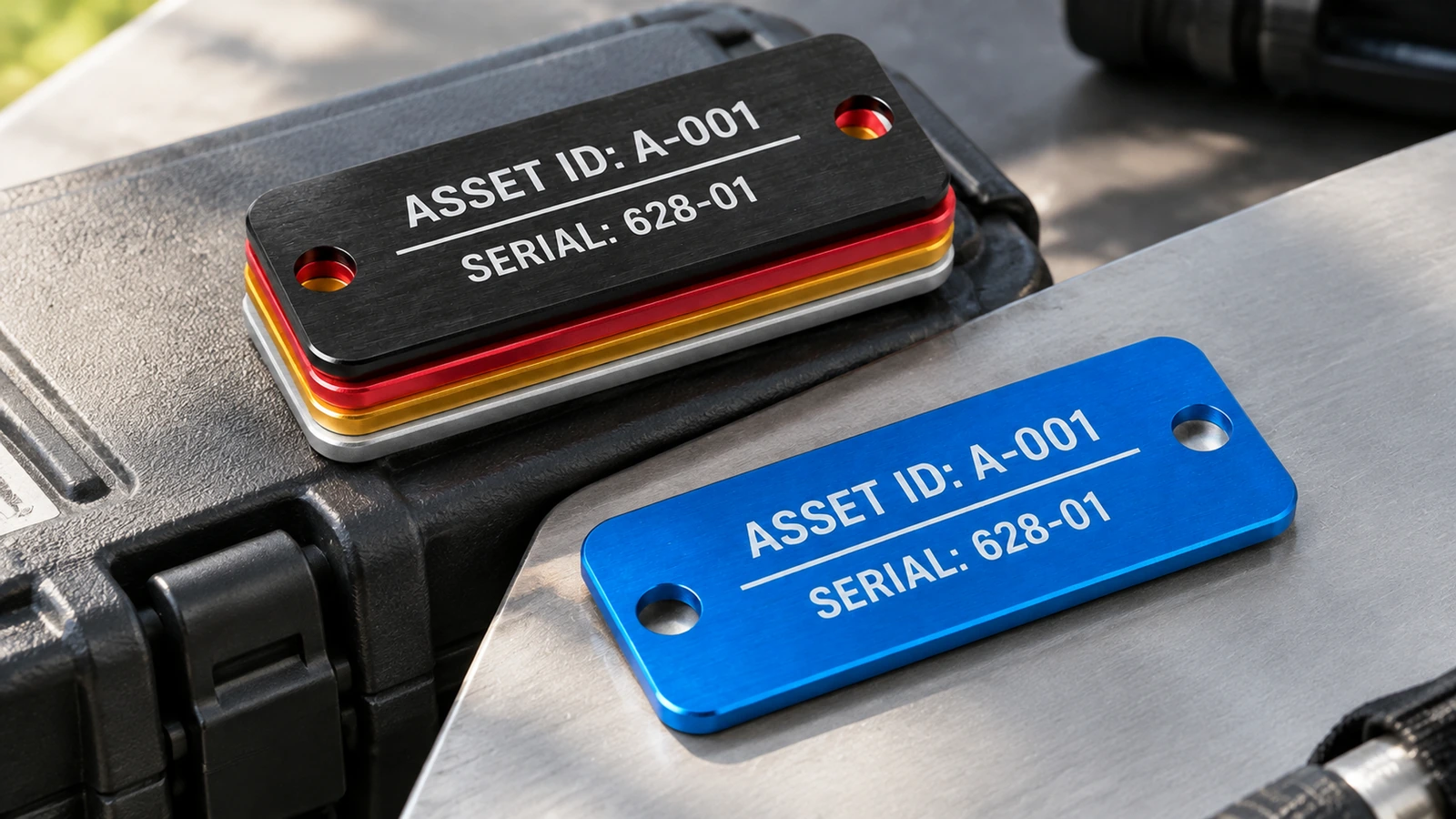
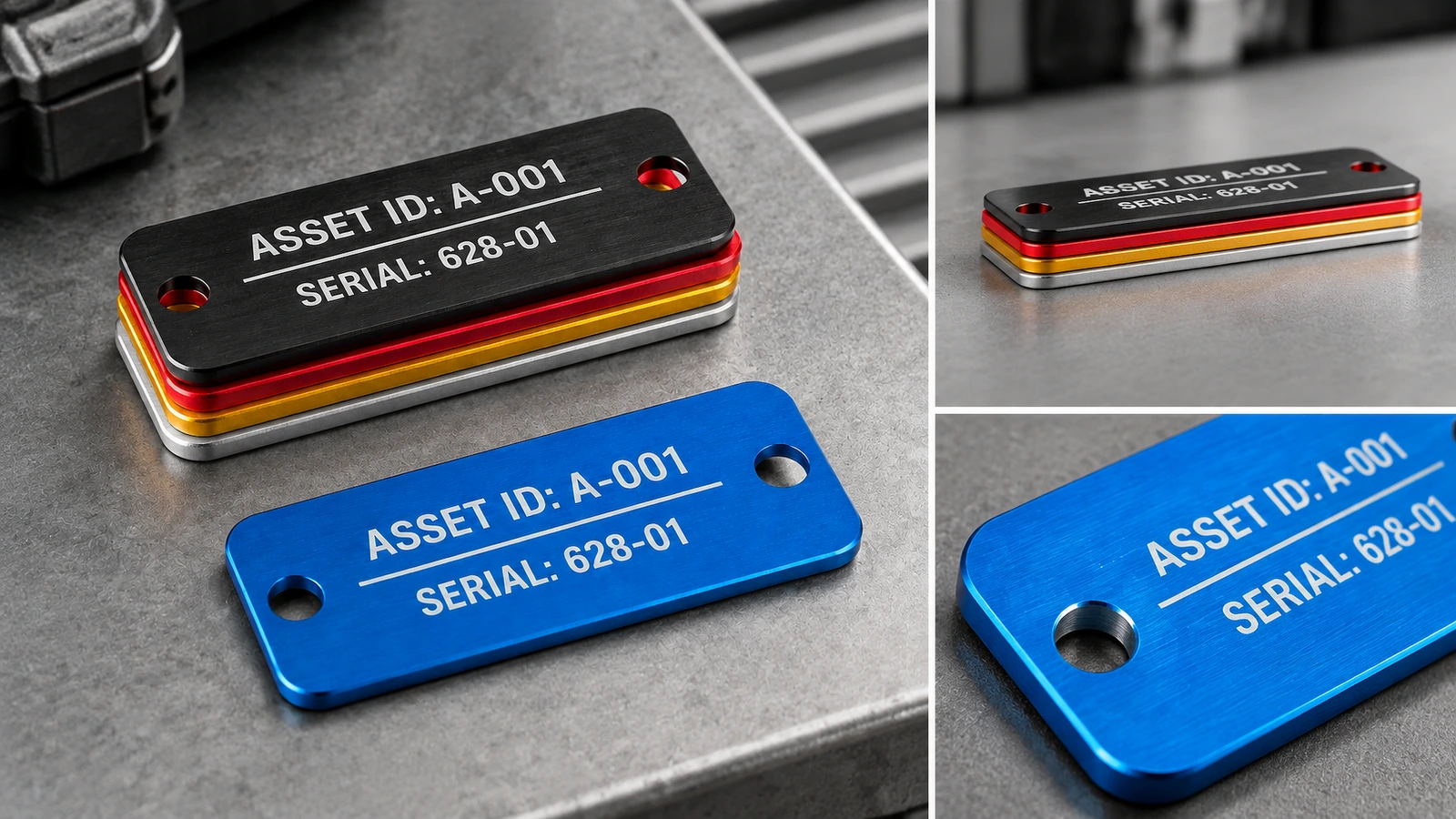
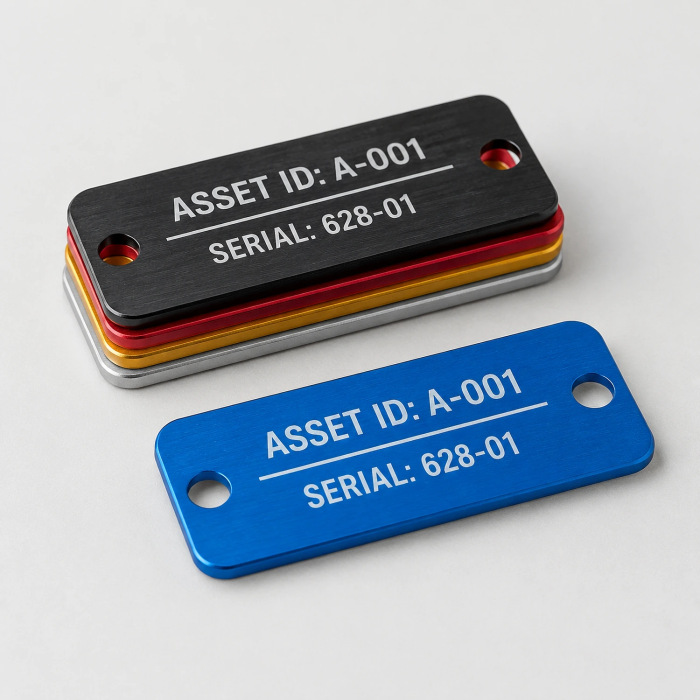
Solution. Treat the tag as a specification, not a material name. Lock the imaging route, thickness, attachment method, and barcode grade before artwork approval. Then confirm all four on a pre-production sample built exactly like the production run. That is how we quote NSKU-628-01.
Contents
What exactly is a custom anodized aluminum asset tag? ↑
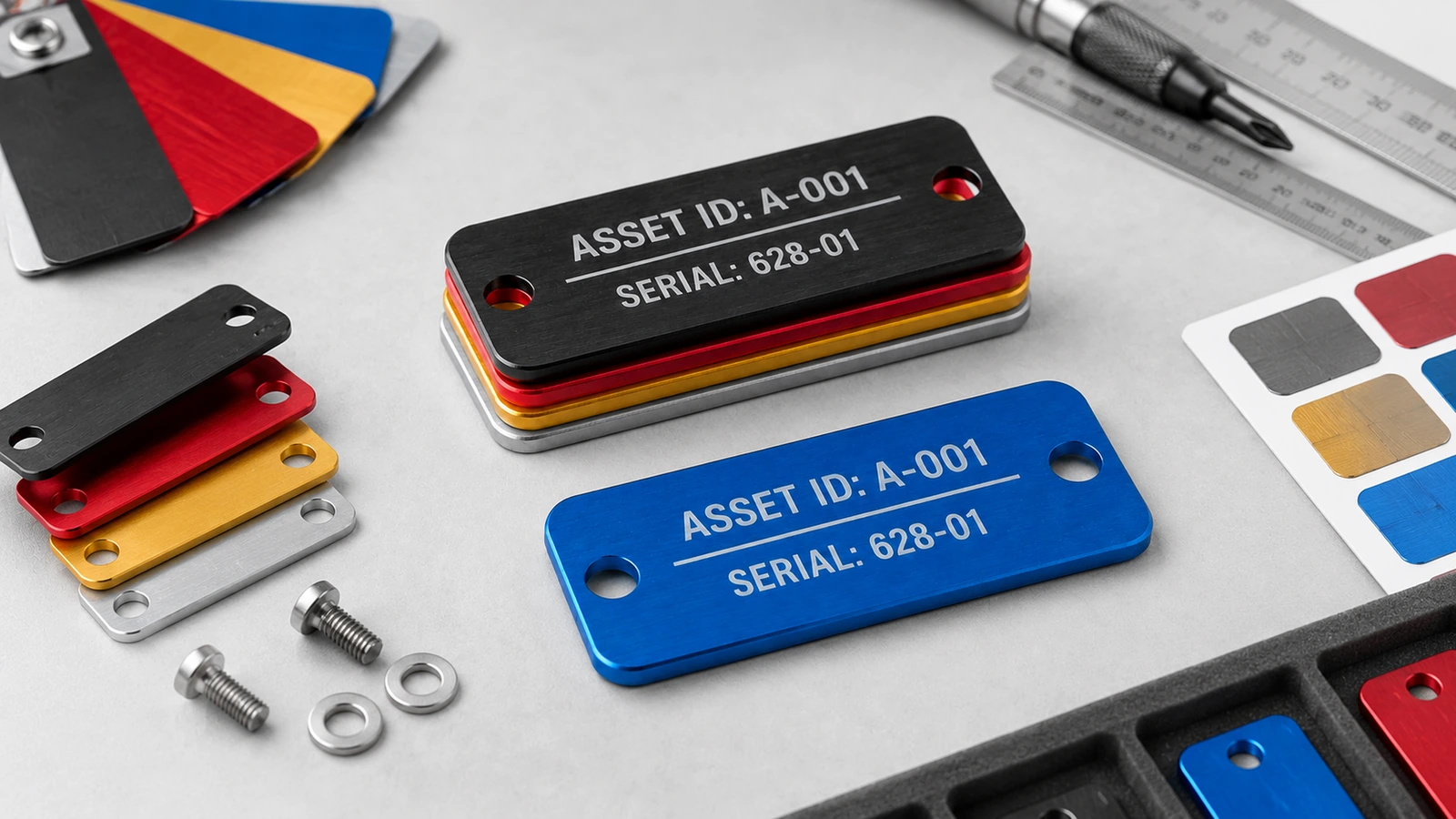
A custom anodized aluminum asset tag is an aluminum foil or sheet with an anodic oxide layer. It carries fixed graphics, such as a logo or owner name, plus variable data, such as an asset number, a serial, and a 1D or 2D barcode. "Anodized" describes the oxide layer, not where the image sits, and that difference drives service life.
Three imaging routes share the name. Surface-printed anodized tags put ink on the oxide and then seal it. MPC lists this class at 5 to 10 years, because graphics weather without a topcoat[9]. Laser-marked anodized tags change the oxide to create contrast, and Pannier rates UV resistance for some laser anodized tags at 1–2 years[10]. Photosensitive anodized aluminum, the Metalphoto type, develops a silver-halide image inside the anodic layer and then seals it. Camcode cites the GPI industry manual, which calls this the most durable printed aluminum substrate. With image intensification, Camcode states an expected exterior life exceeding 20 years[11] on 0.020 in stock, with 0.008–0.063 in options.
That 20-year figure rests on accelerated testing. Federal specification GG-P-455B[12] requires that the image show no deterioration after 400 Weatherometer hours, and the industry extrapolates that to about 20 outdoor years. It is a test equivalence, not a field warranty, and it applies only to correctly processed photosensitive stock. Your quotation states which route a given NSKU-628-01 configuration uses, and the sample confirms it. We do not apply photosensitive test data to surface-printed or laser-marked builds.
How do you specify a tag that still scans in ten years? ↑
Work through the following five steps in order. Each one ends with something you can write into the drawing or the purchase order.
Step 1: Freeze data fields, symbology, and size
Start with the asset register, not the plate. Every tag needs a unique asset number, matching human-readable text, and a barcode that encodes the same value. Use Code 128 for dedicated scanners, QR for phone lookups, and Data Matrix for item-unique identification. For deliveries to the U.S. Department of Defense, DFARS 211.274 ties item unique identification to MIL-STD-130[13]. Write the quiet zone, minimum module size, and character height into the drawing. Check serials for uniqueness against the register before release, because duplicates otherwise only surface at go-live.
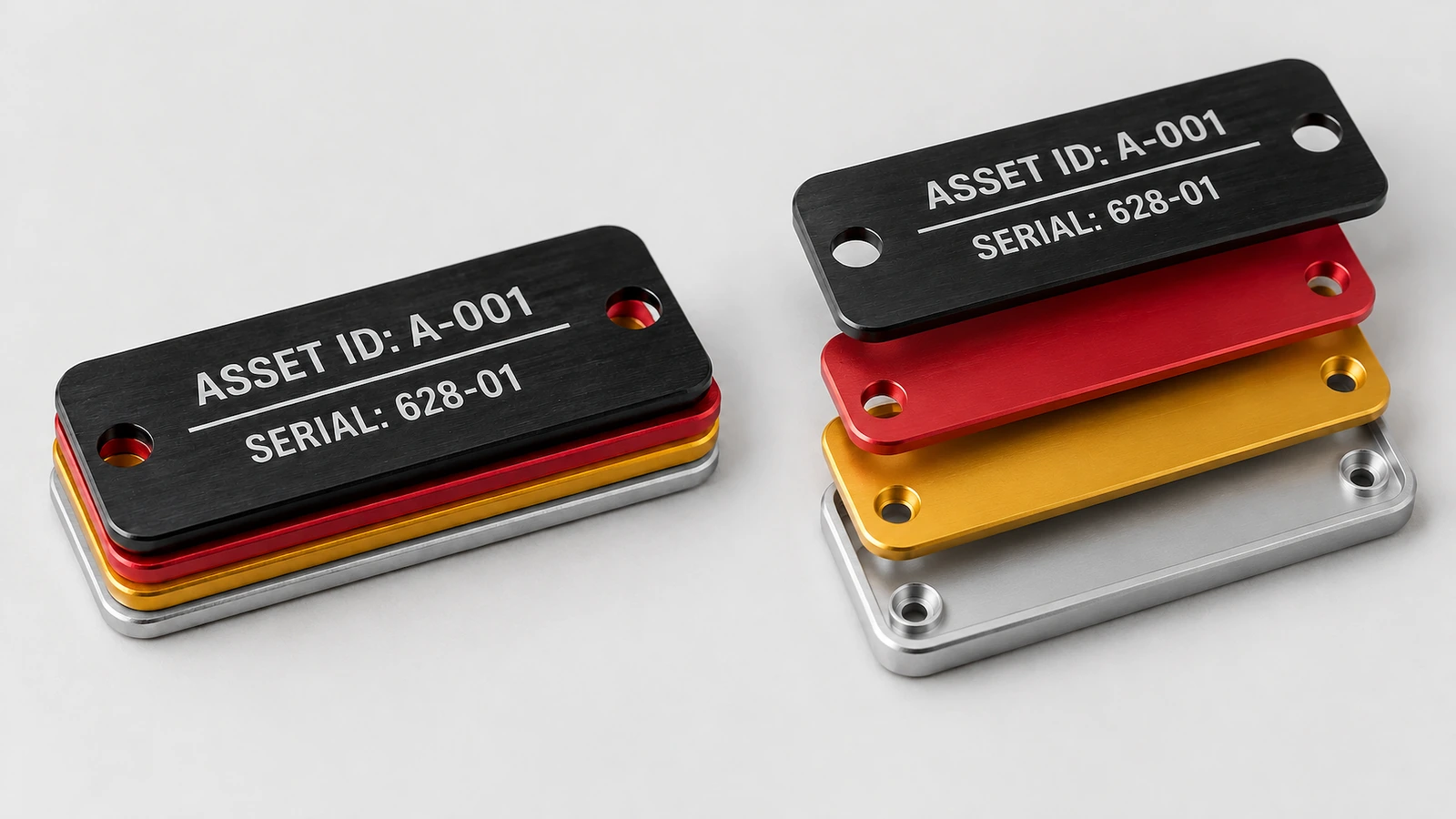
Size follows content and mounting area. Seton's heavy-duty aluminum bar code tag[14] measures 3 × 1 in on 0.020 in aluminum. Seton rates the tag body to 650°F but its #467 adhesive to only about 300°F on smooth non-metal plastic, so treat tag and adhesive limits as separate numbers. Final dimensions for your layout are set by the proof, not by catalog defaults.
| RFQ field | What to write | Why it matters |
|---|
| Imaging route | Image inside the anodic layer, surface-printed, or laser-marked | Sets abrasion and UV life |
| Base thickness | Foil (0.003–0.008 in) or rigid (0.020 in and up) | Drives tear resistance and fastening options |
| Symbology and grade | Code 128, QR, or Data Matrix, with a minimum grade | Makes readability testable |
| Attachment | Adhesive and substrate, or rivet/screw with hole spec | The bond often fails before the metal |
| Environment | UV, salt, fuels, cleaners, maximum temperature | Matches test data to real exposure |
| Standards | MIL-STD-130 revision, a customer spec, or none | Avoids implied compliance |
| Lead-time start | Days counted from artwork approval | Prevents schedule disputes |
Any field you leave blank gets filled with supplier defaults, which may not suit your environment. A complete sheet also lets you compare competing quotes on the same build.
Step 2: Match finish, thickness, and attachment to the real surface
Matte finishes reduce glare for scanners. Choose thickness and attachment together. Camcode's Metalphoto attachment guide[15] strongly recommends pressure-sensitive adhesive rather than mechanical fastening for 0.003, 0.005, and 0.008 in foils. It also specifies aluminum fasteners when mounting to aluminum.
Powder coat and textured paint are low-surface-energy surfaces, below about 34 dynes/cm, where standard adhesive may not bond. For these, JTT Logos recommends an LSE acrylic adhesive such as 3M 300LSE[16], plus a trial application on the actual surface. On vibrating machinery, rivets or screws through a rigid plate outlast adhesive. Drilled holes and cut edges are no longer anodized, and MPC notes that plates 0.063 in and thicker can receive secondary edge protection[17]. On steel in salt environments, isolate the aluminum with coatings or non-metallic washers.
Step 3: Preflight the artwork file
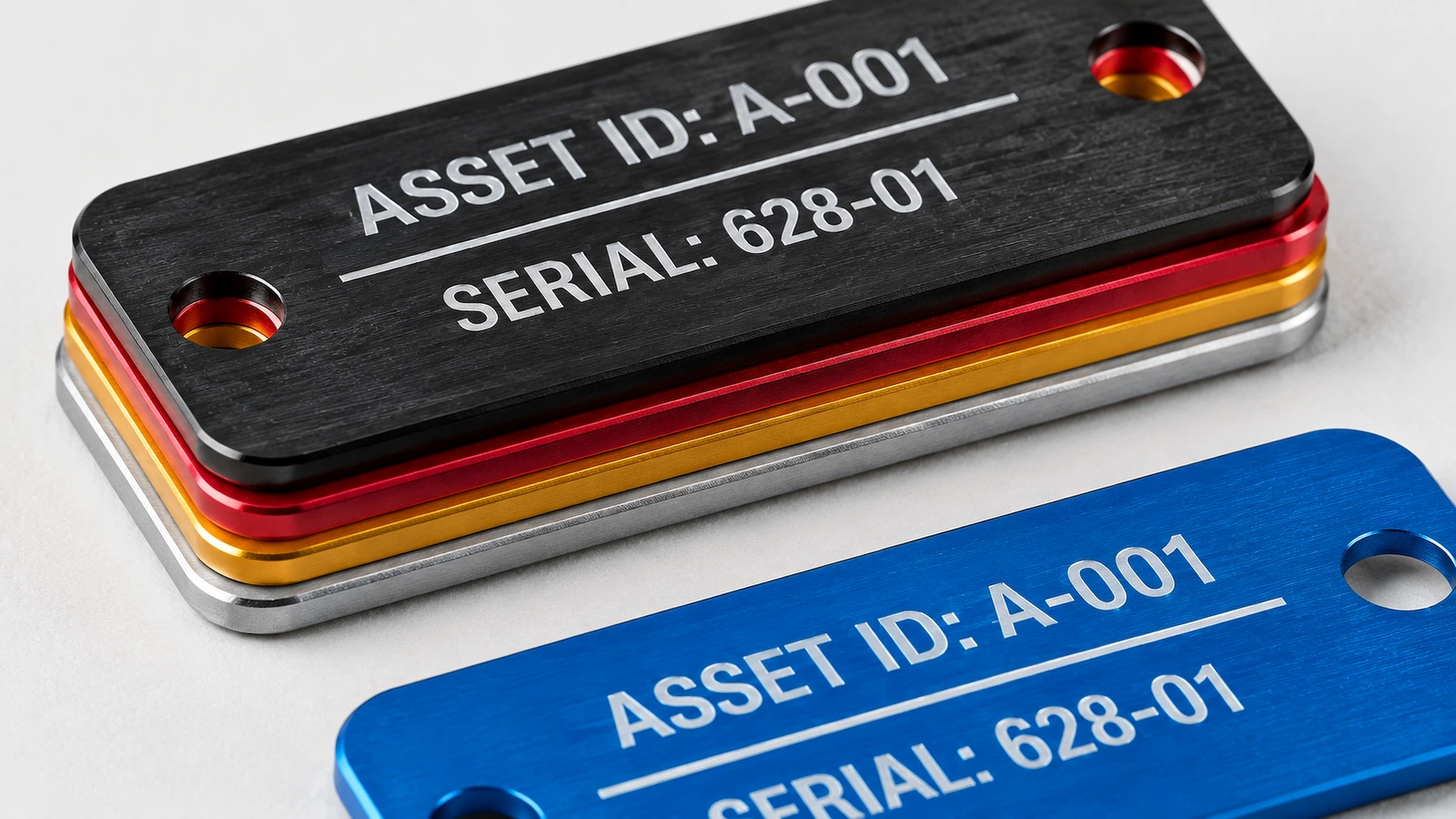
Send fixed graphics and variable data as separate layers, so a serial change does not force a full remake. Specify the serial start and end, check digit, symbology, and quiet zone. Confirm how many tags fit on each sheet; one buyer complained that a quantity mismatch left over half of a sheet blank[18]. Put holes, slots, and tamper cuts on the drawing before production starts. Photosensitive imaging is mainly black on a metal base, and non-black images have limited UV resistance, so never approve it against a four-color print proof. Once the image is sealed it is permanent, which means a wrong serial is a scrapped tag.
Step 4: Production — expose, develop, seal
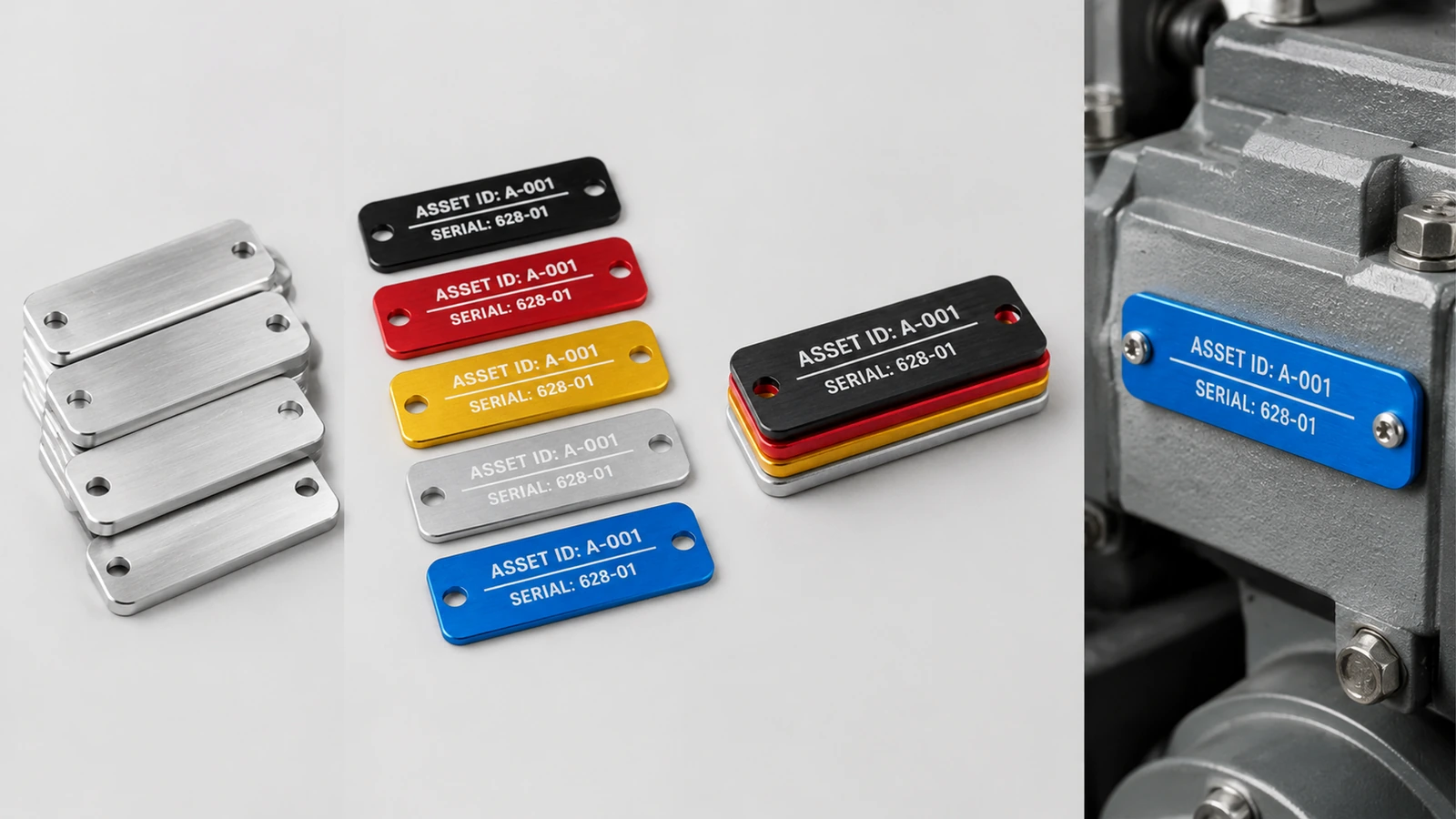
For photosensitive stock, Stryker describes three stages: exposure, development inside the anodic layer, and sealing[19]. Because the process is photographic, serials and barcodes can change from tag to tag without new tooling.
Lead time depends on scheduling and stock. MPC quotes 15 working days from order and artwork approval, with a $400 minimum per part number excluding setup. Metal Marker notes that out-of-stock raw material typically adds 4 to 8 weeks[20]. For NSKU-628-01, MOQ, production time, and unit weight are not yet verified and will be stated on your quotation. Require that the sample uses the same imaging and sealing route as production.
Step 5: Verify, then install where it will be scanned
Release tags on measured readability, not on appearance. Grade 2D codes to ISO/IEC 15415:2024[21] and linear codes to ISO/IEC 15416, typically at grade B or better.
Tie each durability claim to the grade you purchased. The Metalphoto ISG spec sheet[22] lists no corrosion after 700 hours of 5% salt spray at 95°F. The same sheet rates a one-hour soak in 1% sodium hydroxide as not recommended because of surface attack, and the Navy synopsis also flags sensitivity to bleach. If the tag carries safety information, check the specific UL file. UL 969, 6th edition (2025-07-28)[23] covers a specific labeling system, not every thickness and adhesive combination.
| Check | Method | Release basis |
|---|
| Dimensions and holes | Measure against the drawing | Within drawing tolerance |
| Barcode quality | Verifier per ISO/IEC 15415 or 15416 | Agreed grade, e.g. B or better |
| Serial integrity | Scan the sequence against the register | No duplicates or gaps |
| Image and seal | Visual check under magnification | No pinholes, residue, or unsealed areas |
| Durability evidence | Supplier data for the purchased grade | Stated test conditions, not years alone |
| Documents | Certificate of conformance | Cites the standard revisions named in the PO |
When the contract requires third-party barcode verification or salt-spray reports, they are priced separately. Request them at quotation rather than assuming they are included in the unit price.
Placement decides whether a good tag stays useful. Oxmaint advises mounting tags on the fixed frame, not on removable panels[24], on the side technicians face, and away from heat and impact zones. If you also need non-line-of-sight reads, note that anodized aluminum tags are not compatible with standard RFID[25] because of metal interference. Use a separate on-metal RFID tag and test it on the real coating.
Which tag option fits your environment and budget? ↑
| Option | Image location | Durability evidence | Best fit |
|---|
| Rigid photosensitive anodized | Inside the anodic layer | 400 h Weatherometer, about 20-year equivalent | Outdoor equipment, UID, long-life assets |
| Thin anodized foil (about 5 mil) | Sealed into the foil | Vendor claims; corners can be picked | Indoor IT, fleets, flat surfaces |
| Surface-printed anodized | Ink on the surface | About 1–3 years outdoors (vendor blog) | Indoor, short-cycle, full color |
| Laser-marked aluminum | Grooves or altered oxide | Contrast falls as grooves wear | Human-readable serials, low counts |
| Polyester label | Ink under laminate | Weaker under solvents and abrasion | Indoor, changeable, low-risk assets |
| Etched stainless steel | Etched and filled | Better heat and impact resistance | High heat, caustic, or stainless-mandated specs |
The table compares process classes, not brands. Every durability entry is a vendor or test claim, not a field guarantee.
On price, MyAssetTag lists 5 mil AlumiGuard foil tags[26] at 0.75 × 1.5 in for $2.90 each at 100 and $1.06 each at 500. That is a catalog price for one design, and it changes with size, color, or overlay. On wear, Stryker notes that engraved aluminum relies on surface grooves that become shallower[27] under abrasion. On aluminum versus steel, SSCPID says aluminum costs less than stainless steel[28] for large projects. Metal Marker, however, finds that stainless outperforms on abrasion and high heat[29] in strenuous environments.
Use this buying sequence:
- Indoor, low-wear assets with changing data: start with polyester.
- Hundreds of flat-surface tags that need sealed barcodes: compare thin-foil price breaks.
- Outdoor, chemical, rivet-mounted, or MIL-STD-130 work: specify a rigid photosensitive plate and accept a per-part-number minimum.
- Temperatures above the purchased aluminum grade, or caustic washdown: move to stainless.
Do not treat adhesive tags as theft-proof. One verified buyer noted that the tags are removable "if you really want to remove them"[30], so security-critical assets need tamper cuts or mechanical fastening.
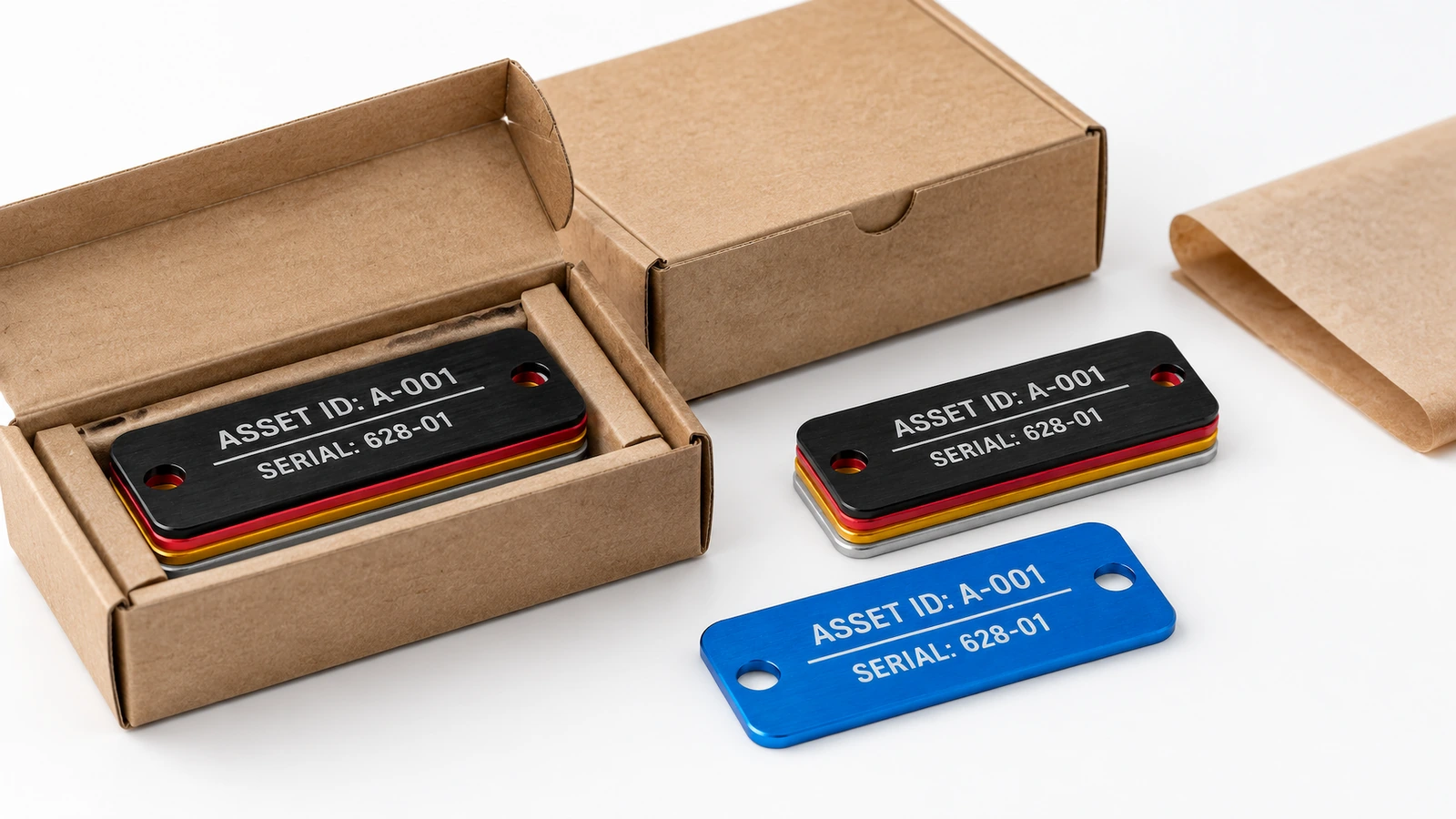
Plan delivery and reorders as part of the spec. Ask for tags packed in serial order with the range marked on each pack, and scan a sample on arrival rather than at installation. Record the part number, imaging route, thickness, and adhesive so the next order continues the same register without drift. Packing format and carton details for NSKU-628-01 are confirmed at quotation.
What should buyers lock in before ordering? ↑
- Long-life claims rest on accelerated tests, not field warranties — 400 Weatherometer hours under GG-P-455B (Source)
- Surface ink is the weak point outdoors — roughly 1–3 years (Source)
- Custom photosensitive runs carry a value floor — $400 per part number at MPC, excluding setup (Source)
- Raw-material stock can dominate schedules — 4 to 8 weeks added when material is out of stock (Source)
- Thin foil gets cheap at volume but is not a rigid nameplate — $2.90 per tag at 100 vs $1.06 at 500 (Source)
- Anodized is the largest aluminum label type, per one commercial estimate — 48.5% of an estimated USD 980.5 million market in 2025 (Source)
Ready to quote tags against your spec, not a slogan? ↑
Custom aluminum asset tags earn their cost only when the specification matches the environment. That means an image inside the anodic layer for outdoor life, attachment matched to the mounting surface, and barcodes graded before release. Commercial terms for NSKU-628-01, including MOQ, production time, and unit weight, are set on quotation and verified by sample. Send your drawing, environment list, and a sample of your asset register to request a quote and a pre-production sample.




The information below is required for social login
Sign In
Create New Account