Custom vinyl transfer stickers are cut-vinyl decals that leave only your lettering or logo on the surface, with no background film. Each design ships weeded on a paper liner under application tape, so separate letters land in register in one pass. Solid single-color art fits this format best. Gradients and photos need a printed or UV DTF format instead.
Who orders these, and for what? Supplier pages and reviews point to three buyer groups. Micro brands such as candle makers, coffee roasters, bakeries and boutiques want a logo on jars, lids and mailers without a square sticker edge. Local service businesses need door lettering, storefront hours and tool ID. Event teams and design studios reorder lettering in batches for clients. PrintRunner positions its transfer stickers for bottles, jars, tools, lids, and glass, metal or plastic surfaces in its transfer sticker product page[1]. All three want a decal that looks painted on, holds on its surface, and arrives ready to apply with no weeding.
The problem: "transfer" covers several different products, and buyers often learn which one they bought only on arrival. Why it costs money: one buyer reported that "5 out 6 transfer stickers came missing letters or parts" on a small, high-cost batch[2]. Another received decals "about 1,3 times bigger than on my SVG file," and a third found "a white background around it" in the color transfer reviews[3]. Installers face a fourth failure: Decals.com calls tape that won't release "one of the most common frustrations in decal application" in its tape release guide[4]. The fix: treat each NSKU-615-01 order as a written spec. Film grade, adhesive, tape tack, finished dimensions and inspection criteria are confirmed at quote and proof, and any outdoor or substrate claim is validated by sample testing.
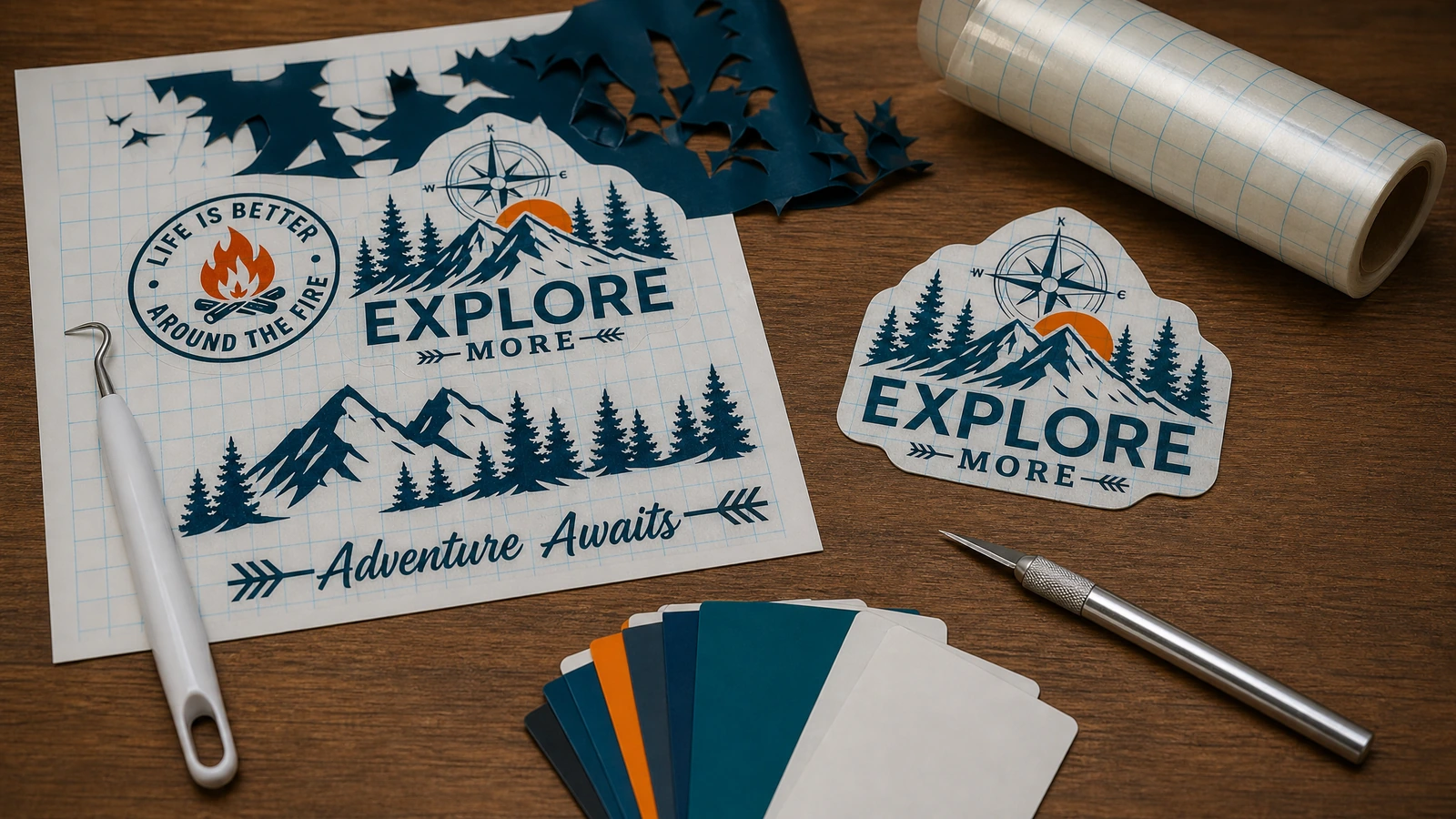
Table of Contents
What Is a Custom Vinyl Transfer Sticker, Exactly? ↑
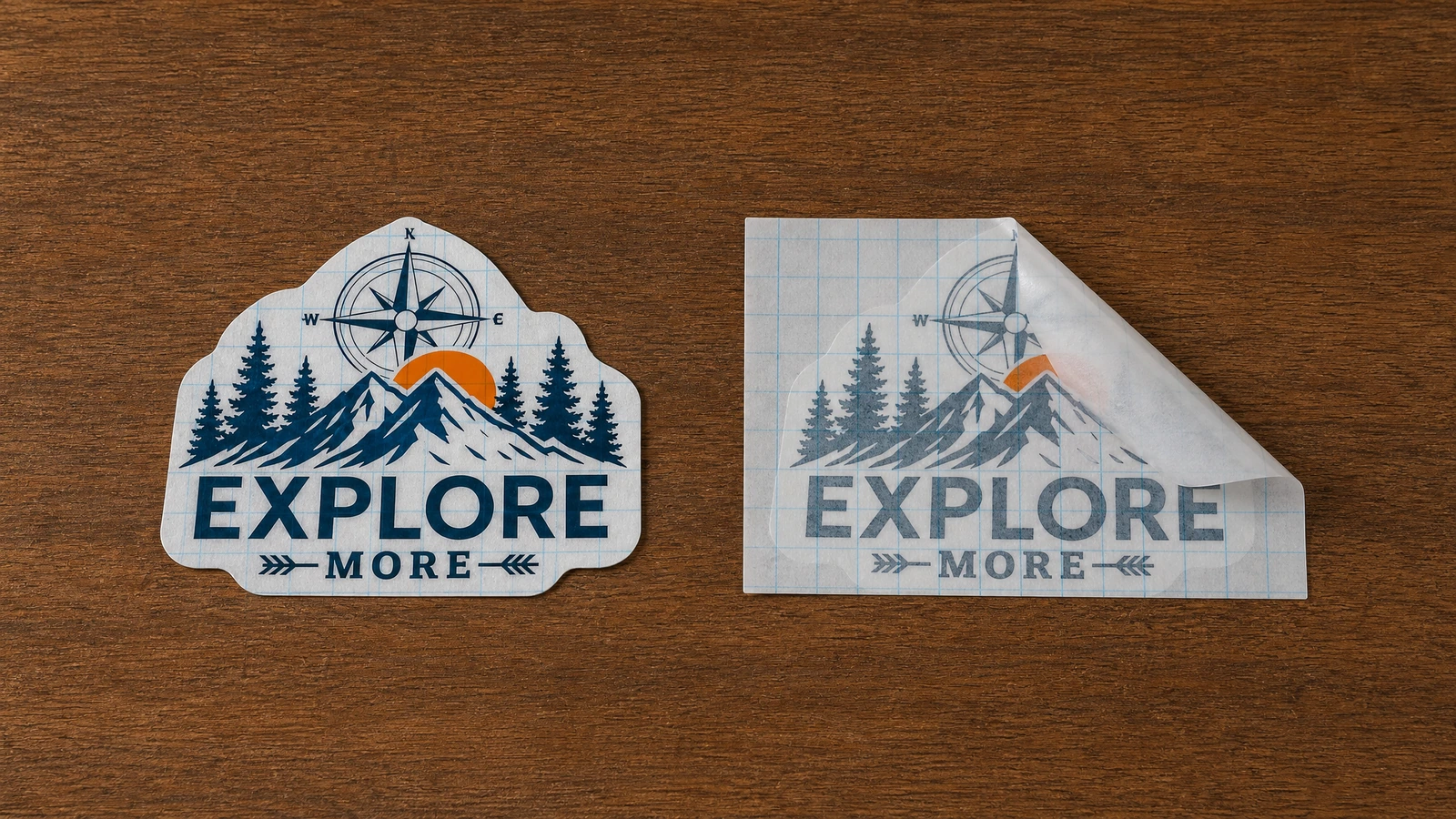
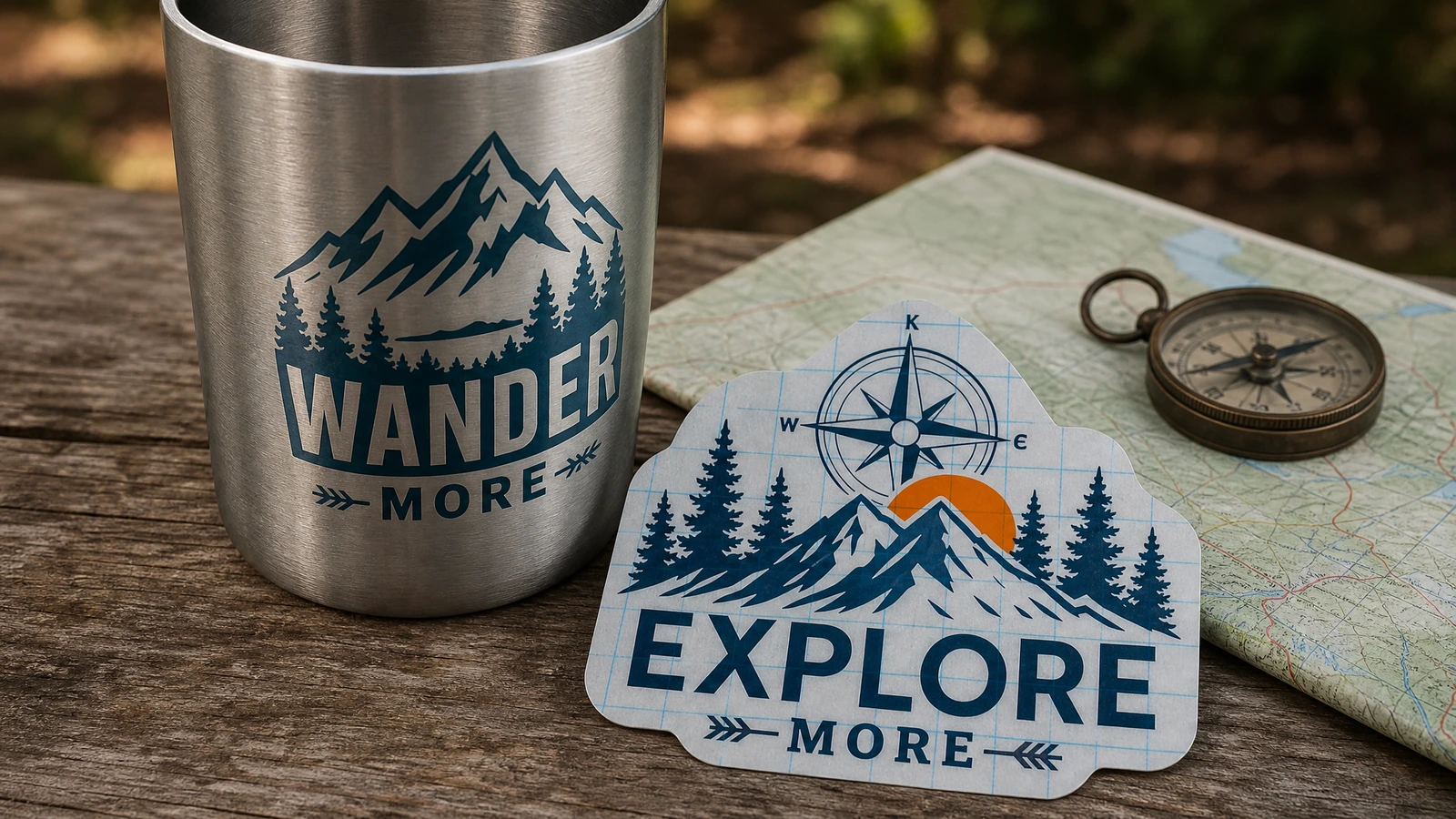
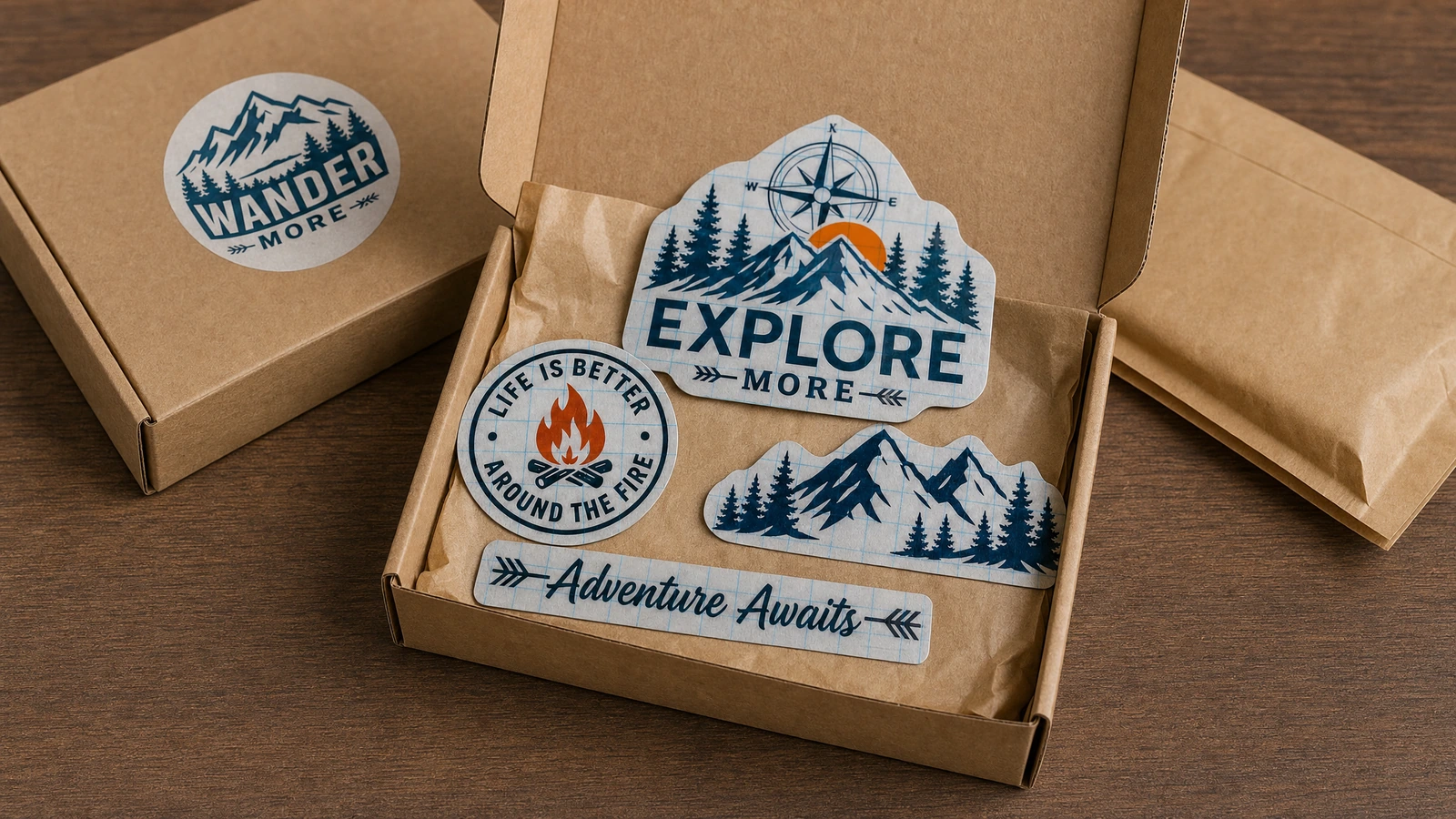
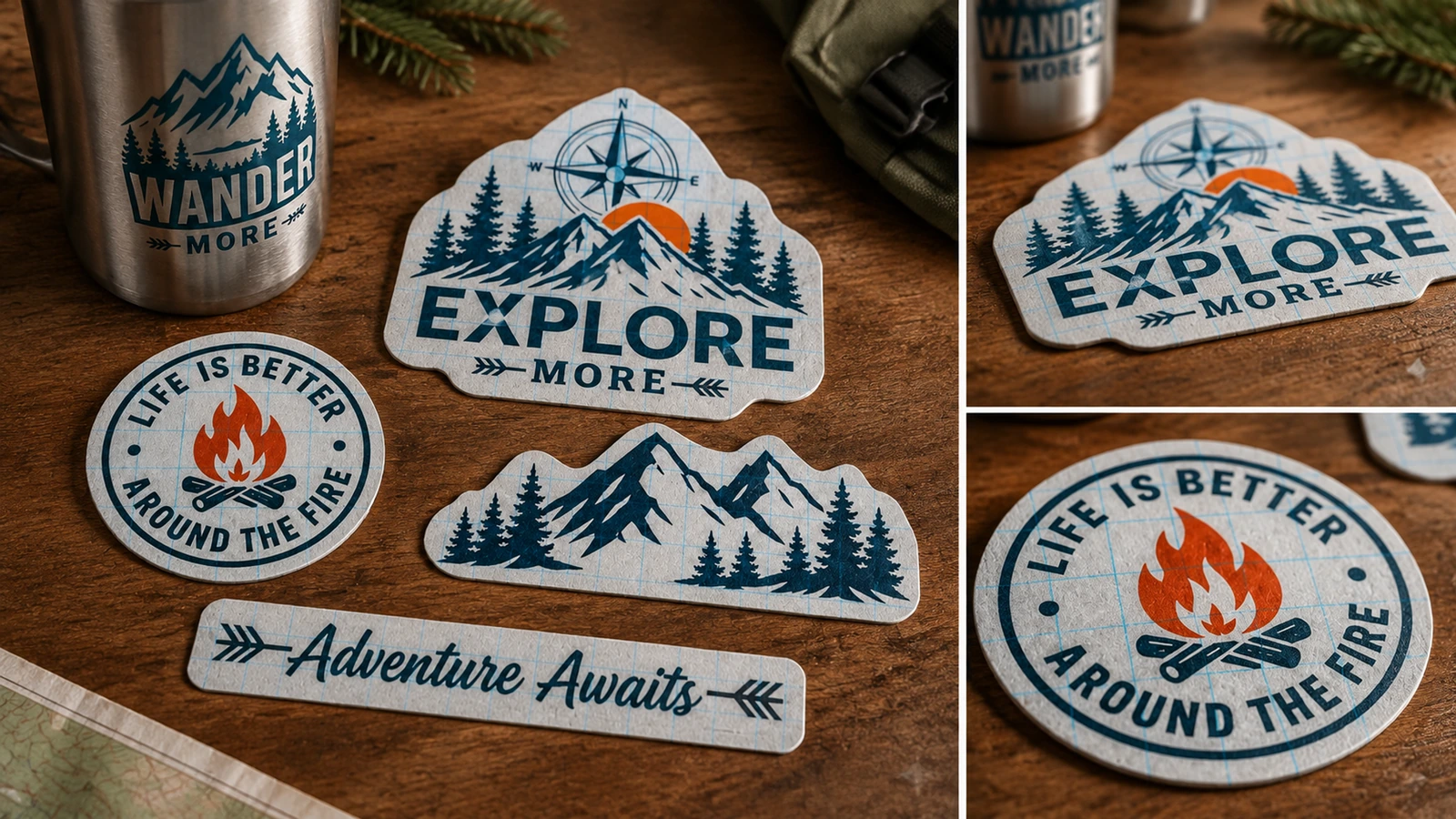
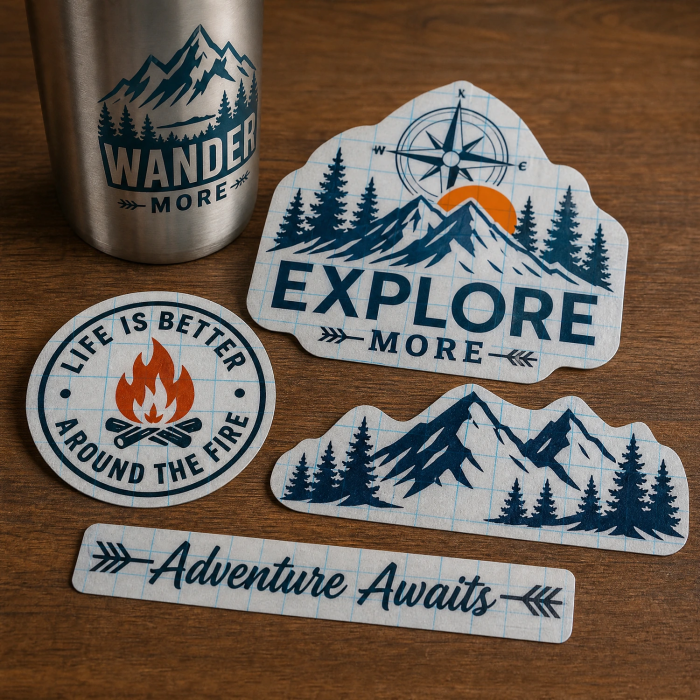
A transfer decal has three layers: a release liner underneath, pressure-sensitive vinyl artwork in the middle, and low-tack application tape on top. Want Stickers explains that once the pieces "are removed from the backing liner, they can be positioned together, and then 'transferred' onto the surface," in its transfer sticker guide[5]. After installation the tape comes off and the surface shows between the letters. 4over4 adds: "Tack levels are matched to the job, because fine detail needs more grip and large solid areas need less," per its transfer sticker guide[6]. NSKU-615-01 is the cut-vinyl version: solid-color film cut on a plotter, weeded by hand, and covered with application tape.
| Format | Construction | After install | Color range | Best fit |
|---|
| Cut vinyl transfer (this product) | Plotter-cut solid film, weeded, under application tape | No background; surface shows between letters | One solid color per piece | Window lettering, truck doors, simple logos |
| Printed full-color transfer | Printed white vinyl with multiple inner cuts, on transfer tape | No background around pieces | Full color | Indoor multicolor logos on glass, metal, doors |
| UV DTF transfer | Printed image layer released from carrier film | Little or no visible film | Full color, slightly raised | Tumblers, notebooks, small hard goods |
| Laminated die-cut (reference) | Printed vinyl plus laminate, one piece | Visible sticker edge | Full color and photos | Water bottles, laptops, merch |
Printed transfers are a different material system from cut vinyl. Sticker Mule's material FAQ[7] states its transfers are printed on 3.4 mil (86 μm) white matte vinyl, are "ideal for indoor use," and carry no protective laminate or UV-resistant inks. UV DTF is not a universal upgrade either: The Print Reviewer concludes vinyl stays more specifiable when a job depends on conformability, a particular adhesive, removability, large formats or vehicle workflows, in its UV DTF vs vinyl comparison[8].
How Small Can Letters and Lines Go and Still Read? ↑
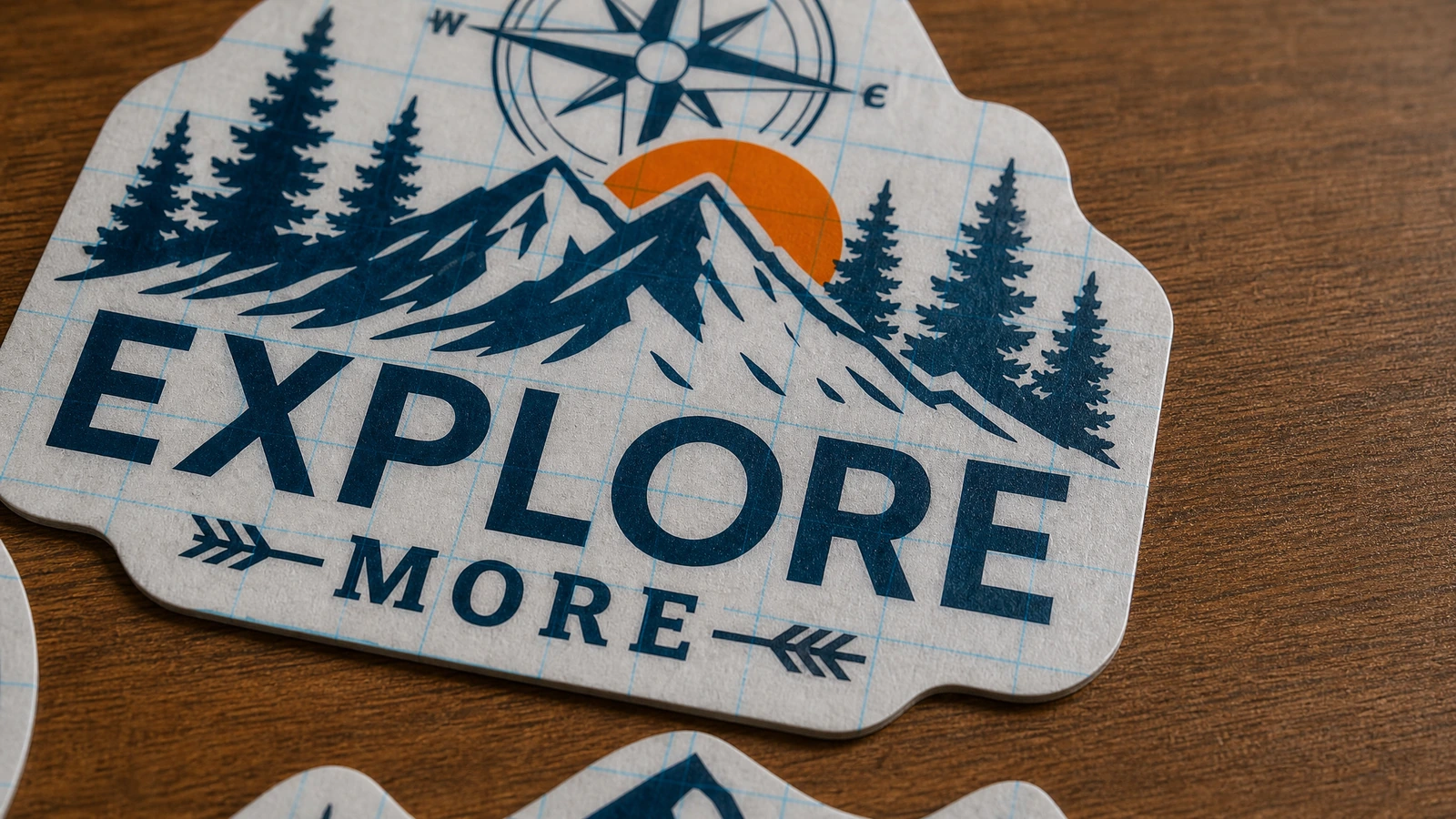
Thin strokes cause the most transfer failures, so set minimums before artwork is final. Published limits vary by supplier and process. For its printed transfers, Sticker Mule's transfer sticker FAQ[9] lists solid parts of at least 0.08 in, cut-out gaps of at least 0.09 in, sizes from 1 × 1 in up to 15 × 15 in, and 300 PPI artwork at final size. Decals.com's transfer cut guidelines[10] are more conservative for cut work: text at least 1/2 in and lines at least 1/8 in, with complex art proofed first. These are other suppliers' rules, not ours. For NSKU-615-01, minimum stroke and gap are confirmed by a test cut on your selected film.
YG Tape notes that "small text, sharp corners and narrow elements are usually the first areas to fail if the cut is incomplete," per its cut vinyl tape guide[11]. Script fonts, serifs and the counters inside a, e and o are the usual weak points. Readability is separate from cuttability: specify the finished outer bounding box in inches or millimeters, state whether letter height means cap height or overall height, and note the viewing distance. Storefront hours read at arm's length; fleet numbers must read across a lot. The approved proof prints the real dimensions, so nobody guesses the scale.
Which Surface, Film, and Adhesive Fit Your Application? ↑
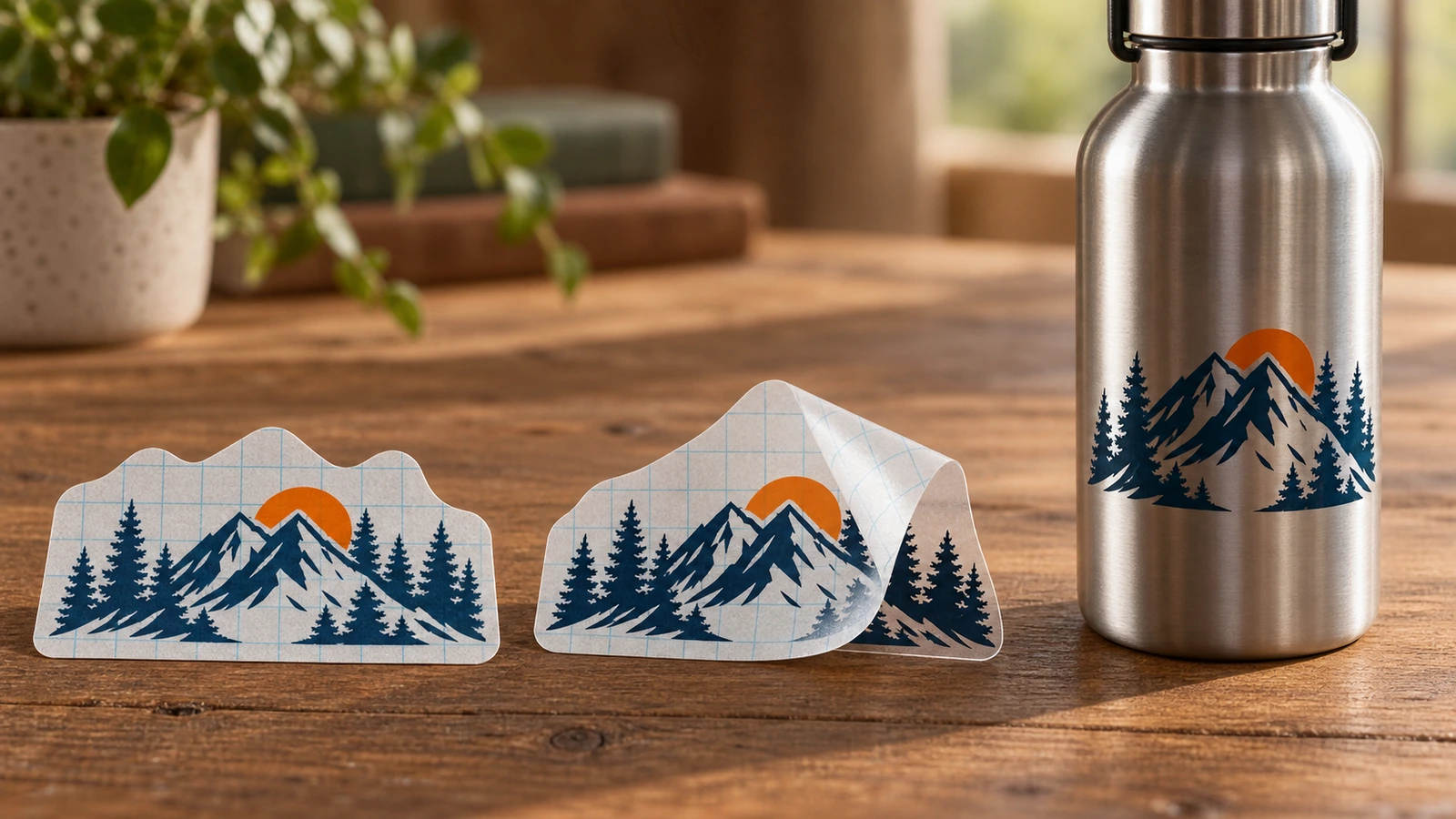
The surface decides more than the decal does. Stickerit's transfer sticker page[12] lists reliable bonds to glass, powder-coated metal, acrylic, anodized aluminum, painted walls and most smooth plastics, states that "fabric does not work," and says fresh paint needs at least 30 days to cure. Low-surface-energy materials are the hidden risk. Kim's Direct names "polypropylene, silicone, powder-coated surfaces," along with oils, dust and curve stress, as the most common reasons decals peel, in its peeling and bubbling guide[13]. Tell us the exact substrate. HDPE or PP containers need a higher-tack adhesive, tested on your actual part.
Calendered film is the economical option for flat, indoor or short-term use. Cast film is thinner, more stable, and conforms to rivets and curves without shrinking back. Flywheel Brands summarizes public manufacturer ratings in its outdoor decal comparison[14]:
| Film system | Rated outdoor life (vertical) | Basis |
|---|
| Economy monomeric calendered | Can fail within 1 year | Flywheel Brands summary |
| Polymeric calendered | 5–7 years | Flywheel Brands summary |
| Unprinted cast | 8–10 years | Flywheel Brands summary |
| Printed cast + UV-stable laminate | About 8 years (3M rating as reported) | Flywheel Brands summary |
| Avery MPI 1105 SuperCast, printed | Up to 7 years | Avery PDS, Rev. 12 |
These figures are manufacturers' expected performance under stated conditions, not a warranty for a finished decal. Flywheel reports that Avery Dennison cuts rated durability by 50% for horizontal applications, so plan hoods, tabletops and roof boxes at roughly half. Avery's MPI 1105 data sheet[15] (dated 12/15/25) sets minimum application temperatures of 45°F flat, 50°F over rivets, and 60°F on complex curves. The film and adhesive (permanent or removable) for NSKU-615-01 are named on your quote, and any lifespan we cite is the film maker's published rating for that exact film.
How Do You Prepare Artwork That Cuts Cleanly? ↑
A plotter follows paths, not pixels. Stickerit states that vector files give the cleanest results: AI, EPS, SVG and PDF with outlines. A last-minute bitmap trace produces jagged paths that cause half-cuts, stringing and weeding failures, so plan redraw time if you only have a JPG or PNG. Preflight before you upload:
- Convert all text to outlines so a missing font cannot change the letterforms.
- Close every path and delete duplicate or overlapping strokes.
- Put each film color on its own layer or swatch.
- Check strokes, gaps and letter counters against the minimums confirmed for your film.
- Draw the finished outer box at true size and label it in inches or millimeters.
The size line prevents the 1.3× mismatch described above. Our proof states outer dimensions in both units, and production starts only after you confirm them. For script or hairlines near the limit, ask for a test cut rather than trusting a screen preview.
How Is Each Decal Cut, Weeded, and Taped? ↑
Production has three stages, each with its own failure point. First, the plotter kiss-cuts the face film without cutting the liner; blade depth is set for the film, and the cut line must be continuous with no uncut bridges. Second, weeding removes waste vinyl by hand, large areas first, then counters and fine gaps. For very small parts, reverse weeding (medium-tack tape applied before the waste is pulled) keeps pieces from getting lost. Weeding is the labor bottleneck, so ultra-fine artwork costs more and rarely suits low-price bulk runs.
Third, the weeded sheet is checked under strong light, and application tape is laid on oversized by about 0.5–1 in per side, squeegeed with overlapping strokes, and burnished. PalmGear rejects the claim that "all transfer tape brands are interchangeable," noting that Oracal, Cricut and Siser engineer tapes to pair with their own vinyl, in its transfer tape guide[16]. Your tape and film pairing is fixed at proof and kept on file. Production days are quoted after proof approval, because they depend on quantity, color count and weeding complexity.
What Should a Batch Pass Before It Ships? ↑
Write defect definitions down before the run, so "acceptable" means the same thing to both sides. The table maps the complaints quoted earlier to the checks that catch them.
| Defect | Usual cause | Acceptance check |
|---|
| Missing letters or parts | Incomplete cut depth, loss during weeding | Visual check of every sheet on fine-text jobs |
| Vinyl stays on liner when tape lifts | Tape tack too low, light burnishing | Peel test on a sheet pulled from the run |
| Vinyl stuck to tape at install | Tack too high, cold surface, steep peel | Release test at the stated application temperature |
| Finished size differs from proof | Auto-scaling to canvas or font ascenders | Measure outer box against proof in mm |
| Unexpected background | Wrong format ordered or approved | Format confirmed on the proof |
If a check fails on a small batch, the remedy is a full remake, not a partial top-up, because signage with one broken word is unusable. For lab evidence, the FINAT test methods[17] include FTM 1 (180° peel at 300 mm/min), FTM 9 (loop tack) and FTM 14 (dimensional stability). Accelerated weathering commonly follows ASTM G155 xenon-arc exposure, but Brady's outdoor ID white paper[18] warns that many market durability claims have no data behind them. We publish no in-house test results for NSKU-615-01. Peel, tack or weathering tests on your film and substrate are arranged per order and reported as measured.
How Do You Apply It Without Bubbles or Lifted Letters? ↑
Most installation failures come from technique, so each order includes a one-page instruction sheet:
- Clean, dry, then wipe with isopropyl alcohol. Printable Press uses "70% concentration or higher" and allows "at least two full minutes of dry time" in its application protocol[19]. Never finish with ammonia glass cleaner.
- Check the temperature. Vinyl Status says the surface "should be at least 50°F (10°C)" in its application guide[20]; Decals.com recommends 60–80°F out of direct sun.
- Hinge the decal with masking tape along the top or center, check level, then peel back half the liner.
- Squeegee outward from the hinge in overlapping strokes at about 45° to push air to the edges.
- Peel the tape back on itself at close to 180°. Re-press any lifted letter, then allow 24–48 hours before washing.
For delicate art, Sticker Mule's FAQ suggests waiting 24 hours before removing the tape. Wet application suits only large, repositionable graphics, because water can float small letters out of position.
Which Transfer Format Should You Buy? ↑
Choose by job, not by product name.
| If you need | Choose | Watch-out |
|---|
| Storefront, fleet numbers, tool ID in one color | Cut vinyl transfer | Fine script needs a test cut |
| Multicolor logo on indoor glass or doors | Printed full-color transfer | Unlaminated ink fades in prolonged sun |
| Tumblers and small hard goods, no visible film | UV DTF | Dishwasher claims are mostly seller tests |
| Photos, gradients, long-term outdoor merch | Laminated die-cut or kiss-cut | Visible sticker edge |
| Horizontal or high-UV surfaces | Rated cast film | Plan for about half the vertical rating |
Compare prices only within the same format. As a market reference, Sticker Mule's printed transfer page[21] showed about $17 for one small decal and $65 for 50 in a 2026 snapshot. PrintRunner describes its 2 mil cut vinyl as suited to "indoor and light outdoor use." NSKU-615-01 quotes are built from finished size, color count, quantity and weeding complexity, so an intricate script logo costs more per piece than block lettering at the same size.
Compliance applies only when the use case triggers it. UL 969 covers permanent safety markings evaluated as a system on specified substrates, per the UL 969 standard listing[22]; it does not certify promotional decals. CPSC's phthalates guidance[23] limits eight phthalates to 0.1% (1,000 ppm) in accessible parts of children's toys and child care articles, relevant only if the decal is designed for children 12 and under. For California, OEHHA listed bisphenol S under Proposition 65[24], with warning obligations effective 2024-12-29, so ask for ink and adhesive declarations. For EU food-contact packaging, FINAT's PFAS note[25] explains that PPWR limits apply to the finished packaging from 2026-08-12, with label components assessed within that. Do not describe PVC transfer decals as compostable or plastic-free.
How Should Packing, Shipping, and Reorders Work? ↑
Packaging is the last point where a good decal can fail. One sign shop reports that small letters cling to the liner while larger letters "end up pulling off the tape somehow and getting all fucked in the tube during shipping," in a car wrap installer thread[26]. Flat-pack or roll, and the stiffener used, are agreed per order and checked on the sample shipment. Avery's data sheet gives a two-year shelf life from manufacture for that film, so use stocked decals oldest first.
Lead time needs the same written precision as size. A Reddit buyer who "approved my proof within seconds" was "still waiting 3 weeks" in a public turnaround complaint[27]. Your order confirmation states production days and transit days separately, counted from proof approval. For reorders, we keep the approved proof, film and color, adhesive, tape tack, outer dimensions and defect notes on file, so the next batch matches without re-proofing.
Key Takeaways for Buyers ↑
- Solid-color cut transfers suit clean, smooth outdoor surfaces for years, not decades — 3 to 5 years before visible fading (Source)
- Horizontal surfaces cut rated film life sharply — 50% reduction under Avery Dennison's guarantee terms (Source)
- Cold surfaces slow adhesive wet-out — minimum 50°F (10°C) surface temperature (Source)
- Thin strokes need published minimums before artwork is final — 0.08 in solids and 0.09 in gaps at one major printer (Source)
- CPSIA phthalate limits apply only to children's toys and care articles — 0.1% (1,000 ppm) (Source)
- Third-party sticker market estimates use different scopes and should not be added together — stickers subsegment $1.60 billion (2024) projected to $2.90 billion by 2030, 10.4% CAGR (Source)
Ready to Spec Your Transfer Decals? ↑
A transfer decal succeeds or fails on details settled before production: whether the art suits single-color cut vinyl, whether strokes clear a tested minimum, which film and adhesive match the substrate, which tape tack matches the art, and what inspection standard the batch must pass. NSKU-615-01 is ordered on those terms, with pricing, production days and any performance claims confirmed in writing at quote and proof. Send your outlined vector file, the finished outer dimensions and a photo of the target surface to request a written quote and proof.




The information below is required for social login
Sign In
Create New Account