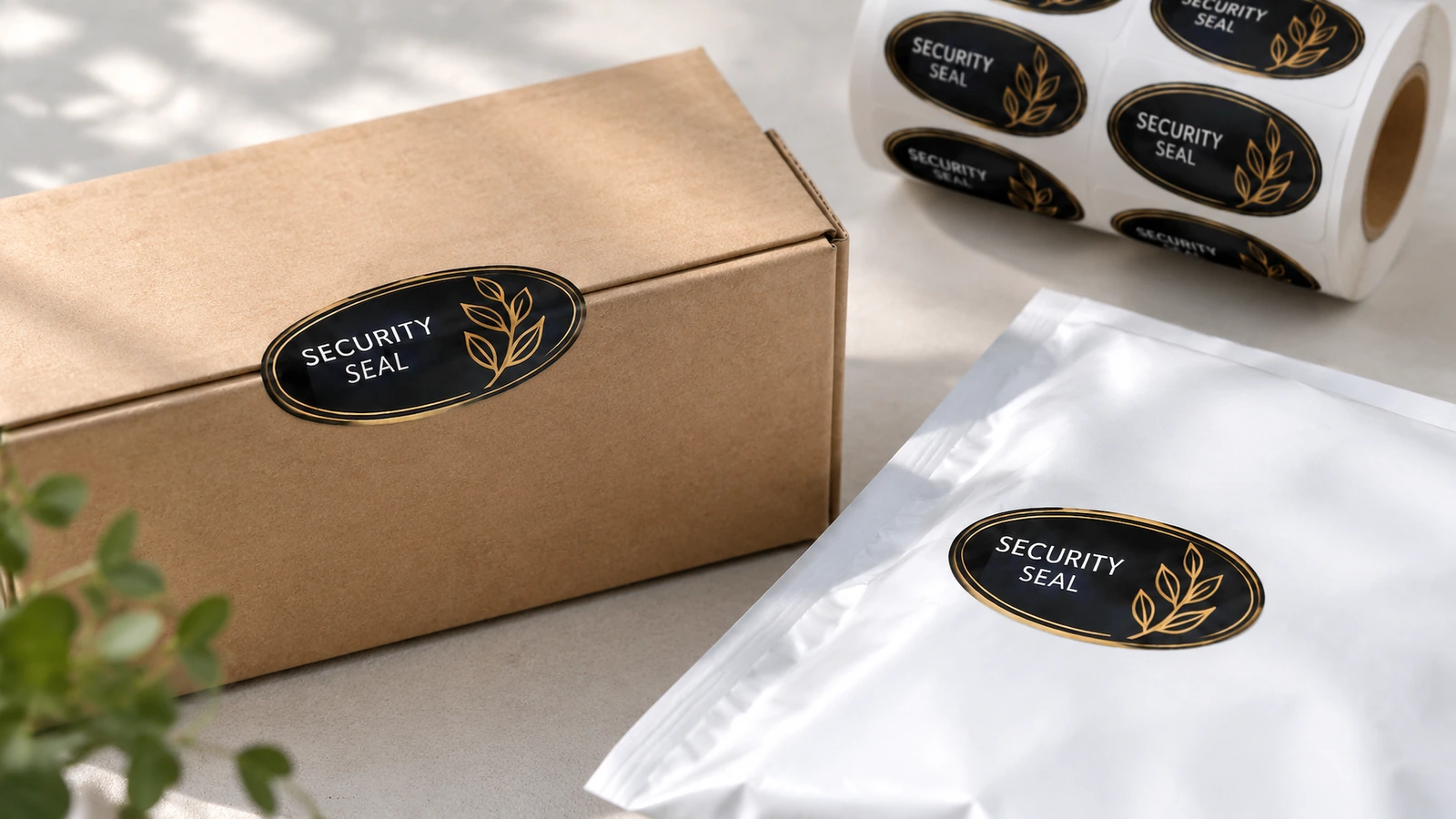
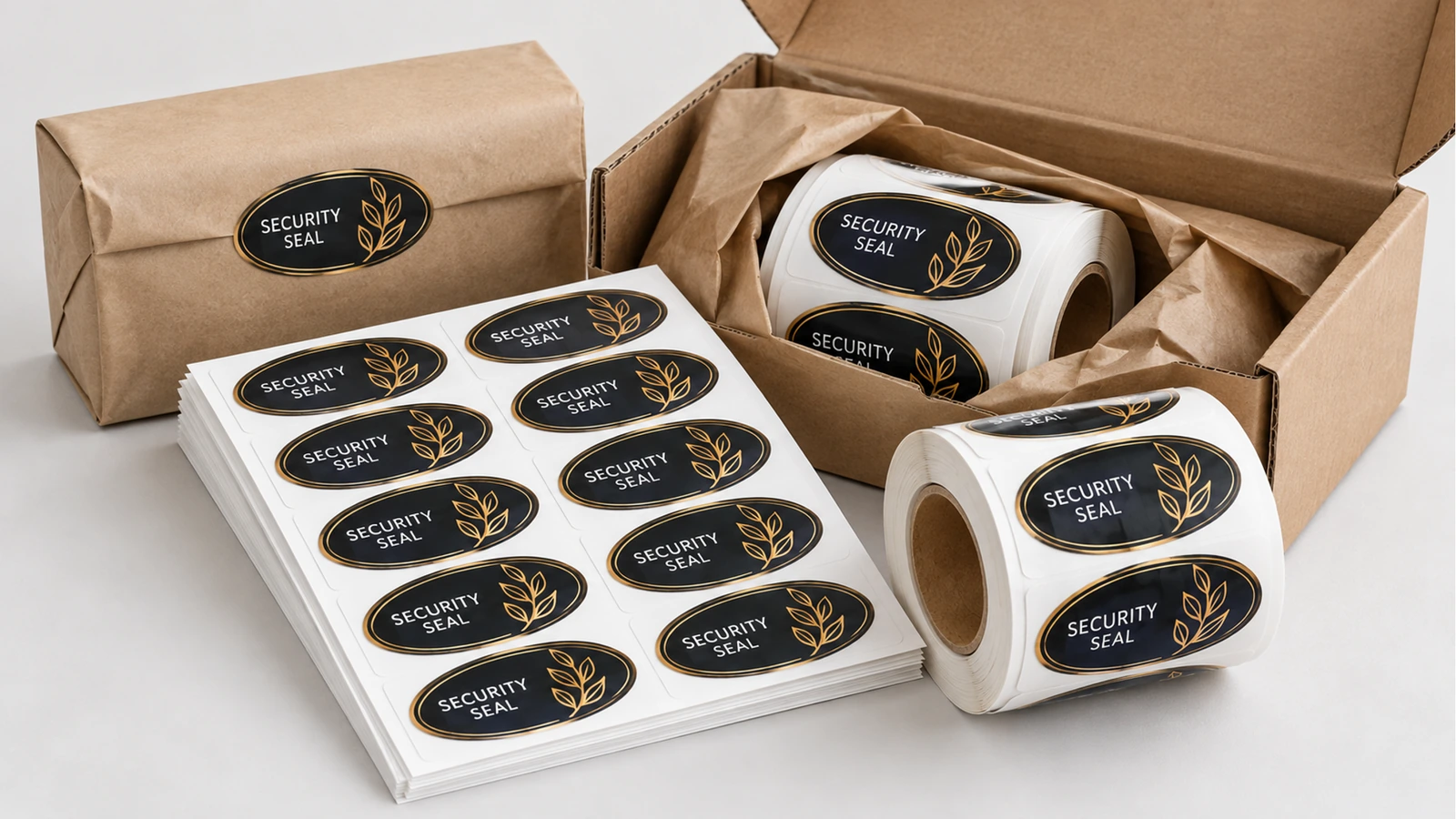
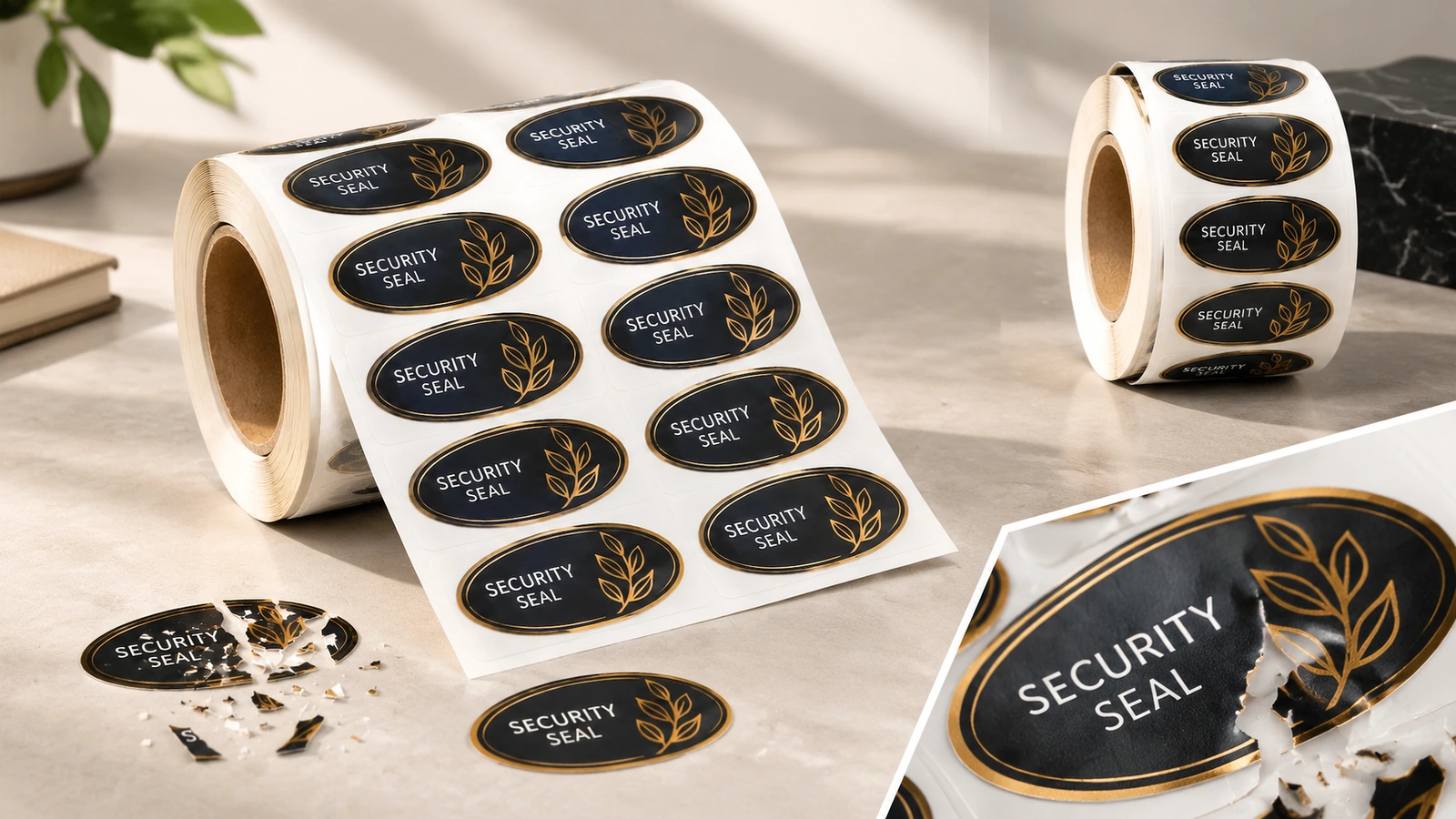
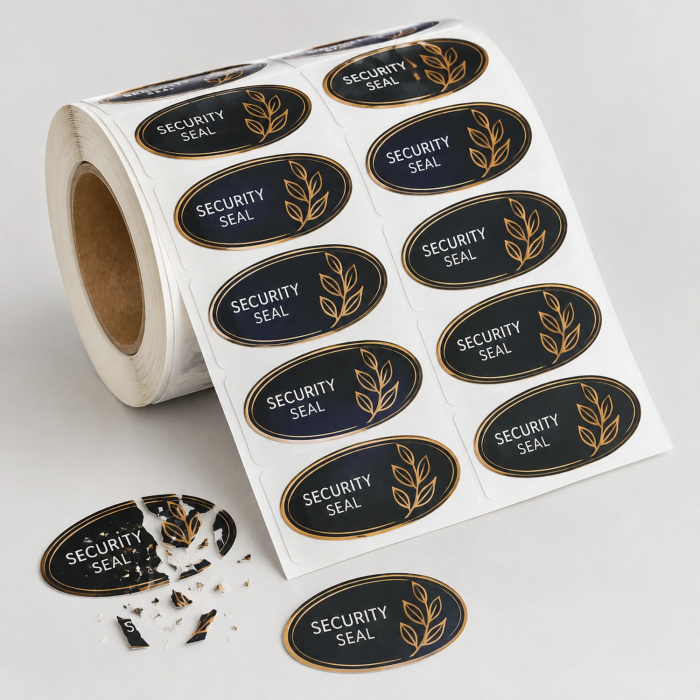
Custom eggshell stickers are destructible security labels. A thin, brittle face film sits on a permanent acrylic adhesive. When someone tries to remove the label, the face cracks into small flakes before the adhesive lets go, so the label cannot be lifted off in one piece and reapplied. That makes them a tamper-evident signal for warranty seals, asset tags and packaging closures. They also work as hard-to-remove promotional labels on owned or authorized surfaces.
Who orders them. Buyers fall into three groups, and each has a different reason to buy. Quality, procurement and packaging teams specify destructible labels for several jobs listed by material supplier Vizlent[1]: electronics warranty seals, pharmaceutical secondary packs, IT asset tags, and anti-counterfeiting closures for spirits and cosmetics. Small brands, bands and event organizers order mid-size runs of full-color die-cut labels that should not come off a mirror, merch case or counter in one piece. Street artists buy blank and printed versions because the film resists clean removal and takes paint markers. This page focuses on the first two groups and assumes every placement is on a surface you own or are authorized to label.
The problem. A standard vinyl label lifts off whole. A customer can open a device, peel the warranty seal and press it back down. A returned product can be swapped and resealed. An asset tag can move to a different machine. Nothing on the surface shows that any of this happened. Destructible film exists to close that gap. StreetSticker[2] describes its stock as destructible eggshell vinyl on permanent acrylic adhesive and says the labels "can't be lifted off in one piece."
Why it gets expensive. Switching to eggshell stock brings its own failure points:
Liner tearing: one buyer reported the stickers "have torn" while peeling them off the backing (Graff-City review[4]).
Surface limits: CustomLabels[3] warns that the brittle face "hates bending and stretching," that oily surfaces let someone pick up an edge, and that PP/PE plastics need a sample first.
Outdoor durability: one seller says its eggshell stock has "no outdoor warranty or rating" (The Sticker Cult[5]).
Hologram mismatch: a holographic order drew the complaint that the hologram "was barely visible" and ran the opposite direction to the artwork (Trustpilot review[6]).
A seal that fails in any of these ways either frustrates installers or leaves no evidence at all.
The fix. Treat the label as an engineered component:
Choose the face stock for your substrate and environment, keep artwork inside safe zones, and prove the label on your real surface after a full adhesive dwell. Then accept production against a signed master sample.
For this item (NSKU-681-01), face stock, adhesive, liner, MOQ and lead time are confirmed per order at quotation and sampling. No factory test values have been published for this item yet.
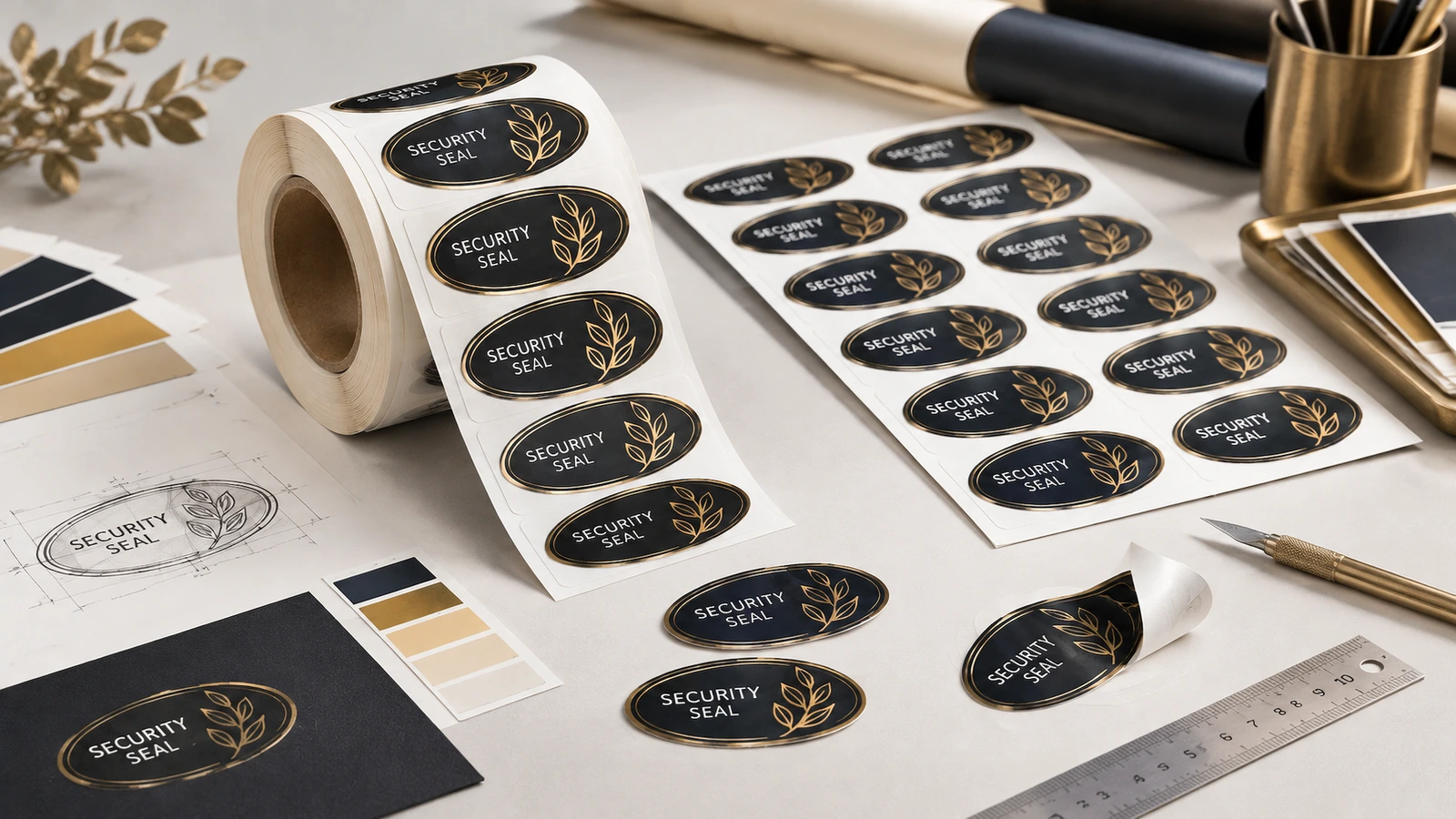
Table of Contents
What Are Eggshell Stickers, and Why Do They Break on Purpose? ↑
"Eggshell" is a trade name, not a raw material. The label pairs a thin, brittle face with a permanent acrylic pressure-sensitive adhesive. The face is either ultra-destructible vinyl or fragile paper. Its internal strength is lower than the adhesive's bond to the surface, so any removal attempt fractures the face instead of releasing the glue. Carstickers[7] describes its stock as "a 2.0 mil destructible vinyl with permanent adhesive," where "the vinyl face is designed to fail during removal."
That makes the label tamper-evident, not tamper-proof. The same supplier says these stickers "should not be described as tamper-proof": a determined person can still scrape one off, but the attempt is hard to hide. Stickerit[8] makes two related points:
Eggshell labels can leave residue, depending on the adhesive, the surface and how long the label has been in place.
Not every tamper-evident label is an eggshell label.
Your product copy, invoices and packaging inserts should all say the same three things: the label flakes on removal, it cannot be transferred, and removal may leave fragments and adhesive.
Compliance claims need separate evidence.
UL 969. ANSI/UL 969 Edition 6 was published 2025-07-24 and revised 2025-07-28. It covers permanent, safety-related nameplates and requires markings to be "permanent and legible." Intertek lists a compliance date of 2027-07-28 (Intertek SUN[9]). UL recognition applies to a listed combination of face stock, ink, adhesive and surface, not to the word "eggshell." A face designed to fail may also conflict with a permanent-nameplate role.
Pharmaceutical packaging. Tamper-evident pharmaceutical packaging is assessed against DIN EN 16679:2014 (FINAT award report[10]). A destructible label on its own does not establish conformity.
Do not print "UL Recognized" or "EN 16679 compliant" unless you hold a certificate for that exact construction.
How Should You Size the Label So Logos, Serials and Codes Stay Readable? ↑
Brittle film cracks first at its edges and at narrow die-cut features, so readability is a layout decision. Follow these rules:
Keep serial numbers, barcodes, QR codes and small text about 1–2 mm inside the cut line.
Avoid hairline strokes.
Prefer short security text plus a serial number over dense halftone artwork.
Carstickers states that consecutive numbering, variable data, barcodes and QR codes are available on its eggshell product. For NSKU-681-01, variable-data capability and minimum code size are confirmed during proofing. If you add a holographic layer, scan a printed sample before approval, because strong holographic effects can reduce barcode contrast.
Size also affects how cleanly the label goes down. Display-Wholesale[11] does not recommend eggshell stickers larger than 5 inches, because larger pieces of brittle film are harder to apply without bubbles. A creator testing a UV-printed eggshell sticker of about 14.5 × 9.5 cm (5.7 × 3.7 in) worried it would crease when applied one-handed to a pole (Reddit r/sticker[12]). For warranty points and screw holes, a smaller label bridges the joint with less flexing. For promotional pieces, test your largest size before committing to a full run.
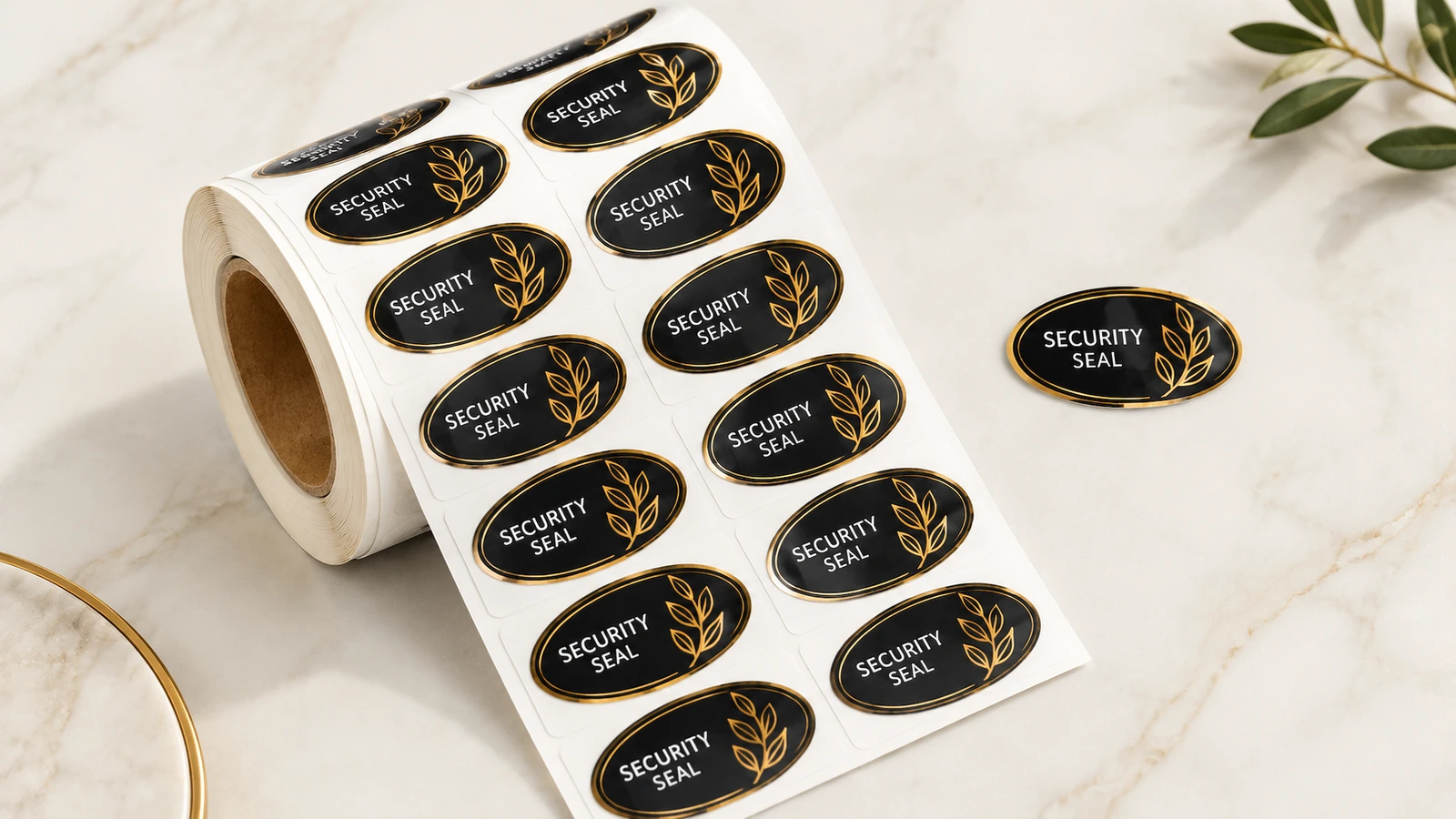
Which Surface, Face Stock and Liner Combination Will Hold? ↑
Suppliers publish different face-stock specifications. The table below lists them side by side so you can see the spread before asking for a technical data sheet.
| Source | Face stock | Published thickness | Other published claims |
|---|
| Carstickers | Tamper Evident Vinyl | 2.0 mil (≈0.051 mm) | 2-year outdoor rating; max width 25 in |
| Signworld roll[14] | Egg shell adhesive vinyl | 3 mil (≈0.076 mm) | 42 in × 150 ft; "Not to be Used with Laminate" |
| Nokleen[13] | Ultra destructible vinyl | 0.06 mm (≈2.4 mil) | Elongation 2–4%; water-based PSA; −65 °C to 148.5 °C |
| Vizlent | Brittle calendered paper | 60–80 g/m² face | Acrylic adhesive 18–22 g/m² dry; ±5 g/m² shifts fracture pattern |
These are supplier-published values, not an industry standard. Keep the following in mind when you compare them:
Do not average 2.0 mil, 3 mil and 0.06 mm into a "typical" thickness. The mm conversions in the table are editorial, using 1 mil = 0.0254 mm.
Nokleen's temperature range conflicts with other datasheets that list −20 °C to 60 °C. Both cannot apply to the same material.
Request the technical data sheet for the face stock and adhesive actually quoted.
Carstickers rates its vinyl for two years outdoors. Stickerit and The Sticker Cult give lower or no outdoor ratings. Treat any outdoor life figure as one seller's claim for one material.
Surfaces that work. Adhesion is best on smooth, non-porous, higher-energy surfaces: metal, glass, rigid plastics and painted finishes.
Surfaces that need testing first. Low-surface-energy plastics (PP/PE) and powder coatings may need a dedicated LSE adhesive and a sample run. Tight radii crack the face during application. Contamination lets someone lift an edge. CustomLabels also notes that acrylic adhesive will not wet out properly below roughly 10 °C (50 °F).
Paper versus vinyl. Fragile paper is the cheapest option and suits dry, smooth indoor surfaces. Vinyl handles mild curves and light outdoor exposure better.
Lamination. Never laminate eggshell stock. Carstickers explains that a laminate stops the face from fragmenting, which removes the tamper evidence.
The liner (backing) matters as much as the face. Many installer complaints start before the label ever touches the target surface. ZOLO[15] lists 80 g glassine and 160 g coated-paper liners for its 70-micron brittle vinyl. For hand application, a kiss-cut or peel tab gives installers a corner to lift without snapping the face. For automatic labeling, highly brittle grades often pre-crack on the peel plate, so confirm that the release force and brittleness grade suit the applicator speed.
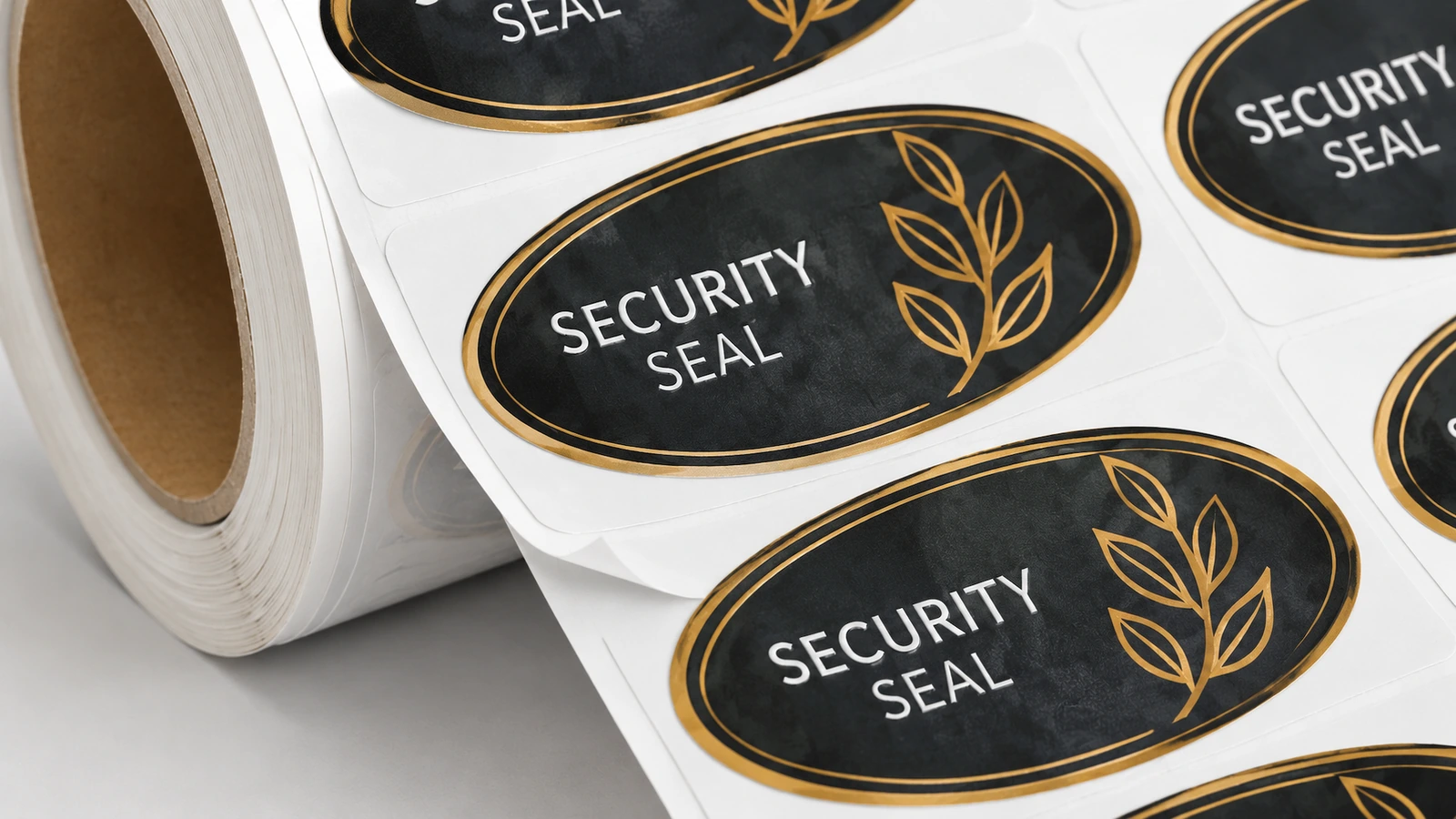
How Do You Take an Eggshell Label From Artwork to an Approved Run? ↑
The order process controls risk best when you settle the substrate and the artwork before you discuss price. File preflight catches most proof disputes. Hologram direction, cut-line placement and variable-data fields should be fixed on the proof, not argued about after delivery.
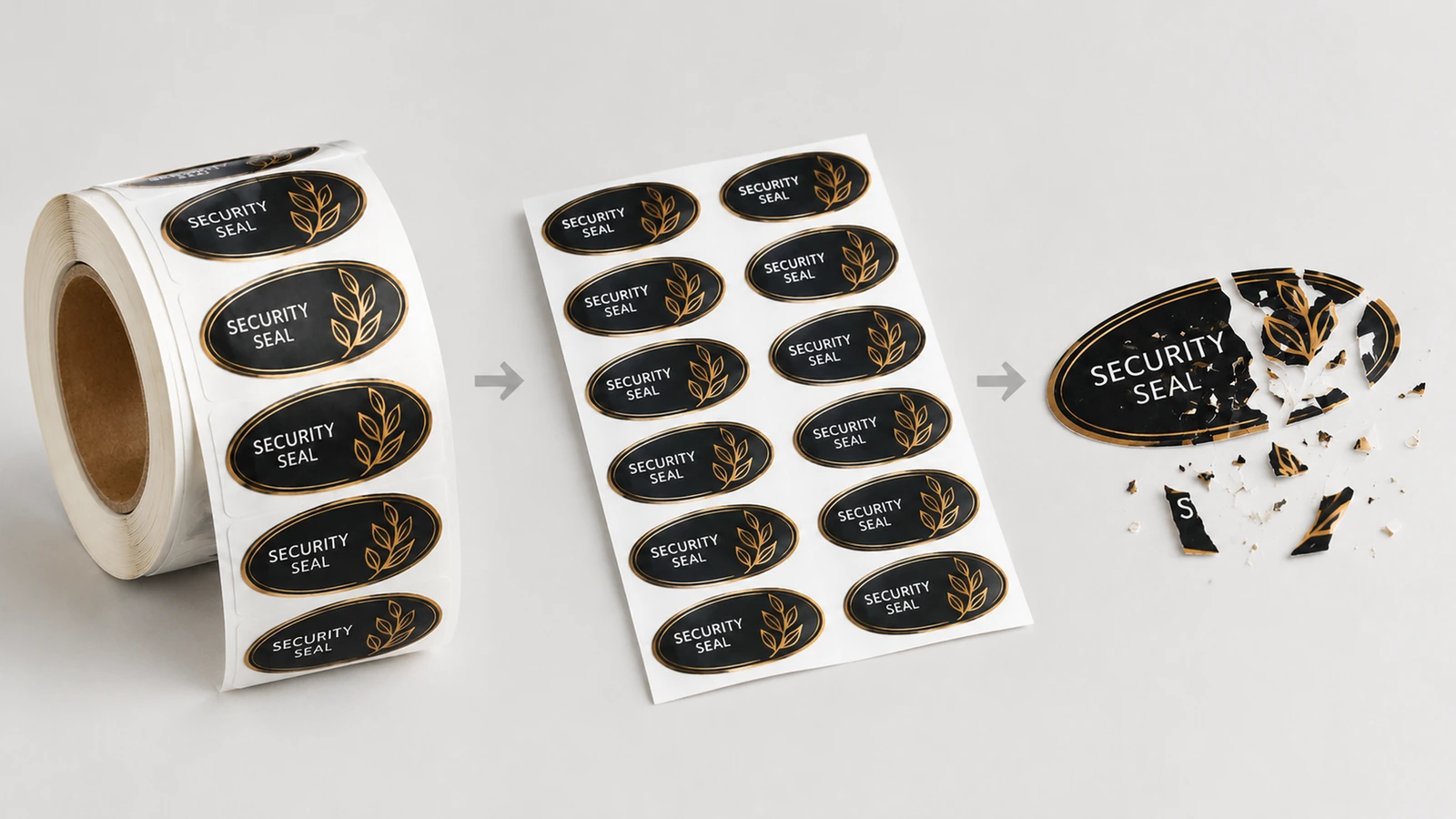
- Define use and substrate. Record the target material (metal, glass, ABS, PP/PE, powder coat or carton), indoor or outdoor exposure, temperature range, and hand or machine application. If inspectors need readable text left behind after removal, consider a VOID label instead.
- Preflight the file. Supply vector AI, EPS or PDF. Specify CMYK or Pantone. Outline all fonts. Mark the cut line, the safe zone, the serial or QR fields and the hologram direction.
- Choose the construction. Specify the face (paper or vinyl; white, clear or holographic), the adhesive (standard or LSE), the liner, the format (sheet or roll) and any numbering.
- Sample on the real surface. Clean with isopropyl alcohol, apply firm pressure and wait 24 hours before attempting removal, the prep method also given by Fulshear Athletics[16]. The sample passes when it cannot be lifted whole and fragments stay on the surface.
- Sign a master sample. The approved piece becomes the reference for color, hologram direction, die-cut depth and fracture behavior.
- Release production. Confirm the quantity, packing format and per-lot inspection plan in writing.
Lead times depend on the construction. Published examples from other sellers:
StreetSticker: 3–5 business days of production.
The Sticker Cult: 5–7 business days of processing, then normally 2–5 days in transit.
Nokleen: 3–7 business days after design confirmation.
For NSKU-681-01, sample and production timing are quoted per order.
Whichever supplier you use, never judge "won't peel" on the day the labels arrive. Performance depends on at least 24 hours of dwell on the substrate. A 2021 video review lists "don't put it on anything you'll want to remove later" as its first piece of advice, and its wood test panel ended up being painted over (YouTube review[18]). Run your trials on scrap parts.
How Should You Inspect and Accept a Delivered Batch? ↑
Test the adhesive and release behavior separately from the fracture behavior. For adhesive and release checks, buyers commonly reference the test methods published by FINAT[17], the European self-adhesive label association.
| Check | Method | What it tells you |
|---|
| FTM 1 | 180° peel adhesion at 300 mm/min | How strongly the label bonds to a standard or customer substrate |
| FTM 2 | 90° peel adhesion at 300 mm/min | Peel behavior at a steeper angle |
| FTM 8 | Resistance to shear | Holding power under sustained load |
| FTM 9 | Loop tack | Initial grab before dwell |
| FTM 3 / FTM 10 | Low-speed release; silicone release | Whether the liner releases without pre-cracking the face |
| 24 h application test | Clean, apply, dwell 24 h, attempt removal | Pass only if the label cannot be lifted whole |
FINAT has no dedicated "eggshell fragmentation" method. Fracture can only be judged on the customer's actual substrate. Also note:
FINAT methods are test procedures, not certifications.
Vizlent quotes a 180° peel adhesion of ≥14 N/25 mm on stainless steel for its paper product. That is a supplier specification, not a universal limit. Quote it only with that label attached.
Inspect every lot against the master sample and record:
Liner release, and whether labels crack on the liner.
Fracture after 24 hours on your substrate.
Color difference from the master.
Die-cut depth, which must never cut through the liner.
Hologram direction.
Reject any lot in which a sampled label lifts whole. Variation between batches is exactly what turns a security promise into a dispute.
Eggshell, VOID or Fragile Paper: Which Tamper-Evident Label Should You Buy? ↑
Each option shows tampering through a different mechanism, and each mechanism suits different products. Pick by failure mode first and price second.
| Option | How it shows tampering | Strength | Limitation | Best fit |
|---|
| Ultra-destructible vinyl | Face cracks into flakes | Non-transferable; handles mild curves and screw heads | Hard cleanup; no hidden message; small die-cuts are fragile | Warranty screws, asset tags, calibration seals |
| Fragile eggshell paper | Paper tears apart | Lowest unit cost | Absorbs moisture; weak outdoors and under abrasion | Dry indoor cartons and documents |
| VOID / transfer PET | Film stays whole; leaves "VOID" or "OPENED" | Readable evidence; some grades remove more cleanly | Pattern may break up on curves, texture or screw heads | Carton seals, electronics packaging, logistics |
| Holographic eggshell | Cracks, plus a visual security layer | Harder to imitate | Higher cost and proofing effort; may weaken barcode reads | High-value goods, brand protection |
The choice usually comes down to whether an inspector needs to read a message or you need to stop reuse. Fulshear Athletics puts it plainly: "If you want a readable message and cleaner removal, choose transfer labels. If you want to block re-use, choose destructible." CustomLabels makes the same split. Choose eggshell when non-transferability matters most and you do not want a large adhesive message left on equipment. Choose VOID when a clear message must remain on the surface.
End-of-life deserves the same scrutiny. A FINAT whitepaper updated in October 2025 states that labels with permanent adhesives "could hinder recycling," because they do not release cleanly in PET wash lines (FINAT whitepaper[19]). An eggshell label on a PET bottle therefore works against wash-off label design. Do not describe vinyl eggshell labels as recyclable. Compostable eggshell paper seals are a different material and need their own specification sheet.
What Do Published Prices Tell You Before You Request a Quote? ↑
The clearest public price ladder comes from StreetSticker. It prices square 2 × 2 in custom eggshell stickers with shipping included. These are that seller's public prices, not NSKU-681-01 pricing.
| Quantity (pcs) | Unit price (USD) | Order total (USD) |
|---|
| 500 | 0.44 | 219 |
| 1,000 | 0.29 | 288 |
| 5,000 | 0.14 | 696 |
| 10,000 | 0.12 | 1,213 |
On this ladder, moving from 500 to 10,000 pieces cuts the unit price by about 72%. Recheck the live page before using these figures, because public prices change. Other published price points cover different products and are not comparable:
Blank sheets: Nokleen lists blank 10 × 6 cm sheets at $6.00 for 50 and $25.80 for 250, based on June 2026 public prices. These are not die-cut security labels.
Chinese B2B listings: roughly $0.01–$0.35 per piece, with MOQs from 50 to 1,000 pieces or priced per square meter (Accio listings[20]). These depend on specification and are not landed costs.
For NSKU-681-01, the quote depends on size, color count, holographic layer, serialization and custom die.
Packaging and reordering protect the investment you made in the master sample:
Ship brittle stock flat or on rolls in crush-resistant cartons, so corners do not pre-crack in transit.
Reference the master sample, construction specification and file version on every reorder.
Buying guides list slight color variation between batches as a common complaint. Ask for retained samples from each lot so the next run can be matched to the last.
Key Takeaways for Buyers ↑
- Destructible labels are a major segment of tamper-proof label demand. — USD 950.0 million, about 38.8% share in 2025 (Source)
- The wider tamper-proof label market is projected to grow. — USD 2.45 billion (2025) to USD 3.80 billion (2032) (Source)
- UL 969 Edition 6 sets a compliance window for permanent safety markings. — compliance date 2027-07-28 (Source)
- Published face thickness differs by supplier and should not be averaged. — 2.0 mil destructible vinyl at one seller (Source)
- Judge fracture only after the adhesive has fully wetted out. — 24 hours of dwell before the removal test (Source)
- Volume sharply lowers published short-run unit prices. — $0.44 at 500 pcs to $0.12 at 10,000 pcs, 2 × 2 in, shipping included (Source)
Ready to Prove a Seal on Your Own Surface? ↑
A destructible label is only as good as its match to the surface, the artwork layout and the acceptance test. Write the substrate into the specification. Keep codes inside the safe zone. Never laminate the face. Judge every lot after a 24-hour dwell, against a signed master sample. Market these labels as tamper-evident, never as tamper-proof, and claim UL or EN certifications only when you hold the certificate.
Send your substrate, label size, quantity and vector artwork to request a sample quote for Custom Destructible Eggshell Security Labels (NSKU-681-01).




The information below is required for social login
Sign In
Create New Account