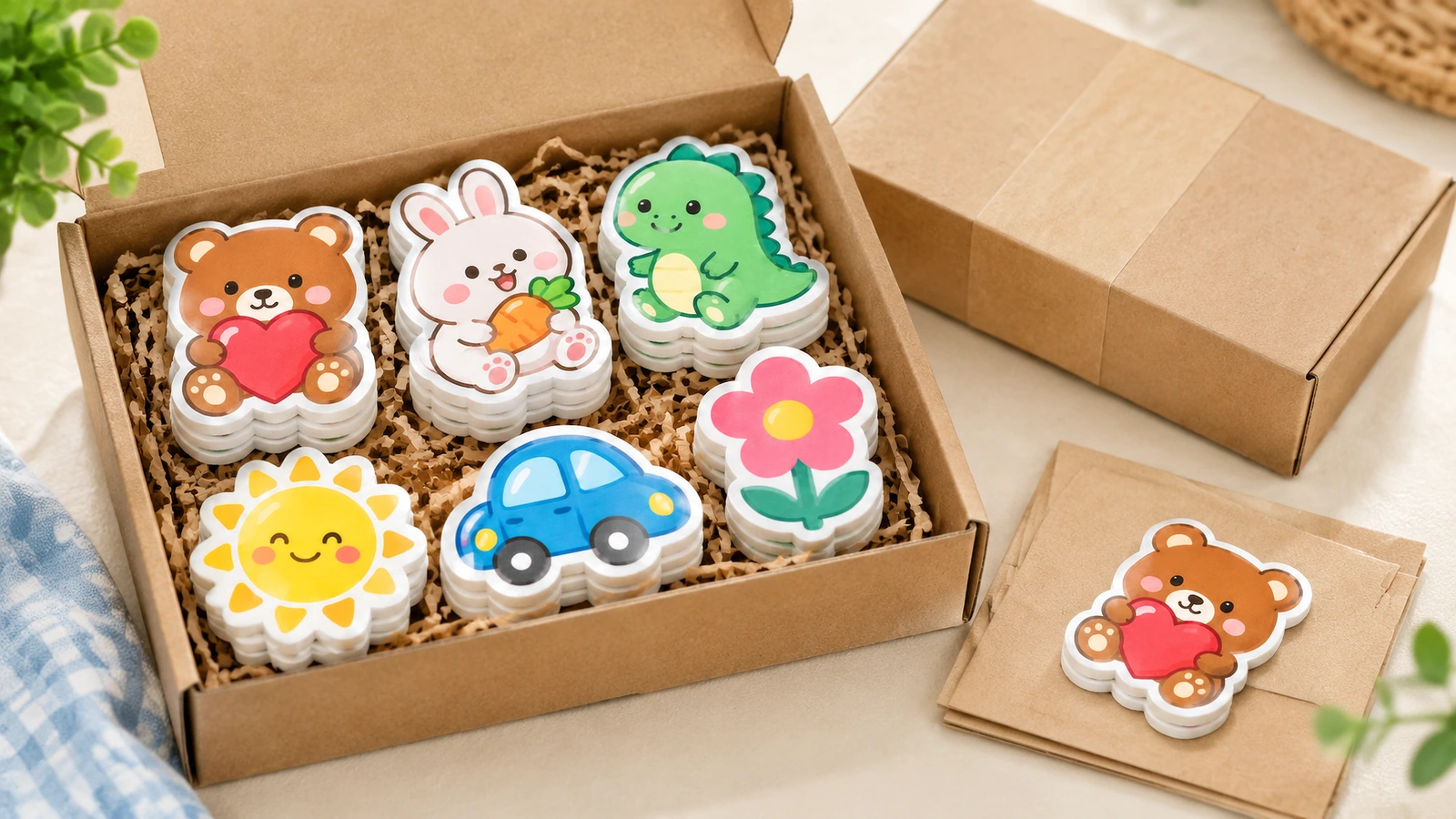
Custom EVA foam stickers are die-cut, self-adhesive stickers built on a closed-cell ethylene-vinyl acetate foam core. They add a raised, cushioned feel to logos, characters, and labels. They suit packaging accents, classroom kits, and event giveaways. Outdoor, oily, curved, or child-mouthing uses each need their own adhesive, coating, and test plan, confirmed on a physical sample before bulk production.
Who Buys Custom EVA Foam Stickers, and Where Do They End Up? ↑
Most buyers fall into four groups. Brand, packaging, and promotion teams order raised logo or character stickers for toy and stationery packaging, subscription boxes, and event giveaways. Their concerns are color accuracy, artwork approval, lead time, and whether children will handle the piece. Education and craft buyers want soft, bright shapes for reward charts and classroom kits. Small creators want short runs and fast proofs. US suppliers position the format the same way: one lists "toy and game packaging, children's books and craft kits, stationery and planner sheets, event and school giveaways" as core uses on its foam sticker product page[1].
A smaller lifestyle group puts thick foam badges on hard cases, coolers, and camera boxes. One gear brand sells a 6 mm, CNC-cut, high-density EVA sticker backed with 3M high-bond adhesive[2] for toolboxes and action camera cases. That product shares a name with a 1 mm classroom sticker, but it does not share a spec. A third group of electronics, automotive, and packaging engineers often reaches this term while looking for adhesive-backed die-cut gaskets and bumpers. Those parts are judged by compression, density, and adhesive data rather than artwork, so this page treats them only as a comparison point.
Why Do Foam Sticker Orders Pass the Sample and Fail in the Field? ↑
Problem. A foam sticker sample usually feels right in hand: soft, raised, and sticky on a clean desk. The trouble starts when the bulk order meets real surfaces. Edges lift on bottles, a reorder arrives in a slightly different shade, or a child cannot peel the sticker off its liner.
Agitation. Most of these causes are mechanical or chemical, not simply "bad glue." A self-adhesive foam guide names dust, oil, grease, moisture, and detergent residue as the most important reasons foam fails to stick. It also warns that sharp corners, excessive thickness, and tight curves let soft foam spring back until the edges gradually separate[3]. Sunlight is the second trap. A materials comparison rates EVA's UV and ozone resistance only "fair," because prolonged direct sun yellows and embrittles it. The same comparison rates its oil and solvent resistance "poor"[4]. Removal is the third trap. One boat owner described stripping blistered EVA from a paddle board as "a giant pain"[5] because the old adhesive would not come off. Even a premium marine EVA brand lists adhesion and workmanship as outside its warranty[6]. That shows where the risk sits when nobody specifies the adhesive.
Solution. Treat the order as a specification, not a style choice. Start by defining the surface, the environment, and the user. Then choose the thickness, adhesive, liner, and cut style. Finally, approve a physical sample against agreed checks. The sections below walk through that sequence and show where public benchmarks end and where your quote, sample, or test report has to take over.
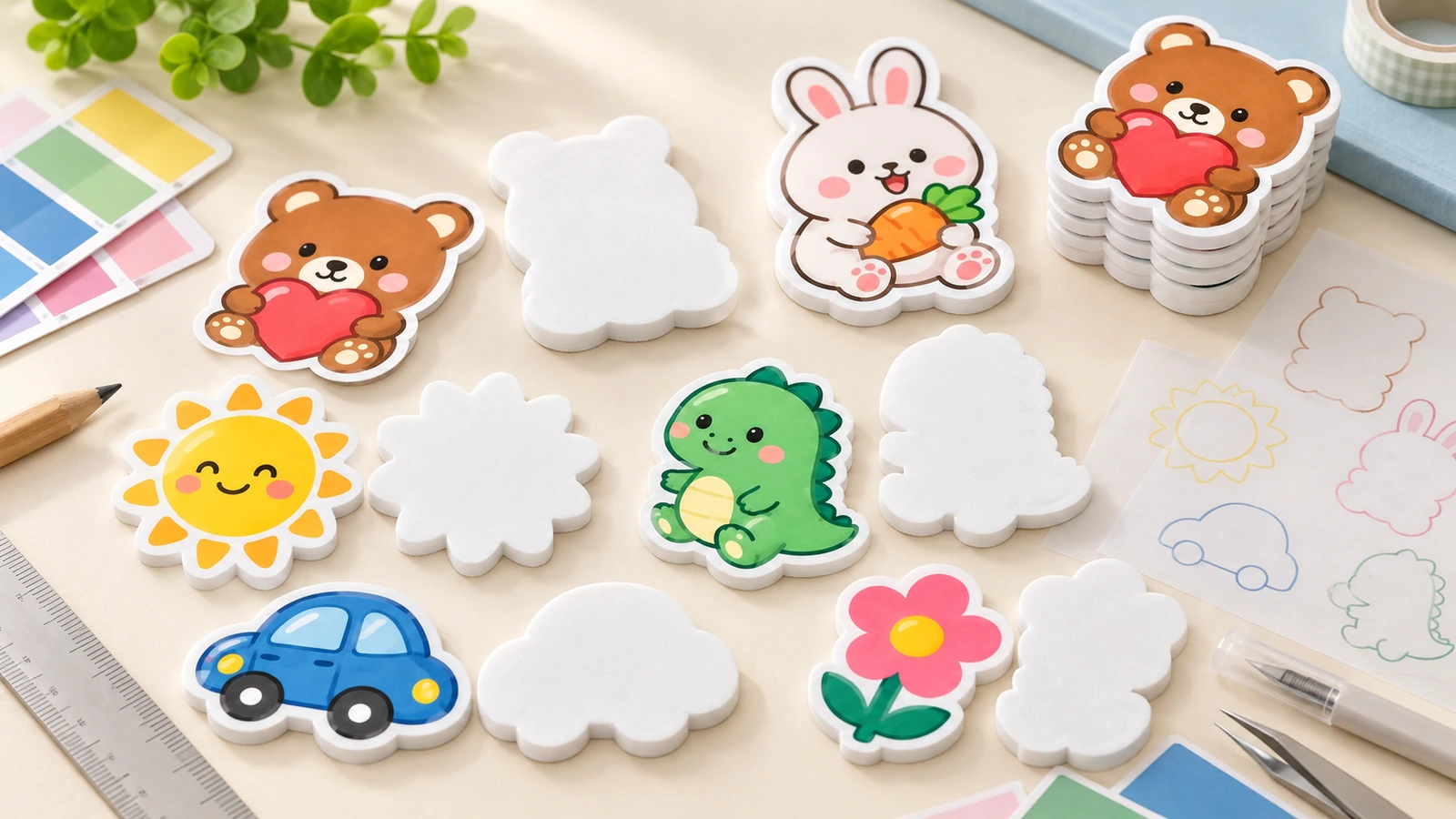
Table of Contents
What Is a Custom EVA Foam Sticker, and What Is It Not? ↑
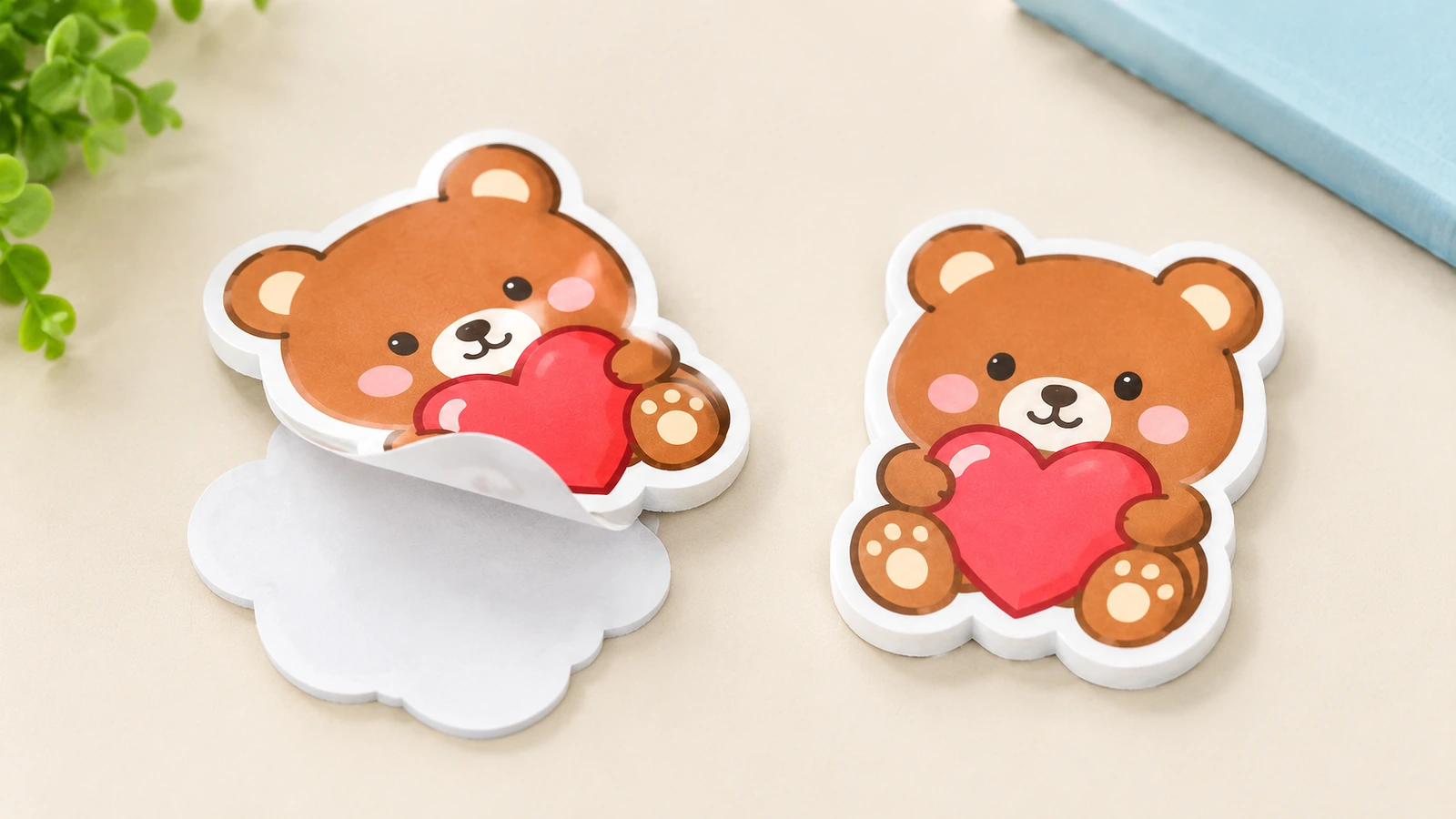
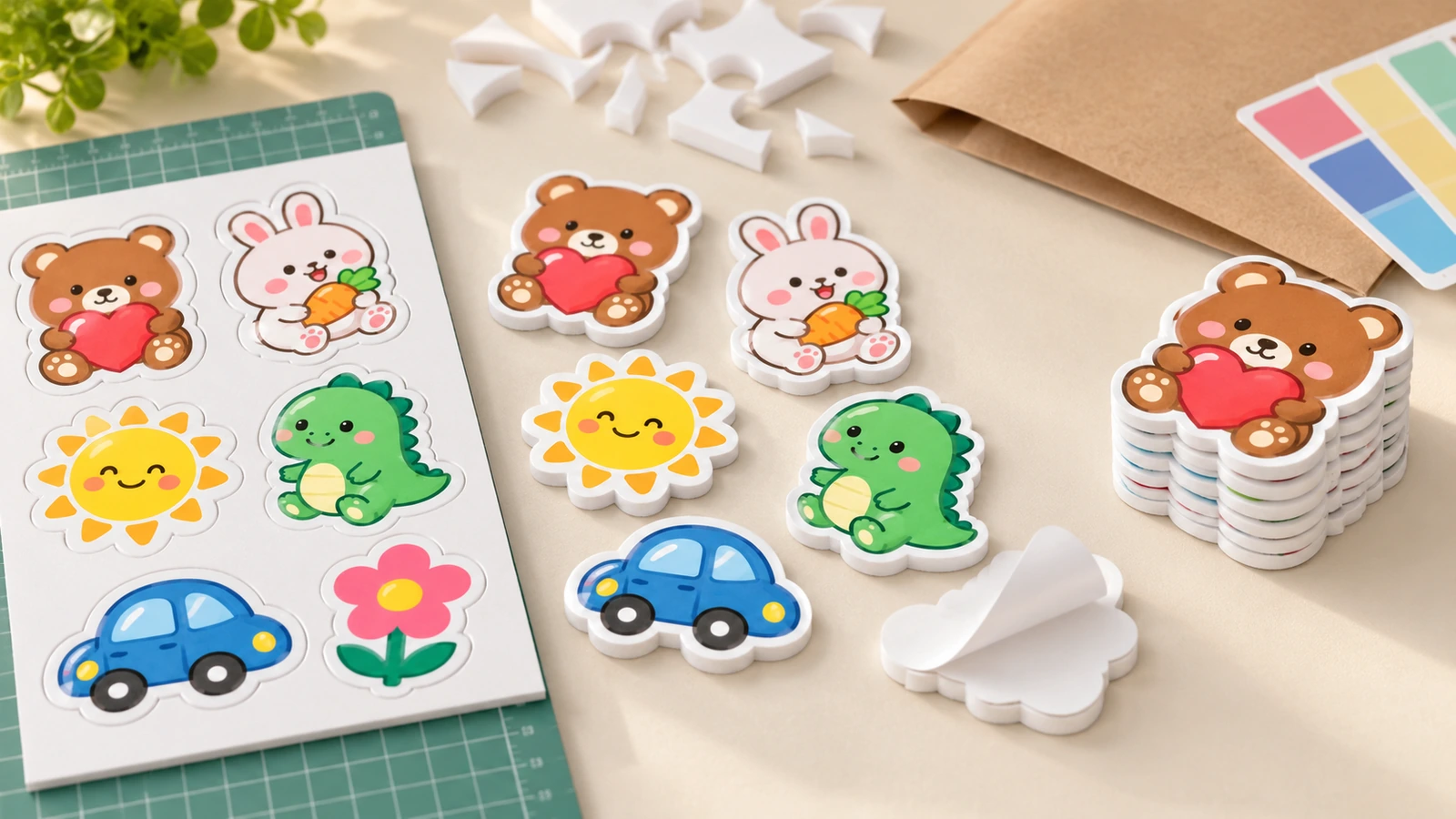
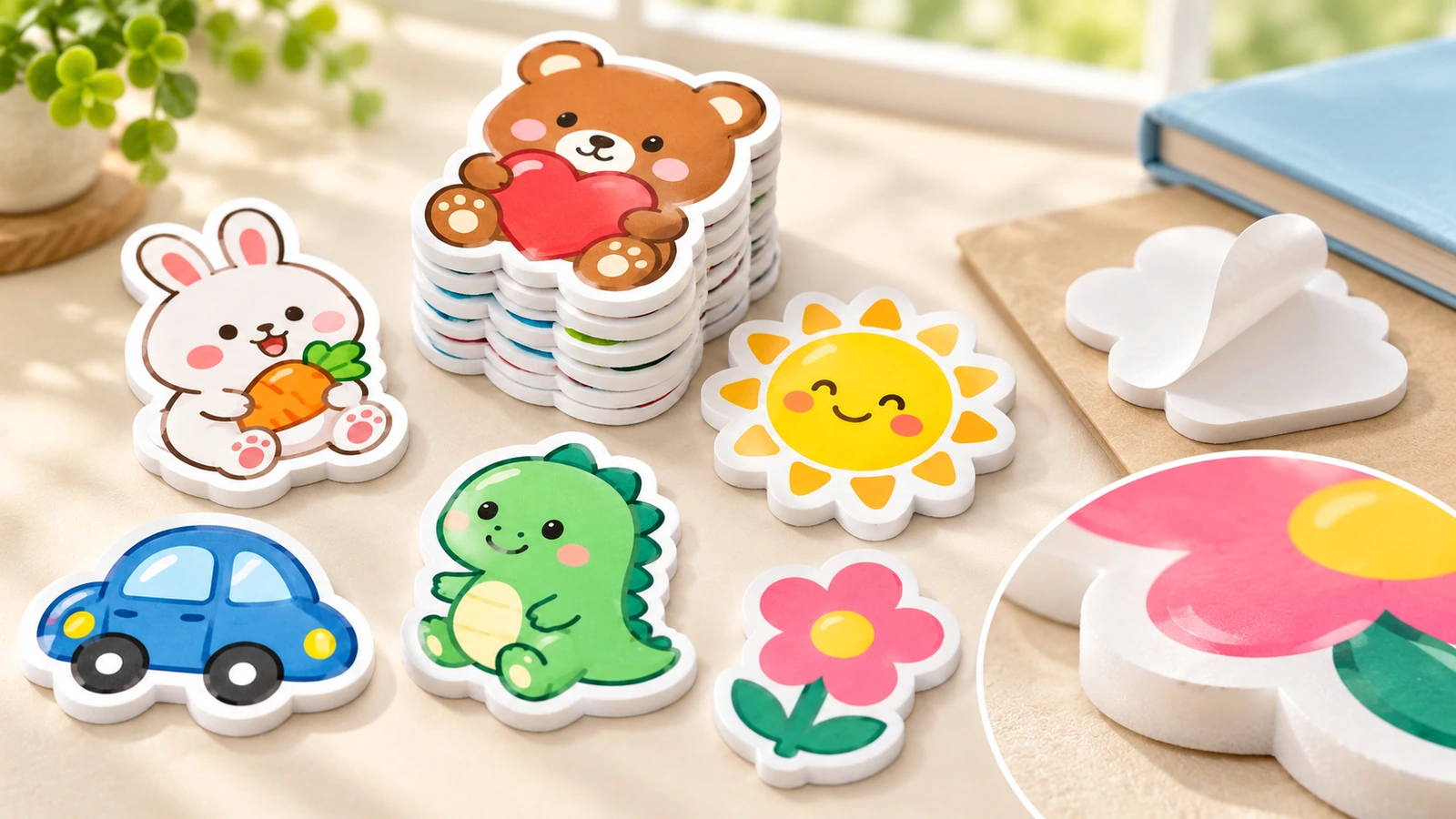
EVA is ethylene-vinyl acetate copolymer. In sticker form it comes in two constructions. The laminated "puffy" build is described by one supplier as raised, cushioned stickers made by laminating a printed top film over a soft EVA foam core[7] and then die-cutting the stack to shape. The plain craft build uses colored EVA foam with an adhesive layer and a release liner. A production guide notes that these can be kiss-cut on sheets or fully cut into singles[8], and that its craft adhesive is meant for decorative use. Long-term fixation or outdoor use needs separate testing.
The closed-cell structure matters. The materials comparison cited above describes it as fine, uniform, and non-absorbent, so splashes and rain do not soak into the foam body. That does not make the finished sticker outdoor-rated. The print, the film, and the adhesive each fail on their own schedule, and outdoor-life figures for vinyl decals should not be borrowed for foam stickers. A foam sticker is also not a gasket. Functional pads are bought on density, Shore hardness, and compression set, while decorative stickers are bought on look, feel, and peel behavior. Mixing the two in one RFQ is a common source of mismatched quotes.
Size and readability follow from how foam behaves. Supplier guidance says foam takes bold, simple shapes best. Fine serif text, hairline outlines, and tiny counters inside letters tend to tear or close up when the blade compresses the foam. Plan lettering heights and stroke widths around the cut rather than the screen preview, and check legibility at arm's length on a printed mock-up before approving.
How Do You Specify and Approve a Foam Sticker Order, Step by Step? ↑
Step 1: Define the surface, environment, and end user
Write down the exact substrate: coated carton, PP plastic, painted metal, or fabric. Note whether the sticker will sit indoors or outdoors, the temperatures it will see, and whether children will handle it. These answers drive every later choice. Flag curved targets such as water bottles or helmets now, because spring-back on tight curves is a documented lifting mode. Also note any cleaning routine, since detergent residue and wiping in the direction of an edge both work against adhesion.
Step 2: Choose thickness, density, and hardness on a stated scale
Graphic foam stickers are commonly offered with 1, 2, or 3 mm cores. Thicker foam looks richer, but it raises edge stress and makes cutting harder. If hardness matters, specify it with the scale named. A density guide gives common EVA ranges of 30–200 kg/m³ and Shore C 20–70, and stresses that Shore A and Shore C values are not interchangeable[9]. For lab verification, ASTM D3575[10] covers density, compression set, tensile, tear, and water absorption for flexible closed-cell olefin foams. No density or hardness value is published for this SKU. Those figures are set in your quote and checked on the sample.
Step 3: Match the adhesive and liner to the substrate
Keep the foam's temperature rating separate from the adhesive's. One 2# EVA data sheet lists a service range of −76°F to 194°F[11] for the foam alone, but the adhesive usually fails first. For low-surface-energy plastics or sustained heat, converters typically recommend acrylic transfer adhesives such as 3M 467MP or VHB[12] over ordinary hot-melt rubber adhesive. Bonding pressure and dwell time should then follow that adhesive's own data sheet. Treat permanent and removable adhesives as two separate SKUs, because "strong" and "easy to remove" rarely hold together on one product. For children's products, the liner is an acceptance item too: if it is hard to peel, usability drops.
Step 4: Preflight the artwork file
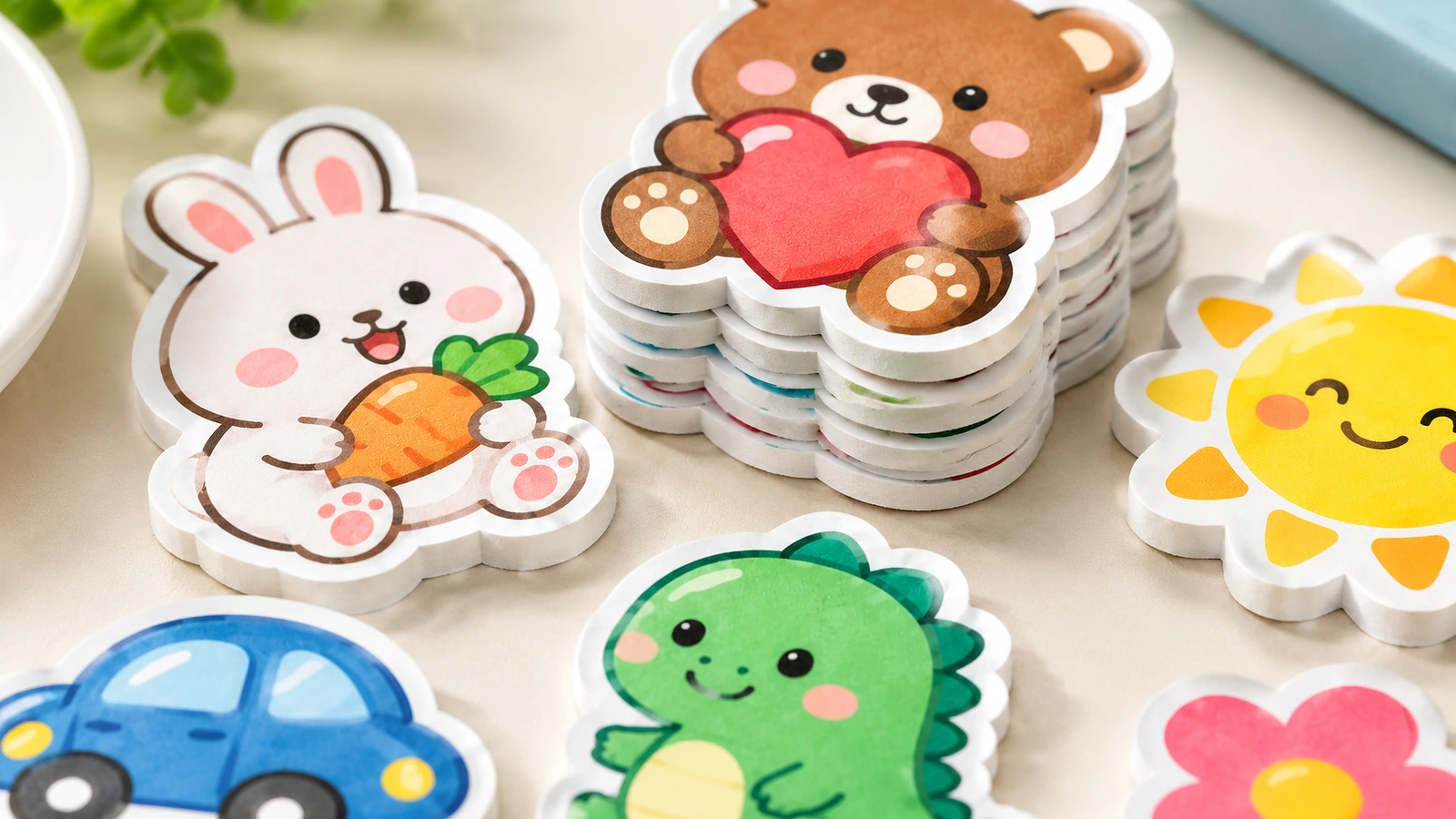
Send closed vector outlines (AI, EPS, PDF, SVG, or DXF) at 1:1 scale. Include Pantone or CMYK references, put the cut line on its own layer, and add a sheet layout if you need kiss-cut sheets. Simplify the design before you submit it. Narrow bridges, internal cutouts, sharp turns, fragmented features, and tight spacing raise scrap rates and destabilize converting[13]. Round internal corners, merge tiny islands, and keep a margin between the print and the cut so normal registration drift does not expose bare foam at the edge.
Step 5: Pick the cutting method and agree on tolerances
Digital or laser cutting suits short runs and complex outlines. Steel-rule dies suit repeated shapes in volume. Agree on realistic tolerances in writing. A custom-cut EVA guide gives roughly ±1.0–1.5 mm for die-cutting, depending on thickness, and ±0.5–1.0 mm for CNC. It adds that thick foam can show slight "hourglassing" on cut walls, and states that a supplier promising absolute zero tolerance on foam does not understand the material[14]. Laser edges may carry light heat marks or odor, and the same color name can vary between foam batches. Mark critical dimensions and the acceptable edge bevel on the drawing.

Step 6: Approve a physical sample against written checks
Measure the sample's outline, thickness, and print registration. Peel it from the liner by hand, apply it to your real substrate, and recheck the edges after a dwell period. When you run a peel test, look at how it fails, not only at the force. An adhesion guide distinguishes clean interfacial release, cohesive adhesive failure, and foam tearing, which only proves the bond outlasts the foam[15]. Ask for test reports that name their methods. One published adhesive EVA roll report lists density 123.5 kg/m³ (GB/T 6343-1995) and compression set 6.0% (GB/T 6669-2008)[16]. Use it as a format reference, not as data for this product. For outdoor or in-vehicle use, request heat and humidity aging before release instead of relying on a room-temperature press test.
| RFQ field | Public reference (not this SKU) | Status for this SKU |
|---|
| Core thickness | 1, 2, or 3 mm EVA core on a US puffy sticker page | Quoted per design; verified on sample |
| Density / hardness | 30–200 kg/m³; Shore C 20–70 (Damao) | Buyer-specified; pending sample test |
| Cut tolerance | Die-cut ±1.0–1.5 mm; CNC ±0.5–1.0 mm (Damao) | Agreed on drawing at proof stage |
| Adhesive | Permanent acrylic with removable option; 3M 467MP/VHB for demanding surfaces | Selected per substrate; peel-checked on sample |
| Size | 0.75–8 in per side; kiss-cut sheets to 8.5 × 11 in (PuffSticker) | Confirmed against artwork |
| MOQ / lead time | 250 pcs per design; 18–20 business days after proof (US benchmark) | Quoted per order; not published here |
| Water / UV | Closed cells resist water; UV rated "fair" (Damao) | Outdoor use requires separate testing |
The middle column shows public market and material references so you can sanity-check any quote. The right column shows what this listing commits to today. No MOQ, lead time, density, or performance value is published for this SKU. Each one is set in your quote and confirmed on the approved sample, so the figures you sign off on describe your stickers, not a catalog average.
Which Raised-Sticker Option Fits Your Budget, Volume, and Use? ↑
| Option | Public price / MOQ / lead time | Best fit | Watch-outs |
|---|
| Laminated EVA puffy, US small batch | $680 for 250 pcs (1×2 in, 1 mm, $2.72/pc); 18–20 business days (PuffSticker) | Brand merch, packaging seals, event kits | Foam water resistance rated "Medium"; fine lines unsuitable |
| Overseas OEM 3D EVA / puffy | Displayed about $0.02–$0.10/pc; MOQ about 500–5,000; 5–15 days plus freight (supplier listings[17]) | Promotional gifts, kids' crafts, wholesale | Tooling, freight, duty extra; certificates need batch reports |
| Industrial die-cut EVA pads | $0.04/pc at 1,000–9,999; $0.01 at ≥100,000; 3 mm; −10°C to 50°C (pad listing[18]) | Cushioning, anti-slip feet, spacers | Poor print quality; not a graphic product |
| Destructible EVA security label | 0.14±0.01 mm; MOQ 2,000; 7 days (catalog[19]) | Tamper-evident box seals | No raised feel; 5–40°C window |
| Epoxy dome label (non-EVA) | Quote only | Nameplates, bottles, outdoor badges | Hard, non-compressible; no soft touch |
Every figure in this table is a supplier's catalog or retail statement, not a lab comparison. Prices shift with size, thickness, color count, adhesive, and trade terms. Low-MOQ listings often mean a higher unit cost or a non-equivalent foam, so compare like with like. Choose laminated EVA for soft, full-color pieces in runs of a few hundred. Choose volume imports only when you can wait for sampling and freight. Use pads for cushioning and thin destructible film for tamper evidence. When gloss and water resistance matter more than softness, epoxy is the better fit: the same US supplier rates epoxy water resistance "Very high" against "Medium" for foam.
What documents should children's and regulated orders carry?
Ordinary brand stickers do not automatically fall under toy rules. Once a sticker is designed mainly for children, or sold into toy kits, test documents matter more than "non-toxic" wording.
| Rule | What it controls | What to request |
|---|
| Directive (EU) 2015/2115[20] | Formamide in foam toys for under-36-month or mouthed use: 200 mg/kg content cut-off; above it, 20 µg/m³ emission within 28 days | Content or emission report naming method and batch |
| EN 71-15:2025, harmonised by Decision (EU) 2026/2032[21], published 2026-09-14 | Test method for formamide content in foam toy materials | Report citing EN 71-15:2025 |
| Regulation (EU) 2025/2509[22] | Replaces Directive 2009/48/EC from 2030-08-01; adds Digital Product Passport per toy model | Documentation plan per toy model |
| REACH Annex XVII entry 77, Regulation (EU) 2023/1464[23] | Indoor formaldehyde emission of 0.080 mg/m³ for non-furniture articles, including foam goods, from 2026-08-06 | Emission data covering foam, ink, and adhesive |
| US CPSIA, 16 CFR part 1250 (CPSC toy safety[24]) | Products designed mainly for children 12 and under need third-party testing and a Children's Product Certificate | Report from a CPSC-accepted lab; CPC tied to model and batch |
Ask for the report number, method, sample description, and the batch each report covers. EN 71 or SGS claims in catalog listings remain supplier statements until a report for your color and batch arrives. Other regulated uses need their own proof. The 2# EVA sheet cited earlier passes FMVSS 302 only at a thickness of at least 0.250 in, which thin stickers rarely reach. An EVA resin cleared under 21 CFR 177.1350 does not clear an assembled sticker with ink, adhesive, and liner for food contact.
How should packing, warranty, and reorders be handled?
Keep the approved sample as the golden reference. For each run, record the foam color batch, adhesive type, and liner, because reorders drift when any one of them changes. Pack kiss-cut sheets or singles flat with interleaving so raised faces do not dent, since soft foam can keep visible compression marks. Label adhesive-laminated stock with its production date and storage conditions. Finally, write warranty terms that treat foam, print, adhesive, and installation separately, so edge lifting on an unapproved surface is not disputed after delivery.
What Are the Key Takeaways Before You Request a Quote? ↑
- Benchmark small-batch pricing before comparing quotes. — $680 for 250 pcs at 1×2 in, 1 mm; 18–20 business days after proof (Source)
- Foam is not a metal part, so agree on tolerances in writing. — die-cut ±1.0–1.5 mm; CNC ±0.5–1.0 mm (Source)
- Children's foam products face EU formamide limits. — 200 mg/kg cut-off; 20 µg/m³ emission within 28 days (Source)
- EU indoor formaldehyde limits now reach foam goods. — 0.080 mg/m³ from 6 August 2026 (Source)
- The EVA foam material market grows steadily but does not measure sticker demand. — US$2,346.3 million in 2025; 5.3% CAGR to 2033 (Source)
- Personalized stickers are a growing segment, per a secondary summary. — US$4.84 billion in 2025, projected US$8.45 billion by 2035 (Source)
Ready to Turn Your Artwork Into a Tested Foam Sticker Spec? ↑
A good foam sticker order starts from the surface, the environment, and the person who will peel it, and only then moves to the artwork. Thickness, adhesive, liner, and cut tolerance are confirmed in your quote and proven on a physical sample. Children's, outdoor, automotive, and food-adjacent uses each add their own report. Nothing on this page replaces that sample. It tells you what to ask for and how to judge the answer. Send your vector artwork, target surface, intended use, and quantity tiers to request a quote and a physical sample.




The information below is required for social login
Sign In
Create New Account