Custom felt stickers are die-cut shapes of wool, polyester, or blended felt with a pressure-sensitive adhesive back. Use them where a soft, matte, tactile finish matters more than outdoor durability. Specify the felt type, thickness, adhesive, and target surface. Then approve a physical sample and test tack, dwell bond, and residue before bulk production.
Who Buys Custom Felt Stickers, and Where Do They Work Best? ↑
Three buyer groups account for most real demand. Packaging teams for wine, spirits, candles, and specialty foods use felt labels because the textured surface creates a tactile experience that "communicates quality and craftsmanship," according to Blue Label Packaging[1]. Apparel brands, schools, clubs, and outdoor labels want a matte heritage look instead of shiny synthetics. American Patch Shop[2] lists boutique apparel brands, private schools, outdoor lifestyle brands, and artists who want "a softer alternative to traditional plastic-backed patches." The third group is creators and event teams. They use small felt shapes as merch inserts, convention giveaways, and journaling extras, where a soft, fuzzy feel is the point.
One group should not buy this product: households protecting floors under chairs that move every day. The Wearify[3] explains that on kitchen chairs, desk chairs, or stools, "the constant shear force peels the felt off." Nail-in or screw-in glides suit that job better. This page covers decorative and branding felt stickers (SKU NSKU-632-01), not furniture pads.
Why Do Felt Sticker Orders Disappoint, and How Can You Prevent It? ↑
Most failures start with the wrong expectation: buyers assume felt behaves like laminated vinyl. Felt is a mat of fibers. The adhesive has to grip loose fibers on one side and an often unknown surface on the other. Fiber density, thickness, and adhesive chemistry therefore decide whether the sticker survives, not just the printed artwork.
Public reviews show what happens when buyers ignore this. A Feefo reviewer[4] reported that on anything other than a flat surface, "the sticky adhesive used comes away from the felt," leaving tape behind while the felt curled away. A buyer of pre-cut adhesive felt circles[5] described fuzzy edges "as though the blades were dull," black felt that bled color through iron-ons, and weak tack. Satisfied buyers of custom fuzzy stickers[6] still report trade-offs. One said the artwork "lost some of the contrast." Another said the edges "feel very sticky around custom shapes." For a brand, each of these means a reprint, a refund, or a stalled packaging line.
The fix is procedural, not cosmetic. Freeze the material and adhesive specs in writing, and design the artwork for fiber texture. Approve a physical sample from the same material batch as the bulk order. Then accept bulk goods against failure-mode tests rather than "looks right." The sections below walk through that workflow step by step.
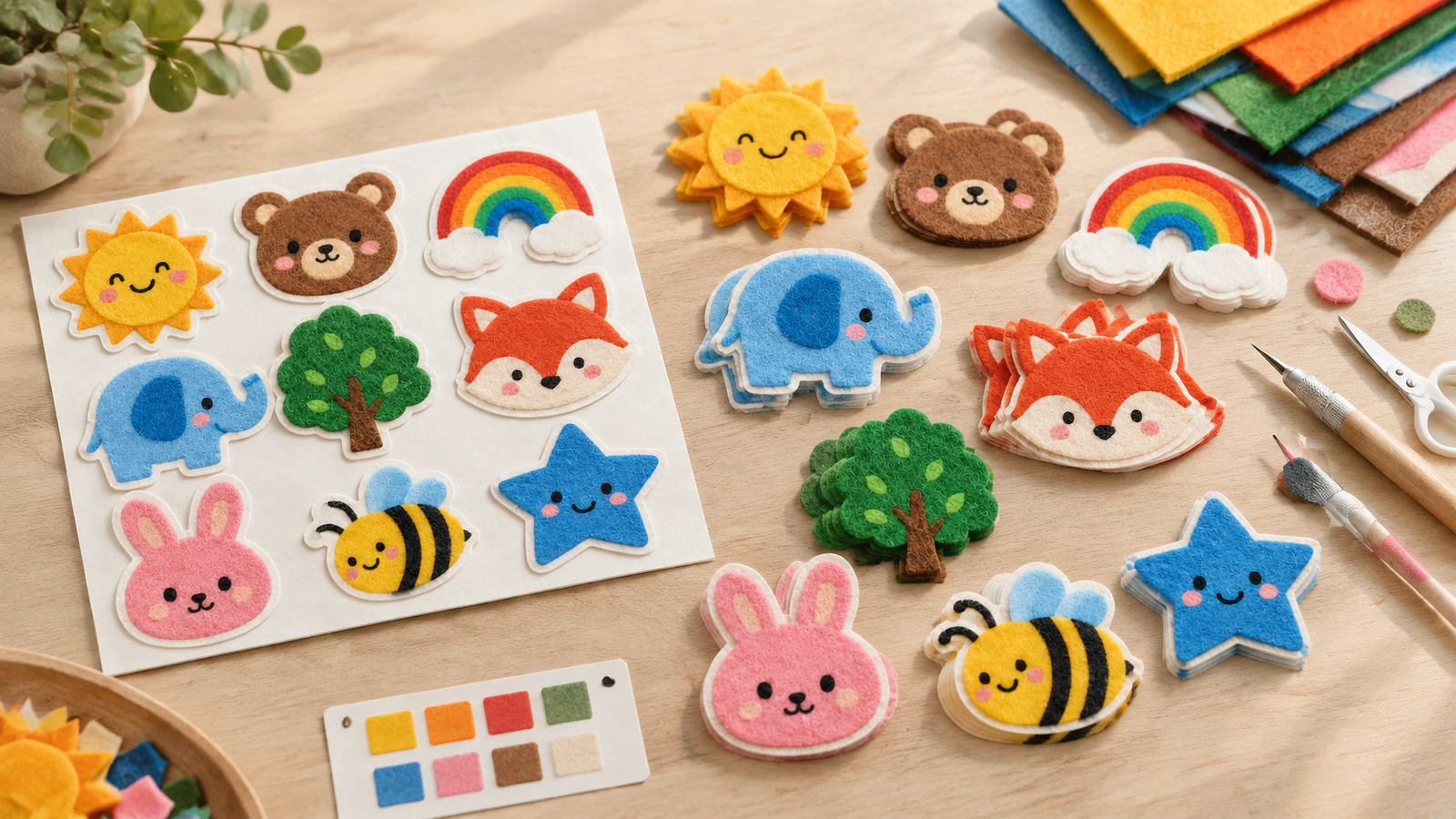
Table of Contents
What Is a Custom Die-Cut Self-Adhesive Felt Sticker? ↑
A self-adhesive felt sticker has three layers:
- a felt face, made of needle-punched polyester, wool, or a blend;
- a pressure-sensitive adhesive (PSA);
- a silicone release liner.
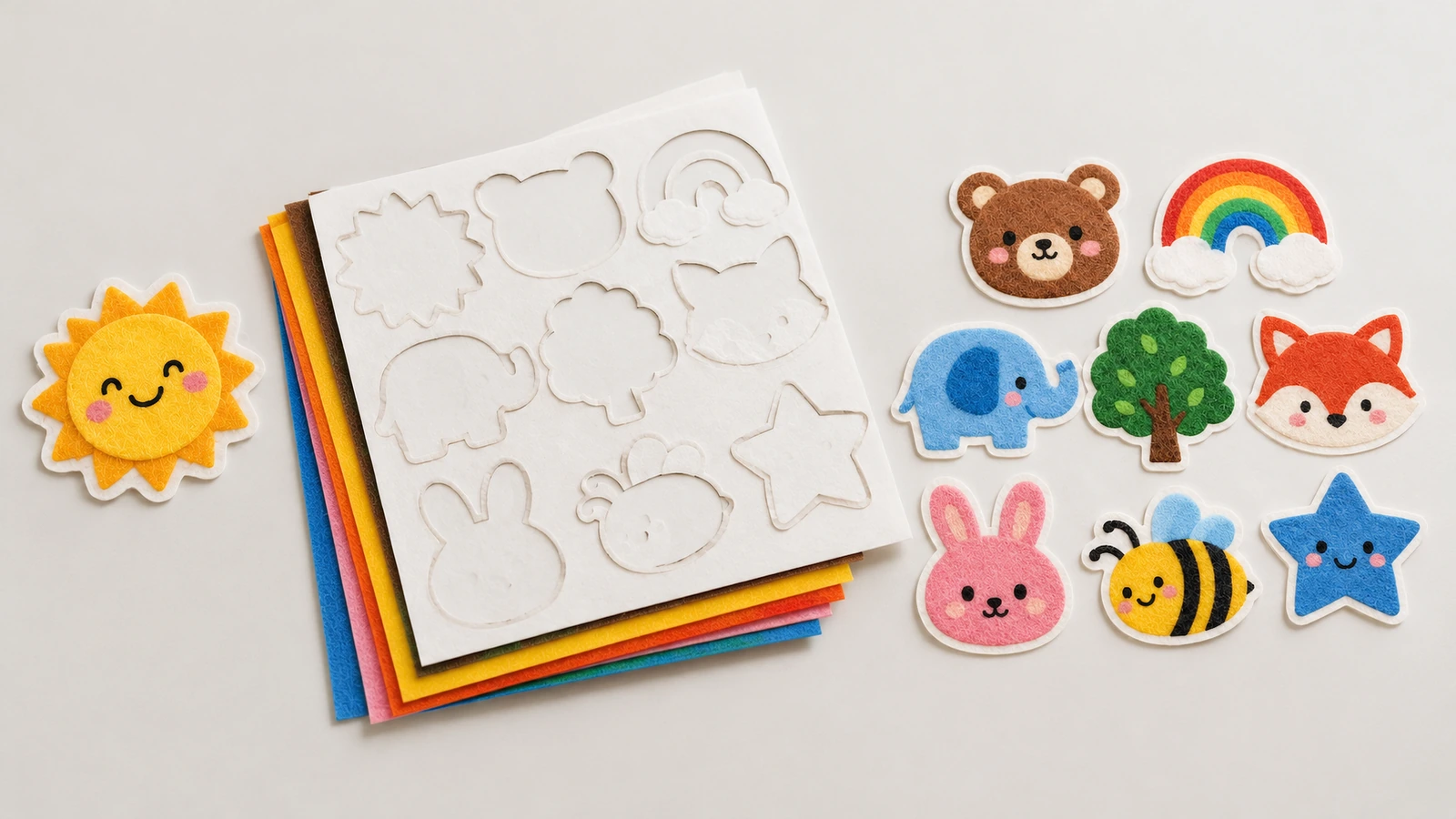
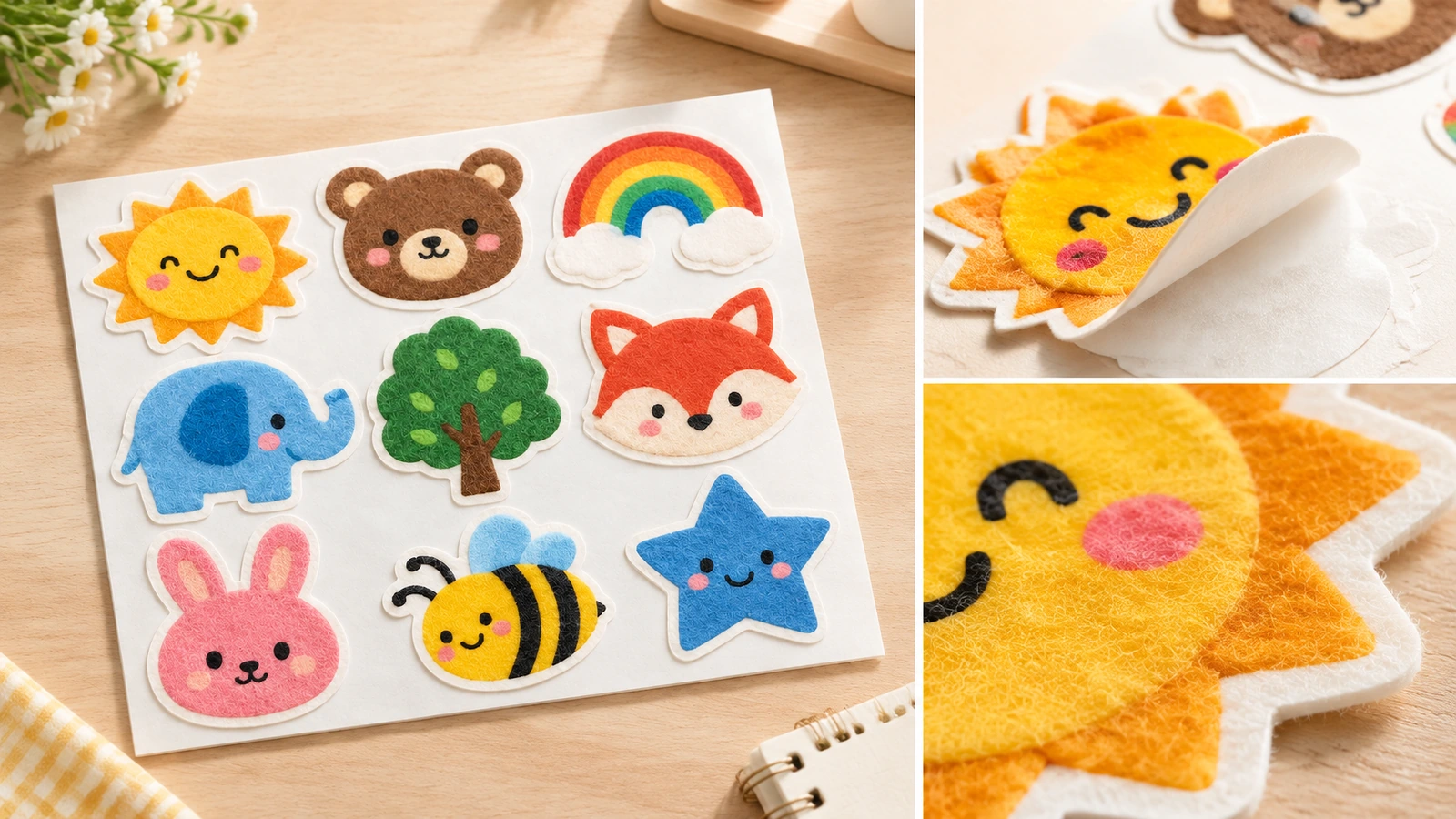
"Die-cut" means the shape is cut through the felt and adhesive to its final outline. "Kiss-cut" leaves several shapes on a shared liner sheet. Laser cutting is an alternative for intricate outlines, but it can leave a melted edge on synthetic fibers. Public supplier catalogs show the typical range. One felt sticker supplier[7] lists 180–400 g/m² weight and 1–5 mm thickness, with heat-press cutting, laser cutting, and screen printing. These are one vendor's catalog claims, not measured values for NSKU-632-01.
Two adjacent products are often confused with felt stickers. Flocked or "fuzzy" stickers carry short fibers on a film base, which gives a velvety sheen rather than true felt thickness. Felt patches are embroidered and meant to be sewn on or ironed on. On bonding, an Avery Dennison bonding study[8] states that "felt bonding is affected by the felt's thickness and integrity." The same study evaluates bonds with a 180° peel test at 12 in/min. Density also controls print quality: The Felt Store[9] notes that higher-density felt gives clearer screen prints.
| Spec field | What to define in your RFQ | Status for NSKU-632-01 |
|---|
| Fiber content | Wool %, polyester %, recycled content claim | Pending sample |
| Weight and thickness | g/m², mm, and agreed tolerance | Pending quote |
| Adhesive | Permanent or removable PSA; named target surface | Pending testing |
| Cut method | Die-cut, kiss-cut, or laser; smallest inside corner | Pending sample |
| Decoration | Print method, color count, Pantone references | Pending sample |
| Size and shape | Outer dimensions in mm and tolerance | Set by approved artwork |
| MOQ, unit price, lead time | Per design, per quantity break | Pending quote |
| Compliance documents | Lab reports that match the actual end use | Pending testing |
The "pending" entries are deliberate. No factory test data has been published for this SKU, so each value is confirmed through quotation, sampling, and testing. Catalog ranges from other vendors are not a substitute. Use this table as the skeleton of your purchase order so every value is signed off before cutting tools are made.
How Do You Order Felt Stickers That Stay Stuck and Readable? ↑
Step 1: Set size, thickness, and readable detail
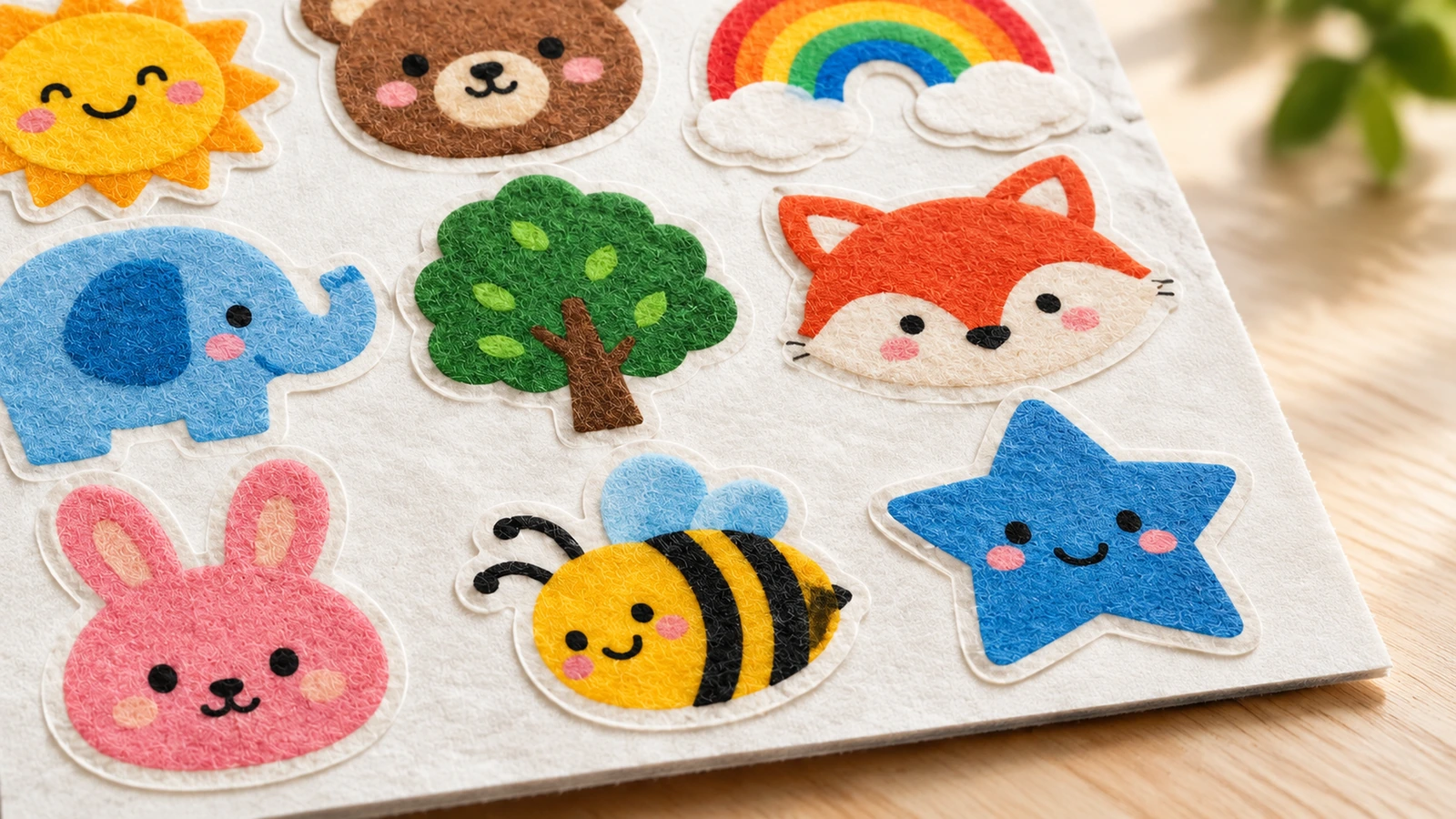
Felt fibers swallow hairline strokes and small type. The StickerYou reviews above show that contrast drops even on short-pile flocking. Design with bold shapes, generous counters in letters, and high-contrast color pairs. Ask for the proof to include your smallest text and thinnest line, so legibility is judged on real material rather than on screen. Thickness is a trade-off. Thicker felt gives depth and shadow, but it softens fine outlines and changes how the adhesive bonds, as the Avery study notes. Confirm the minimum line width and text height on the physical sample.
Step 2: Match adhesive and backing to the surface
Blue Label puts the moisture limit plainly: felt labels are "moisture-resistant, not waterproof." Condensation and occasional splashes are acceptable, but long immersion or ice buckets call for film labels. The same source says the right adhesive holds in refrigerated storage. Estrella Felt's FAQ makes the same point about water: "This isn't diving gear."
Surface choice matters as much as moisture:
- Good bases: smooth paper, coated board, glass, and rigid plastic.
- Weaker bases: rough, porous, or tightly curved surfaces, which is exactly the failure the Feefo reviewer described.
- Adhesive type: choose permanent or removable PSA per SKU, and never mix the two in one listing.
- Clothing: a patch backing guide[10] rates adhesive backing as temporary and warns that "it will come off in the wash." Garments need sew-on or iron-on patches instead.
Step 3: Preflight the artwork files
Supply vector artwork with the cut line on its own layer. Convert all text to outlines. Give Pantone references for every printed color, and name the felt base color separately. Flag any dark felt that will sit under light ink or next to light substrates, so bleed risk is tested on the sample. Keep critical details away from the cut edge, because fiber fuzz at the edge can blur nearby elements. A short written spec sheet (dimensions, quantity per design, adhesive type, target surface) should travel with the files. That way the quote, the proof, and the production run all reference the same data.
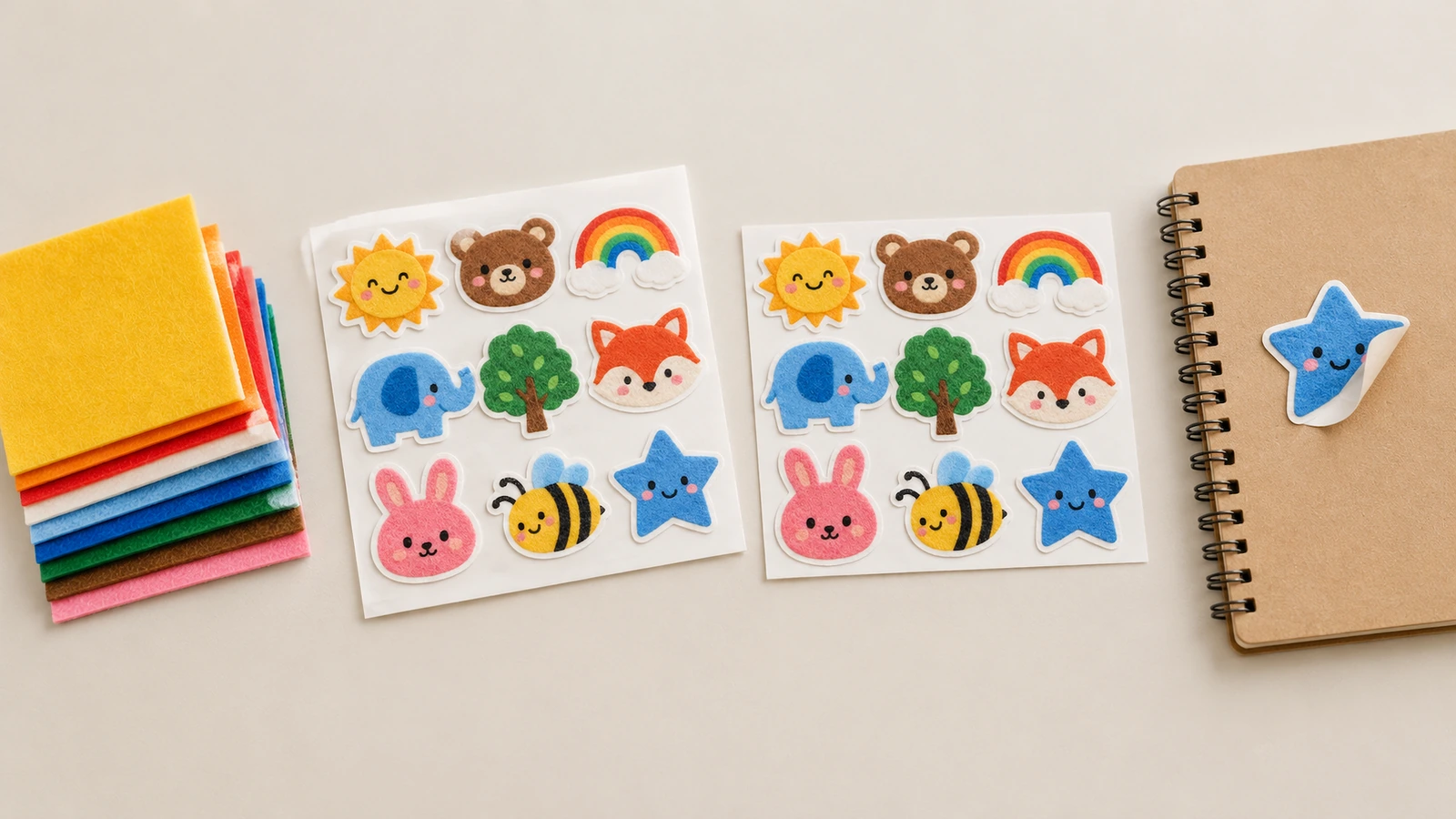
Step 4: Approve a sample, then run production
Follow a fixed sequence:
- Request a quote.
- Receive a sample made from the same felt and adhesive batch intended for bulk.
- Test the sample on your real packaging or product.
- Sign off in writing.
- Have the cutting tool made, and run decoration, adhesive lamination, cutting, inspection, and packing.
Never let a cutting tool or bulk material purchase happen before sign-off. Changing felt thickness after approval changes both the bond and the cut quality. Sample lead time, production time, and MOQ for NSKU-632-01 are confirmed in the quotation. They are not fixed in advance.
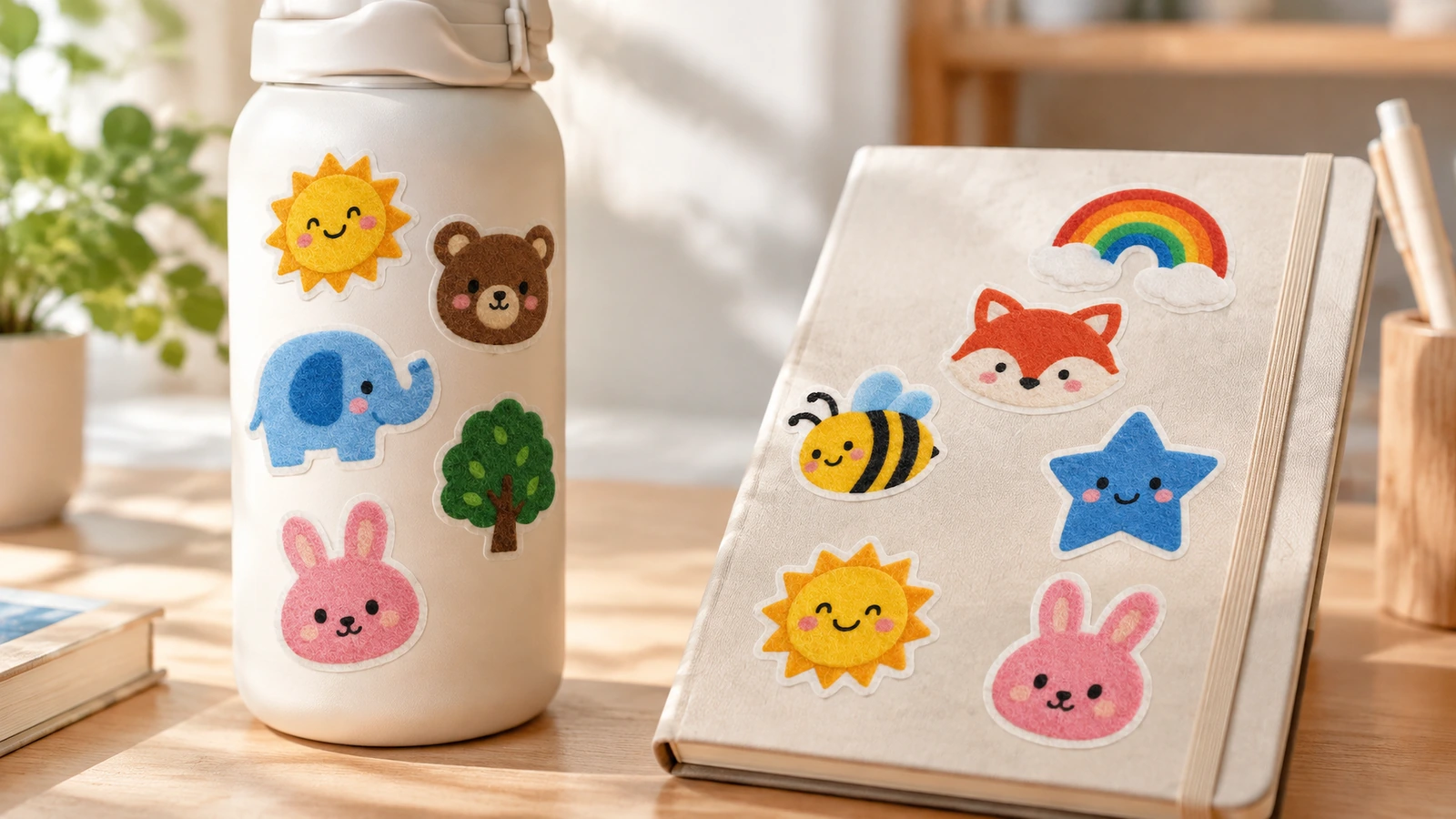
Step 5: Inspect against real failure modes
| Check | Method | Reject if |
|---|
| Initial tack | Press firmly for 30 seconds on the target surface | Edges lift immediately |
| Dwell bond | Leave undisturbed several hours, ideally overnight, then push and peel | Felt separates from the adhesive layer |
| Removal | Peel after dwell (removable spec only) | Heavy residue remains |
| Cut edge | Magnified visual check | Fuzzing, burnt edges, or cuts into artwork |
| Color transfer | Rub dark felt against a light substrate | Visible bleed |
| Dimensions and liner | Caliper measurement; liner alignment check | Out of agreed tolerance or fibers on the adhesive |
The press and dwell methods come from adhesive-felt application guides. Lazada's guide[11] advises pressing "hard for at least thirty seconds." Engineer Fix[12] recommends letting adhesive cure several hours, "ideally overnight." Both sources address furniture pads, so treat them as starting points rather than specifications for stickers. For cold-chain or warm-display products, run 72-hour and temperature-cycling tests on the actual container. For lab-grade data, a 180° peel test like the one in the Avery study gives comparable numbers. Write tolerances into the purchase order so a "reject" is a contract fact, not an opinion.
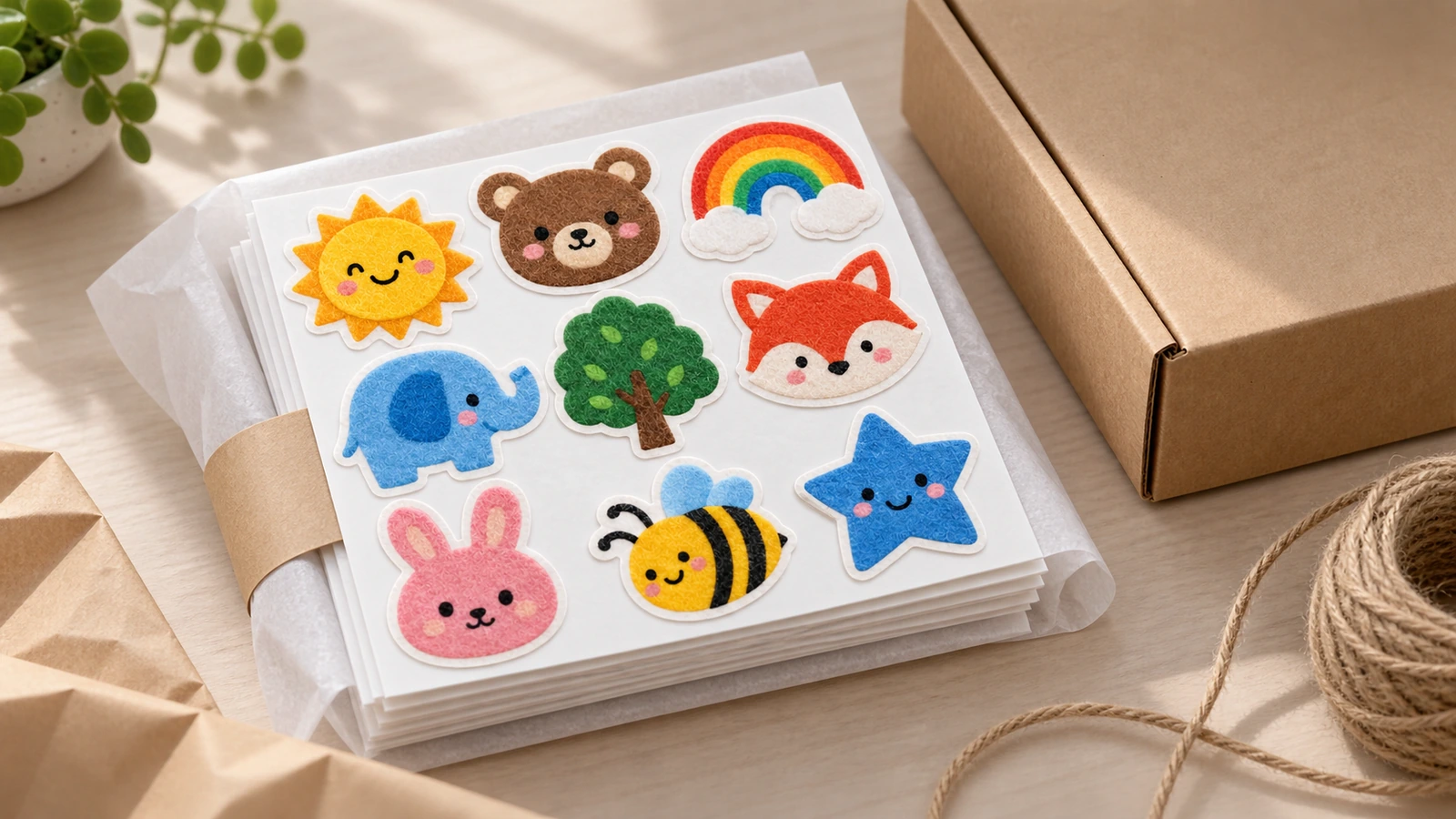
Step 6: Pack, ship, apply, and reorder
Felt deforms under pressure. One adhesive felt sheet listing[13] drew complaints that panels "arrived crammed in plastic wrap causing the edges to bend." Specify flat packing with rigid board and no folding. Label cartons with simple application instructions: clean, dry, oil-free surface; do not touch the adhesive face; press firmly; allow dwell time before handling. For reorders, keep one approved sample as the reference standard and record the lot. Then compare the new batch against that sample for color, thickness, and tack before release.
Felt Stickers, Flocked Labels, Felt Patches, or Vinyl: Which Fits? ↑
| Option | Look and feel | Durability boundary | Best fit |
|---|
| Die-cut self-adhesive felt sticker | Soft, matte, visible thickness | Indoor; moisture-resistant only; no soaking or machine washing | Premium packaging, merch, giveaways, journaling |
| Flocked / fuzzy label | Velvety sheen on a film base | Fine contrast drops; still sticker-level adhesion | Apparel trims, shoe and bag packaging |
| Embroidered felt patch | Raised stitching on felt | Sewn is most durable; adhesive backing is temporary | Hats, jackets, uniforms |
| Laminated vinyl die-cut | Flat gloss or matte print | Built for outdoor and wet use | Bottles, vehicles, outdoor promotion |
Choose felt when touch is part of the brand message. Choose vinyl when the sticker faces rain, dishwashers, or sunlight. Public catalog figures show the cost and volume logic, but they are not quotes for NSKU-632-01:
- One printed felt sticker listing[14] shows US$0.096–0.38 per piece at a 5,000-piece MOQ, with samples within 7 days and orders in 15–20 days.
- A flocked felt label listing[15] steps from US$0.19 at 1,000–4,999 pieces down to US$0.05 above 50,000.
- PB-Patch[16] offers felt patch samples from 1 piece, with bulk runs typically 50–100 pieces per design.
- Teal Packaging[17] claims vinyl withstands outdoor exposure for 3–5 years. That is a supplier statement, not a lab standard, and does not apply to felt.
Which Compliance and Material Checks Protect Your Brand? ↑
Children's products (US). If your felt stickers are designed or intended primarily for children 12 and under, US rules apply. The CPSIA[18] requires testing by a CPSC-accepted lab, with limited exceptions, and a written Children's Product Certificate. CPSC tracking label guidance[19] adds that distinguishing marks must be permanently affixed to the product and its packaging, to the extent practicable. A loose shipping sticker does not meet that requirement.
California Proposition 65. The adhesive layer is a chemical exposure point. An OEHHA information letter[20] dated December 2025 says product stickers that accompany a consumer purchase can create bisphenol S (BPS) exposure requiring a Proposition 65 warning. Intertek[21] flags pressure-sensitive adhesives and UV or flexo inks as possible BPS sources and suggests BPS-free acrylic PSAs.
EU PFAS limits. If any water-repellent or stain-resistant finish is fluorinated, check it before export. Beveridge & Diamond[22] reports that from October 10, 2026, EU textiles for apparel and related accessories may not contain 25 ppb or more of PFHxA and its salts.
Colorfastness and flame claims. ISO 105-B02[23] is a xenon-arc test method for colorfastness to light, not a pass grade. Ratings such as "≥ Grade 4" are supplier claims until a batch-specific lab report exists. On flame behavior, The Felt Store notes that 100% wool is naturally self-extinguishing, while synthetic and blended felts need treatment. Confirm flame performance separately for public spaces or vehicle interiors.
What Are the Key Takeaways for Buyers? ↑
- Retail search demand for felt stickers is niche. — about 475 weekly Amazon US searches for "felt stickers," July 26–August 1, 2026 (Source)
- The parent personalized-sticker market is growing steadily. — US$4.84 billion in 2025, forecast US$7.99 billion by 2034, 5.73% CAGR (Source)
- Felt resists moisture but is not waterproof. — condensation is acceptable; long immersion is not (Source)
- Children's felt products need lab testing and permanent tracking labels. — CPSIA, 15 U.S.C. § 2063(a)(5) (Source)
- EU apparel textiles face a new PFHxA limit. — 25 ppb from October 10, 2026 (Source)
- Procurement values for NSKU-632-01 are confirmed per order. — MOQ, production time, and unit weight are pending quotation and sampling
Ready to Specify Your Felt Sticker Order? ↑
Felt stickers earn their place when touch carries the brand: a bottle neck, a candle lid, a merch bag, a convention giveaway. They fail when buyers treat them as waterproof, wash-proof, or furniture-grade. A successful order follows six steps: define fiber, thickness, adhesive, and surface in writing; design artwork for fiber texture; approve a same-batch sample; inspect for tack, dwell bond, edge quality, and bleed; pack flat; and keep a reference sample for reorders. Confirm compliance before selling to children, into California, or into the EU. Send your artwork, target surface, and quantity to request a quote and a pre-production sample of your custom felt stickers.




The information below is required for social login
Sign In
Create New Account