Custom embossed PU leather brand tags are polyurethane faux-leather labels pressed with a raised or recessed logo. They are sewn, riveted, or hung on knits, denim, bags, and gifts. Order them by fixing size, thickness, emboss direction, attachment, and wash target in writing. Then approve a production-grade sample before bulk.
Who Orders Custom Embossed PU Leather Tags, and Where Do They Go? ↑
Three kinds of buyers sit behind this search. The largest group is makers: knitters, crocheters, Etsy sellers, and craft-fair vendors who want a shop name on a beanie, scarf, or sweater hem. Printing Studio's tag page[1] names these buyers directly. They care about small runs, a soft hand, and easy removal. One r/knitting member[2] put it this way: "Make sure they are easily removable - leather has very different care needs."
The second group is micro apparel, denim, and bag brands. They place leather-look tags on the back waist of jeans, on jacket shoulders, hats, and handbags. OEM trims suppliers often quote from around 100 pieces; Acctrims[3] lists an MOQ of 100 pcs. These buyers weigh unit cost, wash durability, and whether a synthetic can still read as premium.
A smaller third group buys gift tags and luggage IDs. Luggage tags call for thick, full-grain hide, which is a different product from a thin sewn PU label. PU suits the first two groups best because you can specify it for laundering. Most genuine-leather labels cannot be machine washed.
Why Do Cheap Leather-Look Tags Fail Before the Garment Does? ↑
A brand tag is the one component every customer touches and reads. If it peels, cracks, scratches, or becomes illegible, the complaint lands on your brand, not on the trim supplier. Customers also see the failure on the product itself.
These failure modes are well documented. Chief Labels[4] explains how low-grade PU fails: dryer heat drives out the plasticizer, and "the polyurethane becomes incredibly brittle." The face can also peel off its backing and leave "a fuzzy, ugly white rectangle" stitched to the garment. Comfort fails too. An Athleta shopper[5] said a thicker tag "feels uncomfortable against my skin," and cutting it out ruined the leggings. Legibility is another trap. A verified Amazon buyer[6] found text "not legible on any of the medium to dark brown shades." Dye problems cost real money. Leeline Bags[7] describes a client who lost about $20,000. The bags passed visual inspection, then bled black dye onto customers' clothing.
Words like "premium" do not prevent any of these failures. A written specification does: material, thickness, emboss direction, attachment, and a wash target. The second safeguard is a production-grade sample tested against that specification before bulk, which is the workflow below. This page has no factory test data yet. Every performance value for this tag is therefore listed as to be quoted, sampled, or tested, not promised.
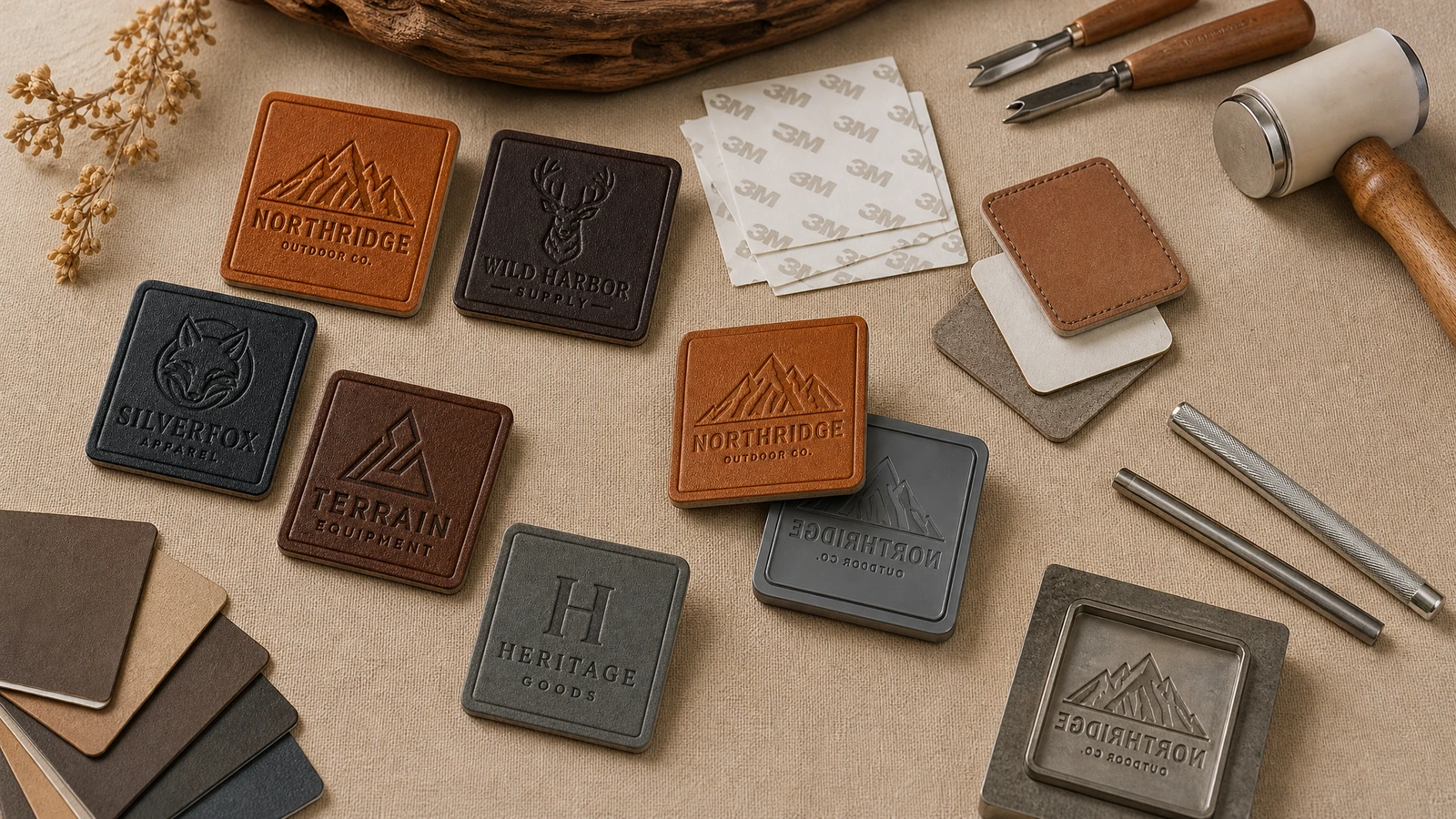
Table of Contents
What Exactly Is a Custom Embossed PU Leather Brand Tag? ↑
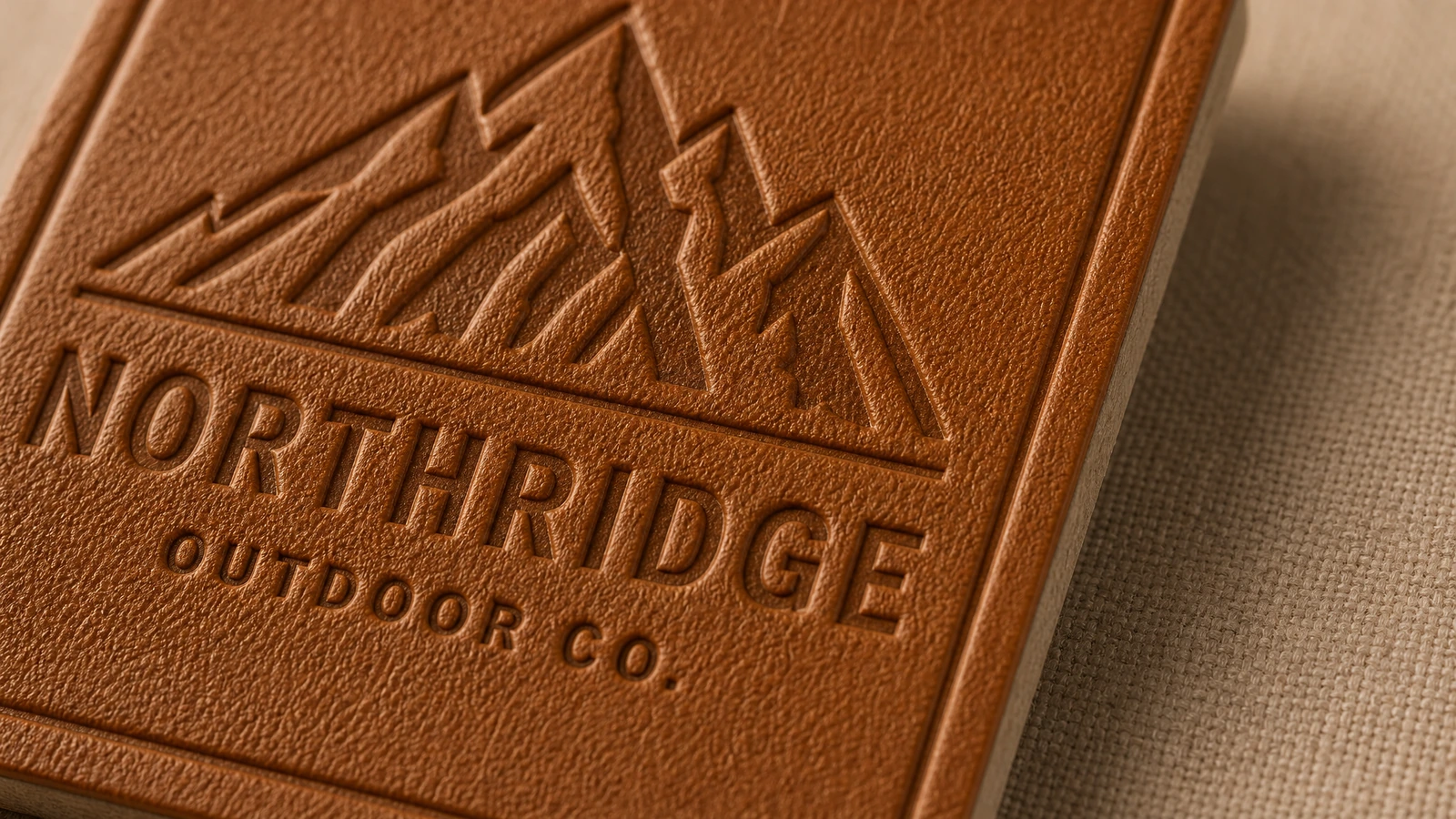
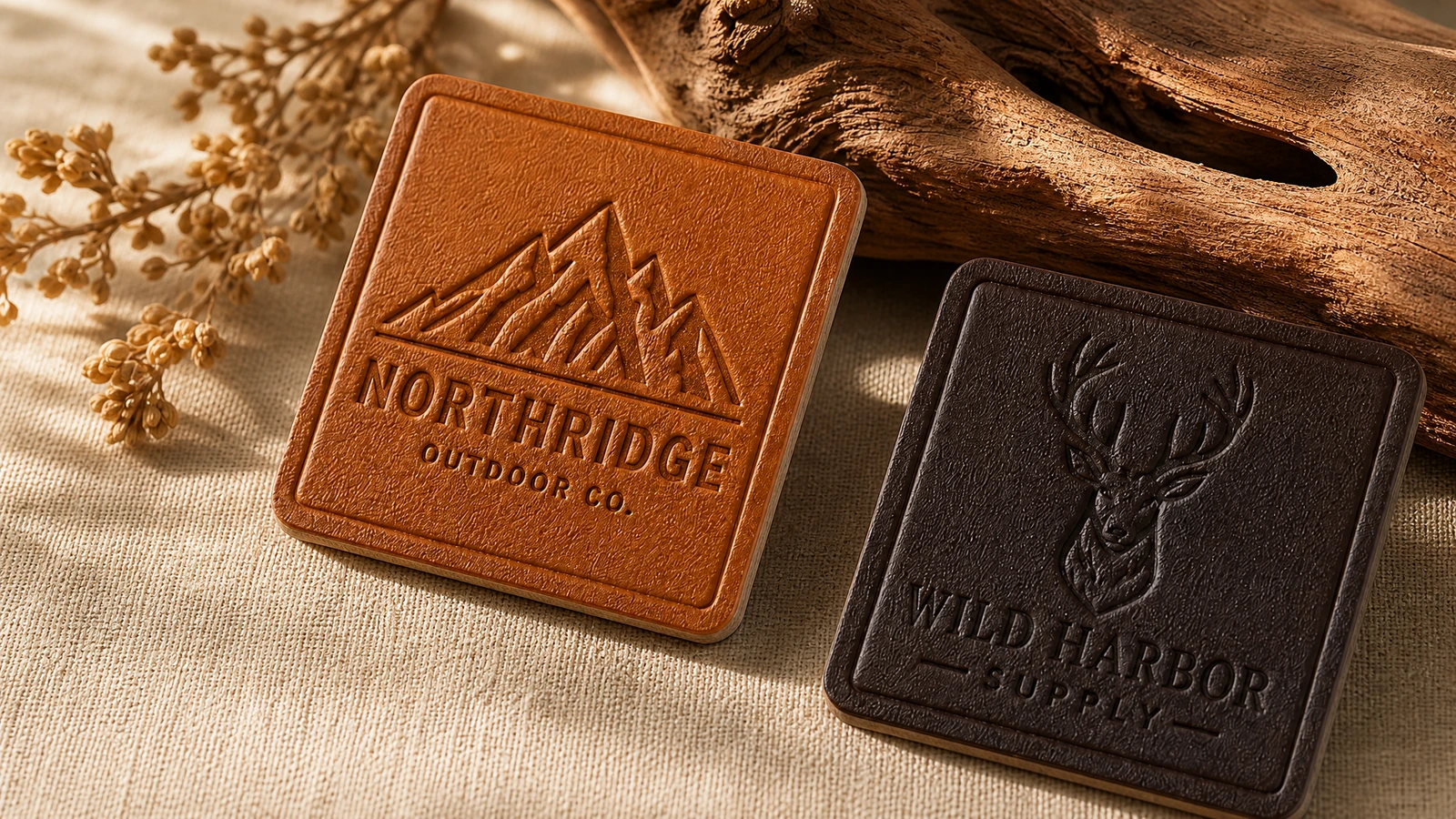
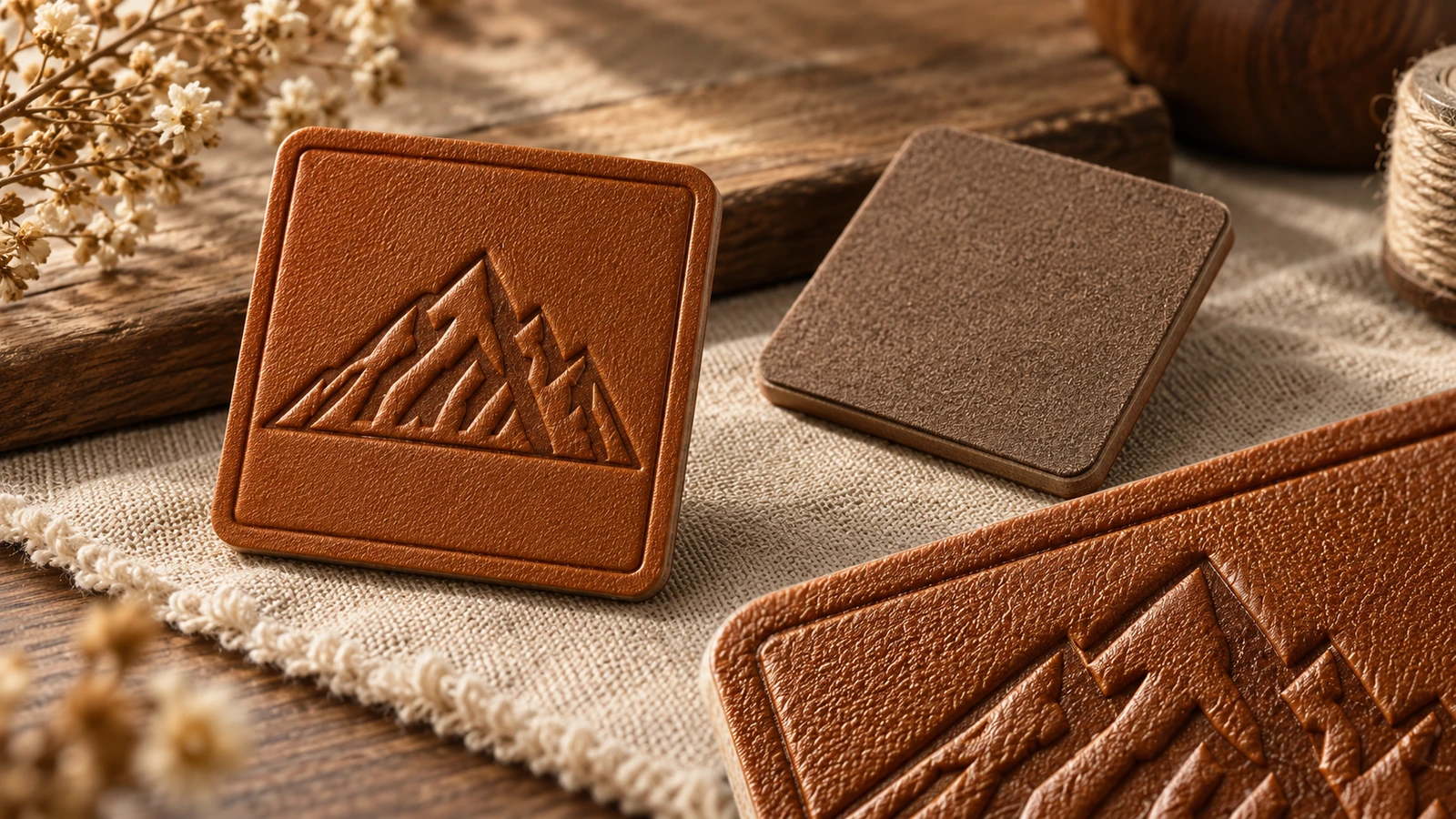
It is a polyurethane-faced synthetic sheet, cut to shape and marked with a heated die under pressure. It is finished with sew holes, a rivet point, adhesive, or a hang hole. The word "embossed" is used loosely in this trade. Hoplok[8] warns that "buyers sometimes use 'embossing' for a recessed logo." Strictly, embossing produces a raised mark and debossing presses the mark in. Write "raised" or "recessed" on your spec so the sample matches what you pictured.
The name matters for compliance too. The FTC Leather Guides, 16 CFR Part 24[9], treat the unqualified word "leather" on a non-leather product as deceptive. They also require disclosure when an imitation looks like hide. The Guides list luggage, small leather goods, footwear, and stand-alone belts, not sewn garment tags. Even so, they are the FTC's clearest statement on leather wording. Describe this tag as polyurethane or faux leather on listings and invoices, and never as "genuine."
| Material | Construction | Supplier-stated wash guidance | Main watch-out |
|---|
| Genuine leather | Tanned cowhide or goat hide | Not washable | Color and thickness vary by hide; dark dyes can transfer |
| PU faux leather (this tag) | Polyurethane face on a backing | Machine washable up to 30°C / 86°F | Low-grade PU can embrittle or delaminate in dryers |
| Washable paper | Cellulose and latex, leather look | Up to 60°C / 140°F | Lacks the hand of leather |
| Bonded leather | Leather scraps plus binder | Not stated in sources | Peeling; may not qualify as "genuine" |
The wash limits in this table come from Wunderlabel's product specs[10]. They state PU at up to 30°C / 86°F, washable paper at up to 60°C / 140°F, and genuine leather as not washable. They describe one supplier's materials, not a lab standard. Use them as a benchmark in your RFQ. Until an approved sample passes your wash test, this tag's own rating stays "to be tested." Bonded leather is typically about 10–20% leather scraps bound with polyurethane, according to Decrum[11], which explains why it flakes. Chief Labels reports that its qualified blanks resist cracking for about 50 home launderings under AATCC-type methods. That figure is a reasonable question to put to any supplier. It is not a guarantee for this tag.
How Do You Specify, Sample, and Approve Custom Leather Tags? ↑
The six steps below follow the sequence most suppliers describe publicly. Each step produces a written record you can enforce later. Skipping a step usually shows up as a review complaint rather than a factory defect.
Step 1: Fix size, thickness, and legibility
Start from where the tag will sit. For clothing labels, Curtidos Cabezas[12] recommends 0.8–1.2 mm. Thicker stock starts to feel like a patch and can scratch skin. Typical sew-in footprints at one online supplier are 60×15, 60×20, and 60×30 mm[13]. Text limits are real. KMM & Co.[14] caps its standard tag at about 27 characters and its mini at about 16. If you want a scannable code, one maker on X[15] says QR codes need at least 0.8 × 0.8 in. That is a single report, so verify it on your sample. On PU, an embossed mark's legibility depends on relief depth and color contrast. Proof your fonts at actual size, on the actual color.
Step 2: Choose marking, surface, and backing
| Marking | How it forms | Best fit | What to check on the sample |
|---|
| Blind deboss | Die presses a recessed mark, no color | Tactile single-color logo | Even depth; show-through on the back |
| Raised emboss | Tooling forms a raised design | Bold, short marks | Relief holds; high points scuff |
| Foil | Heat transfers metallic or color foil | Visible brand color | Coverage, edges, adhesion |
| Laser | Changes or removes surface material | Variable text, fine detail | Contrast, residue |
| UV print | Ink forms a surface graphic | Full color, gradients | Registration, adhesion after flexing |
The sample checks above follow Hoplok's comparison. Cost depends on the process. Senior Printer[16] notes that pressed marks need a plate, and every artwork change needs a new one. UV print avoids that cost on small full-color runs. Some small shops charge for tooling outright: LetterandLeather[17] lists a $50 die fee and a 30-piece minimum for custom designs. Foil wears fastest under abrasion. Users on PurseForum[18] report heat stamps peeling after one to three months. For tags that rub, debossing or embossing is safer.
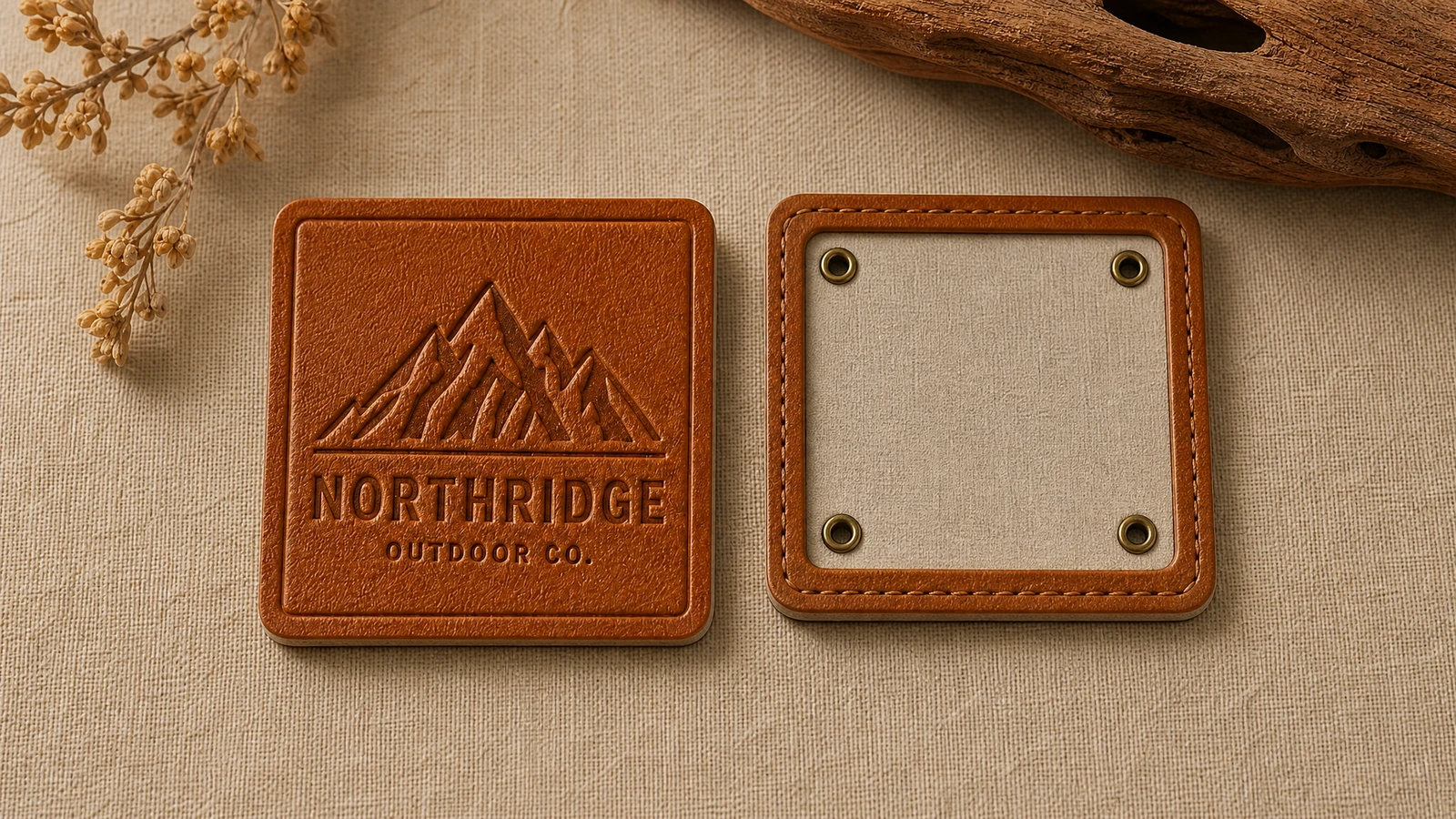
Backing choices bring trade-offs of their own. Sew holes suit knits. Rivets suit denim, but one crafter on Reddit[19] avoids them on hats for fear of catching hair. Adhesive backings tend to loosen in machine washing. On color, Acctrims[20] advises against placing dark dyed labels on light or white fabric.
Step 3: Preflight the artwork file
Send vector artwork (AI, EPS, PDF, or CDR), which is the format list Acctrims requests. Raster files below 300 DPI will lose edge detail on small tags. Convert fonts to outlines and close every path. Mark which areas are raised and which are recessed using a color key, and draw hole positions to scale. State whether text should be centered on the whole tag or on the space left beside an icon. A miscentered layout is one of the most common fulfillment complaints. Have a second person check spelling: once the die is cut, a typo means new tooling.
Step 4: Sample, then sign the production reference
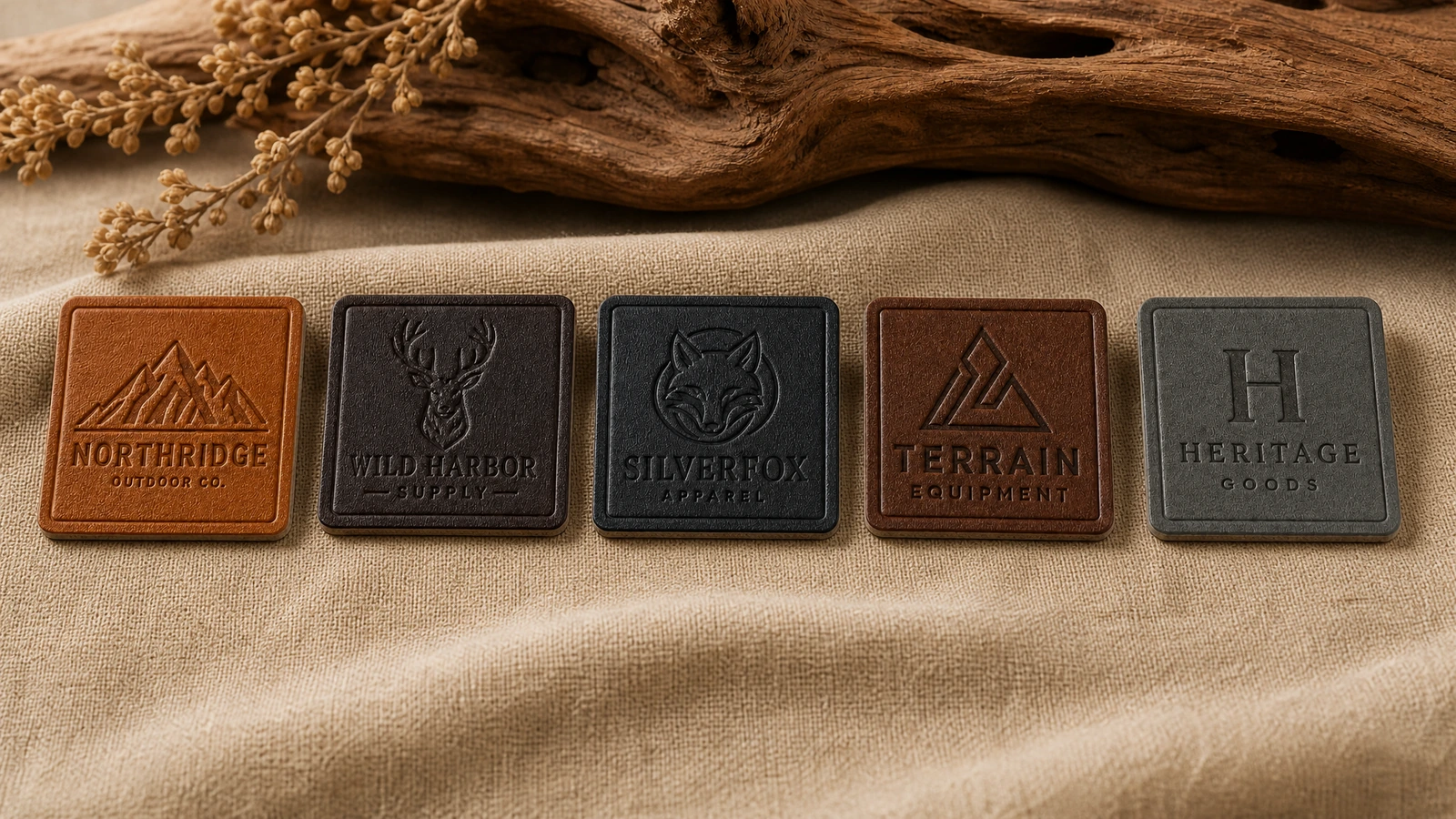
Ask for a sample made from the bulk material with the bulk tooling, not a digital mockup. Leather Crafts International[21] says its sample is "not a quick mockup." Once approved, the sample "becomes the production reference." The same supplier quotes 7–14 days for sampling. Production itself is usually described as cutting, shaping, and logo processing, followed by checks on color difference, embossing depth, washing, and wear, as Kunshuo[22] outlines. Use the sheet below as your RFQ.
| Spec field | What to write | Status for this tag |
|---|
| Material | PU faux leather, backing type, color reference | Confirm on sample |
| Size and thickness | L × W in mm; nominal thickness with tolerance | To be quoted |
| Marking | Raised emboss or recessed deboss; foil color if any | To be sampled |
| Attachment | Sew holes, rivet, adhesive; hole size and position | To be sampled |
| Wash target | Max °C, cycle count, dryer yes or no | To be tested |
| Rub and color transfer | Dry and wet rub on white cloth; lab method if required | To be tested |
| MOQ, lead time, price | By quantity break, with Incoterm | Pending quote |
Every row is open on purpose. No factory capability, MOQ, lead time, or test result has been verified for this SKU. Values enter the sheet only after a written quote or a passed sample. Once filled in, the sheet and the signed sample together define what "acceptable" means at delivery.
Step 5: Inspect against the signed sample
Run inspection against the signed reference, not against photos. A practical program covers the following checks:
- Dimensions, thickness, and hole position against the spec sheet.
- Emboss depth and legibility compared side by side with the signed sample.
- Rubbing behavior. ISO 11640:2018[23] rubs the surface with wool felt and grades the result with grey scales.
- Finish adhesion and flex cracking, using methods such as IUF 470 and ASTM D6182, which the Leather Research Laboratory[24] lists.
- One home wash at your stated temperature, checking for delamination and dye migration.
These standards define test methods, not universal pass marks, so agree on pass grades in the contract. For hang-tag versions, Szoneier[25] lists the typical failures as torn straps, cracked corners, and peeling edges. It recommends bend, pull, abrasion, and humidity tests before mass production.
Step 6: Pack, ship, and lock in the reorder
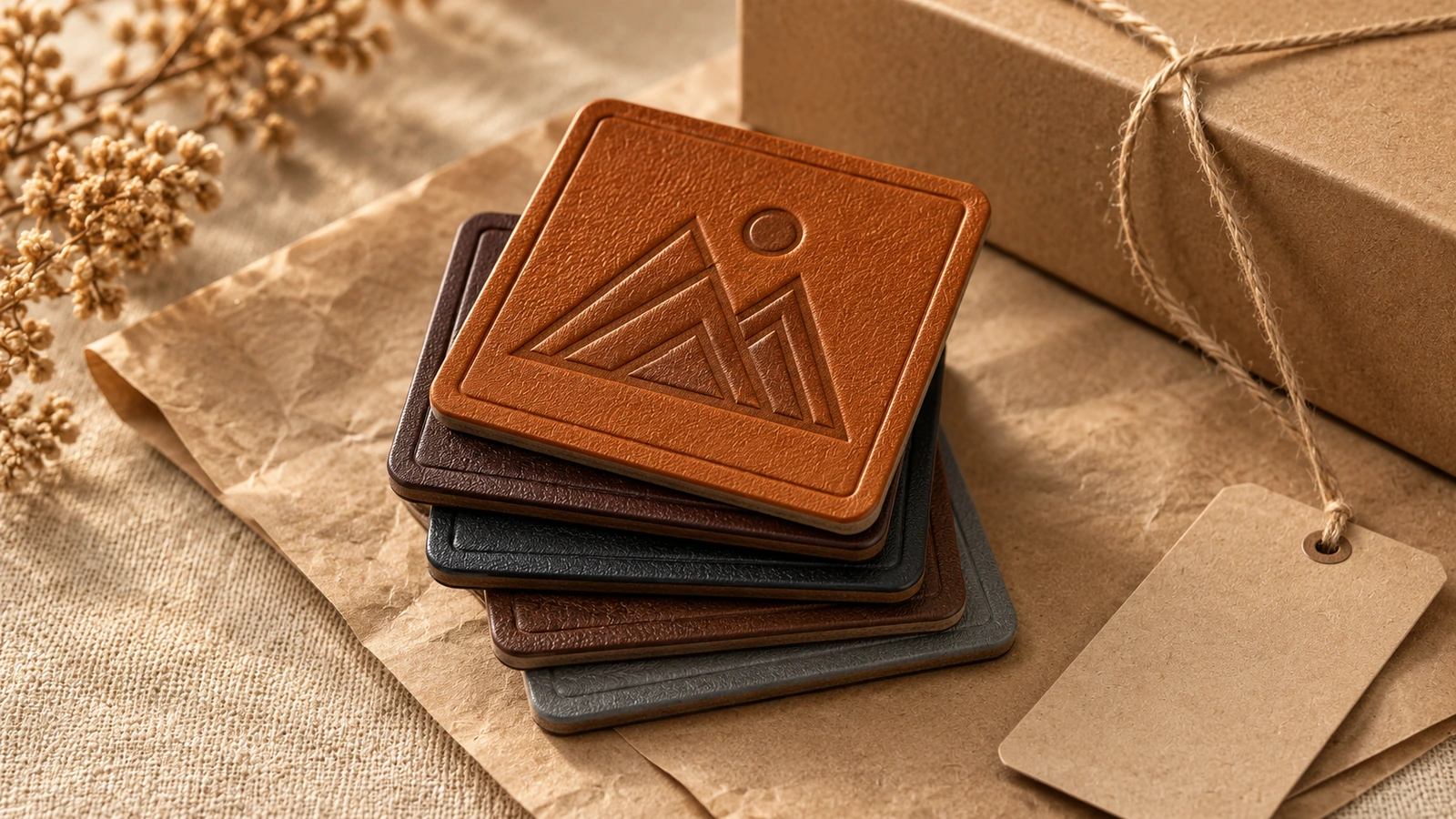
Count tags and hardware separately on the day they arrive. One Trustpilot reviewer[26] received 44 fewer studs than ordered, days before an event. Another buyer's repeat order[27] arrived with a different background color and no border. Keep a retained sample and batch photos, and write "match signed sample" on every reorder PO. Imported finished goods still need English country-of-origin marking. CBP[28] lists only "Leather, except finished" as exempt.
Which Tag Option Fits Your Product and Budget? ↑
| Option | Public entry point | Marking | Wash or care note | Best fit |
|---|
| Wunderlabel | 5 pcs from $12.95 | Laser | PU cold wash; genuine leather not washable | Maker test runs |
| DORTEX | From 1 piece; e.g. 10 pcs $23.95 | Laser or UV color | Faux leather machine washable | Vegan materials, color logos |
| Contrado | 10-pack from $34.95 | Single-sided full-color print | Surface wipe only | Removable swing tags |
| Alight Custom | List price $20 | Laser with digital proof | Thin leatherette engraves crisper | Knit and crochet runs |
| Murdy Creative Co. | From $29 | Personalized text | Full-grain cowhide | Luggage, not garments |
These are public entry prices observed around October 2026. They change with size, quantity, and promotions. Wunderlabel lists 5 pieces from $12.95. DORTEX[29] shows 10 pieces at $23.95 and orders from 1 piece. Contrado[30] sells 10-packs from $34.95 and ships in 1–2 days. Alight Custom[31] lists $20 with roughly 1–3 weeks to make. Murdy[32] starts at $29 with 2–3 business days to craft. A die-embossed PU tag quoted directly sits in a different tier. Its price and MOQ depend on the quote, and the setup cost of the die is spread across volume.
Use the table to match the option to your situation. If you need five to twenty-five pieces to validate a design, a configurator site is the cheapest way to learn. For a fixed logo on hundreds of washable garments, specify an embossed PU tag through the six steps above. For full-color tags that customers remove after purchase, a printed swing tag fits better. Luggage IDs belong with thick full-grain hide, not with garment labels.
Compliance limits what any decorative tag can claim. Under US textile rules, leather patches are not counted in fiber content, as Triplicate[33] summarizes. The garment still needs its own fiber, origin, and RN or company-name label. Care instructions must sit on a permanent label that stays legible for the product's useful life, under 16 CFR Part 423[34]. An embossed logo tag does not replace that label. Tags shipping to the EU face a further limit. From 10 October 2026, leather and textiles in clothing accessories must stay below 25 ppb of PFHxA and its salts, measured in the homogeneous material, according to Textile School's summary[35]. That makes fluorinated water-repellent finishes on PU worth screening for.
Key Takeaways for Your Next Tag Order ↑
- Choose PU over genuine hide for garments that get washed. — One supplier rates PU to 30°C / 86°F and genuine leather as not washable (Source)
- Specify thickness for skin contact. — 0.8–1.2 mm recommended for clothing labels (Source)
- Treat dye transfer as a financial risk, not a cosmetic one. — About $20,000 lost in one documented case (Source)
- A decorative tag is not a care label. — 16 CFR Part 423 requires a permanent, legible care label (Source)
- EU-bound PU tags need fluorine screening. — PFHxA limit of 25 ppb from 10 October 2026 (Source)
- Validate the design on a small run first. — 5 pieces from $12.95 at one online supplier (Source)
- Budget time for a real sample. — 7–14 days sampling at one OEM supplier (Source)
Ready to Brief Your Tag Project? ↑
A custom embossed PU tag earns its place when it stays soft, readable, and attached through the life of the product. That outcome comes from a filled-in spec sheet, a production-grade sample, and an inspection against that sample. Price per piece matters less than any of these. For this tag, MOQ, lead time, unit price, and wash performance are confirmed only through a quote and sample testing, never assumed.
Send your vector logo and the completed spec sheet above to request a quote and a production-grade sample.




The information below is required for social login
Sign In
Create New Account