Custom embroidered patches are logo badges stitched in polyester thread on a twill or felt base. Each one has a merrow, heat-cut or laser-cut edge and a sew-on, iron-on or hook backing. They suit solid logos, bold lettering and uniform IDs. Fine lines, gradients and photos belong on woven or printed patches. Quantity, lead time and final specs are confirmed at the quote and sample stage.
Who Orders Stitched Logo Patches, and What Does Each Buyer Need? ↑
Public reviews and forum threads point to four buyer groups. On Pacific Emblem's review page[1], a security company owner reports receiving 100 patches seven days after sending the design. At the opposite end, a collector in a r/BattleJackets thread[2] paid about $30 for three 7-inch patches. Another member of that thread warned that cheap one-off "custom" patches may turn out to be printed patches, which fade quickly.
| Buyer | Typical run | Top priority | Do not promise |
|---|
| Uniform, brand and association buyers | 50–300+ | Logo fidelity, deadline, repeatable reorders | "Never peels" without wash testing |
| Teams, schools and families | 5–50 | Artwork cleanup, iron-on for existing kit, total cost | 100% reproduction of a child's drawing |
| Collectors and small labels | 1–10 | Single large back patches | Photo-realistic stitching |
| Tactical and ID wearers | A few to a squad | Fabric colour, font, hook backing | Military-spec compliance without thread and fabric evidence |
The run sizes are directional ranges drawn from reviews and supplier pages. They are not market-share data. They still matter because each group fails in a different way. Uniform buyers lose time when a reorder drifts away from the first batch. Families struggle to turn a drawing into usable artwork. Collectors run into minimums built for 100-piece runs.
Why Do Patch Orders Fail After the Proof Looks Right? ↑
Most complaints are not about whether a logo can be embroidered. They cluster around three failures: adhesive that lets go, a finished patch that does not match the approved art, and a delivery that misses the event.
The reviews are specific:
- A Ninja Patches reviewer[3] wrote in September 2026 that patches applied with both a heat press and an iron "peeled right off after 24 hours of resting time."
- A Custom Patched buyer[4] said in April 2026 that the finished product "lacked detail, was badly misaligned."
- A Fineyst Patches customer[5] confirmed delivery by 9/25 for an event, received the order on 9/28 and was refused a refund.
Small runs add a fourth frustration. In a r/Patches thread[6], a maker explained that one custom patch takes one to six hours from art to finish. In his words: "You will not find this done cheaply."
The fix is to agree the specification before anything is stitched:
- Check readability against minimum text height before digitizing.
- Match the backing to the garment fabric and how often it is washed.
- Start production only after you sign a stitch-level proof listing size, thread colours, border and backing.
- State the ship date separately from carrier transit time.
Pricing, minimum quantity and lead time for this product are quoted per design, not promised in advance.
Contents
What Exactly Is a Custom Embroidered Fabric Logo Patch? ↑
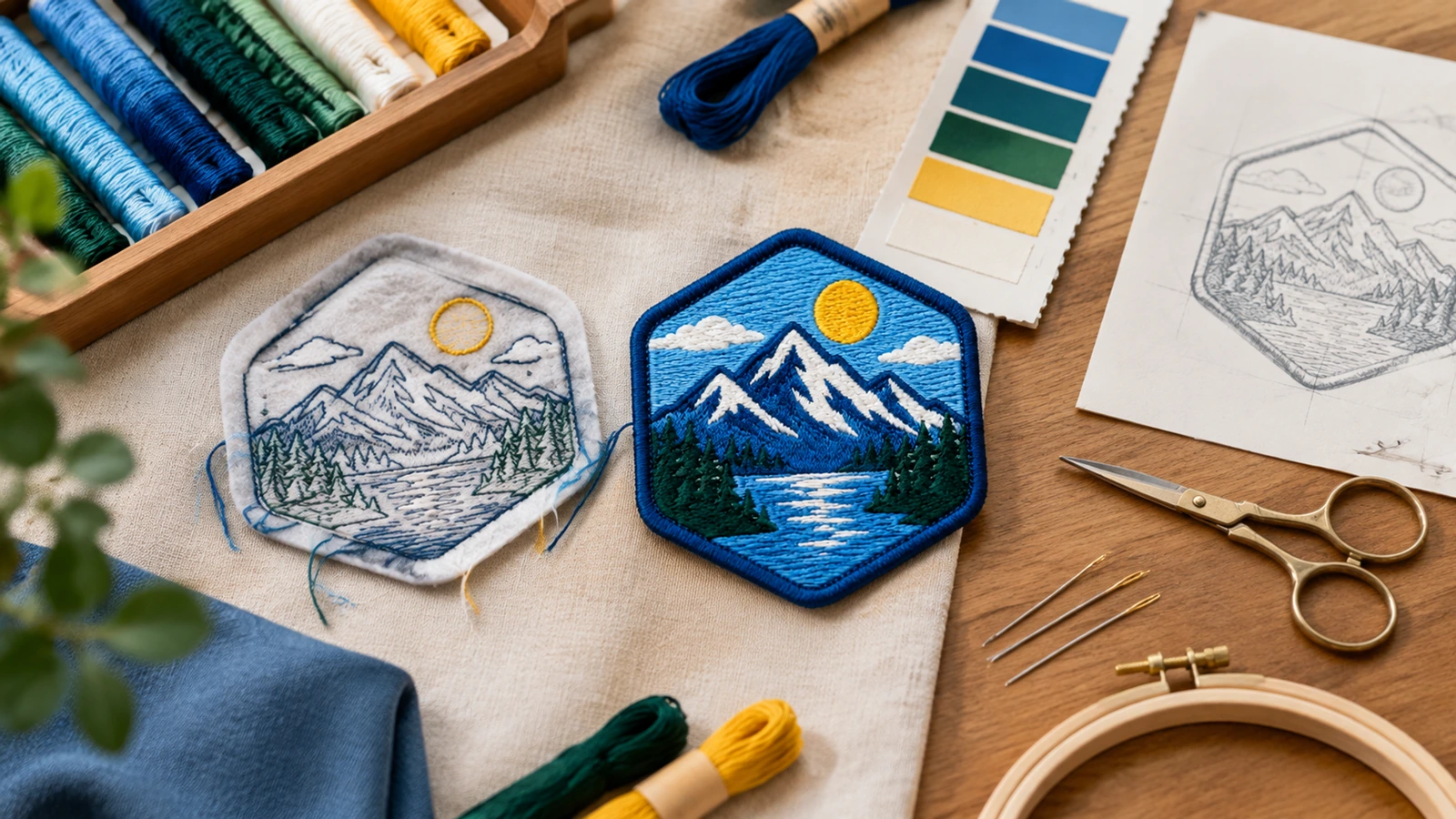
It is a standalone badge made in four stages. First, polyester or rayon thread is stitched onto a twill or felt base with a stabilizer. The patch is then cut to shape and the edge is finished. Finally, a backing is added so the patch can be attached to a garment, cap or bag.
Three stitch types do the work. Running stitches draw fine outlines. Satin stitches form borders and lettering. Fill stitches cover large areas. An underlay is laid first to hold the base flat.
Coverage sets both the look and the cost. Signature Patches[7] describes two levels: up to 75% coverage, which leaves the twill visible, and 76–100% coverage, a fully stitched surface that is thicker and stiffer.
Density cuts both ways. Northwest Custom Apparel[8] notes that high density on small patches "causes fabric distortion," while low density on large patches "looks sparse." For scale, a maker in r/Machine_Embroidery[9] logged 30,782 stitches and about 90 minutes of machine time for a fully filled 4-inch design.
No standard sets patch fill density. ASTM D6193-16(2025)[10], published 1 November 2025, classifies the stitches and seams used in sewn items. "Merrow" is a trade name for an overedge stitch in the 500 class. An order should therefore state the border width in millimetres, not just "merrow edge."
How Do You Specify a Patch That Stitches Cleanly? ↑
Step 1: Check size and legibility before digitizing
Start from the smallest letter, not the logo outline. Ruixing's 2026 sourcing guide[11] puts clean embroidered text at 3.5–4.0 mm, against 1.5–2.0 mm for high-density woven micro-lettering. Panda Patches' specs[12] give minimum heights by font style:
- About 4 mm for a clean sans-serif.
- About 8 mm for serif faces.
- About 10 mm for decorative fonts.
Thin strokes fall below the roughly 1 mm width of the thread. If your text is smaller than this, enlarge the patch, simplify the font or switch to woven.
Next, size the patch by where it will be worn. The Eagle Patches[13] suggests these sizes:
- Small accents: 1×1 to 1.5×2 inches.
- Left chest: 2.5×3 to 3×4 inches.
- Sleeves: 2×3 to 3.5×4 inches.
- Jacket backs: 8×10 to 10×12 inches.
World Emblem[14] prices by (width + height) ÷ 2. It also caps designs at 15 thread colours, including the border. Put both size and colour count in the first brief.
Step 2: Match backing and border to the garment
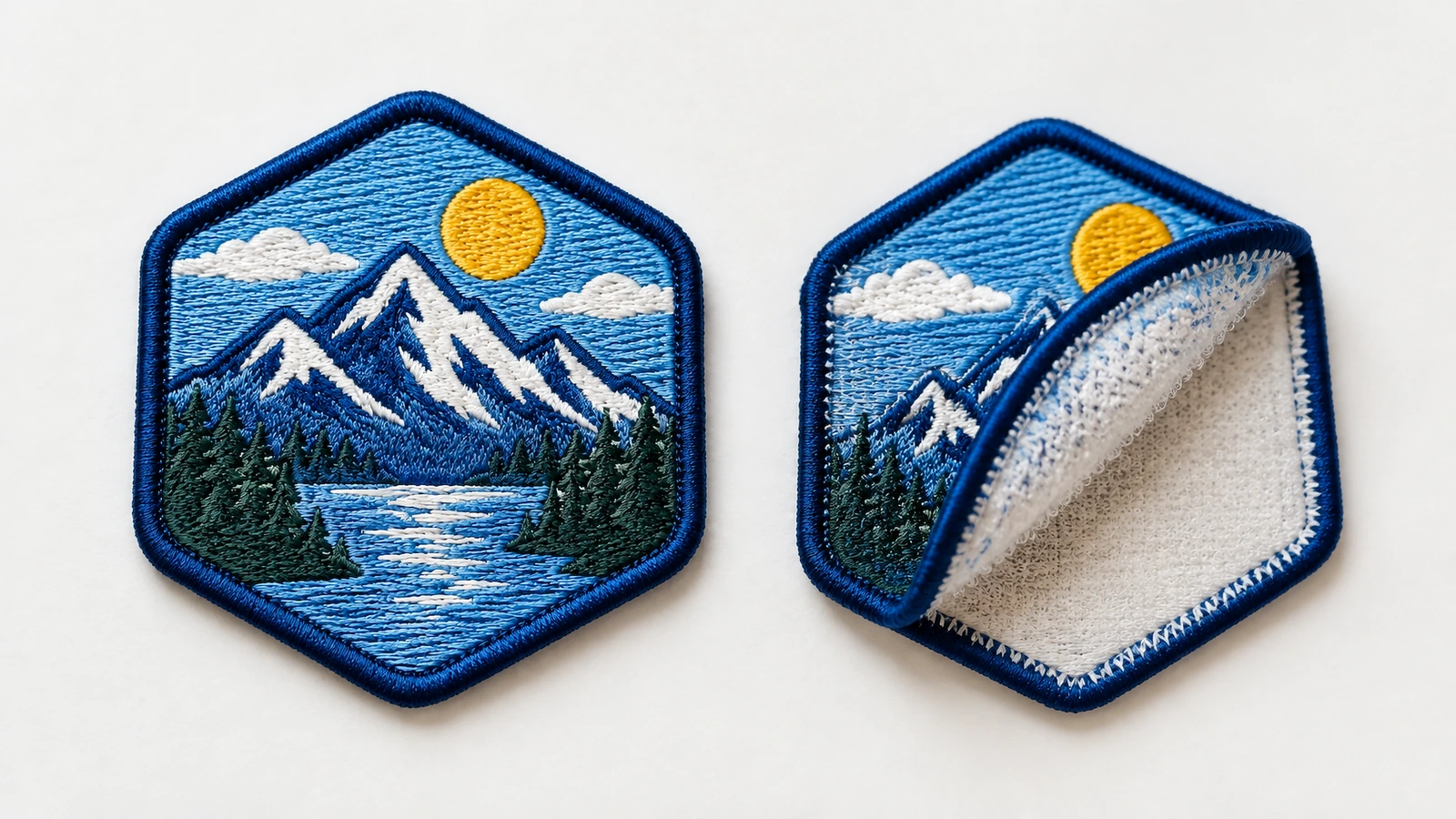
Choose the backing by fabric and washing, not habit. Sew-on is the default for anything laundered often. Hook-and-loop suits swappable IDs. Iron-on works on heat-tolerant cotton, denim and twill. World Emblem advises against heat-seal backing on some nylons, silks, leather, wool, fleece and weather-treated fabrics, because finishing chemicals stop the adhesive bonding.
| Backing | Suitable fabrics | Supplier-stated durability | Watch-outs |
|---|
| Sew-on | All, including nylon and leather | Long-term, repeated washing | Needs sewing labour |
| Iron-on (heat seal) | Cotton, denim, twill | About 20–30 washes when home-ironed | Lifts on caps, fleece and coated fabrics; not offered on PVC |
| Hook-and-loop | Depends on the garment panel | Repeated swapping | Loop panel must match the patch size |
Adhesive settings vary by supplier, so write them on the order:
- Ruixing quotes a commercial press at 150–160°C for 15 seconds under 4–5 bar. It claims 50+ household washes and a 25 N/cm peel target.
- Panda Patches specifies 350°F (175°C) for 25–30 seconds for its own glue.
- Northwest Custom Apparel rates home-ironed backing at roughly 20–30 washes.
Owl Badges[15] notes that molded PVC cannot take iron-on backing. For industrial laundering, add a perimeter lock-stitch after heat sealing.
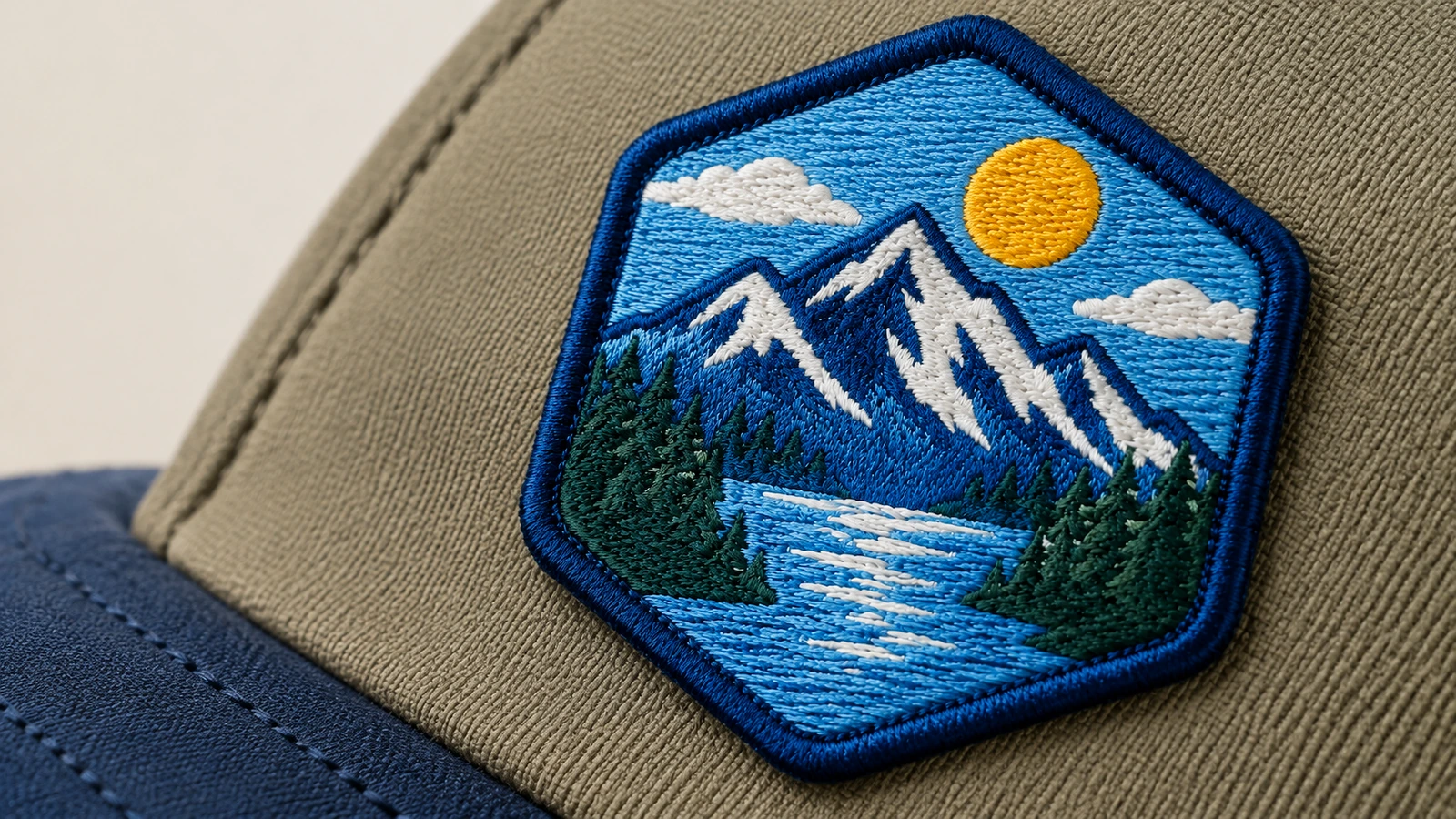
The border decides how much artwork survives. ChinaPatchFactory[16] lists typical widths: merrow at 3.0–4.0 mm, laser satin at 2.0–2.5 mm and hot-cut at 1.0–1.5 mm. It also notes that a 3 mm merrow border uses 6 mm of total width, which crowds a 1.5-inch patch. Use merrow for circles, ovals, rectangles and simple shields. Use hot-cut or laser-cut for sharp corners and contour shapes. These widths are manufacturer experience, not ASTM tolerances.
Step 3: Preflight the artwork file
Send AI, EPS, PDF or SVG files. Raster files should be at least 300 dpi. Qinghan Label[17] recommends vector files for clean edges and Pantone (PMS) references for colour accuracy, because screen RGB does not map to a thread library.
State the finished outer size, including the border. Changing size after digitizing is not a simple scaling job. Enlarging a stitch file by more than roughly 10–20% thins the coverage, and shrinking it stacks stitches, so a resized patch needs a new file. Flag photos, gradients and hairlines at this stage. They should move to woven or printed patches rather than being forced through higher stitch density.
Step 4: Approve a physical sample, then freeze the stitch file
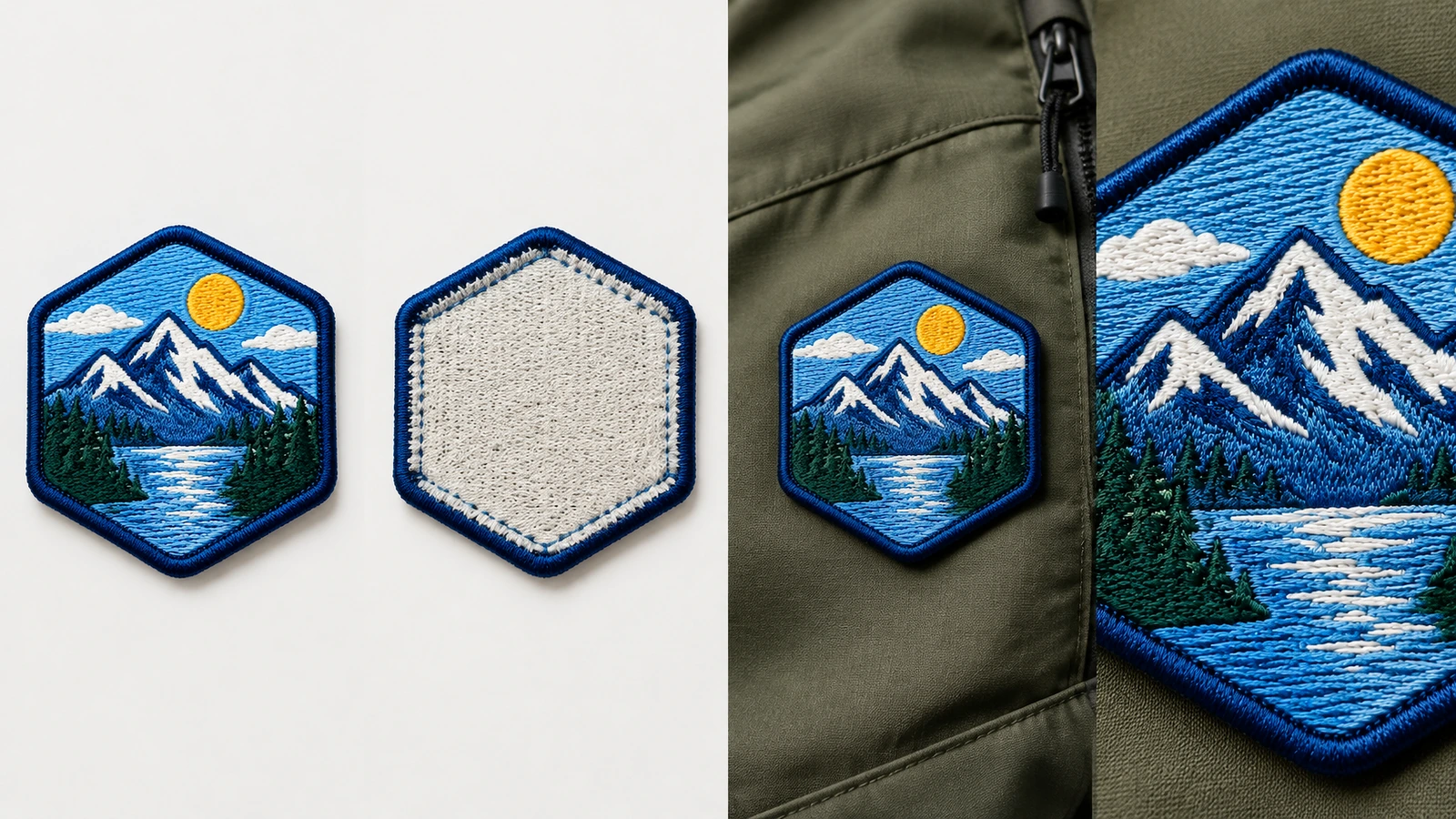
A digitized simulation shows the layout. Only a sewn sample shows stiffness, curl, sunken stitches and colour under real light. On the first piece, check size, text height, colour sequence, border width and loose threads on the back.
A common failure reported in r/Machine_Embroidery[18] is small white lettering sinking into a dark fill. It is usually fixed with base fabric colour and fill spacing, not another stitched layer. Once the sample is approved, the stitch file (DST) is locked, and no stitches are added on the production floor.
As a benchmark only, Ruixing lists a 24-hour digital simulation, 3–5 working days for a physical sample, and 10–14 working days for runs under 5,000. Sample and bulk timing for this product are confirmed in your quote. Both are counted from proof approval and exclude freight.
Step 5: Inspect against countable criteria
Inspection only works when defects can be measured. Ruixing inspects to AQL 2.5 major / 4.0 minor under ISO 2859-1 sampling. That level is a buyer's contract choice, not an embroidery mandate. If the order calls for it, colourfastness to washing can be tested to ISO 105-C06.
Write rejection triggers as numbers, so a failed batch is remade rather than discounted. Typical triggers are visible thread tails longer than an agreed length, text offset beyond an agreed number of millimetres, missing stitches and the wrong backing.
In one BBB review[19], a buyer with an order over $2,000 reported loose threads and misaligned letters. These were dismissed as "typical in the embroidery process," and the buyer was offered only a 10% discount.
Embroidered, Woven, PVC, Chenille or Printed: Which Patch Fits? ↑
Buyers searching for custom embroidered patches are usually comparing processes, not brands. 6Six Needles' August 2026 price page[20] lists these prices at 100 pieces: $2.20 each for embroidered, $2.35 for woven, $3.20 for PVC and $3.40 for chenille. Atlanta Vinyl's 2026 comparison[21] puts readable text at about 1/4 inch for embroidery and PVC, against 1/8 inch for woven.
| Type | 100-pc list price | Smallest readable text | Strength | Limit |
|---|
| Embroidered | $2.20 | ~1/4 in | Raised texture, classic uniform look | No photos or gradients; dense fills turn stiff |
| Woven | $2.35 | ~1/8 in | Fine text, thin and soft | Flat, no raised texture |
| PVC | $3.20 | ~1/4 in | Water-resistant, good outdoors | No iron-on; heavier than fabric |
| Chenille | $3.40 | Bold letters only | Letterman-jacket look | Low detail, higher cost |
| Printed/sublimated | Not listed | Photo-level | Full colour and gradients | Flat; may fade with wear |
These are public list prices from US suppliers, not market averages. Size, stitch count and backing can change unit cost several times over, and each design usually carries its own minimum. As a rule of thumb, choose embroidery for solid logos and lettering on uniforms, caps and club gear. Choose woven for fine text, and PVC for patches that will get wet or live outdoors.
What Should You Confirm Before You Pay? ↑
Children's products
If the patches go on products made mainly for children aged 12 and under, every component counts. 16 CFR 1252.1[22] restates the CPSIA limit of 100 ppm total lead. 16 CFR 1307.3[23] caps listed phthalates at 0.1% in children's toys and child care articles. CPSC's lead guidance[24] adds that material exemptions waive testing, not the limit, and a Children's Product Certificate is still required.
Thread rarely contains plasticizers. Testing matters most for adhesives, coatings and PVC parts. The 16 CFR 1610 flammability standard applies to the garment fabric, not to a loose patch, according to CPSC clothing guidance[25].
Flame-resistant workwear
REED Manufacturing[26] cites ASTM F1506 Appendix X1.2.5 on emblems that are not flame-resistant. On the outside of arc-rated garments, each should cover no more than 16 in², with no more than 40 in² in total. NFPA 2112 guidance recommends no more than five such emblems, and its seam-thread rule excludes embroidery. These are recommendations, not automatic compliance. Certification stays with the garment maker.
Duties, recycled claims and acceptance
Embroidered badges fall under HTS 5810. Textile School's HTS summary[27] lists 14.1% for 5810.10.00.00 and warns that table rates exclude Section 301 duties. For context, OEC data[28] show the US imported $118M of embroidery in 2024 and exported $8.78M. China supplied $35.9M of those imports.
For "recycled thread" claims, OEKO-TEX's 2026 notice[29] put new STANDARD 100 rules into effect on 1 June 2026. Cite the thread's certificate and its expiry date. Do not make a blanket claim that covers the patch and adhesive.
| Item | Write on the confirmation sheet | Reject or remake if |
|---|
| Size and shape | Finished outer size, stitch area, orientation photo | Size or orientation differs from the proof |
| Colours | Pantone or thread numbers, colour count | A colour is substituted without approval |
| Border | Edge type and width in mm | Edge type is swapped |
| Backing | Type, plus press temperature, time and pressure | Backing is missing or wrong |
| Stitch quality | Thread-tail length, text offset in mm | Agreed limits are exceeded or stitches are missing |
| Delivery | Ex-factory date, separate from transit | Rush fee is not refunded when the date is missed |
A proof without these fields is only a picture. Keep the approved sample and stitch file as the master for reorders, so the next batch runs from the same file. Packaging format, carton details and unit weight are confirmed with the quote rather than assumed here.
Key Takeaways for Patch Buyers ↑
- Embroidery needs larger text than woven. — about 1/4 inch vs 1/8 inch minimum readable height (Source)
- Volume lowers unit cost, but list prices vary. — 100 embroidered pieces listed at $2.20 each (Source)
- Children's patches have a hard lead cap. — 100 ppm total lead per component (Source)
- Non-FR emblems on arc-rated garments are size-limited by guidance. — 16 in² each, 40 in² total (Source)
- Listed duty is not the landed rate. — 14.1% on HTS 5810.10, excluding Section 301 (Source)
- The US relies on imported embroidery. — $118M imports vs $8.78M exports in 2024 (Source)
Ready to Turn Your Logo into a Stitch-Ready Patch? ↑
A good patch order is decided before the machine starts. That means text sized for thread, a backing matched to the fabric, a border chosen for the shape, and a signed proof that becomes the acceptance standard. Minimum quantity, sample timing, bulk lead time and packaging are confirmed per design in your quote, so you compare like with like before committing.
Send your logo, target size, garment fabric and quantity to request a stitch-file proof and quote.




The information below is required for social login
Sign In
Create New Account