Custom full-cover nail wrap sticker sets are pre-printed, adhesive-backed strips that cover the entire nail plate in your own artwork, widths, and finish. Buyers choose between dried polish-film and semi-cured gel builds, then validate fit, top-coat compatibility, and wear time through sampling before locking a production run.
If you are a beauty brand, subscription box, or private-label seller, "custom" here usually means two different things: printing your artwork onto the wrap, or cutting the wrap to specific nail widths. Both are buyable, but they carry different sampling and tooling implications. This page is written for the person placing the order, not the end consumer painting their nails, so it stays on specs, failure modes, regulatory limits, and what to confirm on a proforma invoice.
The core sourcing problem is that wear time and fit are advertised generously and delivered inconsistently. Shoppers buy wraps to escape polish that chips in two days, then report lifting within 24–48 hours, edges that snag hair, and removal that peels a layer of nail. One widely sold full-cover set on Amazon ships 12 sheets of 14 multi-size pieces yet still sits at an average 3.7-star rating, which is the gap between a nice mockup and a wrap that holds. Custom full-cover nail wrap sets close that gap only when sizing, finish, backing, and QC are specified up front rather than assumed.
Table of contents
What is a custom full-cover nail wrap sticker set? ↑
A nail wrap is a thin, pre-shaped strip with an adhesive backing that presses directly onto the natural nail, so there is no wet polish to dry. "Full-cover" means each piece spans the whole nail plate edge to edge rather than being a partial decal. Two builds dominate. Polish-film wraps are made from dried nail polish or vinyl and need no lamp; semi-cured gel wraps carry a partially cured gel layer and require UV or LED curing to finish. Custom simply means the print, colorway, or cut sizes are produced to your order, while the application logic stays the same as a stock design.
This classification matters because it decides your regulatory and safety path. In the United States, wraps are generally regulated as cosmetics and need no pre-market FDA approval, but any claim to treat a condition such as nail fungus reclassifies the product as a drug under the FD&C Act[1]. Dermatology reviews also note that wrap adhesives commonly rely on cyanoacrylate, which can sensitize users even though it rarely cross-reacts with acrylates, as documented in a 2019 Cutis clinical review[2]. Treat the polish-film and the gel build as separate SKUs with separate labels, never a single marketing story.
How do you spec size, fit, and readability? ↑
Fit is the number-one driver of lifting and returns, and it is where custom actually earns its premium. A piece that is wider than the nail touches the cuticle or sidewall skin, and that overlap is where the wrap starts peeling within a day or two. The fix is a real width range, not one generic set. Retail full-cover sets typically ship many widths per set—Nailvy's full-wrap option, for example, lists 9 sizes across 18 pieces in its custom decal specs[3], while other brands pack 16 pieces. For a custom run, require a nail-width measurement chart or hand-scan input, give the thumb a dedicated wide size, and specify "size slightly narrow, never onto skin."
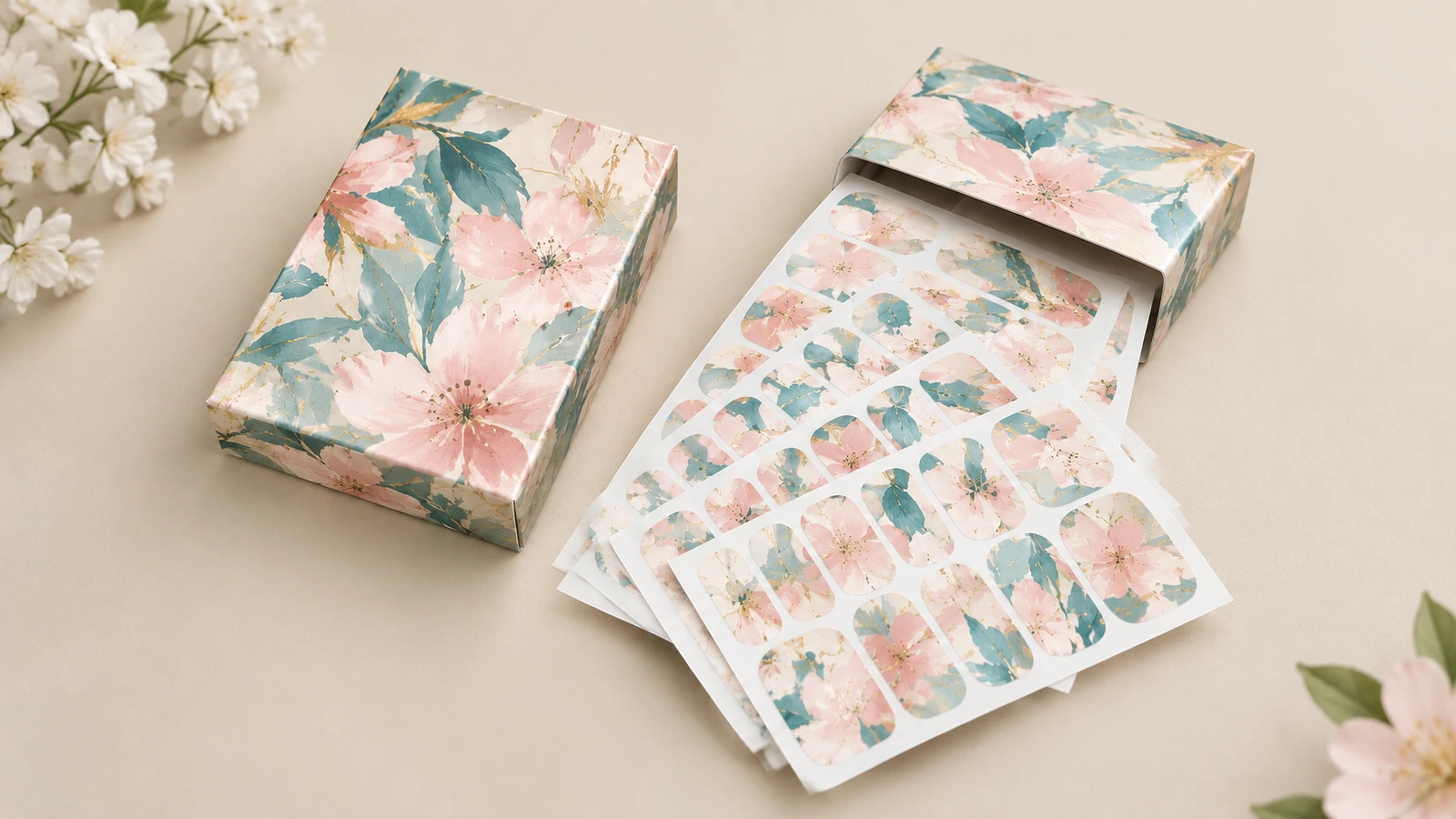
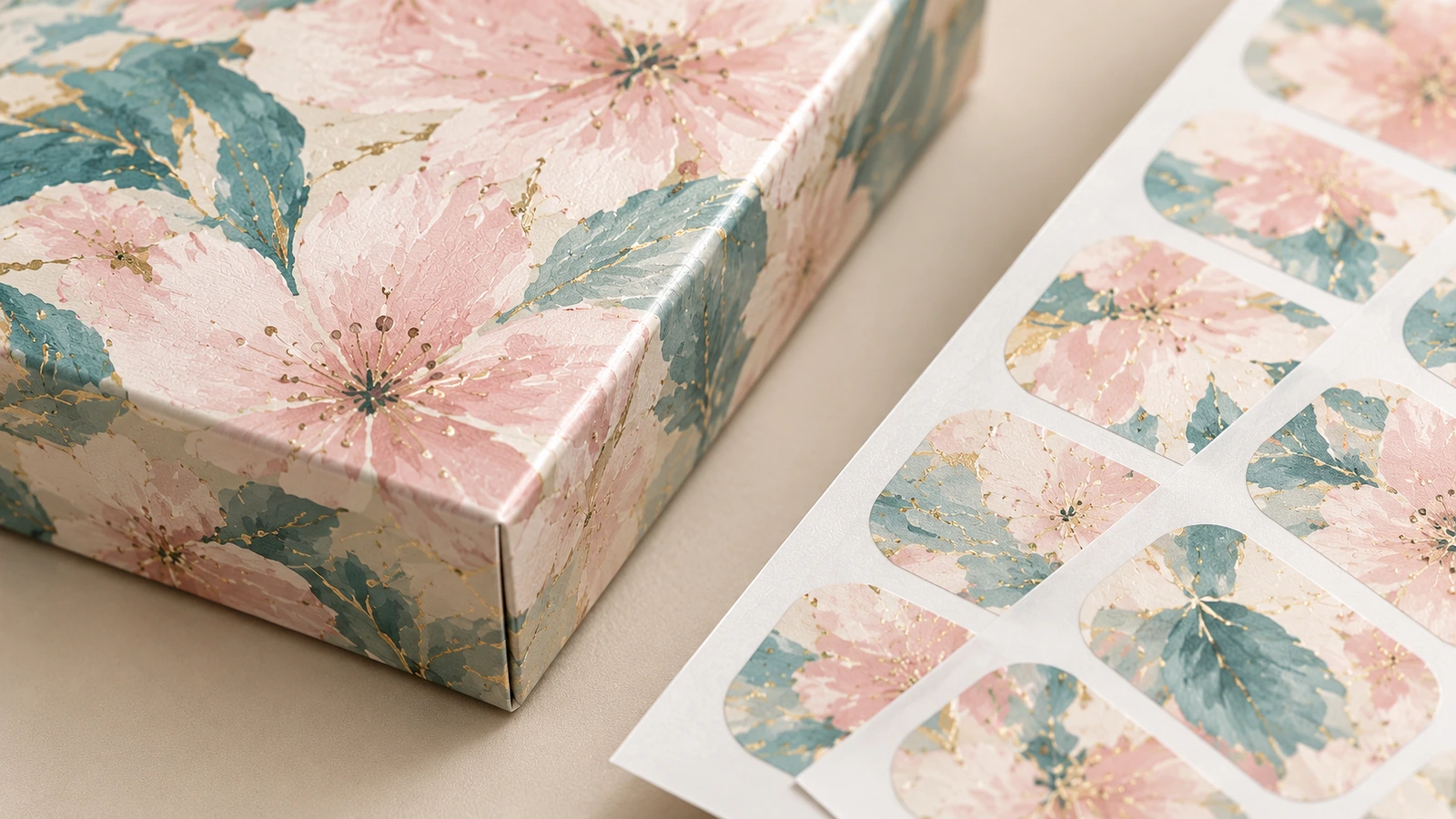
Readability of the artwork is the second sizing variable. Full-cover means the design is seen at nail scale, so fine linework, small type, and gradients can disappear or band. The most common preflight surprise is white ink: suppliers that print on clear film often cannot lay down white, so any white element renders as transparent and the artwork must be redesigned with a printed base. Lock the printable area, the free-edge margin, and a no-cuticle-coverage zone before approving a layout, because the per-nail "sharp edge that snags hair" problem is a sizing-and-finishing issue, not a print-quality defect.
Which finishes and backings should you specify? ↑
Finish changes both look and wear. Glossy wraps tend to hold up longest with the least edge wear, while matte reads premium but shows edge abrasion sooner. For gel builds you must also specify the photoinitiator, because the European Union banned TPO in cosmetics from 1 September 2025[4] with no sell-through period, so any EU-bound semi-cured wrap cured with TPO must be reformulated to an alternative initiator. Separately, if the gel contains HEMA or Di-HEMA TMHDC, EU rules make it professional-use-only with mandatory warnings, enforced since the 2021 supply deadline under Regulation (EU) 2020/1682[5]. None of this applies automatically to plain pressure-sensitive polish-film wraps, and the US has no identical rule.
| Decision | Options | What to confirm at quote |
|---|
| Build | Polish-film (no lamp) or semi-cured gel (lamp) | EU TPO-free; HEMA/Di-HEMA status and label |
| Sizes per set | Multiple widths (e.g., 9 sizes / 18 pieces full-cover) | Width chart or scan; dedicated thumb size |
| Finish | Glossy or matte | Glossy for longest edge life |
| Backing / release liner | Single-piece peel | Reject split liners that tear the wrap |
The backing row looks minor but drives scrap. Buyers have reported new batches whose release liner separates into two layers, leaving pieces glued to the backing and unusable. Treat single-piece liner release as an incoming-material pass/fail, not a cosmetic preference, and write it into the acceptance criteria rather than discovering it after the carton lands.
How does your order move from artwork to delivery? ↑
A custom order is a preflight-then-sample-then-run sequence, and shortcutting the sample stage is where most disputes begin. Industry sourcing guides note that fully custom designs often carry higher minimums—frequently 1,000+ units—and lead times of roughly 3–6 weeks[6]. Your own MOQ, production time, and per-unit weight are not fixed numbers here; they must be confirmed on a proforma invoice and validated by the physical sample, because they depend on artwork complexity, size count, packaging, and finish.
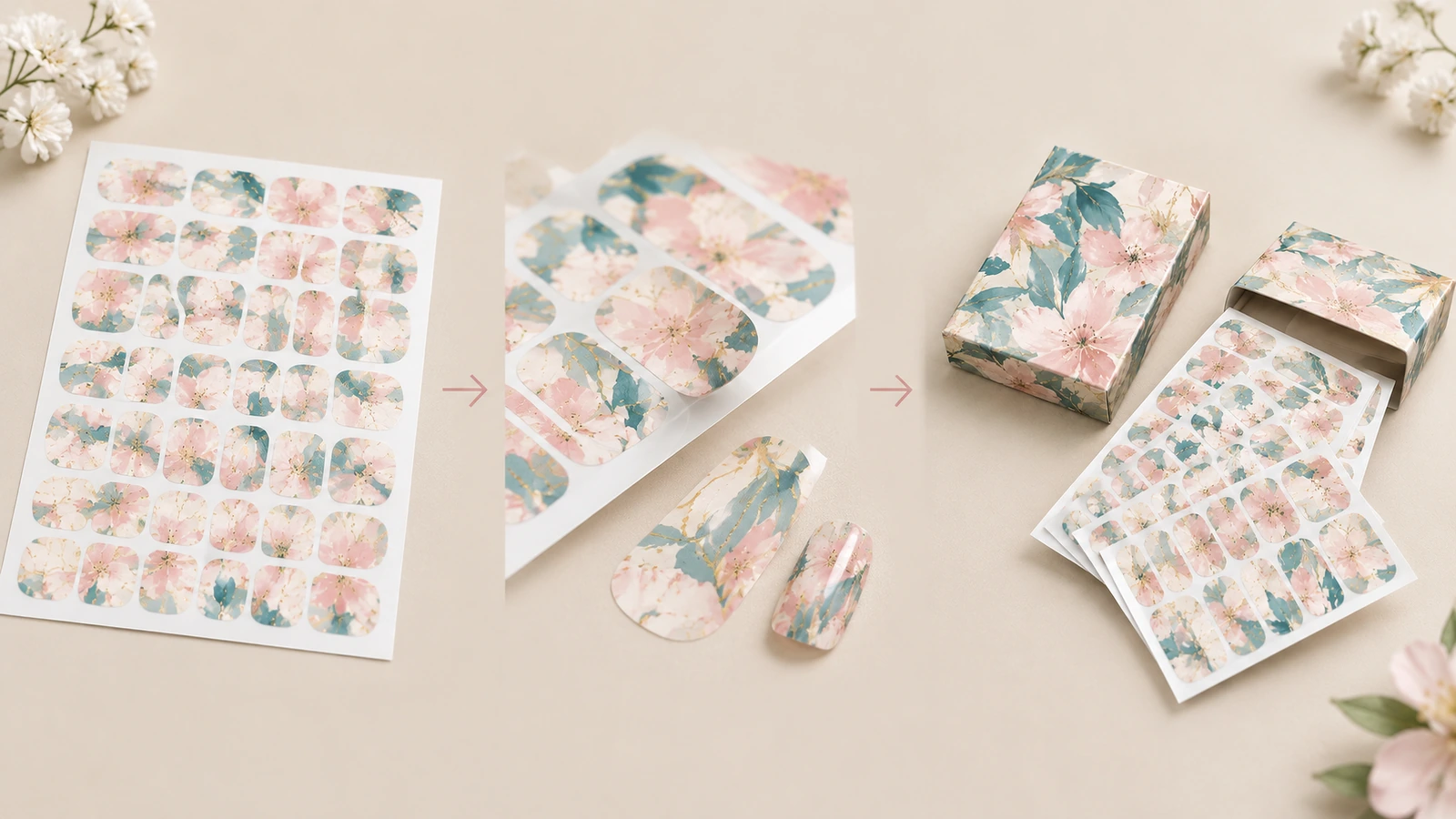
- Preflight artwork: fix white-as-clear, set bleed, confirm resolution at nail scale, and define the no-cuticle zone.
- Confirm the size matrix and give the thumb a wider cut; map each width to a nail-bed measurement.
- Choose build and finish, and clear EU TPO/HEMA labeling if the formula is a gel.
- Approve a physical sample for color, fit, liner release, and a 24-hour edge check.
- Run a top-coat compatibility test on a sacrificial piece before mass production.
- Confirm MOQ, lead time, and unit weight on the proforma invoice, then release the run.
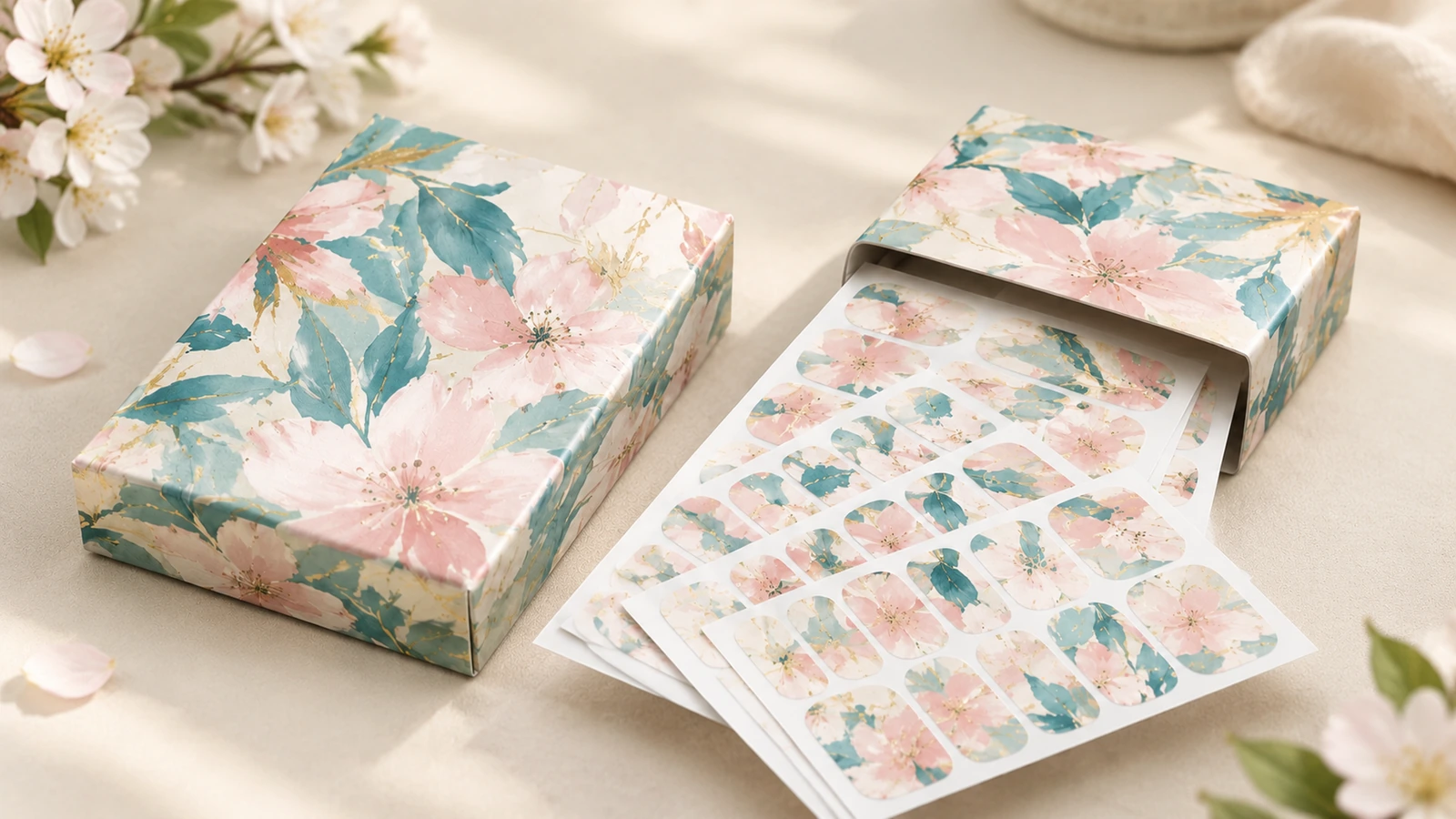
The top-coat test deserves its own line because it is a known failure: a shopper applying a non-compatible top coat over a cheap cross-border wrap watched the printed color dissolve until the silver backing showed through. Printing-layer formulas are rarely published, so you cannot guarantee compatibility in advance—you prove it on one piece, wait 24 hours, and only then approve a top coat for the full set.
How are custom wraps inspected and packed? ↑
Because there is no ISO or ASTM wear-time standard specific to nail wraps, inspection is about repeatable in-house checks, not a certificate. Pull one or two sacrificial pieces per batch and record the result; if the batch fails, it does not ship. Durability claims on the pack should stay honest: realistic wear is days, not weeks, and it depends on prep and daily friction.
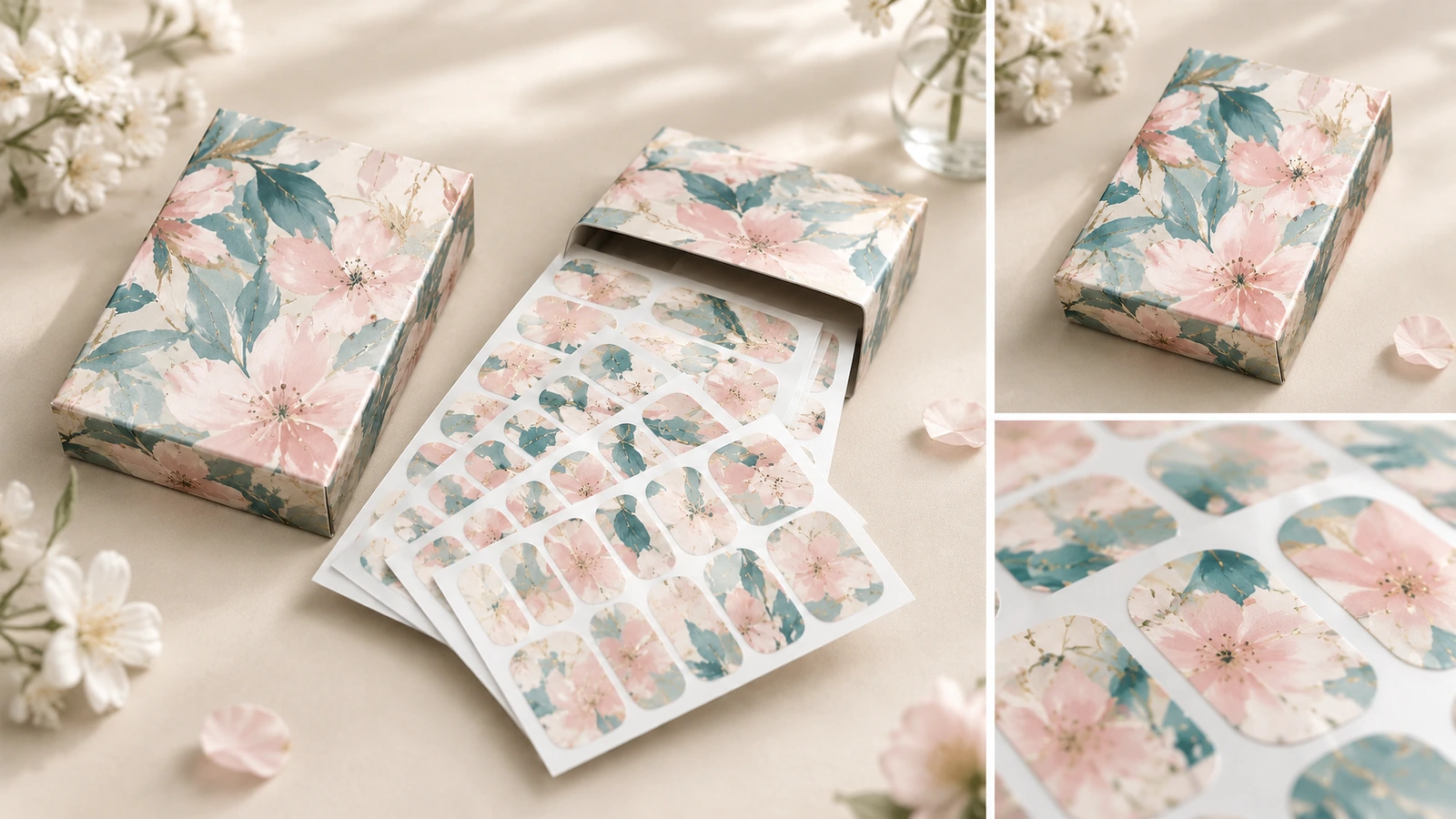
- Liner release: single-piece peel passes; any split liner is a reject.
- Tack after a 70% isopropyl-alcohol wipe, plus a 24-hour edge-lift check.
- Top-coat compatibility on one piece: no color bleed at 24 hours.
- Size-to-skin: the wrap must not sit on the cuticle in the application photo.
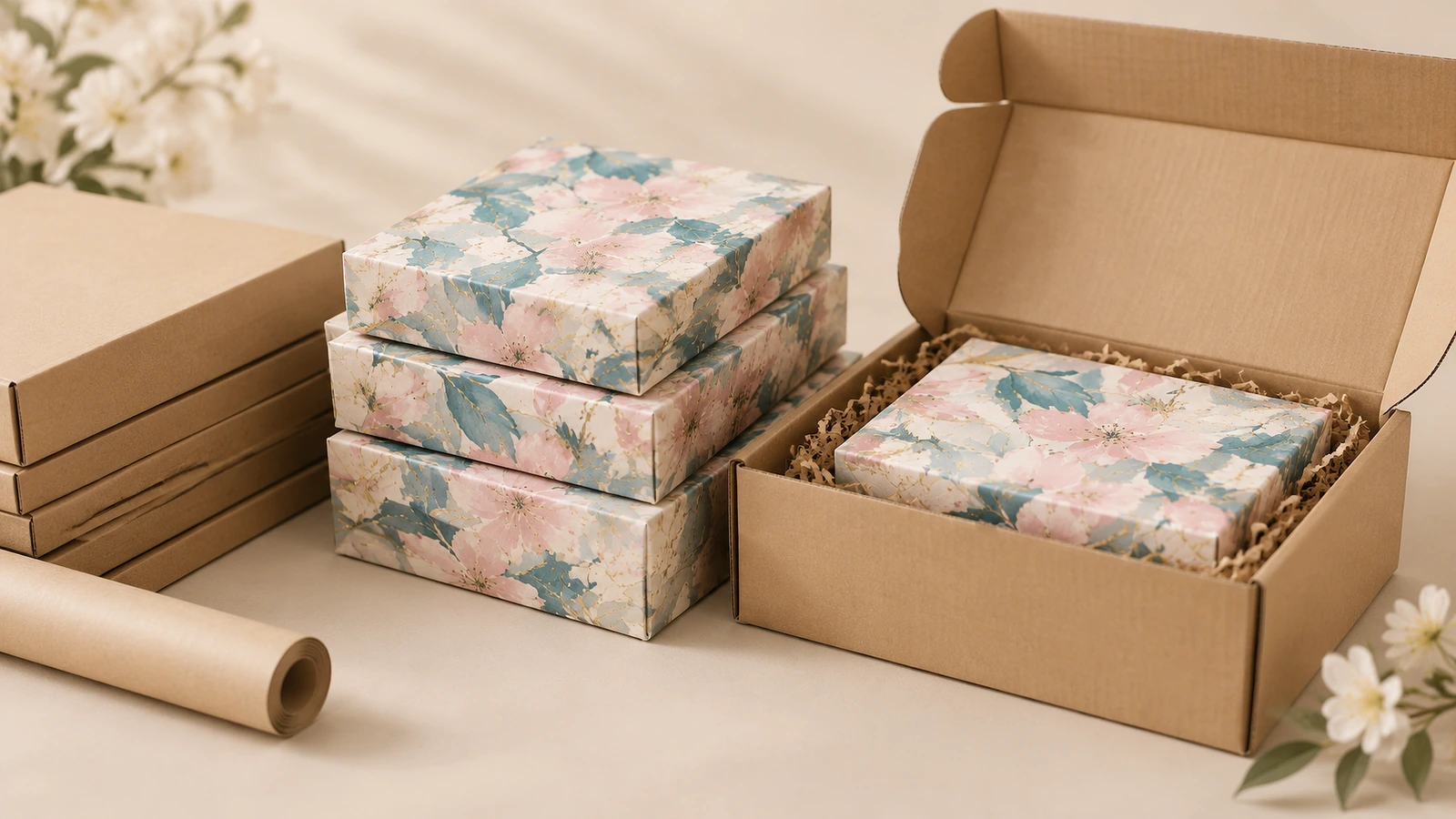
Packaging and fulfillment carry their own risk to reviews. Amazon feedback on this category clusters on "minor tears in open-box items" and "not sturdy," so include a prep wipe and a size guide in the pack, protect the liner in transit, and spell out production lead time and reship rules before the first order. Carton counts, pallet loads, and any "fits X sets per box" figure should be treated as determined by the physical dimensions, loaded state, and packout sampling—do not promise a number that has not been verified on the real product.
Custom nail wraps vs. other manicure formats ↑
Buyers rarely evaluate wraps alone; they weigh them against press-ons and salon gel. The table frames where a custom full-cover wrap wins and where it should not be stretched to compete.
| Format | Build | Lamp | Typical wear | Best fit |
|---|
| Custom polish-film wrap | Dried polish/vinyl + PSA | No | 7–10 days | Branded color drops, no-lamp retail |
| Custom semi-cured gel wrap | Pre-cured gel + PSA | UV/LED | ~2 weeks | Salon look, longer wear |
| Press-on nails | Full tips + glue/tabs | No | 1–10 days | Length and shape change |
| Salon gel polish | Base + color + top, cured | UV/LED | 14–21 days | Longest-wear benchmark |
On pure wear time, gel polish runs 14–21 days versus quality wraps at 7–10, per a 2026 durability comparison[7], and category pricing stretches from about $3 to $23 per set in a 2026 brand round-up[8]. A wrap cannot add length—if a buyer needs extension, point them to press-ons, not a nonexistent "long wrap SKU." The honest custom pitch is instant, lamp-optional, printable branding at a lower unit cost than salon gel, not a permanent manicure.
Safety framing also belongs in the buying decision. Trapped moisture under a lifting wrap is a real risk: a dermatologist told Everyday Health that "the space between the natural nail and the artificial nail material is a perfect incubator for fungus," in guidance on artificial-nail wear[9]. Packaging should instruct removal at the first sign of edge lift and never a dry rip, because brands and removal guides agree that forcing a wrap off takes a microlayer of nail with it, as the Espionage removal page[10] and StickyFix application notes[11] both state.
Key takeaways for buyers ↑
- Demand lives on broad category terms, not the exact phrase — US "nail wraps" moved ~83,100 units in July 2026 (Source)[12]
- Semi-cured gel is about half the strip market — 46.81% / $113.47M of a $242.4M 2025 market (Source)[13]
- Online is the dominant channel — ~48.2% of nail-wrap sales (Source)[14]
- EU gel formulas must drop TPO — banned in cosmetics since 1 Sept 2025 (Source)[15]
- EU labeling is still under-enforced — 22.5% of audited nail products lacked the professional-use warning in 2026 (Source)[16]
- Lifting within 24–48 hours is usually a prep issue — oil or moisture stops the adhesive (Source)[17]
Start your custom nail wrap order ↑
Custom full-cover nail wrap sticker sets are a strong private-label format when you specify them like a technical product: a real width matrix, a glossy-or-matte finish decision, a TPO-free and correctly labeled gel formula for EU markets, single-piece liner release, and a signed-off physical sample before the run. Skip any of those and you inherit the category's 3.7-star problems—lifting, snagging, dissolved ink, and scrap liners. Send us your artwork, target market, and size range, and request a sampling quote so MOQ, lead time, and unit weight are confirmed on paper and proven on a real sample before you commit.




The information below is required for social login
Sign In
Create New Account