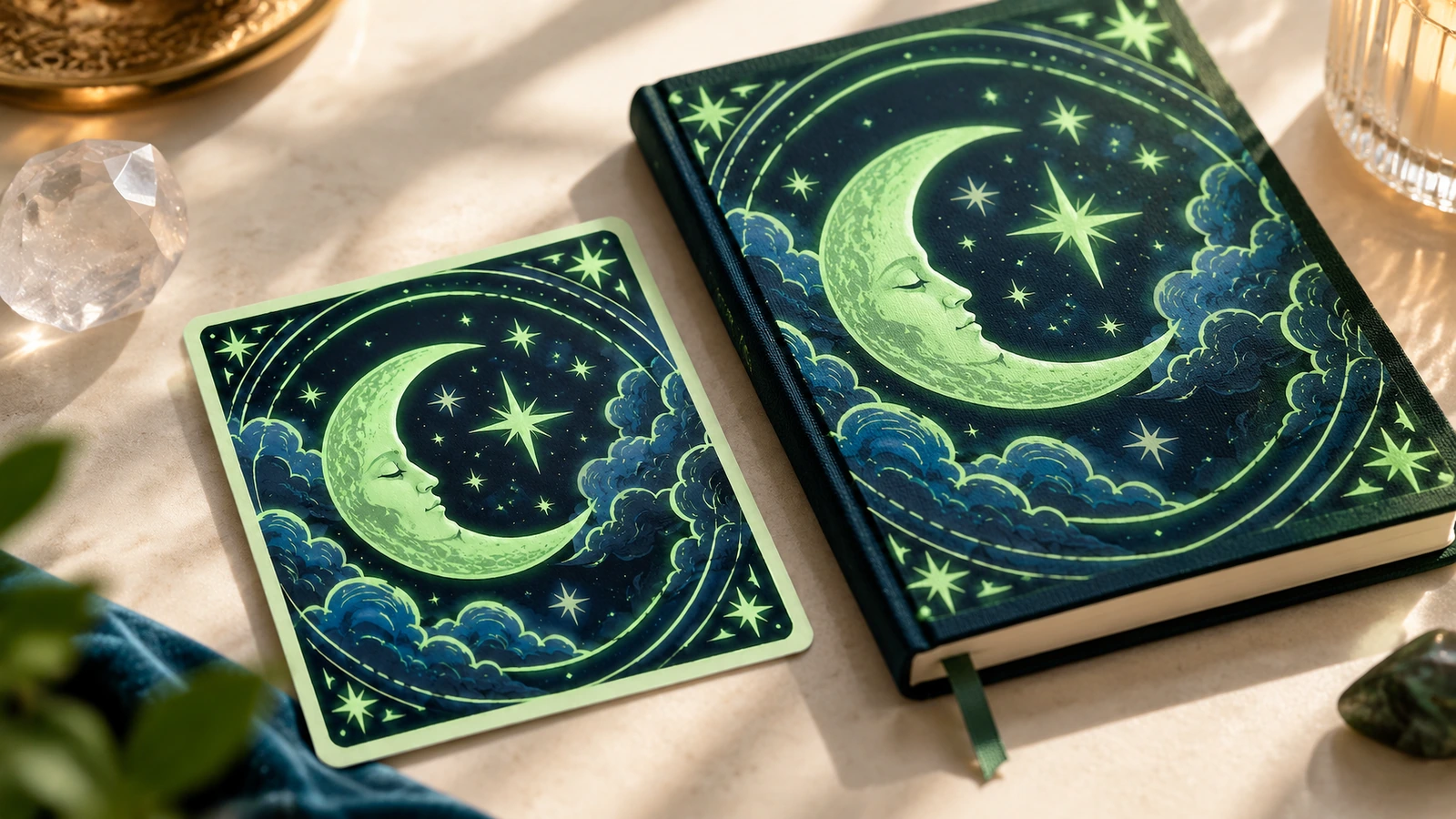
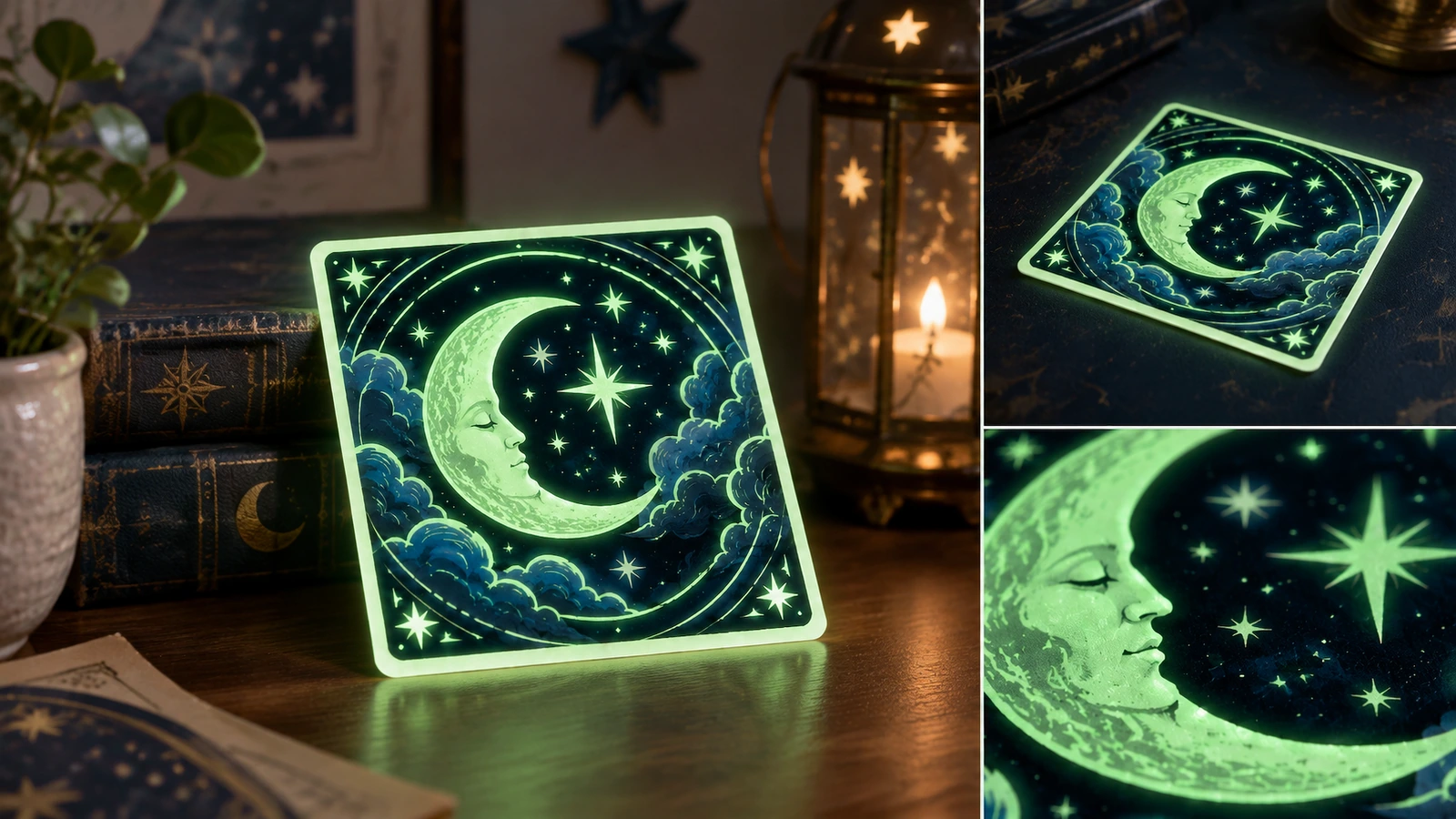
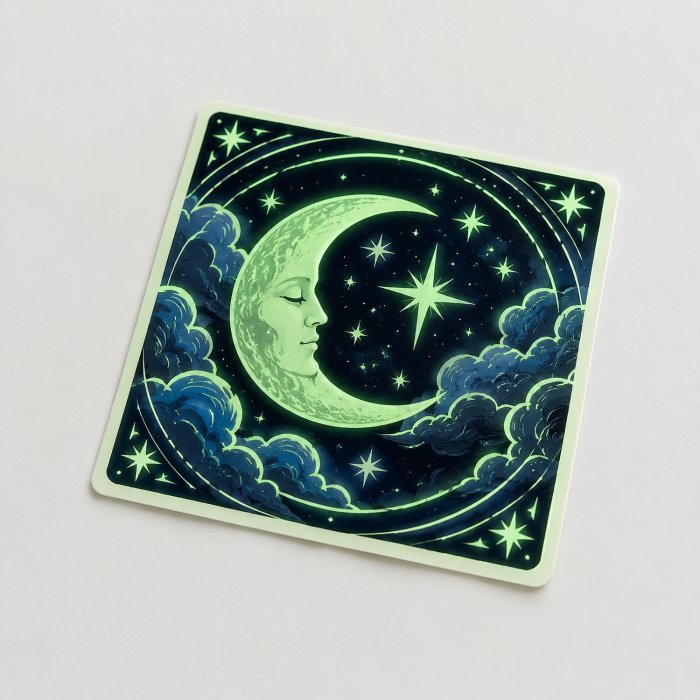
Custom glow in the dark stickers are die-cut stickers printed on photoluminescent vinyl. The film stores light and gives off a fading glow after the lights go out. Unprinted and light-colored areas glow the most. Your artwork, the charging light and the intended use decide how the sticker performs at night.
Who orders them, and why. Most requests come from four groups:
- Brands, bands and event organizers want merch that gets noticed when the room goes dark.
- Parents want a name or constellation that glows on a bedroom wall without batteries.
- Illustrators sell small runs for laptops, bottles and e-readers.
- Facility and gear owners mark switches, toolboxes and helmets.
Creators accept a premium for the effect. One sticker artist pays about $1.50–$1.75 per sticker at a print shop and still calls it worth it. The same artist warns that full-bleed ink can chip (r/stickers creator report[1]).
The problem. Most glow orders are approved from a full-color screen proof. The glow, however, comes from the film under the ink. Dark fills block it, thin lines disappear and colors merge. One hobbyist found that "white, green and blue are all shades of blue in the dark." He also found that ambient room light was not enough to charge his stickers (r/Cubers user test[2]).
Why it gets worse. Published glow claims cannot be compared. One U.S. printer states 20–30 minutes per charge (StickerGiant[3]). Another claims up to 15 hours, while admitting that intensity decreases over time (StickerApp support[4]). A film manufacturer puts it plainly: a glow time "stated in hours alone without a brightness data is not meaningful" (Minhui film factory[5]). Buyers who pick the biggest number usually learn the difference after the event. By then the custom order is printed and cannot be resold.
How we solve it. We treat glow as a specification, not an adjective. Before printing, each order locks in six items:
1. The use case.
2. The glow-reserve area in your artwork.
3. The film and finish.
4. The adhesive for your surface.
5. The charging condition used for acceptance.
6. A signed-off dark-room proof.
Some values are listed as pending sample, test or quotation and are never presented as promises. These are exact afterglow, outdoor life, minimum order and lead time.
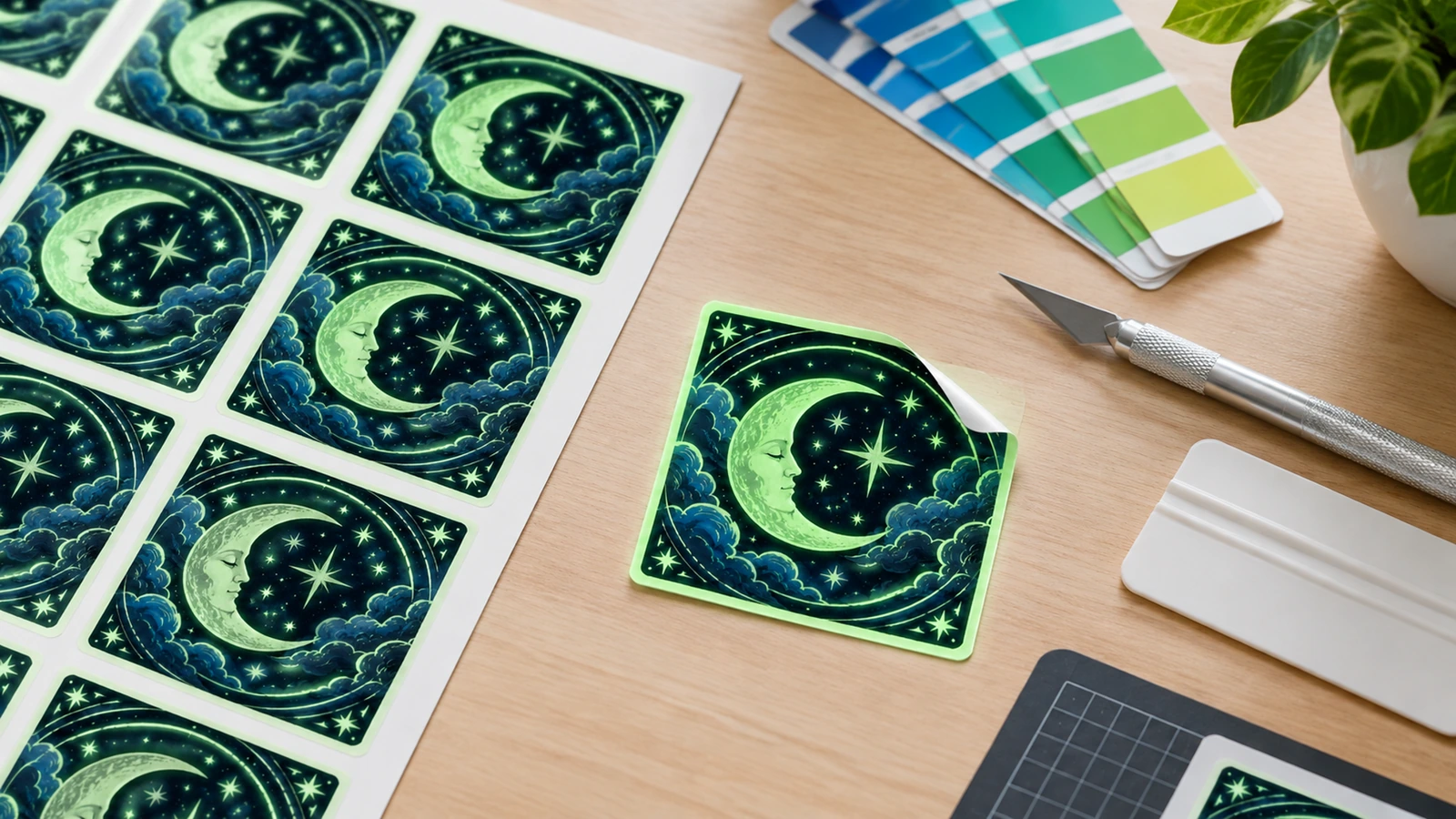
Table of Contents
What Are Custom Photoluminescent Vinyl Stickers?↑
A photoluminescent (phosphorescent) sticker uses a pigment that absorbs light and releases it slowly as visible glow. These pigments are "typically strontium aluminate or zinc sulfide" (Bend Print Co guide[6]). Strontium aluminate is the modern pigment and is generally brighter and longer-lasting. Zinc sulfide is the older chemistry still found in many cheap novelty stars. Neither is radioactive in modern consumer products. The Photoluminescent Safety Association states that "strontium aluminate-based photoluminescent pigment is not radioactive" (PSPA FAQ[7]).
Buyers use "glow" for three different effects. Only one of them lights up on its own in the dark.
| Effect | In daylight or room light | With lights off | Typical fit |
|---|
| Photoluminescent (phosphorescent) | Absorbs and stores light | Glows on its own, then fades | Glow stickers, supplemental markings |
| Fluorescent | Bright only under UV/blacklight | No stored glow; goes dark at once | Blacklight parties, posters |
| Reflective | Shines only when a light hits it | Dark without a light source | Road and vehicle visibility |
If the sticker must glow with no light source nearby, you need photoluminescent film. Glow film also changes how the sticker looks in daylight. Its slight green base tint mutes printed colors compared with white vinyl. CustomStickers.com notes this tint and adds that high-contrast designs glow better (CustomStickers.com[8]).
How Long Do Glow Stickers Really Glow?↑
Every phosphorescent sticker is brightest right after lights-off and then fades. Carstickers says its glow vinyl is brightest in the first 10 minutes and stays visible for up to an hour in complete darkness (Carstickers material page[9]). Only safety-grade film publishes lab-measured brightness. 3M's Product Bulletin 6900 lists typical values of 50 mcd/m² at 10 minutes and 6 mcd/m² at 60 minutes, measured to ASTM E2073 (3M Product Bulletin 6900[10]).
| Source | Published glow claim | Published outdoor claim |
|---|
| StickerGiant | Glows 20–30 min per charge | 12–18 months depending on exposure |
| Carstickers | Brightest first 10 min; visible up to ~1 h | Designed primarily for indoor use |
| Bend Print Co | Charge 5–10 min; peak 0–30 min; fades over 2–4 h | Rated 3–5 years outdoors |
| StickerApp | Up to 15 h; intensity decreases over time | Not tied to the 15 h claim |
| 3M Luminous Film 6900 | Typical 50 mcd/m² at 10 min; 6 mcd/m² at 60 min | 7 years interior, 1 year exterior |
These figures are not a ranking. Each supplier uses its own charging light, charging time and definition of when the glow has "ended." The comparable reference is ASTM E2072-24, published June 1, 2024. It requires new safety markings to reach at least 30 mcd/m² at 10 minutes and 5 mcd/m² at 90 minutes. It applies only to markings that emit mainly at 515–535 nm. It also excludes brightness loss from wear and aging (ASTM E2072-24 summary[11]).
Long "hours" claims usually follow DIN 67510. The method charges the pigment under D65 light at 1000 lx for 5 minutes, then times the glow down to 0.3 mcd/m². That endpoint is a faint glow a dark-adapted eye can still see, not a readable light. Minhui reports 12+ hours for its pigment under these conditions. That is a pigment-level supplier claim, not a guarantee for a printed sticker (Minhui pigment data[12]).
For your order, afterglow is a pending test item. Your quote states the charging light and charging time. You then judge the dark-room proof at fixed intervals after lights-off. We do not promise "all night" glow.
How Do You Design Artwork That Still Glows?↑
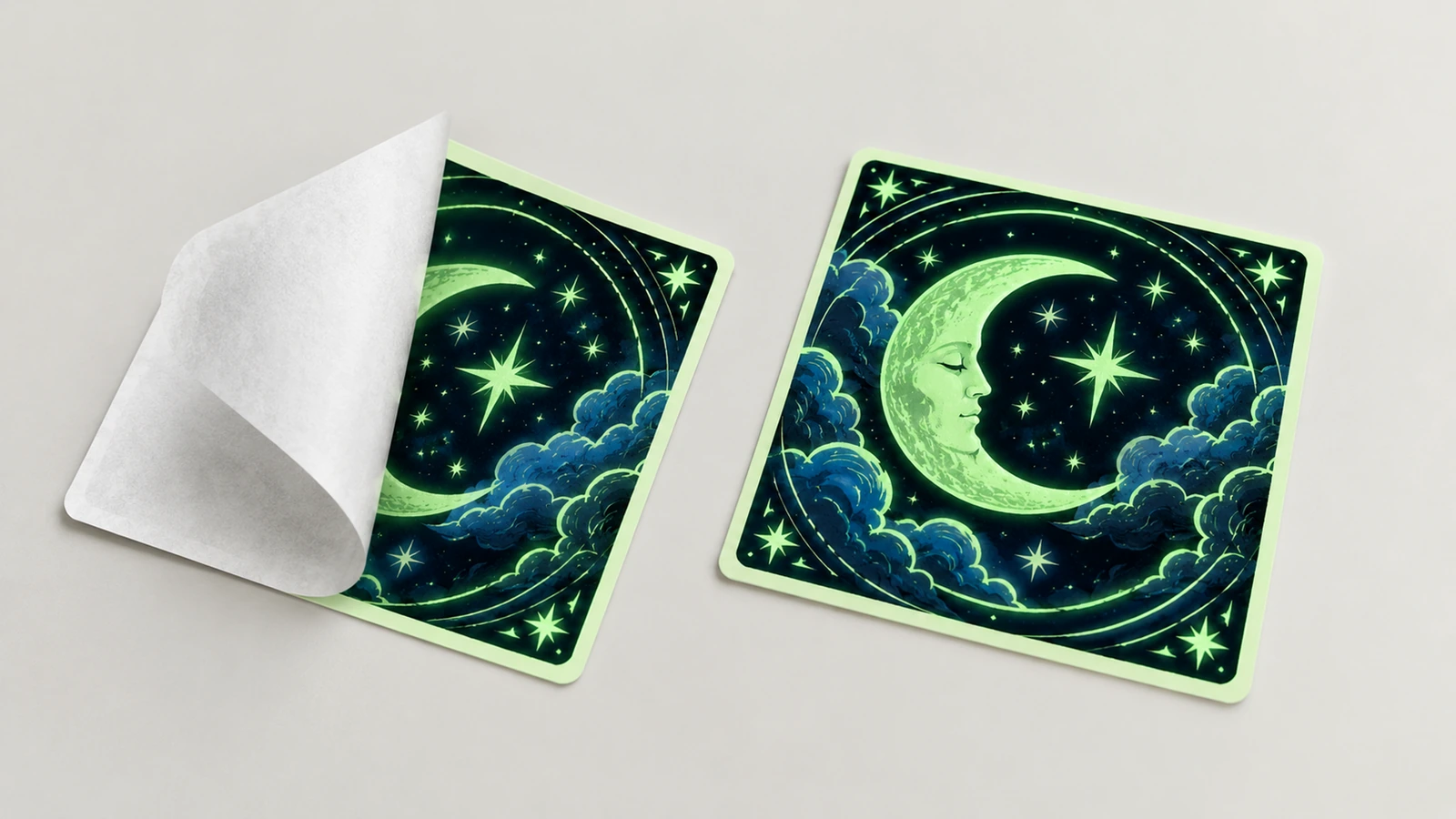
Ink sits on top of the glow layer, so ink coverage is the biggest factor you control. StickerApp says: "Only unprinted, white or very light pastel areas glow fully, and printed areas glow less" (StickerApp help center[13]). A CustomStickers.com guide adds that "heavy inks behave like shutters." It also warns that fine details can turn into a smudge in the dark (CustomStickers.com design guide[14]).
Size and readability. Design for two viewing conditions.
- **Daylight:** The tinted film lowers contrast. One YouTube reviewer's first order printed white on white and was nearly invisible. A darker reprint fixed it.
- **Darkness:** Only the glow-reserve areas show, and they all glow one color. Line art, bold outlines and open shapes hold up. Thin strokes, small text and color-coded details do not.
A narrow clear border helps the edge glow and reduces chipping at the cut line. Legible lettering size depends on your artwork, so we confirm it on the proof rather than quote a minimum.
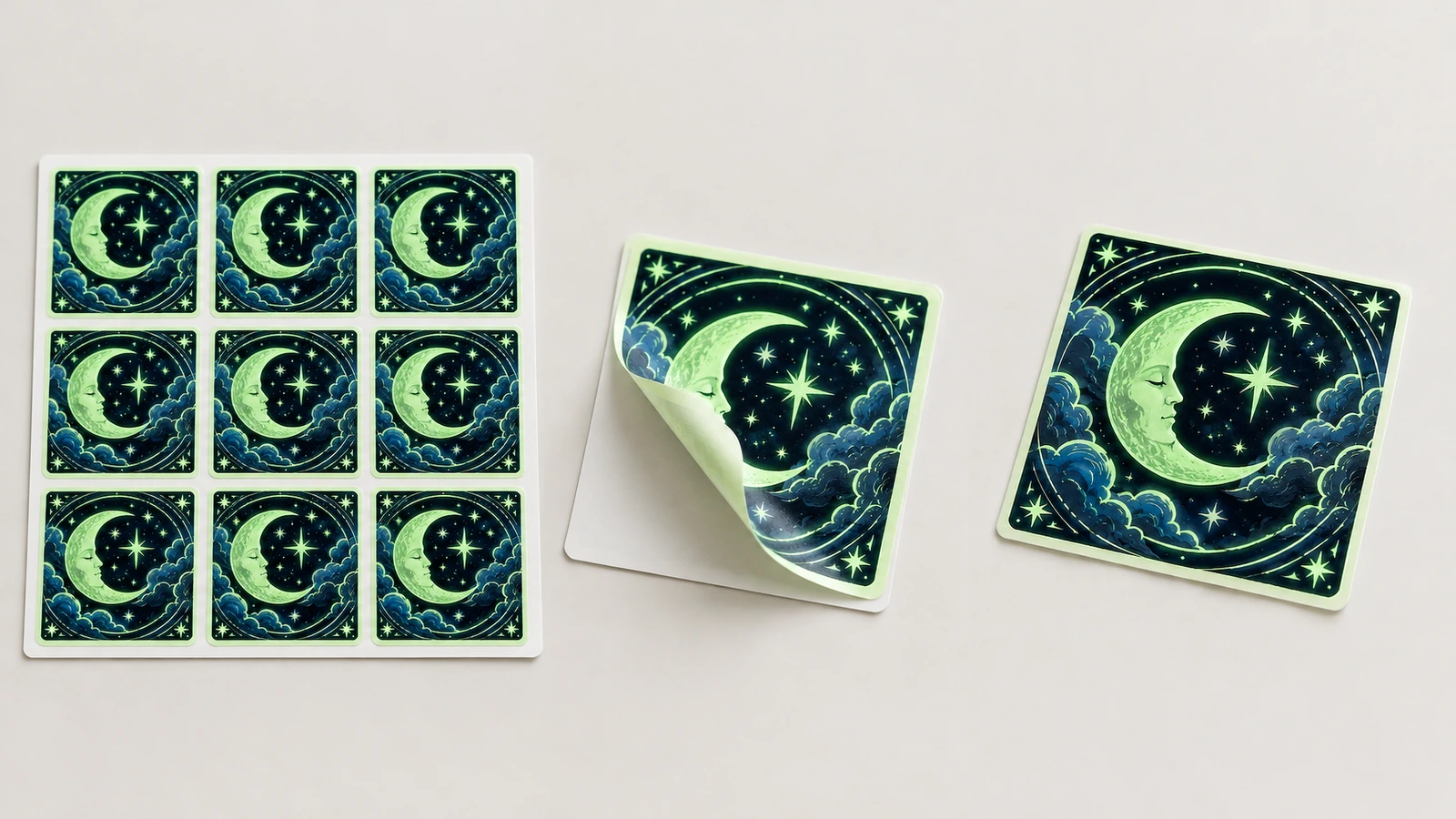
File preflight. Send an editable vector or high-resolution file. Mark the glow-reserve area as a separate layer or as a note on the proof request. Preflight flags five issues:
1. Solid dark fills covering most of the glow area.
2. Unoutlined white or pale-yellow text.
3. Hairlines that vanish in the dark.
4. Color-only separation of parts.
5. Full-bleed ink that may chip.
Each flag comes back with a suggested fix before any film is printed. The proof sheet also states that only unprinted or lightly printed areas will be visible in the dark.
Which Finish, Adhesive and Surface Fit Your Use?↑
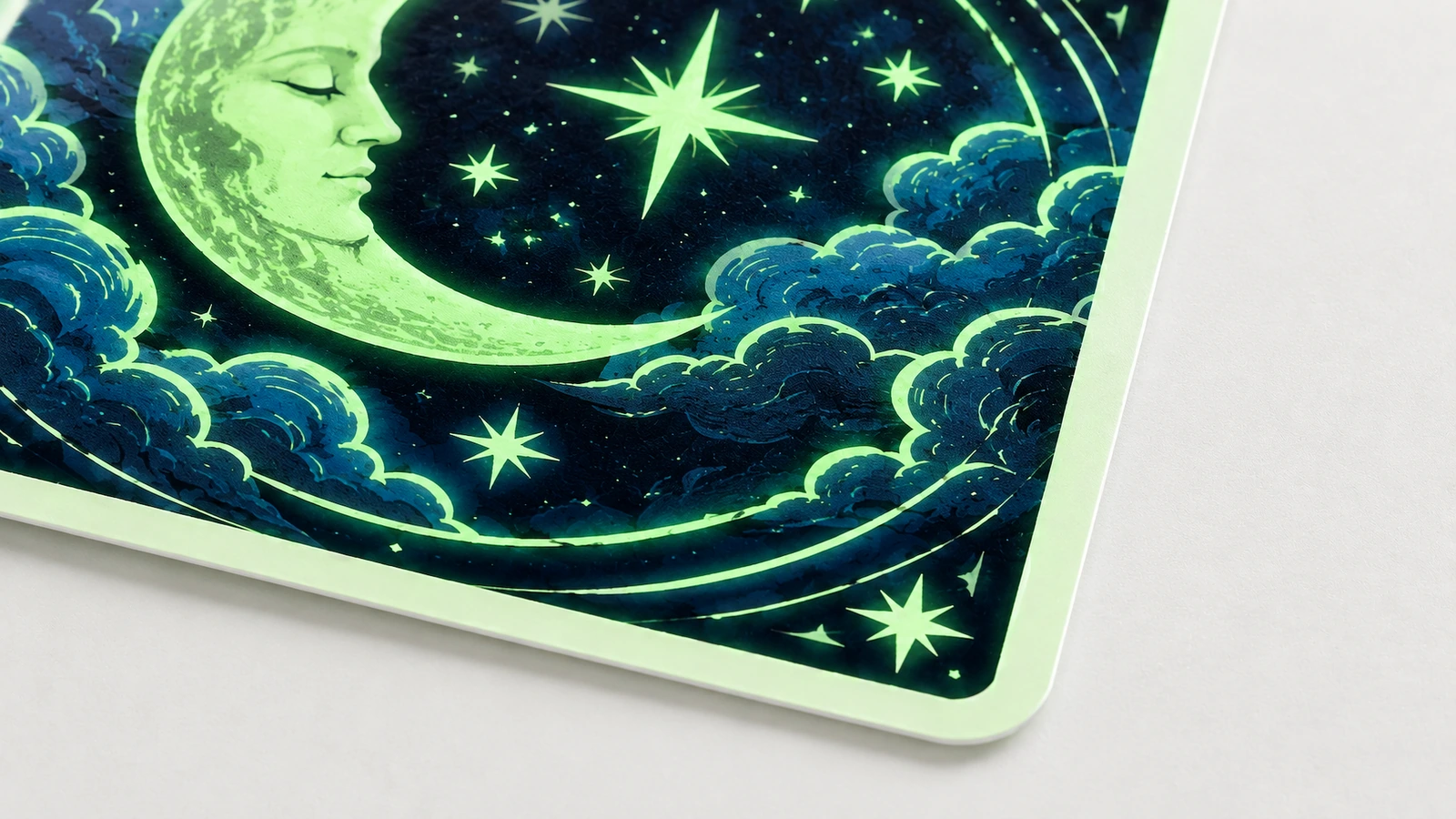
Adhesive draws almost as many complaints as glow does. Verified buyers of a permanent glossy glow sticker praise its brightness. They also say it can be "a pain to separate from the backing" (StickerYou reviews[15]). The opposite failure shows up on walls. A tenant's "apartment-friendly" glow decals left residue that even Goo Gone could not remove (r/Landlord thread[16]).
We choose adhesive by surface:
- **Removable:** painted walls in rentals and kids' rooms.
- **Permanent:** laptops, bottles and gear.
- **Test strip first:** curved or textured surfaces.
If you are unsure, the proof includes an adhesion check on your real surface.
Outdoor claims vary most between suppliers, from 12–18 months at StickerGiant to up to 5 years at CustomStickers.com. Carstickers calls glow vinyl mainly an indoor material, and 3M rates its safety film at one year outdoors. Sunlight, heat, abrasion and dirt all reduce how well the film charges and glows. A UV laminate protects the print and the glow layer, at some cost to clarity. StickerGiant also states that glow stickers are not dishwasher safe. Outdoor life for your SKU is therefore a pending test item, not a fixed number of years.
How Does an Order Move From File to Delivery?↑
Each step ends with something you approve, so expectations are settled before any film is used.
- Use brief: purpose (merch, kids' room, gear, functional marking) and application surface.
- Artwork and preflight: upload the file, mark the glow-reserve area and approve fixes.
- Material selection: confirm film, finish, laminate and adhesive.
- Dark-room proof: after a stated charge, review a daylight photo plus photos at lights-off, 10 minutes and 60 minutes.
- Production: printing and cutting start only after proof sign-off.
- Inspection and packing: finished stickers are checked against the approved proof.
| Field | What gets stated | Why it matters |
|---|
| Use category | Decorative / promotional only, or a project-specified marking | Determines which claims are allowed |
| Pigment system | Strontium aluminate or zinc sulfide film | Large difference in brightness and afterglow |
| Glow-reserve area | Marked on the approved proof | Ink coverage controls visible glow |
| Finish and laminate | Gloss or protective laminate, or none | Affects outdoor wear and print clarity |
| Adhesive and surface | Removable or permanent; target surface | Prevents wall damage or peeling |
| Charge and acceptance | Light source, charge time, check intervals | Makes glow measurable and comparable |
| Quantity, MOQ, lead time | Confirmed in the written quote after sampling | Not published until verified for your SKU |
The quotation fixes these fields in writing, so no result depends on a supplier's own idea of "bright." Minimum order, sample time and production time depend on film, artwork complexity and quantity. They are confirmed in your quotation, not published as figures that may not fit your design.
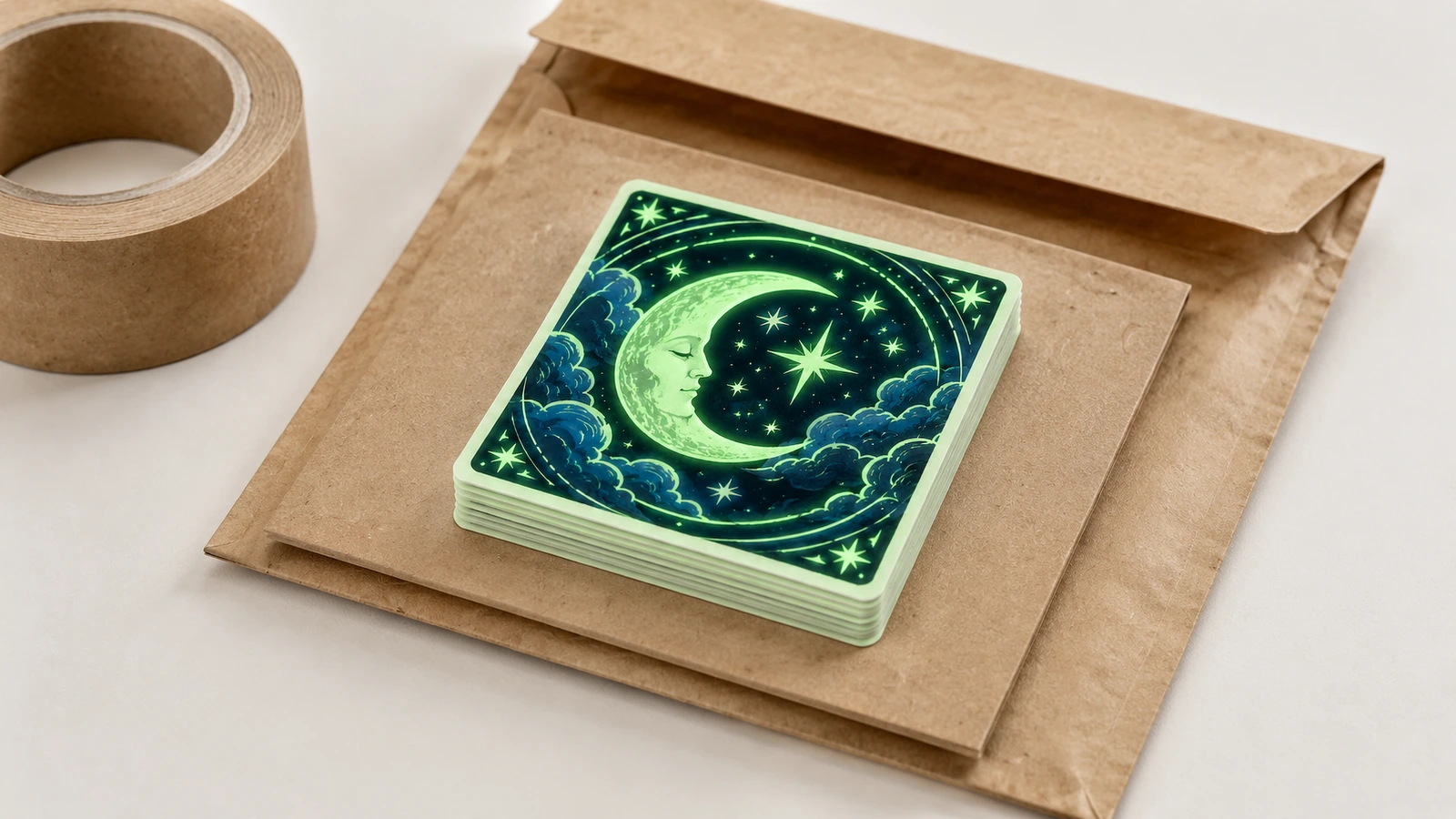
Quality inspection. Cheap glow tape is often criticized for patchy rolls where only part of the length glows. To prevent this, we pull samples from the start, middle and end of each run. Each sample is charged under your proof's light and compared in the same dark room against the approved sample. Print registration, cut accuracy and edge lift are checked in daylight. A batch that glows clearly weaker than the proof is treated as a defect, not a matter of taste.
Packing, shipping and reorders. Stickers ship packed flat to protect cut edges and laminate. Your quote confirms carton details and shipping method, and lists production time and transit time separately. The approved proof stays on file, so a reprint months later is checked against the same standard. Under our returns policy, custom items cannot be refunded "if you don't like the product," because they cannot be resold. Quality problems documented with a photo or video are reprinted (returns and exchanges policy[17]). That is why the proof sign-off matters.
Decorative or Safety Grade: Which Do You Need?↑
Decorative glow stickers and life-safety markings are different products. MyParkingSign, which sells both, says: "Promotional grade is ideal for giveaways and light commercial use. Use Safety Grade materials for critical safety and security purposes" (MyParkingSign grades[18]). Comgraphx notes that consumer glow stickers "are not intended as OSHA-compliant safety markings or emergency egress signage" (Comgraphx guide[19]).
Code-required egress markings follow their own acceptance path. A commercial building checklist dated October 6, 2026 summarizes the usual requirements. Products are listed to UL 1994, and brightness is checked against the ASTM E2072 thresholds. Before occupancy, markings are charged with at least 1 footcandle (11 lux) of fluorescent light for 60 minutes. Locally adopted code editions govern (egress marking checklist[20]). For exit signs: "Decorative 'glow' plaques/stickers are not substitutes for a UL 924 exit sign" (UL 924 guide[21]).
| Use case | Suggested route | What not to claim |
|---|
| Merch, giveaways, tour or event stickers | Promotional glow film; glow-reserve artwork; dark-room proof | "Glows all night" |
| Kids' room names and shapes | Removable adhesive; avoid small pieces; product testing if aimed at children | "Non-toxic" without a test report |
| Laptop, bottle, e-reader decor | Permanent adhesive; laminate; clear border | "Dishwasher safe" |
| Vehicle, mailbox, outdoor gear | UV laminate; outdoor life tested on sample | A fixed number of outdoor years |
| Exit paths, stairs, fire equipment | Listed safety-grade film to project specifications | "Meets fire code" on decorative stickers |
The first four rows are the core of this product. We make no compliance claim for egress or exit use. If your project requires UL 1994 listing or ASTM E2072 testing, send the specification. Without a listing number and a test report supplied with the goods, the sticker is sold as decorative.
What Should Kids' Room Buyers Check?↑
For parents, the main question is not radiation but whether the sticker counts as a children's product. Under CPSC guidance, products designed mainly for children 12 and under need third-party testing and a Children's Product Certificate. Toys manufactured after April 20, 2024 must meet ASTM F963-23, which 16 CFR Part 1250 makes mandatory (CPSC toy safety guidance[22]).
A CPSIA overview dated May 28, 2026 lists lead limits of 100 ppm in accessible parts and 90 ppm in surface coatings. Certain phthalates are limited to 0.1% in toys and child care articles under 16 CFR Part 1307 (CPSIA testing overview[23]). PVC face films and adhesives should be checked against these limits. Small shapes raise a separate choking concern under 16 CFR 1501. For stickers aimed at children, test reports on the finished sticker are a pending item in your quote and are never claimed in advance. Larger shapes and removable adhesive reduce both choking risk and wall damage.
Key Takeaways for Buyers↑
- Glow durations in hours are not comparable without a stated brightness and charging condition. — 20–30 min per charge vs. up to 15 h claimed (Source, Source)
- Safety markings have a measurable minimum; decorative stickers do not. — ≥30 mcd/m² at 10 min and ≥5 mcd/m² at 90 min (Source)
- Egress markings also require listing and defined charging light. — UL 1994; 11 lux for 60 min before occupancy (Source)
- Glow film costs moderately more than standard vinyl. — ~25% premium; $0.27 vs. $0.22 per 3"×3" sticker at 100 units (Source)
- Outdoor life claims vary widely between suppliers. — 12–18 months to up to 5 years (Source, Source)
- Children's glow products follow toy and CPSIA rules. — ASTM F963-23 for toys made after April 20, 2024 (Source)
Ready to See Your Design in the Dark?↑
A glow sticker succeeds when four things line up:
- The artwork leaves room for the film to glow.
- The adhesive suits the surface.
- The charging condition matches the room.
- The claims match the grade.
We set all four in writing and confirm them with a dark-room proof before production. Afterglow, outdoor life, minimum order and lead time stay marked as pending until they are verified for your design. Decorative stickers are sold as decorative. Projects that need listed safety markings are built to your specification, not filled with a relabeled novelty product.
Upload your artwork and use case to request a dark-room proof and written quotation.




The information below is required for social login
Sign In
Create New Account