Custom kiss-cut sticker sheets put several peelable designs on one shared liner. A single page can then serve as a retail pack, a mailer insert, or an event giveaway. Four factors decide whether every sticker peels cleanly, holds its color on reorder, and survives water or sun: the material, the laminate, the layout spacing, and proof approval. The sheet format itself does not.
Who Orders Custom Sticker Sheets, and What Do They Need? ↑
People who search for this product usually want to place a print order. They are not looking for a finished pack. Four buyer groups show up again and again in reviews and seller forums:
Independent artists and fandom creators build themed collections for conventions and online shops. Fourthwall reports that about 70% of sticker sales on its platform come from small-tier creators who work without a team Fourthwall creator data[1]. Small DTC brands in skincare, honey, and PC resale use sheets as logo inserts and package seals. Event organizers order small runs for youth teams, reunions, and parties. Planner sellers need matte, writable stock, not outdoor vinyl.
All four groups need the same things in different proportions: several designs on each page, a first run small enough to test what sells, a finish that suits the surface the sticker will go on, a ship date they can rely on, and a unit cost that still works when the sheet is a free gift. The rest of this page follows those decisions.
Why Do Sticker Sheet Orders Fail After They Ship? ↑
Problem. Sheets can fail in ways that single die-cut stickers rarely do.
The first is blocking. Stacked vinyl pages cling together until one page pulls stickers off the next. A seller who ordered 300 vinyl sheets wrote that "sometimes the sheet above will actually peel off the stickers from the sheet below." The free second batch had the same defect blocked vinyl sheets[2]. In a separate complaint, a supplier blamed stacking the sheets too soon after printing.
The second is cut depth. Another seller received sheets with uneven cutlines and wrote: "I shouldn't have to cherry pick through my stickers about which are good enough to sell" uneven cutline report[3].
Agitate. These defects do the most damage when the order is tied to a date. A reprint is the usual fix, but a reprint cannot bring back a missed show. One buyer gave an event order more than two weeks of lead time. The order still "arrived two weeks AFTER the bachelorette" late event delivery[4]. Color drift between batches costs you more slowly. If you cannot match last month's sheet, the old inventory no longer pairs with the new.
Solution. Write the specification before you order. Match the face stock and laminate to the end use, build the layout to measured spacing rules, approve the proof against a physical reference, agree on written acceptance criteria, and leave enough time before any event for one full reprint.
Contents
What Is a Kiss-Cut Sticker Sheet, and How Many Designs Fit? ↑
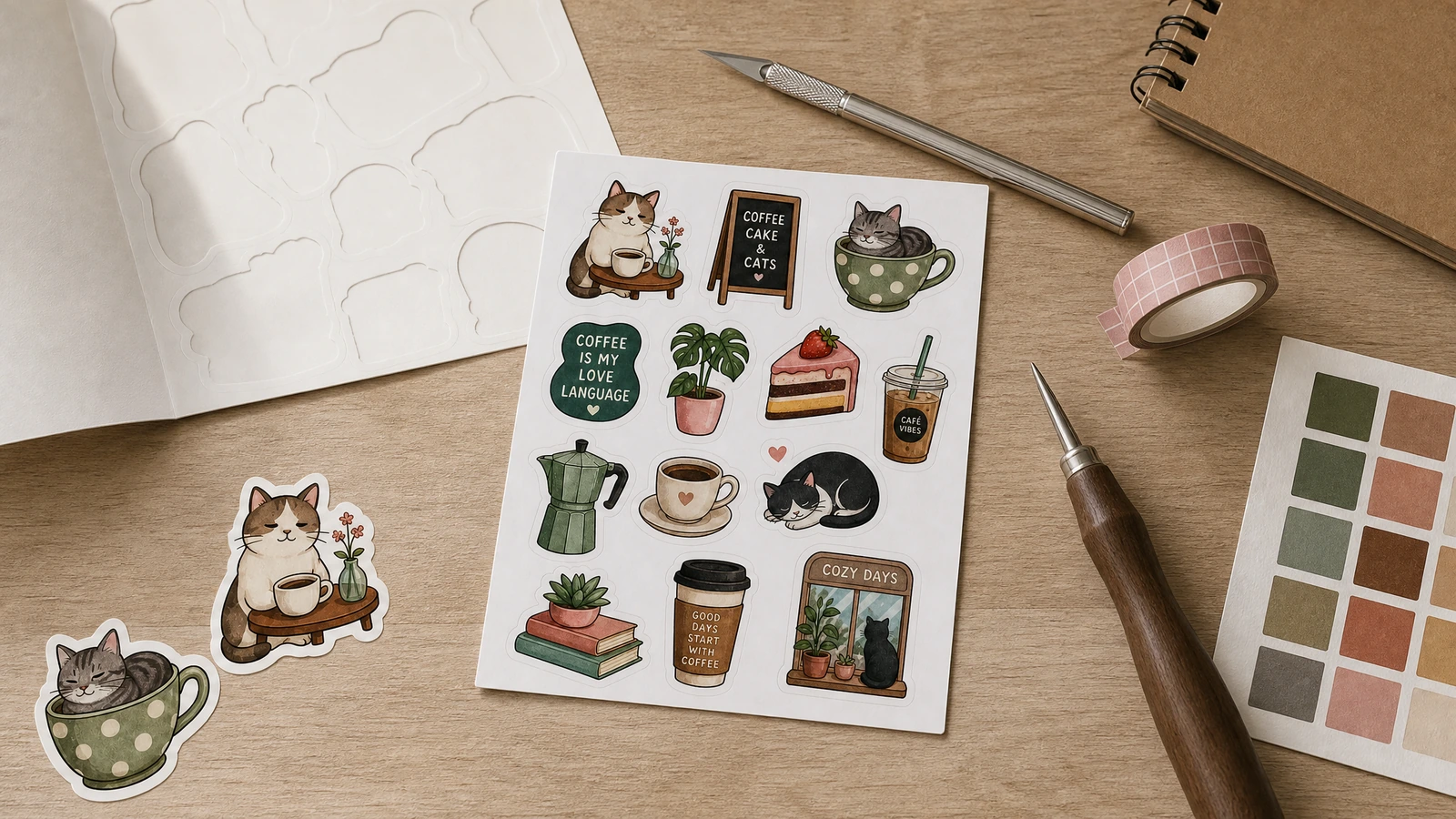
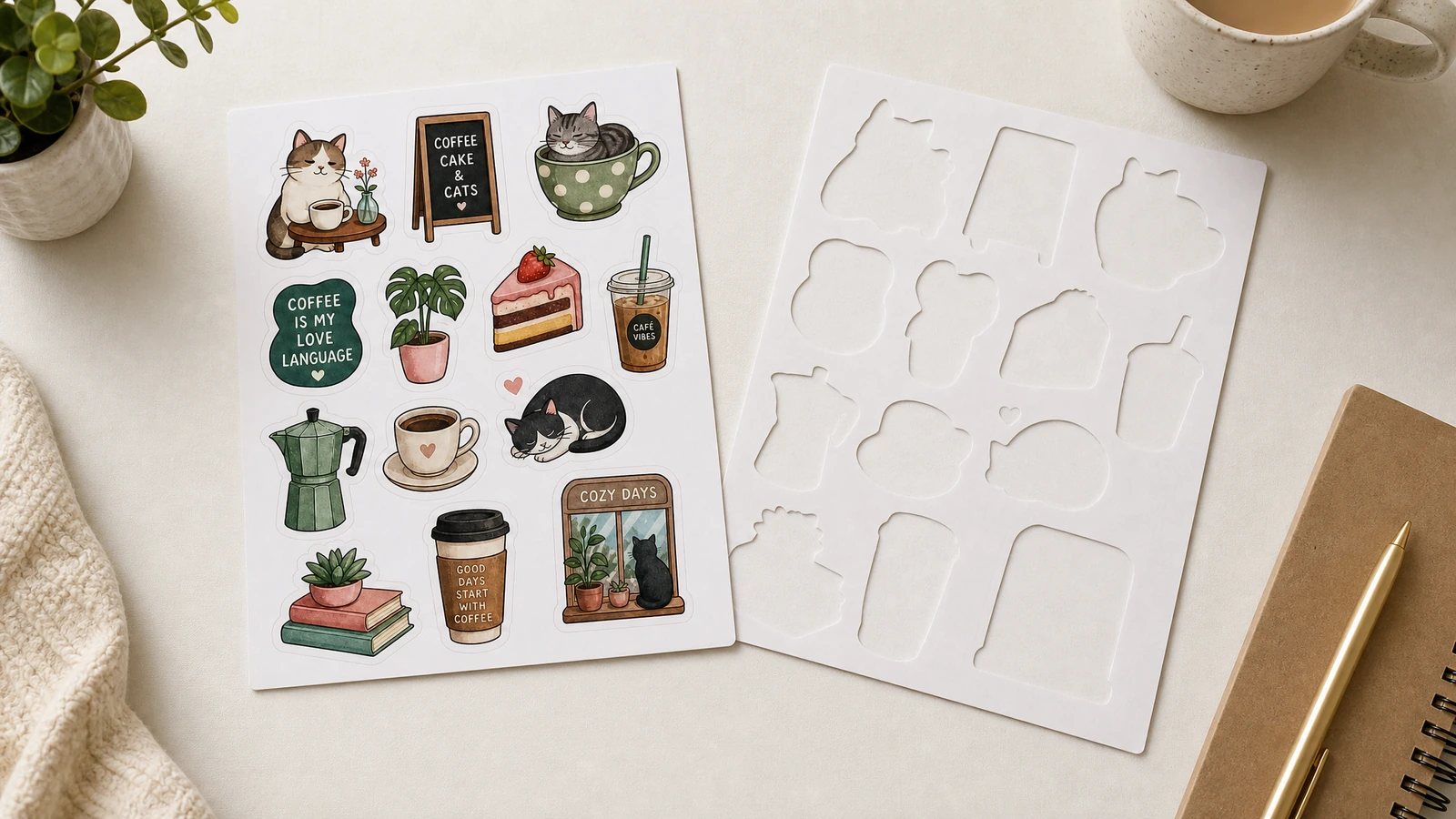
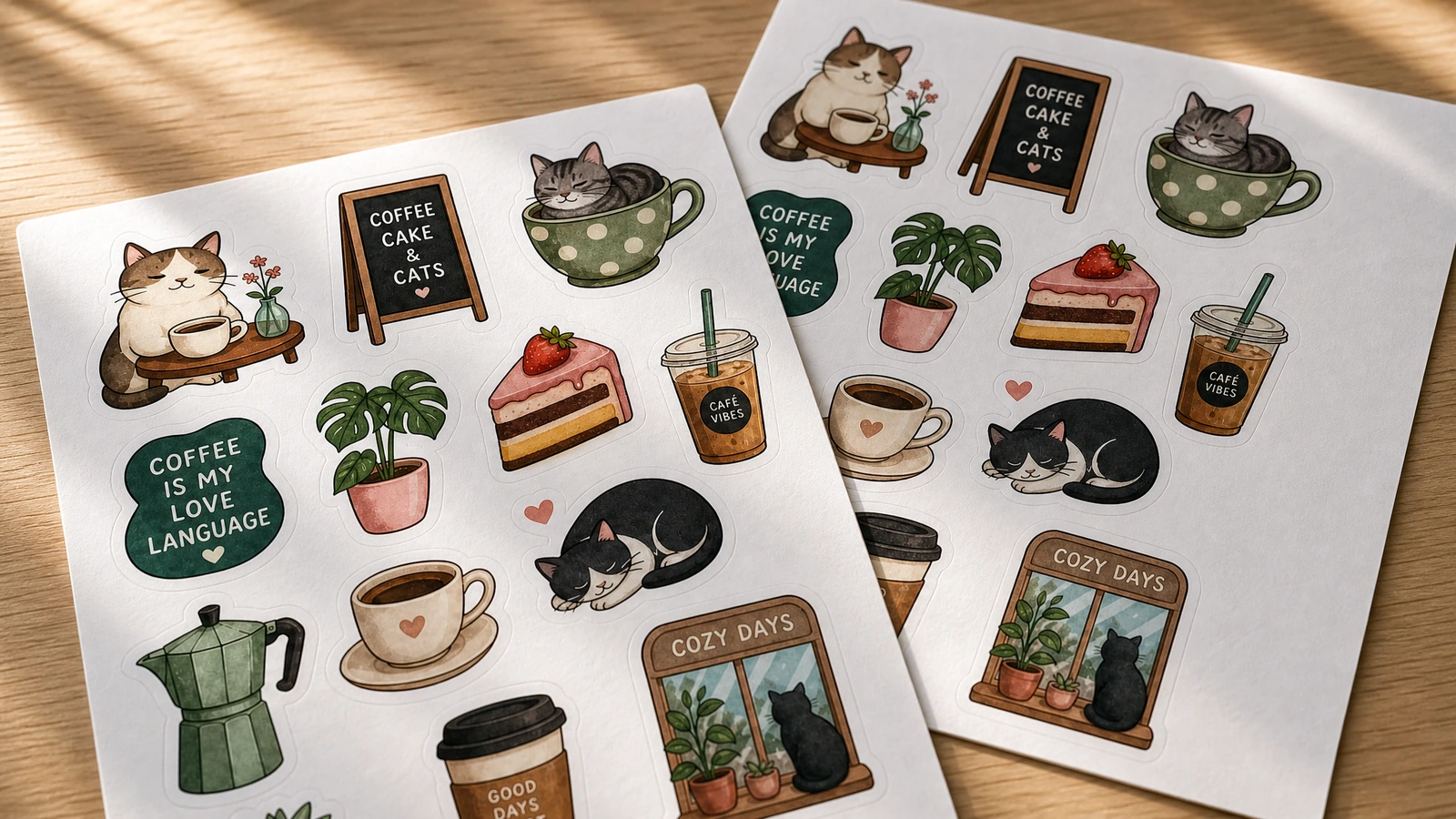
For a kiss cut, the blade depth is set to the thickness of the face stock plus the adhesive. 4OVER4 describes the result this way: "it cuts the shape but the liner underneath stays intact and continuous" kiss-cut definition[5]. That shared liner is what makes a sheet. Each sticker lifts off on its own and the rest stay in place.
A die-cut single is cut through the liner as well, so it arrives as a loose piece. Choose singles when each design needs its own outline with no liner around it. Choose sheets for sets, bundles, or mixed sizes on one page.
The number of stickers per sheet comes out of the layout. It is not a fixed spec. The table below shows 4OVER4's published counts for square stickers, based on a 0.25 in sheet margin and 1/8 in gaps sheet density guide[6].
| Sheet size | mm | 1 in squares | 2 in squares | 3 in squares |
|---|
| 4 × 6 in | 101.6 × 152.4 | 15 | 2 | 1 |
| 5 × 7 in | 127 × 177.8 | 20 | 6 | 2 |
| 8.5 × 11 in | 215.9 × 279.4 | 63 | 15 | 6 |
Use these as planning figures only. Rounded corners, irregular outlines, and bleed all lower the count. Your actual artwork sets the final number, and the proof confirms it.
Supplier limits also vary. StickerGiant allows up to 11 × 14 in and 30 designs per sheet, with a 0.375 in minimum sticker size StickerGiant artwork rules[7]. StickerApp lists a 10.8 × 10.8 in maximum and a 1 × 1 in minimum StickerApp size limits[8]. Ask for the limits that apply to your own quote.
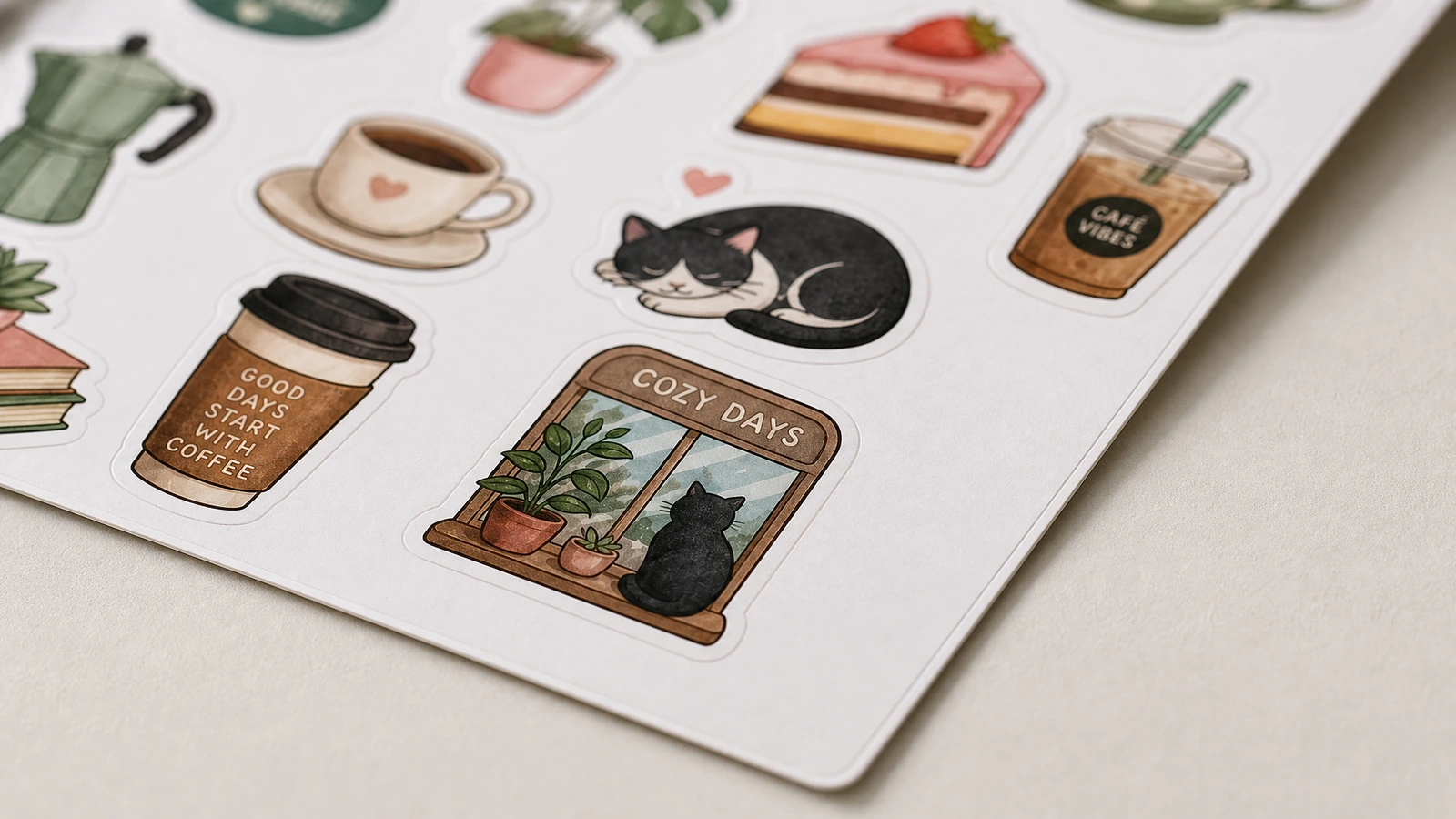
Small stickers leave little room for text, so a few habits help:
- Keep critical copy inside the safe zone.
- Avoid hairline strokes near cutlines.
- For stickers under about 1 in, ask for a peel tab or an exposed liner corner so they can be lifted easily.
- On the proof, give every dimension in both inches and millimeters.
- Label the overall sheet size separately from each cutline size. Mixing up "2 × 3" in inches with centimeters is a common source of disputes.
The surface and backing decide how the sheet behaves in use. Paper is writable and cheap. But 4OVER4 notes that uncoated, semi-gloss, and hi-gloss UV paper "will wrinkle and lift once they are properly wet" paper vs vinyl guide[9]. White vinyl handles moisture and outdoor use.
Holographic films catch the eye but can swallow detail. One verified buyer wrote that the illustration "got 'lost in the sauce' of the holographic parts" holographic review[10].
On the back of the sheet you have two more choices: permanent or removable adhesive, and a plain or printed liner. Confirm which backing options your material supports at the quote stage.
How Do You Order a Sheet That Peels, Matches, and Arrives on Time? ↑
Most failures in the section above can be traced back to a gap at one of these six steps:
- Define the end use and the in-hand date. Write the date the stickers must be in your hands on the order, not just a production estimate.
- Choose a face stock and laminate that suit that environment, using the comparison table below.
- Draw closed cutlines on a separate spot-color layer. Extend bleed past every cutline, and keep a safe zone inside it.
- Preflight the file. Use vector art, or 300 dpi at final size. Outline all text and use CMYK color.
- Approve the proof against a physical reference sheet, not against your screen.
- Inspect the shipment against written criteria before anything goes to your customers.
Spacing rules differ enough between suppliers that mixing their figures causes errors. Paperlust recommends at least 3–4 mm between adjacent cutlines, and 4–5 mm at sharp corners, so that drift in the cut does not merge shapes Paperlust spacing guide[11].
| File rule | StickerGiant | StickerApp | 4OVER4 general |
|---|
| Bleed past cutline | 1/16 in | 2 mm (0.075 in) | 1/8 in |
| Gap between stickers | 1/16 in | 2 mm | 1/8 in |
| Distance from sheet edge | 1/8 in | 2 mm | 0.25 in |
| Safe zone | 1/16 in inside cutline | Not listed separately | Text 1/8 in from trim |
| Minimum sticker | 0.375 in | 1 × 1 in | Not fixed on page |
Use one column for each job and do not mix them. These figures come from the sources cited above. If your quote lists its own tolerances, those override all three columns.
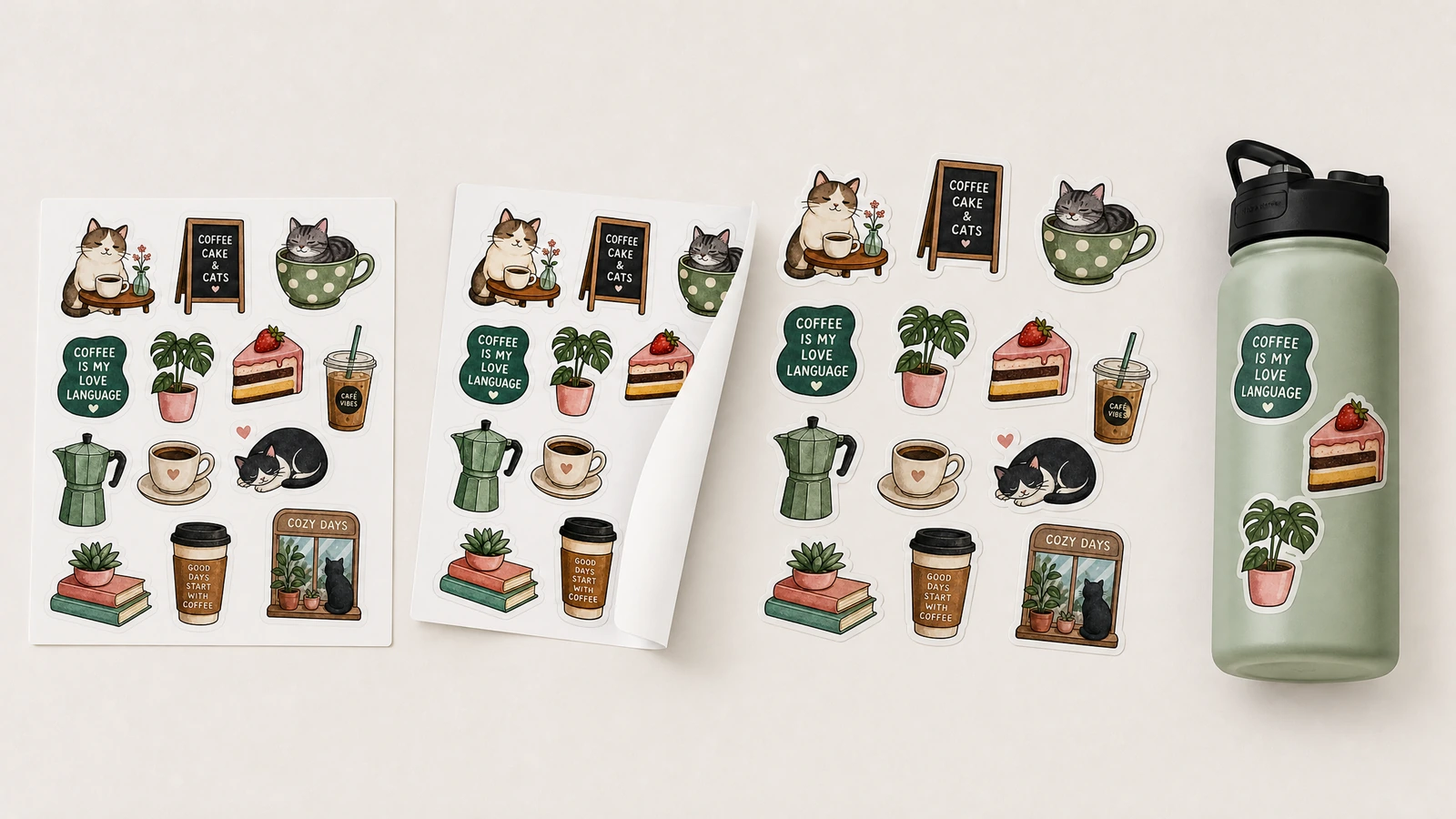
A typical digital short run goes from approved proof to print, laminate, kiss-cut, and trim. Two process points matter most to you as a buyer: cut depth has to be tested on each material, and laminated sheets need time to cure before they are stacked. Ask how both are controlled before your order goes into production.
If you need documented performance rather than adjectives, ask which test method backs each claim:
- Peel adhesion of pressure-sensitive materials is measured under ASTM D3330[12].
- For conditions closer to labels, the equivalent is FINAT FTM 1, a 180° peel at 300 mm/min FINAT test methods[13].
- Rub resistance of the print uses the Sutherland rub tester under ASTM D5264[14].
Rub cycles in a lab do not translate into years outdoors. UL 969 recognition covers only a specific labeling system that has a file number UL 969 constructions[15]. Promotional sheets usually have no such file.
When the order arrives, and before any sheets ship to customers, peel 5–10 stickers at random, including the smallest and any with inner corners. Pull pages from both the middle and the edge of the stack to check for blocking.
4OVER4 lists these as grounds for a reprint: visible color shift from the approved proof, cutlines off the art, bubbling or uneven laminate, streaks, and misregistration reprint conditions[16]. These are a useful benchmark, but not an industry mandate.
| Check | How to test | Fail condition |
|---|
| Kiss-cut depth | Peel 5–10 random stickers | Sticker will not lift, or tears the liner |
| Cut registration | Compare edges with the proof | White edge where artwork had bleed |
| Blocking | Separate sheets from the middle and edge of the stack | Stickers transfer to the adjacent page |
| Color | Compare with the signed reference sheet | Visible shift, banding, or missing ink |
| Surface | Inspect under raking light | Scratches or debris under the laminate |
If any check fails, photograph the defect next to the order number and ask for a reprint of the whole lot. Do not cherry-pick usable sheets.
Expect some registration drift between print and cut on kiss-cut sheets. Full-color backgrounds without bleed can therefore show a white edge.

Which Material, Price Point, and Claims Fit Your Order? ↑
| Option | Best fit | Durability claim | Caveat |
|---|
| Paper (uncoated, semi-gloss, hi-gloss UV) | Planners, indoor seals, handwritten labels | Indoor only | Wrinkles and lifts when wet |
| Laminated white BOPP | Brand merch, packaging, hand-washed bottles | 2.6 mil; up to 12–18 months outdoors StickerGiant specs[17] | Hand wash; dishwashers may affect the laminate over time |
| Laminated white vinyl | Laptops, coolers, outdoor gear | Some vendors claim 5 years outdoors | Vendor-stated, not independently tested |
| Removable vinyl | Glass, rentals, short-term displays | Short-term use | Not for oily packaging or long-term outdoor use |
| Holographic, glitter, kraft | Gifts and fandom drops | Do not assume white-vinyl lifespans | Kraft is often unlaminated; fine lines blur |
Read any lifespan claim with care. The Print Reviewer labeled one vendor's waterproof, dishwasher-safe, 5-year claims as "vendor-stated performance claims, not independent durability results" vendor claim caveat[18]. Apply the same caution to every lifespan figure. Ask for the material datasheet, and read the years as rated conditions, not as a warranty.
Compare prices only at the same size, material, and quantity. Volume breaks on short runs are steep:
- When we checked, StickerYou's white vinyl pages cost $9.99 for one page and $2.89 per page at 100–500 pages, shipping excluded StickerYou pricing[19].
- Sellers comparing 5 × 7 in sheets reported about $3.40 per sheet at Jukebox with a 10-sheet minimum. StickerGiant's clear sheets came to about $1.74 each, but with a 50-sheet minimum of about $87 seller price comparison[20].
- Bend Print Co estimates that sheets cost roughly 15% less per sticker than die-cut singles. That is an author estimate, not audited data sheet cost estimate[21].
None of these figures should be averaged into an "industry price."
Environmental wording carries legal risk. In the US, "recyclable" or "eco-friendly" claims are governed by the FTC Green Guides at 16 CFR Part 260. Their substance has not been comprehensively updated since 2012 16 CFR Part 260[22].
California's SB 343 restricts recycling symbols on products and packaging manufactured after October 4, 2026. A preliminary injunction issued on July 14, 2026 blocks enforcement, but the law itself still stands CalRecycle SB 343[23]. Promotional stickers rarely enter municipal recycling. Unless you hold supporting evidence, make no recyclability claim.
Some market context helps set expectations. Sheets are a niche format: they fell from 7% to 3% of European labelstock demand over two decades FINAT/Panteia data[24]. Meanwhile, US package and label printers expect digital or hybrid output to grow from 39.3% to 53.5% of production within five years PRINTING United survey[25]. Short-run digital printing is what makes small first runs practical. It does not remove the cutting and blocking risks described above.
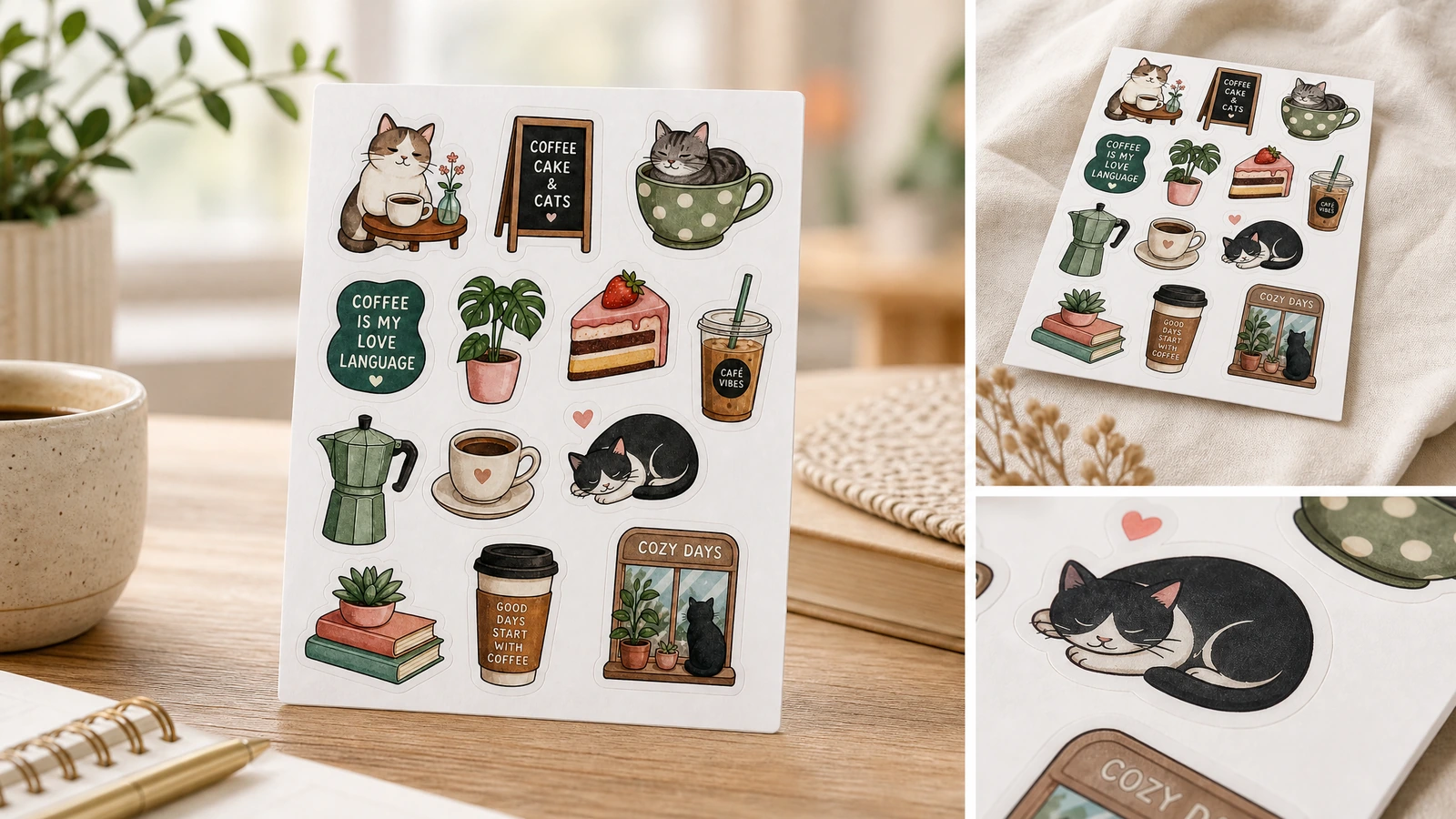
Ask how the sheets will be packed. Gloss laminate shows scratches, so it needs interleaving. Sheets should travel flat so the corners do not crumple, and stored stacks should not sit under heavy weight in warm rooms.
Keep a signed reference sheet from your first run and send it with every reorder. Then color and cut are matched to a physical sample, not to memory. For event orders, set the in-hand date so there is room for one complete reprint plus transit.
Key Takeaways: What Should Buyers Remember? ↑
- Sheets are a shrinking share of labelstock, so precise specs matter more than broad claims — 3% of European demand, down from 7% (Source)
- Outdoor life is specific to each material and stated by the vendor — up to 12–18 months for laminated 2.6 mil white BOPP (Source)
- Short-run volume breaks are steep — $9.99 for 1 page vs $2.89 per page at 100–500 pages (Source)
- Layout tolerances differ by supplier, so keep to one rule set — 2 mm (0.075 in) bleed and spacing at StickerApp (Source)
- California recycling labels now have a manufacturing cutoff date — October 4, 2026; enforcement enjoined July 14, 2026 (Source)
- Digital short-run capacity keeps expanding — 39.3% of output now, 53.5% expected in five years (Source)
What Should You Send to Get an Accurate Quote? ↑
A sticker sheet that works is the result of decisions written down before printing. These include the material and laminate, measured spacing and bleed, a proof checked against a physical reference, acceptance tests for peel, blocking, and color, and a delivery date with room for a reprint.
MOQ, production time, available sizes, and backing options for this product depend on your artwork and material. Your written quote and proof will confirm them, so they are not listed here as fixed numbers.
Send your artwork, sheet size, number of designs, quantity, end use, and in-hand date to request a quote and proof for your custom kiss-cut sticker sheets.




The information below is required for social login
Sign In
Create New Account