Custom lenticular stickers print two or more interlaced images behind a ridged plastic lens. When the viewer tilts the sticker, the artwork flips, moves or gains depth. They work best on flat packaging, launch kits and limited merch. Place a production order only after a physical proof confirms the effect type, lens LPI, minimum font size and adhesive at three viewing angles.
Who Orders Custom Lenticular Stickers, and for Which Jobs? ↑
The core buyer is a brand, packaging or marketing manager who needs a flat panel to stand out on the shelf or on camera. Packaging suppliers such as Alora Packaging[1] list food packaging, cosmetics and beauty, beverage promotions, consumer electronics and retail packaging as typical uses. In practice, the sticker goes on gift-box lids, carton panels and launch mailers, where a logo flips to reveal an offer, a date or a second product shot.
Event teams and corporate gift buyers make up the second group. They buy for launches, pop-ups, trade-show handouts and channel gift boxes. Nobody in this group signs off on a full run without holding a sample, because the effect cannot be judged from a flat PDF.
Game, film and collectible buyers use motion to signal a limited edition. One collector recalled slipcases selling for $3.99 with a lenticular cover and $1.99 without, and added that "the old school special effect package design probably would have sold me anyway" (r/dvdcollection, 2024[2]). Illustrators and fan-merch creators order smaller batches. The Flicksticker FAQ[3] sets a 100-piece custom minimum and charges an extra 30 EUR to convert a photo to 3D, which shows how quickly small runs get expensive.
Why Do Motion Stickers Disappoint, and How Do You Avoid It? ↑
Many first orders fail because the buyer treats lenticular like premium vinyl. They send one flattened file, choose any die shape, plan to apply it to a bottle and expect delivery next week. Each of these assumptions is wrong for lenticular.
Start with cost, timing and shape. The 4OVER4 holographic vs lenticular guide[4] shows holographic stickers starting at 100 for $322.98. 3D lenticular starts at 500 for $866.62 and takes 15 to 22 business days to produce, compared with about 6 for holographic. Lenticular comes in 12 rectangle and square sizes, against 93 holographic sizes. The guide also describes the lens as "thicker and more rigid, best on flat surfaces."
Then comes ghosting. Lenticular World[5] defines ghosting as seeing more than one image at certain angles. It lists four causes: too much color contrast, poor registration, mismatched pitch or too many frames. Enduraline's design guide[6] warns that white or very light backgrounds can leave 10% to 20% of both images visible at once. Thin lines and small serif type break up under the lens, so a URL tucked into a corner becomes unreadable at arm's length.
This SKU, Custom Lenticular Motion-Effect Stickers (NSKU-702-01), is quoted as a specialist print job rather than a sticker upgrade. Before artwork starts, we confirm that the job actually needs a lenticular effect. We then fix the lens LPI and minimum font size, check every frame file, and release production only after you approve a physical proof at left, center and right angles. Minimum order, unit price, lens specification and production time are quoted after artwork review and confirmed on the approved sample. We do not publish fixed figures before the proof passes.
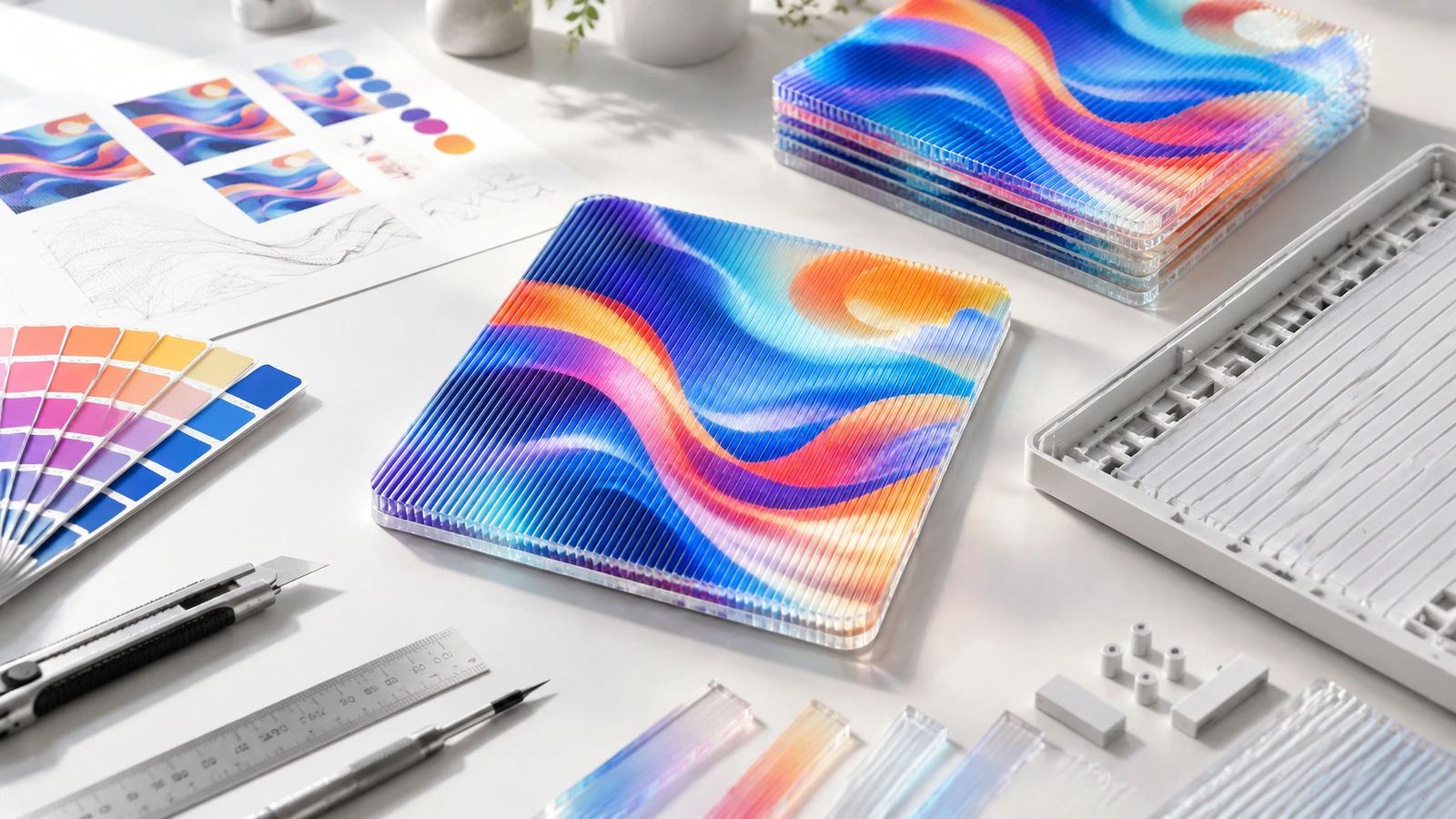
Table of Contents
What Exactly Is a Custom Lenticular Sticker? ↑
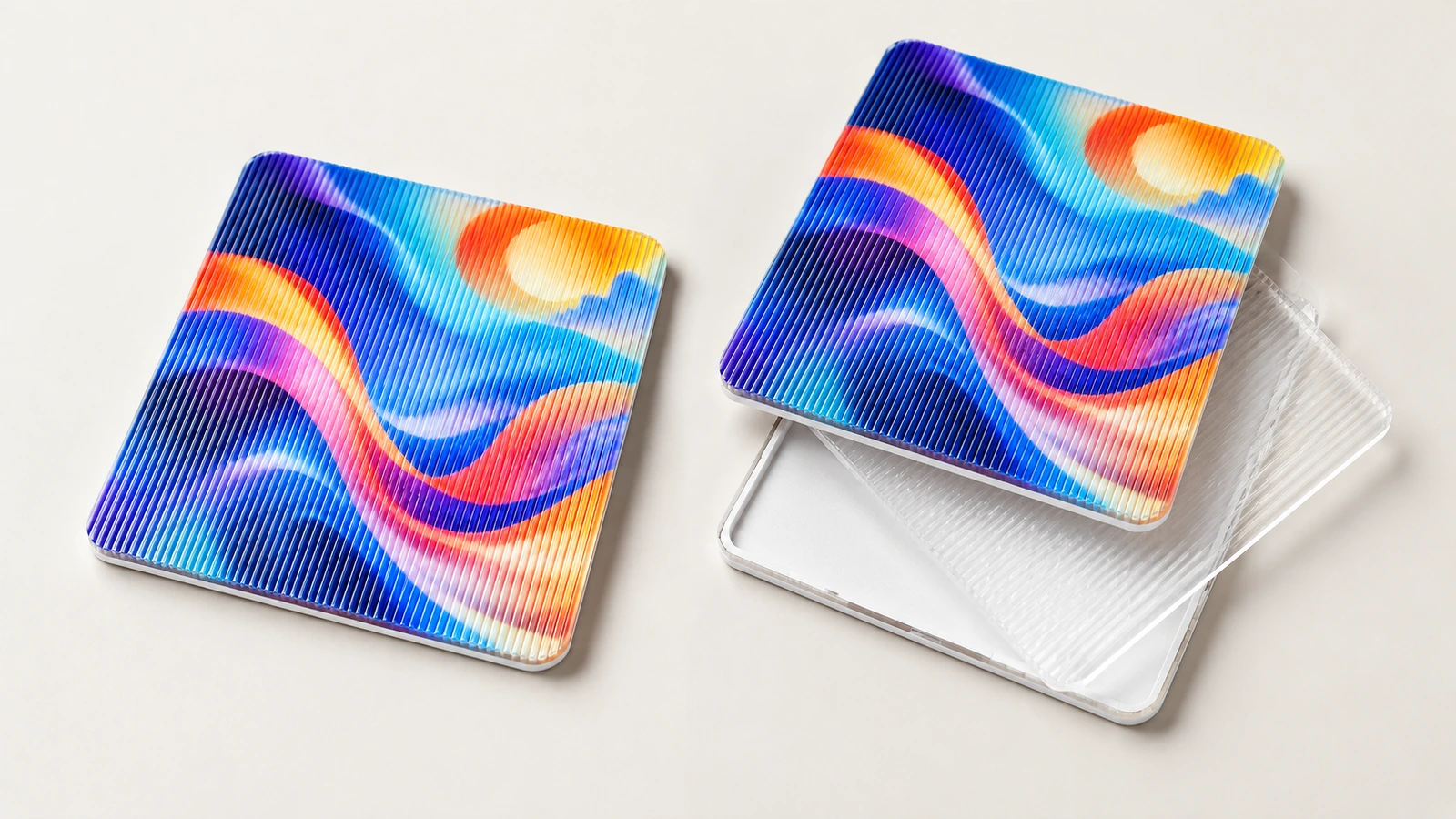
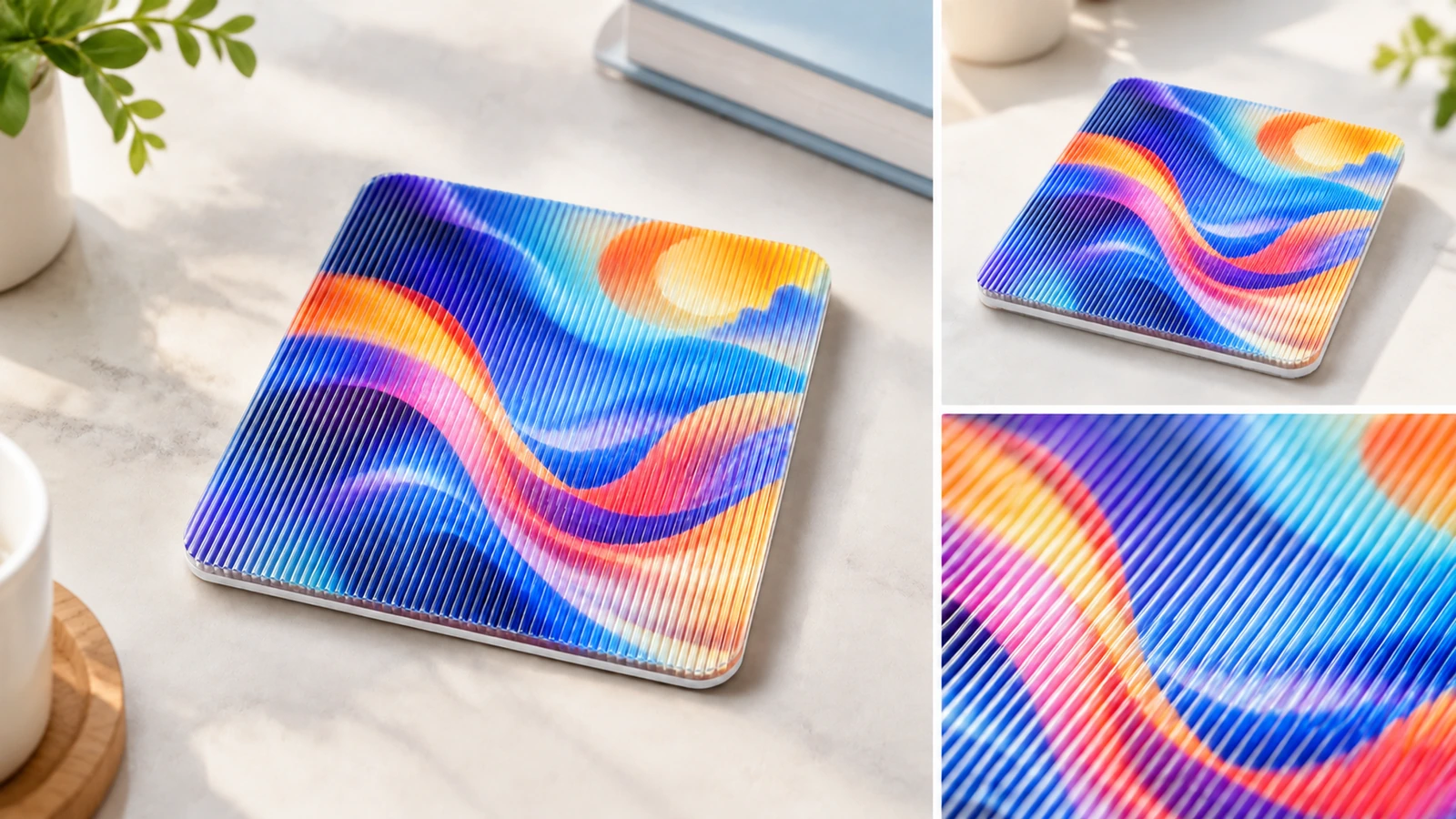
The face of the sticker is a sheet of tiny parallel ridges called lenticules. It is bonded over artwork that has been sliced into strips and interlaced. As 4OVER4 explains[7], each ridge sends different slices to your eye depending on the viewing angle. When you tilt the sticker, a new set of slices reaches your eye and you see a flip or a short animation. A sharp effect depends on the interlace matching the lens pitch, and "a blurry one is almost always an alignment problem." On holographic film, the shine slides over a fixed image. On a lenticular sticker, the image itself changes.
| Effect | What the viewer sees | Typical frames or views |
|---|
| Flip | One image switches to another | 2; hard to keep clean beyond 3 |
| Animation | Short motion sequence | Usually 4–8 |
| Morph | One image gradually becomes another | 10–20 |
| 3D depth | Depth without glasses | Usually 10–16 views |
The frame counts above come from the Owl3D lenticular lens guide[8]. For stickers, a clean two- or three-frame flip is the safest brief, and standard sticker lines offer 2, 3 or 4-image flips running vertically or horizontally. Animation, morph and 3D effects need more frames. More frames raise the ghosting risk and often require a different lens.
How LPI controls detail and readable type
LPI stands for lenticules per inch. The World3D LPI guide[9] notes that most prints smaller than about 18 × 28 in use a 75–100 LPI lens. It sums up the trade-off this way: "Low LPI give you a better effect. High LPI gives you a clearer image." Choose the lowest LPI that still holds your smallest detail.
| Lens LPI | Best for | Minimum font |
|---|
| 40 | Posters and POP viewed beyond arm's length | 18 pt |
| 75 | Packaging stickers, promotional flips, 3D | 12 pt |
| 100 | Small hand-held stickers, fine text | 8 pt |
The font minimums follow Enduraline's guide[6]. The same guide gives lens thicknesses of about 18 mil at 75 LPI and 14 mil at 100 LPI (1 mil = 0.001 in). Nominal LPI is never exact. ISO/TS 20328:2016[10] defines how lens sheet dimensions and pitch accuracy are measured, at 25 °C ± 2 °C and 50% RH ± 5%. It classes lenses below 75 lpi as low frequency and 75–150 lpi as medium. The standard explains how to measure a lens. It does not certify a sticker.
How Do You Take Lenticular Artwork to an Approved Batch? ↑
The process below has seven gates. Each gate rules out one failure mode before you pay for the full run.
Step 1: Confirm the job needs a lenticular effect
Choose lenticular only when the image must change or show depth as the viewing angle changes. A single fixed design is better printed on holographic film or standard vinyl. Choose one effect, set the hand-held viewing distance (roughly 30–50 cm) and the main direction of motion, and keep the frame count low. Do not combine a multi-frame animation with a high-contrast, full-image swap.
Step 2: Confirm the surface and adhesive
A 4OVER4 FAQ[11] states that 3D lenticular stickers are "designed for flat surfaces only" and that "the lens material is rigid and resists bending." Bending the lens also breaks the optical effect. Curved bottles, fabric and soft pouches should use holographic film instead.
For the adhesive, ask for the datasheet. As one example, a DPLenticular double-sided film[12] lists:
- Minimum application temperature of 10 °C
- Peel adhesion of about 11 N/25 mm on steel after 24 hours
- End-use temperature range of −40 °C to +150 °C
- Two-year shelf life and about one year of outdoor durability
These figures describe the film, not a sticker warranty. Outdoor and window jobs need a separately confirmed weather-rated adhesive and UV specification. For this SKU, we confirm adhesive and liner on the quote and test them on your actual substrate during proofing.
Step 3: Lock LPI and print resolution
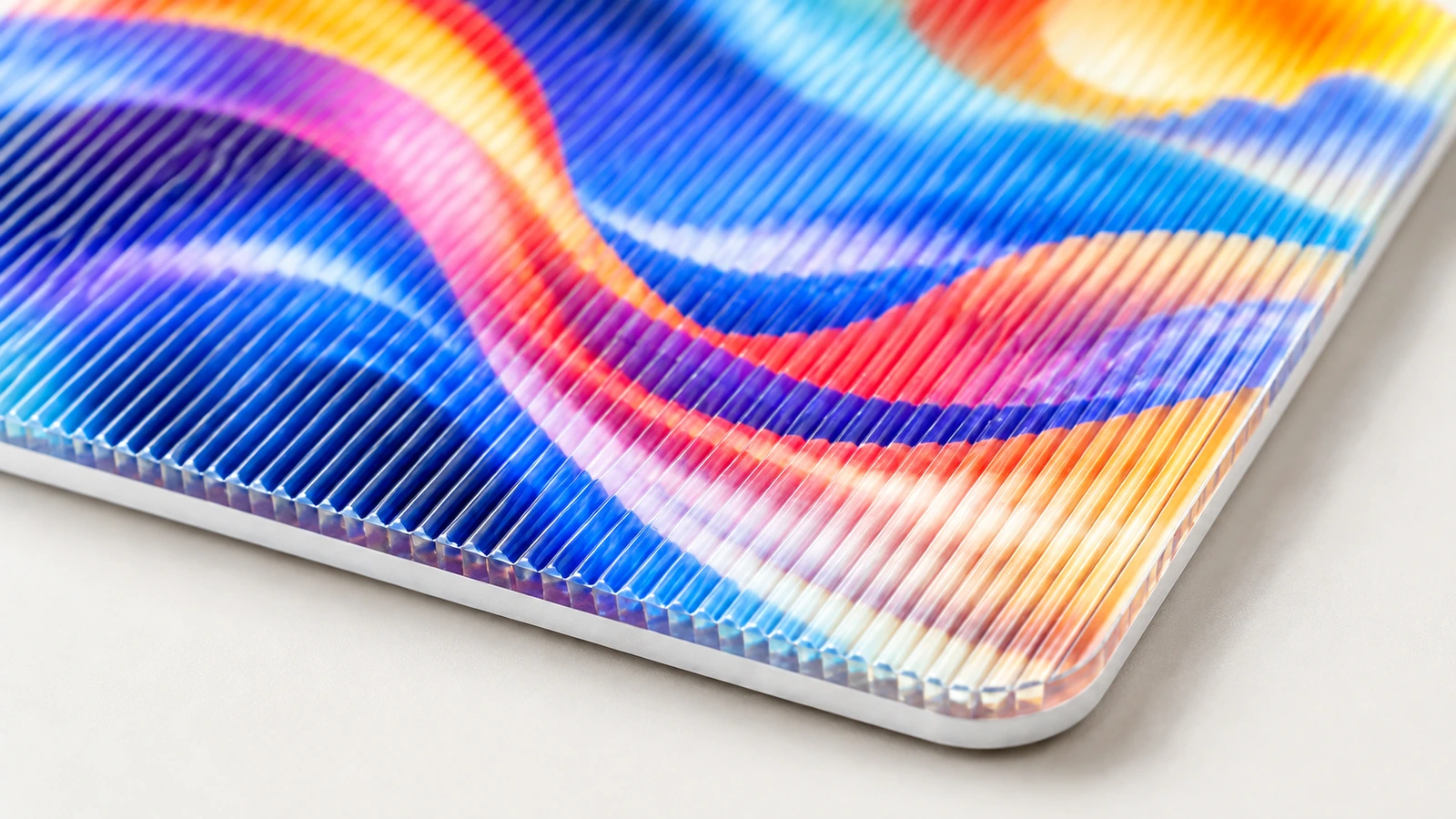
According to 4OVER4[13], the LPI set in the interlacing software "must match the physical lens exactly, and print DPI should be at least 720 for sharp stripe definition." Buyers still supply artwork at 300 dpi. The printer re-interlaces it to the measured pitch.
Step 4: Check every frame file before submission
Supply each flip or animation frame as its own full-size PDF, TIFF or JPEG in CMYK. Include editable source files and write down the frame order. For 3D jobs, supply a layered PSD in which every layer is filled in behind foreground objects. The World3D design guide[14] specifies:
- 300 dpi for pieces smaller than 27 × 40 in
- 1/8 in bleed on animation files
- A 1/4 in safety zone inside the trim line
- For 3D, a full 1 in bleed on the left and right
To limit ghosting, share backgrounds between frames, move only local elements, and avoid flipping from black to white. World3D's ghosting note[15] adds that more frames produce more ghosting, and that left-to-right animations ghost more than up-and-down ones. Do not interlace files yourself unless the printer gives you the measured pitch for that batch of lens material.
Step 5: Measure lens pitch before printing
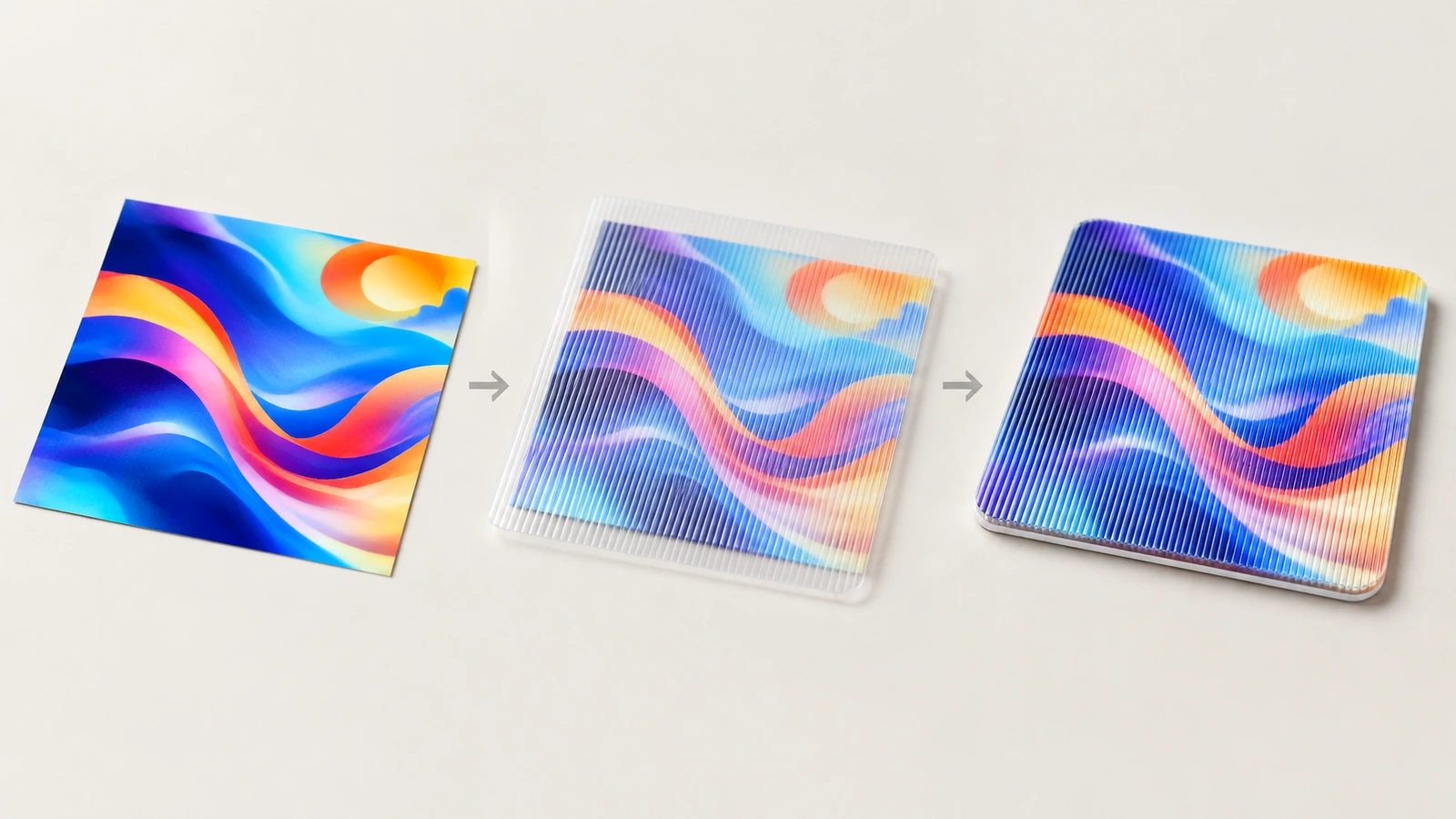
The Kodak white paper[16] describes the production sequence:
- Select the lens material and measure its pitch.
- Set the interlace resolution from that measurement and interlace the frames.
- Print onto the back of the lens, aligning the strips precisely to the lenticules.
- Die-cut and add the adhesive last.
Measuring the pitch matters because nominal values are often off. One DIY maker on Reddit[17] bought sheets sold as 50 LPI, then found from test prints that the artwork had to be printed at 47.73 LPI. Pitch can also shift between batches and with temperature and humidity. For that reason, the proof must be made on the same lens material used for production.
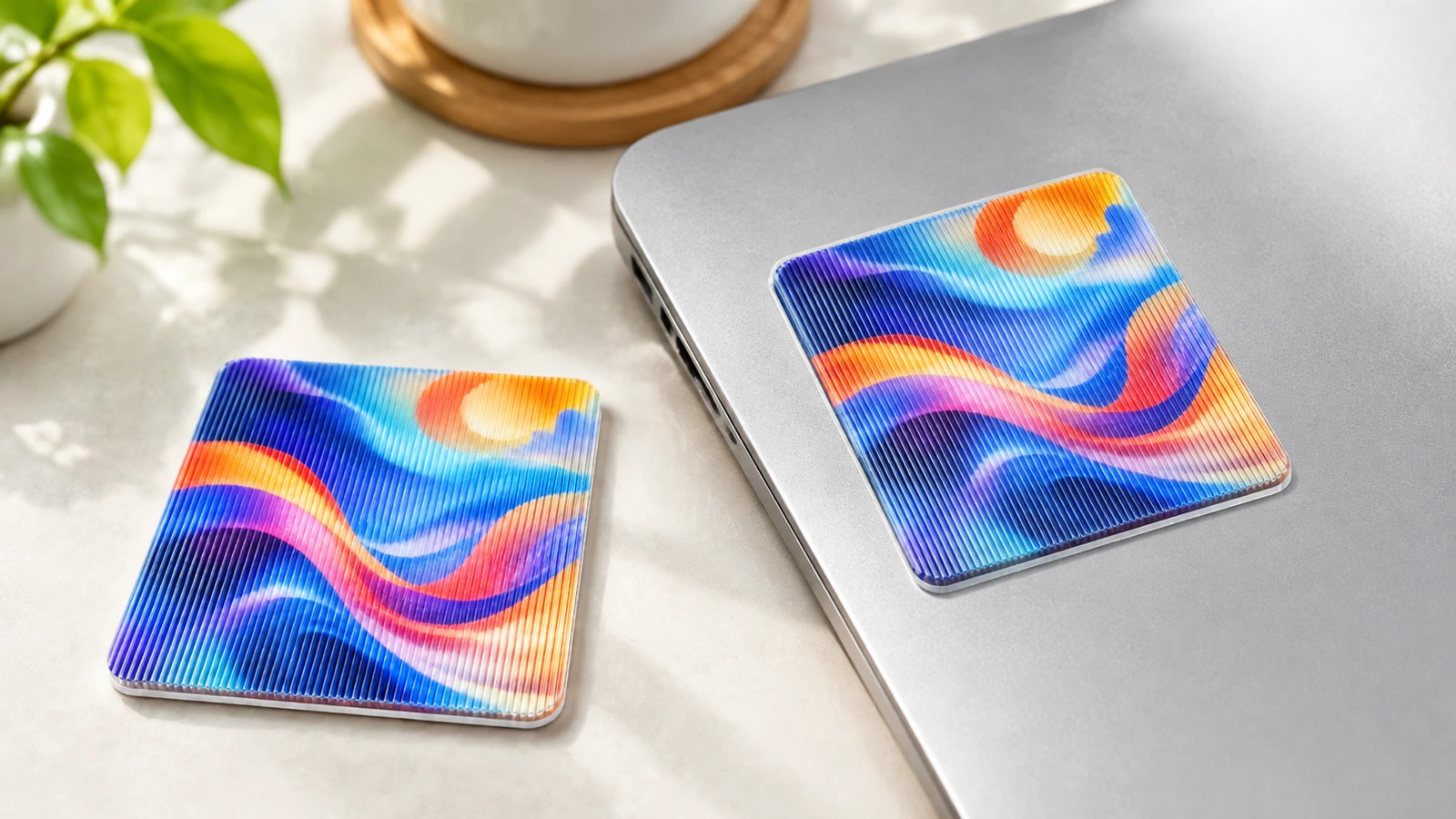
Step 6: Inspect the proof at three angles
Check the proof from the left, center and right under normal indoor light and at the real viewing distance. Reject any proof where both images show at once, where text breaks up, or where the image barely changes. For flip and changing-image work, ISO 20793:2024[18] defines four measures: crosstalk, viewing angle range, angular misalignment from the designed angle, and uniformity across the print area. The standard does not cover 3D prints, so 3D jobs need a visual standard agreed between buyer and printer. Write the inspection angles, light source and pass criteria into the purchase order so both sides judge the proof the same way.
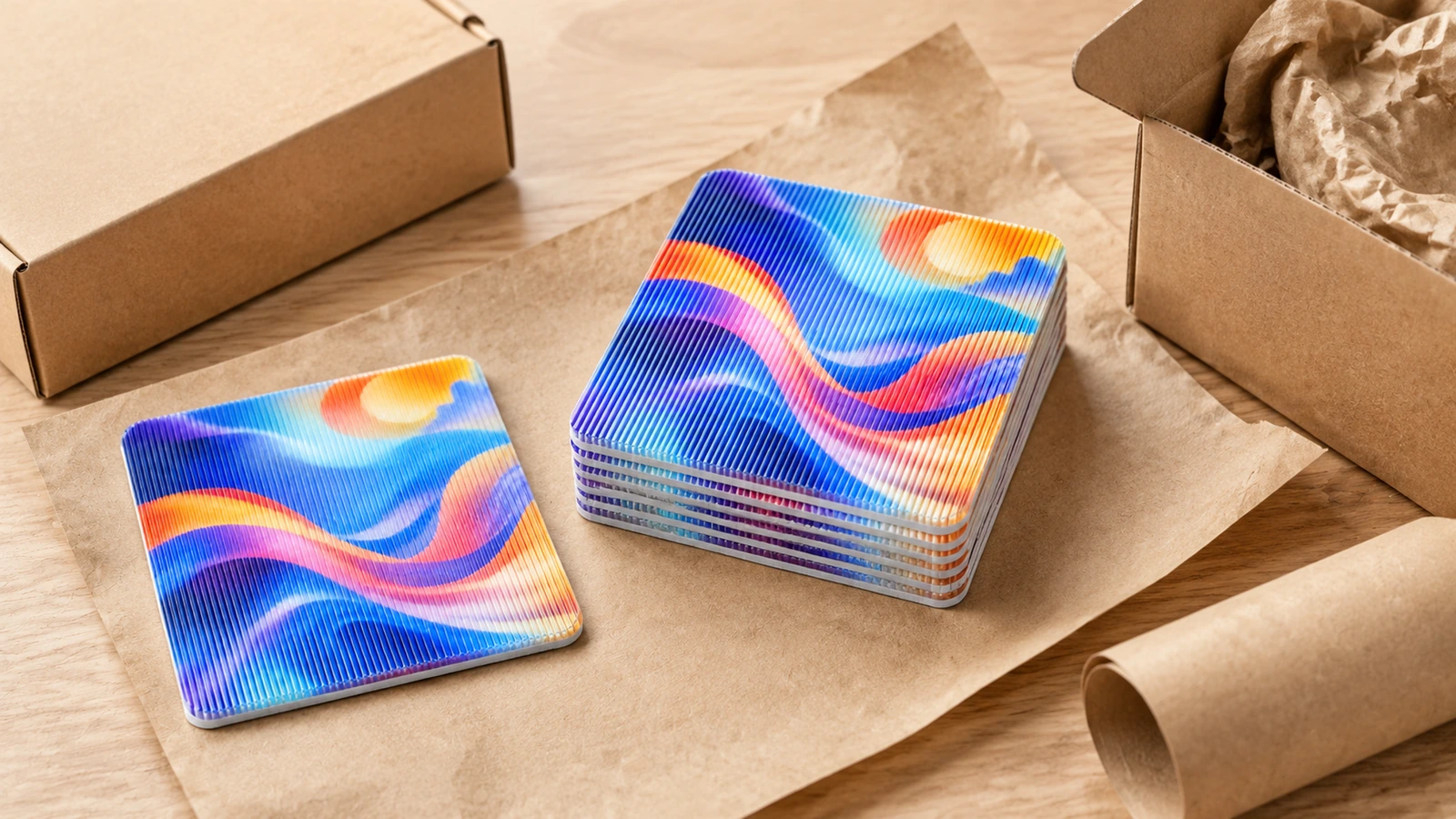
Step 7: Pack, store and plan the reorder
Scratches show more on the lens than on film, and a single scratch across the lenticules looks like a printing defect. Ship stickers with the lens side protected by interleaving sheets, and store them flat. ONE Plastic[19] advises keeping stock "in a cool, dry environment, away from direct sunlight and heat." Changes in humidity can cause the sheets to curl. Archive the approved proof, lens specification and frame files together, so the reorder can be matched against a reference that already passed.
Which Supply Route Fits Your Budget and Deadline? ↑
Published prices are catalog snapshots that change over time. Use them as reference points, not market averages. The 4OVER4 product page[20] lists 3D lenticular stickers from $866.62 per 500, falling to about $0.33 each at 10,000. It shows a 4.7/5 rating, but from only 6 reviews.
The production page states 15 days. However, the 4OVER4 lead-time page[21] advises planning roughly 20 to 22 business days from order confirmation and proof approval, not including shipping. Plan your schedule around the longer figure.
| Quantity | Unit price (USD) | Total (USD, 4OVER4) |
|---|
| 500 | 1.73 | 866.62 |
| 1,000 | 1.02 | 1,020.40 |
| 5,000 | 0.439 | 2,195.65 |
| 10,000 | 0.329 | 3,294.03 |
In this 4OVER4 catalog, the unit price drops about 81% between 500 and 10,000 pieces, but the total cost still rises nearly fourfold. Order the quantity you will actually use. Leftover stock of limited-edition designs tends to go unused once the release is over.
Other supply routes trade price against minimum order and control. Wooacry[22] sells a 35 × 35 mm square from $1.29 for a single piece to about $0.51 at 500, with 5–7 workdays of production. The Lenticular World FAQ[23] cites a minimum of about 250 pieces for small formats such as 4 × 6 in, delivered roughly 18 days after artwork is received. A Made-in-China PET listing[24] offers 0.45, 0.6 and 0.7 mm PET, typical minimums of 1,000 pieces and 15–20 working days. Comparable B2B listings quote about $0.50–0.80 per piece.
| Route | Published starting point | Minimum | Best fit |
|---|
| US online printer (4OVER4) | 500 for $866.62 | 500 | Brand flips, packaging, collectibles |
| Small-batch merch (Wooacry) | $1.29 each; ~$0.51 at 500 | 1 | Artist tests, fan merch |
| Specialist factory (Lenticular World) | Quote only | ~250, small format | Project work, large formats |
| China PET OEM (listing) | ~$0.50–0.80 at 1,000 | ~1,000 | Repeat SKUs, giveaways |
| Holographic alternative (4OVER4) | 100 for $322.98 | 100 | Curves, labels, one-week deadlines |
These rows are not like-for-like. The Wooacry price is for a 35 mm square, while 4OVER4 sizes run from about 2 × 3.5 in to 7 × 5 in. OEM unit prices exclude import duties, freight and the extra sampling and color-proofing rounds that overseas orders usually need. A "waterproof" claim on a supplier page is not a test report. Confirmed figures for this SKU come only from your quote and the approved sample.
What should every quote specify?
A complete quote fixes the following:
- Effect type and frame count
- Lens direction, LPI and thickness
- Finished size and shape
- Adhesive and liner
- Price at each quantity tier, and the minimum order
- Production days counted from proof approval
- Whether proofs and freight are included
Any field missing from the quote tends to come back later as a change order.
Which compliance and recycling rules apply?
A promotional sticker does not automatically fall under regulated-packaging rules, but its end use can bring it under them.
- Food contact: If the sticker touches food, its adhesive is assessed under FDA indirect food additive rules, including 21 CFR 175.125 for pressure-sensitive adhesives (eCFR Title 21[25]).
- Children's toys: If the product is a children's toy, CPSIA makes ASTM F963 mandatory. It also requires third-party testing and a Children's Product Certificate (CPSC[26]).
- EU packaging: Regulation (EU) 2025/40 (PPWR) has applied directly across the EU since 12 August 2026 (European Sealing[27]). A lens sticker used as part of the packaging is therefore treated as plastic packaging.
- California recyclable claims: SB 343 restricts "recyclable" claims on products manufactured after 4 October 2026. A federal preliminary injunction issued on 14 July 2026 is also on record (Strategic Packaging Insights[28]). Multi-layer PET lens labels should not carry a recyclable mark by default.
For demand context, PW Consulting[29] estimates that packaging and labels accounted for about USD 314.48 million, or 29.95%, of the global 3D lenticular sheet market in 2025, behind advertising. Other firms' estimates differ by an order of magnitude. When citing market size, name the report and year instead of quoting a single industry figure.
What Are the Key Takeaways for Buyers? ↑
- Lenticular costs more and starts higher than holographic at the same printer. — 500 lenticular for $866.62 vs 100 holographic for $322.98 (Source)
- Plan the schedule in weeks, not days. — About 20–22 business days after proof approval, excluding shipping (Source)
- Minimum font size depends on the lens. — 18 pt at 40 LPI, 12 pt at 75 LPI, 8 pt at 100 LPI (Source)
- Flip-effect quality can be measured. — ISO 20793:2024 covers crosstalk, viewing angle range, misalignment and uniformity (Source)
- Packaging is a major market for lenticular sheet. — About USD 314.48 million, or 29.95% of the 3D sheet market in 2025 (Source)
- EU packaging rules now apply to lens components used in packaging. — PPWR directly applicable since 12 August 2026 (Source)
Ready to Request a Quote and Proof? ↑
Lenticular is worth the cost when the change itself is the message and the surface is flat. That makes it a fit for a launch date revealed on a gift box, a character that moves on limited merch, or a logo that turns into an offer at a trade show. It is the wrong choice for curved bottles, one-week deadlines or static artwork. Keep the brief to two or three frames, choose the LPI to suit the smallest text, and approve nothing until a proof made on the production lens passes at three angles. Send your frame files, target surface and quantity range to request a quote and a three-angle proof for NSKU-702-01.




The information below is required for social login
Sign In
Create New Account