Custom metal transfer stickers are thin electroformed nickel logos carried on a transparent alignment film and backed with pressure-sensitive adhesive. You press the logo onto a clean, smooth surface and peel the film away. Only the metal strokes remain, with no background and no visible sticker edge. For NSKU-615-03, thickness, finish, adhesive grade, MOQ and lead time are confirmed at quotation and sampling.
Who Uses Metal Transfer Logos, and on Which Products? ↑
Most buyers of this product already know the term they are searching for. They are brand managers, packaging engineers and purchasers at perfume, cosmetics, gift-box, small-appliance, consumer-electronics and drinkware companies. They want a logo that reads as an integrated metal part rather than a label. Supplier specifications describe the construction as two layers: a solid metal logotype, and a transparent "reference mask" used only for alignment and removed after application Qianxi electroforming sticker specification[1]. These buyers ask technical questions: is it nickel or foil, which adhesive is used, how thick is it, will it follow a bottle shoulder, and what is the minimum order?
A second group searches differently. US small businesses, vehicle and storefront brands, and independent creators often look for "metallic transfer decals". They compare chrome or gold vinyl from print shops that advertise no minimum order. That vinyl looks metallic but is not nickel, so this page treats it as a separate option instead of blending the two. Hobbyists ordering small runs describe the same split in practice. Model builders report that large metal stickers hold even on curved parts when pre-bent, while small ones on angled edges are "not worth the trouble" r/Gunpla metal sticker thread[2].
Why Do Metal Logo Orders Fail, and What Prevents It? ↑
The problem is vocabulary. Buyers use "chrome", "foil", "metallic ink" and "metal transfer" interchangeably, but each is a different process. A silver sticker can be made by printing metallic ink, by using a metallised face stock, or by stamping foil with a heated die. Stamped foil sits on the very top with nothing over it, so it scuffs against a key ring or shipping carton faster than a laminated print 4OVER4 silver sticker guide[3]. If you order the wrong process, the logo arrives looking flat.
The pain shows up after delivery. One buyer wrote that the clear film "didn't take all the details off the white backing" and tore the paper away, ruining the adhesive Sticker Mule transfer review[4]. A metal-label maker describes clients calling three weeks after shipment because the edges were lifting. It names a mismatch between adhesive and surface energy as the most common cause, and metal memory as the second JTT Logos peeling analysis[5]. Each failure means a reprint, and it often means a missed launch date.
The solution is to lock the process before you negotiate price. Confirm nickel electroforming, define the substrate and service environment, approve a physical sample on the real part, and accept bulk production against measurable checks. The rest of this page follows that sequence.
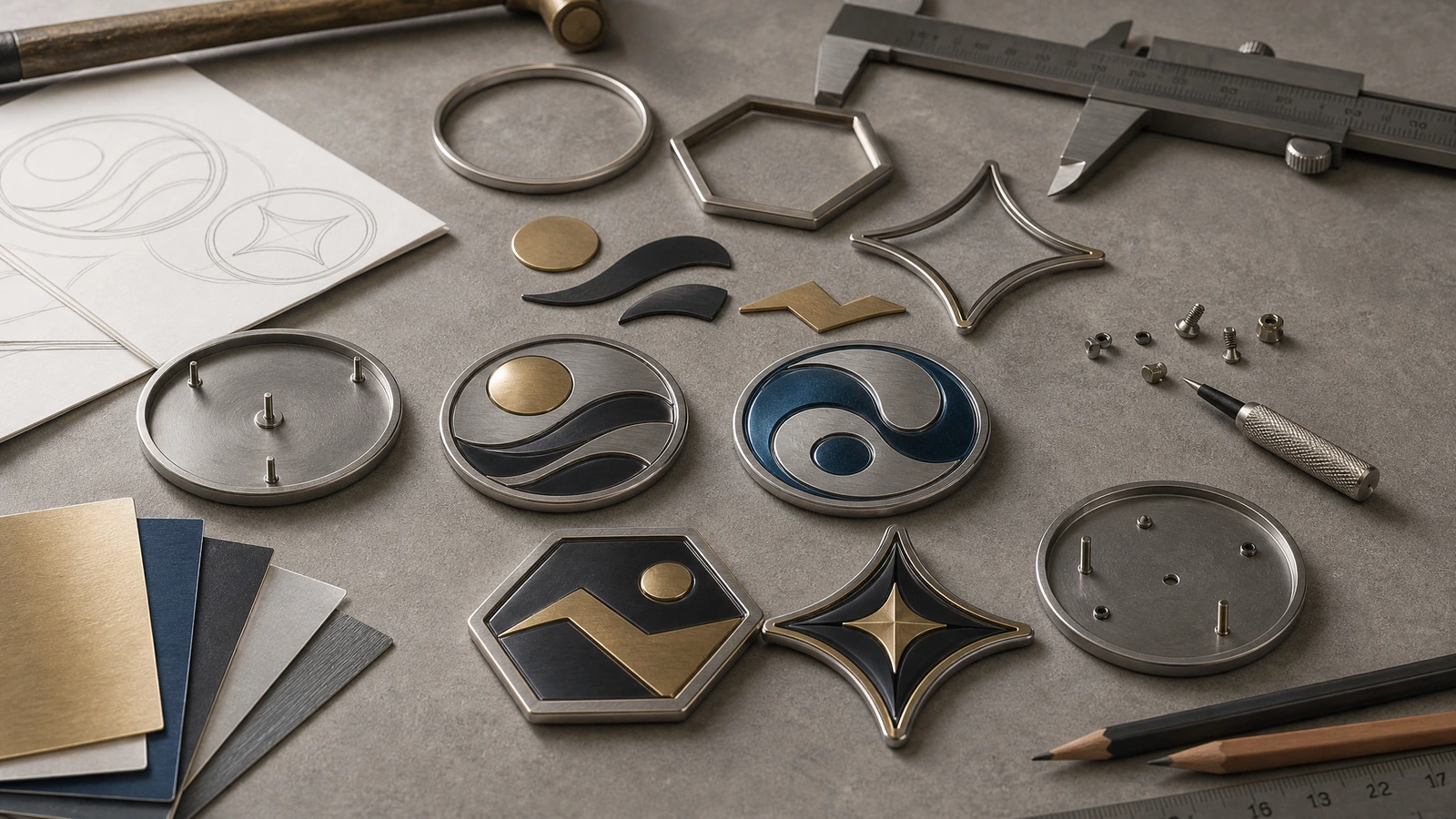
Table of Contents
What Exactly Is a Custom Metal Transfer Sticker? ↑
A metal transfer sticker is a nickel logo built up by electroforming or electroplating, rather than cut from printed film. The logo is backed with acrylic pressure-sensitive adhesive and delivered on a clear transfer film. Because only the strokes are metal, nothing surrounds the logo once the film is removed. One supplier describes the result as "3D embossed metal transfer stickers that use durable nickel foil", backed with 3M adhesive Cusmytrims metal sticker page[6]. A related route etches stainless steel and then plates it with nickel and chrome. Its published steps run from polishing, degreasing and exposure through plating, gluing, membrane replacement, inspection, cutting and packing 4customize process overview[7]. Neither route has an ISO or ASTM product standard. The figures below are supplier specifications, not an industry norm.
| Specification | Published supplier references | NSKU-615-03 |
|---|
| Material | 100% pure nickel (Qianxi); nickel foil (Cusmytrims) | Nickel construction confirmed on quotation |
| Thickness | 0.1–0.15 mm standard (Qianxi); about 0.16 mm finished (Cusmytrims); 0.045–0.12 mm (JTT material guide[8]) | Measured and recorded on the approved sample |
| Adhesive | "Strong 3M adhesive" (Qianxi); 3M 467/7533 (Cusmytrims) | Adhesive model stated on quotation |
| MOQ | 100 pcs (Qianxi); 50 pcs (Cusmytrims) | To be quoted |
| Production time | 5–10 working days, samples 3–5 working days (Qianxi); 7–15 days (Cusmytrims) | To be quoted |
| Colour limits | No gradients; no more than three colours per logo (CMYK Printed[9]) | Reviewed at file preflight |
Published supplier numbers differ by more than a factor of two on thickness and MOQ. Use them to frame your request for quotation, not as promises for this SKU. The colour limit matters most for artwork decisions. Electroformed logos use ready-made nickel finish colours rather than free Pantone matching, so full-colour or gradient artwork belongs on a printed option instead.
Size and readability
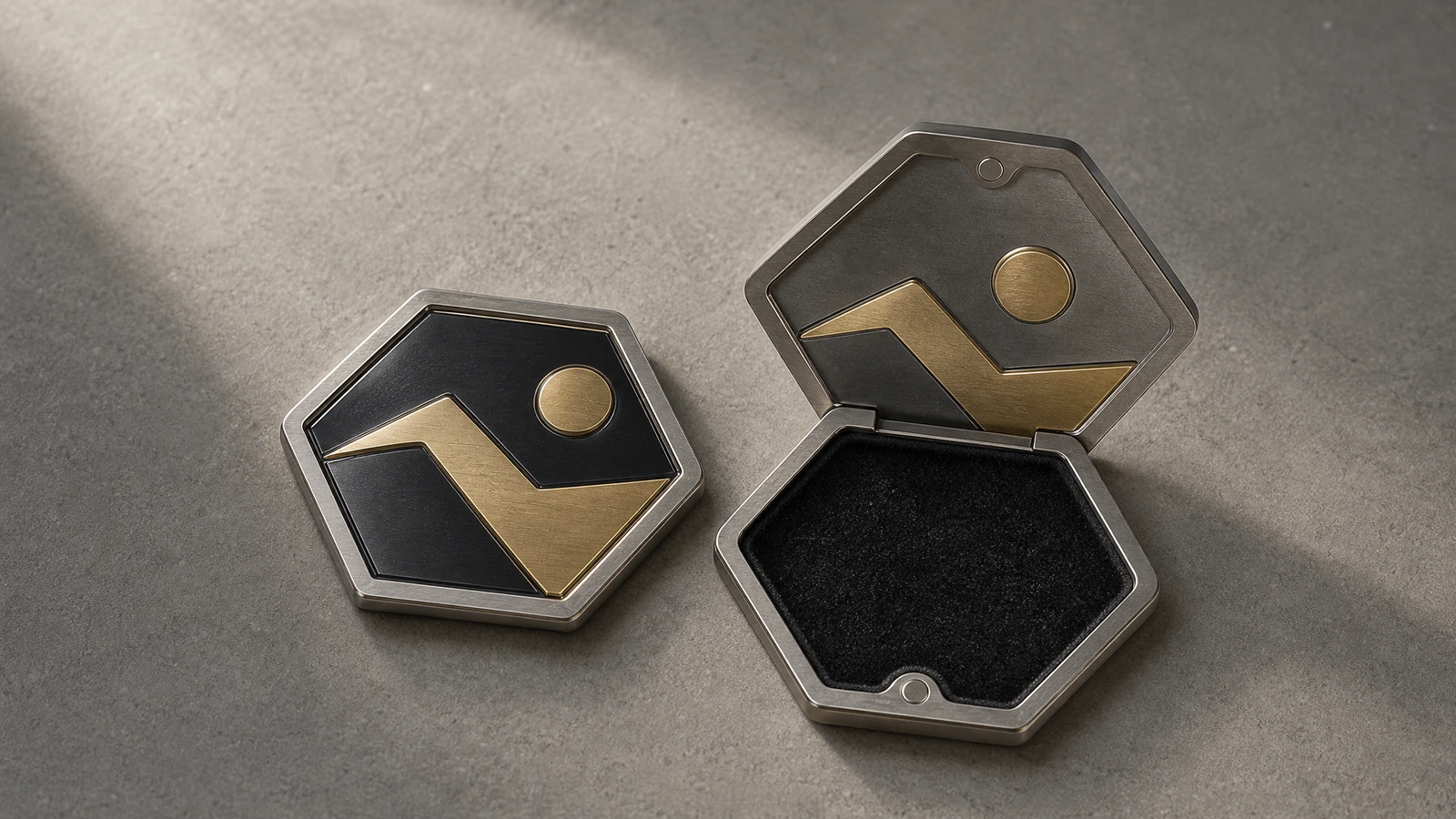
Fine strokes are where electroforming earns or loses money. One engineering note says the minimum stable line width must be confirmed by engineering before ordering. Strokes that are too fine get thickened to a producible width, and the buyer should sign off on a real part Taizhida engineering note[10]. One metallic transfer spec page sets a 3 mm (0.12 in) minimum font height. Treat that as a starting check, not a nickel limit. Small type also makes application harder. A buyer of a gold transfer product warned that small letters were "extremely difficult to lift off the backing sheet" (Amazon review). Inner counters, dots and disconnected accents become separate metal islands, and the film and adhesive must hold each one.
Surface finish and adhesive backing
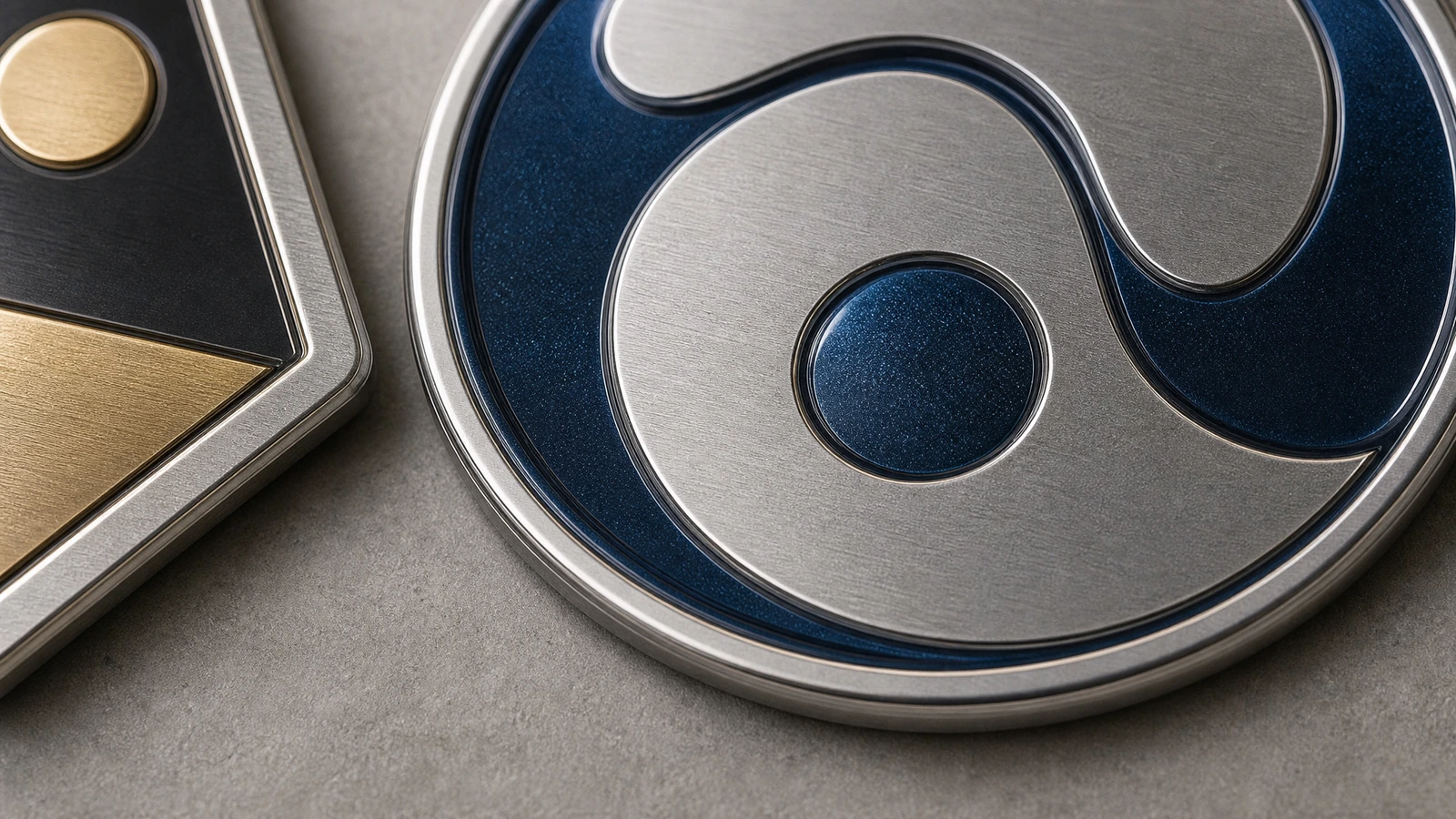
Suppliers list bright silver, gold, rose gold, matte and brushed finishes. Approve colour on a physical swatch, because metallic lustre cannot be reproduced on a CMYK proof. The adhesive is usually an acrylic of the 3M 467 class. One supplier advertises about 150°C heat resistance for 3M 467/7533 (Cusmytrims). Check that claim against the adhesive's own technical data sheet rather than marketing copy. The data sheet values are summarised below.
| 3M 467MP property | Published typical value | Condition and source |
|---|
| Total tape thickness | 0.06 mm | ASTM D3652; 3M TDS, Sept 2024[11] |
| 90° peel, stainless steel | 10 N/cm | 22°C, 72 h dwell, ASTM D3330 |
| Peel after 100 h water immersion | 9.5 N/cm | 22°C, stainless steel; 3M TDS, June 2024[12] |
| Peel after 7 days humidity | 11.9 N/cm | 32°C / 90% RH, stainless steel |
| Peel after UV exposure | 11.4 N/cm | 2,000 h, ASTM G154 Cycle 1 |
| Temperature resistance | 204°C short term; 149°C long term | Minutes to hours vs. days to weeks |
| Application temperature | 21–38°C ideal; not below 10°C | 3M data sheet, Sept 2022[13] |
3M states that these values are typical and "should not be used for specification purposes". They describe the tape on stainless steel, not a finished nickel logo on your product. Peel strength also varies sharply by substrate. A 3M performance sheet lists about 10 N/cm on stainless steel, about 7 N/cm on aluminium and only about 2.4 N/cm on ABS 3M 467MP substrate data[14]. Low-surface-energy plastics and powder coats therefore need their own trial. The 2022 sheet also states that the tape is used by the nameplate industry and is UL and AGA recognised. That recognition covers the tape component, not every nickel label made with it.
How Do You Specify, Approve and Apply a Metal Transfer Logo? ↑
Step 1: Freeze the requirement
Write down the substrate, its curvature, indoor or outdoor use, peak temperature, cleaning method and any skin contact. Metal transfers are cold-applied by pressure. Never heat-press one onto fabric; garments need a chrome heat-transfer film instead. No published dishwasher cycle data exists for these labels, and 3M's water figure comes from static immersion. Specify "hand wash" for drinkware unless a cycle test is written into the order.
Compliance depends on the use case. RoHS applies when the label goes onto electrical or electronic equipment placed on the EU market EU RoHS Directive 2011/65/EU[15]. Items meant for direct and prolonged skin contact must not release more than 0.5 µg/cm² of nickel per week, as tested under EN 1811 REACH Annex XVII, entry 27[16]. A label on a gift box or appliance panel does not automatically fall under that limit. If the logo carries safety information, UL 969 Edition 6, published 28 July 2025, covers permanent nameplates and markings UL 969 Ed. 6 (ANSI)[17]. In that case the whole construction must be evaluated on its intended surface.
Step 2: Preflight the artwork file
Supply vector artwork (AI, EPS, PDF or CDR) with fonts outlined. State the dimensions in millimetres, mark the finish for each element, and give a Pantone reference as a direction only. Bitmaps are reference images, not production files. Lock dimensions on the proof, because size errors are a common complaint. One reviewer expected 35 × 79.5 mm and received about 43.94 × 99.81 mm (Sticker Mule review).
Step 3: Sample, then produce
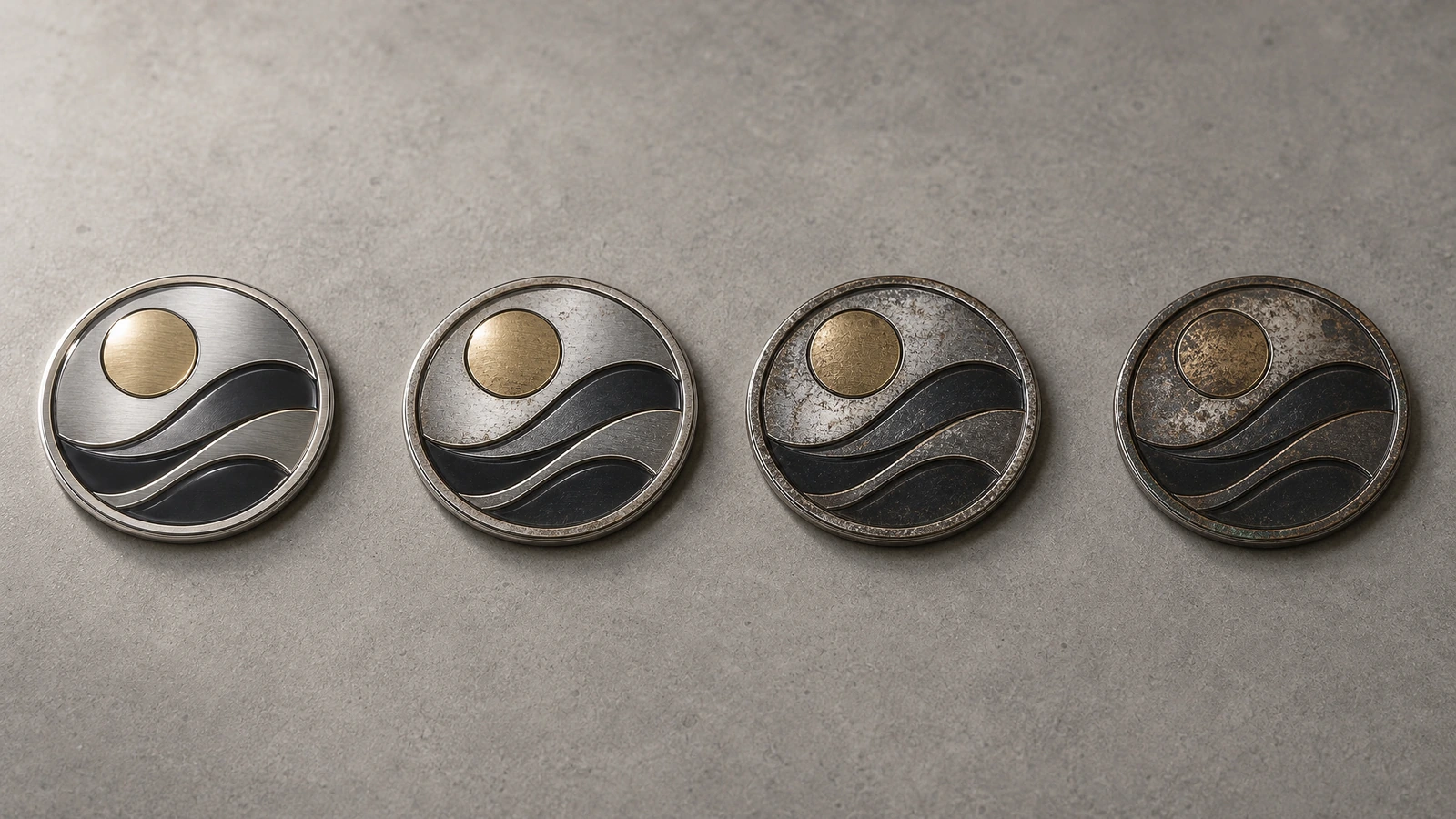
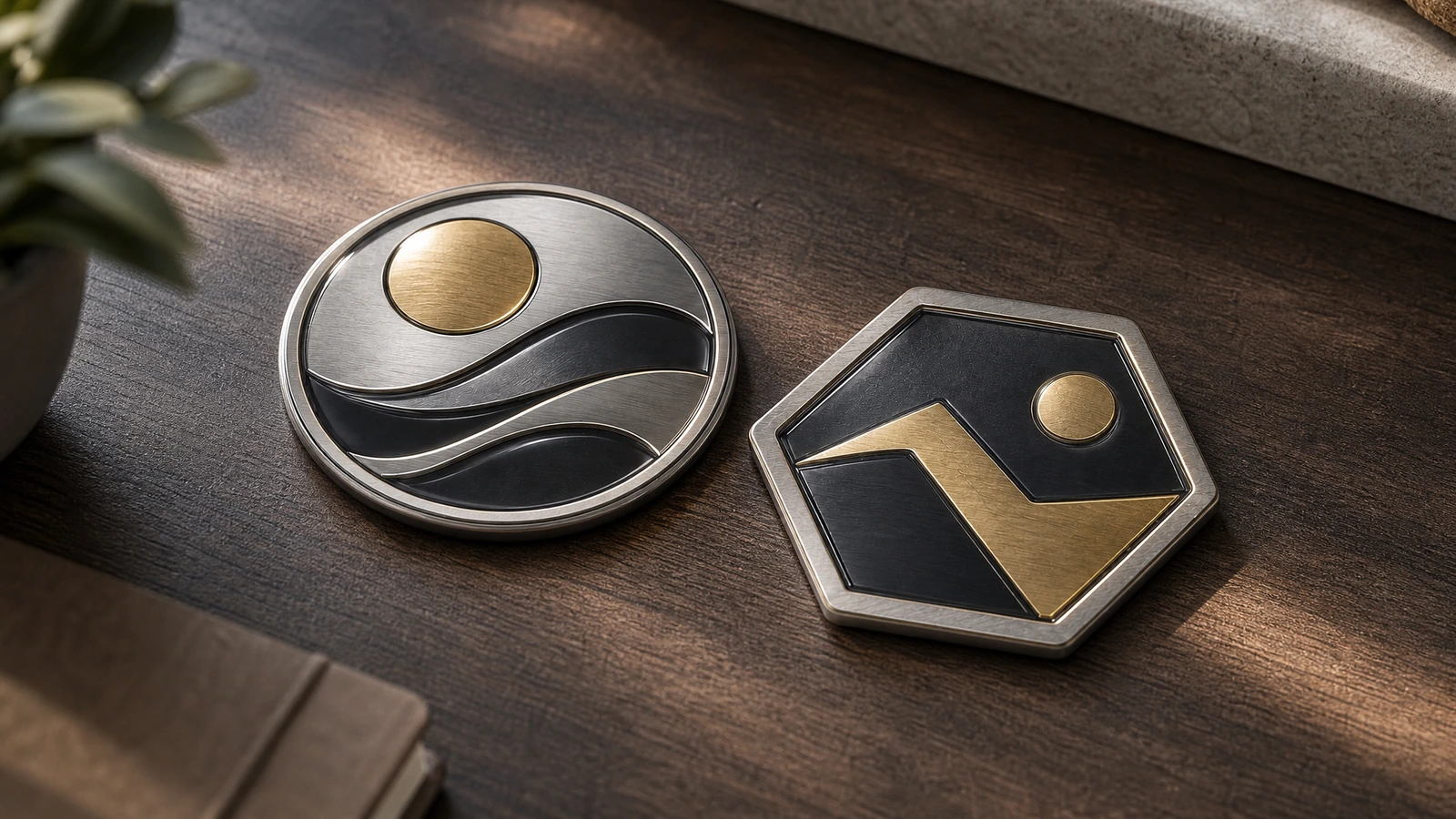
The production sequence is engineering drawing, film or mask, electroforming or etching, surface finish, adhesive lamination, transfer-film replacement, and cutting into single pieces or sheets. A thick raised logo requires a set of hardware molds with a base plate of about 0.2 mm (Cusmytrims), which extends the first order. Plating uses chemicals and generates wastewater, so it belongs in a plant that holds a discharge permit. Sample timing, mold needs and bulk lead time for NSKU-615-03 are given in the quotation and confirmed after you approve the sample.
Step 4: Accept bulk against measurable checks
| Check | Method | Acceptance basis |
|---|
| Dimensions | Caliper on sampled pieces | Millimetre values on the signed proof |
| Thickness | Micrometer per batch | Value recorded on the approved sample |
| Film release | Transfer sampled pieces onto a test panel | Every stroke transfers; nothing stays on the backing |
| Adhesion | Apply to the real substrate, dwell per the adhesive TDS, then peel and observe | Behaviour agreed at sampling; ASTM D3330 is a tape method, not a label spec |
| Finish and colour | Side-by-side under the same light | Signed physical sample, not a screen or CMYK proof |
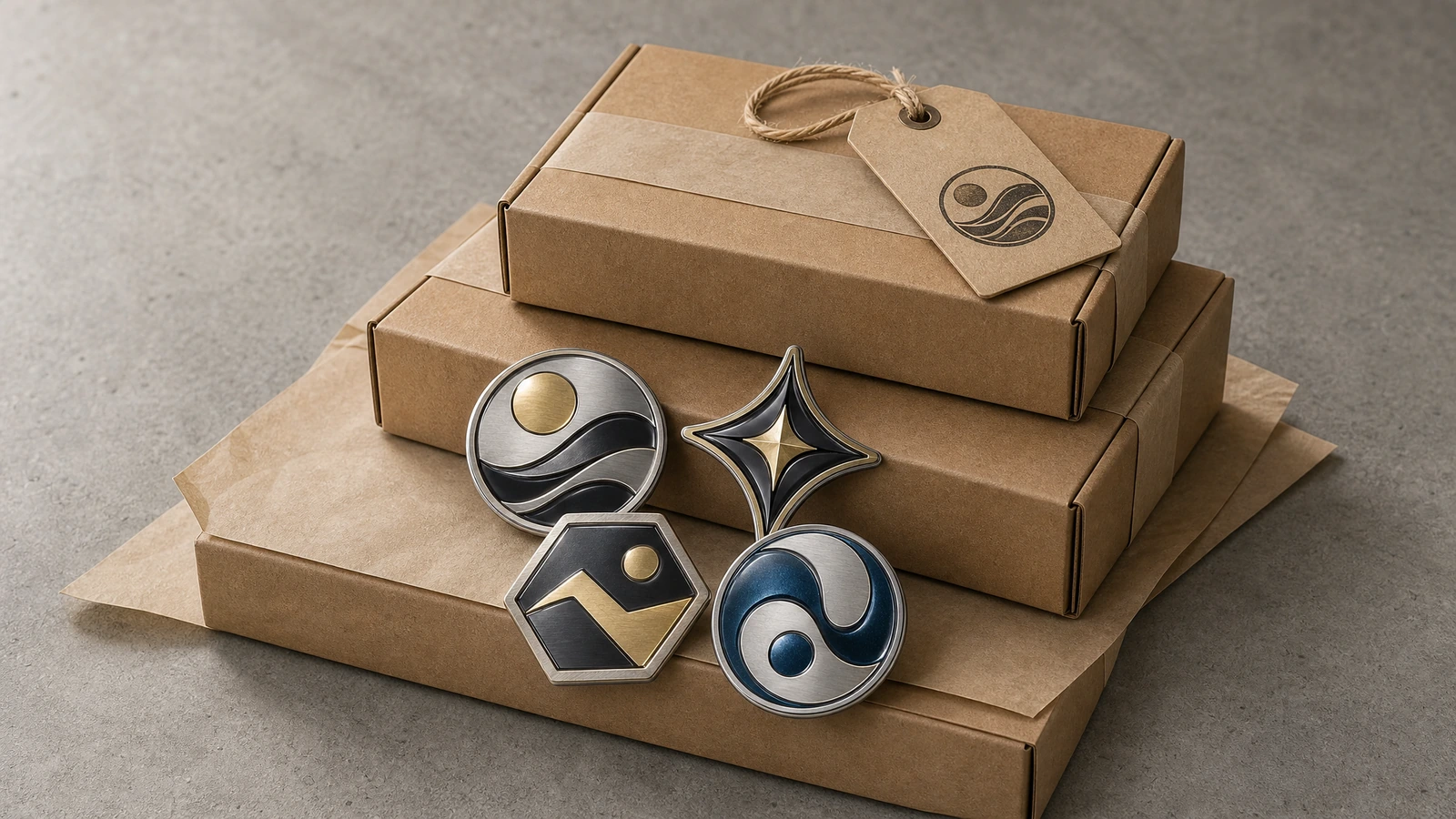
Burrs, adhesive squeeze-out and die cuts that nick metal strokes also belong in the visual check. Salt spray, abrasion or alcohol-rub tests are performed only when written into the purchase order. Deliverables should include the approved artwork, the material and adhesive models, batch photos and measured thickness. Treat UL, REACH or RoHS documents as delivered only when they arrive with report numbers for that batch.
Step 5: Apply on site
Follow the cold-application method published by suppliers, and do not heat the logo.
- Clean the surface with a neutral cleaner and dry it fully. Isopropyl alcohol suits glass; avoid ammonia-based glass cleaners.
- Work when the surface is between 21°C and 38°C, and never below 10°C, following the 3M guidance above.
- Peel the clear film carrying the logo off the backing paper, then align it using the film as your guide.
- Press from the centre outward with a squeegee to push out air.
- Rub firmly over the film, then remove it slowly at a sharp angle so the logo does not lift with it JTT application tips[18].
- Re-press fine strokes, then let the adhesive build its bond before any load or washing. Use the adhesive TDS for the timing.
Which Metallic Option Fits Your Product and Budget? ↑
| Option | Construction | Strength | Limitation | Best fit |
|---|
| Electroformed nickel transfer | Solid nickel strokes, acrylic adhesive, clear film | Real metal, no background, follows gentle curves | No gradients, limited colours, higher unit price | Perfume, cosmetics, gift boxes, electronics |
| Foil transfer | Metallic foil on a transfer or UV layer | Bright and lower cost | Prone to fade and deform over time | Promotions, seasonal packaging |
| Chrome or metallic vinyl | Metallised film or metallic ink, die-cut | Full colour, fine text, low minimums | Looks metallic but is not metal | Laptops, promotions, short-term vehicle decals |
| UV DTF transfer | UV-printed full-colour transfer | Accurate colour and small text | No metal thickness or mirror finish | Bottle and carton labels |
| Etched steel or anodised aluminium plate | Etched or anodised plate | Industrial and outdoor durability | Rigid, heavier, project pricing | Equipment nameplates |
Price anchors show how wide the gap is. One online shop lists metal labels from $0.299 each and UV transfers from $0.153, both with an MOQ from 100. It also notes that its metal labels are not for curved surfaces Unik Portrait price list[19]. Wholesale listings titled "metal transfer" show about $0.01–$0.30 per piece (Alibaba showroom). These are seller listings, not audited transaction prices. Print-shop pricing works differently: standard stickers start at $23.88, metallic ink at $108.75, and foil or holographic at $322.98 per set (4OVER4).
Durability claims need the same caution. One supplier states that nickel transfers "will not deform or fade", while gold foil transfers are "prone to fade and deform over time" Golden Mouth foil vs nickel[20]. Mirror and brushed metallic vinyls are rated for 3–5 years of outdoor UV exposure and −20°C to +80°C service StickerNation metallic specs[21]. Film makers rate metallic colours below standard colours. ORACAL 651 metallic is rated at 4 years against 6 years for standard colours, in vertical exposure Hoosier Decal on ORAFOL data[22]. None of these figures is an independent lifetime test of nickel labels, so verify on your own part.
For market context, one analyst values the metal decal market at USD 1.3 billion in 2025 and projects 3.6% annual growth to USD 2.0 billion by 2036 FMI metal decal report[23]. Another puts the same category at USD 3.12 billion in 2026 (Packaging Market Insights). The two reports define the market differently, so neither figure measures metal transfer stickers alone.
What to include in your request for quotation
Send vector artwork, target size in millimetres, quantity tiers, finish per element, and photos or a sample of the substrate. Add the service environment (heat, washing, outdoor exposure, skin contact), any preferred adhesive grade, and the compliance documents you need with report numbers. Also specify packing. Transfers are vulnerable to crushing; one buyer reported an order that "arrived and was crushed so the transfers were ruined" (Trustpilot review). Ask for flat sheets between rigid board with no folding. For reorders, keep the signed sample, adhesive model and batch photos on file so the next run matches the first.
Key Takeaways for Metal Logo Buyers ↑
- Real metal transfers are thin nickel, not printed silver — 0.045–0.12 mm in one supplier's material matrix (Source)
- Adhesive data is typical, not a specification limit — 10 N/cm 90° peel on stainless steel at 22°C (Source)
- Plastic housings need their own adhesion trial — about 2.4 N/cm on ABS, against about 10 N/cm on stainless steel (Source)
- Metallic vinyl ages faster than standard colours — ORACAL 651 metallic 4 years vs. 6 years for standard colours (Source)
- Skin-contact products face an EU nickel release limit — 0.5 µg/cm² per week (Source)
- The metal decal market is modest but growing — USD 1.3 billion in 2025, 3.6% CAGR for 2026–2036 (Source)
Ready to Put a Real Metal Logo on Your Product? ↑
A metal transfer logo succeeds when the process, substrate and adhesive are settled before price, and when bulk production is accepted against a signed physical sample. Expect real nickel, a clean edgeless look and good resistance to gentle curves. Do not expect gradients, unlimited colours or untested dishwasher claims. NSKU-615-03 is quoted on your actual artwork and part, with thickness, finish, adhesive model, MOQ and lead time stated in writing. Send your vector artwork, target size in millimetres, substrate and quantity to request a quotation and physical sample.





The information below is required for social login
Sign In
Create New Account