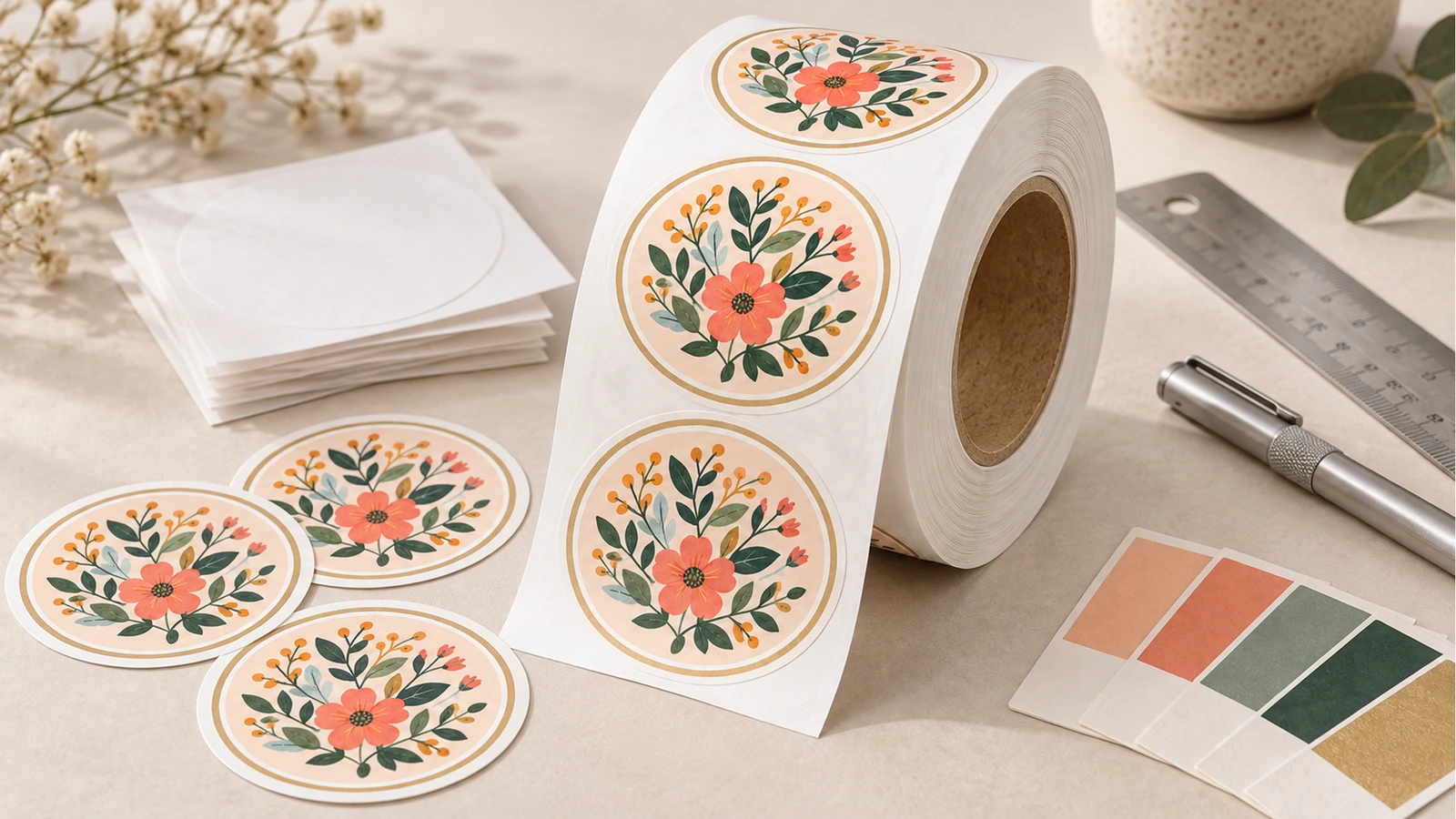
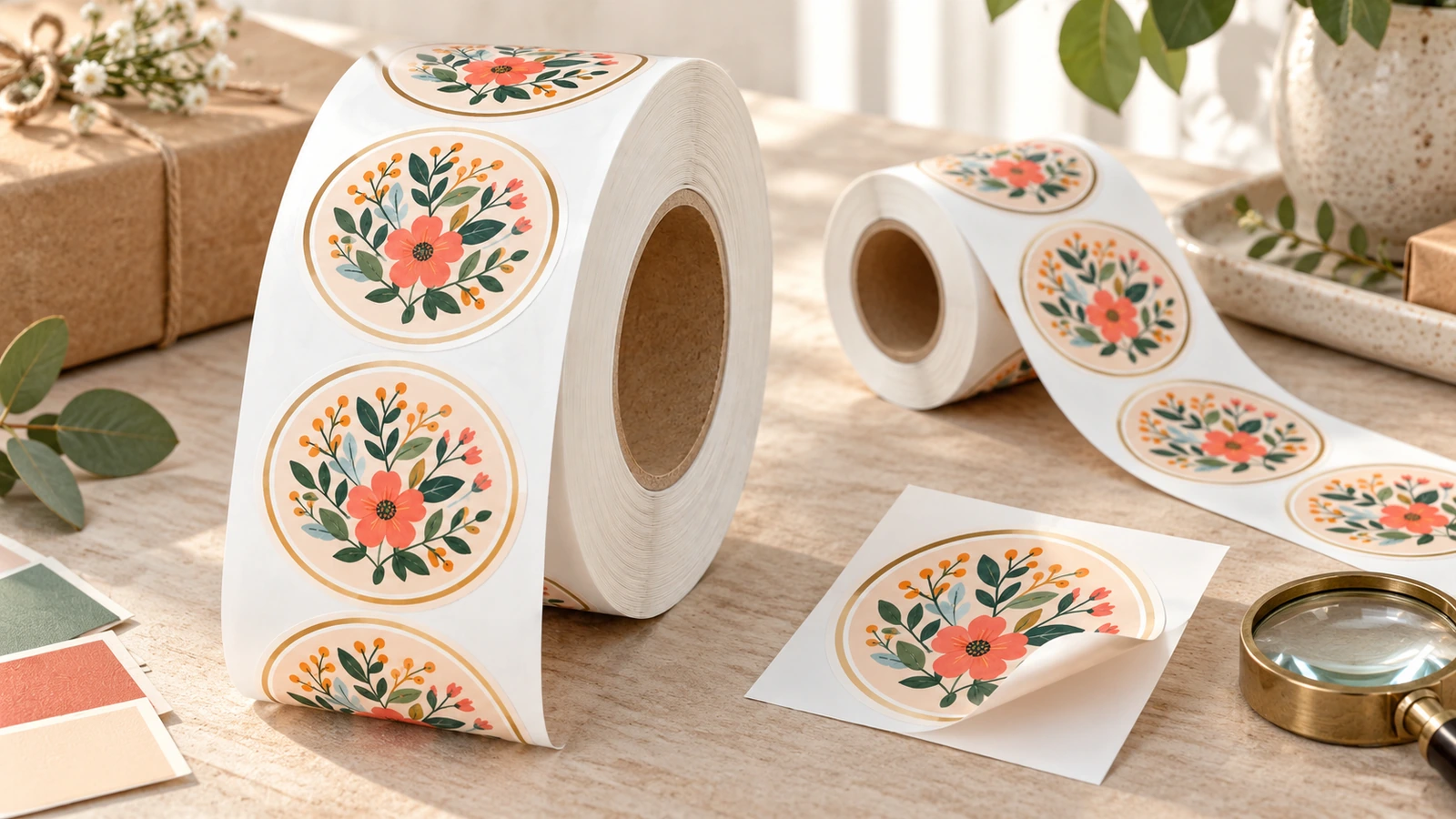
Custom roll labels are full-color pressure-sensitive labels wound on a core so they can be hand-dispensed or fed into an applicator. Packaging rolls usually use a 3-inch core. Whether an order succeeds depends on five things being written down before printing: face stock, adhesive, rewind direction, labels per roll, and an approved proof.
Who Orders Custom Roll Labels, and for Which Products? ↑
Most buyers are not shopping for a label printer. They are brand owners, operations leads, and production managers. Their job is to get one design to land straight, and stay put, on hundreds or thousands of identical containers. Typical products include candle tins, soap and skincare bottles, coffee bags, honey and hot-sauce jars, craft beverages, and subscription-box inserts. A 4OVER4 roll vs. sheet guide[1] notes that nearly every subscription box, craft beverage, candle line, and cosmetics brand runs on rolls. Category research points the same way. PW Consulting's craft labels research[2] attributes about 44.9% of craft-label revenue to food and beverage and about 29.4% to personal care and cosmetics, based on 2025 data.
Two roles usually share the purchase, and they want different things:
The founder wants a shelf-ready look, a scratch-resistant finish, and a first run small enough to test a new scent or flavor. The production manager wants rolls that load without adjustment, peel cleanly, and never stop the line.
The trigger is usually the same for both: hand-applying sheet labels stops scaling. One spice producer called the process “slow and inconsistent, leading to bubbles and wrinkles”[3] while planning a move to semi-automatic application.
This page covers full-color printed product labels on rolls (provisional SKU NSKU-612-01). It does not cover blank direct-thermal shipping rolls for desktop printers. Those use different cores, materials, and buying logic.
Why Do Roll Label Orders Fail After the Proof Looks Perfect? ↑
A roll label order can pass every visual check and still fail on the filling table. The proof shows artwork. It does not show which edge comes off the roll first, how many labels sit on each core, or how the adhesive behaves on a cold, curved bottle.
Public reviews show what that gap costs:
One buyer ordered 500 labels and received four rolls of 125[4]. The line had to stop to reload every 125 applications.
Another reported adhesive oozing from label edges[5]. It gummed the applicator so badly that it had to be cleaned about every 100 labels. The refund covered the labels, not the hundreds of filled products that had to be destroyed.
A third buyer ran a tape test on every roll in a shipment worth roughly £1,500, and every roll failed ink adhesion[6].
A pill-bottle brand received 2×6 labels wound the wrong way on a 6-inch-wide roll[7], so its Easy Labeler could not be used.
The fix is to buy roll labels as an engineering spec, not as a graphic. Define the container, the environment, the application method, and the roll geometry first. Then validate on a sample before releasing volume.
For NSKU-612-01, minimum order quantity, production time, material availability, and roll options are confirmed in your written quote and proof. None of these are published here as fixed values, because they have not yet been verified for this page.
Contents
What Exactly Is a Pressure-Sensitive Roll Label? ↑
A pressure-sensitive label bonds with light pressure, without heat or water. On a roll, each label is a stack of layers:
The top is printed face stock (paper or film), sometimes with a laminate or overcoat. Under that is the adhesive. A release liner carries the labels around a cardboard core.
Laguna Digital[8] describes a roll sticker as several materials glued into one web. It calls curl the top complaint in short-run label printing, and says the usual cause is layers expanding at different rates, not the ink.
Buyers often blur two terms that suppliers keep separate. OnlineLabels' product page[9] draws the line clearly: the material is what you print on, and the laminate is a separate top layer added for durability.
Packaging rolls are normally wound on a 3-inch core. OnlineLabels' roll-label FAQ[10] states that all of its custom roll labels ship on a three-inch core. The same FAQ suggests printed sheets instead when a run is under roughly 1,000 labels.
Rolls make the most sense when one design repeats. In the 4OVER4 guide, 1,000 roll labels cost $380.66 (about $0.38 each), while 25,000 cost $1,758.48 (about $0.07 each). Those are one supplier's published figures, not a quote for this product.
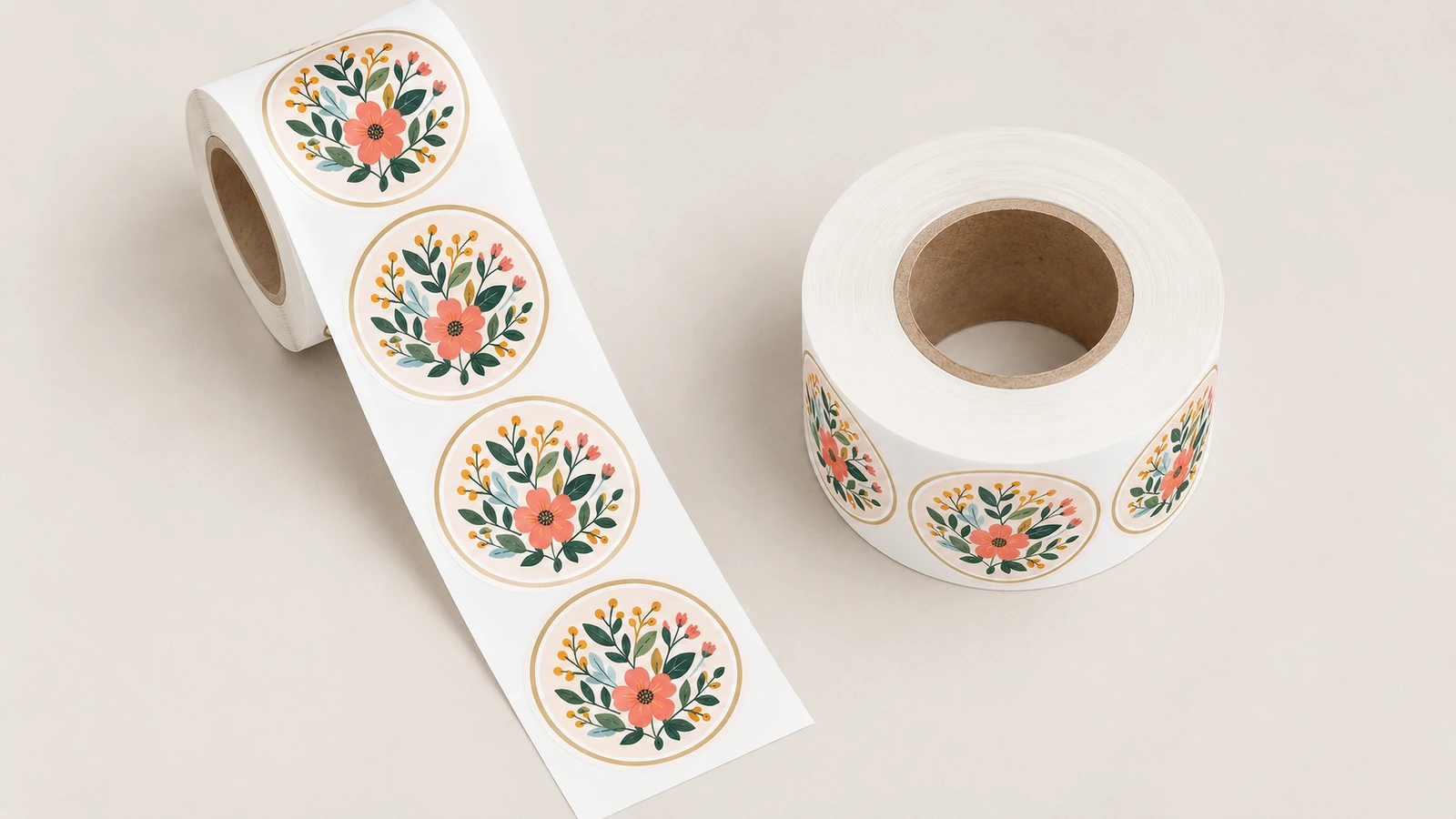
Size the label to the flat or gently curved panel, not to the whole container. Very long labels behave differently on a roll. LP Automation[11] notes that labels longer than about 5 inches tend to curl near the core. That curl can defeat both hand and vacuum application, and a larger core may be required. Keep text, barcodes, and fine lines away from the die line so they survive small cutting tolerances.
How Do You Specify a Roll That Runs on Day One? ↑
Work through six decisions in order. Each one removes a failure mode described above.
Step 1: Describe the container, surface, and environment
Write down four things:
The substrate: glass, PET, HDPE, kraft pouch, or tin. The container's shape. How it is filled. And where it lives afterward: refrigerator, ice bucket, shower, shelf, or outdoor market.
Resource Label Group[12] lists three common causes of flagging and wrinkles: face stock that doesn't suit the container, adhesive that doesn't match the application or service temperature, and oversized labels. It recommends giving the adhesive 24–48 hours to build bond before cold storage or shipping.
Step 2: Choose face stock, adhesive, and finish

| Material | Moisture and oil | Use boundary | Published reference value |
|---|
| Uncoated paper | Not waterproof | Dry, indoor packaging only | Lowest cost; scuffs without overcoat |
| Overcoated paper | Gloss or matte overcoat protects from oil and water | Indoor shelf products | Overcoat chosen at order |
| White BOPP | Water and oil resistant | Indoor or refrigerated; avoid prolonged sun | 2.4 mil; −75°F to 200°F after application |
| Clear BOPP | Film resistance like white BOPP | Light colors need white underprint | Vector artwork requested |
| Silver BOPP | Oil and moisture resistant | Metallic look on bottles | 2.0 mil; about −40°F to 200°F |
White BOPP is the common default for anything that sees water or oil. But published limits matter more than the word “waterproof.”
StickerGiant's specification[13] lists 2.4 mil white BOPP with permanent acrylic adhesive and a 40# liner. It recommends indoor use and warns against prolonged direct sunlight.
SheetLabels[14] publishes silver BOPP at 2.0 mil with a service range of about −40°F to 200°F.
PrintRunner[15] states that BOPP resists oil and moisture well enough for freezer products, and that uncoated paper is not waterproof.
For paper, the overcoat row follows the OnlineLabels FAQ, which says both gloss and matte overcoats protect against oil and water. The clear-film row follows the same FAQ's white-underprint guidance.
Food-contact claims need careful wording. Suppliers sometimes cite 21 CFR 175.105. In the eCFR[16], that section covers adhesives used in food packaging under defined conditions, such as a functional barrier or trace contact at edges.
Labels applied directly to food surfaces fall under 21 CFR 175.125[17], which treats fresh produce separately from other foods. Neither section certifies a whole label, ink, or face stock as “FDA approved.”
Step 3: Lock roll geometry for your application method
| Field | What to state on the order | Risk if missing |
|---|
| Core inner diameter | 3 in for most packaging applicators; confirm with your machine | Roll will not mount |
| Maximum outer diameter | Taken from the applicator manual | Roll too large, or split unexpectedly |
| Rewind direction | Top, bottom, right, or left first; attach diagram | Labels applied upside down |
| Labels per roll | Exact count, e.g., “250 labels per roll” | Short rolls and frequent stops |
| Columns | Single-column for applicators | Multi-across rolls will not feed |
| Gap and liner | Gap between labels; PET liner for high speed | Missed sensing or liner breaks |
| Lead-time start | Business days after artwork approval | Missed fill date |
Each row above has a public source:
StickerGiant's roll finishing guide[18] offers four rewind positions and warns that finishing can add time.
Its small-rolls article[19] confirms that orders may be split across smaller rolls by default. It sets a minimum of 125 labels per custom roll, and notes that special instructions do not carry over to reorders.
VistaPrint[20] states that single-column rolls work with both automatic and manual applicators.
A packaging creator who has hand-labeled more than 100,000 units gives the same advice on YouTube[21]: order a 3-inch core, wound in the right direction.
A digital proof usually does not show rewind direction. Attach the applicator's diagram to the order instead.
Step 4: Preflight artwork and regulatory copy
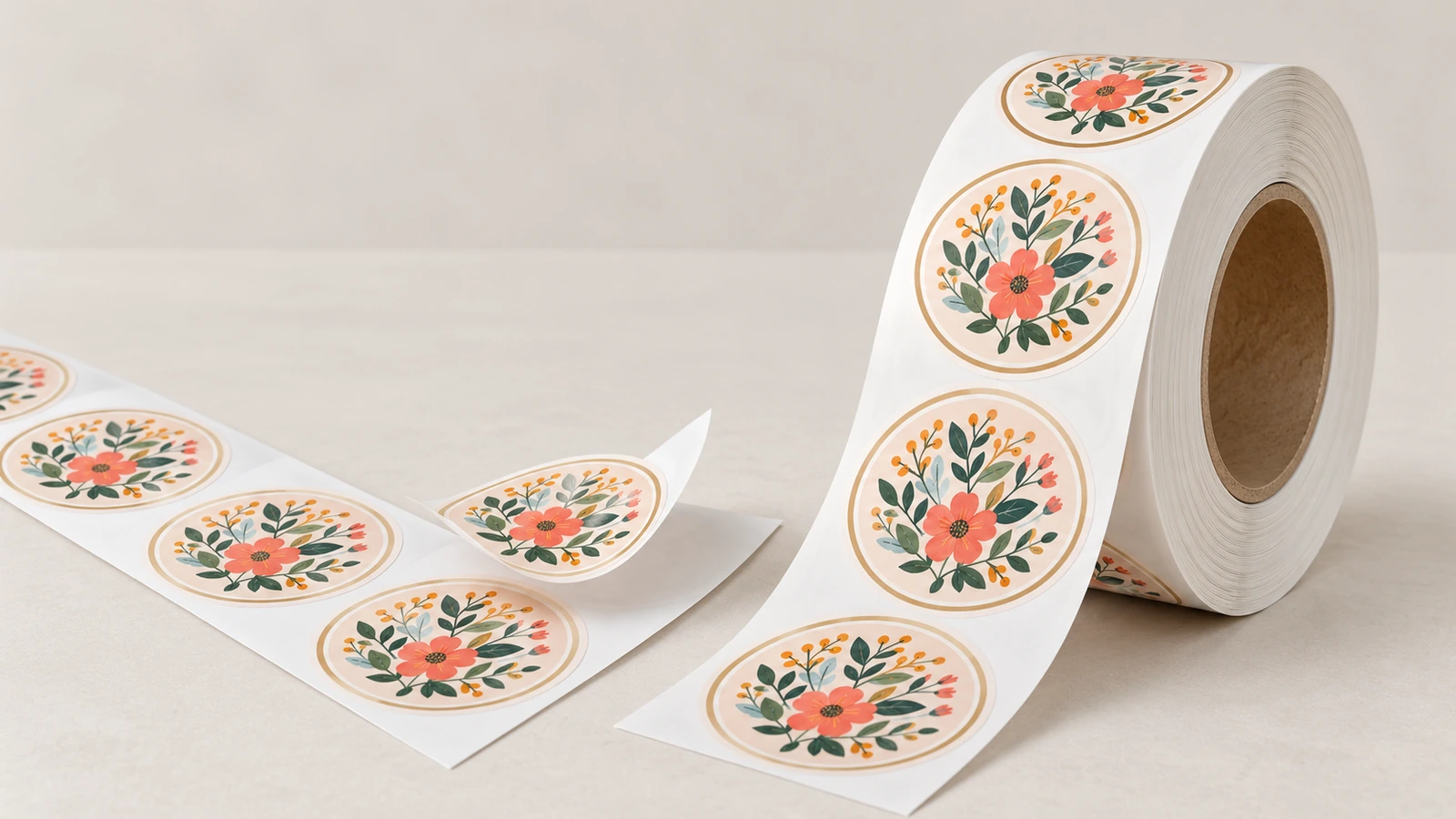
Printing runs in CMYK, while monitors show RGB, so color will shift between screen and roll. StickerGiant's proof guidance[22] also notes that production starts only after the proof is approved. A PDF proof is not a color sample. If brand color matters, request a physical sample and agree on an acceptable variance in writing.
Before upload, convert colors to CMYK, outline or embed fonts, and include bleed. Supply vector art for clear labels, since white underprint follows the vector file. Keep barcodes at full size with their quiet zones intact.
Label copy is the brand's responsibility, and two recent rules affect food labels:
Under California AB 660[23], food made on or after July 1, 2026 and sold in California must use “BEST if Used by” or “USE by” style phrasing, and may not carry “sell by.”
The FDA food traceability rule[24] originally had a January 20, 2026 compliance date. Congress then directed FDA not to enforce it before July 20, 2028, so lot-code areas on labels no longer face a 2026 cutover.
Confirm final wording with your own regulatory counsel.
Step 5: Approve a proof, then pilot before volume
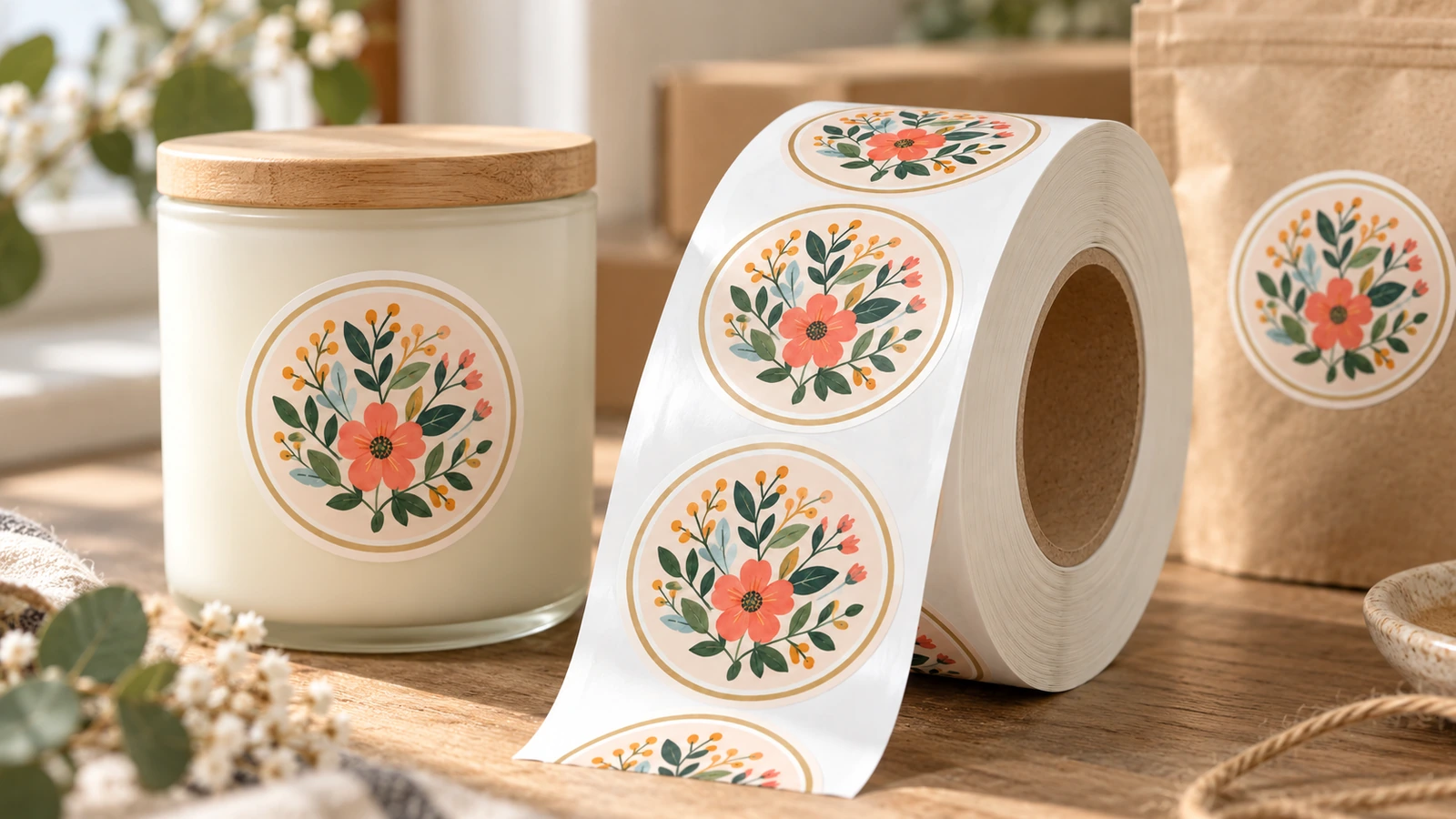
Count production time from artwork approval, not from payment. Every benchmark below uses that starting point.
If the labels feed an applicator, run a short pilot on the real line with the real container. Then hold the pilot bottles through the same cold or wet cycle the product will see.
For NSKU-612-01, the pilot quantity, production time, and any rush option are stated in the quote. Treat them as pending until you have written confirmation.
Step 6: Inspect every shipment before it reaches the line

| Check | Reference method | Caveat |
|---|
| Peel adhesion | ASTM D3330/D3330M-04(2025); FINAT FTM 1 | Dwell times differ; name the method |
| Ink anchorage | Tape test on first and last label of each roll | Keep failed rolls as evidence |
| Die-cut depth | Marker along cut line: solid line means too deep, broken line means not cut through | Check before loading the applicator |
| Bond on real container | Apply, wait 24–48 h, then cold or wet exposure | Valid only for tested conditions |
| Barcode quality | ISO/IEC 15416:2025 grading; GS1 General Specifications | Grade each print batch |
ASTM D3330[25] measures the peel adhesion of pressure-sensitive tapes. It notes that peel values do not translate directly into end-use performance.
FINAT test methods[26] include FTM 1 (180° peel) and FTM 9 (loop tack). Because dwell times differ between methods, a spec should name the exact method rather than just saying “peel tested.”
The marker die-cut check follows the LP Automation guidance cited earlier.
Linear barcodes are graded under ISO/IEC 15416:2025[27]. Symbol sizes and minimum quality come from GS1 General Specifications[28] version 26.0, released January 2026.
Nothing in this table is a factory test result for NSKU-612-01. These are acceptance checks to agree on in writing before the first order.
How Do Published Roll Label Benchmarks Compare? ↑
These published figures help you sanity-check any quote, including ours. Each supplier's defaults differ in size, material, and finish, so read them as reference points rather than like-for-like prices.
| Supplier | Published minimum | Production time | Material or roll note |
|---|
| OnlineLabels | 100 labels | 2–3 business days after artwork approval | 500 × 1.5″ white paper, gloss: $102.10 |
| StickerGiant | 125 labels per custom roll | Roll finishing can extend turnaround | 2.4 mil white BOPP; PET liner from 2×2 in |
| VistaPrint (US) | 50 labels | Not stated uniformly | Single-column rolls for applicators |
| StickerYou | 250 labels | Express, Rush, Standard dates shown | Durable BOPP: waterproof, oil resistant |
| PrintRunner | No single minimum on main page | 6 business days; rush to 4 or 2 | White, clear, or silver BOPP |
Sources for the table:
OnlineLabels figures come from its product page and FAQ. StickerGiant figures come from its roll article. PrintRunner timing comes from its roll page. StickerYou's durable roll page[29] sets its 250-label start.
VistaPrint's US pages disagree with each other: one lists 50 to 5,000 labels and the roll labels page lists 50 to 50,000. Quote the exact SKU page you are using.
Reviews add detail the spec sheets lack. On Trustpilot[30], one OnlineLabels buyer called a set of labels “ridiculously thin” and easily scuffed on spa products. Another found that weatherproof BOPP rolls held color and resisted alcohol better than sheets. The lesson is about material choice, not brand: thin or uncoated stock fails on premium or wet products.
If you sell into Europe or plan to make recyclability claims, ask about adhesive release in recycling. Avery Dennison's AD CleanFlake earned RecyClass technology approval for the PET stream[31] in September 2025.
Linerless labels remain a niche, at roughly 6% of global pressure-sensitive label volume in 2025, according to AWA as reported by Label & Narrow Web[32].
Smithers[33] projects packaging labels growing from $48.3 billion in 2025 to $57.5 billion in 2030. Over a similar period, digital printing is forecast to rise from 7.0% of label volume in 2024 to 11.3% in 2030.
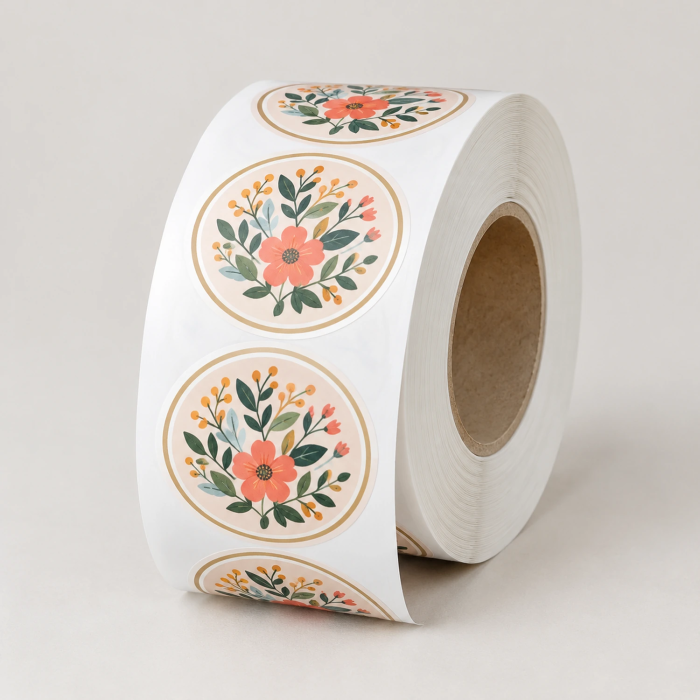
For reorders, keep a one-page roll spec. It should list the core, outer diameter, rewind direction, labels per roll, material, finish, and the approved proof file. Paste it into every reorder, because special instructions do not repeat automatically.
Ask how rolls are packed so labels do not crush or lift at the edges in transit. If a fill date cannot move, keep a second qualified source with an approved sample on file.
What Should You Remember Before Requesting a Quote? ↑
- Food and personal care drive most craft-label demand — about 44.9% and 29.4% of revenue (Source)
- Roll unit cost falls steeply with volume at one published benchmark — about $0.38 at 1,000 vs. $0.07 at 25,000 (Source)
- Packaging roll labels typically ship on a standard core — 3 in (Source)
- Default roll splitting can stop an automated line — 125 labels minimum per custom roll at one supplier (Source)
- California date phrasing rules now apply to labels — effective July 1, 2026 (Source)
- FDA food traceability enforcement is deferred — not before July 20, 2028 (Source)
Ready to Turn Your Roll Spec Into a Quote? ↑
A roll label that looks right but jams, flags, or arrives on the wrong core costs far more than the labels themselves. Start with the container and environment. Lock face stock, adhesive, and finish next, then write down the core, outer diameter, rewind direction, and labels per roll. Approve a proof, pilot on your real line, and inspect every roll on arrival.
For NSKU-612-01, MOQ, production time, and material options are confirmed only in a written quote and proof, never assumed. Send your container type, label size, quantity, and applicator details to request your custom roll label quote.




The information below is required for social login
Sign In
Create New Account