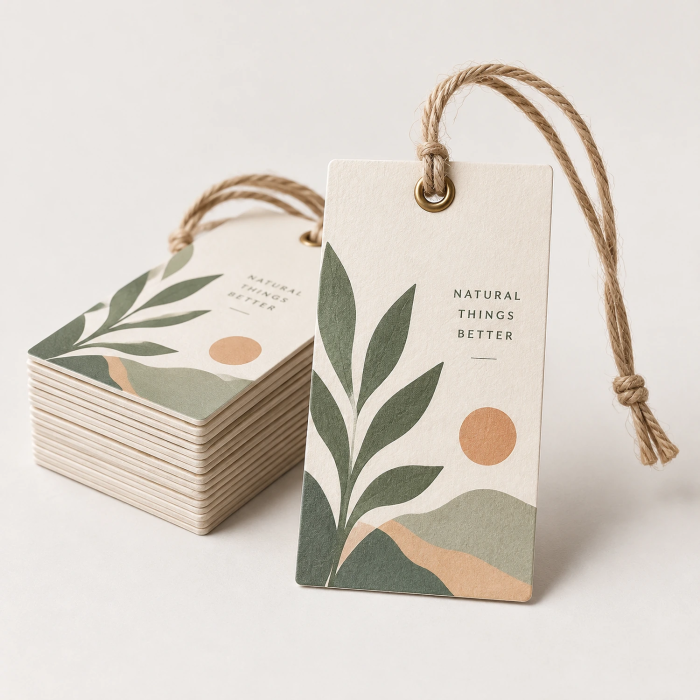
Custom printed paper hang tags carry your logo on the front and price, size and a QR code on the back. A good order fixes five things in writing before printing starts: finished size, stock thickness, hole size and position, attachment method, and a signed physical proof. That proof then becomes the color reference for every reorder.
Who Buys Custom Printed Paper Hang Tags, and What Job Should Each Tag Do? ↑
Most people searching for custom hang tags are already comparing suppliers. Typical buyers are founders and designers of small apparel, accessory, gift and handmade brands. At larger labels, purchasing and e-commerce staff take part, and packaging design, merchandising and finance each sign off. The real task is to match brand visuals, required information, stock and finish, hole and attachment, delivery timing and total cost in one order. Unit price alone does not cover that.
Give each tag one primary job: brand recognition, retail price and size, a product story, a promotion, or a QR link to traceability content. 4OVER4's clothing hang tag guide[1] puts the logo and brand name on the front. Price, size, fiber content, country of origin and basic care go on the back, and a QR code carries anything extra, "since the tag is small." List mandatory fields separately from optional marketing copy. If the back cannot be read in one glance under store lighting, move content to the QR page instead of shrinking the type.
Small sellers often cite perception. A market seller on T-Shirt Forums[2] (October 2023) reported paying about $30 for a tag gun and roughly $20 for 5,000 plastic barbs, concluding that "perception is indeed everything." Shoppers in a Reddit r/crochet thread[3] (February 2023) were split: some said a tag looks "official" and supports a higher price, others would "take or break it off at first washing." A hang tag does its work at the shelf, not after purchase.
Why Do Hang Tag Orders Fail After the Proof Looked Fine? ↑
The problem starts with incomplete specifications. Many buyers have not decided the finished size, single or double sided printing, hole position, corner shape, barcode or care summary. Quotes built on partial specs cannot be compared fairly, and the gaps only show up once the tags are printed.
Public complaints point to the same few failure points. 4OVER4's size guide[4] says "the hole is where most reprints come from" and notes that hole drilling is a separate configurator option, not automatic. A verified buyer at VistaPrint Canada[5] (2026-10-06) described flimsy cardstock, paper dust on every tag, and glare that made the text disappear. A repeat customer reviewing Wunderlabel on Trustpilot[6] received a different background color and lost the border used on earlier orders. A PrintRunner buyer[7] (2026-04-24) received tags "stacked on top of each other in one huge, very heavy box." A Greener Printer buyer[8] (2026-10-13) said production delays "weren't relayed to me well at all." Each complaint traces back to specification, proofing, packing or communication, not printing ability.
This page turns each failure point into a specification item or acceptance check for our Custom Printed Paper Hang Tags (SKU NSKU-746-01). We have not published a fixed MOQ, unit price, production time or stock list for this SKU. Each is confirmed in your written quotation and, when color or finish matters, on a physical sample before production.

Table of Contents
What Is a Custom Printed Paper Hang Tag, and What Can It Not Replace? ↑
A custom printed paper hang tag is a removable card, usually cover stock or kraft board, printed on one or both sides, punched or drilled, and attached with string, ribbon, a snap-lock cord or a plastic barb. It presents brand identity and retail information at the point of sale, and the buyer is expected to remove it.
A hang tag is not a care label. Under 16 CFR Part 423[9], a care label is "a permanent label or tag" attached so that "it will not become separated from the product." Section 423.6(a) allows care information on a hang tag only as an addition, when packaging or folding hides the permanent label. Fiber content, country of origin and the RN or company name fall under separate FTC textile and wool rules and belong on permanent labels; for garments with a neck, origin goes on the front of the label at the inside center neck. Your tag can repeat a care summary that matches the sewn-in label, but should never be described as satisfying the care labeling rule. A woven label is a separate purchase: it survives washing, while the paper tag carries the seasonal story.
How Do You Specify, Proof and Approve Your Hang Tag Order? ↑
Step 1: Size the tag to the information load
UPrinting's size guide[10] calls 2.0" × 3.5" "the most widely used" size, close to a business card, with room for brand elements, product details and price. GotPrint[11] offers 25 sizes from 2" × 2" to 2" × 8" and says the right size depends on the product and information. The 4OVER4 size guide notes that "2 by 3.5 is the one most brands order."
| Size (inches) | Typical use | Constraint to check |
|---|
| 2 × 2 | Logo-only or minimal brands | Visible area can shrink to about 1.5 × 1.25 after bleed, margins and hole |
| 2.5 × 2.5 | Square layouts with short copy | Keep text clear of a centered hole |
| 2 × 3.5 | Apparel and retail default: logo front; price, size and QR back | A top hole uses about 1/4" of the height |
| 2 × 4 | Extra detail or a scannable barcode | A UPC-A needs about 1.469" of width |
Reprints usually come from the constraint column, not the use column. Fitting care, fiber and story copy onto a 2" square hurts readability; move to 2 × 4, print both sides, or use the QR page. Check readability on a printed sample at arm's length, since a screen preview cannot tell you.
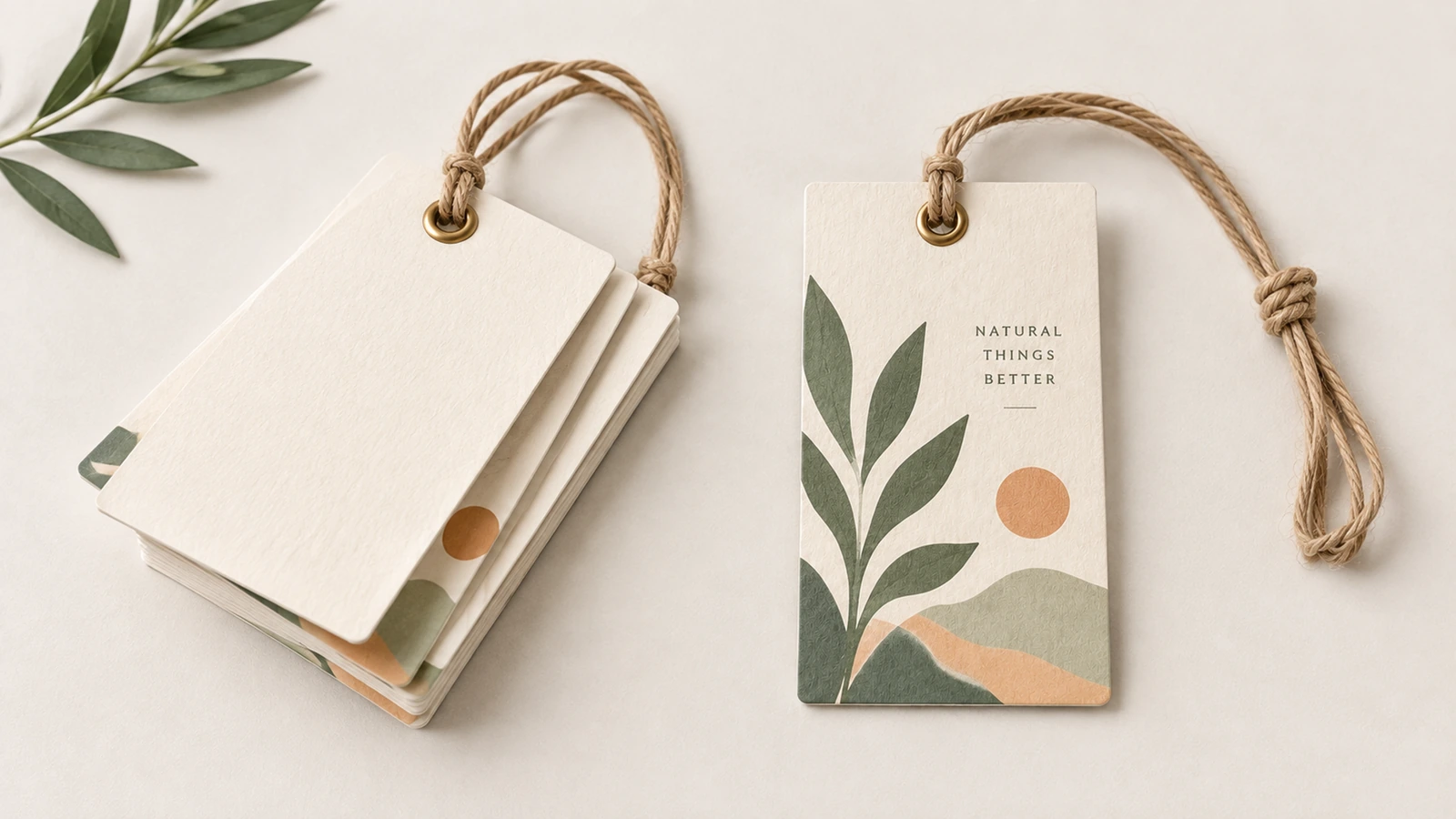
Step 2: Choose stock and attachment before premium finishes
UPrinting's materials guide[12] says most tags use 14, 16 or 17 pt cardstock: 14 pt is the everyday retail choice, and 16 pt is "noticeably thicker and sturdier," so premium brands lean toward it. Greener Printer lists 100#–130# cover, 16 pt double-thick silk and 17–20 pt kraft board as stocks that hold up to handling. Uncoated stock suits handwritten prices but absorbs ink differently. Kraft and dark recycled papers lower contrast, so light text on them always needs a physical sample. Waterproof synthetics and lamination suit swimwear and outdoor goods; ordinary apparel does not need them by default.
Choose the attachment next, because it sets the hole size. UPrinting's product page[13] states that "no strings are included" by default and strings cost extra. The 1/8" hole is most popular, with 1/4", 3/16" and 5/16" also offered. Pick the string, ribbon or barb first, match the hole to it, and keep the hole well inside the trim so the edge does not tear. Add foil stamping, embossing and spot UV last; they need separate plates or layers and add time, so they cannot be combined with "lowest price, fastest delivery" as a default.
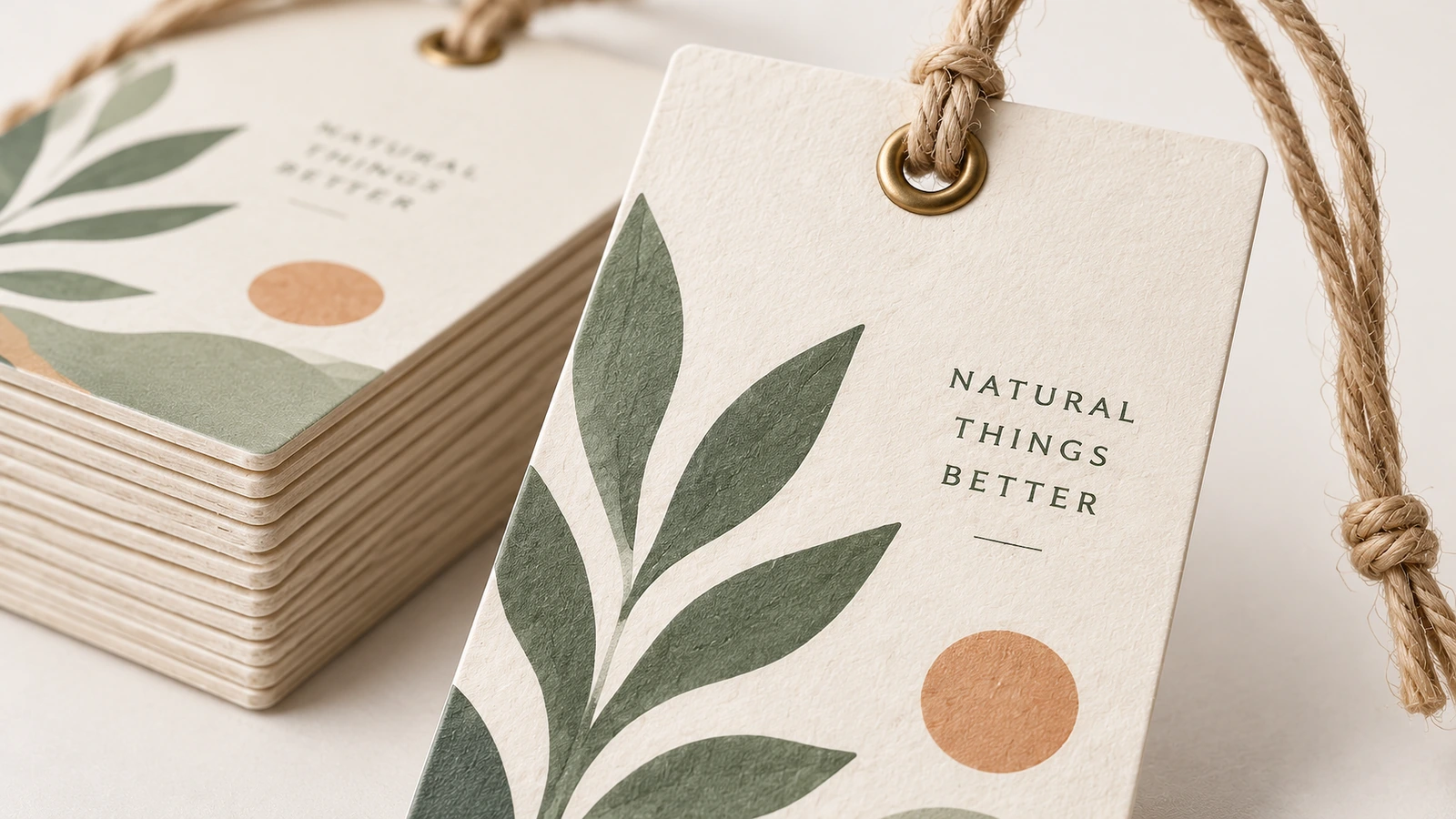
Step 3: Prepare print-ready files
Export a PDF at finished size plus 0.125" of bleed on every edge. Keep live text 0.125" inside the trim and 0.25" away from the hole, following the 4OVER4 guide. Mark the hole center on a non-printing layer. Supply brand colors as CMYK values or Pantone references, state whether the stock is coated or uncoated, and do not send RGB PNGs as color references. The XINGKUN production guide[14] asks for foil, emboss, spot UV and die lines on separate, named layers. Place QR codes on a plain light field, away from foil and dark images. Set front and back as pages 1 and 2 and mark the flip direction. Artwork changes after approval pause production, so count lead time from proof signoff.
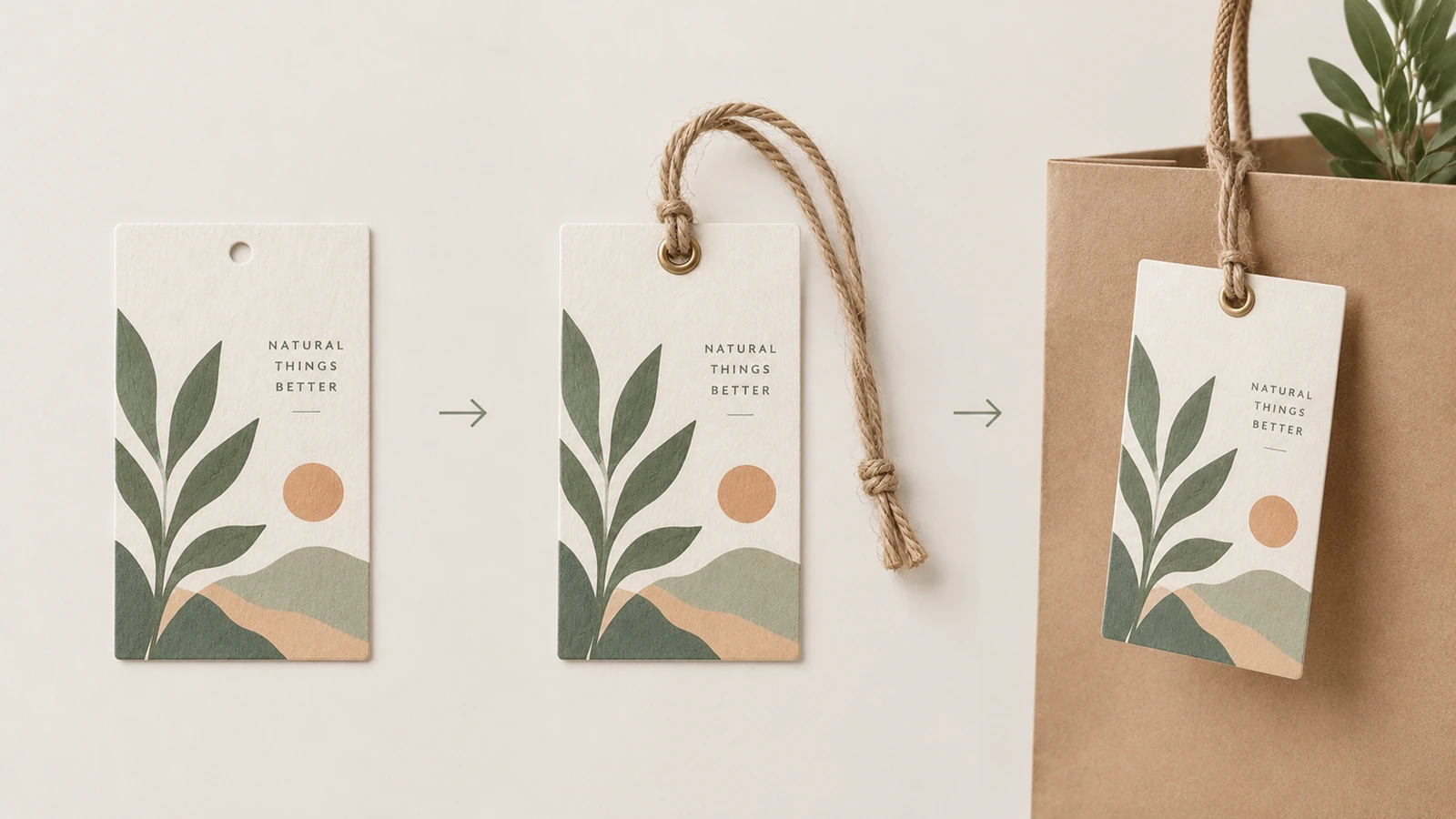
Step 4: Proof by risk tier
| Proof type | What it confirms | When to use |
|---|
| Screen or PDF soft proof | Text, bleed, hole and die-line position | Reorders with unchanged stock and finish |
| Calibrated digital contract proof | Color direction against ISO 12647 conditions | New brand colors or a stock change |
| Physical pre-production sample | Color, stiffness, finish, hole, string or barb | First orders, foil, emboss, dark stock, QR codes |
XINGKUN warns that a digital proof "confirms layout but may not accurately represent final color, texture, stiffness, or finish." ISO 12647-1:2013[15] defines a contract proof as a reliable representation of prepress output, used as the production color reference and for later disputes. Greener Printer gives up to two free digital proofs and starts production only after approval, while noting that mock-ups do not show final color or special finishes. Your signoff should cover color direction, logo position, spelling, hole position, die cut, finish registration, QR scanning, string or barb strength, and whether the tag flips on the product. Number and keep the signed sample. Physical sample fees for NSKU-746-01 are quoted per configuration.
Step 5: Plan production and buffer the lead time
A typical sequence runs from imposition to save paper, to printing (offset for long runs and spot colors, digital for short runs and variable data), surface finishing, die-cutting, drilling or eyeleting, stringing or barbing, then counting and packing. For market context, GotPrint says production takes "3 to 6 days," beginning the day after proof approval and payment, and Greener Printer lists 5–10 business days, excluding shipping. Production time is not arrival time, and foil, embossing and overseas freight need extra buffer. For our SKU, production time appears in the quotation once specification and proof are fixed. Leave room for at least one reprint before launch.

Step 6: Test hanging and durability
Most tag failures happen at the hole, the string or the hanging position, not in the print. Hang 20–50 samples on the actual product and check for cracking around the hole, slipping knots, and tags that rotate and hide the logo. Scan every QR variant on the final stock. Under store lighting, check for paper dust, scratches, glare and fingerprints, the exact problems the VistaPrint reviewer reported. Only call a tag washable if you have tested it, and never present a removable tag as a permanent label.

Step 7: Pack, receive and reorder with traceability
Ask for tags in small cartons labeled by SKU rather than one heavy box, the issue in the PrintRunner review. On arrival, count by carton and photograph damage the same day. Check hole placement, white edges, color and accessory counts, and order 5%–10% extra strings or barbs. Record the proof number, stock specification and any FSC or recycled-content certificate number on the purchase order, and require written notice of any delay before the promised production date. On reorders, write "match previous job" and send a retained sample, so color does not drift as in the Wunderlabel repeat order.
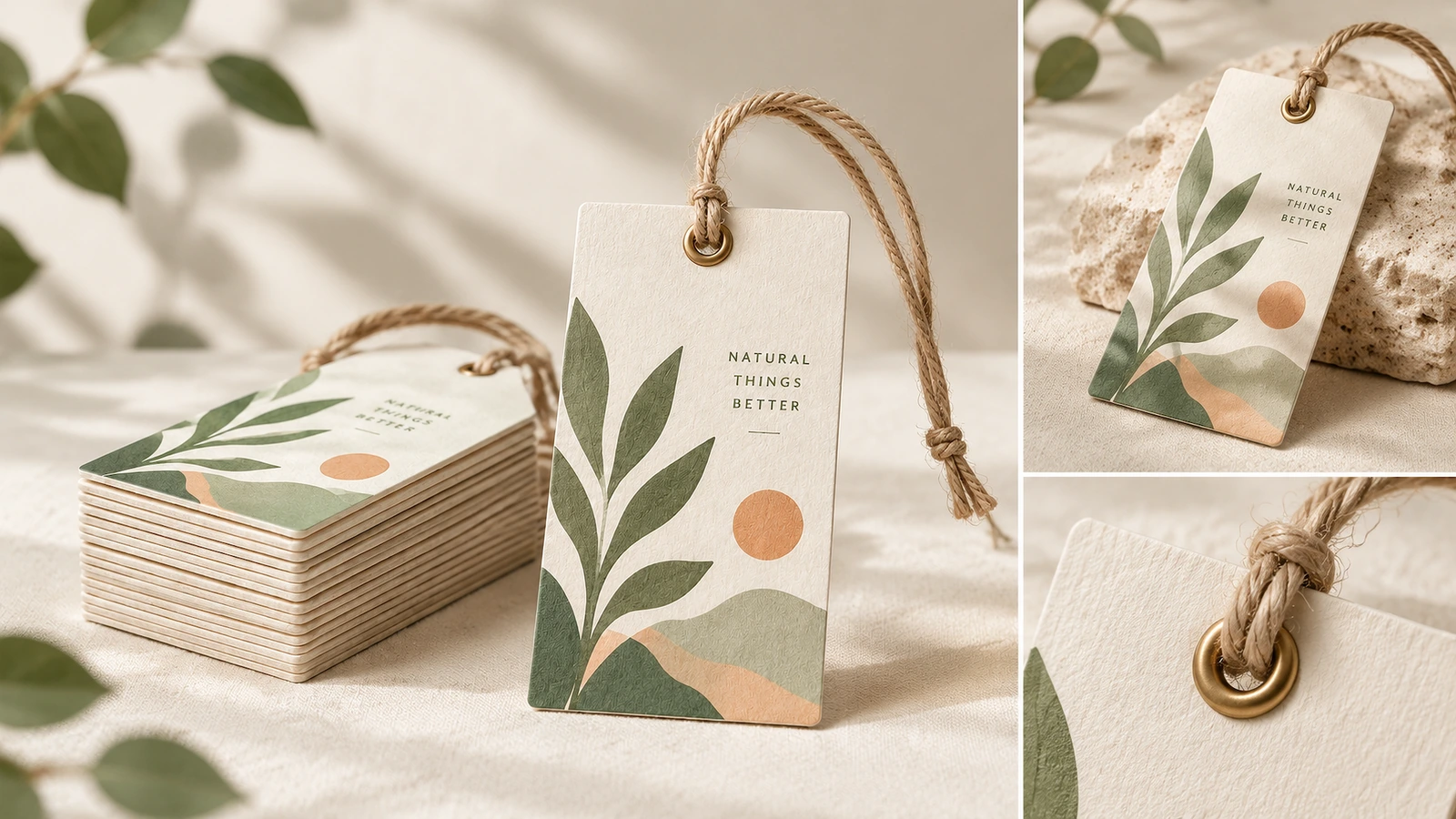
Which Stock, Finish and Attachment Fits Your Budget? ↑
The public prices below are starting points from supplier pages. They exclude shipping and tax, vary with size, sides, finishing and quantity, and are market references, not our quotation.
| Option | Public price reference | Durability | Best fit |
|---|
| Standard 14 pt card | 2" × 2" at $25.00 for 50 (GotPrint); $25.27 for 50 (4over4[16]) | Handles retail use; vulnerable to moisture and folding | Test runs, price and size tags, QR tags |
| Premium kraft or thick board | From about $35.38 for 50 (4over4) | Stiffer and more tactile; still not waterproof | Mid-to-premium apparel, gift, beauty |
| Plastic or synthetic | 20 pt rigid vinyl, 2" × 3.5", $174.65 for 100 (4over4) | Resists water and scratches | Swimwear, outdoor, long shelf life |
| Attachment service | $0.30 per unit, tags not included (Threadbird[17]) | Depends on the barb or string | Brands shipping retail-ready garments |
The price gap follows the environment the tag must survive. On the 4over4 catalog, plastic works out to about $1.75 per tag at 100 pieces, versus roughly $0.51 for a 50-piece paper run, so plastic only makes sense when water or abrasion is a real risk. It also raises recycling questions and rules out any "plastic-free" claim. Foil dies, custom die shapes, strings and rush service are added on top, and unit cost falls with quantity, so pricing a full season's volume usually beats pricing each drop separately.
How Do You Write Tag Claims and an RFQ That Hold Up? ↑
Environmental wording needs evidence. The FTC Green Guides summary[18] (16 CFR Part 260) says marketers "should not make broad, unqualified general environmental benefit claims like 'green' or 'eco-friendly.'" Use verifiable statements such as "Printed on FSC-certified paper," "Made with 100% post-consumer recycled paper," "Soy-based inks," or "Plastic-free attachment," each backed by a supplier document. FSC covers forest management or chain of custody; it does not mean compostable or carbon neutral, and a kraft appearance is not a claim at all. If only the paper is certified, do not extend the claim to ink, lamination or barb. Material certifications for NSKU-746-01 are confirmed per order against supplier documents, never assumed.
Origin and fiber claims carry enforcement risk. In 2022 the FTC finalized an order[19] requiring Lions Not Sheep Products to pay $211,335 over "phony Made in USA labels" on imported clothing. Business of Fashion[20] reported (2026-06-23) that an EU Commission-backed test found about 37% of tested garments had fiber content not matching their tags or labels. Print origin or fiber on a hang tag only when it matches both the permanent label and the product.
QR codes and RFID only pay off when the data behind them is maintained. In an HGI interview[21] (2026-10-09), Avery Dennison's Delia Glover said RFID, NFC and QR codes let a garment carry "what it's made of, where it came from and how it should be recycled." Link only to a stable URL, check it for dead links yearly, and do not claim digital product passport compliance unless legal counsel has confirmed it.
| RFQ field | What to fix in writing |
|---|
| Format | Finished size, single or double sided, bleed, safety margins |
| Content | Logo, SKU, barcode, price, size; care summary checked against the permanent label |
| Structure | Hole diameter and position, corners or die shape, attachment, pre-strung or loose |
| Stock and finish | Thickness in pt or gsm, coated or uncoated, foil, emboss, spot UV |
| Proof | Proof tier, signed sample number, Pantone or CMYK references |
| Commercial | Quantity, unit price, sample fee, production days counted from proof approval |
| Acceptance | Color reference, quantity tolerance, cartons split by SKU, sampling method, delay notice |
Send the same sheet to every supplier so quotes compare like for like, leaving nothing to default settings. For NSKU-746-01, we answer the commercial row in your written quotation, and the acceptance row becomes part of the purchase order.
What Should Every Buyer Remember Before Ordering? ↑
- 2" × 3.5" is the default retail tag size. — 2.0" × 3.5" is "the most widely used" size (Source)
- Hole specification drives most reprints. — 0.125" bleed, with text 0.25" clear of the hole (Source)
- 14 pt suits everyday retail, and 16 pt reads as premium. — Most tags use 14, 16 or 17 pt cardstock (Source)
- Production time starts after proof approval. — 3–6 days at GotPrint, shipping not included (Source)
- A hang tag cannot replace a permanent care label. — 16 CFR § 423.6(a) treats it as additional only (Source)
- Unqualified "eco-friendly" claims are hard to substantiate. — FTC Green Guides, 16 CFR Part 260 (Source)
Ready to Turn Your Spec Sheet into a Quote? ↑
A reliable hang tag order comes from decisions made in the right order: one job per tag, sized to its information; stock and attachment before premium finishes; files with bleed and hole clearance; a signed sample as color reference; hanging tests on real products; and SKU-labeled packing so reorders stay traceable. Keep every claim on the tag verifiable. Send your completed RFQ sheet and artwork for NSKU-746-01 to request a written quotation, and we will confirm MOQ, unit price, sample options and production time for your exact configuration.




The information below is required for social login
Sign In
Create New Account