Custom printed scratch-off code labels keep a coupon, PIN, or prize code unreadable under an opaque, coin-removable layer until the recipient reveals it. The right build depends on what the hidden data is worth. Low-stakes reveals can use applied stickers. Redeemable codes need opacity, tamper evidence, and unique serials, all proven on samples before production.
Who Buys Custom Scratch Off Labels, and for Which Jobs? ↑
Buyers fall into four groups, and each group needs a different level of protection. The largest group is promotion teams at retailers, DTC brands, restaurants, real estate offices, salons, and dealerships. They turn a discount into a reveal on package inserts, counter handouts, direct mail, and door hangers. One use-case page sums up the reasoning: "A coupon code in an email gets skipped. A scratch-off card in the bag or the shipping box gets opened.[1]"
The second group is gift card, prepaid, utility, and activation-code issuers, along with personalization bureaus. For them, the label is a security component. One PIN-label supplier describes the gift card trade as a market "where every concealed PIN is a target[2]." Any attempt to lift and replace the label must therefore leave visible damage. Bilingual prompts such as "Raspe Aqui" are common on cross-border card faces.
The third group is HR managers, sales leaders, and nonprofits running bonus reveals or fundraising incentives. Their main risk is a leaked prize file. That is why suppliers emphasize unique control numbers on every piece and careful handling of prize files[3]. The fourth group is wedding and small-event hosts ordering tiny runs. This page focuses on business programs where the hidden data has real value.
Why Do Cheap Scratch-Off Stickers Fail Promotions? ↑
The problem usually appears after launch. Buyers of low-cost foil dots report coverage so thin that "even after we applied 2 stickers we could still see through to the image[4]." Other buyers hit the opposite failure. One seller tested four products before putting any on customer items. The seller said the worst one "was hard to scratch off… and it left smear marks all over the paper[5]."
Each of these failures costs more than the label itself:
The industry also lacks a shared benchmark. One patent filing notes that scratch-off opacity levels "are not well-defined within the industry[9]."
The fix is to specify by risk, not by color. Tell us what sits under the panel, what surface it goes on, and how it travels. We then scope the build and prove opacity, scratch behavior, and adhesion on samples before any production run. MOQ, unit price, and lead time are quoted per artwork after sampling, not promised in advance.
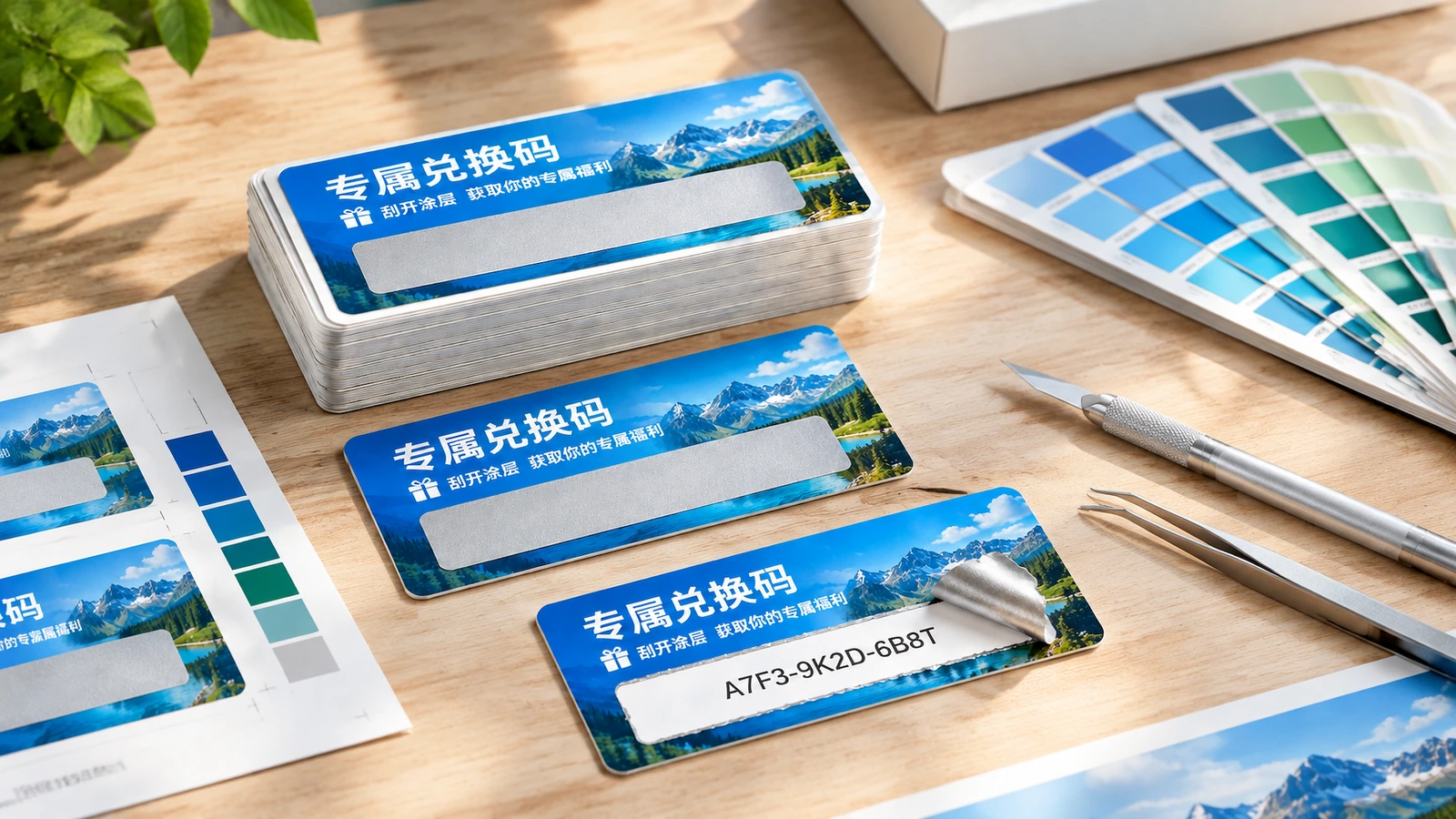
Table of Contents
What Is a Custom Printed Scratch-Off Code Label? ↑
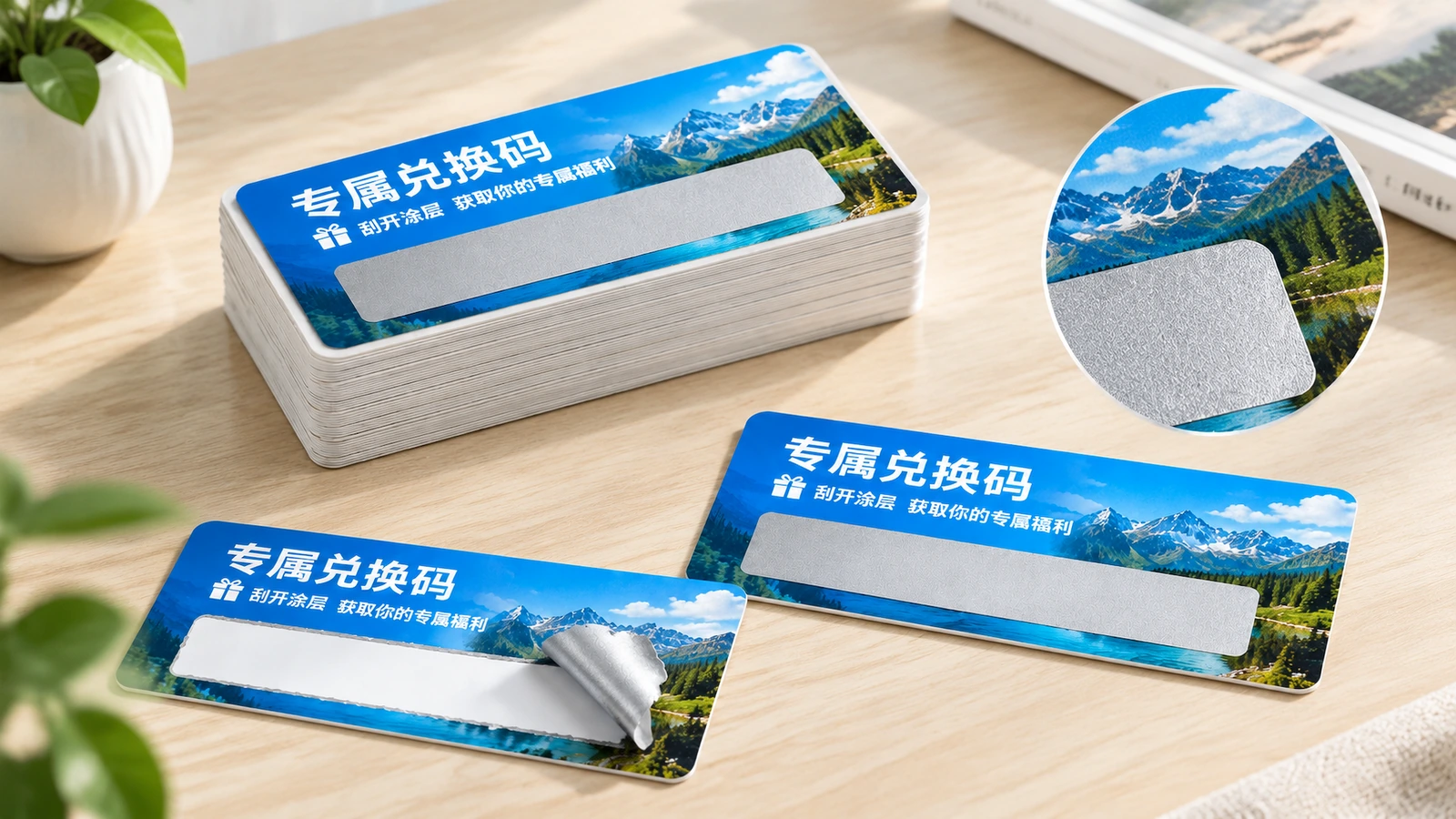
It is a label or panel that keeps printed information unreadable until someone removes an opaque coating with a coin or scratcher. Two structurally different products share the name:
The difference shows up under attack. The same panel guide states that labels "do not provide the same level of tamper resistance as screen-printed latex coatings." Card security labels close that gap by adding slits and an aggressive adhesive or destructible acetate, so any peel attempt fractures the panel. Lottery tickets go much further. They use a heavy black light-blocking layer, a varnish seal over the numbers, and multiple elastomer layers[12]. A promotional label should borrow only the features that match its risk.
How Do You Specify a Label That Hides Codes Reliably? ↑
Step 1: Grade the risk of the hidden data
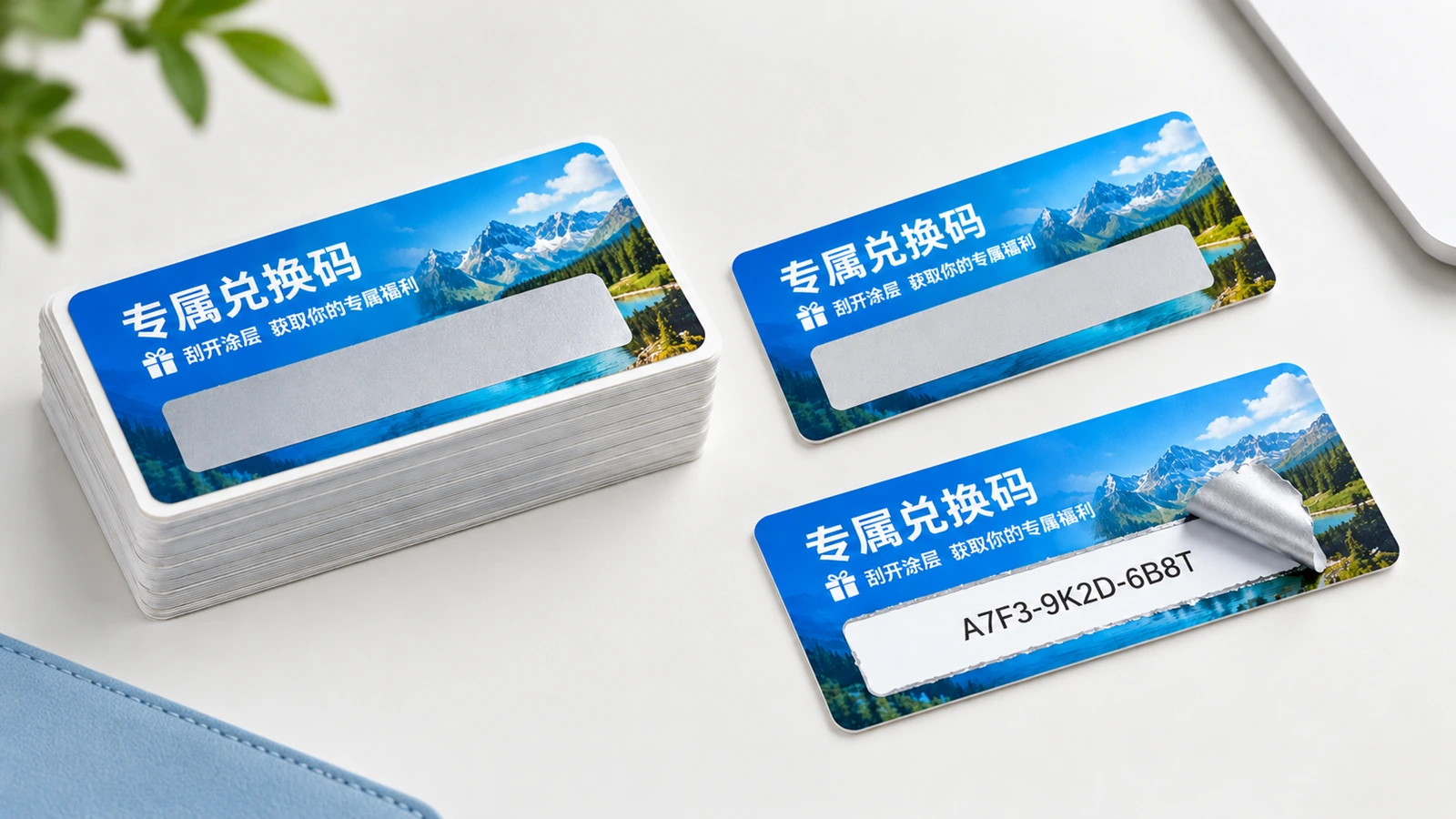
Fun reveals with no redemption value can use an applied label. Codes, prizes, PINs, and balances need more. Inprint's checklist for secure panels says the panel must hide content under bright light, resist peeling, lifting, and tape tests, and come off in one clean pass. If the code unlocks money, ask for tamper-evident construction and unique serials, not just "opaque silver."
Step 2: Set size, color, and readability
The dominant retail size is a 1 in (2.54 cm) round. Larger panels can carry short phrases but cost more per unit. Follow these readability rules:
If you handwrite codes under an applied label, use permanent markers or gel pens. Ballpoints and stamps leave raised marks that show through the sticker. One maker also recommends a coin or scratcher rather than a fingernail[16].
Step 3: Match substrate, adhesive, and surface
For printed panels, coated stock of 200–400 gsm is the working range, and promo cards use 300–400 gsm, per the Inprint guide. Uncoated paper absorbs latex and is not suitable. PVC, OPP, and other films need an adhesion trial on the final material.
For applied labels, temperature and surface energy decide adhesion. Security-label guidance links residue problems to application below 0°F (−18°C) or above 120°F (49°C)[17], and to high-energy surfaces such as glass or bare stainless steel. The same guidance recommends applying at +25°F or warmer (about +70°F is ideal) and cleaning the surface with 90%+ isopropyl alcohol first. Any code with value needs a permanent adhesive. A 2026 buyer guide quotes a manufacturer warning that "cheap scratch off labels peel due to temperature changes or tampering[18]."
Step 4: Preflight the artwork file
Before the file goes to press, check four things:
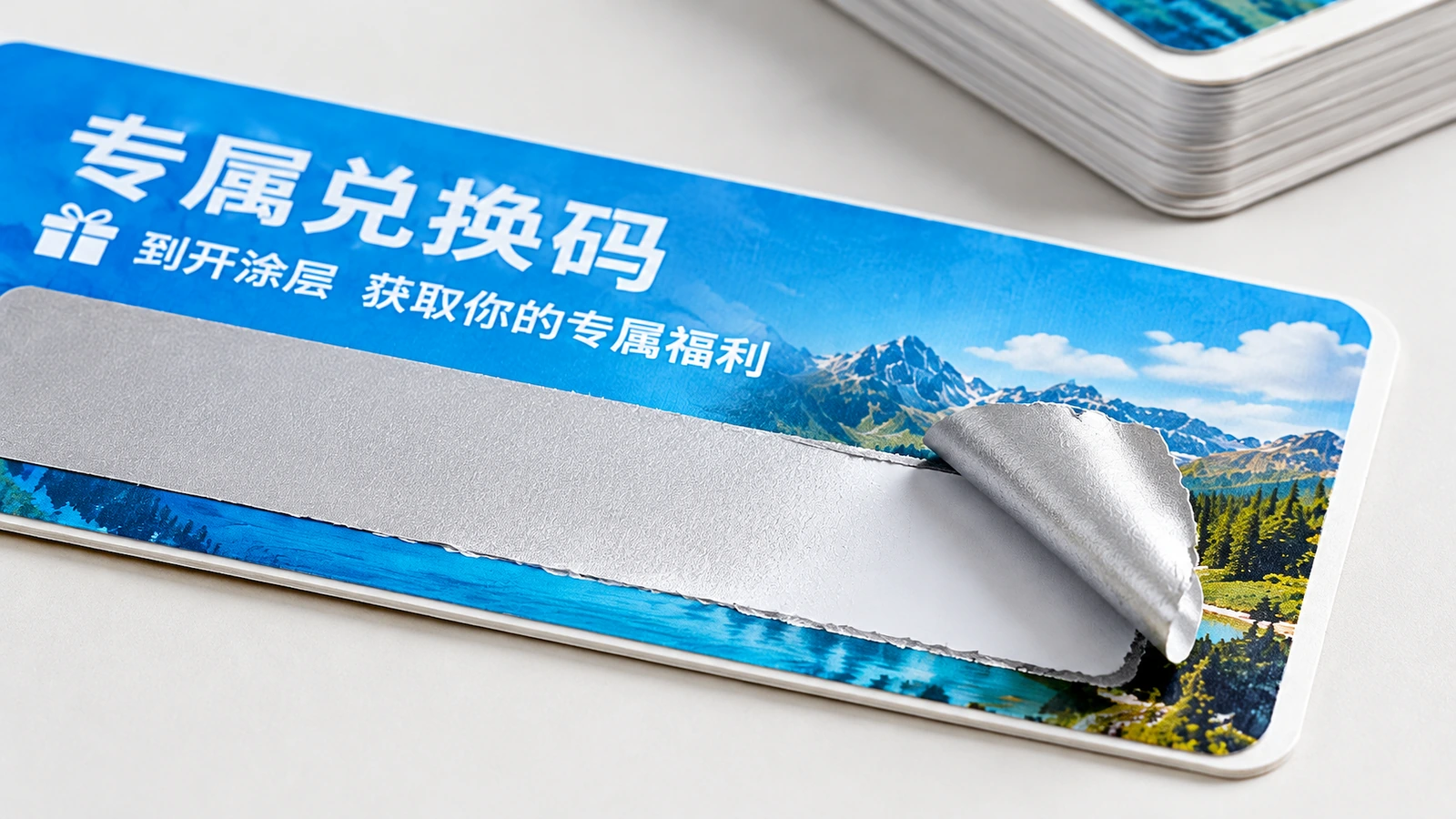
- The scratch area is built as its own mask layer, with the shape marked in the file[19], and includes the 2 mm overlap.
- No saturated color blocks sit under the panel, since they can show through from the back or side.
- Overprinted prompts such as "Scratch here" use 100% black.
- For variable data, the code list and prize table are locked, two people have proofed them, and the first, middle, and last pieces match the control file.
Step 5: Respect the production sequence
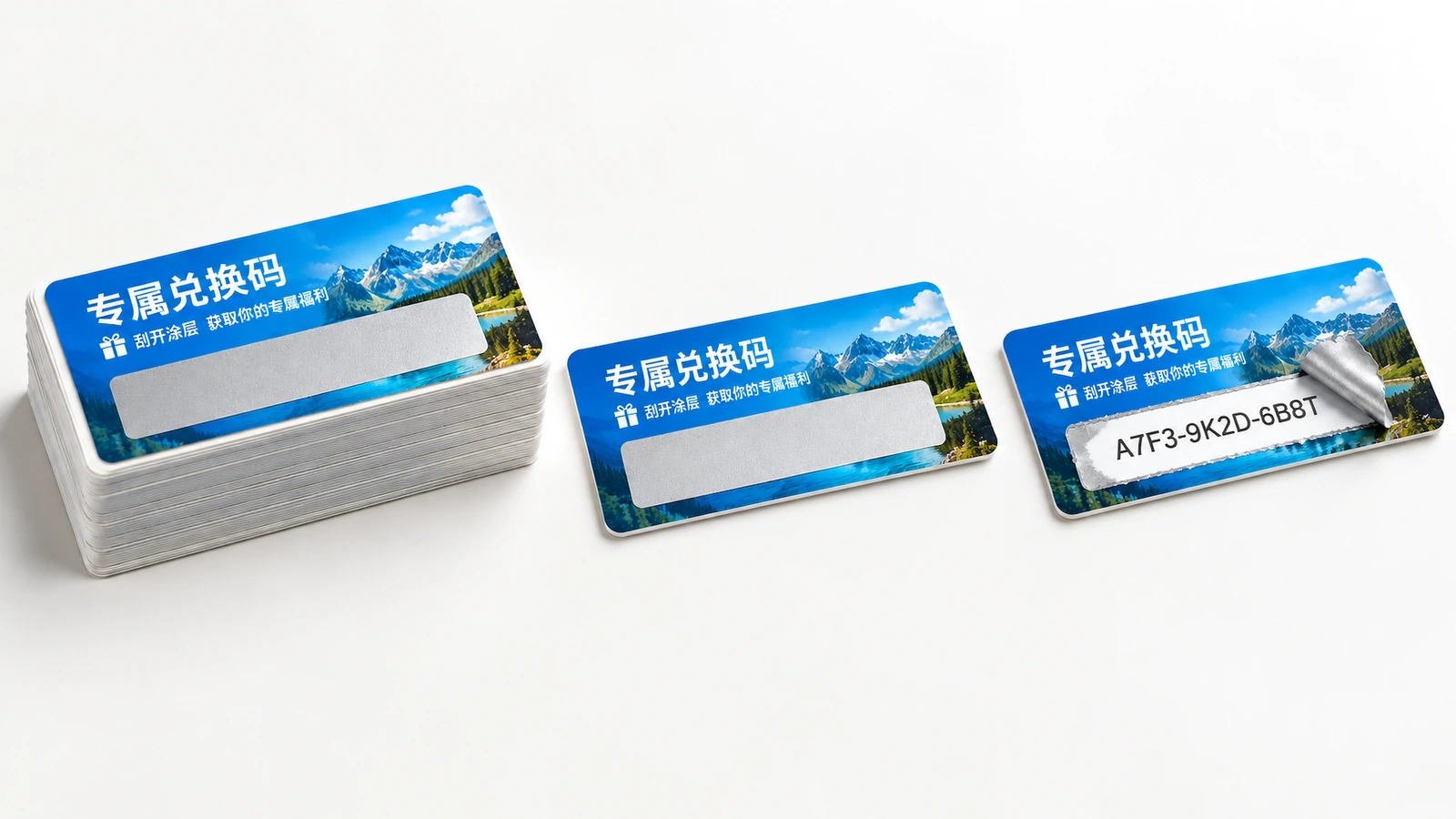
A printed panel goes through these stages in order: base print, release or lottery seal, optional varnish or laminate, scratch ink and curing, die cutting, and sampling. Each layer must dry before the next is applied.
Ink maker Printcolor advises curing pre-print varnish for at least 24 hours and keeping stacks at or below 35°C[20], because the ink is thermoplastic. It lists UV energy of 100–200 mJ/cm² for silver and 400–600 mJ/cm² for gold.
One printer advertises registration within ±0.3 mm[21]. Treat a figure like that as a written acceptance clause, not an industry standard. Rushed schedules are a common cause of adhesion failure, which is why lead time is quoted only after sampling.
Step 6: Apply, cure, and pilot
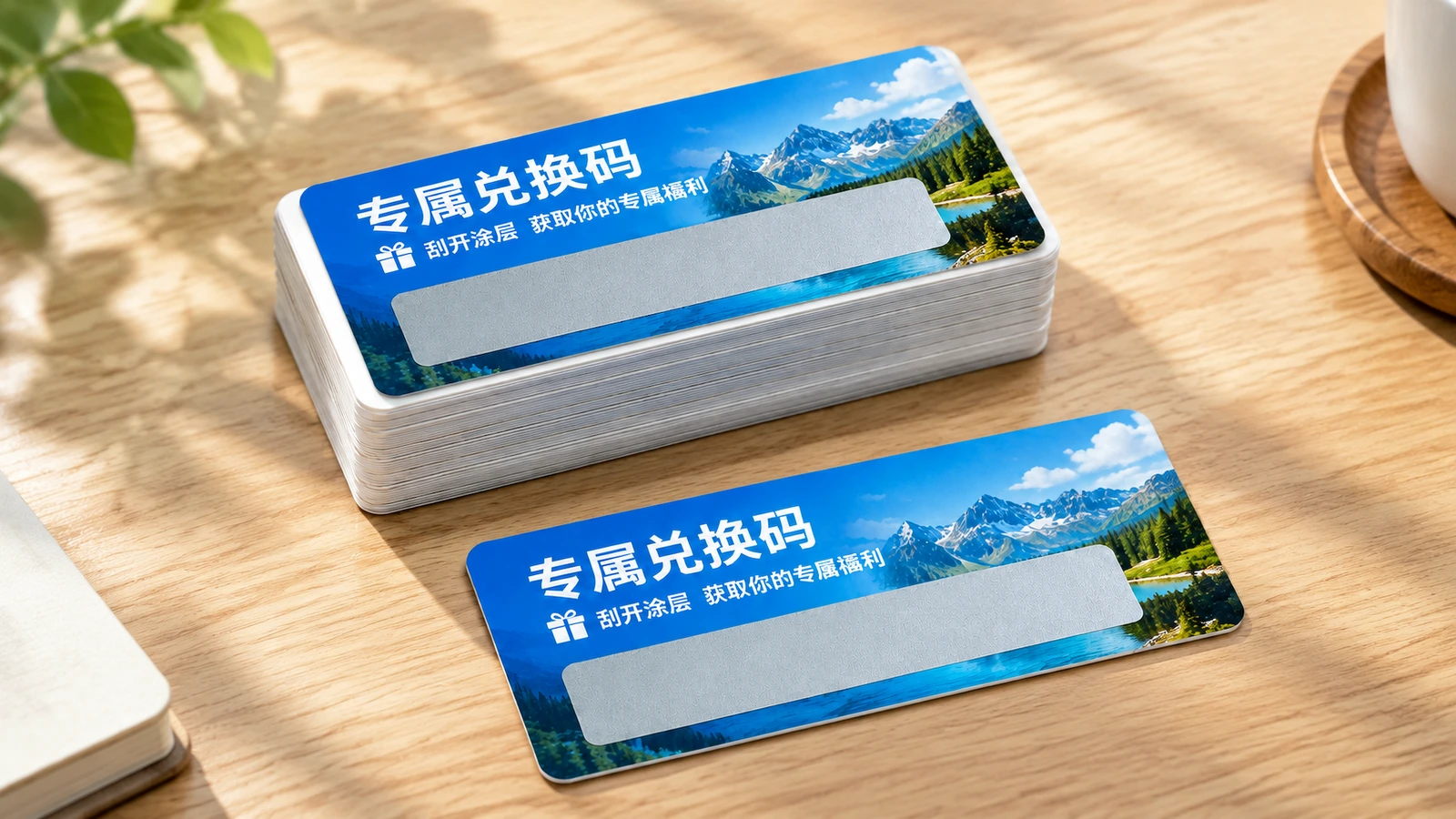
Applied labels need firm pressure and time. The My Scratch Offs listing cited above asks for about 48 hours of adhesive cure before scratching or mailing. Before you release a campaign, run a pilot:
- Apply labels to the real stock and wait for the adhesive to cure.
- Scratch at least four pieces, using a coin, a fingernail, and a plastic scratcher.
- Record any residue, digit damage, or odor.
Which Format Fits Your Program: Printed Panel, Applied Label, or Security Label? ↑
| Build | Tamper resistance | Moisture durability | Best fit | Verify at sample |
|---|
| Printed latex/UV panel on card | High when layered | Low–medium on paper | Coupons, prize and member codes at volume | Bright-light opacity, clean one-pass scratch |
| Applied silver/gold label | Lower; can lift whole | Depends on adhesive and surface | Inserts, invitations, mail, short runs | See-through, cure time, scuffing |
| PET/PVC/BOPP film code label | Medium–high | High | PINs, device codes, cosmetics, logistics | Ink adhesion on film, code legibility |
| Holographic + scratch composite | High | High | Recharge codes, high-value seals | Serial match, hologram alignment |
| Security label with slits | High; fractures on peel | Depends on facestock | Gift and prepaid card PINs | Peel test leaves visible damage |
This table ranks structures, not brands. Public pricing varies widely:
These are seller listings, not audited prices. Your quote will depend on size, number of layers, variable data, and security features.
What Should You Check Before Approving Production? ↑
| Check | Method | Pass criterion |
|---|
| Opacity | Bright light from front, back, and an angle | No hidden text or code visible |
| Scratchability | Coin, fingernail, plastic scratcher | Clean in one pass, digits intact, minimal residue |
| Adhesion | Tape test and handling | Prize area cannot lift whole; no dusting |
| Overprint | Visual read of panel prompt | Legible, ideally 100% black |
| Stack storage | Pile temperature check | At or below 35°C; no pressure marks |
| Variable data | First, middle, and last pieces vs. control file | No duplicate or missing codes |
| Transit | Arrival photos | No scuffed or exposed panels |
Agree on these criteria in writing at the sample stage. The approved sample then becomes the reference for every batch. Final values depend on the ink's current data sheet and the test results on your own stock.
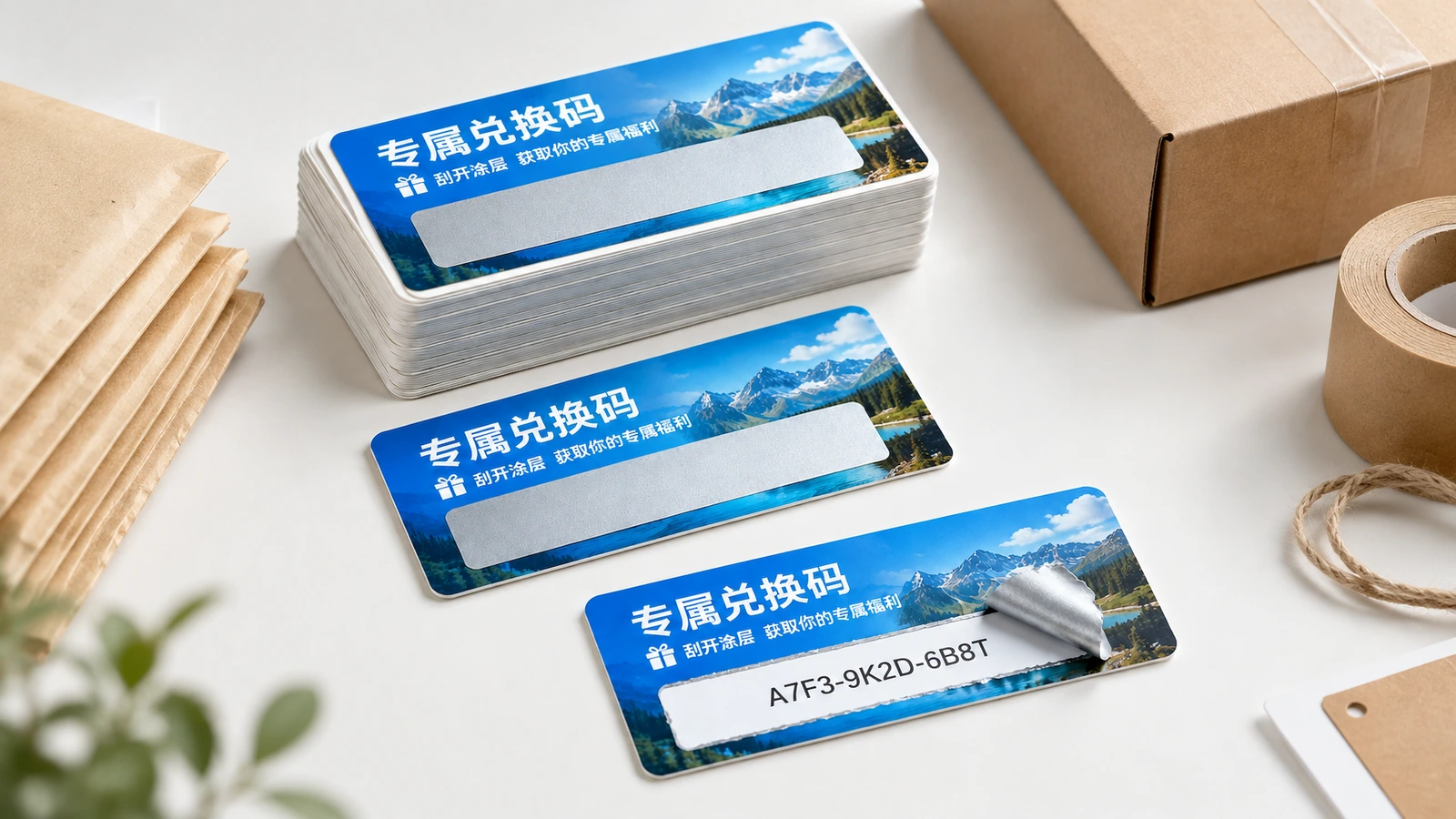
To compare quotes fairly, every request should state the same fields:
| Field | What to state |
|---|
| Size and shape | Diameter or W×H; round, rectangle, or custom die |
| Substrate | Coated paper (gsm), PVC, PET, or BOPP |
| Panel color and coverage | Silver, gold, white, or black; easy-scratch or anti-peek |
| Base coat | Required on paper and absorbent stock |
| Adhesive | Permanent or removable; acrylic or rubber; target surface |
| Variable data | Codes, serials, QR; file format and control numbers |
| Delivery format | Sheets or rolls; core size; labels per roll |
| Sample tests | Opacity, scratch, adhesion, tape, odor |
If a field is missing, the resulting quotes cannot be compared. Sheet versus roll delivery alone changes how the labels get applied and what packaging they need.
Transit is a hidden failure point. One print-quality review traces sticker scratches to stacking, roll winding, work surfaces, and tight packaging[25], not printing. Specify interleaving for sheets, controlled winding tension for rolls, and no panel-to-panel friction in cartons. Photograph shipments on arrival, and agree in advance who is responsible for transit damage.
Security programs should also train staff on visual tamper cues[26]: uneven coating, misregistered panels, lifting corners, and gloss that differs from the rest of the batch. For reorders, keep the approved file, the signed sample, and one unused retained piece so the next run matches.
Which Rules and Standards Actually Apply? ↑
In the US, a promotion that combines prize, chance, and consideration can be treated as an illegal lottery. That is why sweepstakes guidance centers on offering a "no purchase necessary" entry route[27]. Get legal review before you print prize odds or redemption terms.
Lottery standards do not cover promotional labels. The WLA-SCS:2024 security standard[28] governs lottery operators and their ticket suppliers. A promotional label should never be marketed as "WLA compliant."
Material rules apply only in specific cases:
- Food contact: if the adhesive becomes the food-contact surface of a label applied to food, 21 CFR 175.125[29] limits which pressure-sensitive adhesives are allowed.
- Children's products: a removable coating on a children's product counts as a surface coating. 16 CFR 1303 bans coatings with more than 0.009% lead[30], a limit in force since August 14, 2009. Adult promotional labels should not claim CPSIA compliance unless they have been tested.
Key Takeaways: What Matters Most for Your Order? ↑
- No shared industry definition of scratch-off opacity exists, so test it yourself — patent EP3471846A1 (Source)
- Printed panels need coated stock and coating overlap — 200–400 gsm stock, about 2 mm overlap (Source)
- Curing and storage limits protect adhesion — varnish cure of at least 24 h, stacks at or below 35°C (Source)
- Children's products need lead-tested coatings — 0.009% lead limit since 2009-08-14 (Source)
- Lotteries dominate scratch-off ink demand; security labels are a small niche — US$531.42M market in 2025, security labels about 5.01% (paid research estimate) (Source)
- Professional MOQs typically run in the thousands — 1,000–10,000 units per public 2026 comparison (Source)
Ready to Quote Your Scratch-Off Code Labels? ↑
Reliable scratch-off code labels come from matching the build to the value of the hidden data, then proving opacity, scratch behavior, adhesion, and code accuracy on samples before the run. Applied stickers work for fun reveals. Redeemable codes and PINs justify layered panels or tamper-evident security labels. Send your artwork, the type of hidden data, the target surface, and an estimated quantity to request a sample-based quote.




The information below is required for social login
Sign In
Create New Account