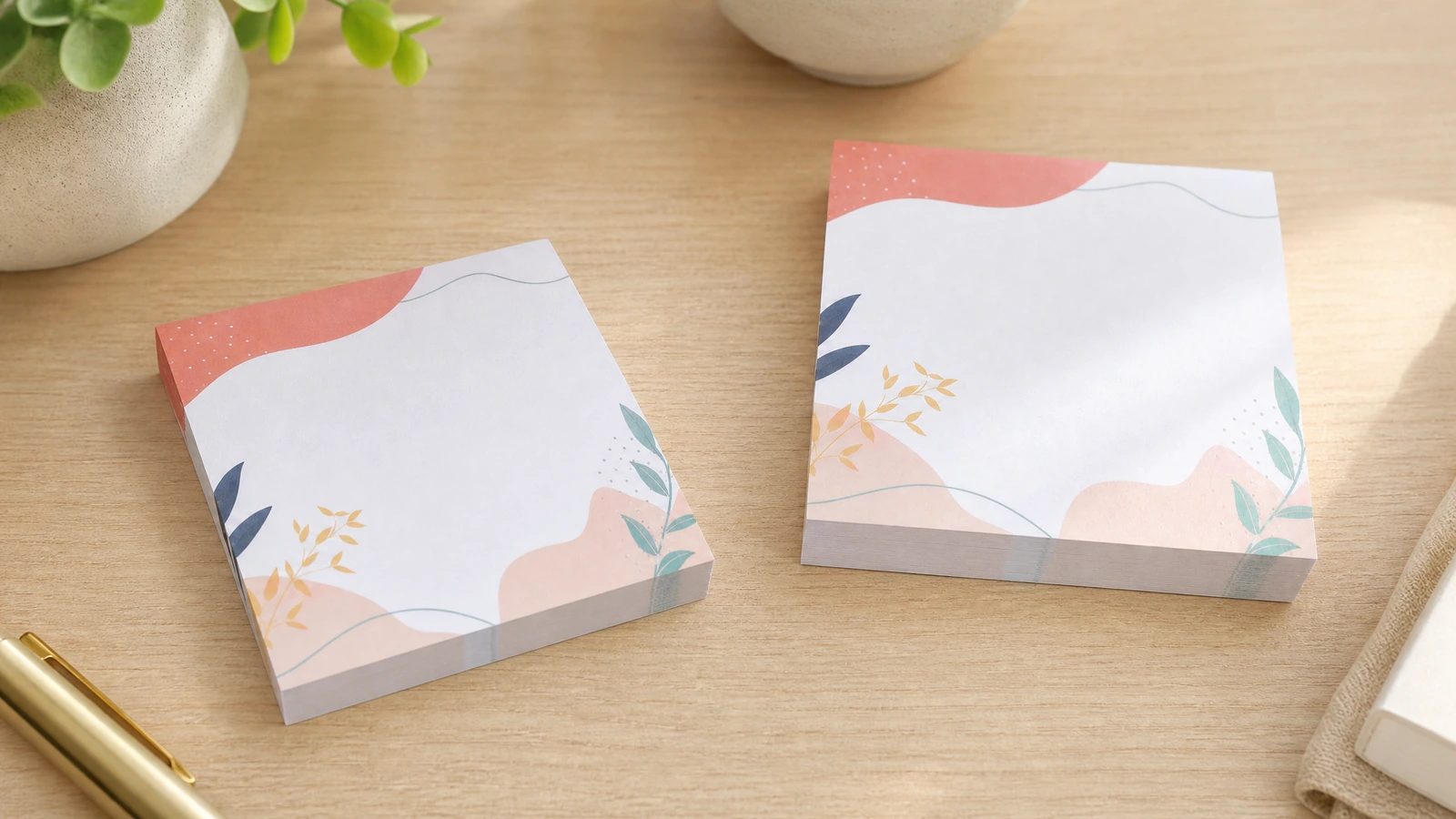
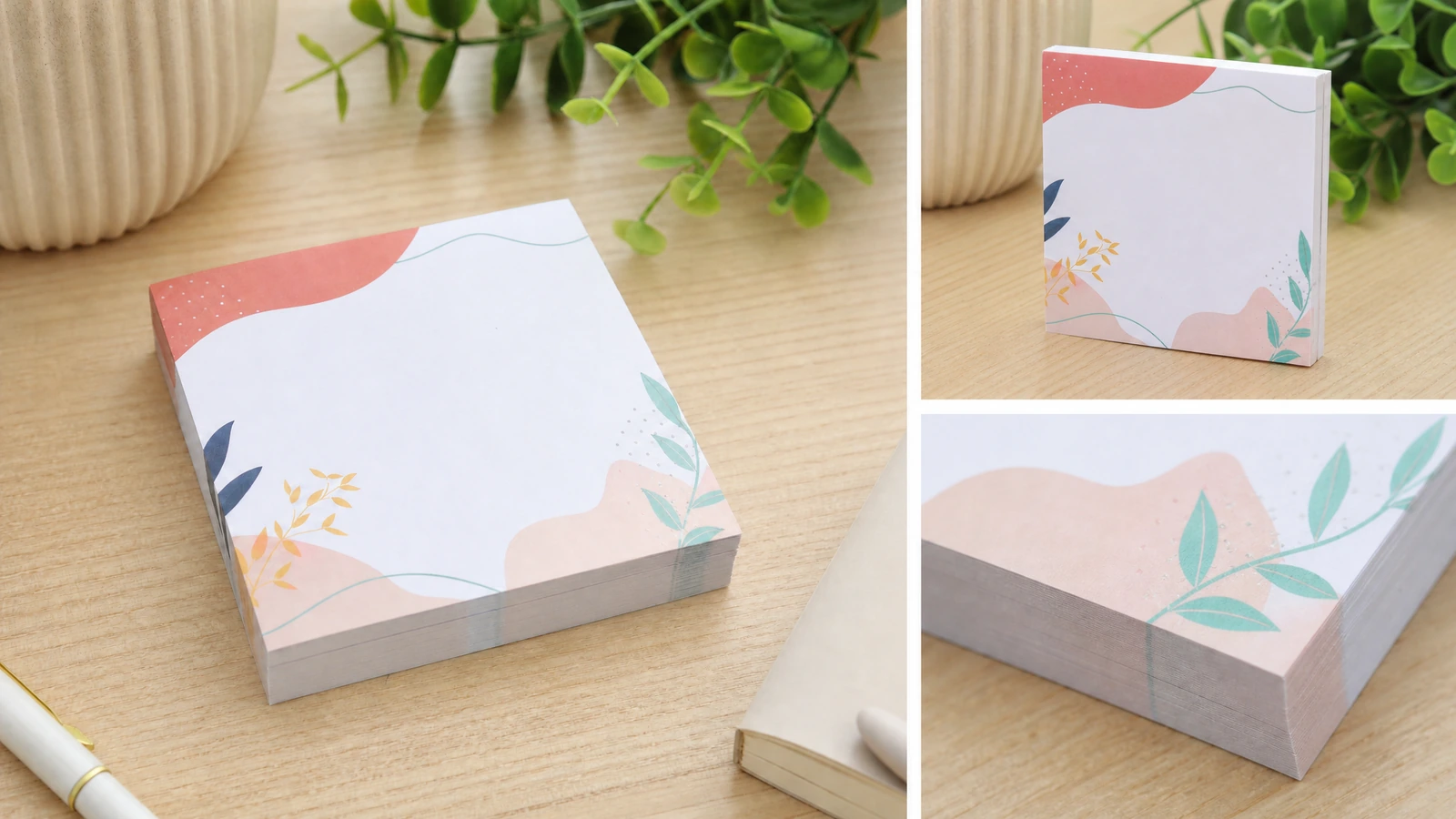
Custom sticky notes are repositionable adhesive note pads printed with your logo, contact details or artwork. Businesses use them as desk-level brand reminders, client handouts and event giveaways. For our Custom Printed Sticky Note Pads (NSKU-735-01), your quote confirms size, sheet count, paper, adhesive grade, MOQ and production time. A pre-production sample then verifies them before the full run.
Who Orders Branded Note Pads, and Where Do They End Up? ↑
Four buyer groups place most orders. Marketing and event managers need trade-show bag stuffers, onboarding kits, reception-desk pads and sales-visit leave-behinds. Service businesses such as real estate agents, tax preparers, insurance brokers, clinics and spas print checklists, appointment reminders and product recommendations on paper their clients will look at again. Office managers and HR teams order internal pads for training, brainstorming and document routing. Teachers, independent shops and creators order small runs for classroom rewards, fan merchandise or wedding thank-yous. The purposes differ, but the questions do not. Will the note stick? Will the logo read clearly? Will it arrive before the date it is needed? Is the unit price justified?
Promotional buying patterns explain why consistency matters. In the PPAI 2024 Consumer Study[1], managers made up about 37% of decision makers, and about 63% of order values fell between $1,001 and $5,000. About 73% of buyers purchase monthly or quarterly, and about 45% prefer online platforms. A pad you reorder every quarter has to match the last batch in color, adhesive behavior and trim. A spec sheet you can resend therefore matters more than a one-off design.
Budget pressure seldom removes the custom element. PPAI's January 2026 research note[2] reports that about 60% of buyers cut quantity first when budgets tighten, while only about 11% cut customization. The same note says buyers judge value by durability (70.4%), design (65.2%) and materials (58%). A smaller run of pads that hold and write well is worth more than a larger run that ends up in drawers.
Pads earn their keep through dwell time. Stik2it's marketing guide[3] notes that "a single note may remain in place for days or weeks." It suggests printing QR codes that point to landing pages so giveaways can be measured. If you add a QR code to NSKU-735-01, scan it from the printed sample with a phone. A screen preview does not confirm it scans.
Why Do So Many Branded Pads Fail After Delivery? ↑
The most common failure is adhesion, not artwork. In a July 2026 RELYmedia comparison[4], testers put Post-it, Koozie and generic pads on drywall, monitor plastic, wood, metal and glass under fan pressure. Post-it averaged 41 minutes 39 seconds of hold, Koozie 13 minutes 44 seconds and generic notes 11 minutes 15 seconds. Wood was the worst surface: five of nine pads did worst there, and four fell in under a minute. Roughly a third of drop-offs were linked to repositioning, and most notes lost measurable tack after about 20–30 peel cycles.
End users notice quickly. One Staples reviewer wrote[5]: "This product does not stick. Used five of them and they all fell off overnight." Another reported that several employees had to tape notes down. When a branded note ends up on the floor, the logo goes into the bin with it.
The second failure is a gap between preview and print. The VistaPrint US sticky note page[6] showed about 2,907 reviews in its October 2026 snapshot, roughly 86% five-star and 3% one-star. Most orders work. The complaints repeat a pattern, though. One buyer warned, "be wary that logo will appear a lot smaller once printed." Another said the mock-up "did not line up with the actual print."
The third failure is the paper. EduExpertHub's 2025 comparison[7] found that budget notes had thinner paper "more prone to ink bleed-through" and curled more after removal. If a gel pen bleeds through after two lines, the user stops writing on the pad.
Our approach is to treat the pad as a written specification rather than a picture. The quote names the adhesive grade and paper. The artwork respects the glue band and safe zones. You approve the proof in writing. The sample is tested on your actual surfaces and pens. Anything we have not yet measured for NSKU-735-01 appears as a quote or sample item, not as a promise.
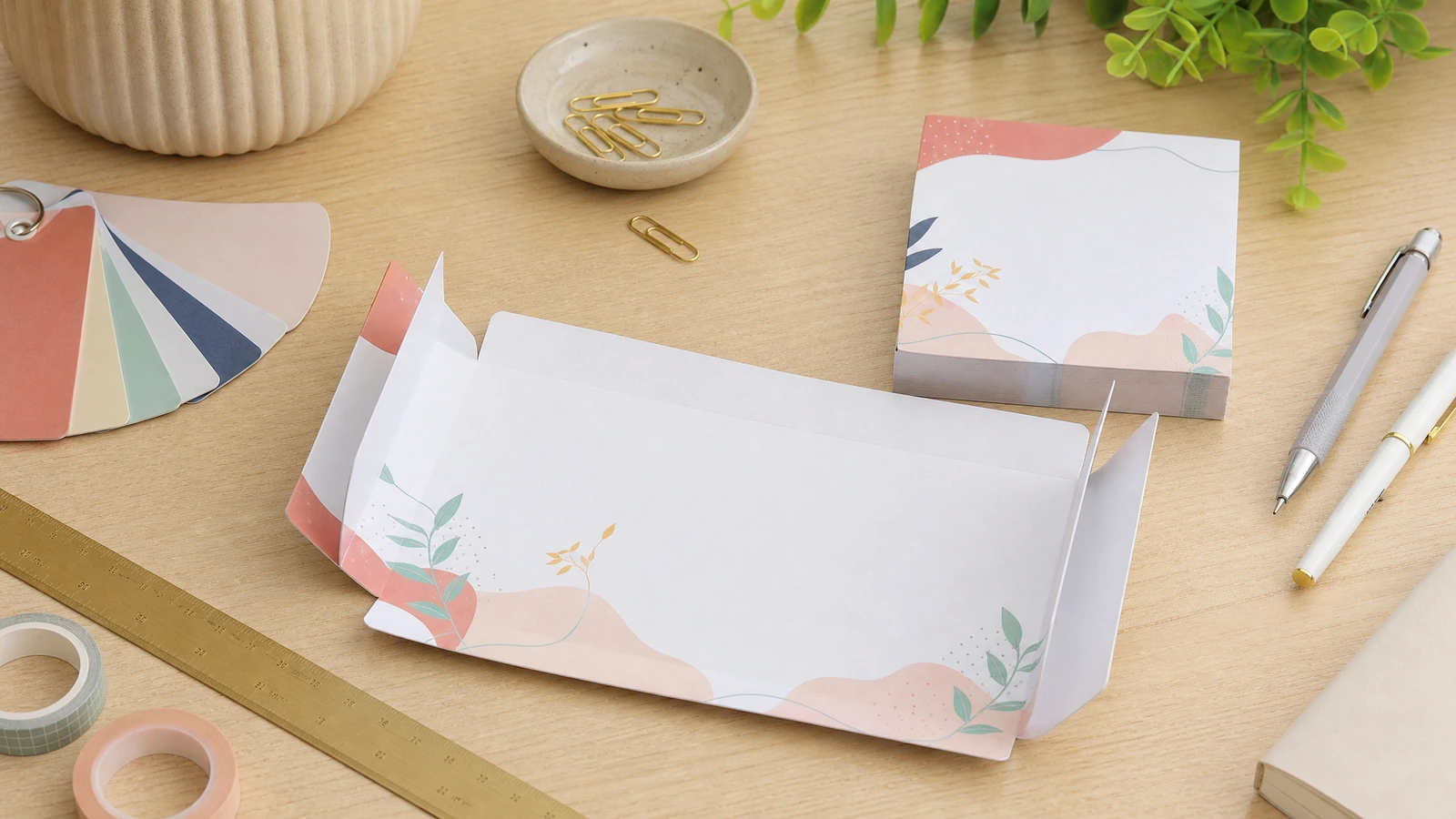
Table of Contents
What Exactly Are You Buying in a Printed Note Pad? ↑
A printed note pad is a stack of sheets, commonly 25 or 50, bound along one edge by a pressure-sensitive repositionable adhesive. Each sheet carries your printed design and leaves space to write. The adhesive concept goes back to Spencer Silver's acrylic microspheres. The National Inventors Hall of Fame[8] describes them as "strong enough to hold papers together but weak enough to allow the papers to be pulled apart again without being torn" (U.S. Patent No. 3,691,140). The underlying chemistry has long been off-patent. Performance now depends on each maker's formulation and coat weight, which is why the test results above vary so much.
Naming matters as much as chemistry. 3M's distributor branding standards[9] state: "The Post-it® Brand is not a substitute for the generic terms 'adhesive notes,' or 'sticky notes'." Only licensed printing on genuine Post-it® stock may carry that name. NSKU-735-01 is sold as custom sticky notes. Its listing makes no Post-it® claim, and a quote would state any licensed stock explicitly.
Paper weight drives the writing experience. VistaPrint lists 75.2 gsm paper, 50 sheets per pad and full-color CMYK on its US page. An Alibaba buying guide[10] suggests staying above roughly 60 gsm, because lighter sheets tear and show writing through. PrintPPS[11] markets 90 and 100 gsm stock as its own claim. For NSKU-735-01, your quote states the paper weight, and the sample is checked with your usual pens.
Nominal size is not printable size. On 3M Promote's specification page[12], a "2 × 3" pad trims to about 2" × 2-7/8", with an imprint area near 1-5/8" × 2-1/2". 4OVER4's guide[13] names 3 × 3, 4 × 3 and 4 × 6 inches as the most popular sizes.
| Nominal size | Typical use | Design implication |
|---|
| 2" × 3" (trims near 2" × 2-7/8") | Packaging inserts, pocket reminders | Small imprint area; logo plus one line only |
| 3" × 3" | Desk notes, trade-show handouts | Header or footer branding, open center |
| 4" × 3" / 3" × 4" | Phone and appointment reminders | Room for a URL or QR outside the glue band |
| 4" × 6" | Checklists, client handover notes | Ruled lines or checkboxes work well |
| 3" × 8" | Forms, menus, multi-step lists | Check the actual trim before final layout |
The sizes above are market references. Which sizes are available for NSKU-735-01 is confirmed in your quote. Smaller pads magnify the "logo printed too small" problem. If your logo carries fine type, choose 3 × 4 or larger, or simplify the mark. Whatever size you choose, measure your layout against the real trim and imprint area on the proof, not against the nominal size.
Adhesive and backing options
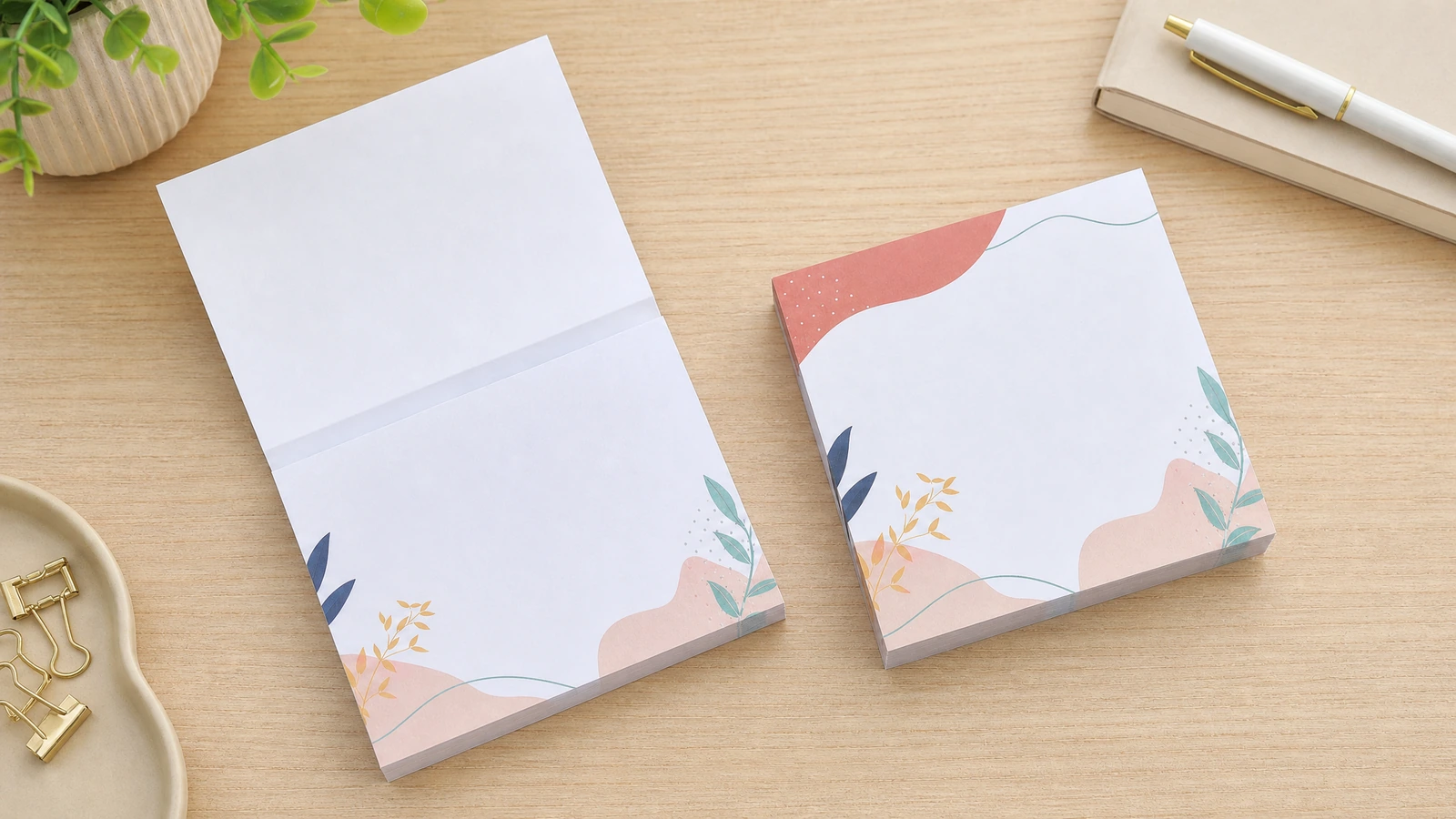
Standard repositionable adhesive suits paper, folders and flat desks. Monitors, walls and other vertical or textured surfaces call for a high-tack grade. As a market reference, 3M Promote prices Super Sticky at about a 15% upcharge, on white paper only, and recycled paper at about 10%. 3M also cautions: "Adhesive may mark some surfaces or lift inks… Test before using." The same applies to any maker. The RELYmedia data shows that the surface often matters more than the brand, and wood and rough paint are the hardest cases. Your quote confirms whether NSKU-735-01 is offered in standard or high-tack grade. The grade you choose is then validated on your own surfaces at the sample stage.
How Do You Order a Pad That Prints Right and Stays Put? ↑
Step 1: Write a one-paragraph brief
State the quantity range, the surfaces the notes will go on, the pens people will use, the distribution channel (event bag, mailer, desk) and the hard in-hand date. These five facts settle the adhesive grade, paper and schedule before anyone opens a design file.
Step 2: Build the file for press, not for screen
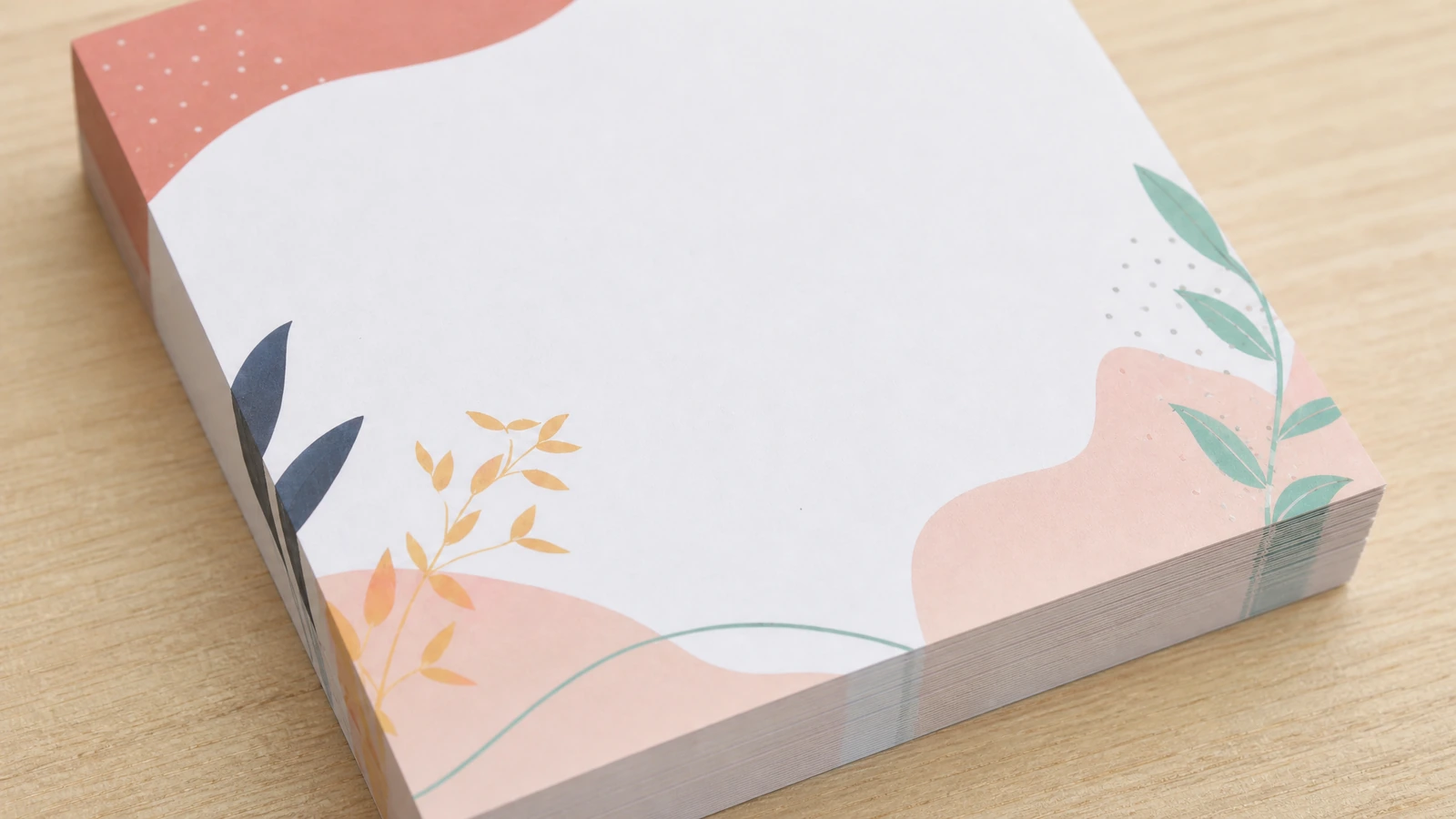
4OVER4's rule is simple: "Find the glue edge first… Keep your logo and text off that band." It also asks for CMYK color, 300 DPI logo art and a safe margin inside the trim. Its showcase adds: "Leave the center open so people can write." 3M warns that "100% solid copy in the adhesive area is not recommended." VistaPrint's FAQ on its product page recommends text no smaller than 4 pt and lighter backgrounds for writing.
| Preflight item | Requirement | Why it matters |
|---|
| Color mode | CMYK; supply Pantone number if brand-critical | RGB previews print darker or duller |
| Resolution | Vector logo preferred; raster at 300 DPI | Prevents soft edges at small sizes |
| Bleed and safe zone | About 0.125" bleed; key copy inside safe zone | Trim drift will not cut text |
| Glue band | No logo, phone or solid ink coverage | Copy stays visible once the note is stuck |
| Minimum text | 4 pt or larger; test at actual size | Avoids illegible contact lines |
| QR code | Scan from a printed proof on two phones | Screen zoom hides scan failures |
Most reprint disputes trace back to one of these six lines, so check them before you upload. Print the PDF at 100% scale on office paper and hold it next to a real pad. This simple step catches the "logo smaller than expected" problem before it costs a run.
Step 3: Approve a proof in writing, then a physical sample
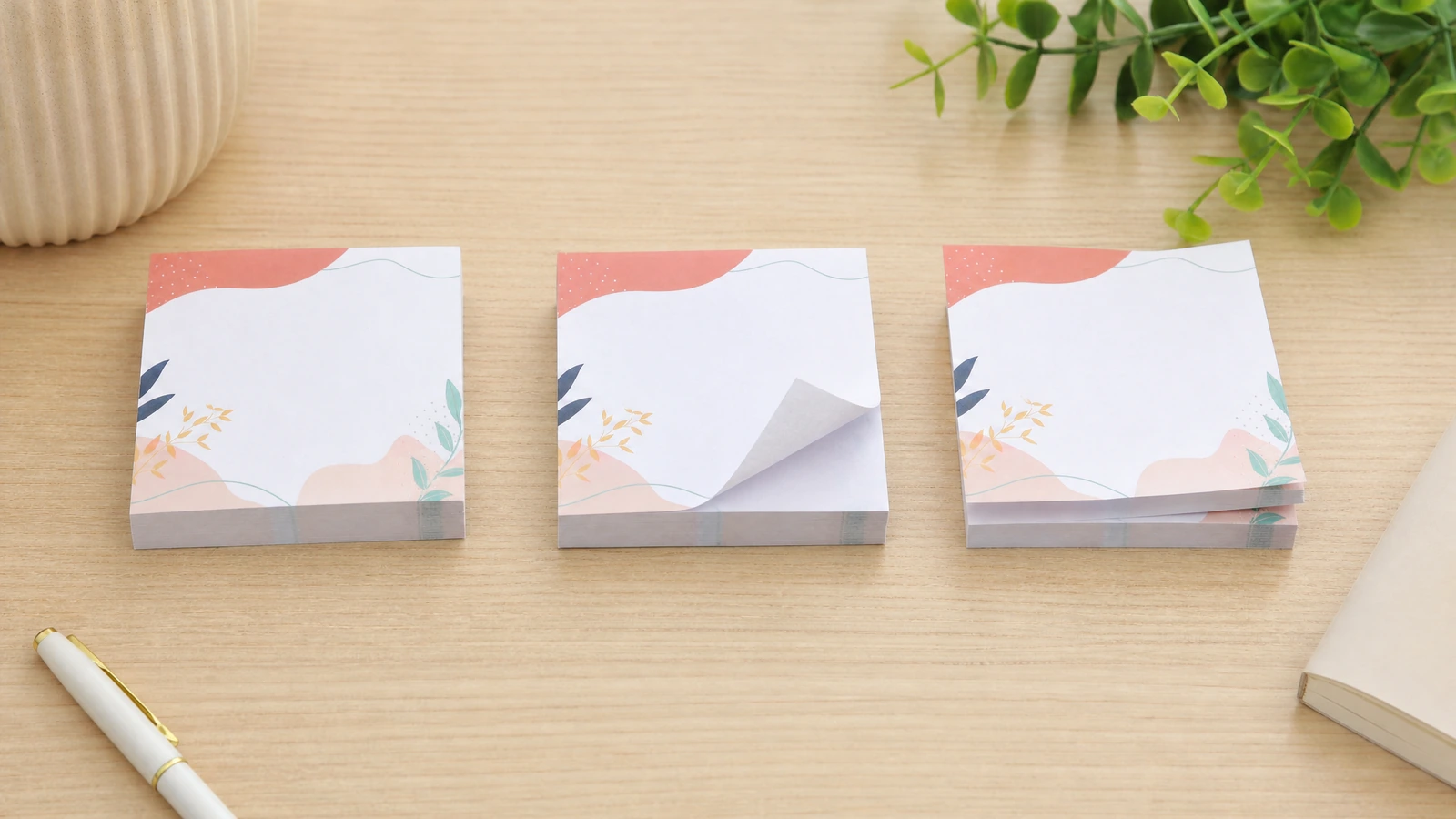
Established printers set clear proof rules. Stik2it's ordering guide[14] describes proofs within one business day, two free revision rounds and payment after approval. Return policies also draw a clear line. Sticky Flyer's policy[15] reprints cut, glue or paper defects reported within seven days. It excludes errors in customer artwork and in approved proofs. Keep your "I approve this proof for print" email on file. For NSKU-735-01, the quote sets out proof timing, revision rounds and pre-production sample terms.
Step 4: Schedule backward from the event
Public lead times show the range. Stik2it lists 5 working days for standard pads, 7 for Super-Sticky or shaped pads and 7–10 for full color, and estimates 6–11 business days door to door. Captain Notepad[16] quotes 9–14 business days from approved proof on the 3M program. Count back from the event: design freeze, then proof, then sample, then production, then freight. Add at least 2–3 business days of buffer. For a hard event date, split the order so a small first batch arrives early.
Step 5: Inspect the sample and the bulk against agreed criteria
| Check | Method | Pass criterion (agree before order) |
|---|
| Vertical hold | 24-hour hang on your real surfaces | No drop on listed surfaces |
| Repositioning | Peel and re-stick a set number of times | Still holds after agreed cycles |
| Residue and ink lift | Peel from paper, laminate, painted wall | No visible residue or lifted ink |
| Pen test | Gel pen and ballpoint on printed area | No bleed-through to next sheet |
| Color and registration | Compare against signed proof in daylight | Within agreed tolerance; text not ghosted |
| Curl after humidity | Overnight in damp and air-conditioned rooms | Sheets lie flat after removal |
Write the cycle counts and tolerances into the purchase order. "Good quality" cannot be enforced; a number can. Color needs particular care. The 3M 2023 catalog[17] explains that full-color process converts Pantone colors to the nearest CMYK match, so an exact match is not guaranteed. Spot color is the route when the brand color is non-negotiable. An Alibaba 2026 guide[18] proposes 600 dpi and ±0.15 mm registration. That is vendor content, useful as a checklist but not an industry standard. Inspect bulk deliveries within 48 hours so any claim falls inside the supplier's window.
Which Supply Path Fits Your Budget, Brand Rules and Deadline? ↑
Suppliers in the US market range from single-pad web printers to overseas factories. The table uses public 2025–2026 page data as market reference points. These figures are not quotes for NSKU-735-01.
| Supply path | Public reference | Published timing | Best fit |
|---|
| Low-MOQ web printer | VistaPrint: minimum 1 pad, 50 sheets | As few as 3–4 days | Design tests, small teams |
| Licensed Post-it® printer | Stik2it: 250 standard, 500 Super-Sticky | About 6–11 business days | Trade shows, Pantone matching |
| 3M program distributor | Captain Notepad: 250 pads, $90 (25 sheets) or $156.94 (50 sheets) | 9–14 business days | Auditable unit pricing |
| Mid-volume online printer | 4OVER4: 500 pads about $466.82 | About 10 business days | Hundreds of pads, stable artwork |
| Advertising flyer notes | Sticky Flyer[19]: from $96 per 800 notes | 3–5 business days after approval | Door hangers, pizza-box promos |
| Overseas non-3M factory | Yahik-type supplier[20]: 500–1,000 pads per design | 12–20 business days plus freight | Cost-led bulk, flexible formats |
Compare like for like. Flyer notes are priced per sheet and office pads per pad, so dividing $96 by 800 tells you nothing about a 50-sheet desk pad. Overseas factories offer the most format flexibility, but the full timeline is closer to 3–6 weeks once freight and customs are included. Adhesive consistency between batches has to be proven by sample. Licensed printers charge for the Post-it® name and its adhesive benchmark, and only they may use that name. NSKU-735-01 belongs to the custom-printed, non-Post-it® category. Its MOQ, unit price and production time are set in your quote. Once samples are signed, they should be judged against the acceptance table above rather than against a brand name.
Making sustainability claims you can defend
Green claims carry legal weight. The FSC promotional-licence FAQ[21] warns that "'FSC-certified product' as a standalone statement carries a high level of risk." A valid claim needs chain-of-custody paperwork and a license code. On recyclability, 3M states[22] that its notes use recycling-compatible adhesive and are curbside recyclable. That statement applies to 3M products, and local recycling rules still vary. Packaging is changing as well. In October 2025, UPM and one.five[23] reported that transparent FSC paper wrap produces about 15–20% fewer emissions than 30 µm OPP film. For NSKU-735-01, recycled content, certification and packaging material are listed only if the quote documents them. Without that documentation, keep "eco-friendly" off the box.
Packaging, shipping and reordering
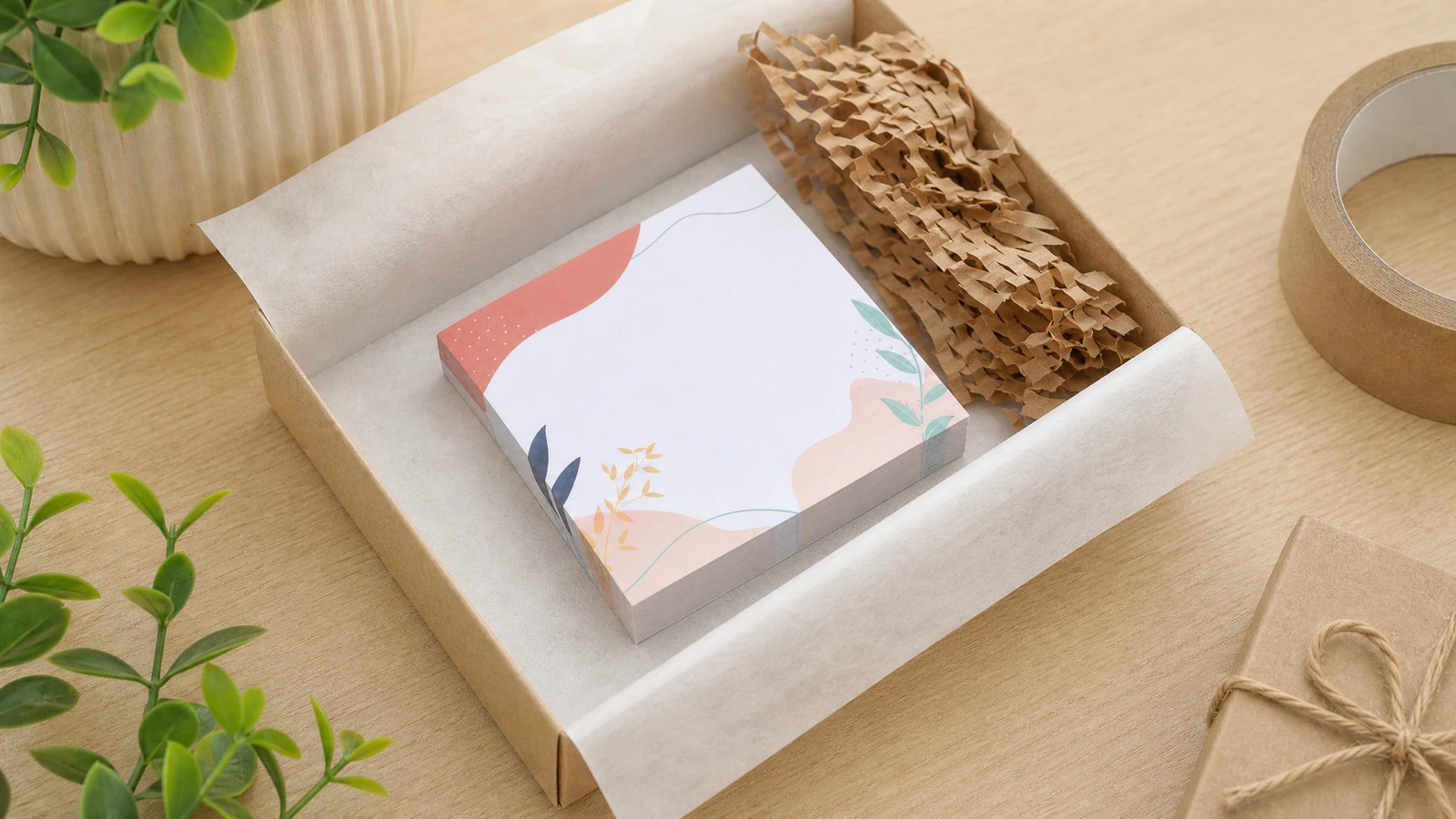
Ask for pads to be shrink- or paper-wrapped in small bundles and cartoned against humidity. Damp transit is a common cause of curl and weak tack, so re-test a few pads from the received cartons. Carton counts, weights and shipping method are confirmed at quote stage rather than assumed. For reorders, archive the approved PDF, the signed sample and a one-page spec covering size, sheets, paper, adhesive grade, colors and tolerances. Quarterly buyers can then reorder without re-proofing.
A word on market context. Analyst estimates disagree, so treat them as direction rather than as one figure. DataHorizzon[24] puts the global market at USD 2.84 billion in 2025, growing at a 3.2% CAGR. Research and Markets[25] estimates USD 2.61 billion in 2025 and 2.75 billion in 2026. Both point to a mature category in which value sits in branding, certification and specialty formats.
Key Takeaways for Note Pad Buyers ↑
- Adhesive grade decides whether the brand stays visible. — Post-it averaged 41 min 39 s of hold versus 11 min 15 s for generic notes (Source)
- Buyers trim quantity before they drop customization. — about 60% cut volume first; about 11% cut customization (Source)
- Typical promo orders are mid-sized and recurring. — about 63% of orders fall between $1,001 and $5,000; about 73% buy monthly or quarterly (Source)
- Licensed-printer timelines run more than a week. — about 6–11 business days from order to delivery (Source)
- The category is mature, so value sits in specification. — USD 2.84 billion in 2025, 3.2% CAGR (Source)
Ready to Specify Your Branded Note Pad? ↑
A branded note pad pays off only when it sticks, takes ink and shows a logo people can read. Buy it as a specification. Name the adhesive grade, state the paper, keep copy off the glue band, sign the proof and test the sample on your real surfaces before bulk production. NSKU-735-01 is quoted on exactly those terms. Send your artwork, target size, quantity range, surfaces and in-hand date to request a quote and a pre-production sample.




The information below is required for social login
Sign In
Create New Account