Custom printed vinyl wall decals are full-color adhesive films printed from your artwork, cut to shape, and applied to interior walls. Three matches keep them on the wall: the adhesive to the paint, the file resolution to the viewing distance, and the panel layout to the install crew. Material, panel size, MOQ, and lead time are confirmed at quote and proof.
Who Orders Custom Wall Decals, and for Which Walls? ↑
Search demand for this product is commercial. Keyword data from SEMrush[1] for October 15, 2026 shows about 3.6K US monthly searches for "custom wall decals," a keyword difficulty of 36%, a $2.05 CPC, and commercial intent. The same report's top-ten results mix home décor stores with sign printers, which means the people searching include both households and businesses.
Market sizing should be read as direction, not as a budget anchor. PW Consulting[2] puts the 2025 wall decal market near $650 million, with residential use at 74.8% and vinyl at 59.8%. MarketIntelo[3] estimates $3.2 billion for 2025, puts online channels at about 54.3%, and says custom designs carry a 35–45% premium over standard designs. The two reports define the market differently, and their totals differ by about five times. Both point the same way: housing leads, and vinyl dominates.
Four buyer groups place most orders. Parents want nursery names, themes, and growth charts that can change as a child grows. Custom Sticker Shop[4] advises choosing the room before the font, because ornate script blurs when read from across a room. Renters want graphics that come off without costing them a deposit. Offices, retailers, gyms, and schools need logo walls, values statements, and wayfinding that survive cleaning and are ready by an opening date. Designers who order for clients control the file, the proof rounds, and the deadline. They need specifications they can explain to the end customer.
Why Do Wall Decals Peel, Wrinkle, or Arrive Wrong? ↑
The most common failure is adhesion, not print quality. In a r/CommercialPrinting thread[5], an installer reported that a school graphic printed on 3M IJ39 began peeling about three days after a clean install. The installer traced the problem to low-VOC paint. 3M's wall guide, Instruction Bulletin 5.37[6], says that because wall surfaces vary so much, "including low VOC paints," 3M gives no warranty for the adhesion, appearance, durability, or removability of applied graphics.
When a decal fails, the buyer pays. One Trustpilot reviewer[7] described waking up every morning to find sections peeling off clean, five-year-old drywall, and debated whether to just "eat the $700." Another mural buyer[8] said the mural started peeling within days and called the $1,000 spend wasted. Shipping and cutting cause many of the remaining problems. One Wall Decal World customer[9] received a large decal folded three times into a small box, and the creases never relaxed. Other reviewers[10] reported that the two halves of a 72-inch decal did not line up, and that lettering stuck to the transfer sheet instead of the window.
These failures are predictable, so they can be prevented at the spec stage. Before production, write the paint finish and paint date, the adhesive class, the panel split, the file resolution, and the packaging method into the proof. For NSKU-617-01, the MOQ, lead time, maximum panel width, and rated film life are pending quote and proof. Nothing on this page replaces those written terms.

Table of Contents
What Is a Custom Printed Vinyl Wall Decal? ↑
A custom printed vinyl wall decal is a pressure-sensitive film. It is printed in full color from your artwork, cut to shape, and applied to an interior wall. Three choices define it:
The face film is either calendered vinyl, which is common for flat indoor walls, or cast vinyl. Cast vinyl is thinner, conforms better to uneven surfaces, and lasts longer outdoors. The cut is one of three types. A die-cut goes through both film and liner to make a stand-alone shape. A kiss-cut goes through the film only and leaves the shape on a carrier sheet. Cut-vinyl lettering is plotted from solid-color film with no printed background. The adhesive is removable, repositionable, or permanent. Riot Color[11] notes that "repositionable does not mean reusable," because the bond still builds with pressure and time.
Thickness is quoted in mil, and the unit is often misread. One mil equals 0.001 inch, so a 3 mil film is about 0.076 mm, not 3 mm. The Decals.com thickness guide[12] also says thicker film is not automatically more durable. Vinyl type, laminate, and adhesive quality matter more than mil count.
Rated lifespans apply to specific films under specific conditions. Avery Dennison's MPI 2600 data sheet[13] (revised December 2025) rates its printed wall film for up to 3 years indoors with a matching overlaminate. The GF 226 WallMark data sheet[14] lists 5 years of indoor durability, a 1-year clean-removal window, and an ASTM E84 Class A flammability rating. Retailers claim wider ranges. One Decals.com materials page[15] estimates 3–5 years for standard tack and up to 7–10 years for extreme tack. Treat any lifespan that is not tied to a named film and a test condition as marketing.
How Do You Size, Prep, Proof, and Install a Decal That Stays Up? ↑
Step 1: Size for the viewing distance
Measure the wall, and decide the viewing distance before you choose a font. Hyper Creative[16] recommends bold, simple, high-contrast designs that account for wall texture, lighting, and how far away people will stand. For a focal piece, JiffDiff[17] suggests centering it 57–60 inches above the floor, 2–6 inches lower in seating areas, and checking a taped mock-up from 6–8 feet away. Note door frames, outlets, and baseboards on the order so the layout clears them.
Large pieces are printed in panels, and the material width decides where the panels split. Printleaf[18], for example, lists a 52-inch maximum width and splits wider jobs with a 0.4-inch overlap. For your order, the panel width, overlap, and registration marks should appear on the proof. Panels wide enough to need two installers should be flagged before you approve it.

Step 2: Match the adhesive to the surface
The paint must be fully cured, and its finish must suit vinyl. Wall Decal World's paint guide[19] recommends waiting 3–4 weeks after painting before applying small die-cut pieces, and a full 30 days before applying wall wraps. It ranks eggshell and satin as the best finishes. Flat and gloss finishes are less reliable.
| Wall condition | Adhesion risk | Recommended action |
|---|
| Cured eggshell or satin latex, smooth | Low | Standard removable adhesive; run a test patch |
| Flat, low-VOC, or scrub-resistant paint | High | Test first; consider high-tack film and accept harder removal |
| Paint less than 30 days old | High | Delay the install; the curing paint releases gas that causes bubbles |
| Orange peel or knockdown texture | Medium | Fabric media or firm pressing; expect a less flat finish |
| Stucco, plaster, bare block, brick | Very high | Not recommended for peel-and-stick decals |
A test patch costs little and prevents most of the failures in the table. Arlon Tip 39[20] recommends applying a sample, checking it for edge lift after 24 hours, and then peeling it to confirm the paint releases cleanly. For commercial installs, 3M's smooth-wall checklist[21] sets an adhesion threshold of 1,000 g per 15 minutes to qualify for its MCS warranty. For textured walls, Wallhogs[22] limits its Photo-Tex EXS fabric to moderate texture and excludes plaster, stucco, and cinder block. For NSKU-617-01, the adhesive class is set after you share wall photos and your test result.

Step 3: Preflight the artwork
| Artwork type | Preferred format | Rule to check | Failure it prevents |
|---|
| Logos, text, line art | AI, EPS, SVG, vector PDF | Fonts converted to outlines | Font substitution, jagged curves |
| Photos, illustrations | High-res PNG, JPG, or PDF | 150 dpi minimum at print size; 300 dpi for close viewing | Pixelation on arrival |
| Full-bleed panels | PDF with bleed | At least 1/8 in (about 3 mm) bleed | White edges after cutting |
| Die-cut shapes | Vector cut line on its own layer | Cut path and orientation match the proof | Reversed or clipped cuts |
The two resolution figures come from different suppliers. The Decals.com product page[23] accepts raster files at 150 dpi or higher at print size and asks for outlined fonts and embedded images. The Wall Decal World FAQ[24] asks for 300 dpi. Use 300 dpi for anything people will view within arm's reach; at that density, a 48-inch photo panel needs about 14,400 pixels across. Printleaf's mistake list[25] calls for roughly 1/8 inch of bleed. It also warns that adhesive vinyl, removable vinyl, clear film, and static cling cannot be swapped for one another.
Step 4: Install and remove correctly
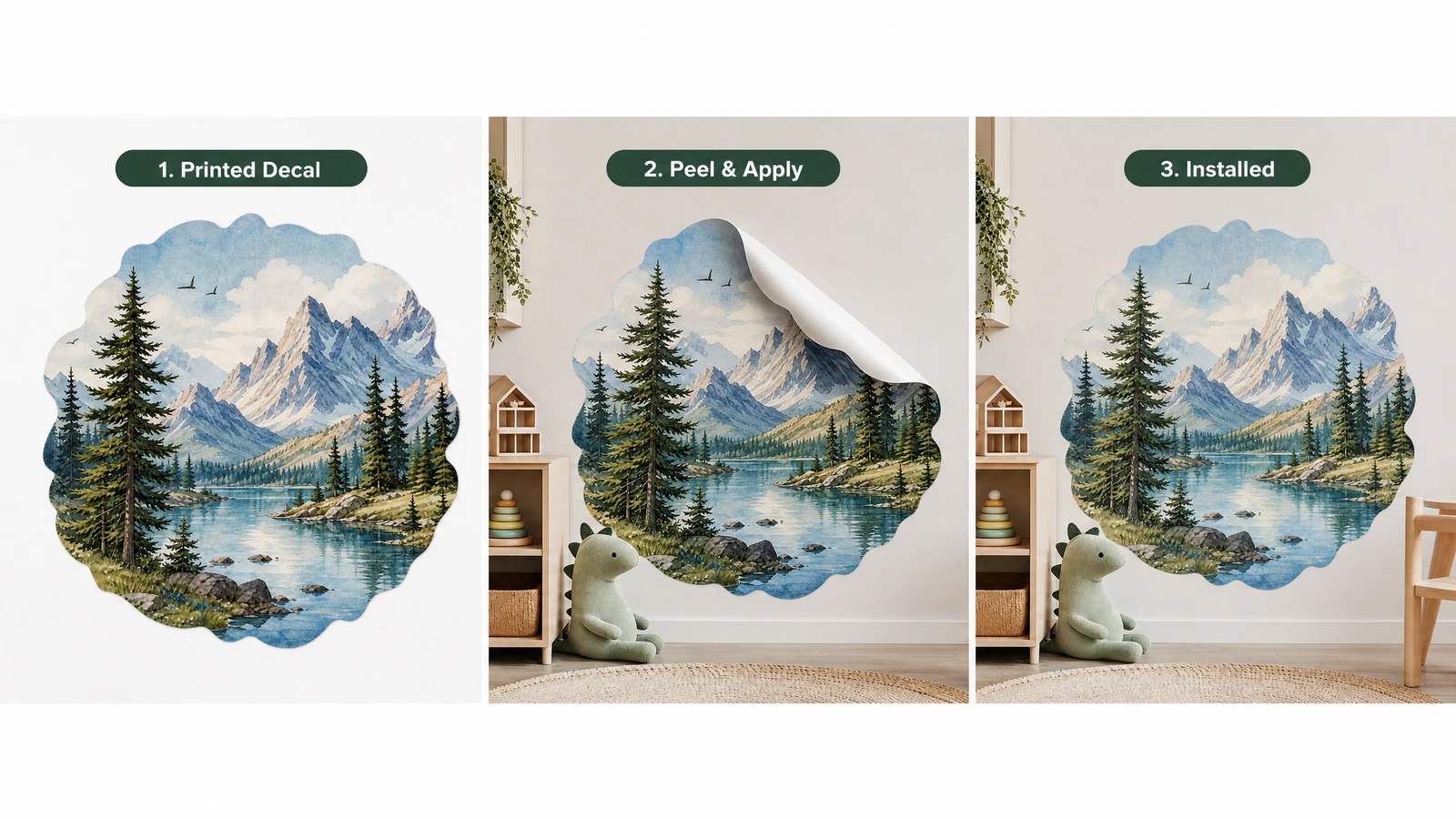
Clean the wall with isopropyl alcohol and let it dry completely. The Decals.com adhesion guide[26] lists installing below about 50°F as a cause of failure and recommends 65–90°F. Position the decal, squeegee from the center outward, and peel the transfer tape back on itself at close to 180 degrees so the letters stay on the wall. Do not paint over or seal a removable decal. 4OVER4[27] warns that sealing turns a five-minute removal into an hour with a scraper. To remove a decal, warm it with a hair dryer and pull it slowly back on itself at a low angle.
What Should Happen Between Proof Approval and Delivery? ↑
Production time is quoted per order, so ask the supplier for the full sequence rather than a single number. A typical digital run goes through these stages:
- File prep and proof
- Printing
- Drying
- Laminating
- Cutting and weeding
- Transfer-tape masking
- Packing
Solvent inks must finish releasing gas before lamination. Jessup[28] warns that rushing this step causes bubbles or tacky adhesive, so any same-day promise should exclude solvent ink. For comparison, Wall Decal World's policy[29] lists 4–5 business days of standard production and a $50 priority option that speeds up production only, not shipping. That is one supplier's benchmark, not a commitment for this SKU. NSKU-617-01 lead time is pending quote. It depends on size, quantity, material, and the number of proof rounds.

Inspect the delivery against the approved proof, not the website mockup. Photograph any defect before installing so that a manufacturing fault is not mistaken for a wall-compatibility problem. Check these five points on arrival:
- Every shape is fully cut, with no torn edges or clipped tops.
- Overlap marks line up across adjacent panels.
- All panels came from one print run and match under room light.
- Lettering lifts from the liner and releases from the tape on a test surface.
- There are no creases, dents, or crushed tube ends.

Packaging decides whether large decals arrive flat. Ask for large pieces to ship rolled in a rigid tube rather than folded, and confirm the packaging method on the quote. For reorders, keep the approved proof, the film and laminate names, and the panel layout on file so that a replacement or a second location matches the first run. Color matching on a reprint is confirmed with a new proof.

Which Material and Adhesive Fits Your Wall and Timeline? ↑
| Option | Best for | Rated life (supplier claim) | Main trade-off |
|---|
| Standard-tack removable calendered vinyl | Rentals, nurseries, office quotes on smooth paint | 3–5 years indoors | Weak on low-VOC and textured walls |
| Extreme or high-tack vinyl | Low-VOC paint, light texture, gyms | Up to 7–10 years claimed | Hard to reposition; higher paint-pull risk |
| Cast vinyl with UV laminate | Curved, long-term, or outdoor signs | Up to about 8 years outdoors | Higher cost than short indoor jobs need |
| Cut vinyl lettering | Reception logos, solid-color text | 3–5+ years | No photos or gradients |
| Fabric media (Photo-Tex type) | Photo murals, moderate texture | Varies by supplier | Visible seams; extreme texture still excluded |
| Paint stencil or hand-painting | Permanent, film-free look | Lasts until repainted | Changes require repainting; not renter-friendly |
Read the lifespans in this table as supplier claims under good conditions. The indoor ratings come from the Decals.com materials page cited above[15]. Its outdoor fade guide[30] gives laminated calendered vinyl 3–5 years outdoors and high-performance cast vinyl up to 8. The same site also states different indoor lives for extreme tack on different pages, so ask which named film your quote uses. Removable adhesive made for promotions is a different product again: eSigns[31] rates it for weeks to months, while indoor removable wall films are rated in years. As a rule, choose removable film for walls you will change within a year, and high-tack film only after a test patch shows ordinary film won't hold.
Which Safety and Compliance Questions Should You Ask First? ↑
No US federal standard covers custom wall decals as a product category, and none sets a mandatory lifespan. Which rules apply depends on who the product is for and where it is sold.
| Use case | Rule | Requirement |
|---|
| Designed or marketed for children 12 and under | CPSIA total lead, 16 CFR 1252.1 | 100 ppm or less, verified by third-party testing |
| Children's toys and child care articles | CPSIA §108 phthalates | DEHP, DBP, and BBP at 0.1% or less |
| Surface coatings on children's products | 16 CFR Part 1303 | Lead at 90 ppm or less |
| Sold in California with listed chemicals | Proposition 65 (1986) | Warning required above the safe-harbor exposure level |
The lead and phthalate limits come from eCFR 16 CFR 1252.1[32]. The 90 ppm coating limit is set out in CPSC guidance[33]. SEMA's Prop 65 explainer[34] notes that DEHP softens PVC. Whether a warning is required depends on the measured exposure, not just on the fact that a product contains PVC. For schools, offices, and retail corridors, request the flammability report for the specific film. GF 226 lists ASTM E84 Class A, but that rating applies to that film, not to vinyl in general. Low-emission claims need a UL 2818 / GREENGUARD[35] certificate. No certification is claimed for NSKU-617-01. Compliance documents are pending and will be confirmed for each order.
Key Takeaways for Buyers ↑
- Search demand is commercial and competitive — 3.6K US monthly searches, KD 36%, CPC $2.05 (Source)
- Market size estimates disagree by about five times — $650 million (Source) vs. $3.2 billion for 2025 (Source)
- Letting paint cure is the cheapest way to prevent failure — 3–4 weeks for small decals, 30 days for wall wraps (Source)
- Commercial adhesion has a measurable threshold — 1,000 g per 15 minutes for 3M MCS qualification (Source)
- Check resolution at final print size — 150 dpi minimum; 300 dpi for close viewing (Source)
- Children's products trigger federal lead limits — 100 ppm total lead in children's products (Source)
Ready to Spec a Decal for Your Wall? ↑
A decal that looks right and stays up starts with information about the wall, not the artwork alone. Match the adhesive to the paint finish and cure date. Size the text for the distance people will read it from. Preflight files at print size, split panels with marked overlaps, and ship large pieces rolled. NSKU-617-01 is quoted on those terms: material, adhesive, panel layout, MOQ, and lead time are confirmed in the written quote and proof, not assumed from this page. Send your wall photos, paint finish and paint date, dimensions, and artwork to request your proof and written quote.




The information below is required for social login
Sign In
Create New Account