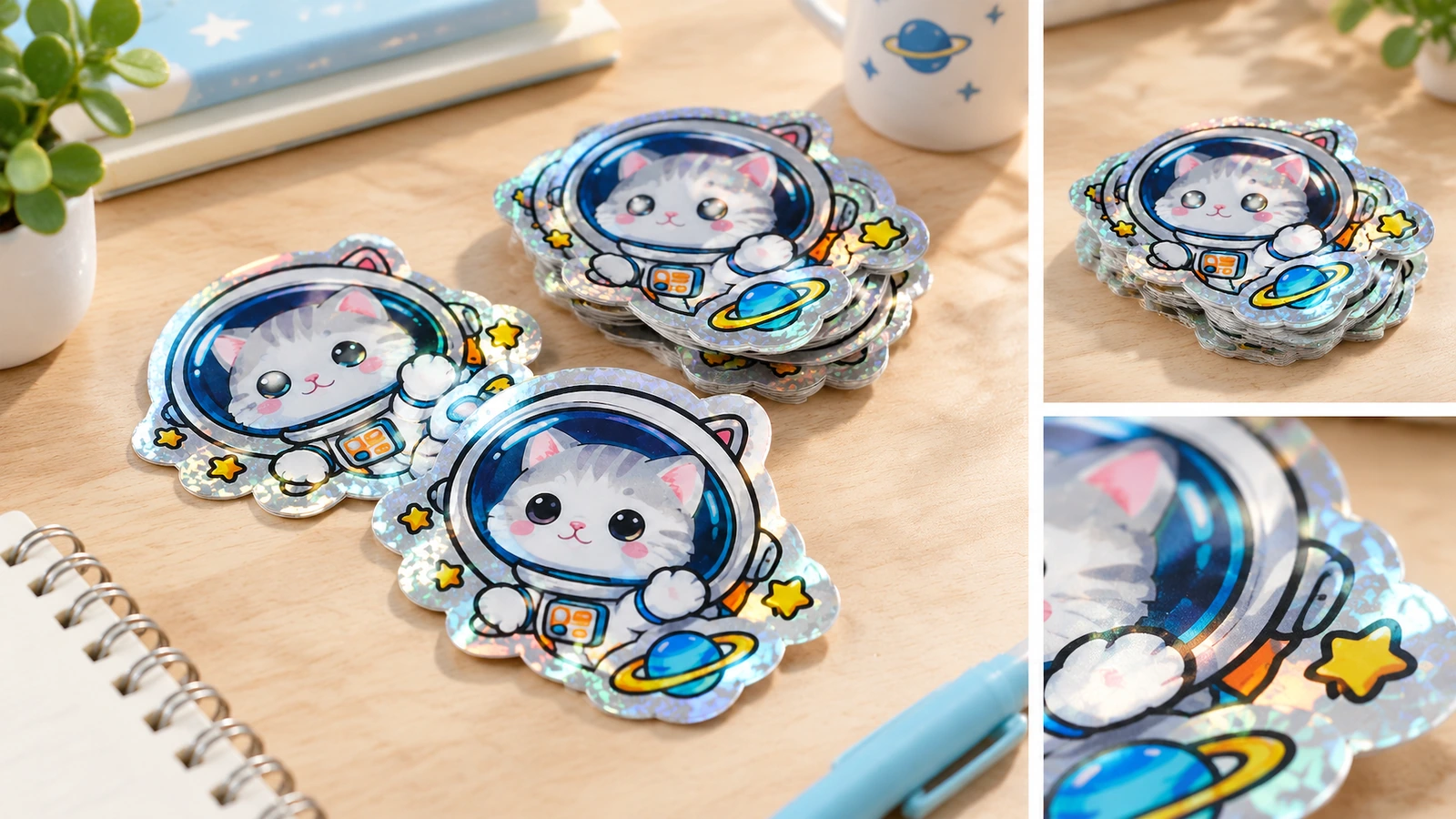
Custom reflective die-cut stickers are printed on retroreflective vinyl. Each one is cut through both the face film and the liner to your exact outline, so a logo, unit number, or warning sends headlight beams back toward the driver. Light ink areas reflect best and laminated builds last longest. These stickers add visibility. They do not replace certified DOT-C2 conspicuity tape or required vehicle reflectors.
Who Buys Reflective Die-Cut Stickers, and Where Do They Go? ↑
Three buyer groups drive this product. Fleet, construction, and EHS teams put shaped reflective labels on hard hats, service vans, equipment, warehouse aisles, and numbered asset tags. Commuters, cyclists, and motorcyclists put them on frames, fenders, cargo boxes, and helmets. StickerApp's rider guidance says to start with the rear of the bike and to treat stickers as a bonus on top of lights and reflectors, not a replacement[1]. Designers, clubs, and small brands order short runs for night events, team identity, and packaging accents.
All three groups want the same result: an outline that looks crisp by day, lights up in a beam at night, and survives rain and sun. Their tolerances differ. A fleet buyer needs a spec sheet that holds up in an audit. A creator needs fine lettering that stays readable after it is cut from thick reflective film.
Why Do Reflective Stickers Look Great on Day One and Fail by Month Two? ↑
The problem: Most complaints in this category are not "it doesn't reflect." They are about edges lifting after rain, kiss-cuts that never separate from the liner, and night brightness fading while the daytime print still looks fine. Reflective film handles very differently from standard sticker vinyl. One installer put it this way: "They rip, they don't stretch, no air-release"[2].
Why it hurts: A Safety Products traces early peeling[3] to poor surface prep or the wrong adhesive, low application temperature or moisture, wax or oil on the surface, too little pressure during application, and washing too soon after install. Edges and die-cut corners let water in first. Wet application causes a separate failure. Soapy water can corrode the aluminum layer behind the glass beads, and black spots show up months later[4].
Production has its own risks. A printer cutting 5 mil reflective film with a 3 mil laminate lost most stickers on test runs[5]. One buyer received 500 kiss-cut stickers with none cut through[6].
Even a sticker that lasts has a cost at removal. 3M reflective decals that stayed on a car for about 6–7 years left sun-side "shadows"[7] in the paint.
The fix: Treat the order as a specification, not a style choice. Name the sheeting type, request measured brightness, match the adhesive to the surface, round the cut line, laminate the print, and approve a physical sample before bulk production.
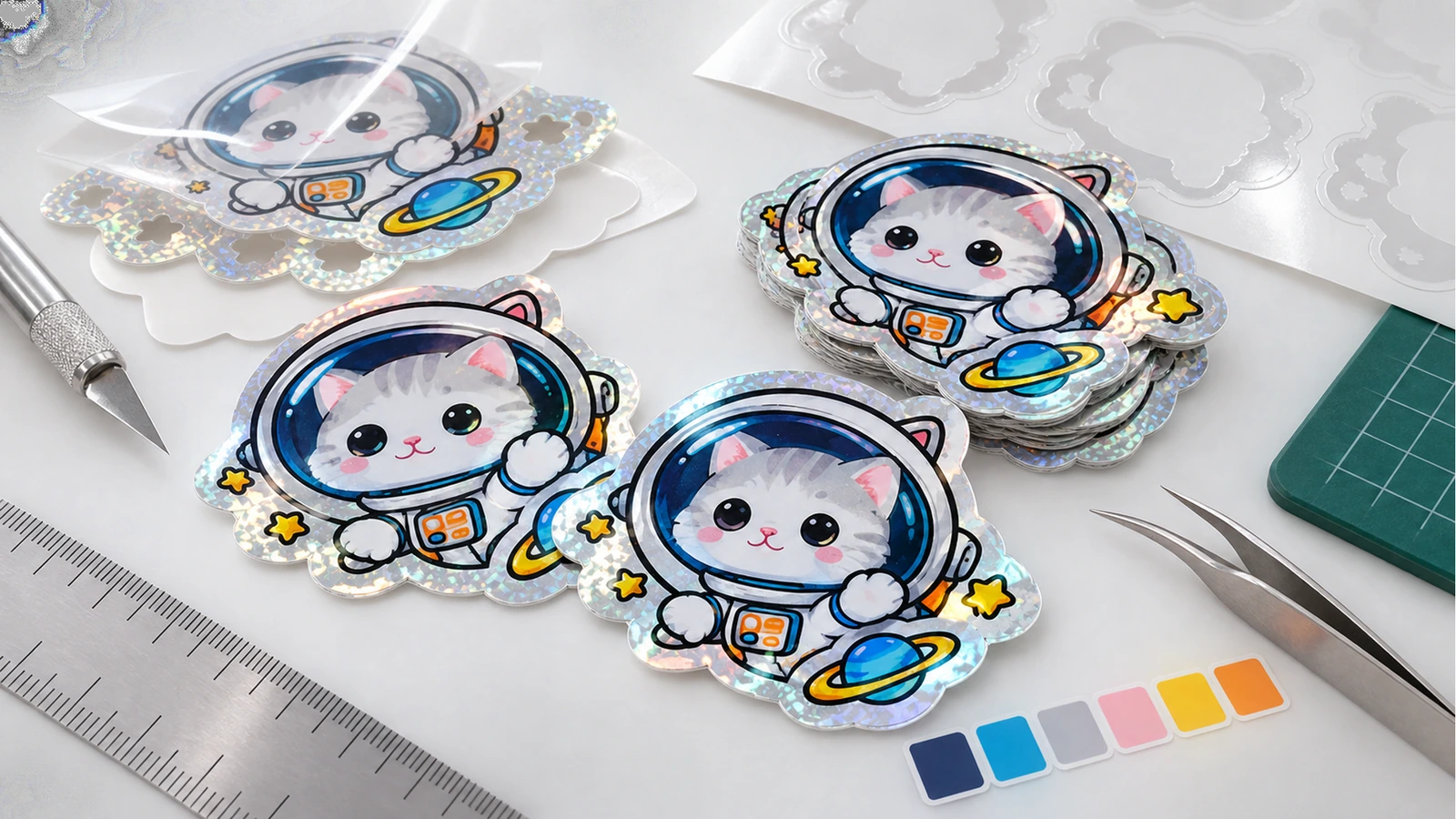
Table of Contents
What Is a Custom Reflective Die-Cut Sticker, Technically? ↑
A few terms define this product. In a die-cut, the blade cuts through both the reflective face film and the paper liner, so each sticker ships as a free-standing shape. A kiss-cut cuts only the face film and leaves the liner intact, which suits sheets and rolls. Retroreflective means glass beads or microprisms send light back toward its source, so a driver behind the headlights sees the brightest return. RA is the coefficient of retroreflection, in cd/lx/m². It is measured with instruments under ASTM E810[8], commonly at a 0.2° observation angle and a −4° entrance angle.
Two optical families matter for custom work. Glass-bead "engineer grade" sheeting (usually ASTM Type I) accepts digital and screen printing and cuts on standard equipment. Microprismatic sheeting (Type III and up) is brighter but stiffer. In the same printing thread, practitioners say glass-bead film perf-cuts routinely, while prismatic film often needs a flatbed cutter or a laser.
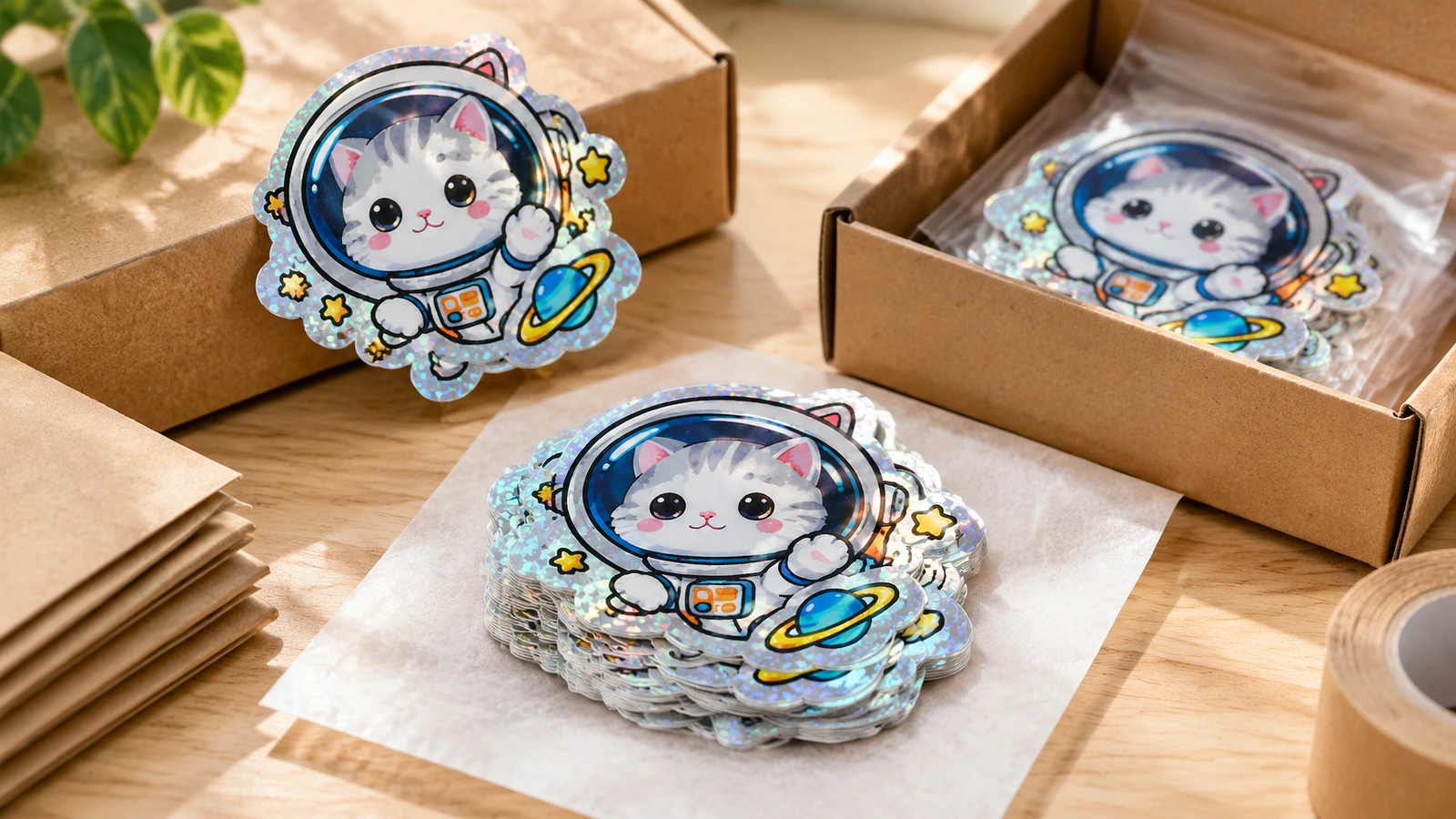
Holographic film is not reflective sheeting. It is metallized and diffractive, which makes it eye-catching on a shelf, but it is not a retroreflective safety material[9].
The standard has a clear boundary. ASTM D4956-26[10], released July 1, 2026, covers retroreflective sheeting for traffic control. It explicitly does not cover inks, overlays, or other imaging methods applied to that sheeting. A printed, laminated, die-cut sticker therefore does not automatically carry the base film's D4956 Type.
Ink also filters the light that comes back. On one supplier's film, white areas look light silver by day and reflect white at night[11]. Dark blue, black, and dark green won't reflect. Put the message that matters at night in light colors.
How Do You Specify Artwork, Size, and Adhesive Before Ordering? ↑
Step 1 — Set the use tier. Decide whether the sticker is decorative or brand-led, a visibility aid for equipment or vehicles, or something that must meet a regulation. SH Reflective tells buyers to ask for the specific ASTM D4956 type or EN 12899 RA class[12]. Push back when a supplier only says "highly reflective." For NSKU-688-01, the sheeting type and RA values are confirmed on each quote. Nothing on this page is pre-certified.
Step 2 — Size for readability. Thick reflective film and small details don't mix. Fine serifs, hairline connectors, and tight inside corners tear during weeding or lift outdoors. Choose the finished size from the viewing distance. Then check the smallest stroke on a physical proof, not just on screen.
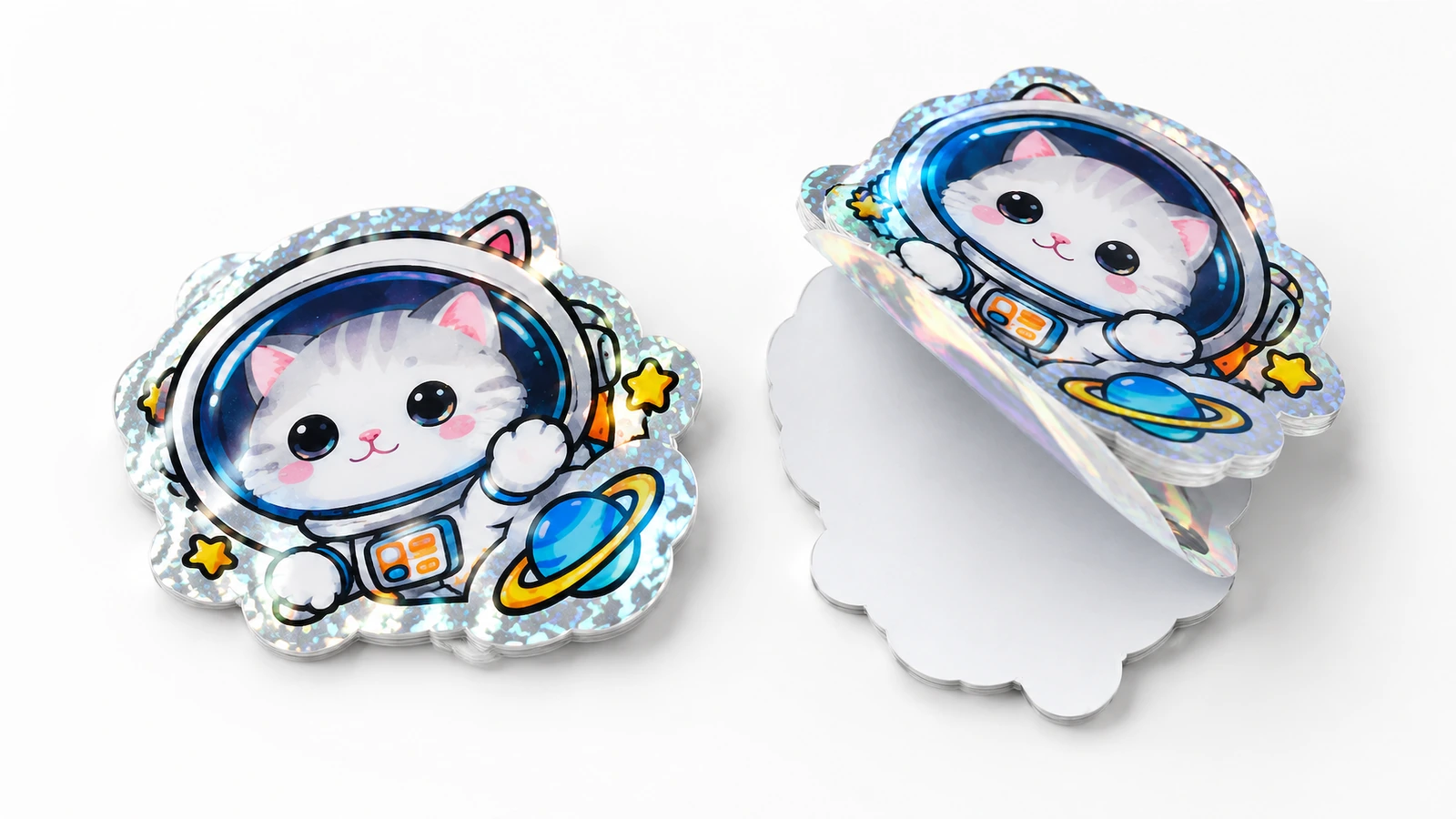
Step 3 — Match the surface and the liner. Tell the supplier the exact surface—painted steel, powder coat, low-surface-energy plastic, or a curved hard hat—and the coldest temperature you expect at installation. Reflective films often use aggressive permanent adhesive, so repositioning is limited. If you are installing in volume and a hard-to-start liner would slow the work, ask whether a split or crack-back liner is available. Availability is confirmed at quote.

Step 4 — Preflight the file. Send vector artwork (AI, EPS, or PDF) with fonts converted to outlines, CMYK color, and the cut line on its own layer as a closed, single-color path. A common spec is a 3 mm bleed with at least 3 mm of safe area inside the cut line[13], plus rounded corners. Avery Dennison warns that a mitered corner leaves a small nick that "may propagate into a tear or crack"[14].
| Specification field | What to state on the RFQ | Status for NSKU-688-01 |
|---|
| Sheeting optics and ASTM Type | Glass bead or microprismatic; named Type | Confirmed at quote |
| Initial RA (white) | Measured per ASTM E810 at 0.2°/−4° | Supplier report or test pending |
| Protection layer | PET laminate or clear coat; thickness | Confirmed at quote |
| Adhesive and surface | Surface type; minimum application temperature | Sample test on your surface |
| Cut type | Die-cut (through liner) or kiss-cut | Specified on order |
| Smallest feature | Narrowest stroke and inside corner radius | Verified on physical proof |
| Finished size | Width × height in inches or mm | Confirmed at quote |
| MOQ and production time | Quantity breaks; working days | Pending written quote |
No value in the right-hand column is a commitment until it appears on a written quote or passes on a sample. Treat any field a supplier leaves blank as unverified, especially RA and adhesive performance.
How Is a Reflective Die-Cut Order Printed, Cut, and Inspected? ↑
A sound production sequence runs in six stages: print, let the ink cure fully, laminate or clear-coat, cut, inspect first articles, and only then release the run. Porous glass-bead surfaces need a protective layer, and Vizlent recommends a PET clear laminate over the print (source). 3M's Label Sheeting 5330 bulletin[15] calls for a clear coat at least 0.0004 in (0.4 mil) thick when dry. Coats must be completely dry before sheets are stacked. The same bulletin requires that fully wet stickers keep at least 90% of their listed RA, and it recommends cleaning with a soft cloth and warm soapy water.
Cutting reflective film needs its own settings. ORAFOL's processing instructions for ORALITE Type IX/XI say drag-knife systems are not recommended[16] and favor pneumatically controlled die heads. Avery adds that dies wear out faster on bead-structured film than on other stock. Compared with standard vinyl, expect higher blade pressure, slower speeds, and sometimes a second pass.

| Check | Method | Reject or escalate when |
|---|
| Cut depth | Peel 20 pieces in a row at start-up and after any pressure change | Any piece won't release, or the liner is cut through |
| Registration | Measure the cut-to-print offset at roll start, middle, and end | Offset exceeds the agreed tolerance |
| Weeding | Pull fine strokes on the first article | Strokes tear or lift |
| Print surface | Inspect under standard light against the approved proof | White specks, patchy color, or a color shift |
| Night return | Flashlight check, or an E810 report against the spec | Dark zones, or values below the stated RA |
| Adhesion | Apply to the target surface; check edges at 7 and 14 days with water exposure | Corners or text edges lift |
Each check targets a documented failure: uncut kiss-cuts, cut-line drift on long runs, and reprints that repeat the same color error. One reject should put the whole lot on hold rather than trigger a quiet reprint. For safety-oriented orders, file the photometric report with the lot record.
Testing by lot matters even for major material makers. NHTSA campaign 23E033 covered one lot of 244 rolls of 3M conspicuity tape[17] that measured below 60 cd/lx/m² at a 30° entrance angle. That recall involved conspicuity tape, not a die-cut sticker.
Which Reflective Material Fits Your Application? ↑
| Option | Optics | Min. new RA, white (cd/lx/m²) | Typical outdoor-life claim | Best fit |
|---|
| Plain white vinyl (control) | None; daytime only | Not retroreflective | Depends on laminate | Brand giveaways, indoor use |
| Printable commercial reflective | Usually glass bead; Type often unstated | Rarely published | Specific to each SKU | Helmets, bikes, events, hard hats |
| ASTM Type I engineer grade | Glass bead | 70 | ~5–7 years | Low-speed, non-critical marking |
| Type III high intensity | Bead or prism | 250 | ~10–12 years | Vehicles, work zones |
| Type IV high-intensity prismatic | Microprism | 360 | ~10–12 years | Long-term fleet and outdoor marking |
| Type XI | Microprism | 580 | 12+ years | Critical road signs, not sticker SKUs |
| Holographic film | Metallized diffraction | Not retroreflective | Shorter | Retail shelf appeal |
The RA minimums come from SignWarehouse's August 2026 summary of ASTM D4956[18] at 0.2°/−4°. Note that a higher Type number does not always mean a brighter film, and Types VII and X are retired. The life ranges come from the SH Reflective guide and assume a mild climate and correct surface prep. That same guide warns that "a claimed lifespan without supporting data is a marketing claim."
Public listings give rough price anchors. 4OVER4[19] prints on 4 mil reflective vinyl in quantities of 1–100, from $29 for one, with a standard turnaround of 4 business days. Printleaf[20] lists 2″×2″ stickers at $105.75 for 50 and $368.25 for 1,000. These prices are market context only. NSKU-688-01 is quoted per order.
Where Does a Reflective Sticker Stop and Regulated Conspicuity Begin? ↑
Some trailers and semitrailers need certified red-and-white conspicuity marking[21] under FMVSS No. 108 and 49 CFR 393.11. The requirement applies when the trailer is at least 80 inches wide, its GVWR is over 10,000 lb, and it was built on or after December 1, 1993. In a DOT-C2, C3, or C4 marking, the letters are the manufacturer's certification and the numeral shows the width[22]. For example, C2 tape is no less than 2 in (50 mm) wide. A shaped logo sticker is none of these, even when it is cut from good film.
For commercial motor vehicles, 49 CFR 393.26[23] allows extra retroreflective surfaces "in conjunction with, but not in lieu of" required reflectors. The rule also bans designs that resemble traffic signs or lamps, requires 3 in of clearance from required lamps and reflectors unless the colors match, and cites ASTM D4956-04 rather than the 2026 edition.
Other standards cover other products. High-visibility apparel falls under ANSI/ISEA 107-2020[24], and public road signs must meet MUTCD minimum maintained retroreflectivity levels[25]. None of these standards applies to a decorative die-cut sticker by default. So don't call a sticker "DOT approved," "highway grade," or "ANSI compliant" unless a material certificate names the standard, color, construction, and test geometry.
What Should Your RFQ Include, and What Moves the Price? ↑
Cost rises with the sheeting grade, the complexity of the cut, the laminate, and rush service. For budgeting, Printable Press cites roughly $0.50–$2.50 per sq ft for engineer grade and $3–$6 per sq ft for prismatic[26]. On complex shapes at low quantities, a steel die adds a large share of the cost. Simple outlines can be plotter-cut, which avoids die fees. Dark full-coverage art adds proofing rounds and reduces how much light the sticker returns at night.
A complete RFQ for NSKU-688-01 states the use tier and artwork file, finished size and quantity, target surface and coldest installation temperature, die-cut or kiss-cut, laminate preference, and whether you need an E810 report. MOQ, production time, and unit weight for this SKU are not yet verified. They will be set on the written quote. Before ordering in bulk, test the approved sample on your real surface for 7–14 days, including rain, temperature swings, and washing.
For reorders, keep three things on record so the next run matches: the approved physical sample, the final file, and the sheeting lot number. Ship only after the laminate or clear coat is fully dry. Pack-out format and carton counts are confirmed at quote.
Key Takeaways ↑
- A printed reflective sticker is not automatically ASTM-compliant. ASTM D4956-26, released 2026-07-01, excludes inks and overlays (Source).
- The sheeting grade sets the brightness floor. Type I white has a minimum of 70 cd/lx/m², compared with 360 cd/lx/m² for Type IV (Source).
- Lifespan claims need test data. Supplier guides cite ~5–7 years for engineer grade and ~10–12 years for high-intensity prismatic (Source).
- Covered trailers need certified conspicuity tape. The rule applies at 80 in or wider, over 10,000 lb GVWR, built from 1993-12-01 on (Source).
- Helmet reflective stickers are a growing niche. One third-party estimate puts the market at $400M in 2025, rising to $650M by 2034, a 6.2% CAGR (Source).
- NSKU-688-01 procurement facts are not yet verified. MOQ, production time, and unit weight will be set on the written quote.
Ready to Spec Reflective Stickers That Hold Up After Dark? ↑
Reflective die-cut stickers work when visibility, adhesion, and cut quality are specified together. That means a named sheeting type with measured RA, a laminated print with night-critical areas in light colors, rounded cut lines, adhesive matched to your surface, and a sample proven outdoors before bulk. Keep compliance claims inside what the certificates show. Send your vector artwork, target surface, and use tier to request a quote and a physical sample of NSKU-688-01.





The information below is required for social login
Sign In
Create New Account