Custom reusable PET painting stencils are cut from polyester film, usually 7.5 to 14 mil thick, and made from your logo, text, or pattern. They suit repeat brush, roller, or spray work on walls, wood, crates, equipment, and sealed indoor floors. Thickness, bridge placement, cut-out size, MOQ, and lead time are all confirmed on your quote and written proof before any cutting starts.
Who Orders Custom PET Painting Stencils, and for Which Jobs? ↑
Buyers of custom plastic stencils fall into four groups. Each group judges the same sheet of film by a different standard. Facility managers, warehouse safety leads, and striping contractors need lettering, arrows, unit numbers, and safety words they can repaint every season. Sign and graphics shops order on behalf of their own clients and need drawings those clients can approve. Stencil Ease recommends that sign shops get their end customer to sign off on the CAD drawing[1], because a late wording change resets the whole order. Small businesses such as restaurants, sports programs, logistics yards, and gift workshops want their logo repeated on walls, crates, game boards, and merchandise. Home makers want an exact size for wood signs, furniture, and gifts.
PET film fits the middle of that range best: interior walls, wood, fabric, crates, equipment panels, and sealed concrete. On these surfaces the job needs crisp edges and a sheet that bends but still washes clean. Rough asphalt and heavy-overspray parking work belong to thicker polyethylene, which is covered in the buying guide below. Getting this split right at the start matters more than any other spec on the order form.
Buying intent also differs by group. A contractor may reorder the same arrow every spring. A sign shop may place a different one-off design every week. A gift maker may need one stencil in one exact size. For that reason, this page treats the order as a specification exercise rather than a catalog pick. Surface, paint, applicator, reuse count, and storage conditions decide the right sheet. Artwork alone does not.
Why Do Stencil Orders Fail Before the First Coat Dries? ↑
The problem is that "plastic stencil" covers very different materials. A thin film that paints a sharp logo on a café wall can lift and leak on a parking lot. 1-800-Stencil states that craft Mylar works for small indoor projects but is not ideal for pavement[2]. The reverse mistake also happens: a thick sheet loses the fine detail a small logo needs.
The agitation usually shows up in logistics and approval, not in the cutting itself. One buyer of a 36-inch stencil wrote that it arrived folded, and the creases made it unusable[3]. A basketball-court order on hardwood ended in a dispute when the vendor traced the bleed to an overloaded roller that flooded a non-adhesive stencil[4]. The customer reported losing nearly $800. On a marketplace order, a proof sent through platform messaging never reached the buyer's inbox. The seller auto-approved the design and refused a remake[5]. Each of these failures cost money before any paint touched the work surface.
The solution is to treat each order as a short specification. Match film thickness to the surface and applicator. Mark every bridge on the proof. State the cut-out size apart from the sheet size. Get written approval by email. Ship large sheets rolled, never folded. These custom reusable PET painting stencils (provisional SKU NSKU-693-01) follow that sequence. Thickness options, maximum sheet size, MOQ, and production time are not published as fixed figures here. They are stated on your quote and proof for each design.
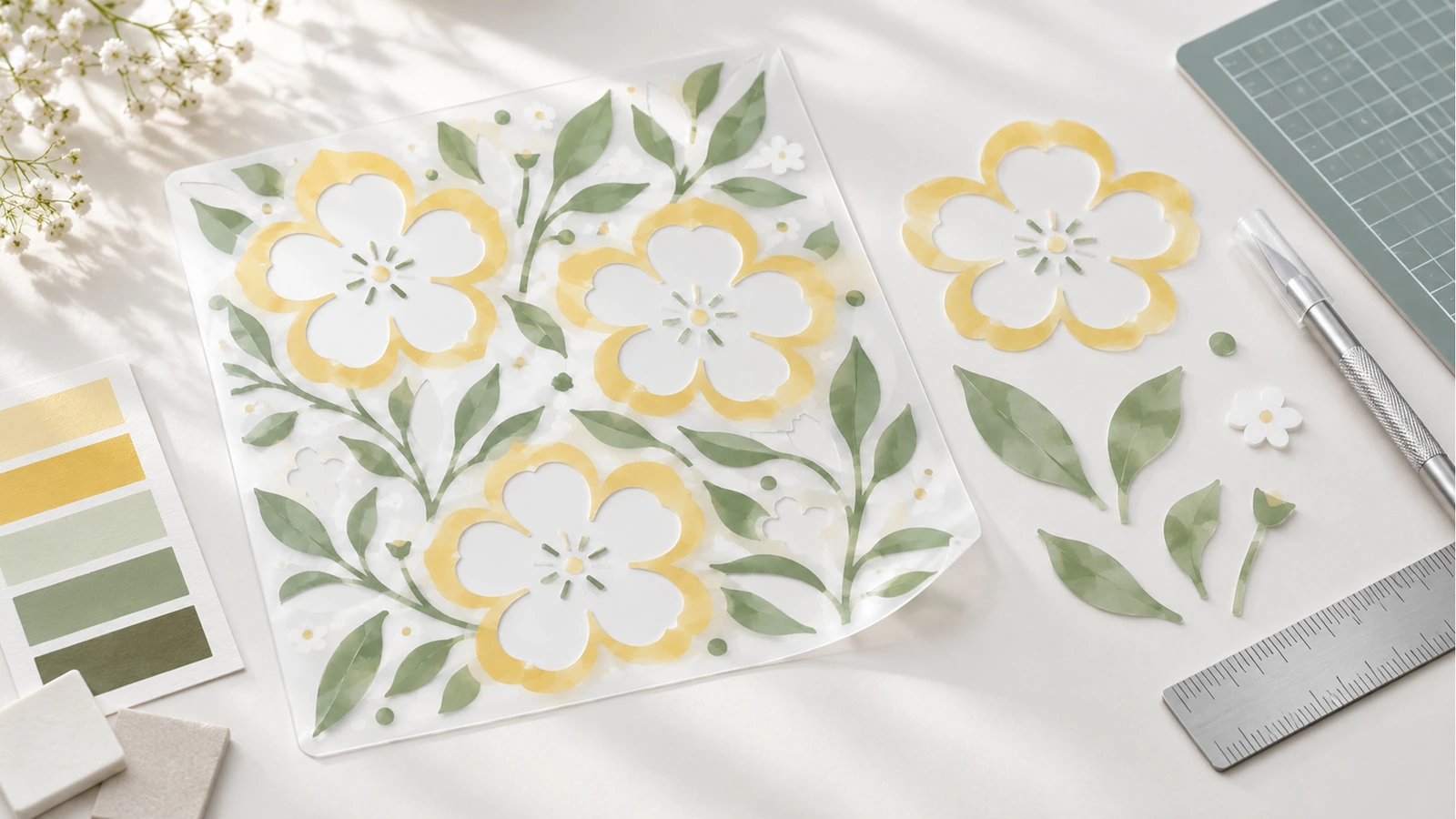
Table of Contents
What Exactly Is a Custom Reusable PET Stencil? ↑
PET here means biaxially oriented polyester film. "Mylar" is the DuPont trade name that many sellers use as a generic label. A stencil is cut from this film with open areas for paint and solid bridges that hold the interior shapes in place. Stencils Online describes polyester as one of the very few solvent-proof stencil plastics[6]. It sorts the film into 7.5, 10, and 14 mil tiers. The same page gives a conservative baseline of at least 15 to 25 applications with proper cleaning, and notes that paint buildup, not thickness, usually ends a stencil's life.
Reuse claims vary widely between sources. Stencil Stop markets its 14 mil film as good for hundreds to thousands of uses and calls Mylar food safe[7]. Both statements are seller marketing. They are not laboratory endurance data or FDA food-contact documentation. If your use involves food, ask for resin-grade compliance paperwork instead of relying on a product-page sentence.
| Thickness | Inches / mm (1 mil = 0.001 in) | Typical fit | Boundary |
|---|
| 7.5 mil PET | 0.0075 in / 0.19 mm | Lettering under 1 in, decorative detail | Creases if folded; light-duty only |
| 10 mil PET | 0.010 in / 0.25 mm | Most common industrial and commercial tier | Feels thin to buyers expecting board |
| 14 mil PET | 0.014 in / 0.36 mm | Larger letters, frequent reuse, gentle curves | Not advised for very fine detail |
| 1/16 in LDPE (60 mil) | 0.060 in / 1.52 mm | Occasional pavement marking | Different material; outside this PET SKU |
| 1/8 in LDPE (125 mil) | 0.125 in / 3.18 mm | Frequent contractor spraying | Coarse detail, heavy, spray only |
The first three rows cover what this PET product addresses. Which tiers are available for your design is confirmed on the quote. The polyethylene rows are included so pavement buyers can see where PET stops being the right answer. Thinner film holds detail and conforms to the surface. Thicker film resists tearing and gives you more cleaning cycles before the edges wear.
The film has hard limits. A Mylar glossary from GOBA lists its UV resistance as none, unsuitable for long outdoor exposure[8]. Short outdoor painting sessions are fine, but do not store stencils in the sun. Custom Cut Stencil lists Mylar as not for sandblasting, heavy paints, or very high heat[9]. That excludes thermoplastic striping and abrasive blasting.
Size drives readability. Stencil Stop puts the minimum feature at about 1/4 inch and notes a detailed crest may need to be larger[10], while a simple swoosh works at 2 inches. If your logo has hairline strokes, either scale it up or accept that the proof will thicken or merge them.
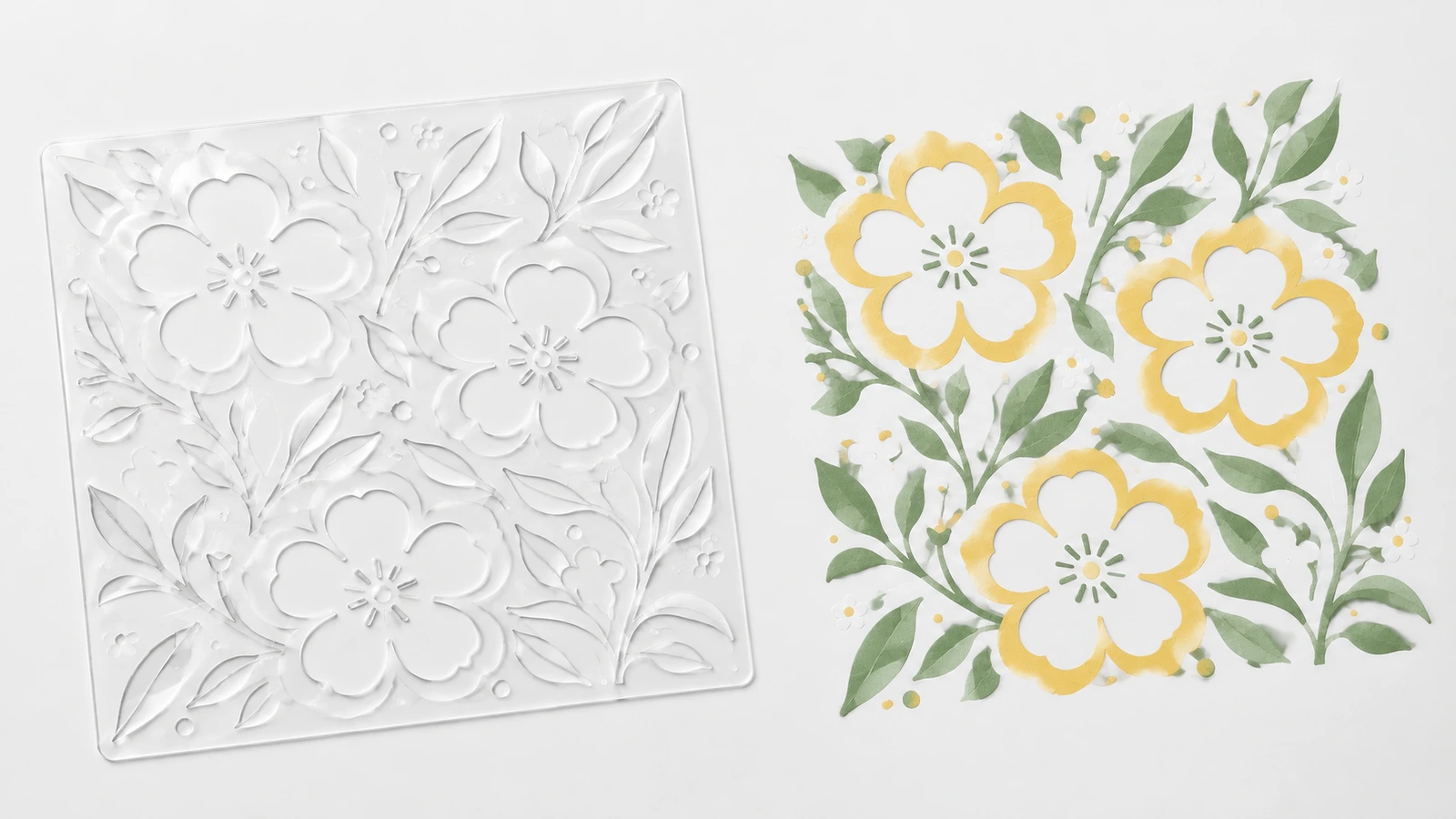
Backing is the second structural choice. A non-adhesive PET sheet is the reusable workhorse. It is held with masking tape, weight, or repositionable spray adhesive and washed between uses. Adhesive-backed film seals tighter on smooth floors, bottles, and pipes, so bleed is less likely. The trade-off is that it is usually a one-time or few-time tool. On smooth hardwood or sealed concrete, budget for spray adhesive with a non-adhesive stencil, or ask the quote to compare an adhesive option. Do not assume an unbacked sheet will seal by itself.
How Do You Order a Stencil That Paints Clean? Six Steps ↑
Step 1: Describe the job, not just the artwork
Send four facts with your file: the surface (drywall, wood, fabric, steel, sealed concrete), the paint (latex, enamel, aerosol), the applicator (foam roller, brush, spray gun), and how many times you expect to reuse the stencil. These answers set the thickness tier and backing before anyone opens the artwork. A sign shop should also say whether its end client must approve the proof, so a second sign-off is planned into the schedule.
Step 2: Preflight the file
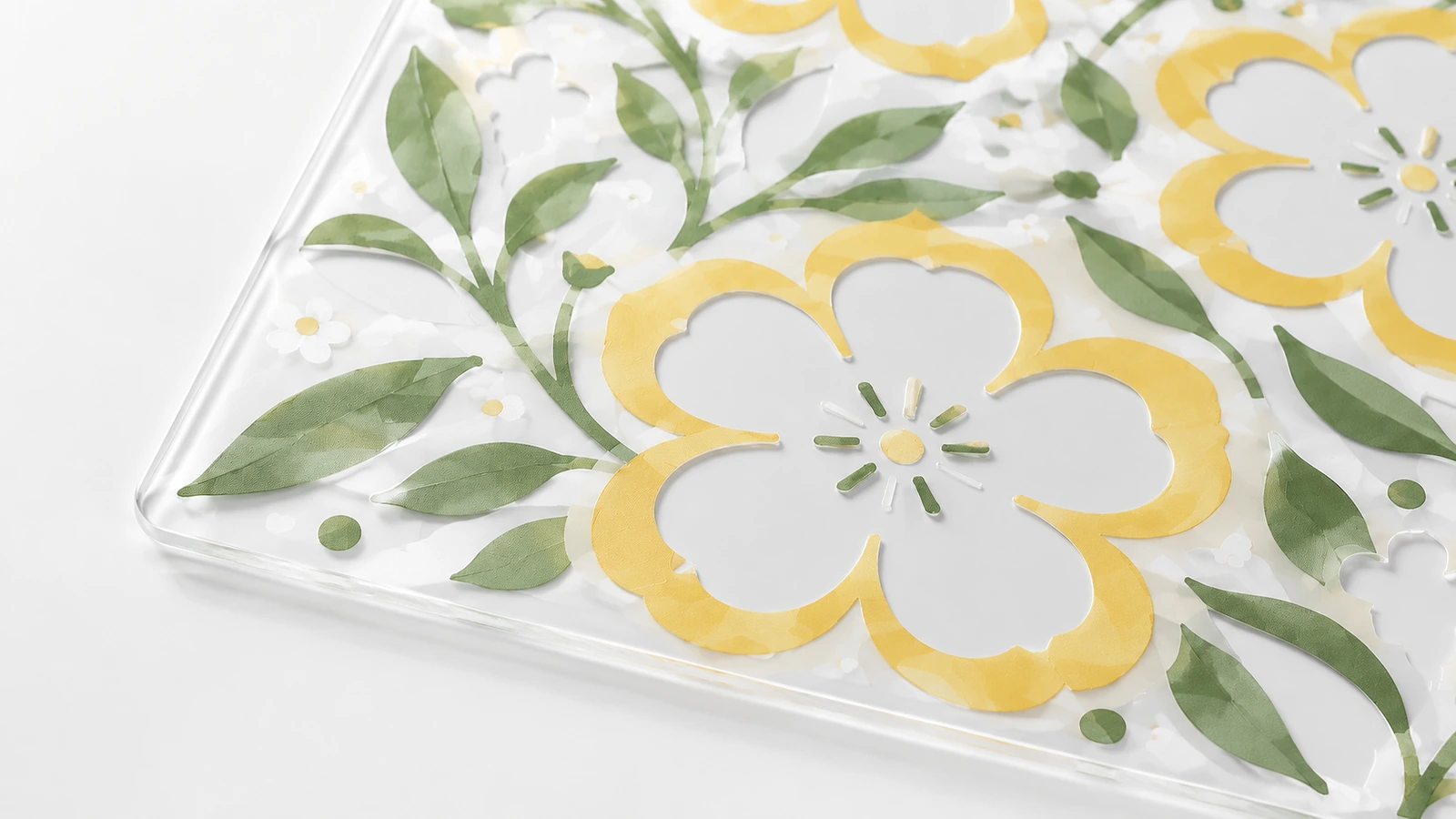
Vector files (AI, EPS, PDF, SVG, DXF) give the cutter clean paths. Photos and low-resolution logos must be redrawn, and that redraw is a design compromise you should review. Every enclosed shape (A, O, R, 8, closed logo counters) needs a bridge, or its center drops out. The Stencil Studio recommends that cut elements, bridges, and gaps be no less than 1 mm wide[11]. It stocks 190, 250, and 350 micron film, and 250 micron is roughly 10 mil. Build the artwork at 1:1 scale so the proof shows true stroke widths.
Step 3: Approve a proof that answers every field
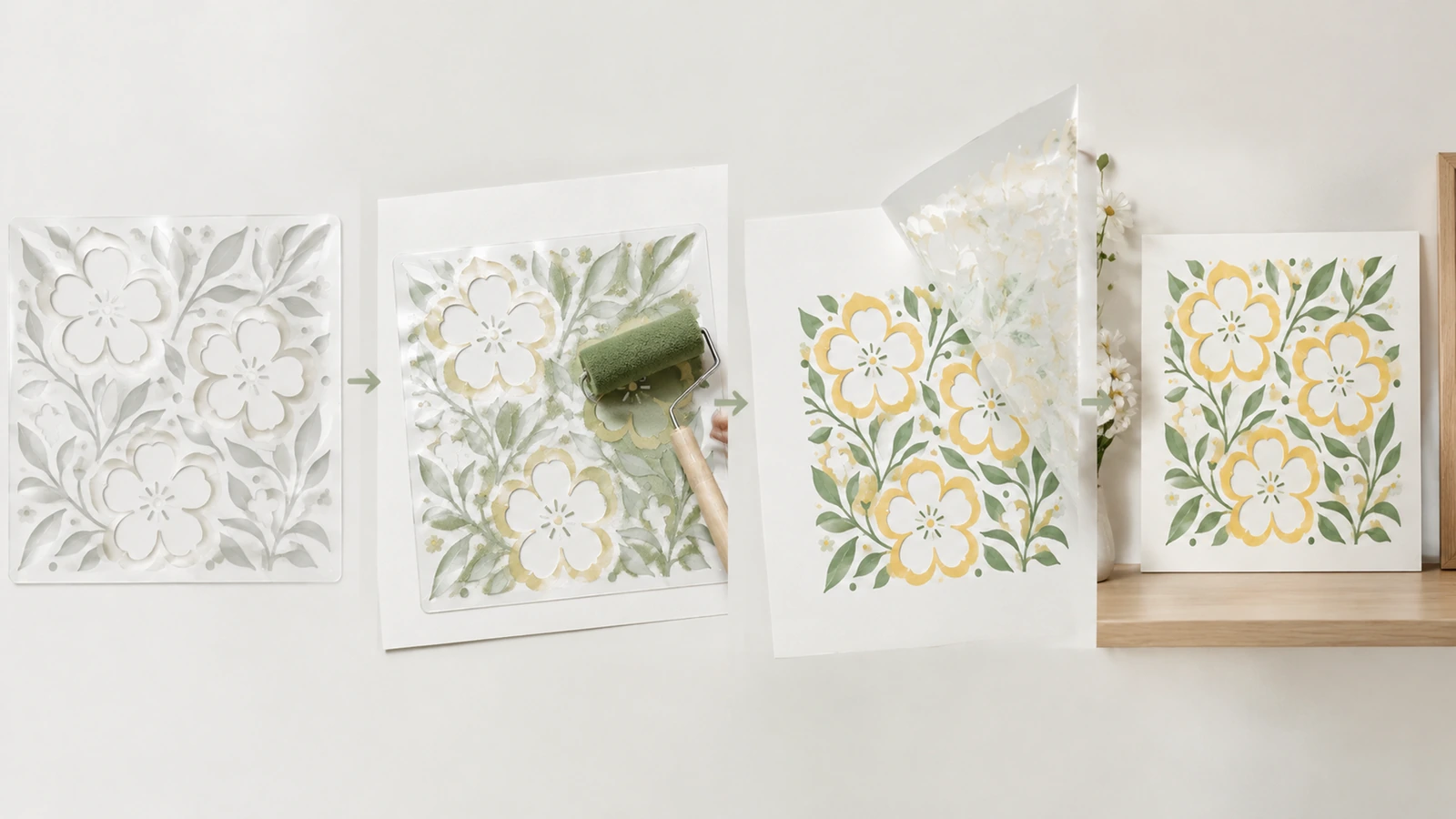
A proof is only useful if it states the facts that cause disputes. One reviewer complained that a stencil was advertised by sheet size while the usable cut-out was much smaller[12]. Use the checklist below before replying "approved" by email. Platform messages alone are not enough.
| Proof field | What to confirm |
|---|
| Thickness | Stated in mil and mm, matched to your applicator |
| Cut-out size vs. sheet size | Both dimensions shown; border width visible |
| Bridges | Marked in a contrasting color, width stated |
| Smallest feature | No stroke below the agreed minimum |
| Backing | Non-adhesive or adhesive, clearly labeled |
| Application method | Roll, brush, or spray noted on the proof |
| Multi-panel layout | Panels numbered with an assembly diagram |
| Quantity, MOQ, lead time | Written on the quote; production starts only after approval |
The bridge and panel rows matter most for logos and large designs. Bridges leave small gaps in the painted result that you may need to touch up by hand. Panel numbering prevents the missing-piece and duplicate-piece problems seen on multi-sheet orders. If a field is blank, ask before approving. A question costs nothing; a reprint costs the full order.
Step 4: Production after written approval
Industry practice is CO₂ laser cutting of polyester film, with power and speed set per material and thickness. Ask for a test cut on the same material lot when edge quality is critical. For timing context, one competitor publishes proofs within 1–2 business days and most custom orders shipping within 3–5 business days[13]. That is a market benchmark, not this product's commitment. Production time and MOQ for this SKU appear on your quote and depend on size, layers, and quantity.
Step 5: Inspect on arrival, before paint
Lay the stencil over a printout of the approved proof. Check that every island is still held by its bridge, that no chips or nicks break the design, that edges are smooth enough not to grab paint, and that the panel count matches the order. Photograph any defect and report it before painting. A complaint about an unused stencil is easy to verify; one about a painted stencil is not. For cleaning, Xometry notes that paint adhesion to Mylar is poor and that slightly flexing the stencil will crack and peel many paints[14]. Clean before buildup thickens the edges. Use mild soap first, and wipe briefly with solvent only when needed.
Step 6: Ship rolled, store flat, reorder from the proof
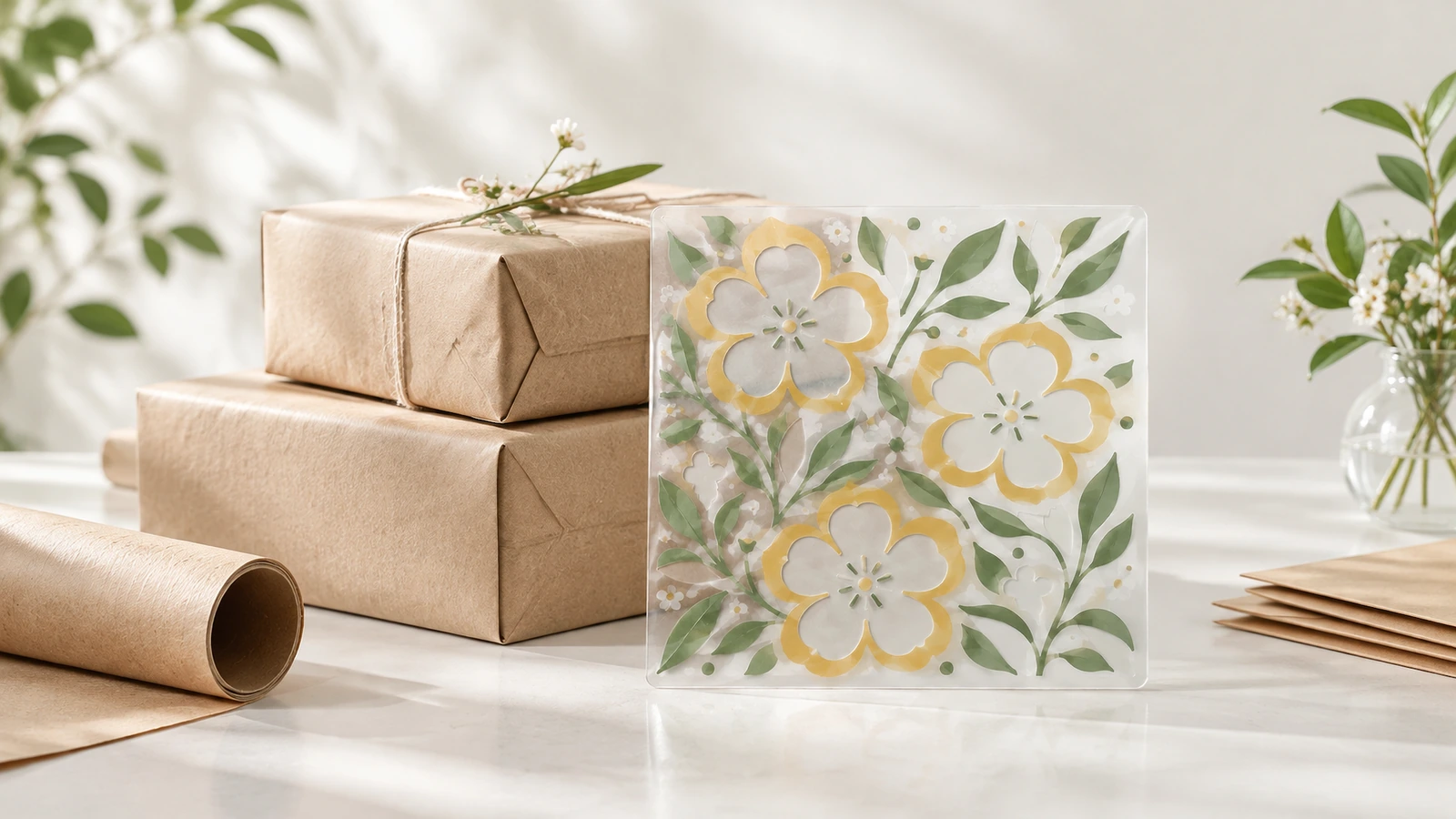
Ask for large sheets to ship rolled on a wide tube or between rigid boards, never folded. Journeyman HQ warns that storing stencils rolled or folded creates permanent memory that stops them lying flat[15]. After unpacking, flatten the sheet under weight. Store it flat between cardboard once the paint is fully dry. Keep the approved proof file and SKU reference so a reorder repeats the same thickness, bridges, and size without a new round of design.
Which Stencil Material Fits Your Job and Budget? ↑
| Option | Reuse (source wording) | Detail | Best surfaces | Main risk |
|---|
| PET film, non-adhesive (this product) | From 15–25 uses up to vendor claims of thousands | Good down to about 1/4 in features | Walls, wood, fabric, crates, sealed floors | Bleed without tape or spray adhesive; UV |
| Adhesive-backed film | Often single use | Cleanest edges | Bottles, pipes, smooth floors | Can lift uncured paint on removal |
| LDPE / LLDPE 1/16–1/8 in | Hundreds (vendor wording) | Coarse | Asphalt, concrete, parking lots | Weight, curl, poor fine strokes |
| Oilboard or cardboard | Short-term | Moderate | One-off projects | Absorbs moisture, degrades fast |
| Metal sheet | Highest durability | Good | Flat, rigid surfaces | Heavy, costly, does not flex |
The reuse column mixes conservative guidance and seller claims on purpose. No ASTM or ISO endurance test exists for painted stencils, so treat any cycle count as conditional on cleaning and flat storage. Thickness expectations also need managing. A buyer who paid $200 called a stencil flimsy, and the vendor explained that 10 mil film is thin by design so it can be rolled, sprayed, or brushed, while thicker stencils suit spray only[16].
When the job is pavement, change materials rather than thicken PET. Stencil Ease specifies 1/16 in and 1/8 in LLDPE for spray equipment, parking lots, and sports fields[17]. Paveman Pro rates 60 mil for occasional use and 125 mil for professional use, with at least 3 in of border on standard 12 in letters[18]. If your order mixes a detailed indoor logo with parking arrows, split it into two specifications.
Cost is best judged per use, not per sheet. Seton positions plastic stencils as resistant to wear, reusable many times, and suited to long-term professional projects[19], at a higher unit price than oilboard. For price context, Stencil Stop's FAQ lists standard custom from $45.99, layered from $72.99, metal from $74.99, and large custom from $115.99[20]. These are a competitor's page prices, not a market median and not this product's quote. For a two-use project, hand-cut or adhesive film may cost less. For a monthly repaint, reusable PET usually pays back through avoided rework.
A stencil is never compliance proof by itself. The U.S. Access Board states that ISA symbols painted on the parking surface cannot substitute for above-ground signs[21]. Stripe colors and hatch spacing are left to state and local rules. On airports, FAA guidance requires that all gaps created by stencil templates must be filled in[22], so bridge gaps need a touch-up pass. On public roads, FHWA states that the current manual is the MUTCD 11th Edition with Revision 1, dated December 2025[23]. Check letter heights against it and against your local adoption before ordering.
Key Takeaways ↑
- PET film comes in clear thickness tiers, each with a job. — 7.5, 10, and 14 mil; at least 15–25 uses with proper cleaning (Source)
- Every enclosed shape needs a bridge you can see on the proof. — bridges and gaps no less than 1 mm (Source)
- Very small strokes will not cut or paint cleanly. — minimum feature about 1/4 in (Source)
- Pavement work belongs to thick polyethylene, not PET film. — 60 mil occasional, 125 mil professional (Source)
- Competitor pricing gives a benchmark, not a quote. — standard custom from $45.99 (Source)
- Public road markings follow the current federal manual. — MUTCD 11th Edition, Revision 1, December 2025 (Source)
Ready to Send Your Artwork for a Proof? ↑
A stencil that paints clean is the result of four decisions made before cutting: the right thickness for your applicator, bridges you have seen and accepted, a cut-out size stated apart from the sheet size, and rolled shipping. These custom reusable PET painting stencils are built around that sequence. Your quote states the thickness tier, backing, MOQ, and production time for your design, and nothing is cut until you approve the proof in writing. Send your vector file along with your surface, paint, and reuse count, and request your custom stencil quote and proof today.




The information below is required for social login
Sign In
Create New Account