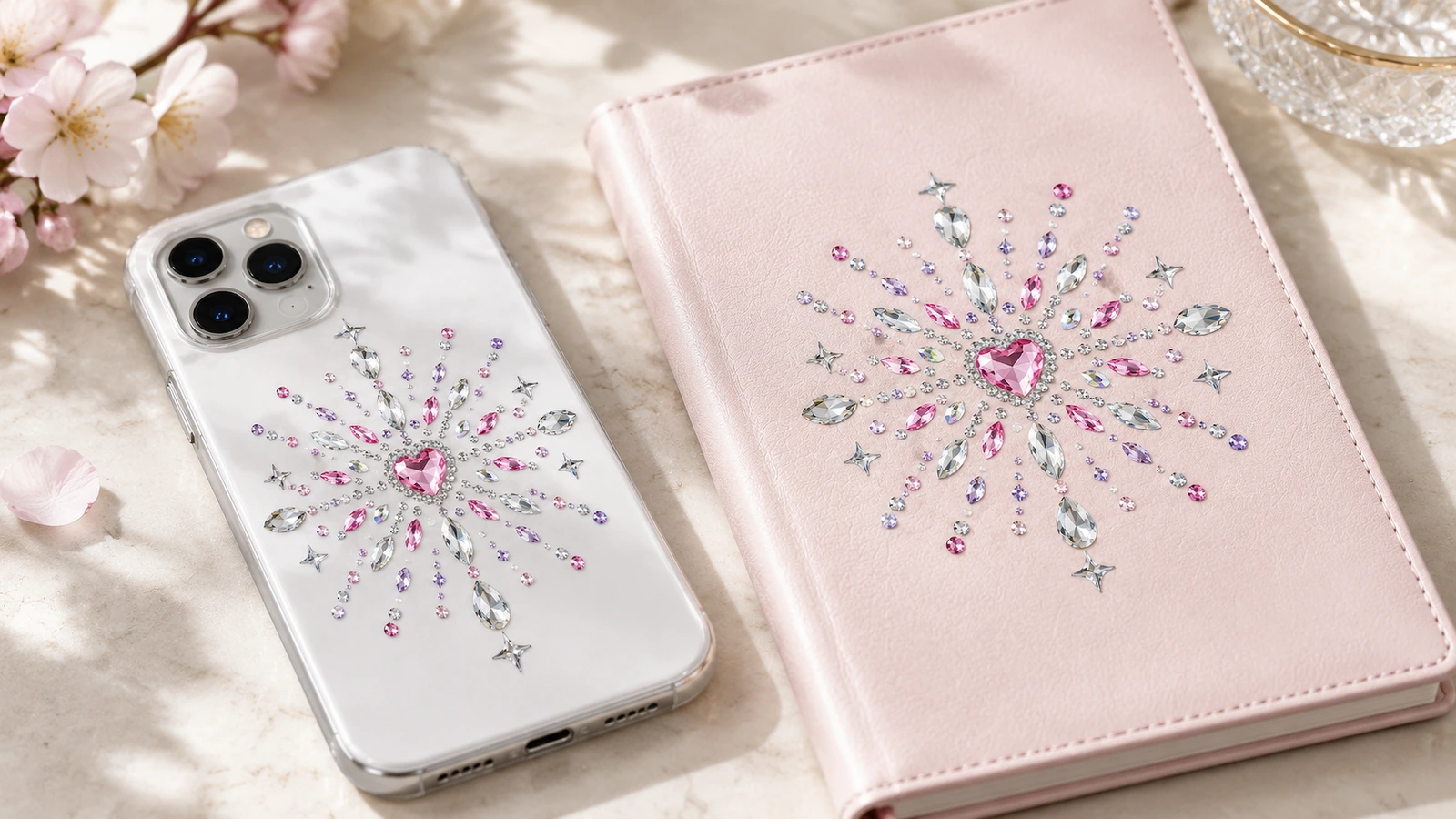
Custom rhinestone stickers are designs made from flatback stones on a pressure-sensitive adhesive and a release liner. You peel them off and press them onto a clean, dry surface such as a card, nail, phone case, package, or skin for short-term wear. They are not hotfix iron-on transfers. An order succeeds when four fields are written into it (stone size, separation format, adhesive type, and target surface) and a physical sample has been tested on the real surface before the run.
Who Actually Orders Custom Rhinestone Stickers, and for What? ↑
Public buyer feedback points to four groups, and each one needs a different specification. No source gives age, gender, or market-share data, so read this as a map of use scenarios rather than a survey. The largest visible group is home crafters who decorate cards, hair clips, graduation caps, and phone cases. One reviewer wrote, "I make cards with them. I also used them with a barrette blank for my hair," and another added, "I add a spot of glue just to be sure!" (Walmart buyer reviews[1]). Even satisfied buyers treat the factory adhesive as a starting point rather than a guarantee.
Event face painters are a smaller group with a specific use. One reviewer builds face-painting "bling" clusters and notes, "The girls definitely choose the designs with these gems first." Another warns the product is "Cute but not for all surfaces" (ANGELS CRAFT reviews[2]). Skin oil, sweat, and the need for clean removal set this group apart from card makers.
The third group is creators and micro-sellers who personalize tumblers, nail displays, and name patches. Many do the work themselves to avoid outside lead times, or as one tutorial puts it, "No more waiting 1-2 weeks for custom orders from Etsy" (Art Beat Box[3]). The fourth group, and the least documented, is coffee carts, wedding planners, and gift shops that order short promotional runs. No public tender or contract shows companies buying this exact item in volume, so handle B2B demand quote by quote.
Why Do So Many Rhinestone Stickers Fail After Purchase? ↑
The problem. Most complaints trace back to the promise of "self-adhesive." The adhesive often stays on the liner instead of leaving with the stone: "half the time when you peel a crystal off the plastic, the glue stays on the plastic" (Amazon review summary[4]). Other buyers receive stones joined together. One said it was not clear "the rhinestones were in strips rather than individual. They were difficult to separate" (Wrapables review[5]). Cutting the strips apart usually weakens the bond further.
Why it hurts. Each of these failures pushes work back onto the buyer. Face-decoration users say they switched to eyelash glue because "Stickers like these don't stay in long," and that the stones are "hard to get the reinstones off the glued white piece" (face-sticker listing[6]). One alphabet-sticker buyer reported "a STRONG, and I say STRONG chemical smell" (WILLBOND review[7]). Opinion is split even on well-rated listings. A Nicpro listing rated 4.6/5 across 3,329 ratings had 149 adhesion mentions in October 2026, of which 107 were positive and 42 negative (Nicpro listing[8]). For a reseller, a 28% negative share on the product's core function means refund requests and one-star reviews.
The fix. The answer is a written specification covering stone size, separation format, adhesive class, target surface, and service life, together with a physical sample tested on your actual surface before production. The sections below walk through that process and the acceptance checks to put in a purchase order.
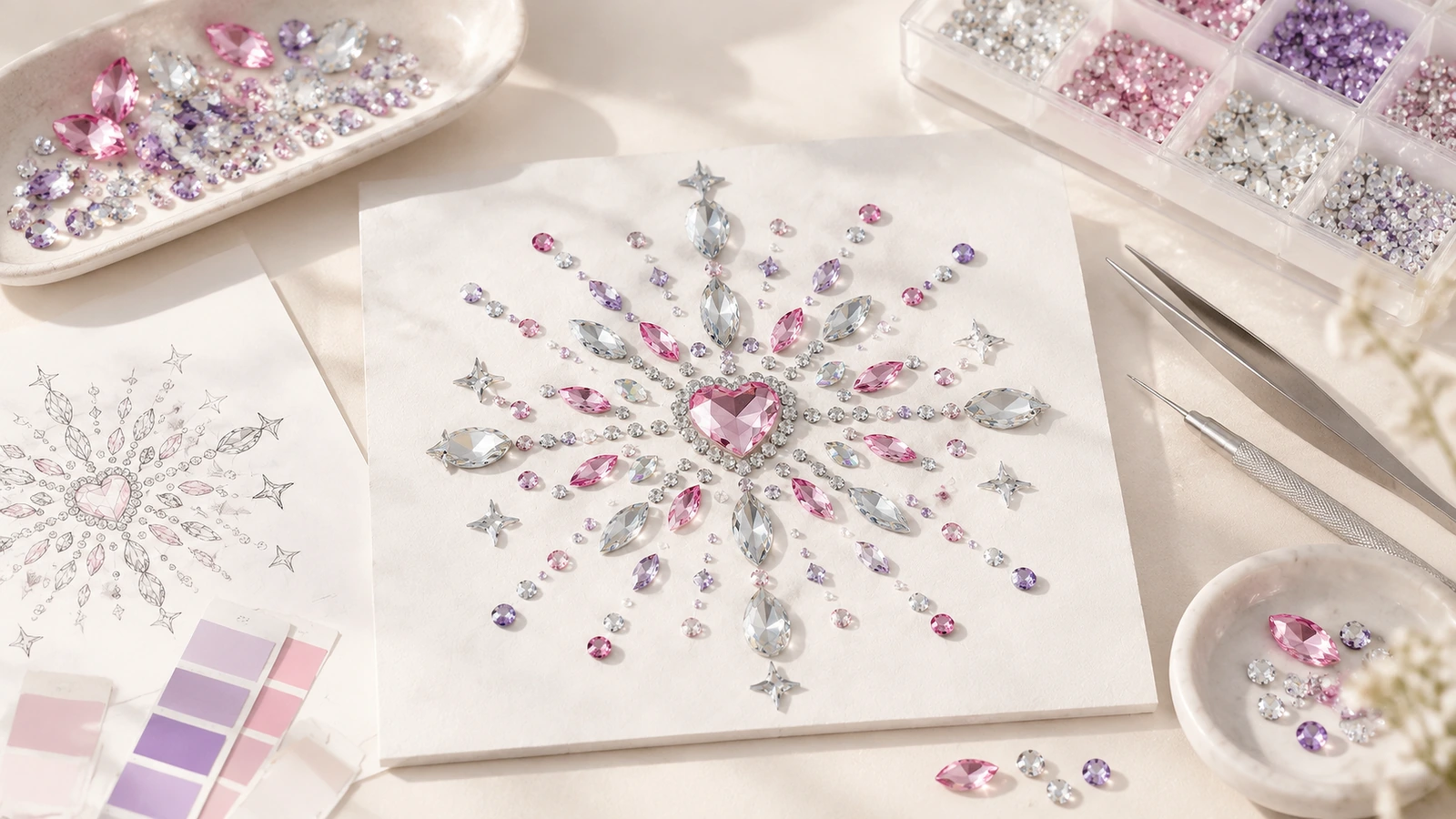
Table of Contents
What Is a Custom Self-Adhesive Rhinestone Sticker Motif? ↑
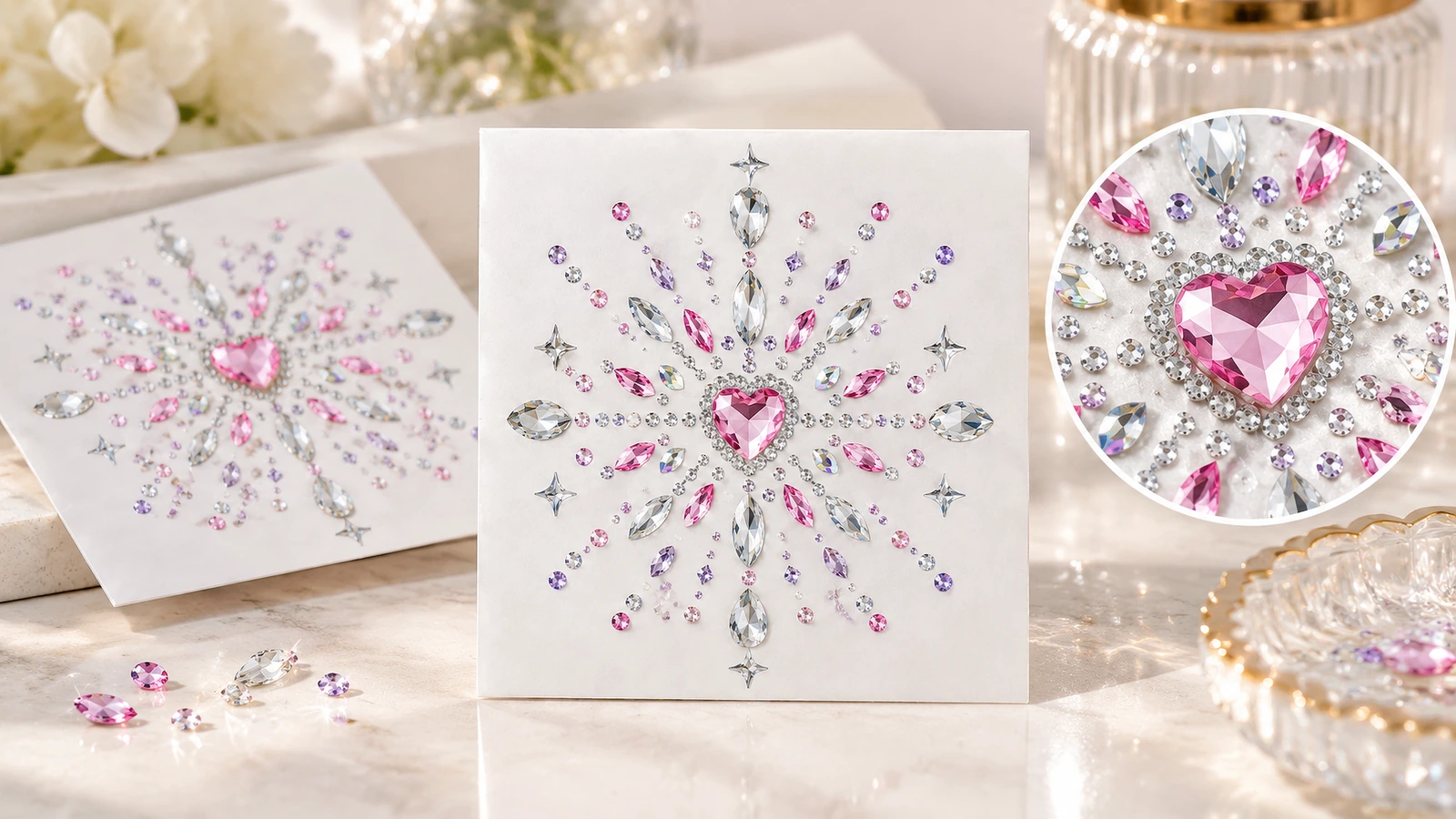
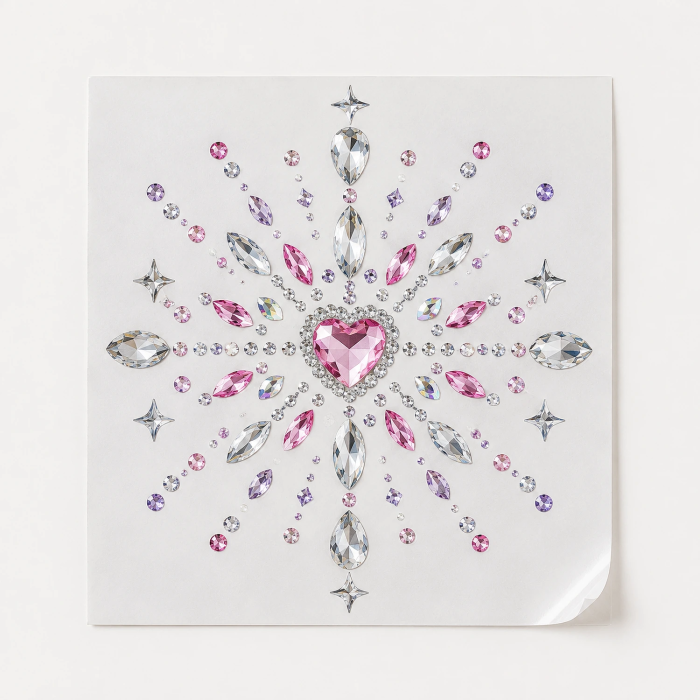
A custom self-adhesive rhinestone sticker motif is a design (a name, logo, number, or shape) built from flatback stones that sit on a pressure-sensitive adhesive over a release liner. The user peels it off and presses it in place without heat. Retail listings often blur this product with two others. Be Createful separates them: "Hotfix rhinestones feature a heat-activated glue disk on the back that bonds the rhinestone to the fabric when heated," whereas "Flatback rhinestones require adhesive to attach to your finished product" (Be Createful FAQ[9]). Some listings even use "self adhesive sticker" in the title of an iron-on transfer, so confirm the adhesive mechanism in writing.
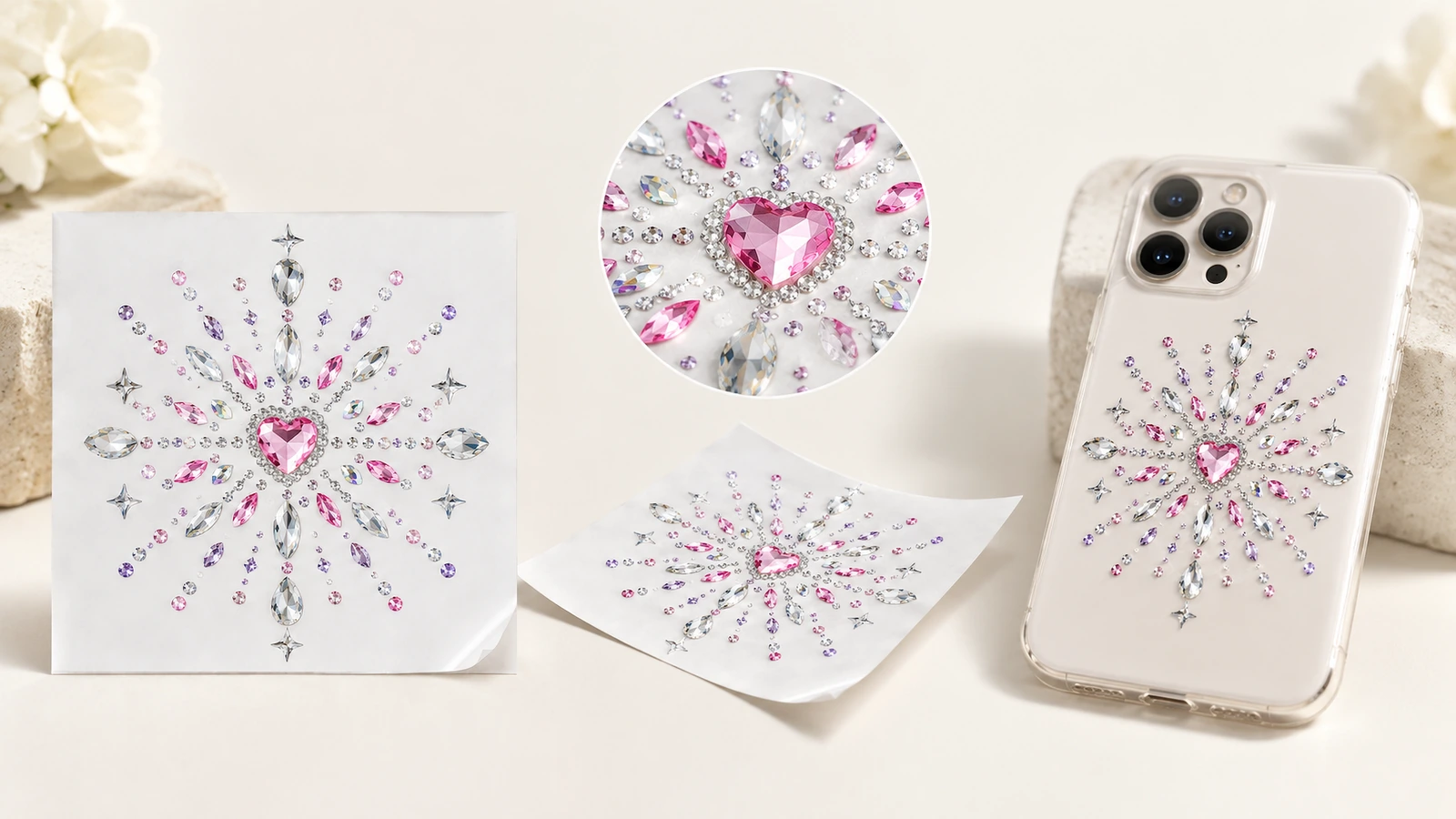
The surface usually decides which route to take. Crystal Parade advises against hotfix crystals on glass or plastic "due to the heat from the applicator and as the surface is non-porous," and recommends non-hotfix stones for small or one-off projects such as greeting cards and shoes (Crystal Parade[10]). Peel-and-stick motifs suit paper, card stock, smooth plastics, nail art, packaging, and short-term skin decoration. Washable apparel generally calls for hotfix transfers, and hard goods that need a long service life call for flatback stones with a matched adhesive.
Stone size and readability
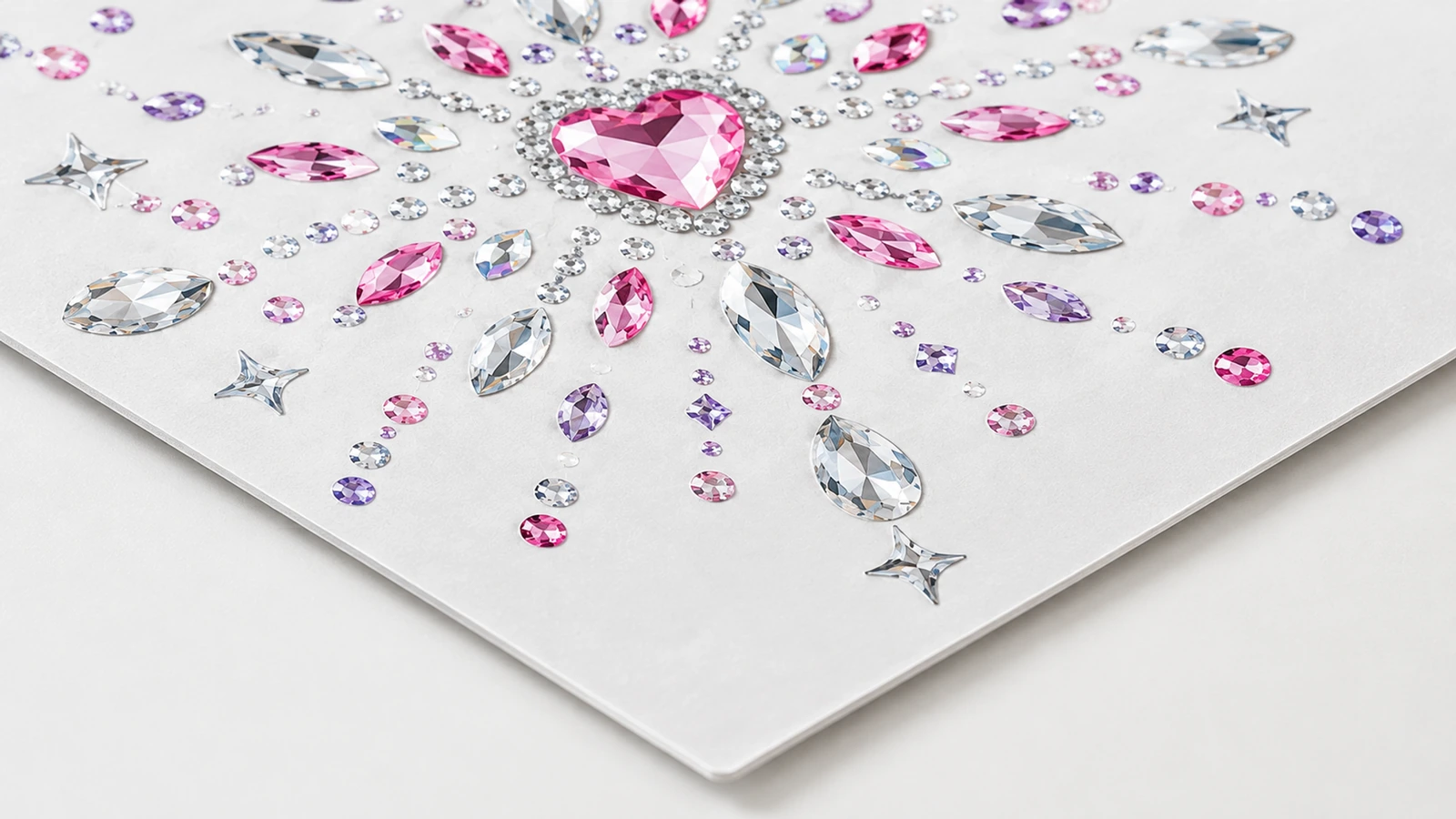
Stone size sets the smallest detail that will still read. Rhinestones are sold by SS number and, as Fire Mountain Gems notes, "are measured in a 'range' of sizes rather than a precise measurement" (Fire Mountain Gems size chart[11]). Plan the design with the ranges below and verify them on the sample, because sellers label the same SS number differently.
| SS size | Diameter range (mm) | Diameter range (in) | Typical design use |
|---|
| SS6 | 1.90–2.10 | 0.075–0.083 | Fine lines, nail art, close-view detail |
| SS10 | 2.70–2.90 | 0.106–0.11 | Lettering and general fill |
| SS16 | 3.80–4.00 | 0.15–0.16 | Medium motifs, team graphics |
| SS20 | 4.60–4.80 | 0.18–0.19 | Borders, designs viewed from a distance |
Fine script and small logos need SS6–SS10. SS16–SS20 read better from a distance but take up more area per letter. No published rule sets minimum letter height, stone spacing, or whether mixed sizes can share one motif. These depend on the stone map and are confirmed at the proof stage.
Surface and backing options
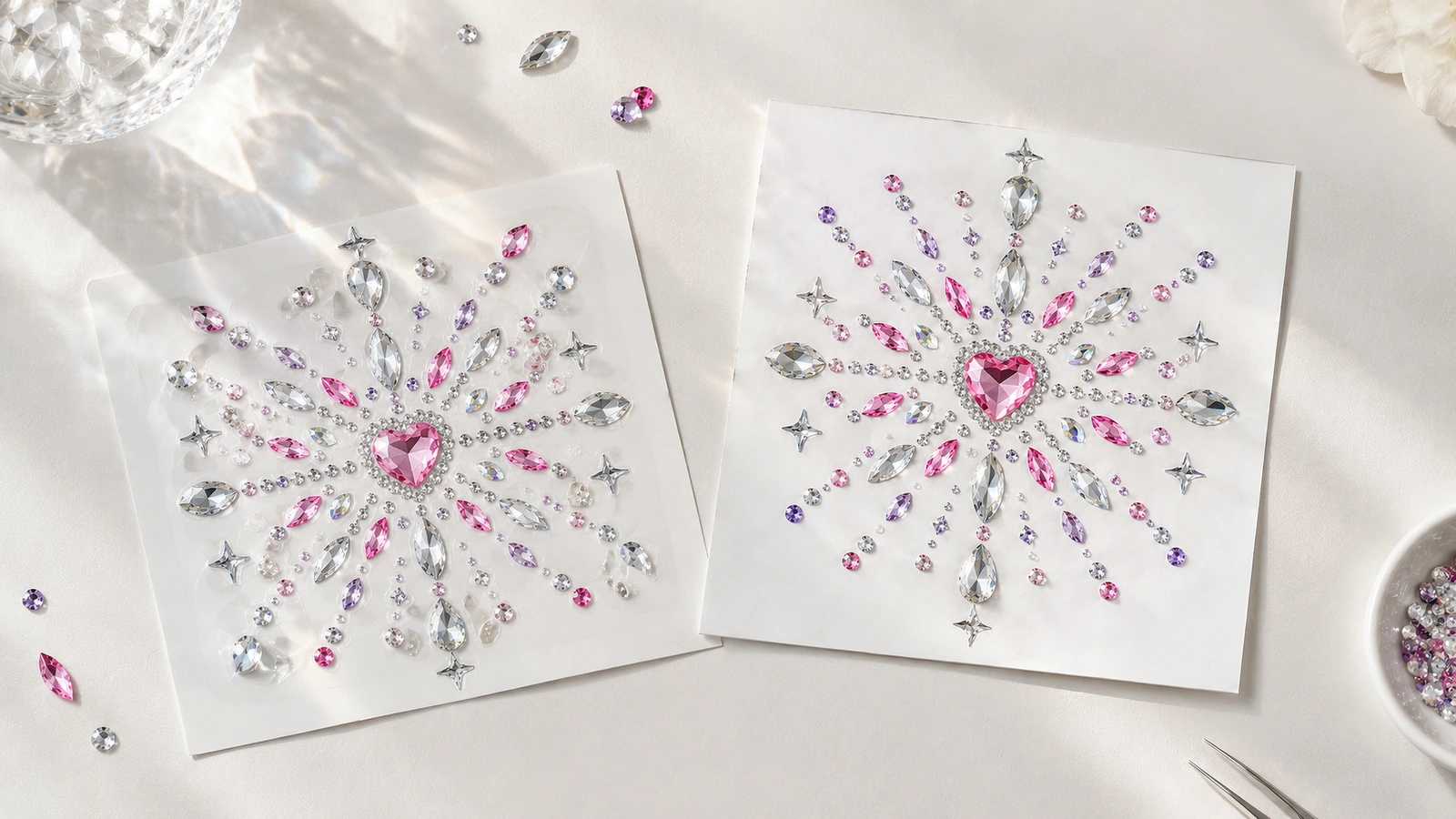
Three backing variables decide how a motif performs in real use. The first is separation format: individually cut stones peel cleanly but take longer to apply, while connected strips or one-piece motifs go on faster but have to be cut if the user wants single stones. The second is adhesive class: a permanent pressure-sensitive adhesive suits card and packaging, while face use needs a removable adhesive intended for skin, and the supplier must document that suitability. The third is the liner: each stone has to release with its adhesive still attached, which is exactly where complaints concentrate. Oily skin, textured plastics, tight curves, and stretch fabric all reduce adhesion, so name the target surface on every quote request.
How Do You Specify, Sample, and Approve a Custom Order? ↑
There is no cross-brand standard for this product, so the ordering process has to produce its own evidence. The five steps below bring risks to light before money is committed.
Step 1: Declare intended use and exclusions
State where the motif will be applied and how long it needs to last. That decision determines the adhesive and the exclusions. Steering wheels are excluded entirely: NHTSA warns that "the force of a deploying air bag can turn the product into a projectile, resulting in serious injury or death" (NHTSA consumer alert[12]). Outdoor vehicle use is another trap. One Etsy seller described buyers who applied indoor-grade stickers to cars despite a clear warning, then requested refunds months later (r/EtsySellers thread[13]). Unless your own tests show otherwise, state "not for vehicles, dishwashers, or machine washing" on the product page.
Step 2: Preflight your artwork file
Supply vector artwork at final size (AI, EPS, SVG, or PDF with text converted to outlines) along with a color list mapped to stone colors. Thin strokes, tight letter counters, and gradients rarely survive conversion to a stone map. Check on the proof that letters read correctly in their final orientation. Hotfix instructions require mirrored text (Fire Mountain tutorial[14]), so a file prepared for that workflow will come out backwards on a peel-and-stick motif. Ask for the stone count per motif on the proof, since it drives both cost and inspection.
Step 3: Approve a digital proof, then a physical sample
Buyers consistently reward previews. Positive custom-order reviews mention "Fast response time, mockups provided" and a seller who "showed me the design, as I requested, before shipping" (Etsy custom listing reviews[15]). A digital mockup confirms layout, size, and colors. Only a physical sample confirms adhesion, liner release, and odor. Sample cost, sample lead time, MOQ, and production time are not published for this SKU and will be stated in the quotation.
Ask the supplier to walk through its production sequence. It typically runs from stone placement to the approved map, through adhesive lamination and cutting (a kiss-cut that leaves the liner intact, or a full motif cut), to mounting on a liner card. Ask which steps are done by hand, because manual placement affects how consistent stone count and alignment are from lot to lot.
Step 4: Test the sample against written acceptance checks
Run these checks on the sample using the real target surface, not a lab panel. Buyer and supplier agree on pass thresholds at the sample stage. The table lists what to measure; it is not a published standard.
| Check | Method | Why it matters |
|---|
| Liner release | Peel 10 stones or motifs; count any that leave adhesive behind | Most frequent buyer complaint |
| Stone count and position | Compare against the proof stone map | Catches missing or flipped stones |
| Separation format | Confirm individual or connected matches the spec | Avoids strip-cutting complaints |
| Adhesion on target surface | Apply, wait 24 hours, flick edges with a fingernail | Shows real-surface performance |
| Curvature and handling | Apply to the tightest curve; reposition once | Reveals edge lift and stone loss |
| Odor and labeling | Open a sealed pack; check warnings and use statements | Addresses smell complaints and compliance |
Keep the approved sample and its photos as the reference for incoming inspection. Static testing alone can mislead, as one creator's laminate experiment showed: "The rhinestones stayed in place until I tried to move the decals and then many of them flew off" (Craftable Things video[16]). Test the motif while it is handled, repositioned, and flexed, not only while it lies flat.
Step 5: Give end users application instructions
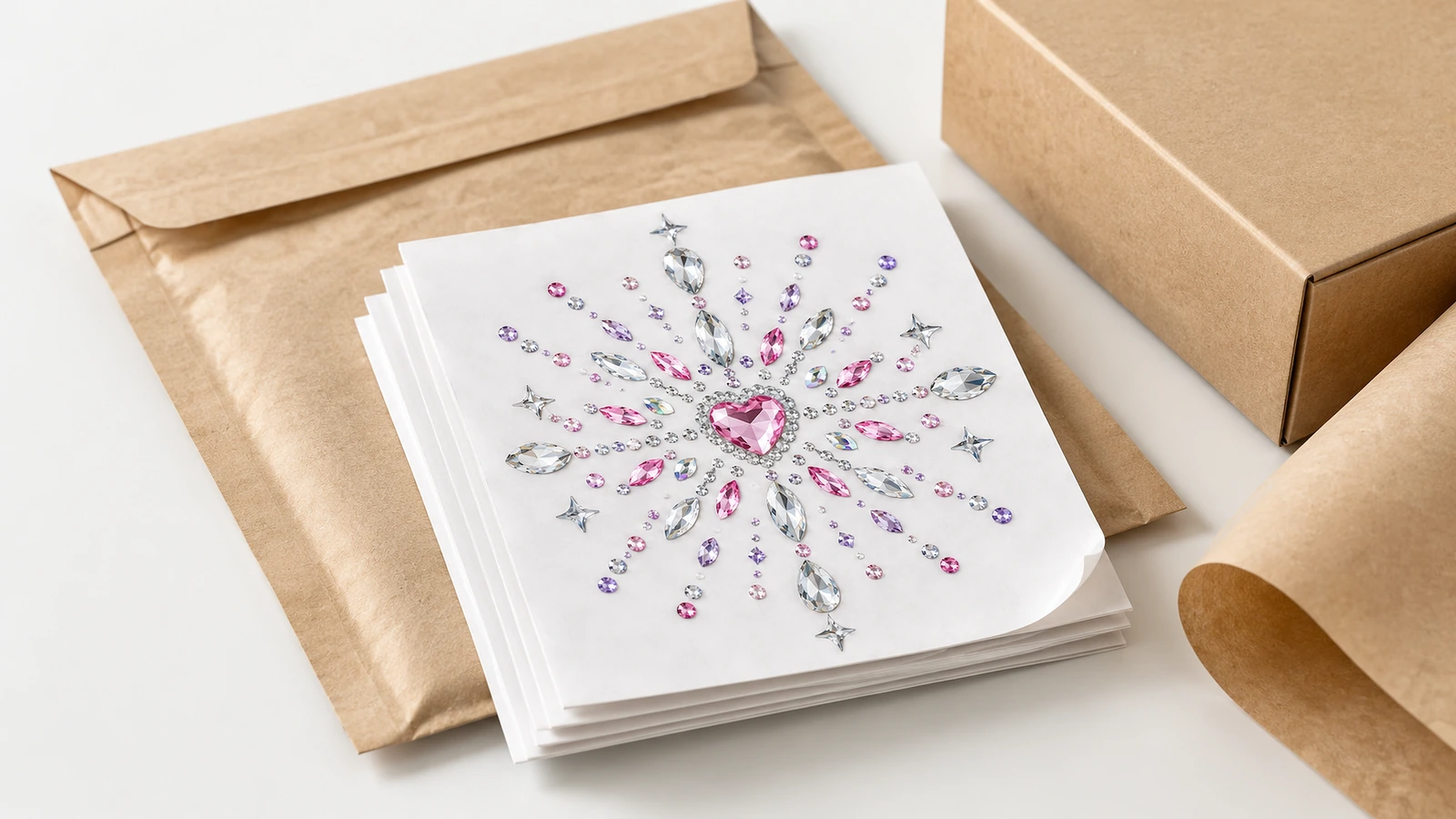
Print short instructions on the liner card: clean and dry the surface, remove any oil, press firmly for several seconds, and keep the motif away from water and stretching right after application. For skin, face-sticker sellers already specify dry, oil-free skin and suggest eyelash glue for sweaty conditions. Repeating that advice up front heads off the most common skin complaint.
Which Application Method Fits Your Surface? ↑
Four production routes answer the same search, and they are not interchangeable. Choose by surface and service life first, and by price second.
| Method | Heat | Best surfaces | Typical failure | Choose when |
|---|
| Self-adhesive motif | None | Paper, smooth plastic, nails, packaging, short-term skin | Adhesive stays on liner; lifts on oily or curved surfaces | Decorative use, applied same day without heat |
| Ready-made iron-on motif | Iron or press | Heat-tolerant fabric | Fixed design; cannot be personalized | A single stock design is enough |
| Custom hotfix transfer | Heat press | Cotton, denim, some polyester | Melts synthetics; cannot be repositioned | Washable apparel logos, repeat orders |
| Loose flatback plus glue | None; glue must cure | Glass, metal, tumblers, shoes, resin | Slow; glue choice decides durability | Hard goods and curved items |
This is why comparing price per piece across routes is misleading. Published terms from other sellers illustrate the hotfix route. Atlanta Vinyl Store lists a 10-piece minimum and 10 to 14 business days of production (Atlanta Vinyl Store[17]), and Planet Rhinestone states setup fees from $40 including one sample, with a 24–50 piece minimum for factory-produced transfers (Planet Rhinestone[18]). These are terms for heat-applied transfers, not for this self-adhesive SKU, whose terms are confirmed in the quote. One supplier summed up the trade-off: "You need cheap and fast so you may not care about quality (can't have all 3 in business)" (r/heatpress thread[19]).
What Should a Buyer Confirm Before Paying? ↑
Turn the specification into a request for quotation (RFQ). The table separates what you supply from what the supplier must confirm in writing. For this product, every supplier-side field is pending quotation or sample.
| Field | Buyer provides | Supplier confirms (quote or sample) |
|---|
| Artwork | Vector file at final size | Stone map and stone count |
| Stone size | Target SS range | Measured millimeters on sample |
| Separation | Individual or connected | Cutting method |
| Adhesive | Target surface and service life | Adhesive type and removability |
| Quantity | Run size and reorder plan | MOQ and unit price |
| Timing | Needed-by date | Sample and production time |
| Market and age group | Adult or children's positioning | Test reports and warning labels |
If a supplier cannot fill in the right-hand column, you do not yet have a quotable product. Treat blank fields as open risks rather than details to settle after payment.
Children's products and compliance
Compliance depends on the intended audience. If a sticker is designed or marketed primarily for children 12 and under, CPSC treats accessible parts with total lead above 100 ppm as banned under 15 U.S.C. § 1278a, and a Children's Product Certificate is required (CPSC total lead guidance[20]). Small-parts rules cover items intended for children under three, and the exemption for children's clothing does not extend to loose stickers or craft stones sold on their own (CPSC small parts guidance[21]). Retail listings already warn of choking hazards and advise keeping the product away from children under 13 (Sorrento Crafts listing[22]). Since July 8, 2026, importers of regulated products must e-file certificate data before entry, although CPSC says this "creates no new testing, certification, or compliance obligations" (CPSC eFiling release[23]). Words such as "kids," "youth cheer," or "toddler" change the compliance path. Positioning the product as adult decoration is simpler, but it has to be consistent across the listing and the packaging.
Durability claims and market signals
Do not copy a supplier's "washable" or "car-wash safe" claims onto your own listing unless you have your own test record. Treat market-size figures with the same caution. One report puts rhinestone apparel at $3.2 billion in 2025 (MarketIntelo[24]), while another puts it at $4.8 billion in 2024 (ResearchIntelo[25]). Both cover finished apparel, neither discloses its method, and neither measures demand for adhesive sticker motifs, so neither should drive a production quantity decision.
Packaging, shipping, and reorders
Specify a rigid backing card or flat mailer, because a liner that flexes in transit can lift stones before the customer opens the pack. Ask for a lot label showing stone size, adhesive type, and proof reference, so that a reorder reproduces the approved sample rather than a look-alike substitute. A few spare stones cost little and build goodwill. One custom-transfer buyer praised the "spare rhinestones sent in case anything falls out of place" (Etsy transfer review[26]). Packaging format, carton size, and unit weight are confirmed at quotation.
Key Takeaways for Rhinestone Sticker Buyers ↑
- Adhesion is the core risk, even on well-rated listings. — 42 of 149 adhesion mentions were negative on a 4.6/5 listing (Source)
- Plan design detail around stone size ranges, not single values. — SS10 measures 2.70–2.90 mm (Source)
- Positioning for children triggers federal lead limits. — 100 ppm total lead in accessible parts (Source)
- Imported regulated products now need e-filed certificates. — effective July 8, 2026 (Source)
- Sampling has a cost on custom rhinestone work. — one hotfix supplier charges setup from $40, including one sample (Source)
- Market-size reports conflict and cover apparel, not stickers. — $3.2B in 2025 versus $4.8B in 2024 (Source; Source)
Is a Custom Rhinestone Sticker Run Right for Your Project? ↑
A self-adhesive motif is the right route when the surface is paper, smooth plastic, nails, packaging, or skin for short-term wear, and the design has to go on without heat. That holds only when stone size, separation format, adhesive, and target surface are written into the order and proven on a sample. For washable apparel, choose a hotfix transfer. For tumblers and other hard goods, choose flatback stones with a matched adhesive. MOQ, pricing, and timing for NSKU-701-01 are issued in a quotation once your artwork has been reviewed.
Send your vector artwork, target surface, and quantity to request a quotation and a physical sample.




The information below is required for social login
Sign In
Create New Account