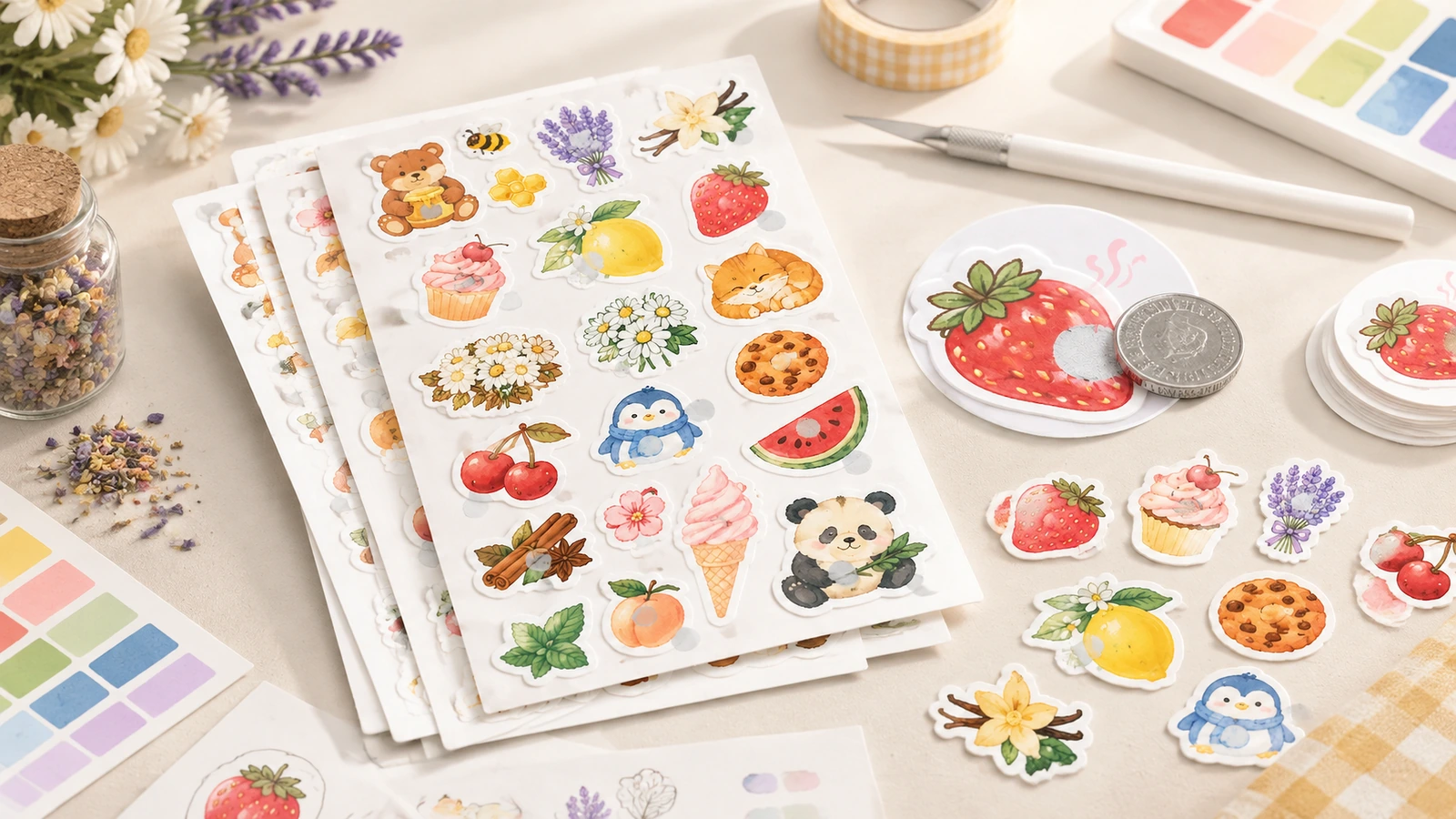
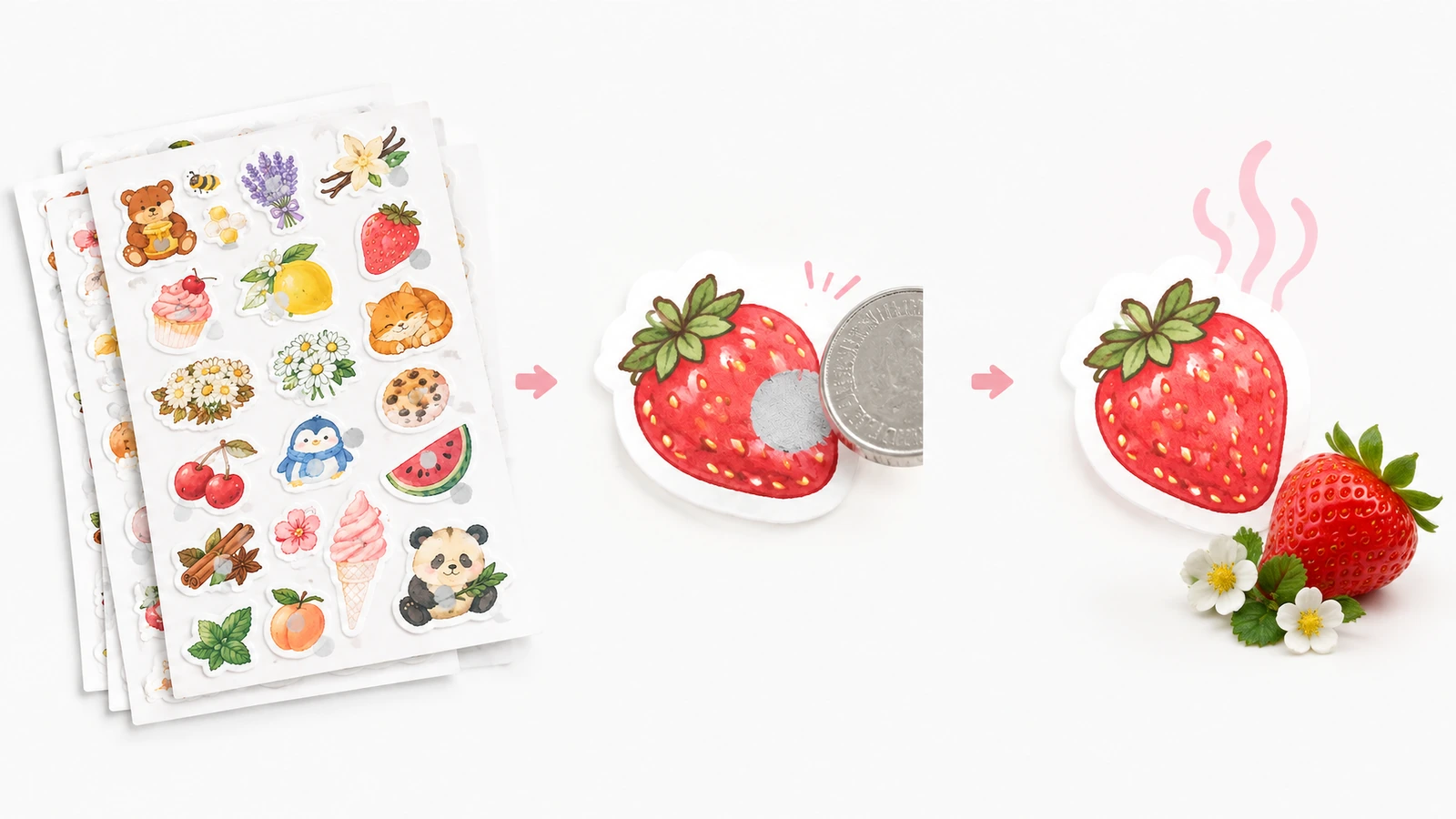
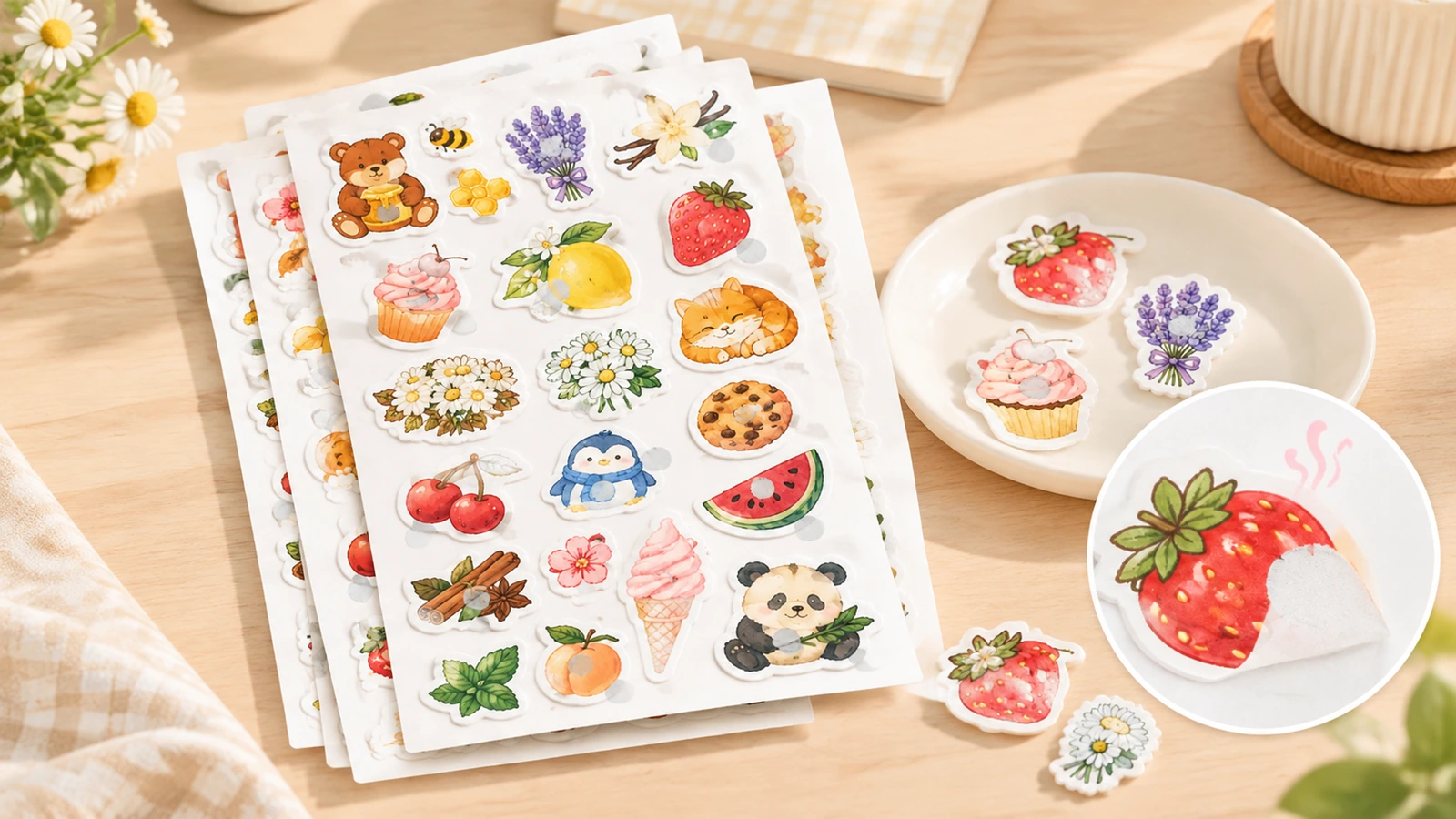
Custom scratch and sniff stickers are adhesive stickers printed with your artwork. A clear coating of microencapsulated fragrance sits over a defined scratch zone. Scratching breaks the capsules and releases the scent. Results depend on three things: true encapsulation, an unlaminated scent zone, and a blind-tested, signed physical sample. The name of the scent alone tells you very little.
Who Buys Custom Scented Stickers, and for Which Scenarios? ↑
Three groups arrive at this page, and their needs barely overlap. The first is brand and packaging teams in air fresheners, candles, personal care and cleaning products. Alpine Packaging lists these same categories as the main users of its scratch-and-sniff labels[1]. These buyers want a shopper to smell the product before purchase. Their questions are about matching the scent in the bottle, white-label pricing, and whether a label will hold on glass, PET or HDPE.
The second group is teachers, clinics and parents, who usually need reward stickers rather than a custom fragrance. Stock packs already cover this use. SmileMakers, for example, sells 75 scratch 'n sniff stickers for $9.99[2]. Before ordering, check whether the school has a fragrance-free policy. The American Lung Association's fragrance-free policy template[3] warns that strong scents can contribute to poor indoor air quality and can trigger reactions in sensitive people.
The third group is event planners, Etsy sellers and illustrators. They want their own artwork in small runs. Their obstacle is the fragrance, not the printing. Harkwell estimates that about 1 kg of scent covers roughly 5,000 A5 labels, and that a 500-sticker order may still require a full kilogram[4]. For very small quantities, the price per piece stays high until the fragrance batch is used efficiently.
Why Do Scented Stickers Disappoint, and What Prevents It? ↑
The most common complaint is simple: the sticker does not smell. One verified Walmart buyer wrote that "the scratch and sniff doesn't smell… the flavor is not distinguishable" (Walmart reviews[5]). Another reviewer on the same page said every design smelled the same, "kinda like soap." For a brand, that kind of review becomes a judgment on the brand, not on the printer.
The causes are usually process shortcuts, and some of them create real risks:
- No encapsulation. Dr. Stinky's says some cheaper versions skip microencapsulation or use lighter fragrances[6]. These fade fast. The same guide notes that citrus scents are especially hard to capture.
- Scent that is too strong. In 1987, a utility mailed gas-odor scratch-and-sniff inserts in unsealed envelopes. The scent leaked in transit and set off false alarms; one call brought out 27 firefighters and 8 pieces of equipment[7].
- Lamination. Asked whether a laminate blocks scent, Alpine answers "Yes—if it covers the scented area" (Alpine[1]).
We build every order around three controls:
- A true encapsulated scent coating, applied only to an unlaminated scratch zone.
- A physical sample, blind-tested against your target scent before production starts.
- Sealed packing with each scent kept separate.
These controls do not guarantee a particular shelf life. They make the supplier claims quoted on this page testable on your own artwork. No figure on this page is a measurement from our own production line; every specification is confirmed at quotation and sampling.
Contents
What Is a Custom Scratch-and-Sniff Sticker, Technically? ↑
To make the scent layer, fragrance oil is broken into microscopic droplets, and each droplet is wrapped in a thin polymer shell. How Products Are Made[8] describes droplets reaching 20–30 microns after about 12 hours of agitation. It also notes that stickers are usually produced by flexographic printing. A 2026 microencapsulation explainer[9] gives a range of roughly 10–40 microns. It lists gelatin, gum arabic and melamine-formaldehyde resin as shell materials: harder shells protect the scent in long storage, and more brittle shells release it with a lighter scratch. The concept traces back to US patent 3,516,846[10], granted in 1970 for microcapsule-containing paper.
The capsules are suspended in a water-based or UV-curable coating, which is printed over the artwork only in the activation area. Alpine states that pure, unencapsulated oils do not perform well on press (Alpine[1]). H&H Graphics[11] adds a practical rule for artwork: the scent area must be a 100% solid, never a halftone. H&H also reports the best results on coated paper or plastic.
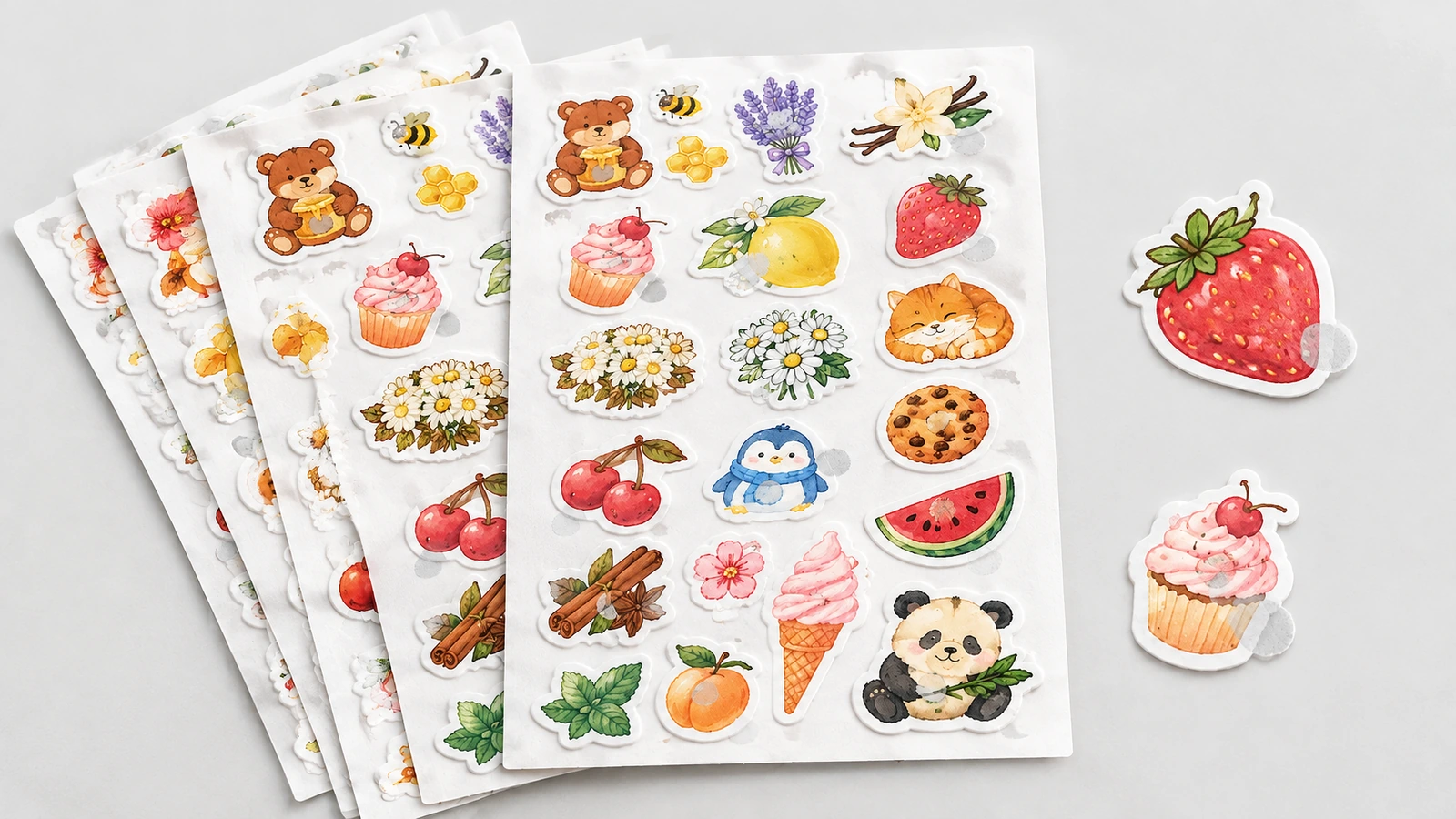
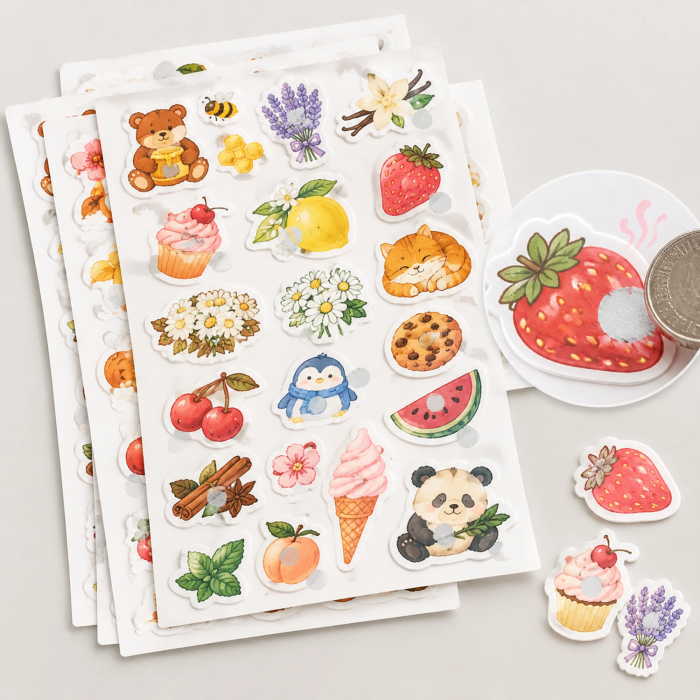
The size of the scent zone affects both how much there is to smell and how easy it is to find. Scratch Off Systems[12] states that an area about 1 inch across can last 10 to 20 scratches, and that larger areas last longer. We recommend a solid scent zone of about 1 inch or larger, with a short "scratch here" cue printed large enough to read at arm's length. Very small stickers cost more in fragrance per piece and leave less surface to scratch. The scratch count on your own design is confirmed by testing the sample.
| Parameter | Public reference (supplier or literature claim) | How it is settled for your order |
|---|
| Capsule diameter | 20–30 µm (MadeHow); 10–40 µm (asmr.education) | Coating datasheet requested at quotation |
| Scratches per zone | 10–20 for a zone about 1 in. across (Scratch Off) | Counted on the approved sample |
| Scent life | 12–24 months (Scratch Off); 3–6 months (Harkwell) | Not promised without storage testing |
| Fragrance source | 70+ stock scents or the customer's own fragrance (Scratch Off) | Stock scent first; customer oil only after a compatibility check |
| Coating location | Scratch zone only, with no laminate over it (Alpine) | Marked on the dieline proof |
| Adhesive | Permanent, removable or freezer grade (Alpine) | Peel test on the target surface |
| Quantity tolerance | ±5% or 12 pieces, whichever is higher (Grandstand[13]) | Written into the order confirmation |
The two scent-life figures differ by a factor of four because they come from different suppliers, with different products and storage assumptions. Treat both as claims, not as an industry standard; none of the sources cited here gives a single ISO standard for scratch-and-sniff stickers. That is why the right-hand column describes a verification step instead of a number.
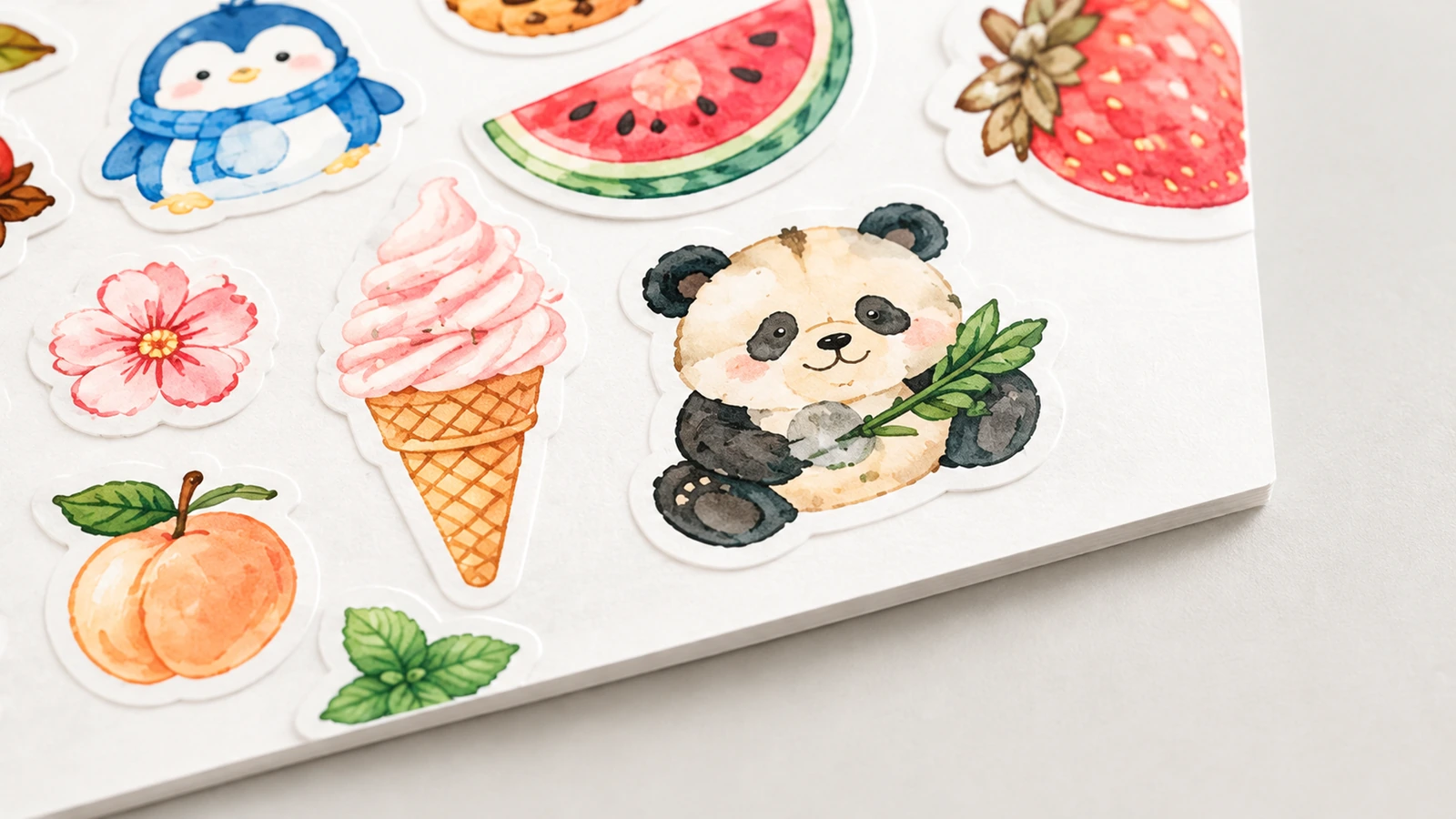
Choose the face stock and backing based on where the sticker will be used. Alpine's scratch-and-sniff labels come on rolls or sheets and can be applied to glass, PET and HDPE. Paper is common under the scent zone, while film adds durability in the areas without scent. Bottles with tight curves, freezer storage and repositionable placement each call for a different adhesive. We confirm the adhesive on your real container or surface during sampling; we do not assume it from a spec sheet. Metallic inks or heavy varnish near the scent zone are adhesion-tested and scratch-tested before approval.
How Does an Order Move From Brief to Delivered Stickers? ↑
The sequence below follows the stages where scent projects most often fail. Each stage ends with something you approve, so problems are caught on a sample rather than on a full production run.
Step 1: Write a one-page brief
List the sticker size, quantity, number of scents, permanent or removable adhesive, the age of the end user, your budget ceiling, and the latest acceptable delivery date. If one sheet carries several scents, each scent needs its own coating plate to avoid cross-scenting, so say this up front.
Step 2: Choose the scent
Start with a stock fragrance library. If your product needs a brand fragrance, Print-A-Scent describes working directly with the customer's fragrance supplier[14] on how the oil must be supplied. Not every oil can be encapsulated. An Accio supplier overview[15] notes that highly volatile or rare materials may encapsulate poorly or fade sooner. Developing a custom scent is quoted separately and adds time.
Step 3: Preflight the artwork files
Supply vector artwork or high-resolution PDF with Pantone or CMYK callouts and a closed dieline. Place the scent zone on its own layer as a 100% solid shape, and keep any gloss varnish or laminate out of it. We return a proof that shows the artwork, the dieline and the scent zone together for your sign-off.
Step 4: Test a paid sample
The same Accio overview[15] reports that paid samples commonly cost about $50–$200 and take about 7–14 days. Blind-test the sample: have people smell it without seeing the label and judge whether it matches the target. Also check for an unwanted sweet base note, fading after repeated scratches, and edge lift. One video reviewer[16] found many stock scents had "this additional sweet smell along with the correct smell." A blind test catches exactly this kind of problem.
Step 5: Sign off, then produce
Your sign-off locks the Pantone colors, fragrance name and batch, scent-zone position, dieline and quantity tolerance. Production then prints the artwork, applies the scent coating, cures it without crushing the capsules, and die-cuts the stickers. For reference, Grandstand lists 29–31 business days for its stock-scent 3-inch sticker (Grandstand[13]). ChinaPrintingGroup[17] lists 4–5 working days for samples and 9–10 for production. Our lead time is quoted per order after the sample is approved. International freight and new-scent development are not included in that lead time.
Step 6: Inspect against the signed sample
Before shipment, we pull at least 10 pieces per scent, or 1% of the run if that is more, and compare them with the signed sample.
| Check | Method | Reject if |
|---|
| Leakage before scratching | Open a sealed pack and smell it before scratching | Strong scent from an unscratched pack |
| Scent identity | Blind comparison with the signed sample | Not recognized, or an off-note compared with the sample |
| Scratch durability | Scratch one zone repeatedly | Fades sooner than the sample did |
| Cross-scent | Smell each scent pack separately | Another scent is detectable |
| Adhesion | Apply to the target surface; check after 24 hours | Edges lift or the sticker detaches |
| Print and cut | Compare with the approved proof | Color, dieline or quantity outside the agreed tolerance |
A faint scent from normal handling is expected, because friction in transit breaks a few capsules. A pack that smells strongly before anyone scratches it is a different matter: it points to a coating or storage fault and is grounds for rejection. Replacement runs use the signed fragrance batch. We do not substitute a "stronger" alternative scent.
Step 7: Pack, ship and reorder
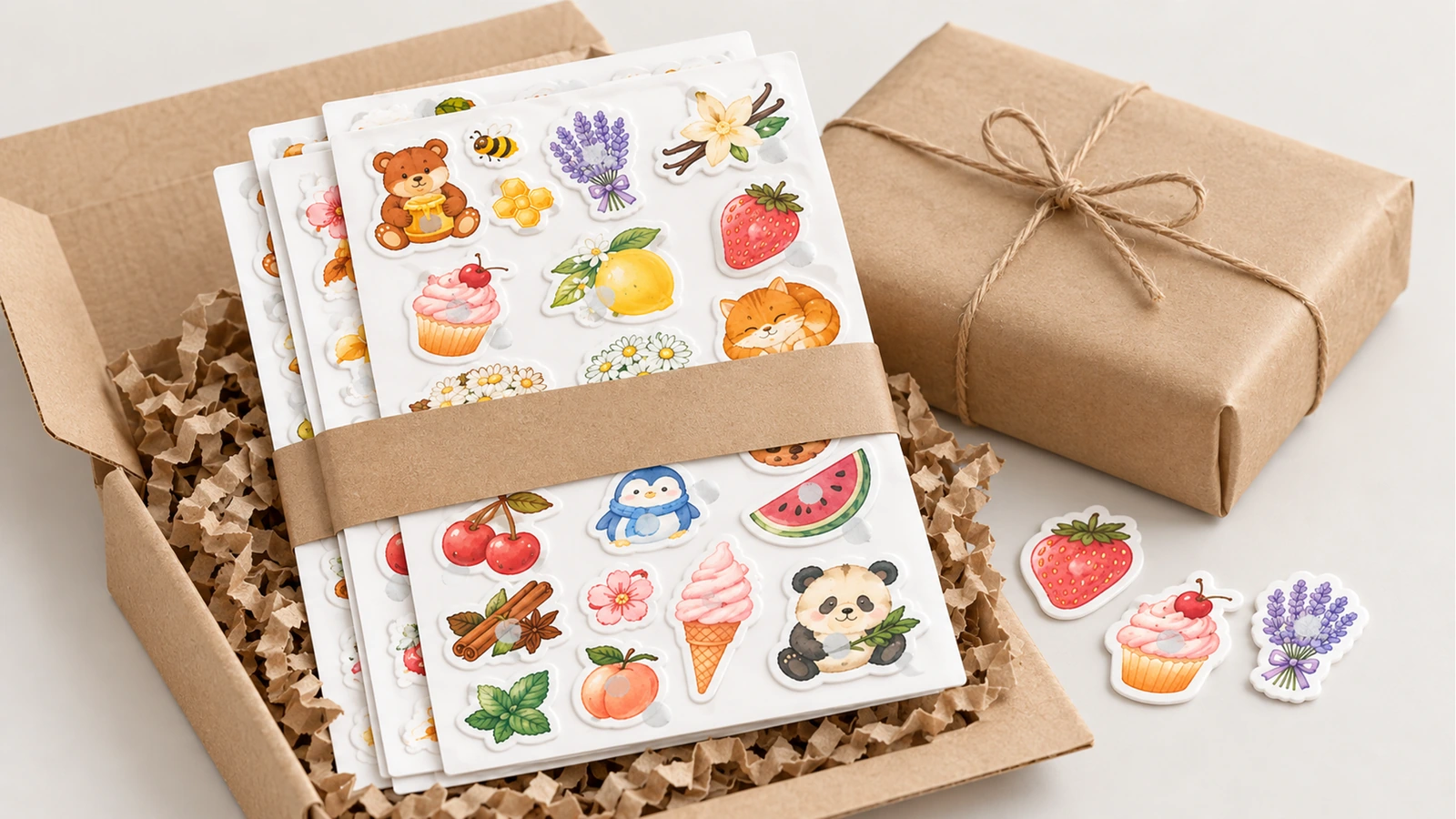
Each scent is packed with sheets facing each other and sealed in its own bag, kept away from heat and from goods with strong odors. Cartons are labeled with the scent name, how to activate the sticker, a "not food" warning and a recommended use-by window. For reorders, we work from the signed sample and the recorded fragrance batch. If the fragrance supplier changes the batch, you re-approve the scent before production.
Which Scent Printing Option Fits Your Project and Budget? ↑
| Option | How the scent works | Public price or minimum reference | Best fit |
|---|
| Custom microencapsulated sticker (this page) | Capsule coating on your artwork; your own or a stock scent | Quoted after brief and sample | Brand packaging, retail sampling, events |
| Promotional sticker, stock-scent menu | Capsule coating; scent chosen from a list | $0.71 at 1,000+, $0.56 at 5,000+ (Grandstand) | Logo merchandise with a listed scent |
| Screen-printed scent sheets | Capsule coating, 100% solid areas | About 1–2 weeks after ink and plates (H&H) | Posters, tickets, covers |
| Stock classroom reward packs | Fixed scents and designs | 75 for $9.99 (SmileMakers) | Teacher and clinic rewards |
| Plain custom vinyl stickers | No scent | No minimum, about $0.10 each (StickerYou[18]) | Artwork-only giveaways |
| DIY oil-dabbed labels | Unencapsulated essential oil | Scent can fade within days (Home to Sight[19]) | Crafts and experiments only |
Prices for "scented stickers" differ by an order of magnitude because the rows above are different products, not competing quotes for the same item. If you need only artwork, a plain sticker printer is cheaper. If you need rewards with no logo, a stock pack is the better buy. A custom encapsulated order makes sense when the scent itself has to carry your brand.
Several things drive cost: fragrance bought by weight, the number of scent plates, the size of the scent zone, and die-cut complexity. Accio reports that standard minimums of 1,000–5,000 units are common for stock designs, and that fully custom scents may require 10,000+ (Accio[15]). Treat these as market reference points, not as our terms. Your minimum and unit price are stated on the quotation.
Compliance depends on how each sticker is positioned and sold, so it is assessed per SKU. If a sticker is sold as a toy for children under 14, CPSC guidance[20] makes ASTM F963 mandatory and requires third-party testing and a Children's Product Certificate. The current 16 C.F.R. Part 1250[21] references ASTM F963-23. Promotional labels sold to adults may fall outside the toy definition. For the fragrance itself, the IFRA Standards 51st Amendment[22], introduced in 2022, is a voluntary industry benchmark and not a CPSC certification. For the EU, Regulation (EU) 2023/2055[23] restricts synthetic polymer microparticles; capsules used for fragrance encapsulation have a transition period that ends on 17 October 2029. We request supplier declarations for your target market. No certification is claimed on this page.
Key Takeaways Before You Request a Quote ↑
- The product is defined by encapsulation, not sprayed perfume. — capsules of roughly 10–40 µm (Source)
- Scratch count depends on the size of the scent zone. — about 10–20 scratches for a zone about 1 in. across (Source)
- Shelf-life claims vary widely between suppliers. — 12–24 months (Source) versus 3–6 months (Source)
- Small runs cost more because fragrance is bought by weight. — about 1 kg covers roughly 5,000 A5 labels (Source)
- Market minimums rise when the scent is custom. — 1,000–5,000 units for stock designs; 10,000+ for custom scents (Source)
- Selling the sticker as a children's toy triggers mandatory testing. — ASTM F963-23 under 16 C.F.R. Part 1250 (Source)
Ready to Scope Your Custom Scent Sticker? ↑
A scented sticker works when every claim on it can be checked on a sample. That means a true encapsulated coating, a solid scent zone with no laminate over it, a blind-tested sample, and inspection against that signed sample. We quote minimums, lead time and price only after reviewing your brief, because fragrance choice and scent-zone size change all three. Send your artwork, target scent, quantity and delivery date to request a quotation and a paid physical sample.




The information below is required for social login
Sign In
Create New Account