Custom scratch-off overlay stickers are pressure-sensitive labels with an opaque coating that you remove with a coin. You apply them over printed or handwritten content. They work well for promotions, classroom rewards, and event reveals. They are not tamper-evident PIN seals. Before a full run, approve opacity, scratchability, adhesion, and odor on your own card stock.
Who Orders Custom Scratch-Off Overlays, and What Does Each Buyer Need? ↑
Three buyer groups place most overlay orders, and each one judges success differently.
Teachers and school staff want a reward they can write, cover, and hand out the same day. One teacher mailed reveal cards to students before the school year and later wrote that parents sent back "videos of them scratching it. Best idea ever." (teacher review on Teachers Pay Teachers[1]).
Event planners and families use overlays for gender reveals, bridal-shower games, and holiday gift-card draws. In these settings, a single failed reveal happens in front of the whole room, so reliability matters more than unit price.
Small brands and retailers treat the overlay as a way to get customers to respond. A promotional printer sums up the logic: "A coupon code in an email gets skipped. A scratch-off card in the bag or the shipping box gets opened." (retail use-case guidance[2]). For this group, the specification grows to include unique codes, prize tiers, expiry dates, and redemption terms. The brand writes those terms and keeps them compliant. A sticker supplier does not supply sweepstakes wording or lottery licensing.
A fourth group needs a different product: gift card, prepaid, and telecom programs that hide PINs. Their labels must show visible damage when someone lifts them, and a standard overlay is not built to do that. The buying guide below marks that boundary so you do not order the wrong tier.
Why Do Cheap Overlays Ruin the Reveal, and How Does a Custom Spec Fix It? ↑
The problem. Most failures come down to one of two things. The coating either shows what it should hide, or it will not come off. My Scratch Offs describes low-quality stickers as "too translucent (ruining the surprise) or too hard to scratch off (ruining the fun)" (My Scratch Offs sticker guide[3]). Buyer reviews confirm both failure modes.
Why it gets worse on the day.
Adhesion can fail under real use. One buyer's first test worked, but during the actual event the "stickers come off when scratching" (holographic sticker review[4]). When the whole label lifts, the reveal goes with it.
Odor and transit damage show up on arrival. Another buyer said the stickers "smell like uncured automotive paint," warned "Don't give the extras to kids," and found coating rubbed off inside the packaging pouch (gold round sticker review[5]). A print-quality review site traces most on-arrival scratches to finishing, handling, and packaging friction, not to the printing itself (Print Reviewer analysis[6]).
The stakes rise when the hidden content has cash value. If it is a PIN or a redeemable code, the FTC warns that scammers "remove the protective stickers from gift cards or even scratch off the back" to steal card numbers and PINs (FTC consumer alert[7]).
The solution. A custom order replaces vague expectations with a written spec. The spec covers:
- the use tier (promotional or PIN-level)
- the exact stock the stickers will go on
- the coverage margin around the hidden content
- four release checks: opacity, scratchability, adhesion, and odor, each approved on a physical sample before production
This page does not claim any tested performance figure for this SKU. Every pass/fail value is set and confirmed at the proofing stage.
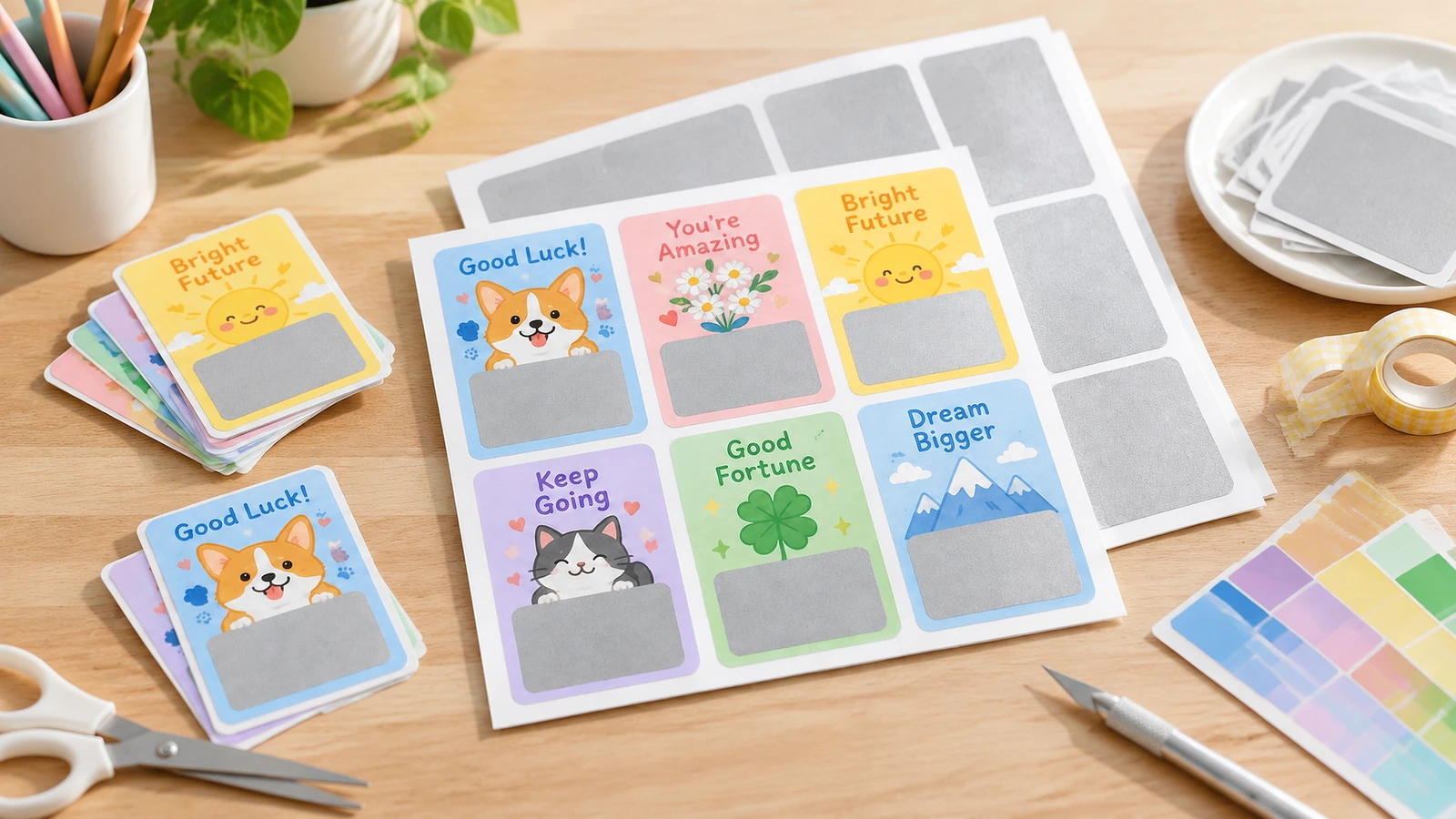
Table of Contents
What Is a Scratch-Off Overlay Sticker, Technically? ↑
The technique is industrial, not a novelty. A Scientific Games patent granted by the European Patent Office notes that hiding information under a scratch-off coating is used for "commercial contests, telephone card account numbers, gift cards," and that "billions of scratch-off products" are printed every year to confirm items have not been used or modified (EP 2 699 324 B1[8]).
An overlay sticker brings that technique to a peel-and-stick label. It has four layers: a release liner, an adhesive, a thin clear film, and an opaque removable coating on top. You print or write the hidden content first, then press the sticker over it, and the recipient scratches the coating off with a coin. One brand's listing describes "a film between the 'scratch-off layer' and your paper so your contents are protected" (ScratchStix listing[9]). A reviewer of the same product noted that the strips sit flush with the paper and that the flakes "brush right off."
An overlay is different from a printed scratch card. My Scratch Offs explains that stickers are "designed to be applied on top of something else," while cards arrive with the scratch panel already built in. For small quantities, stickers are often cheaper because you print your own base (stickers vs. cards comparison[10]). With an overlay, you keep full control of the artwork and the sticker only adds the reveal layer.
The coating formulation decides how opaque the sticker is and how it feels to scratch. A packaging supplier describes the coating as a film-forming resin plus high-hiding pigment and filler. It offers these experience-based starting points (HXMPACK material guidance[11]):
- Coating thickness: about 30–40 μm for easy-scratch promotional coats
- Pigment coverage: about 30 g/m² or more
- Peel force: about 5–10 N/25 mm. Too strong lifts the print underneath; too weak lets the label open in transit.
These are vendor guidance values, not ISO limits. They must be validated by proofing on your own stock. A UK printer adds a caution: self-adhesive scratch labels "do not provide the same level of tamper resistance as screen-printed latex coatings" (Inprint Group panel guide[12]).
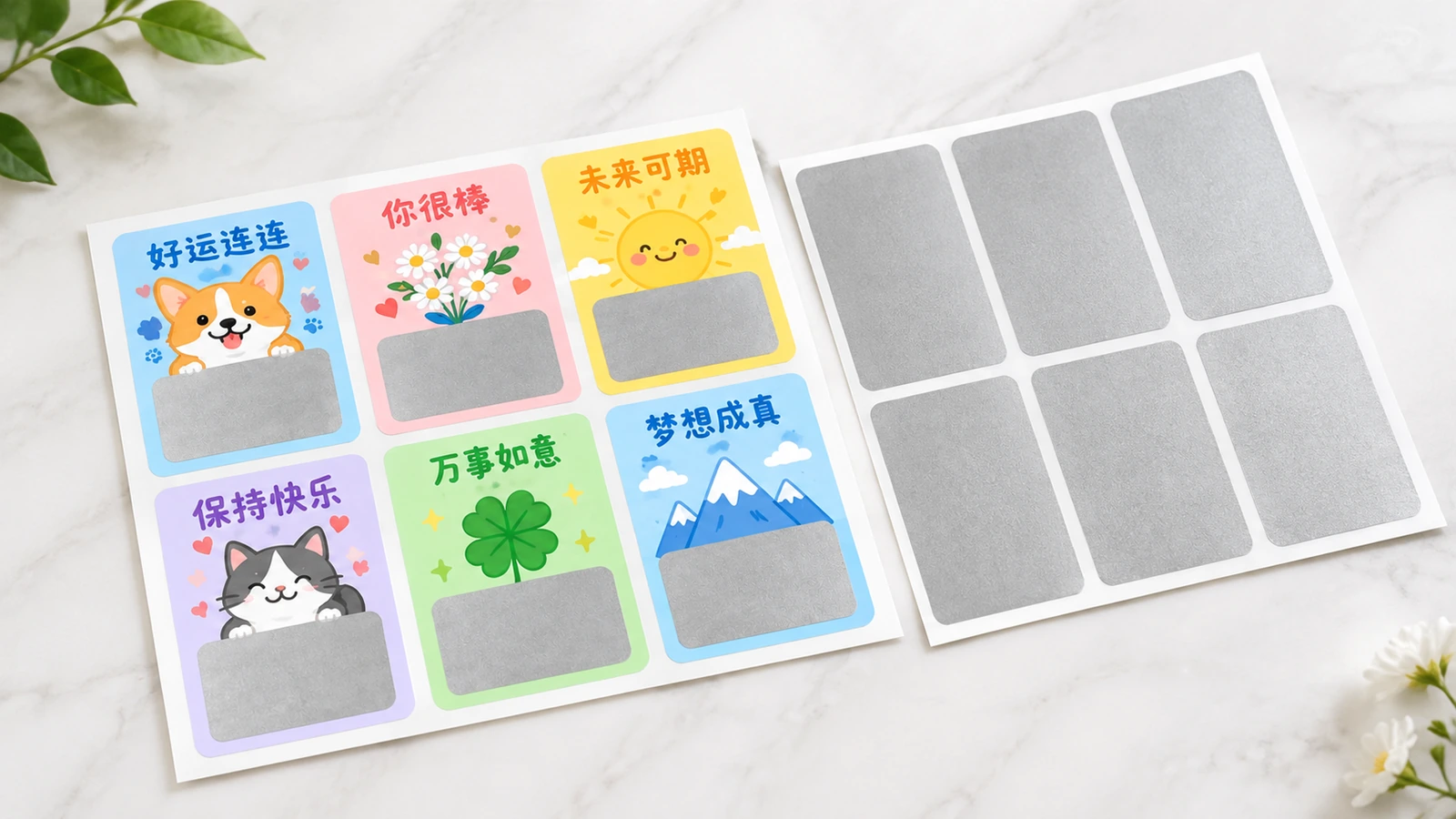
| Common size | Shape | Typical hidden content | Typical use |
|---|
| 0.50 in | Round | Short number, small prize word | Classroom tokens, mini raffle tickets |
| 1–1.25 in | Round or square | Discount code, short phrase | Promotions, wedding cards, gender reveals |
| 1.5 in | Square or heart | Longer message, prize line | Party and mailed DIY cards |
| 8.5 × 11 in | Uncut sheet | Any trimmed area | Game boards, custom shapes |
These sizes reflect common retail stock. A custom die line can follow your own layout instead. Whatever size you choose, the overlay must cover every character with a visible margin on all sides, because an exposed edge leaks digits. Narrow strips work only if the content is written small and the sticker is lined up carefully. Final dimensions, shape, and count per sheet are confirmed on the quote and the approved proof.
How to Specify, Apply, and Verify Your Custom Order ↑
The six steps below follow the order in which mistakes become expensive. Settle each one before moving to the next.
Step 1: Choose the right tier before anything else
Ask what someone would gain by reading the hidden content early.
A promotional overlay is the right choice when the hidden value is a party clue, a classroom reward, or a promotional code that you control through your own redemption system. These codes can be voided, limited, or tracked on your side.
A security structure is the right choice when the hidden value is a gift card PIN, an activation code, or a warranty code that someone could profit from by reading it early. Overlays and security labels are bought, tested, and approved differently, and mixing the two up is the most costly error in this category.
Step 2: Match the stock and surface
Adhesion and scratch behavior depend on the surface underneath the sticker.
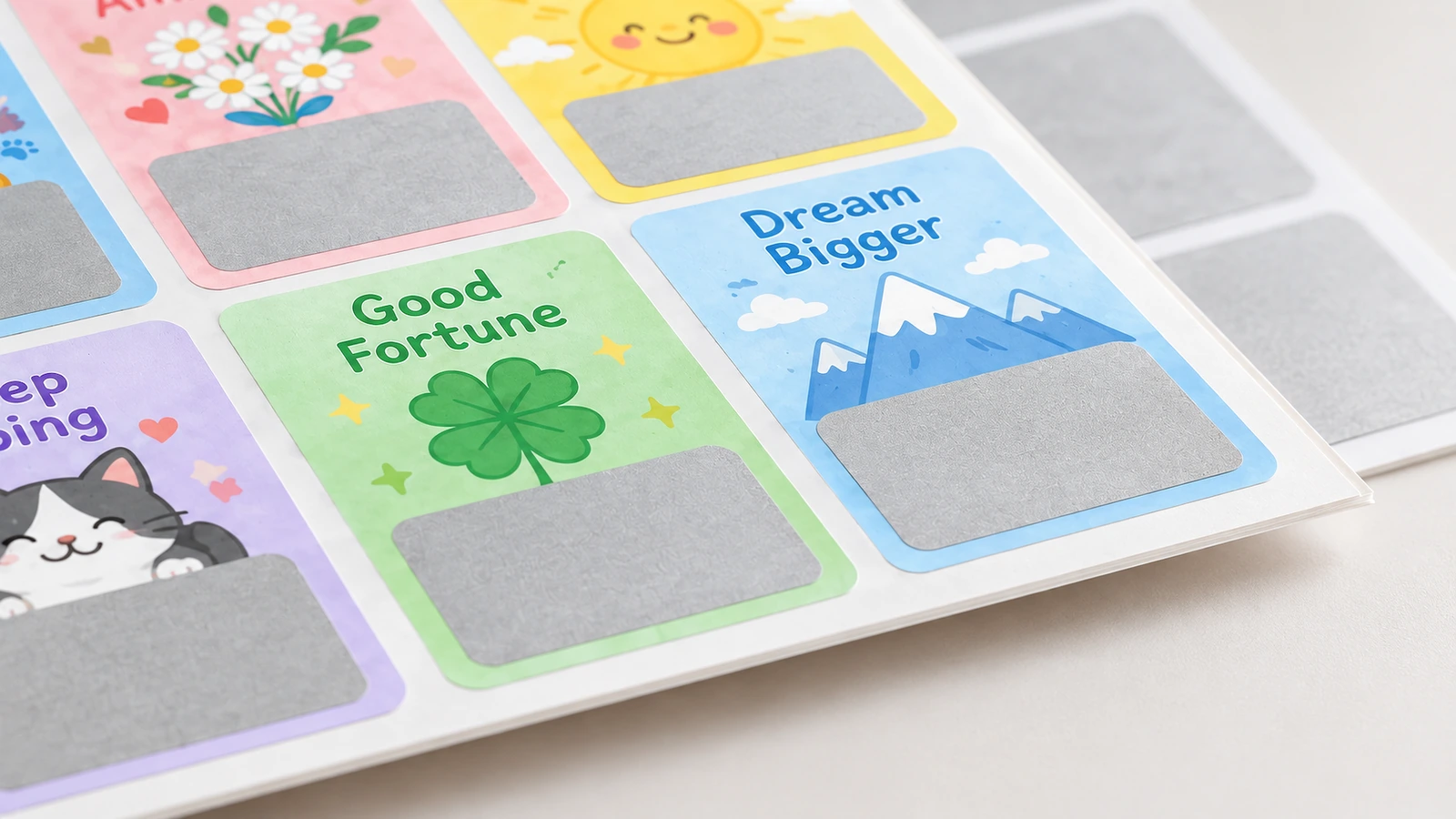
Paper. My Scratch Offs recommends smooth, heavyweight cardstock (80–100 lb). It warns that highly textured or porous paper may not seal completely and "might tear when scratched."
Plastic. The supplier guidance cited above calls for corona treatment to a surface tension of at least 38 dyn/cm and a cross-hatch adhesion target of 4B or better. If the coating feels too tacky, it suggests an optional 5–10 μm silicone release layer.
Finish. Silver, gold, and holographic finishes change how the sticker looks. In this product, holographic is decorative. It only adds security when the program specifically calls for a security foil.
Send a physical sample of your actual stock so adhesion can be tested on it. A spec sheet alone does not show how a particular coating behaves on that surface.
Step 3: Preflight the artwork under the panel
Hidden text can show through even a well-made coating. A print finisher explains that the content under the scratch area should be "a low-contrast solid area, i.e. a dark grey text in a light grey solid area." Otherwise, raised laser toner or UV ink can make the content "discreetly recognisable" before anyone scratches it. The same source recommends sealing paper before applying the scratch layer (SIMSA scratch-off printing notes[13]).
For handwritten content, pressure marks are the main risk. One brand's listing advises using markers or gel pens rather than ballpoints, because ballpoint indentations can show through the sticker surface (My Scratch Offs listing[14]).
Home printers drift out of register. Avoid a "print at home, then stick by hand" workflow for any code that has cash value.
Step 4: Approve the proof, then produce and apply
Supplier side. Production follows the approved proof: coating, die-cutting to your shape, and finishing into sheets or rolls. Format, quantity breaks, and lead time are stated in your written quote. This page lists none, because no verified production data has been supplied for this SKU.
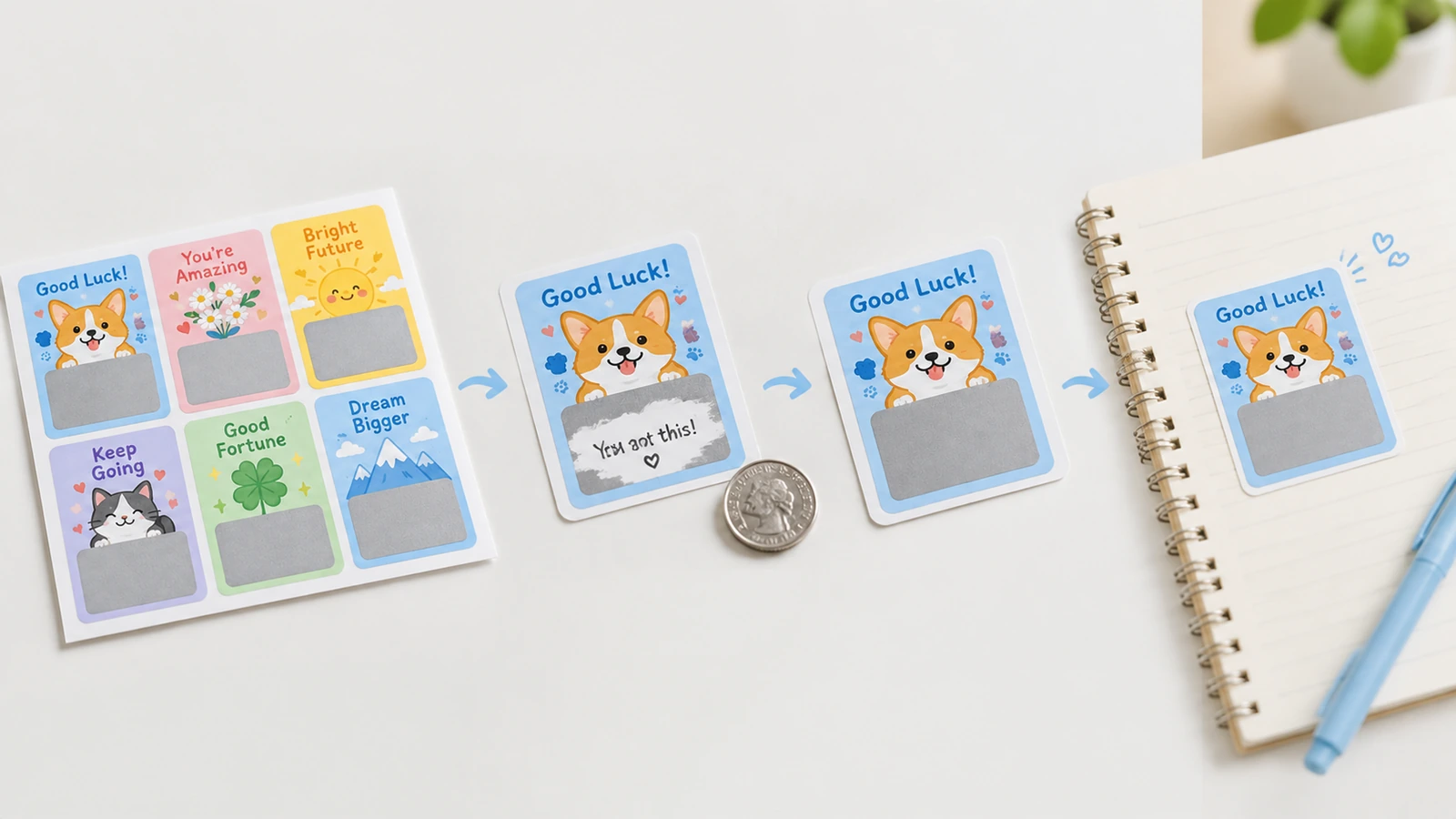
Your side. Apply the stickers to clean, dry, fully cured print and press them down firmly. Then give the adhesive time to set before anyone scratches or mails the cards. One maker asks buyers to allow 48 hours for the adhesive to fully cure (2-inch square product page[15]).
Recipients' side. Tell recipients to use a coin or a scratcher tool. A retail listing states the coating "scratches off cleanly using a coin or scratcher tool only" and that "fingernail scratching is not recommended" (1.25-inch round listing[16]). The brand also warns that knives and keys can slice through the paper underneath.
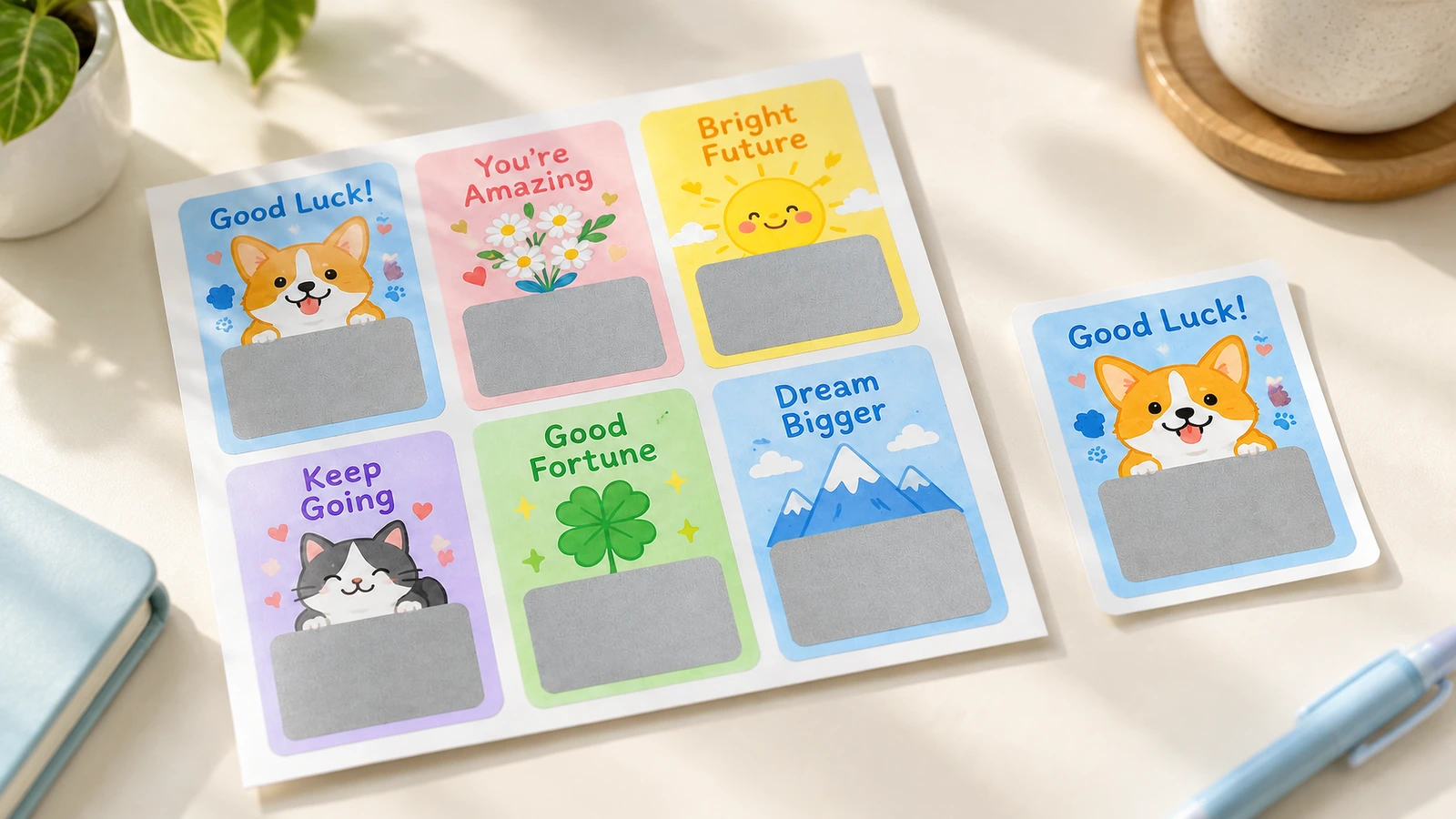
Step 5: Run release checks on every new batch
| Check | Method | Pass condition | Action on fail |
|---|
| Opacity | Read the content under room light, raking light, and phone flash | No character or QR code readable | Reject the batch; review pigment coverage |
| Scratchability | Coin or fingernail, 2–4 passes on the target stock | Panel clears; paper intact; label stays down | Adjust coating hardness or adhesive |
| Adhesion | Scratch the edges and center after curing | No corner lift or full-label peel | Change the adhesive or the stock |
| Odor and transfer | Open a sealed pack; rub the coating with a dry finger | No strong solvent smell; no staining | Quarantine from children's kits |
| Transit wear | Inspect sampled sheets on arrival | No scratch crossing a panel | Isolate the pack; review packing |
These checks combine published process guidance with failure modes that buyers have reported. The exact pass thresholds are written into your proof approval. Run the checks on every new batch and every coating change, using a defined sampling plan.
Use extra caution for children's projects. One published study found lead in scratch-off coatings on prepaid cards and reported health-risk indices above the authors' threshold under conservative ingestion scenarios (heavy-metal coating study[17]). That study did not test this SKU. For any project involving children or possible mouth contact, request a batch-level declaration on heavy metals and solvents. If the product is marketed as a toy, the applicable toy-safety requirements, such as ASTM F963, also apply.
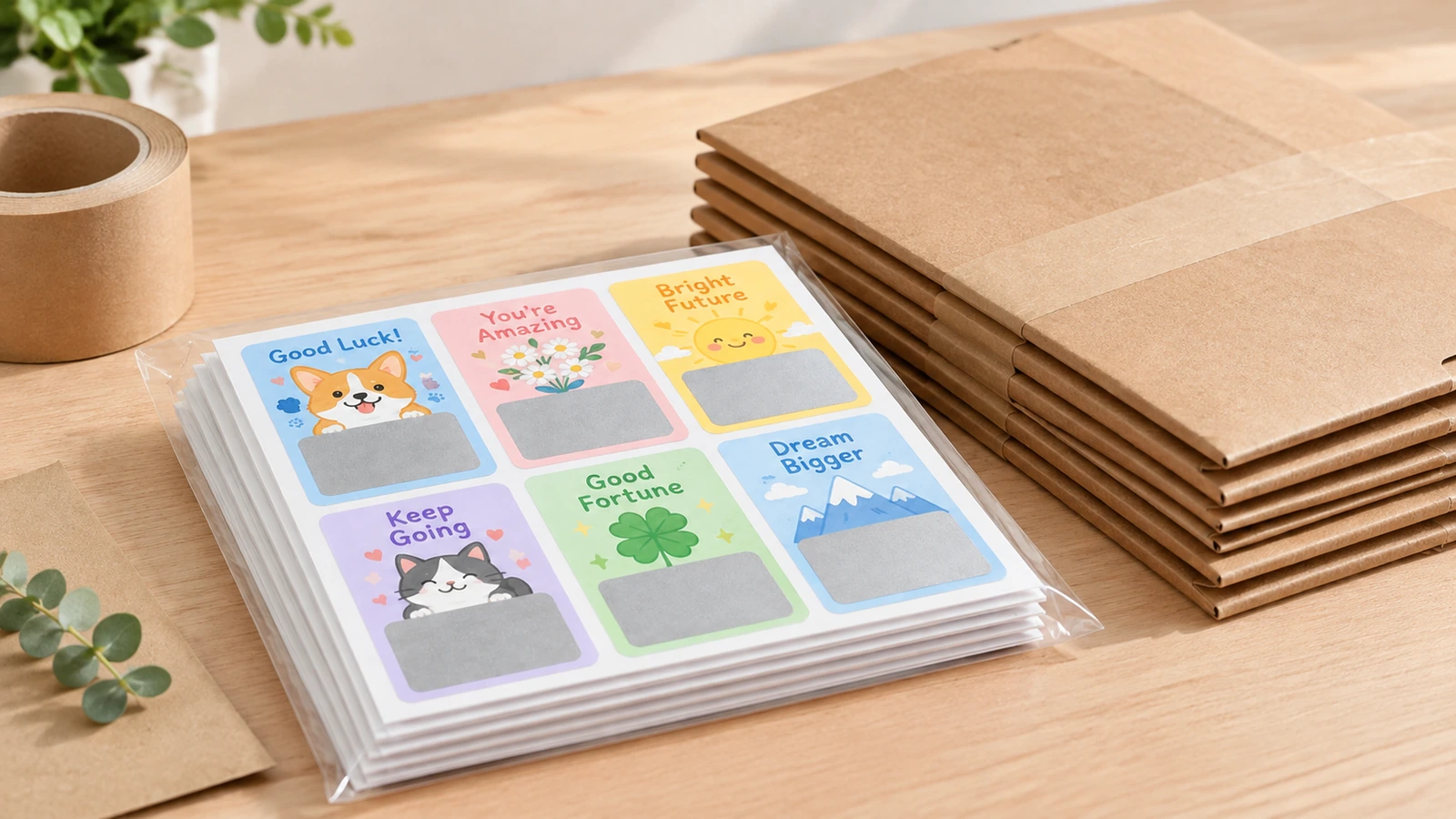
Step 6: Pack, ship, and reorder against a retained sample
Most pre-scuffed coatings come from friction, pressure, and debris during handling. To prevent this, specify the following packing rules:
- Never let a coated face touch an exposed adhesive surface or rough corrugated board.
- Interleave sheets with smooth separator paper.
- Ship large sheets flat, never folded.
- Avoid crushing loads on the cartons.
Quality can also vary between batches. A repeat buyer wrote, "I think I got a bad batch tho was a line going thru most of them," after a first order that had no issues. To guard against this, keep a signed sample from your first approved run. Reference that sample on every reorder, and repeat the opacity and scratch checks before the stickers reach students, guests, or customers.
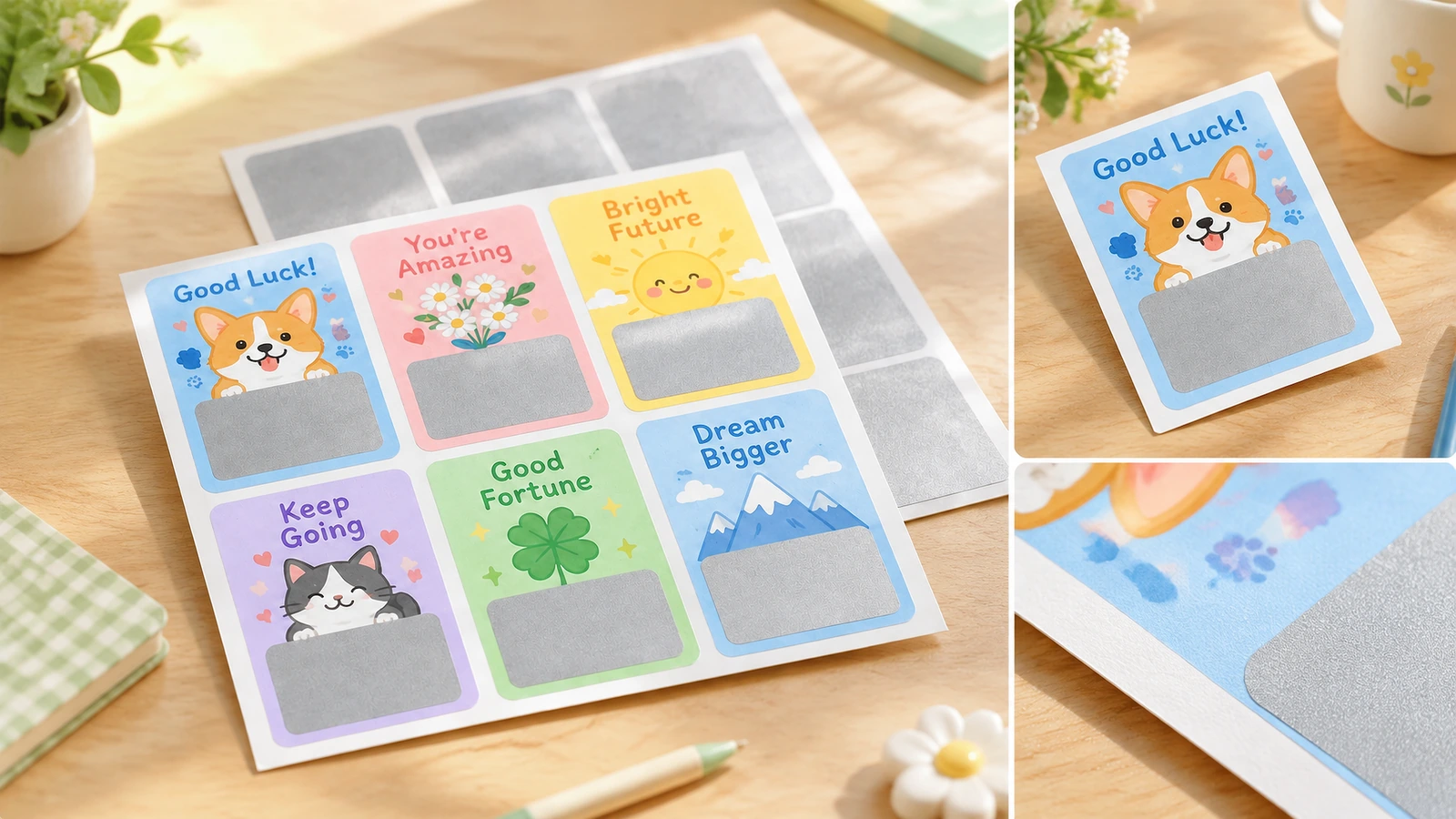
Which Format Fits: Overlay Stickers, Printed Cards, or Security Labels? ↑
| Format | Best fit | Tamper evidence | Main trade-off |
|---|
| Stock overlay packs | One-off parties, small classroom sets | None; can be lifted | Batch consistency is hard to verify |
| Custom overlay stickers | Branded promos, mailers, and reward programs on your own print | Low; not a seal | Requires proofing and acceptance testing |
| Printed scratch-off cards | Ready-to-distribute campaigns | Low to moderate | Higher entry cost; longer artwork cycle |
| Security scratch-off labels | PINs, activation codes, warranty codes | Designed to show lifting | Higher cost; sensitive to substrate and storage |
Choose custom overlays when you already have printed pieces and want consistent opacity and adhesion across a branded run.
Choose printed cards when you want items ready to hand out with no assembly. My Scratch Offs lists custom cards starting at about 100 pieces, with roughly 14 working days of standard production after proof approval (custom card packages[18]).
Choose security labels for codes that carry value. One security-label supplier describes slits and destructible films that make "any attempt to lift, peel, or re-apply the label" damage the scratch-off area (security scratch-off labels[19]).
Regulation also points toward keeping these tiers separate. NCSL reports that at least 22 states introduced more than 30 gift card scam bills in the 2025 session, up from 8 states and 12 bills in 2024. Enacted criminal provisions include Arkansas, Florida, Iowa, Kentucky, New Hampshire, and Texas (NCSL legislation tracker[20]). Digimarc reports that gift card fraud reported to the FTC reached $199 million in the first nine months of 2025, up 25% from $158 million in the same period of 2024. It adds that "the protective scratch-off labels covering redemption codes and PINs can be easily removed and replaced" (Digimarc investor supplement[21]). For anything worth stealing, a promotional overlay is the wrong tool.
If you resell sticker packs at retail, federal labeling basics apply. NIST explains that the Fair Packaging and Labeling Act requires a declaration of identity, a declaration of responsibility, and a net quantity statement. It also notes that the Uniform Packaging and Labeling Regulation has been adopted in 45 of the 50 states (NIST packaging FAQ[22]).
| RFQ field | What to send | What the quote confirms |
|---|
| Use tier | Promotional or PIN-level | Whether an overlay or a security structure fits |
| Shape and size | Die line or dimensions in inches | Final die and coverage margin |
| Finish | Silver, gold, or holographic | Proof color and opacity result |
| Substrate | Physical sample of your stock | Adhesion and scratch test outcome |
| Quantity | Per design and total | Price breaks and MOQ |
| Format | Sheets or rolls; hand or machine application | Lead time and packing method |
| Audience | Children, mail, or retail | Declarations and labeling needed |
A complete RFQ shortens the proof cycle. MOQ, unit price, and lead time are stated only in the written quote, after the substrate test, so the numbers reflect your actual material and not a catalog assumption.
Key Takeaways for Buyers ↑
- Holographic scratch-off labels are a growing adjacent market, not the overlay market itself — USD 542.18 million in 2025, 7.32% CAGR through 2032 (Source)
- Gift card tampering is now a state legislative priority — at least 22 states and 30+ bills in 2025 (Source)
- Reported gift card fraud keeps rising, so PIN codes need security labels — $199 million in the first nine months of 2025, up 25% (Source)
- Retail-resold sticker packs follow federal labeling basics — UPLR adopted in 45 of 50 states (Source)
- Stock choice drives scratch success — smooth 80–100 lb cardstock recommended (Source)
- Allow cure time before scratching or mailing — 48 hours per one maker's guidance (Source)
Turn Your Reveal into a Verified Spec ↑
A scratch-off reveal works when the coating hides the content completely, comes off cleanly with a coin, and keeps the label on the card throughout. Custom scratch-off overlay stickers give you that control for promotions, classroom rewards, and event cards, as long as the spec is proven on your own stock and matched to the right security tier. Send your artwork, a stock sample, quantities, and intended use to request a physical proof and a written quote.




The information below is required for social login
Sign In
Create New Account