Custom etched stainless steel equipment nameplates carry the rating, serial, compliance and safety data that must stay readable for the working life of a machine. To get that result, specify four things. Use 304 indoors and 316 wherever chlorides are present. Recess the mark into the metal. Use mechanical fixing on vibrating equipment. Write the acceptance tests into the purchase order before you approve the first article.
Who Specifies Equipment Nameplates, and Where Do They Have to Survive? ↑
The people who buy these plates read engineering drawings. At a machinery, switchgear, marine, food, pharmaceutical, HVAC or boiler OEM, the design or application engineer decides what the plate must say and which environment it must outlast. Procurement and supplier quality then compare vendors on four things: traceable material, drawing accuracy, consistency between sample and production, and documentation. Quality, EHS and field-service teams live with the result. The plate must still be readable during an audit, a warranty claim or a lockout years after shipment. One buyer's guide[1] describes the nameplate as "a permanent interface between the product, the end user, the field technician, and the regulator."
Typical jobs include rating plates for a new machine model, export plates that must carry CE and electrical data, serial and asset plates for offshore or coastal equipment, washdown-zone plates on food and pharmaceutical lines, and replacement plates when an older label has faded before an audit. Maintenance contractors and valve and pump distributors order the same product in smaller lots for control panels, switch boxes and valves. Decorative door signs and gift plates are a different purchase. This page covers equipment identification only.
Why Do "Permanent" Stainless Steel Plates Still Become Unreadable? ↑
Most failed nameplates are not failures of the steel. A purchase order that says only "stainless steel nameplate" lets a supplier choose the cheapest grade, the shallowest mark and the easiest mounting. Each of those choices has a known failure mode. Surface ink is the weakest link. Metal Marker[2] notes that a screen-printed steel tag can become "a (very durable) blank tag after a few months when the ink wears off."
Chlorides make the problem worse. Seawater averages roughly 35,000 ppm chlorides. Detroit Name Plate Etching[3] reports a pitting resistance equivalent number (PREN) of about 23–28 for 316 and 18–20 for 304. It warns that in spray zones, pitting on 304 tags can obscure etched serial numbers.
Vibration attacks from the back of the plate. On compressors and rotating machinery, adhesive bond lines weaken[4] until the edges lift and the plate detaches, taking the serial and safety data with it.
Grade substitution is the third risk. HXD Nameplate[5] warns that some suppliers swap low-cost 201 for 304, and that these plates can rust and fade after 1–2 years outdoors. In every case the cost goes well beyond the plate: lost traceability, disputed warranties, compliance exposure and replacement labor in the field.
The fix is to treat the nameplate as an engineered part. That means a defined alloy backed by a mill test report, a mark recessed into the metal, a mounting method matched to the vibration and chemistry it will see, and acceptance tests written into the purchase order. The rest of this page walks through that specification in the order a project actually runs.
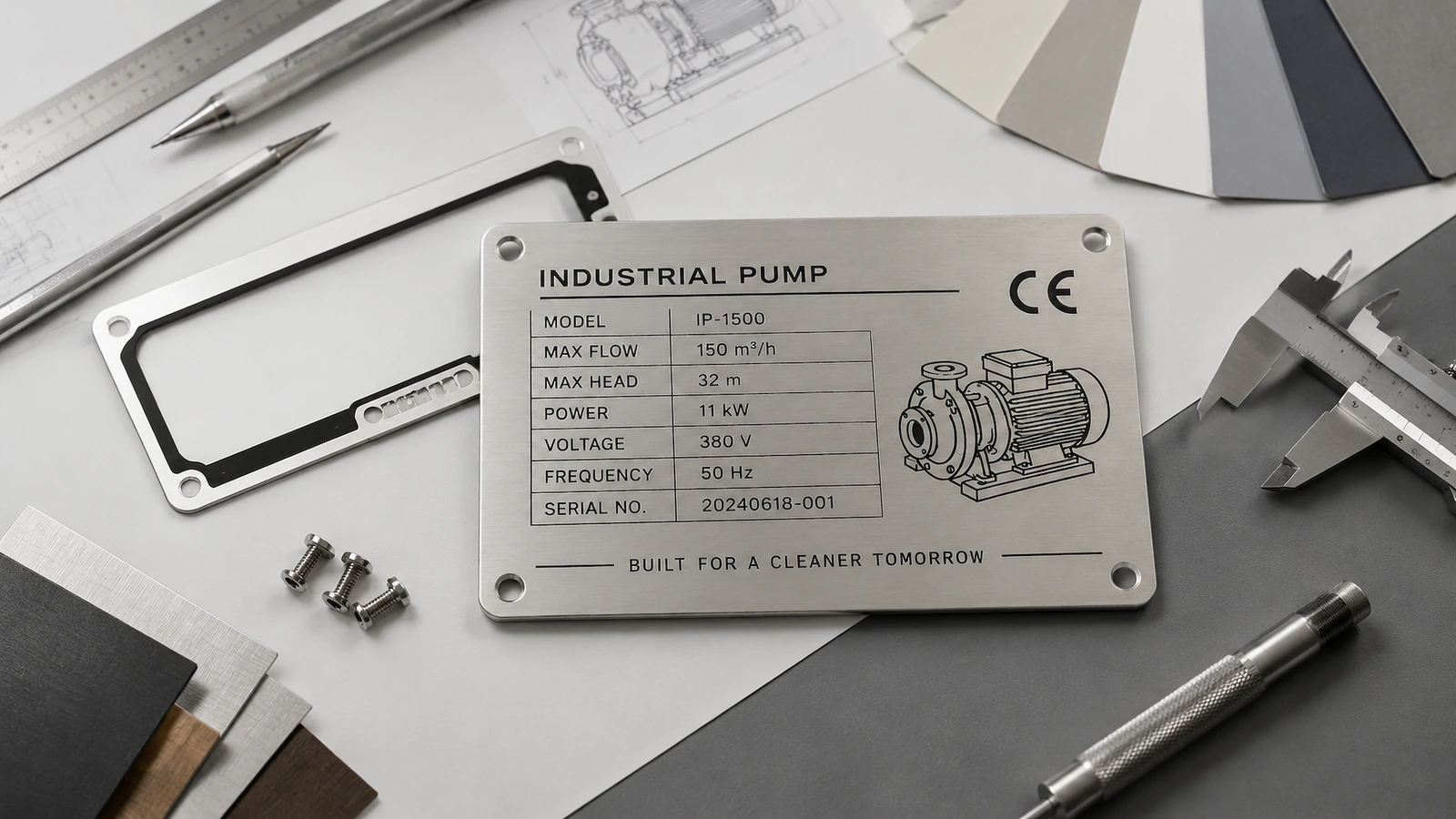
Table of Contents
What Is a Custom Etched Stainless Steel Equipment Nameplate? ↑
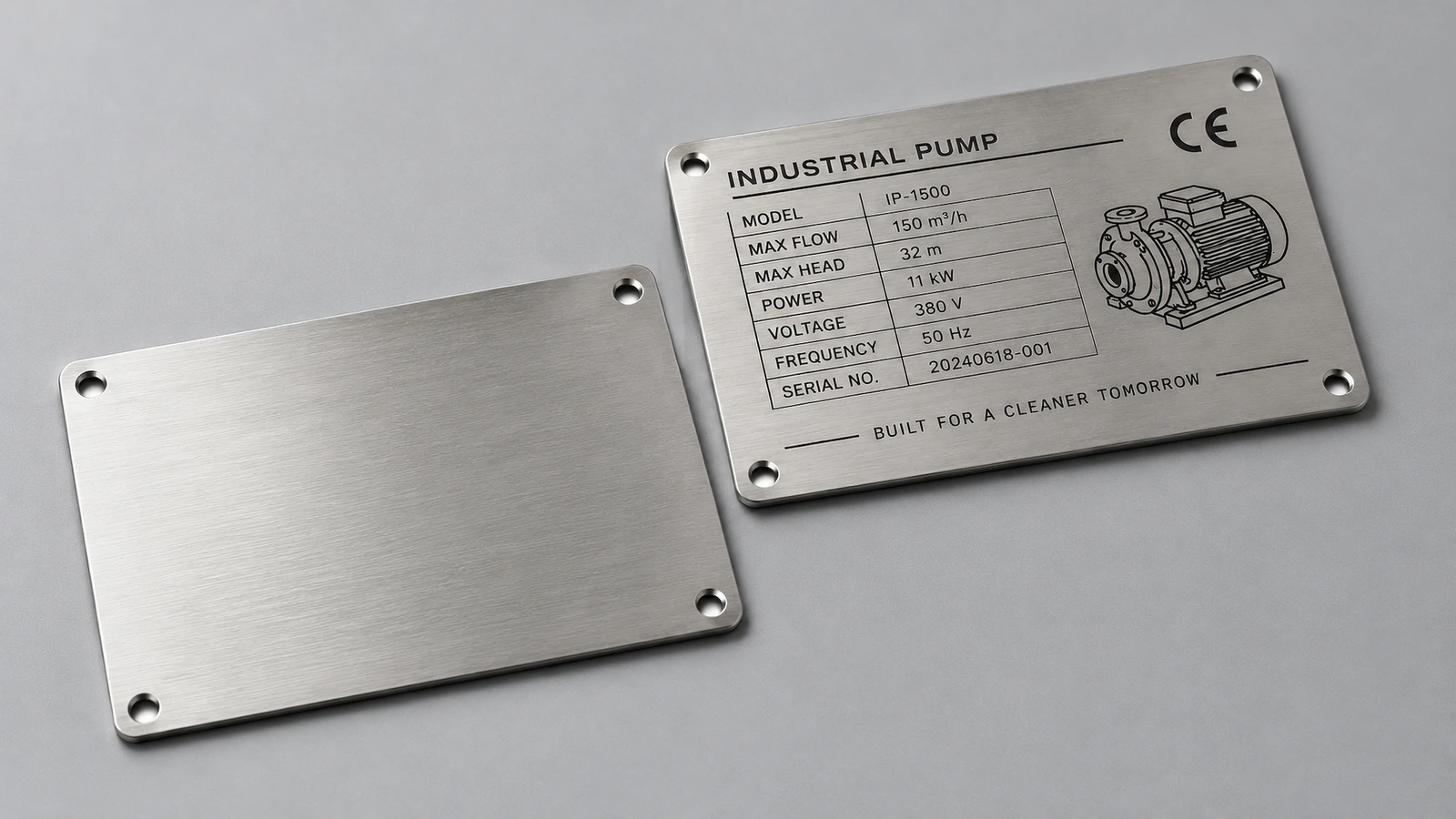
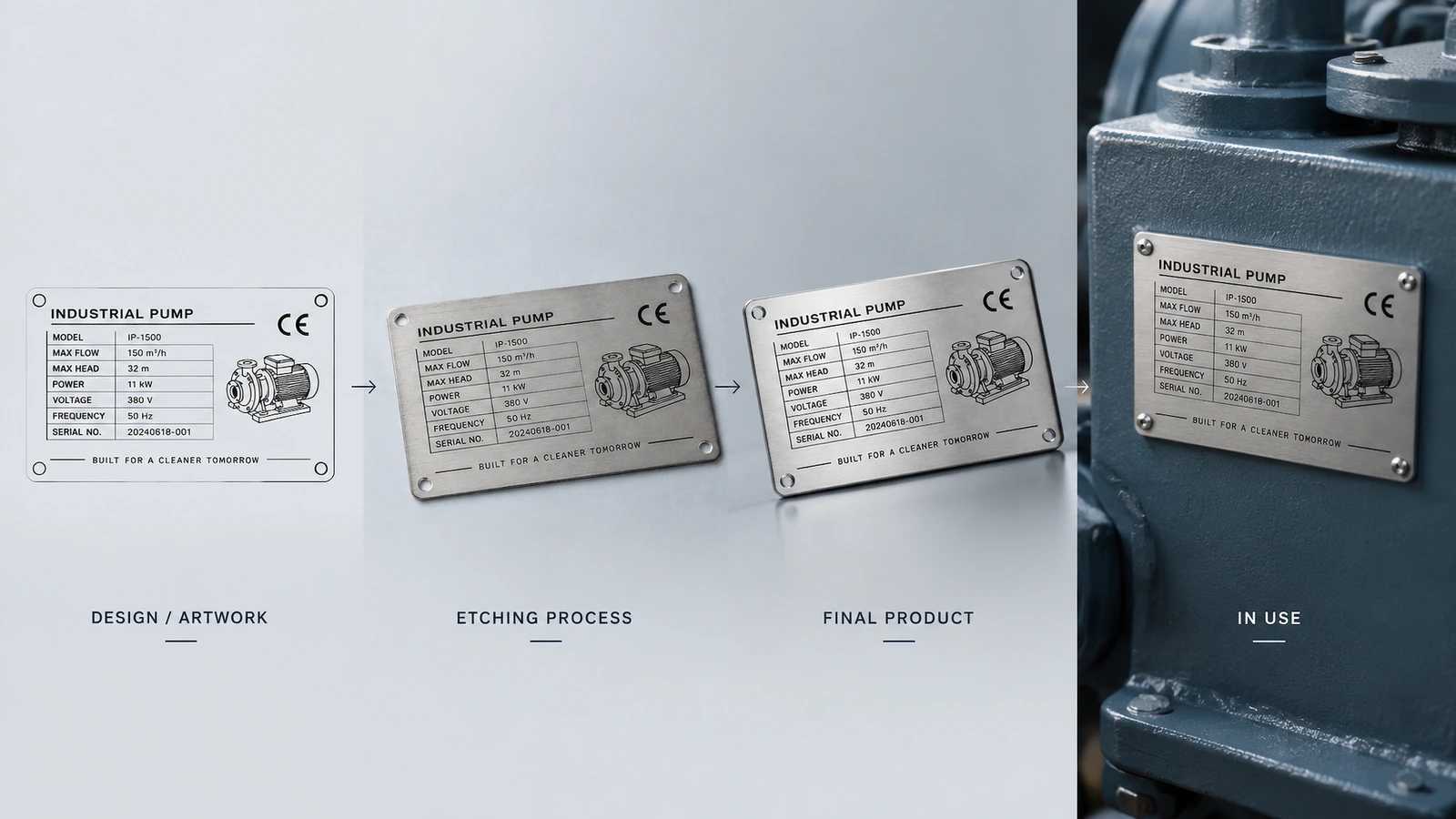
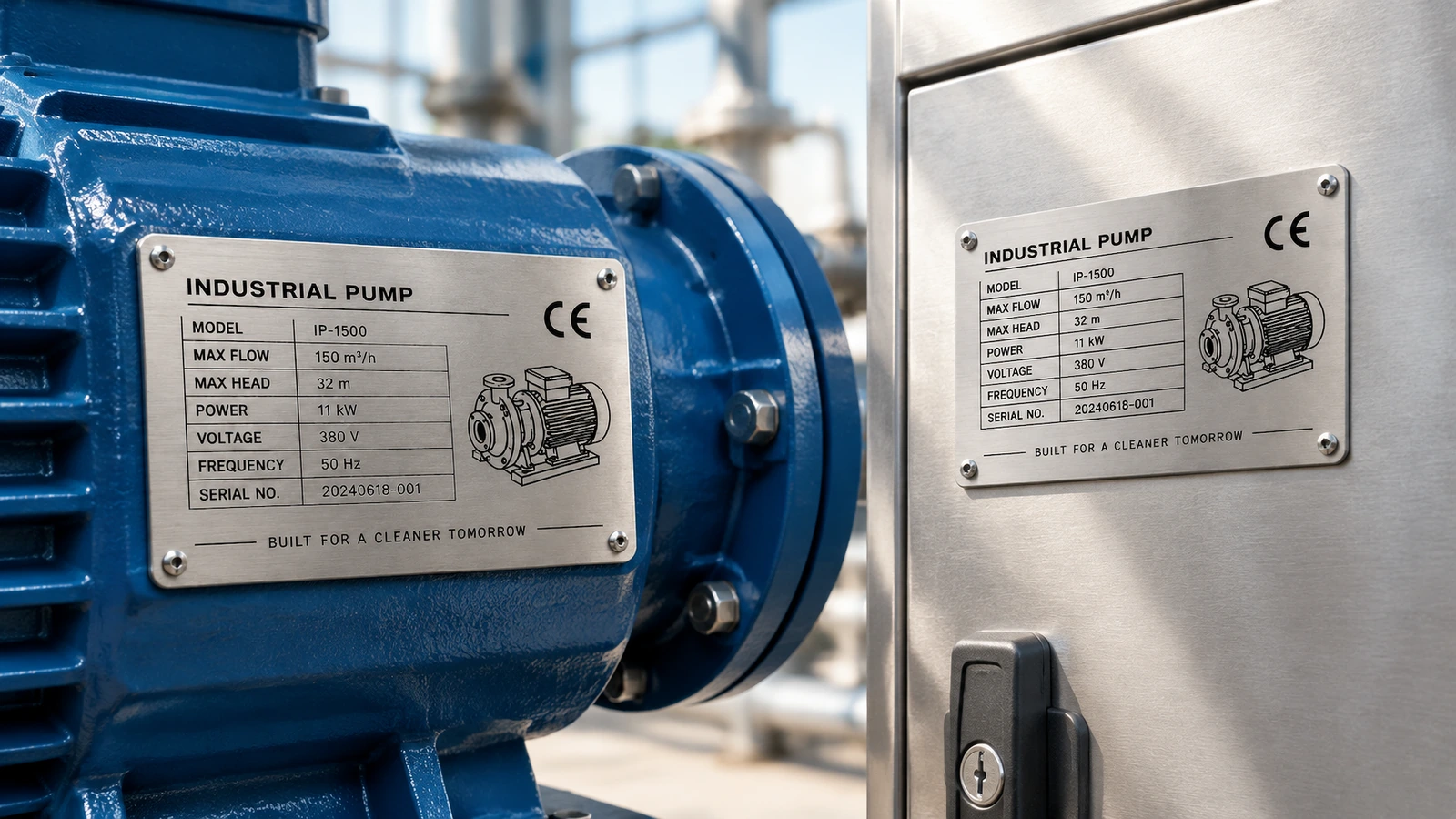
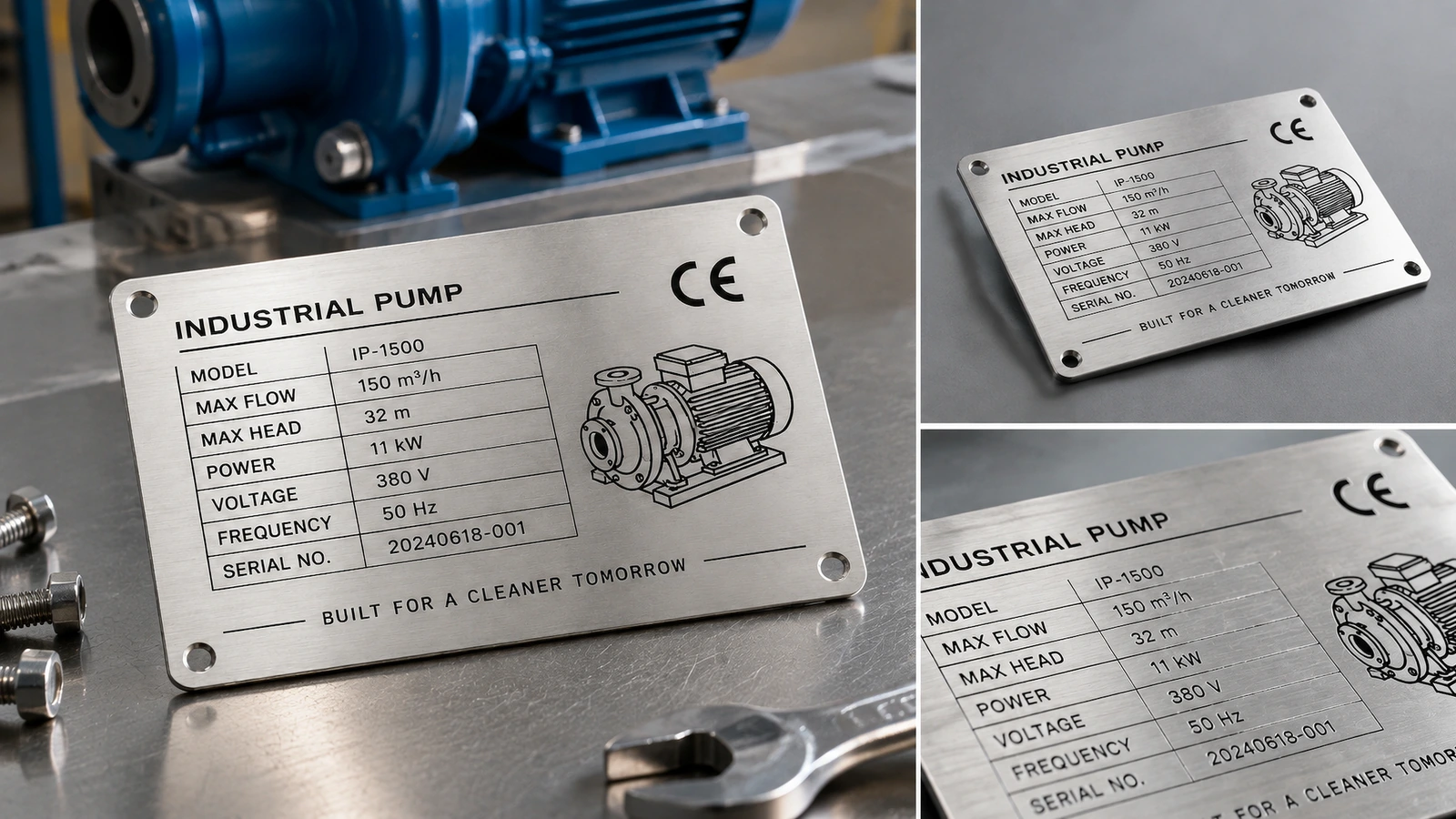
It is a plate cut from stainless sheet, with text, logos and graphics produced by photo-chemical etching. A photoresist is exposed through your artwork, the unprotected metal is dissolved, and the recesses are usually color-filled for contrast. Variable data such as serial numbers or QR and Data Matrix codes can be added by laser after etching, so one etched base design serves an entire production run.
The Etched buyer's guide[6] gives a typical etch depth of about 0.0015–0.004 in. It lists 304 and 316 stock from 0.018 to 0.125 in thick, in either a brighter #4 finish or a matte #2B finish.
Grade names should map to a published standard, not a catalog adjective. Under ASTM A240/A240M[7], Type 304 (UNS S30400) contains 18.0–20.0% chromium and 8.0–11.0% nickel. Type 316 (UNS S31600) adds 2.00–3.00% molybdenum, the element that improves chloride resistance, and Type 316L (UNS S31603) limits carbon to 0.030%.
Two boundaries matter at the quoting stage. First, do not assume a rigid etched metal plate carries a UL 969 rating; that standard mainly covers flexible label systems. Second, military specifications such as MIL-DTL-15024 and MIL-STD-130 apply only when a drawing or contract calls them out, as Specialty Nameplate[8] explains.
How Do You Specify a Nameplate That Stays Legible for the Life of the Equipment? ↑
The six steps below follow the order a real project moves in: content, material, artwork, production, inspection and delivery. Decisions made early (data fields and grade) limit the choices available later (plate size, process and mounting). Freeze each step before you move to the next.
Step 1: Freeze the data fields, size and legibility
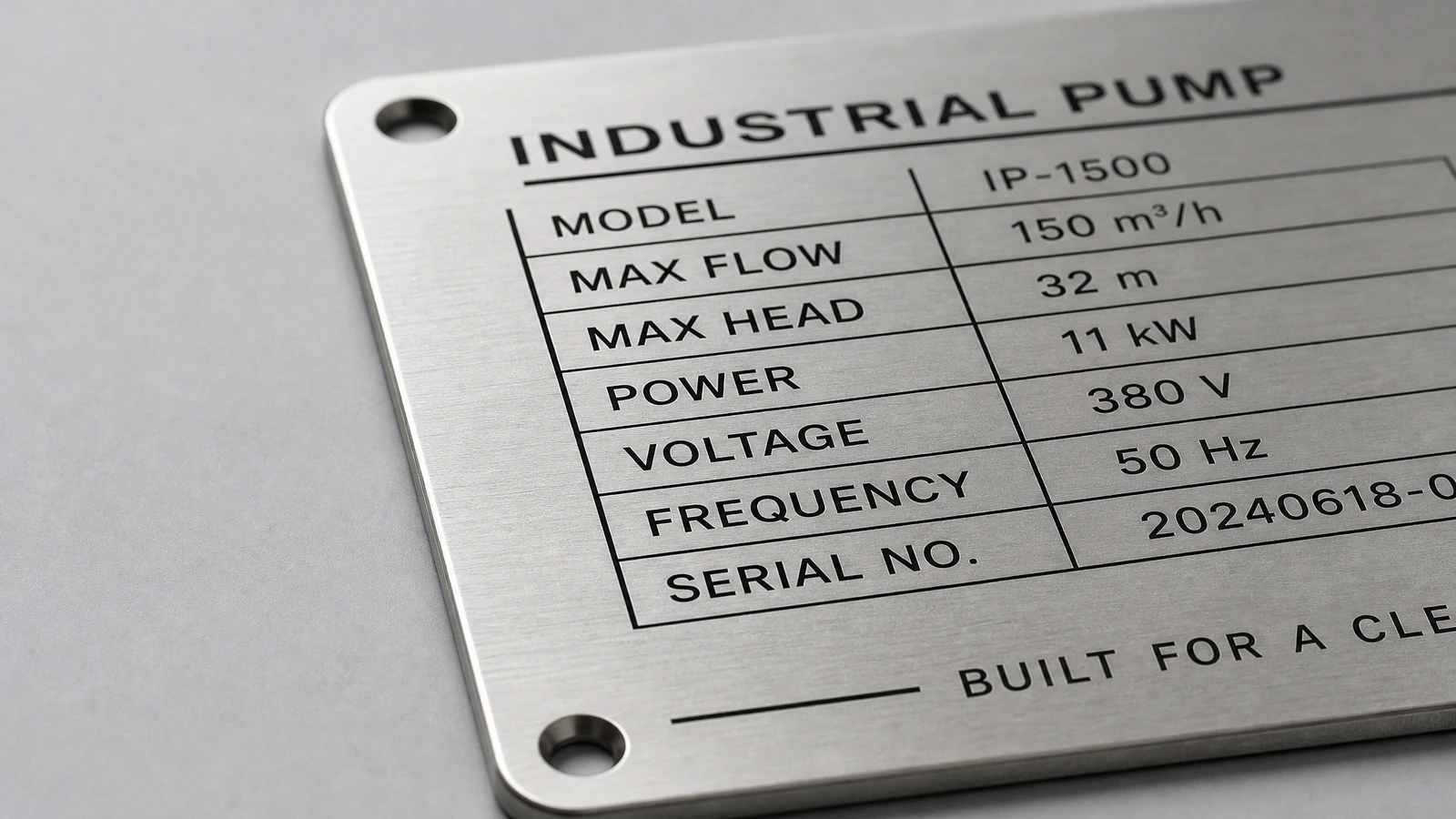
Start with what the plate must say. According to Red Safety IDs[9], NFPA 79 section 16.4.1 requires clear, durable markings on industrial machinery that remain visible after installation. NEC 670.3(A) lists supply voltage, phase, frequency, full-load current and short-circuit current rating (SCCR). CE plates typically carry a CE symbol at least 5 mm tall, plus the manufacturer, machine designation, serial number and year of construction.
Safety content follows its own format. Under OSHA 1910.145, signal words should be readable from about 5 feet[10]. ANSI Z535.4[11] sets the color coding and signal-word hierarchy, and OSHA hazard communication expects messages to stay legible under all reasonably anticipated conditions of use.
| Requirement | Fields to place on the drawing | Acceptance check |
|---|
| NEC 670.3(A) electrical data | Voltage, phase, frequency, full-load current, SCCR, overcurrent rating | Field-by-field check against the electrical drawing |
| NFPA 79 16.4.1 | All control-equipment markings | Legible at the installed position and viewing angle |
| CE machinery plate | CE mark ≥5 mm, manufacturer name and address, model, serial, year | Measure the mark height on the first article |
| OSHA 1910.145 / ANSI Z535.4 | Signal word, colors, hazard text | Readable at about 5 ft; colors per the standard |
| MIL-STD-130 (only if contracted) | Human-readable data plus a 2D Data Matrix | Code grade per ISO/IEC 15415 when the drawing requires it |
Write the minimum character height, viewing distance and viewing angle into the drawing. Treat a missing SCCR or full-load current value as a release blocker, because an incomplete electrical plate is usually caught during certification, when rework costs the most. Character size and line count also determine the plate's outline, so set the size after the data list is complete, not before.
Step 2: Lock grade, thickness, finish and mounting
Choose the grade from the operating medium, not from a simple indoor-or-outdoor split. Hallmark Nameplate[12] makes two points: the best nameplate metal depends on the operating environment, and 316 adds molybdenum for chloride resistance.
| Decision field | 304 (EN 1.4301) | 316 / 316L (EN 1.4401) |
|---|
| Typical service | Indoor, general industrial, moderate corrosion | Marine, offshore, chemical, food and medical washdown |
| Chloride exposure | Pitting risk from seawater, de-icing salt or chlorinated cleaners | Preferred, but can still stain if salt crusts are left in place |
| Relative cost | Lower | Higher; justified where failure is costly |
| Fasteners | 304 or better | 316 hardware, with dissimilar metals isolated |
| Documentation | Mill test report to ASTM A240 | Mill test report to ASTM A240; PMI on critical lots |
316 is not immune to corrosion; it adds margin. Where there is no salt, chemical exposure or washdown, 304 is usually enough, and the budget is better spent on a deeper mark or better mounting. EN 1.4301 and 1.4401 can be cross-referenced to 304 and 316, but a certificate issued under one system does not replace a certificate required under the other.
Mounting decides whether a plate survives on vibrating equipment. Adhesive suits smooth, low-vibration, thin plates. On compressors and rotating machinery, rivets or screws through a rigid plate turn it into a structural part. Detroit Name Plate Etching cites stainless around 0.040 in thick for this purpose[4].
Rate the fasteners as carefully as the plate. Ordinary screws can rust and stain the surface[13] around the holes, even when the plate itself is weatherproof. Fixing a plate to a dissimilar metal[14] can start galvanic corrosion, and on electrical enclosures a conductive metal plate needs insulation or non-conductive standoffs.
For adhesive mounting, take the compatible substrates (powder coat, oily surfaces, low temperatures), the surface-energy requirements and the cure time from the tape's own data sheet. A supplier's word "permanent" is not a substitute.
Step 3: Preflight the artwork before exposure
Production starts from vector artwork or a DXF file, never from a rendered mockup. Fonts are converted to outlines. Before the photo-tool is made, the following are checked against the chosen process: minimum stroke widths, safe margins, hole-to-edge distances and no-etch zones around bends. Etched sidewalls are not perfectly vertical, so very fine serif text should be designed with that taper in mind.
Variable-data files need their own check: serial ranges, duplicate detection and code content. When the drawing requires it, Data Matrix codes are graded to ISO/IEC 15415 or AS9132[8]. Once the metal has been etched or lasered, a typo cannot be corrected. For that reason, lead time runs from artwork and material approval, not from the date of inquiry.
Step 4: Control etch depth, fill and edges in production
Etch depth is where samples and production most often diverge, and two published reference points show the range. SITAPRESS[15] states a minimum etch depth of 0.05 mm, a ±0.01 mm depth tolerance and EN ISO 9227 salt-spray testing for its own line. An etching-equipment guide[16] gives etch rates in ferric chloride at about 45°C of roughly 28–40 µm/min for 304 and 25–35 µm/min for 316, and describes 0.05–0.10 mm depths as ready for color fill on equipment identification.
These are individual suppliers' process windows, not a standard, which is exactly why depth belongs on your drawing. HXD describes what happens otherwise: an agreed 0.2 mm depth was delivered at 0.1 mm, and the text wore away early[5].
Color fill sits in the recess, and the excess is cleaned off the surface. Fill adds contrast but wears faster than the metal, so critical data should remain readable from the recess alone.
Plate outlines are die-cut, CNC-cut or laser-cut, then deburred. Stryker Tough[17] notes that burred edges trap moisture and contaminants, so corrosion starts underneath the tag. In a vendor-reported case, conventionally cut 316 tags showed edge pitting after 18 months. For outdoor plates, do not let deburring be dropped from rush orders.
Step 5: Inspect and verify before release
Minimum release checks cover dimensions, etch depth measured by gauge or cross-section, a character-by-character match to the drawing, burr-free edges and holes, unique serial numbers, and a mill test report shipped with the lot.
Correct grade alone does not prevent surface rust. A U.S. Navy laboratory evaluation, CARDIVNSWC-TR-62-00-05 (June 2005), is cited by Camcode[18]. It found rust staining on 304 and 316 label plates concentrated in the engraved areas, most likely from iron particles left by the engraving tools. Cleaning and passivation after marking (for example, to ASTM A967) address that risk.
When you need environmental proof, state the test method (ASTM B117 or EN ISO 9227), the number of hours and the pass criterion in the purchase order. Do not accept "salt-spray tested" on its own. Keep two limits in mind: accelerated test hours do not equal years of coastal service, and ISO 9001:2015 certification covers a supplier's processes without proving that a particular plate resists salt fog.
MOQ, lead time, unit weight and the test plan for your part are not published here. They are confirmed in writing at quotation and sampling.
Step 6: Pack, install and reorder without drift
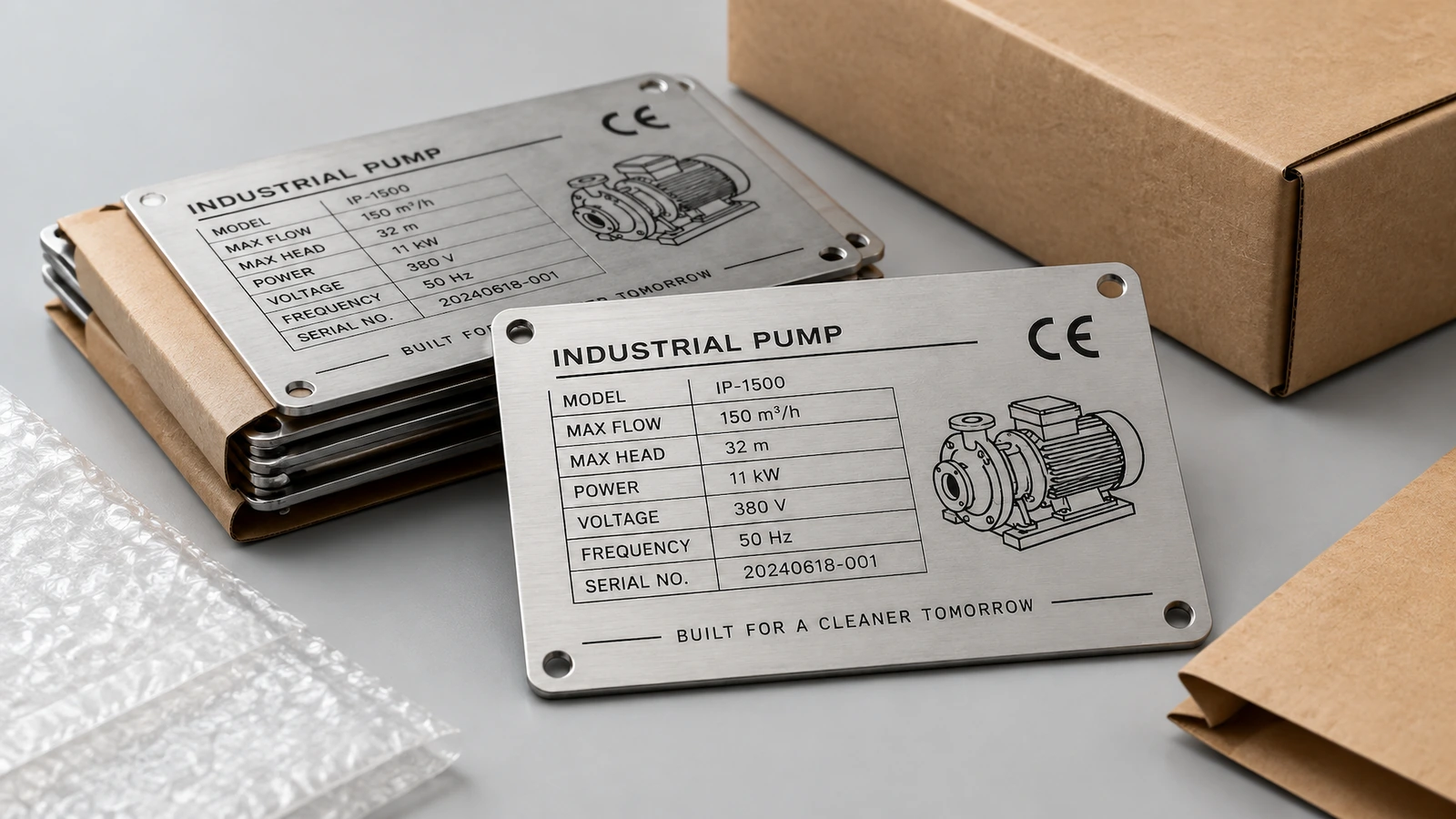
Agree on packaging, surface protection and part-number labeling at quotation, so finished faces arrive unscratched and each lot stays traceable to its process records.
At installation, confirm fastener torque or adhesive cure, remove iron filings from the plate face, and record the serial numbers in the asset file. Never brighten stainless with a carbon-steel wire brush; embedded iron causes the same rust staining seen around engraving.
Replace a plate when its text becomes unreadable at the specified distance, when pitting reaches the mounting holes, when rust runs from the fasteners, or when the rated data changes. For reorders, keep the approved sample and the process card. Change only the laser-marked variable data on the etched base, so the fixed artwork never needs re-tooling.
Which Marking Process and Grade Fit Your Application? ↑
Published service-life figures vary widely, so record their sources rather than averaging them. Hallmark rates engraving and embossing at 20+ years outdoors, and notes that chemical etching is typically specified for 5–10 years of service[12]. Metal Marker[19] gives similar figures: about 5–10 years for etched plates and 20+ years for embossed stainless. Seton[20] lists 3–6 years of average outdoor durability for its 0.030 in 304 catalog plate; its "up to 2700°F" claim describes the metal, not the fill, ink or adhesive, which fail at far lower temperatures.
| Process | Best fit | Watch-outs |
|---|
| Photo-chemical etch + color fill | Fixed artwork, fine detail, brand color, larger lots | Photo-tool setup cost; specify depth and fill system |
| Fiber laser marking or engraving | Prototypes, serial numbers, QR and UID codes | Unit cost barely falls with volume; annealed marks are shallow |
| Rotary engraving | Deeper cuts, small lots, variable text | Slower; fine detail is limited by cutter size |
| Screen printing | Indoor full-color graphics | Surface ink; should not be the only marking in harsh service |
| Embossing or stamping | Large runs of identical data plates | Die cost; variable data is impractical |
Volume changes the economics. JTT Logos[21] suggests mechanical engraving is often cheaper for about 1–50 pieces, because it avoids chemical masking, while chemical etching becomes significantly cheaper above 500 pieces.
Typical matches between application and specification follow from this. Marine and chemical sites call for 316 with etch and fill, plus laser or dot-peen serial numbers. Prototypes and one-off serialized plates suit laser or engraving. Thousands of identical plates that may be painted over suit embossing, and indoor, low-wear color graphics can use screen printing. For defense work, follow MIL-DTL-15024 and MIL-STD-130 only when the contract requires them[8].
A request for quote that suppliers can compare like-for-like should state: grade, thickness, finish, outline and corner radius, process and fill, minimum depth, variable data, mounting method, operating environment, test method and quantity. Send the same drawing to every candidate supplier.
What Should Every Nameplate Buyer Remember? ↑
- 316 earns its premium where chlorides are present. — PREN about 23–28 for 316 vs 18–20 for 304; seawater carries roughly 35,000 ppm chlorides (Source)
- The marking method, not the base metal, sets readable life. — Etching is typically specified for 5–10 years; engraving and embossing are rated 20+ years outdoors (Source)
- Depth must be written on the drawing. — One published benchmark is ≥0.05 mm minimum depth with ±0.01 mm tolerance (Source)
- Grade substitution shows up within a few seasons. — 201 sold as 304 can rust and fade after 1–2 years outdoors (Source)
- CE plates need a measurable mark. — CE symbol at least 5 mm tall on a durable plate (Source)
- Market estimates conflict, so cite each one separately. — USD 1.25 billion for stainless nameplates in 2025 (Source) vs USD 4.8 billion for all nameplates (Source)
Ready to Specify a Plate That Outlasts the Machine? ↑
A nameplate succeeds when its data can still be read at the last audit of the equipment's life, not when it looks good on delivery day. That outcome comes from decisions you can verify. Choose a grade matched to the chemistry, with a mill test report. Recess the mark into the metal at a stated depth. Use fixing hardware that will not corrode first. Write test methods and pass criteria into the purchase order. Freeze the first article as the reference for every reorder.
Request a quote: send your drawing or DXF, the quantity, the operating environment and any required standards. We will return the proposed grade, process, depth, mounting, test plan, MOQ, lead time and unit weight for your review before sampling.




The information below is required for social login
Sign In
Create New Account