Custom TPE stickers are soft, flexible logo stickers made from thermoplastic elastomer. They come as glue-free cling pieces or with a pressure-sensitive backing, and they suit promotional gifts, stationery, drinkware markers and smooth indoor surfaces. Size, Shore A hardness, backing, ink system and compliance tests are confirmed per project during quotation and sampling.
Who this page is for. Bulk buyers of custom TPE stickers are mostly importers of promotional gifts, stationery and educational toys, plus brands running OEM programs. Typical projects are trade-show giveaways, stationery gift boxes, private-label sticker books and fridge-style promotional pieces. The people who peel the stickers are often children, parents and teachers. Retail copy for jelly sticker books promises a "thick, jelly-like texture" that small hands can grip, and adhesion "to smooth surfaces like windows, mirrors, water bottles, and refrigerators," according to retail jelly sticker listings[1]. Those are seller claims, not lab results, which is why a custom order needs a written test plan. If your logo must survive garment washing, you probably need a TPU heat-press label instead; the comparison section explains why.
The problem: A soft logo sticker can look perfect at approval, then turn greasy, lift at the edges or yellow weeks after delivery. The buyer usually blames the printer.
Why it hurts: Very soft TPE gets its feel from oil, and that oil migrates. In one supplier test, a 0 Shore A sample held at 60°C for 24 hours saw surface oil rise from 1.2% to 3.8% and its friction coefficient double from 0.3 to 0.6, per supplier oven-aging data[2]. Migration also weakens adhesives: an aging test on 60A SEBS found 180° peel falling from 6.2 N/mm at 30 phr oil to 0.4 N/mm at 70 phr, according to TPE bonding research[3]. Light colors add a third risk; one formulation yellowed after just 200 hours of UV exposure, per a TPE discoloration analysis[4]. End users notice. Parents note that jelly stickers "can pick up lint if dropped," per Amazon buyer reviews[5], and verified reviews of TPE phone grips with acrylic adhesive include "Lifted at bottom corner after 3 weeks," summarized in a phone sticker buying guide[6].
The fix: Treat the specification as a test plan. Agree hardness, base chemistry, backing, liner, ink system and acceptance tests in writing, prove them on a physical sample applied to your real surface, and only then move to bulk. Any unmeasured value stays marked as pending quotation, sampling or testing.
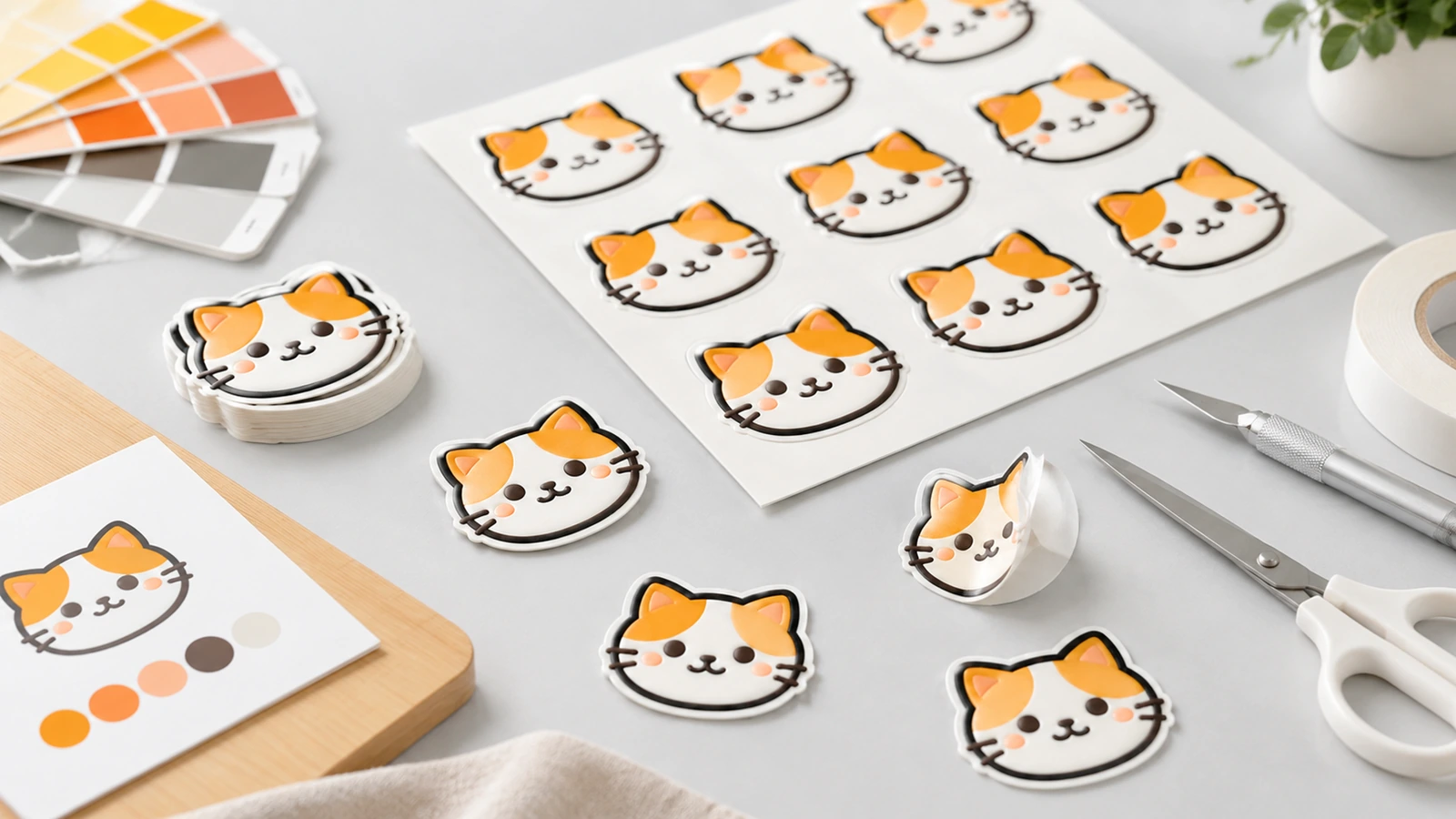
Table of Contents
What Are Custom TPE Stickers, and What Are They Not?↑
TPE (thermoplastic elastomer) behaves like rubber but melt-processes like plastic, so it can be formed into film or thicker sheet, printed and die-cut into logo shapes. Two attachment mechanisms are both sold as "self-adhesive." Glue-free pieces cling through the elastomer's own surface tack and can be repositioned on smooth surfaces. PSA-backed stickers add a pressure-sensitive adhesive and release liner for rougher surfaces or more permanent placement. One Chinese patent extrudes TPE directly as the self-adhesive layer[7], claiming fewer glue-overflow defects; a patent title, however, is not a test report.
Three neighboring products are often confused with TPE stickers. TPU labels belong to the same elastomer family but are heat-pressed or sewn onto fabric; one apparel supplier lists Eco-TPU, hot-melt adhesive and a 3,000-piece MOQ[8]. Soft PVC and silicone rubber labels are micro-injection molded patches. Vinyl die-cut stickers are thin printed films with permanent adhesive. Each is verified with different tests, so the material name on your purchase order must match the product you want.
The wider thermoplastic elastomer market is projected to grow from USD 30.83 billion in 2025 to USD 38.94 billion by 2030, according to MarketsandMarkets[9]. That covers automotive, footwear, cable and medical uses; it is not a sticker market size.
How Do You Specify Size, Finish and Backing So the Logo Stays Readable?↑
Because no universal designation for label materials exists, ISO/TS 18614:2016[10] lists the information buyers and suppliers should agree on when ordering self-adhesive labels. The same approach works for TPE. Fix these fields before a quotation is issued.
| Field | What to state | Why it matters |
|---|
| Base chemistry | SEBS, SBS or TPU, not just "rubber" | Sets heat stability, printability and which compliance documents apply |
| Hardness and oil | Shore A target; oil limit or low-migration grade | A softer feel needs more oil, the main cause of tack and peel loss |
| Size and thickness | Outline, thickness, smallest stroke and gap | Thick jelly pieces hold less fine detail than thin film labels |
| Attachment | Glue-free cling or PSA; removable or permanent | Determines the peel test, residue expectation and target surfaces |
| Liner | PP or PET release liner | PET liners can crack when soft TPE flexes |
| Print and finish | CMYK/UV or Pantone; gloss or matte; white underlay | Drives the color tolerance and ink adhesion tests |
| Use conditions | Surface, indoor/outdoor, temperature, user age | Decides which aging and chemical tests are required |
Fill in what you know and mark the rest "confirm at sampling." An honest blank costs less than a guessed value the sample later contradicts and forces you to renegotiate.
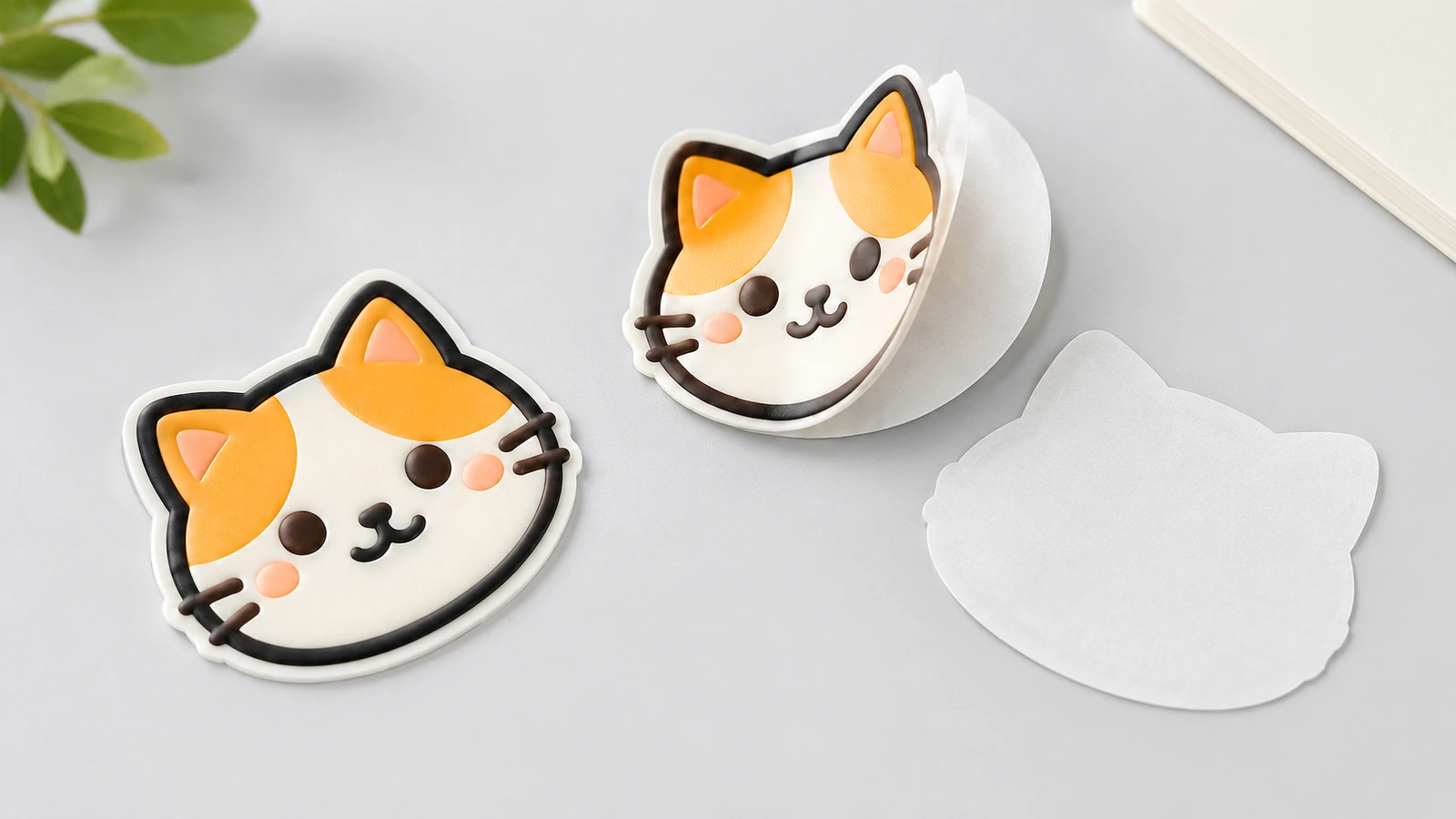
On TPE, readability is limited by thickness and edge rounding, not file resolution. One public promotional listing describes a 70 × 100 × 0.9 mm TPE sheet[11]; at that thickness, hairline type and tight letter counters can fill in during cutting. There is no universal minimum font size, since the limit depends on hardness, die design and ink, so include a test strip of your smallest text and finest line on the sample and approve it at arm's length and close up.
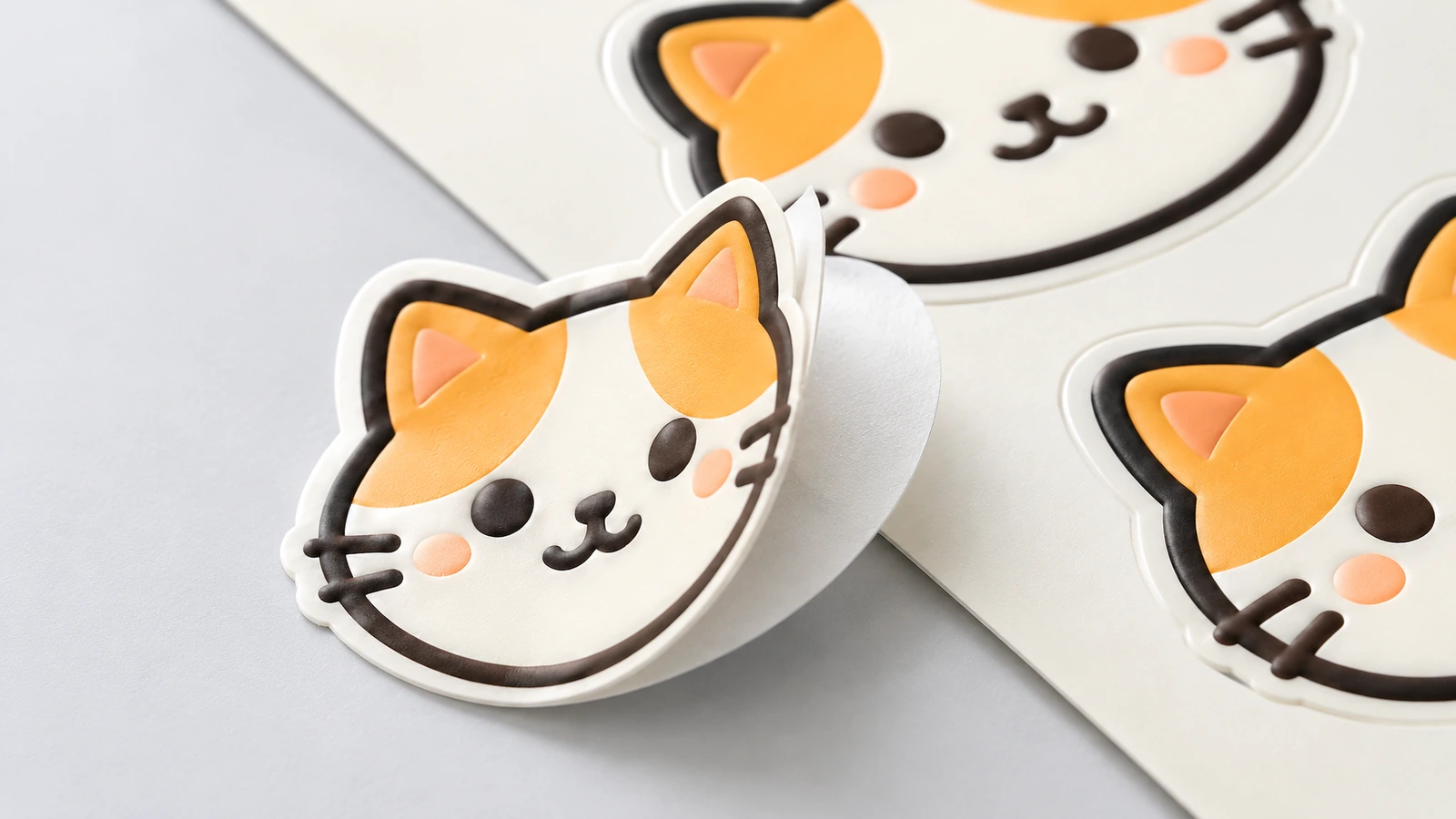
Choose the backing by surface. Glue-free cling works best on glass, mirrors, glossy drinkware and enamel, and fails on dusty, textured or painted walls. Low-surface-energy plastics such as PP and PE are hard for any adhesive, and silicone is designed to be non-stick, as one large printer states in its custom sticker FAQ[12]. For PSA versions on difficult plastics, start from an LSE-rated modified acrylic adhesive[13] sold for slightly oily PE and PP. The liner matters too: one supplier comparison found PET liners crack during die cutting or bending, while PP liners rarely do[14]. If you need clean removal, avoid the cheapest water-based acrylic or natural-rubber systems, which a TPE film maker rates as a very high residue risk[15] after long outdoor use.
How Should Artwork Be Preflighted Before Sampling?↑
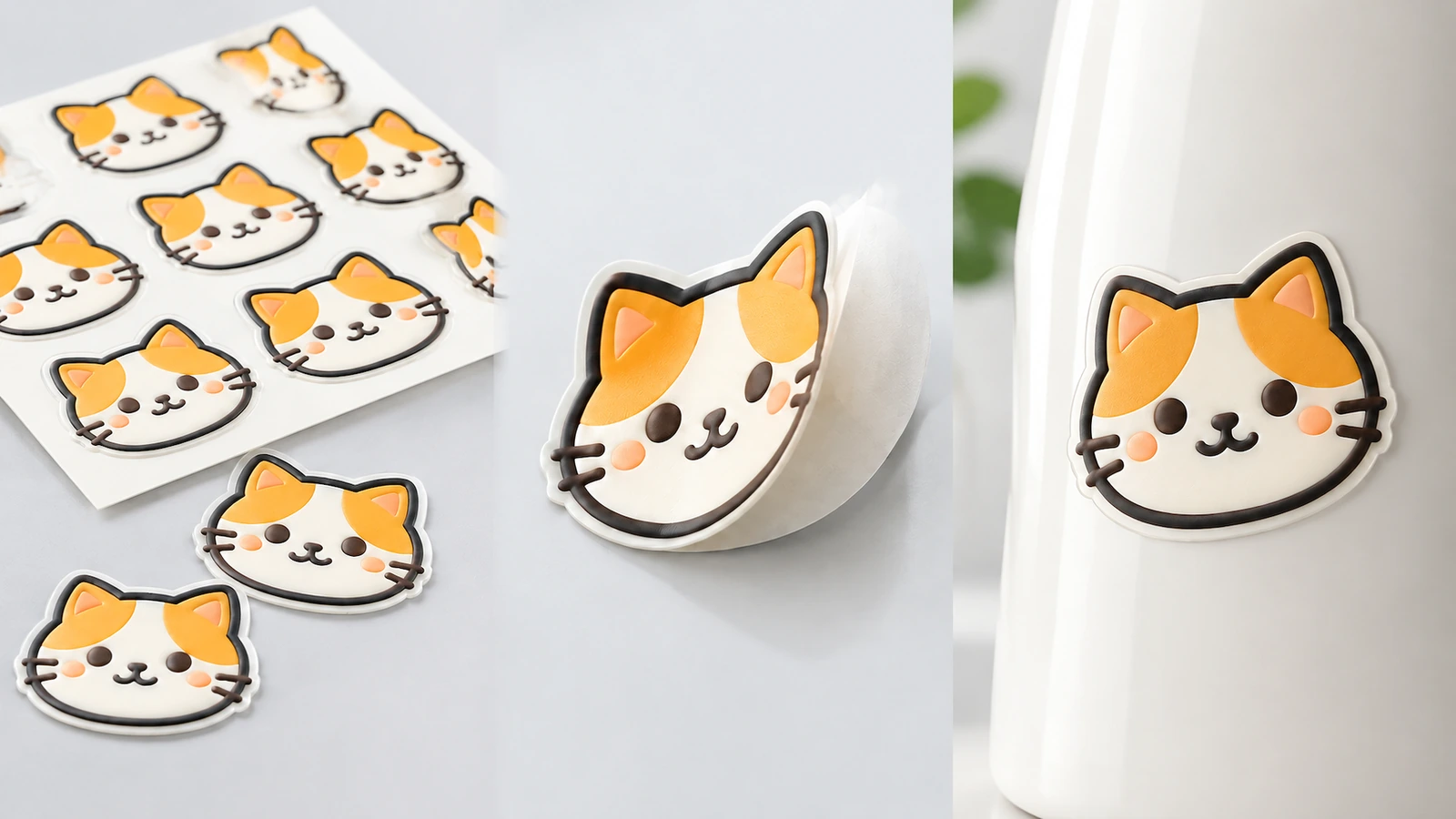
Send vector artwork (AI, EPS or PDF with outlined fonts) so the cutting die and print plate share the same geometry; a traced raster logo is effectively a redesign you must approve. For thin vinyl, one large online printer quotes cut accuracy of about 1/32 inch and asks for about 1/8 inch of bleed, per the same FAQ. Soft TPE stretches and rebounds during cutting, so treat those figures as a best case and let the sample set the real tolerance. Before sampling, check:
- Pantone or CMYK color references, and whether white ink sits under colors on clear or tinted TPE.
- Bleed and safe zone on separate layers, with the cut line as a closed path.
- Smallest text and line weight flagged for the sample test strip.
- Internal holes, sharp points and narrow necks marked, since soft material tears there first.
- Final shape, size and color approved in writing.
That last check protects you. One buyer reported receiving rectangles instead of squares on an order worth almost $2,000[16]. Make "no change without written sign-off" a contract term.
How Are TPE Logo Stickers Produced and Verified?↑
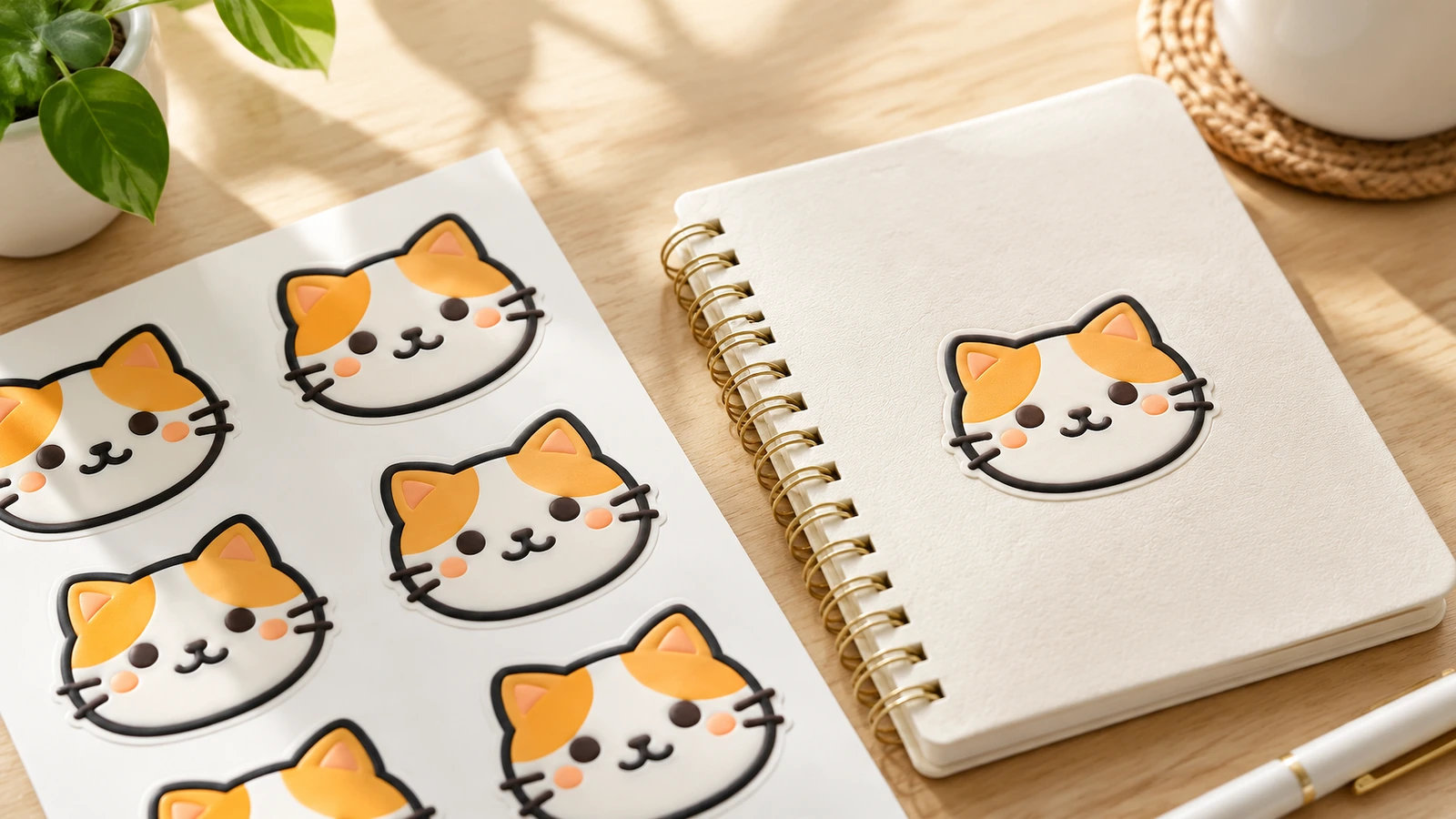
The sequence is incoming material inspection, sheet or film forming, surface treatment, printing, adhesive coating where specified, maturing, die cutting and outgoing checks. Process windows depend on the grade. As one documented example, a TPE vehicle-sticker patent[17] specifies 0.07–0.12 mm film, 0.02–0.035 mm dry adhesive, 2–3 days of maturing after lamination and another 1–2 days after the print coating. Those values belong to that patent's formulation; they show why maturing time appears in a schedule, not a standard for this product.
Surface treatment is the step most often skipped. Untreated TPE sits around 28–34 mN/m, and oil migration can push it lower within hours (bonding research), while reliable printing generally needs at least 38–42 dynes/cm, per Deco Tech Group[18]. Check dyne level after corona treatment or priming, before ink goes down, and recheck every new material batch. For the US market, toluene, xylene and chlorinated-solvent inks should not be the default; ask for TPE/SEBS-rated low-hazard or flexible UV inks verified on the same batch.
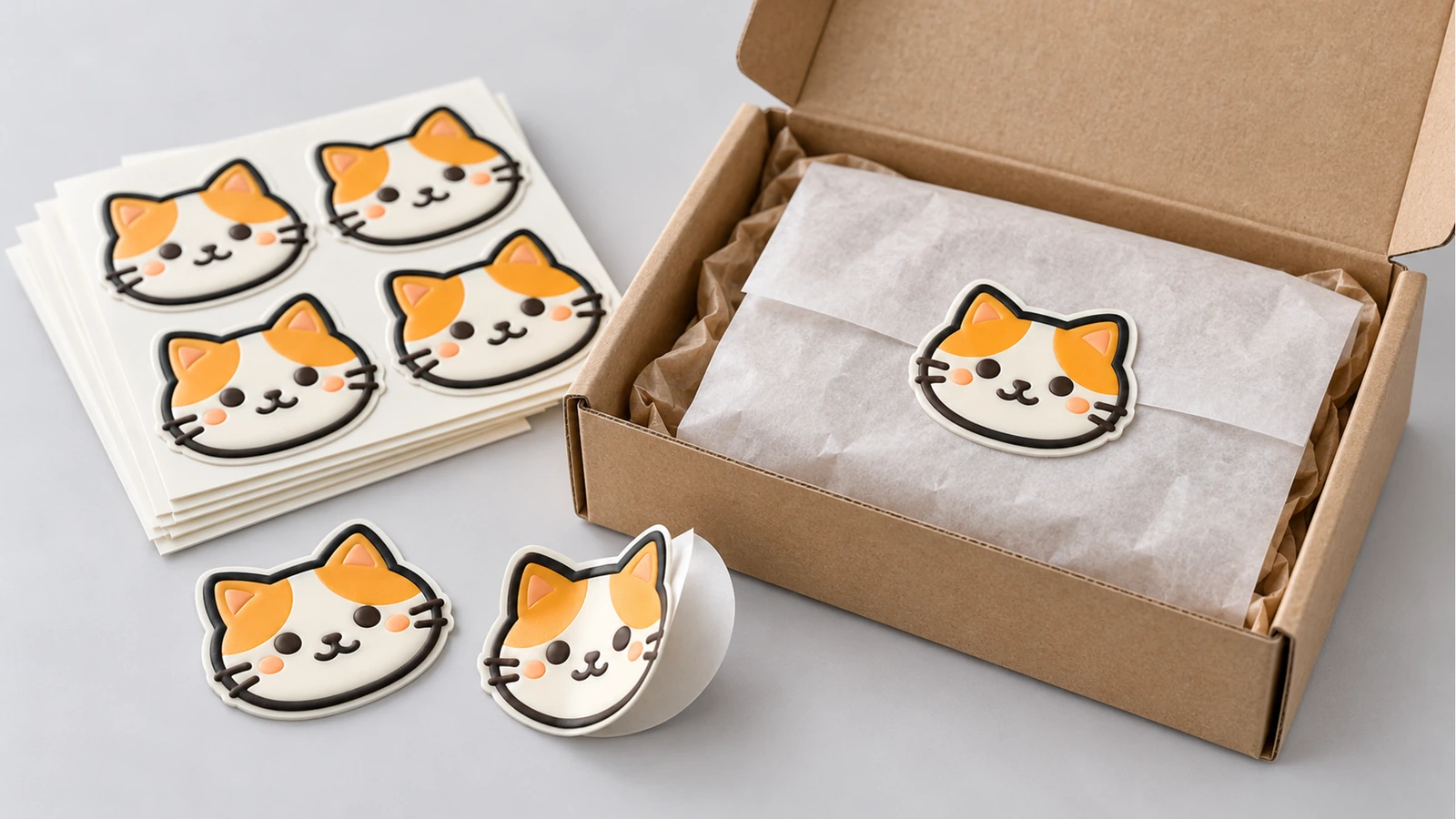
Build your acceptance plan from the table below, dropping only tests that deliberately do not apply to your use case.
| Test | Method or reference | What it catches |
|---|
| Surface energy | Dyne pens, at least 38 dyn/cm before printing (Deco Tech) | Poor wetting by ink and adhesive |
| Ink adhesion | ASTM D3359 or ISO 2409 cross-hatch, plus flex and solvent rub | Logos flaking after bending |
| Peel adhesion | ASTM D3330[19] 180° or 90°, on your real surface at 24 h and 7 days | Edge lift and residue |
| Heat aging | Oven aging, then tack and peel recheck, per migration testing guidance[20] | Delayed oil bloom and bond loss |
| Light aging | UV or xenon exposure if window or outdoor use is claimed | Yellowing of light colors |
| Chemical safety | ASTM F963 and EN 71-3 (SGS guide[21]); CPSIA lead ≤100 ppm, listed phthalates ≤0.1% (toy TPE overview[22]) | Gaps in children's product compliance |
| Visual and cut | AQL sampling against an under-1% defect benchmark (printer benchmark[23]) | Miscuts, scratches and color drift |
Two caveats apply. The N/mm peel figures cited earlier come from TPE part-bonding experiments, not a label standard, so use them as warning signs and let the approved sample set the agreed peel window. And every result belongs to a specific grade, color and batch; a reorder that changes any of them needs a fresh check.
How Do TPE Stickers Compare With TPU, PVC and Vinyl?↑
| Option | Attachment | Durability profile | Public price signals | Best fit |
|---|
| Glue-free TPE jelly | Self-cling, repositionable | Washable on smooth surfaces; weak on texture and strong UV | About USD 0.05–0.50 per piece, MOQ in the hundreds to thousands (marketplace listings[24]) | Gifts, windows, drink markers, sticker books |
| PSA-backed TPE | Pressure-sensitive adhesive plus liner | Stronger hold if the adhesive and oil level are matched | Quote-dependent; confirmed at sampling | Logos on drinkware, cases, equipment |
| TPU heat-transfer label | Hot-melt heat press or sewing | Built for garment flex and washing | 3,000-piece MOQ on one supplier page (Chief Labels) | Apparel, bags, footwear |
| PVC/silicone rubber label | Sewn, ironed or adhesive-backed | Raised layered colors; silicone is softer and pricier | About USD 0.45 each at 2,500 pcs, 15×40 mm, excluding VAT (Label Yourself[25]) | Caps, bags, hoodies |
| Vinyl die-cut | Permanent PSA | Fine detail and laminated water resistance; no soft feel | Vinyl labels about USD 0.08–0.20 (Cubit Packaging[26]) | Bottles, laptops, flat promos |
These price signals come from public pages with different sizes, dates and currencies; they are not quotations for this product. At comparable small sizes, vinyl is cheapest, glue-free TPE and factory PVC overlap in the middle, and small-run silicone is highest. TPU overlaps TPE on price but uses a completely different application process. The decision rule: washable fabric calls for TPU, permanent fine detail calls for vinyl, and a soft, repositionable feel on smooth surfaces calls for TPE.
What Should Your Buying Checklist Cover?↑
A material name does not prove safety; phthalates, heavy metals and odor depend on the formulation. Grade-level claims exist, for example one resin maker lists REACH, RoHS, EN 71-3 and freedom from phthalates, BPA and latex[27] for a specific series, but they do not extend to your inks, pigments and adhesive. One TPE jelly sticker listing carries a California Proposition 65 warning[28], and in September 2026 Chinese inspectors found 16 of 20 children's soft 3D plastic stickers exceeded phthalate limits[29], though the report did not confirm which samples were TPE.
Decorative stickers are not food-contact articles by default. Only when a piece repeatedly touches food does 21 CFR 177.2600[30] for repeated-use rubber articles become relevant, with a grade-specific declaration of conformity. For EU sales, Regulation (EU) 2025/40[31] on packaging applies from 12 August 2026; confirm with your EU importer whether a sticker shipped as part of packaging falls within scope. Before ordering, confirm:
- End use and user age group, which decide whether toy standards apply.
- Base chemistry, Shore A hardness, backing and liner on the purchase order.
- Third-party EN 71-3 or ASTM F963, phthalate and total lead reports matched to grade, color and batch.
- Peel and aging results on your actual surface, not only a steel panel.
- Color tolerance and a retained approved sample.
- Age and small-parts warnings where the product reaches children.
- MOQ, die and plate costs, sample rounds and production time stated on the quotation.
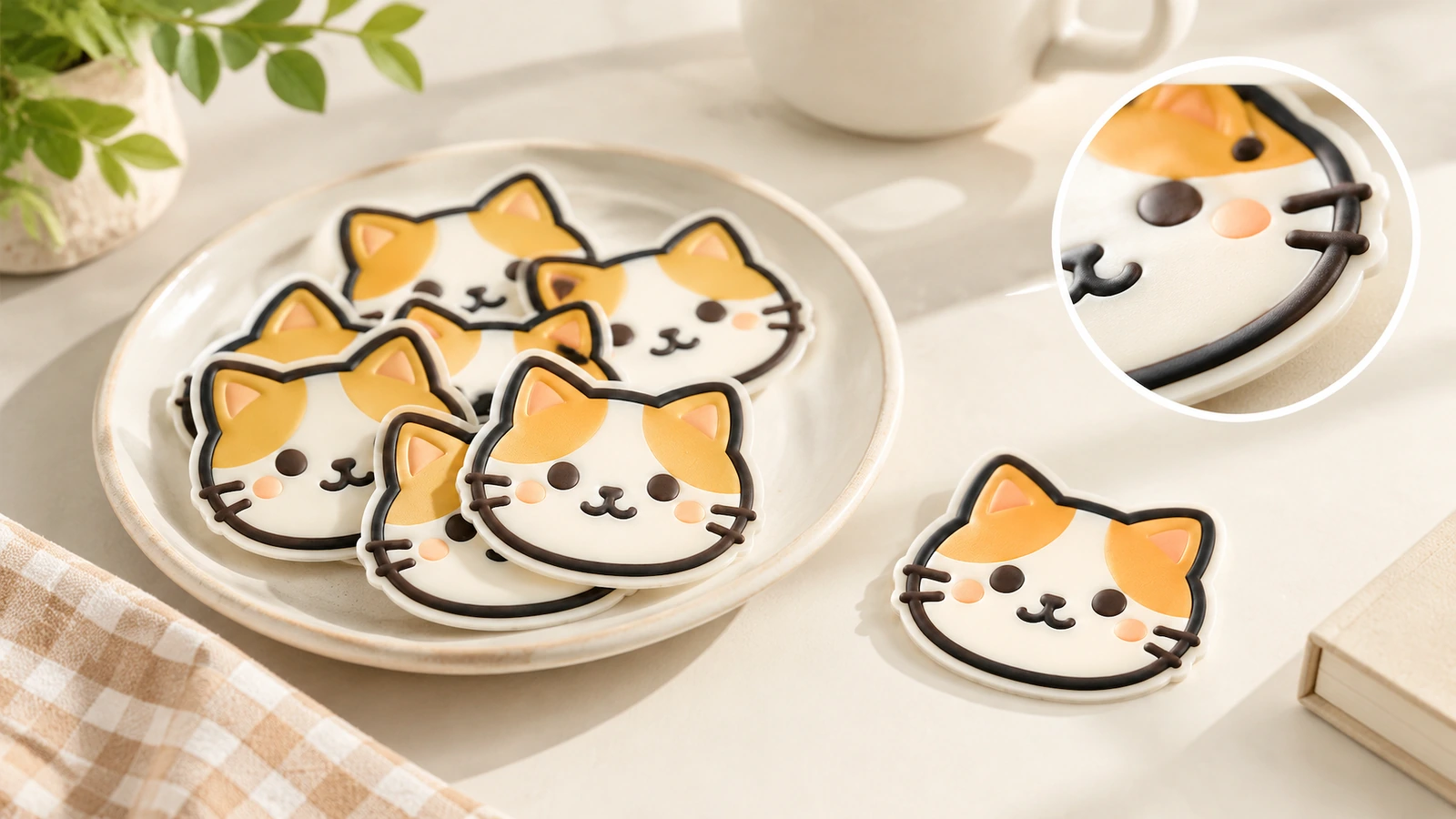
For packaging, interleave sheets with anti-stick release film, avoid tightly compressed bundles, and keep cartons out of hot, humid warehouses, which accelerate oil bloom and yellowing. For reorders, retain the approved sample and record material batch, dyne value and peel result per run, so the next run is compared against data rather than memory. One label maker publishes in-house control of about ΔE ≤ 2.0 for color and ±0.3 mm for size[32]; use such figures as a negotiating reference and set your own tolerance on the approved sample. MOQ, unit price and production time are confirmed in each quotation after artwork and quantity review, so no standard values are published here.
Key Takeaways for Faster, Safer Sourcing↑
- Oil migration is the hidden risk in very soft TPE. — surface oil rose from 1.2% to 3.8% after 24 h at 60°C (Source)
- Adhesion collapses as oil content rises. — 180° peel of 6.2 N/mm at 30 phr vs 0.4 N/mm at 70 phr (Source)
- Printing needs a treated surface. — at least 38–42 dynes/cm is typically required (Source)
- Children's products need batch-level chemistry proof. — CPSIA lead ≤100 ppm; listed phthalates ≤0.1% (Source)
- TPE market growth is not sticker demand. — USD 30.83 billion (2025) to USD 38.94 billion (2030), across all TPE uses (Source)
- EU packaging rules are now in force. — Regulation (EU) 2025/40 applies from 12 August 2026 (Source)
Is a Custom TPE Sticker the Right Fit for Your Logo?↑
Choose custom TPE stickers when your logo needs a soft, tactile, repositionable piece for glass, glossy drinkware, stationery or gift sets, and you are willing to approve a physical sample before bulk. Look elsewhere if the logo must survive garment washing (use a TPU heat-press label) or serve as a long-term outdoor, safety or traceability label (use an industrial film label validated for that environment). Specify base chemistry, hardness, backing and test plan up front, and tack, edge lift, residue and yellowing become measurable risks rather than surprises. Send your vector logo, target surface, end-user age and quantity to request a quotation and sample plan.




The information below is required for social login
Sign In
Create New Account