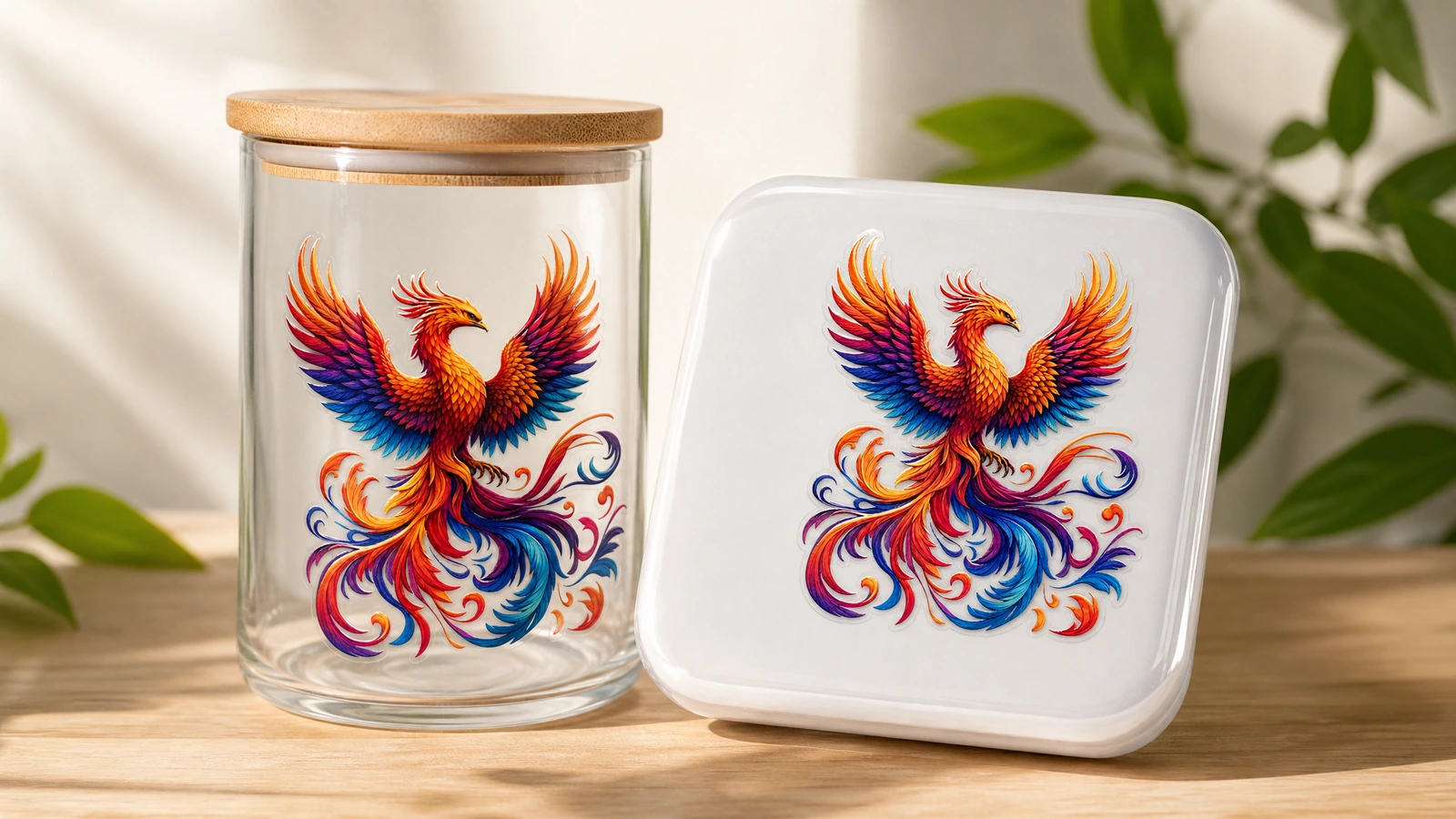
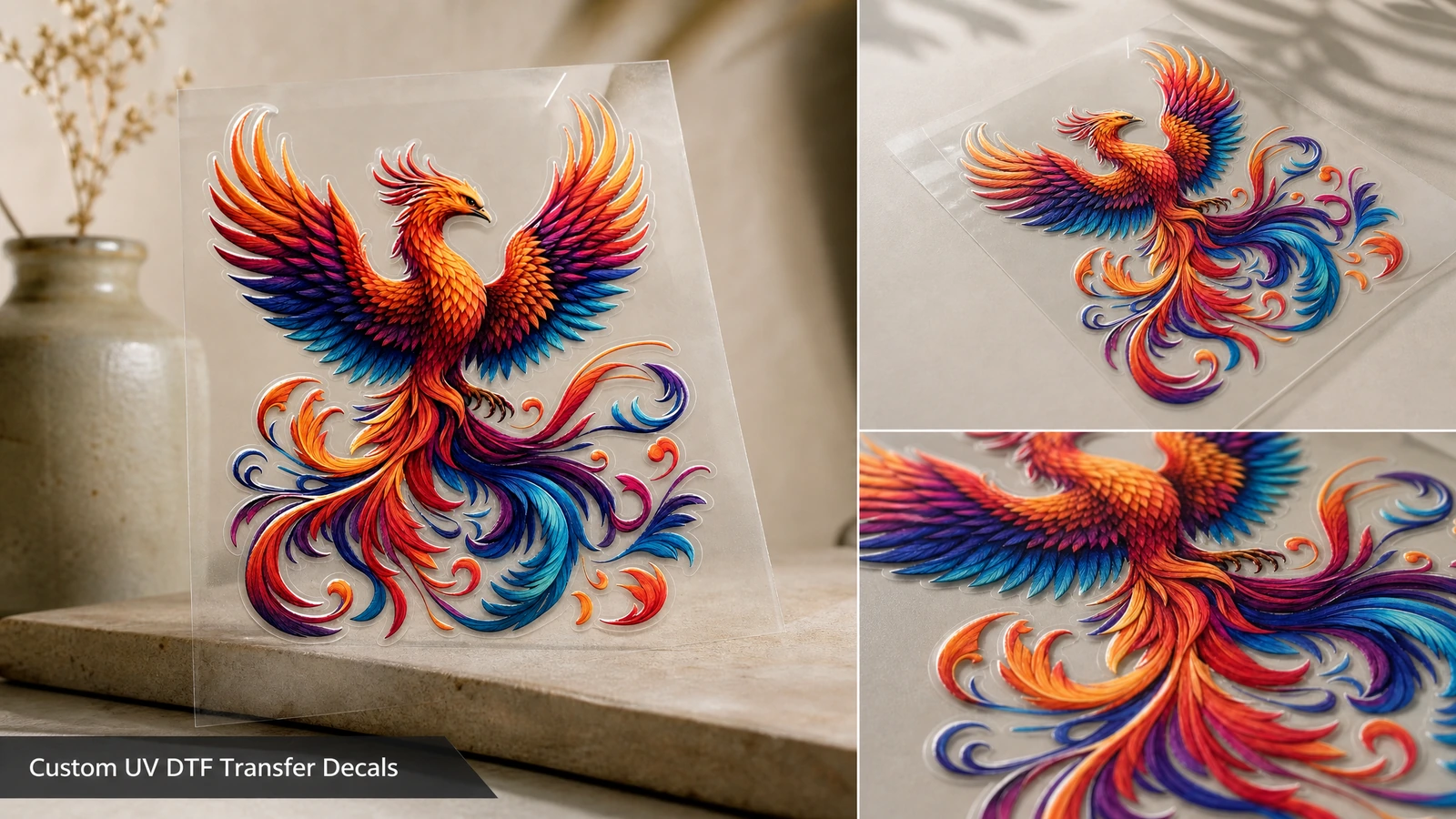
Custom UV DTF stickers are full-color transfer decals. They are printed with UV-cured CMYK, white and varnish layers on a two-part A/B film, then pressed onto smooth hard surfaces. No heat press, water or weeding is needed. They suit glass, ceramic, metal, acrylic and rigid plastic. They are not made for fabric, silicone or repeated dishwasher cycles.
Who orders these decals. Buyers of Custom UV DTF Transfer Decals (provisional SKU NSKU-615-02) usually fall into four groups:
Small product sellers on Etsy, Shopify or TikTok Shop need logos, scent names or customer names on 20–40 oz tumblers, candle jars and cosmetic bottles. They want to do this without buying a heat press.
Print and promo shops want to add hard-goods SKUs for clients they already serve.
Cafés, salons, gyms and event teams need one brand mark on cups, bottles and acrylic QR signs for short campaigns.
Individual buyers order name cups, party favors or pet memorial laptop decals in small quantities.
The time saving is concrete. One tumbler guide estimates about 10 minutes per cup for traditional weeded vinyl. It puts a UV DTF decal at roughly 60 seconds[1], with no fine lines to cut. Repeat demand is just as specific. A commercial printer reports that small candle companies order the same logo across 50 or 100 jars[2] at a time.
The problem. A decal that looks perfect when it ships may not survive a customer's kitchen. One industry write-up describes the usual failure: "A week later the edges lift. The dishwasher finishes it off." It traces this to skin oil, low pressure, textured powder coat or an incompatible substrate[3].
Why it hurts. A failure costs far more than the film. One seller refunded 4 of 10 orders from a roughly $1,000 die-cut batch. The decals tore when customers removed the backing[4], and the supplier only said "clean the surface." Another buyer found white outlines and grainy output on every gang-sheet design[5]. That destroyed the clean, borderless look they had paid for.
The approach on this page. Treat every order as three things together: the design, the substrate and the application method.
Before any batch is printed, confirm the target surface, its curve and the conditions it will be used in.
Then check the white layer and agree written pass/fail criteria.
Pricing, minimum order quantity and production time for NSKU-615-02 are set in your quotation. How the decal performs on your item is confirmed by a physical sample test, not by a catalog claim.
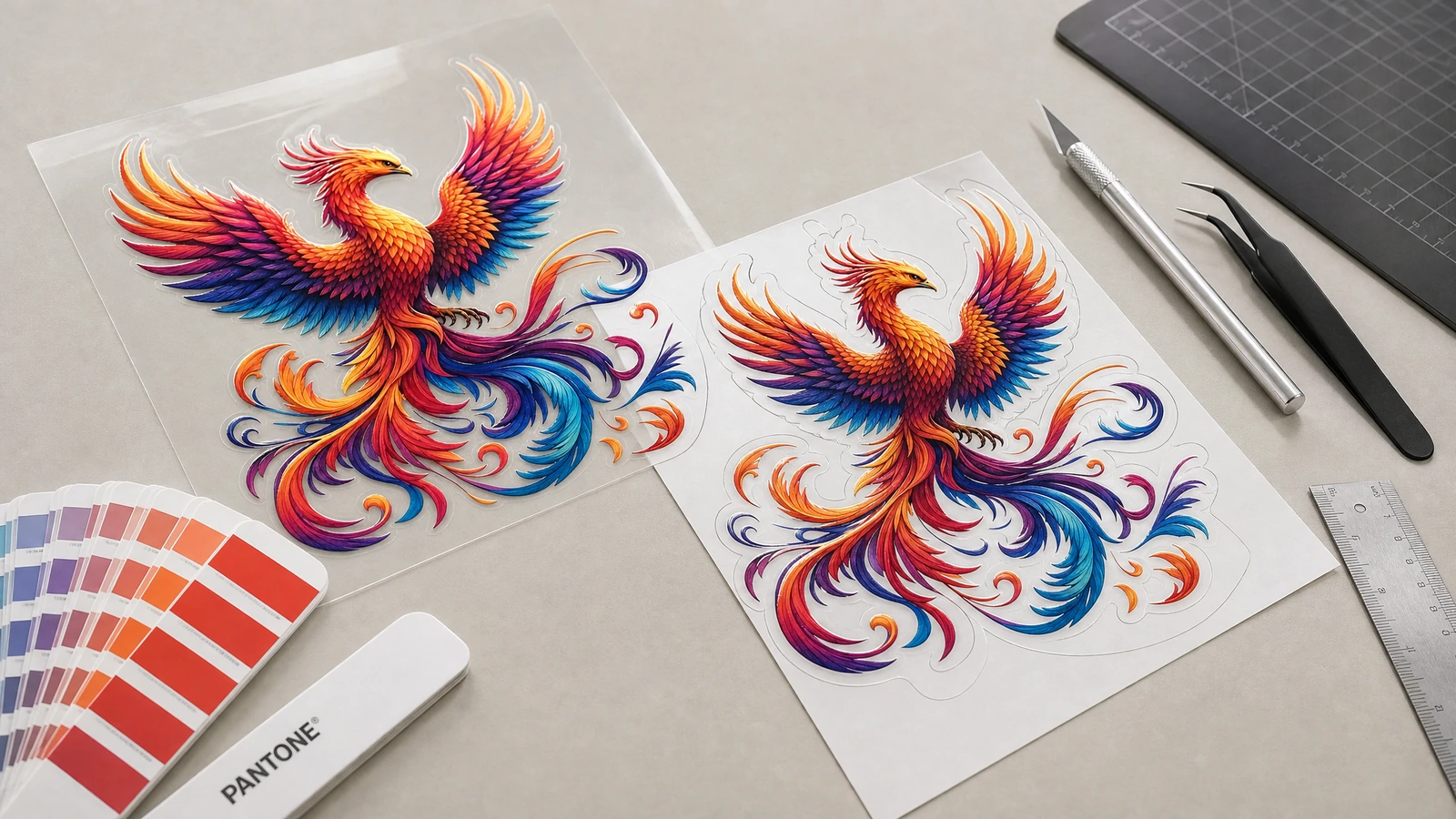
Table of Contents
What Are Custom UV DTF Stickers and How Do They Differ From Vinyl? ↑
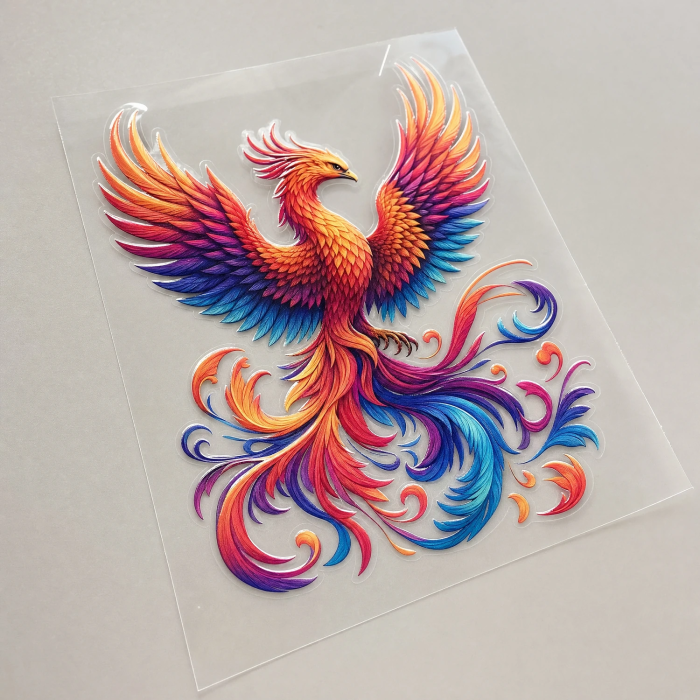
UV DTF stands for ultraviolet direct-to-film. The design is printed onto an A film with UV-curable ink, and each layer is cured instantly. An adhesive B film is then laminated over the print. To apply it, you peel the backing, burnish the decal onto the item and slowly lift the carrier film. Only the printed image stays on the item. A 2026 equipment guide describes the build as white ink, CMYK color and protective varnish on a two-layer film, with "no heat, no water, and no pretreatment required"[6].
Versus garment DTF. Garment DTF is a different product. It uses water-based pigment, hot-melt powder and a heat press on fabric. One printer maker's comparison places UV DTF on glass, metal, plastic, wood, ceramic and acrylic. It notes a raised, embossed feel and higher abrasion resistance than textile DTF[7].
Versus printed vinyl. The visible difference is that UV DTF leaves no clear backing border. The physical difference is that cured UV ink is fairly rigid. On tight curves such as mugs, practitioners note that this stiff layer can act like a spring and pull edges up[8]. That is why the curve of your item belongs in every quote request.
Market size. The category is growing, but estimates of its size vary widely. QY Research's public summary[9] projects the global UV DTF market to grow from US$247 million in 2025 to US$483 million by 2032, a 10.2% CAGR. Other paid reports differ by roughly an order of magnitude because they define the market differently. Treat any single figure as one analyst's view.
Buyer demand. A keyword tool reports about 14,800 monthly Etsy searches for "uv dtf sticker." It shows a median listing price near $4.28, with 75% of listings under $10 (Etsy keyword data[10]). Buyers are comparing many cheap listings. They need a clear way to tell a durable decal from a disposable one.
Which Surfaces, Sizes and Finishes Will Actually Hold? ↑
Whether a decal sticks depends more on the surface than on the print. A 2026 compatibility guide says smooth, sealed, non-porous materials hold best. It traces edge lifting almost always to poor cleaning, low pressure, porous materials or low-surface-energy plastics used without primer[11]. The same guide gives three practical rules:
Apply at roughly 65–80°F (18–27°C).
Let chilled items warm up and dry completely before applying.
Treat placement as permanent, because UV DTF is hard to remove cleanly.
| Surface | Expected fit | Confirm by sample |
|---|
| Glass, glazed ceramic | Good on smooth, clean areas | Curve radius; hand-wash expectation |
| Stainless steel, smooth coatings | Good | Coating texture; condensation at use |
| Acrylic, ABS and other rigid plastics | Good | Mold-release residue; PP/PE need primer test |
| Sealed smooth wood, laptop lids, phone cases | Usually workable | Sealant finish; heat and flex exposure |
| Textured powder coat, rough stone, unsealed wood | Poor | Fine detail often fails to bond |
| Fabric, silicone, soft rubber | Not suitable | Use a textile or flexible-material process |
Use this table to screen surfaces, not as a guarantee. Coatings vary from one tumbler supplier to the next, and even between batches from the same supplier. If your item falls between two rows, test a sample on the actual production part, from the coating batch you will ship.
Size and readability. Specify size as the finished artwork dimensions, not the artboard, so empty margins are not printed or priced. Start with body text no smaller than about 2 mm cap height. Avoid hairlines thinner than the printer can back with white ink. The true minimums come from a printed RIP proof on your specific film and ink. For tumbler wraps, give the printable height and circumference so the layout allows for taper.
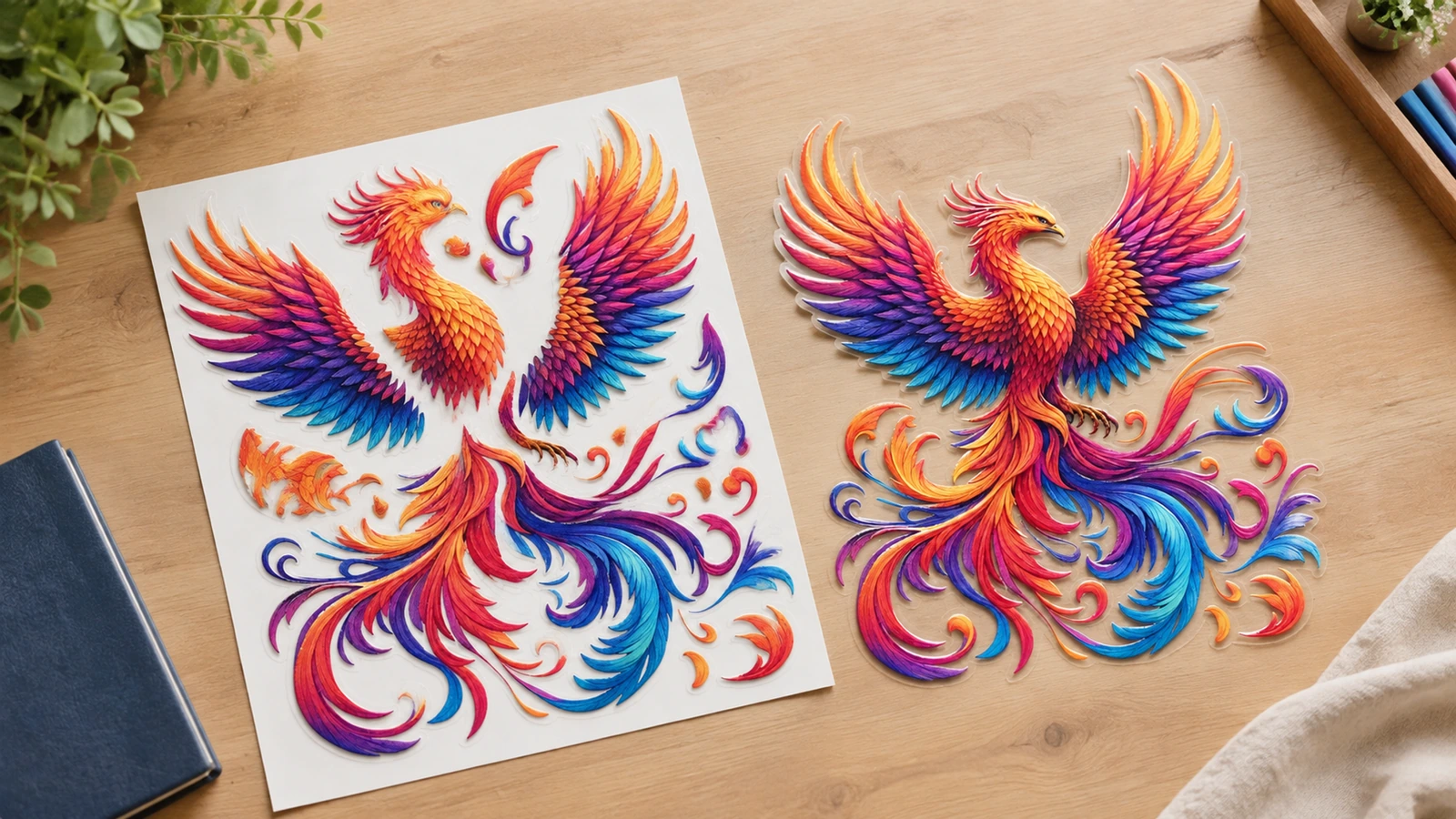
Finish and backing options. You can choose several layers of the decal:
Varnish: gloss or matte. Raised varnish adds the embossed feel noted earlier.
White layer: this controls opacity. Use full white behind color on dark or clear items. Use partial white for a printed-on look on light surfaces. Leave out white for translucent effects.
Adhesive B film: this provides the bond. How strongly it grips your item is checked during sampling, not assumed.
How Should You Prepare Artwork So Edges Print Clean? ↑
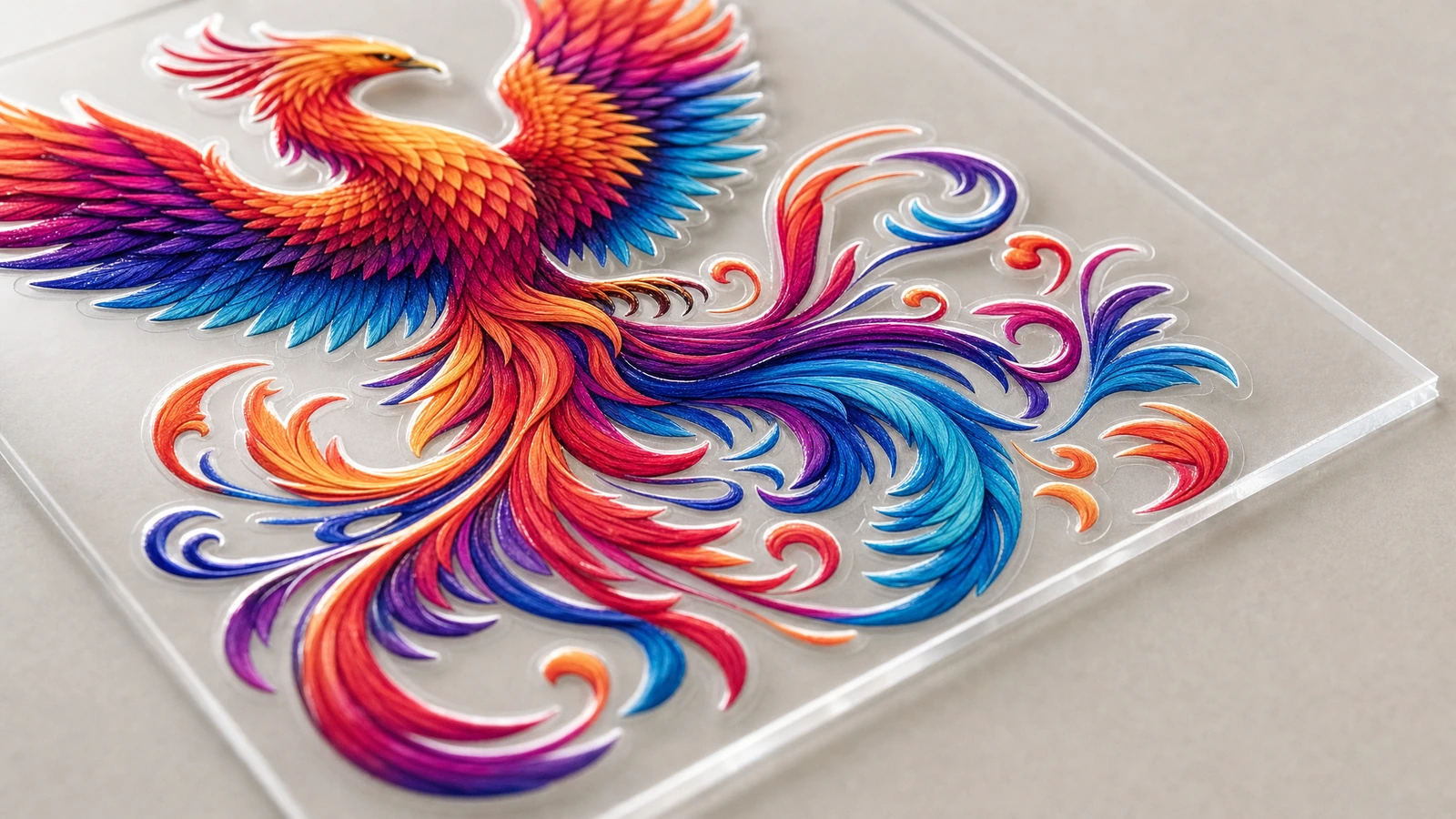
Most visible defects start in the file. Equipment makers cite a standard of CMYK artwork at about 300 DPI on a transparent background, with the white-ink layer separated in RIP software. The buyer with unexpected white outlines learned a second rule from the replies: the white layer needs a slight choke. That means pulling it inward from the color edge so small registration shifts stay hidden instead of showing as a halo. Soft, feathered edges and semi-transparent gradients are the other common trap, because the white base turns them into a pale ring.
| Check | Requirement | Why it matters |
|---|
| Color mode and resolution | CMYK, about 300 DPI, or vector | Prevents soft or pixelated edges |
| Background | Transparent, no stray pixels | Stray pixels print as white specks |
| White layer | Separated and choked inward | Hides white-to-color misregistration |
| Edges and effects | Hard edges; flatten shadows and glows | Soft edges create a white halo |
| Smallest text and lines | Confirmed on a printed proof | Thin strokes break during peeling |
Send the files with these details:
The finished size of each design.
The quantity per design.
The color of the item each decal goes on.
Any areas that must stay transparent.
Ask for a written preflight note and a proof before printing. A design that fails a check should be corrected, not printed as-is and blamed on the customer's application later.
How Are UV DTF Transfer Decals Produced? ↑
Production runs in five controlled stages:
1. Print. The printer lays down CMYK, then white, then gloss or matte varnish on the A film. A built-in UV lamp cures each layer as it prints.
2. Laminate. The adhesive B film is pressed onto the cured print without heat. Use a cold laminator for runs; a hand squeegee is only realistic for single sheets.
3. Cut. Sheets are trimmed or kiss-cut around each design.
4. Check the cure. A print that still feels sticky is under-cured. It will scratch, fade or tear during transfer.
5. Inspect. Each sheet is checked before packing.
Troubleshooting guides link these stages to field complaints. Designs that lose color or scratch easily usually come from insufficient ink curing, weak bonding on high-wear areas, or harsh chemicals[12]. Locking the ink, film, lamp power and print speed matters more than the printer brand. Community replies also connect graininess to high-speed print modes, which helps explain why quality varies so much between suppliers.
How Do You Apply and Care for UV DTF Decals? ↑
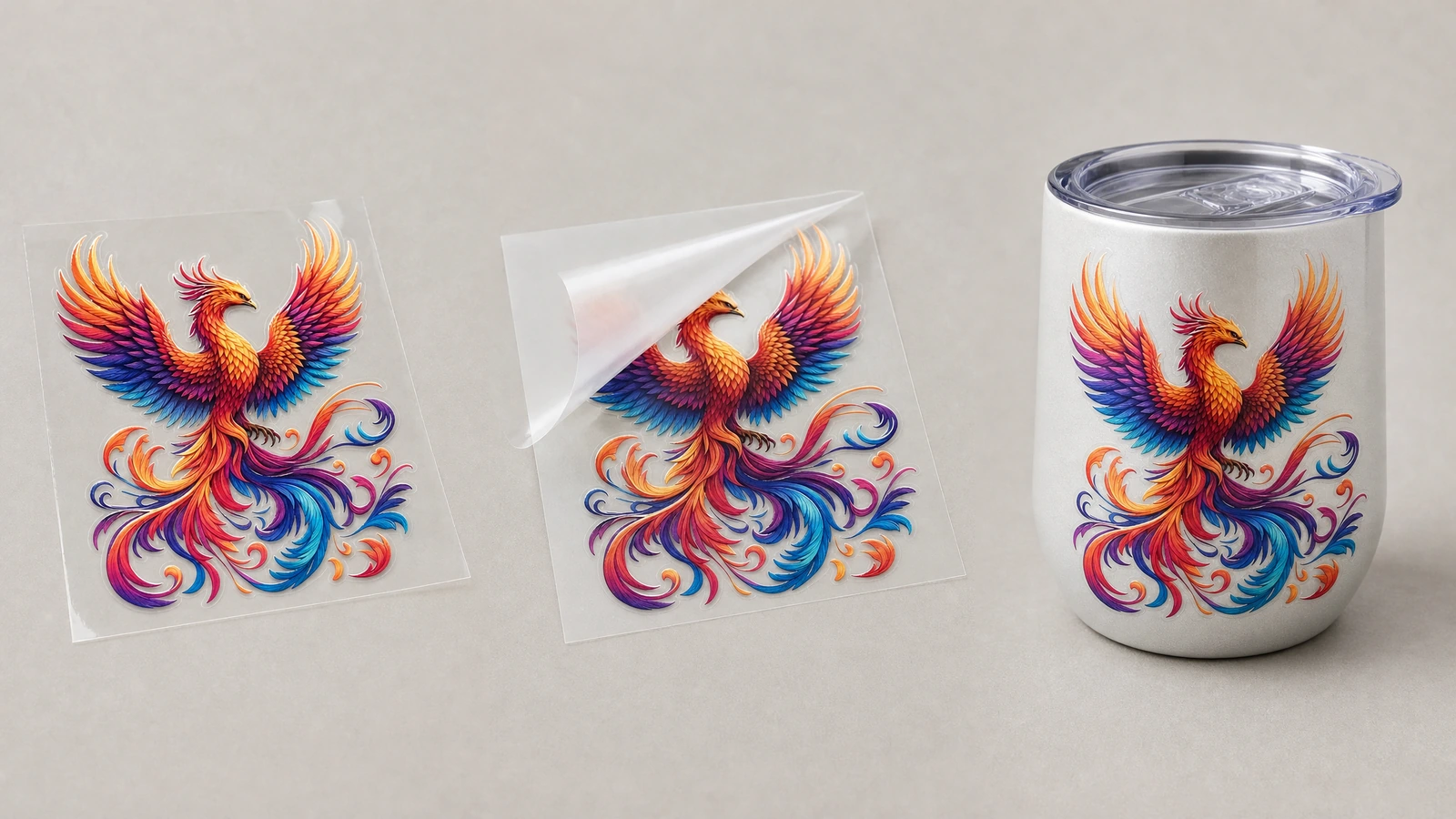
Application is done by hand without heat, so the person applying controls much of the result. One supplier frames it as four steps: prep the surface, peel back the film, position, and press from the center outward[13]. In practice:
- Clean the area with isopropyl alcohol and a lint-free cloth, then let it dry. Skin oil is a leading cause of edge lift later.
- Peel the backing but leave the top carrier on. Do not touch the adhesive.
- Position and burnish from the center outward with a squeegee. On curved items, roll from one side instead of laying the whole sheet down at once.
- Remove the carrier slowly at a low angle, about 45°. If part of the image lifts, lay the carrier back down and burnish again.
- Wait 24 hours before the first wash so the adhesive can fully bond.
Sticky edges. A thin sticky ring around a decal on glass is common when the adhesive extends slightly past the image. Experienced users suggest wiping it with a little isopropyl alcohol instead of picking at the edge[14].
Washing and heat. One supplier's care rules set the practical limits: wait 24 hours before the first wash; hand wash only; no soaking, bleach or microwave[15]. Also avoid long sun exposure and high heat. The heat risk is real: one tumbler owner reported decals that crinkled and cracked after a cup was left in a hot car[16].
How long they last. A commercial printer reports 30+ washes on a glass before it eventually cracked. The same printer notes that most suppliers rate dishware transfers as hand wash[17]. A durability guide gives rough ranges from seller experience: about 3–5 years indoors and 2–3 years outdoors, depending on sun, humidity and abrasion[18]. These are experience figures, not a standardized test. Dishwasher-safe or permanent performance is not claimed for NSKU-615-02 unless it passes a test on your item.
How Should You Inspect Samples and Accept a Batch? ↑
No ISO or ASTM product standard was found for UV DTF stickers, so buyer and supplier must agree acceptance criteria themselves. The checks below turn the failures seen in public complaints into pass/fail tests you can write into a purchase order.
| Test | Method | Pass condition |
|---|
| Peel test | Apply to target item, burnish, lift carrier slowly at about 45° | No part of the image leaves with the carrier |
| White registration | Compare edges with the approved proof under good light | No white outline beyond the agreed tolerance |
| Cure check | Touch test and light fingernail scratch | Dry, not tacky, no scuffing |
| Lamination | Inspect sheets before peeling | No bubbles, creases or trim cutting into artwork |
| Edge watch | Observe applied samples for 24–72 hours | No edge lift on the target surface |
| Use simulation | Hand-wash cycles; dishwasher only if required | Results recorded; claims limited to what passed |
Record keeping. Record results for each combination of surface, ink batch and film batch. Keep one approved applied sample as the reference for reorders.
Supplier test claims. Read supplier self-tests as marketing data. One vendor reports 100 hand washes and 30 top-rack dishwasher cycles on glass with no edge lift, plus 36–48 months in a window fade test. Those results depend on that vendor's own ink, varnish and adhesive[19]. Results for your design are reported only after your samples are tested.
Which Option Fits Your Project: UV DTF, Vinyl or Direct Print? ↑
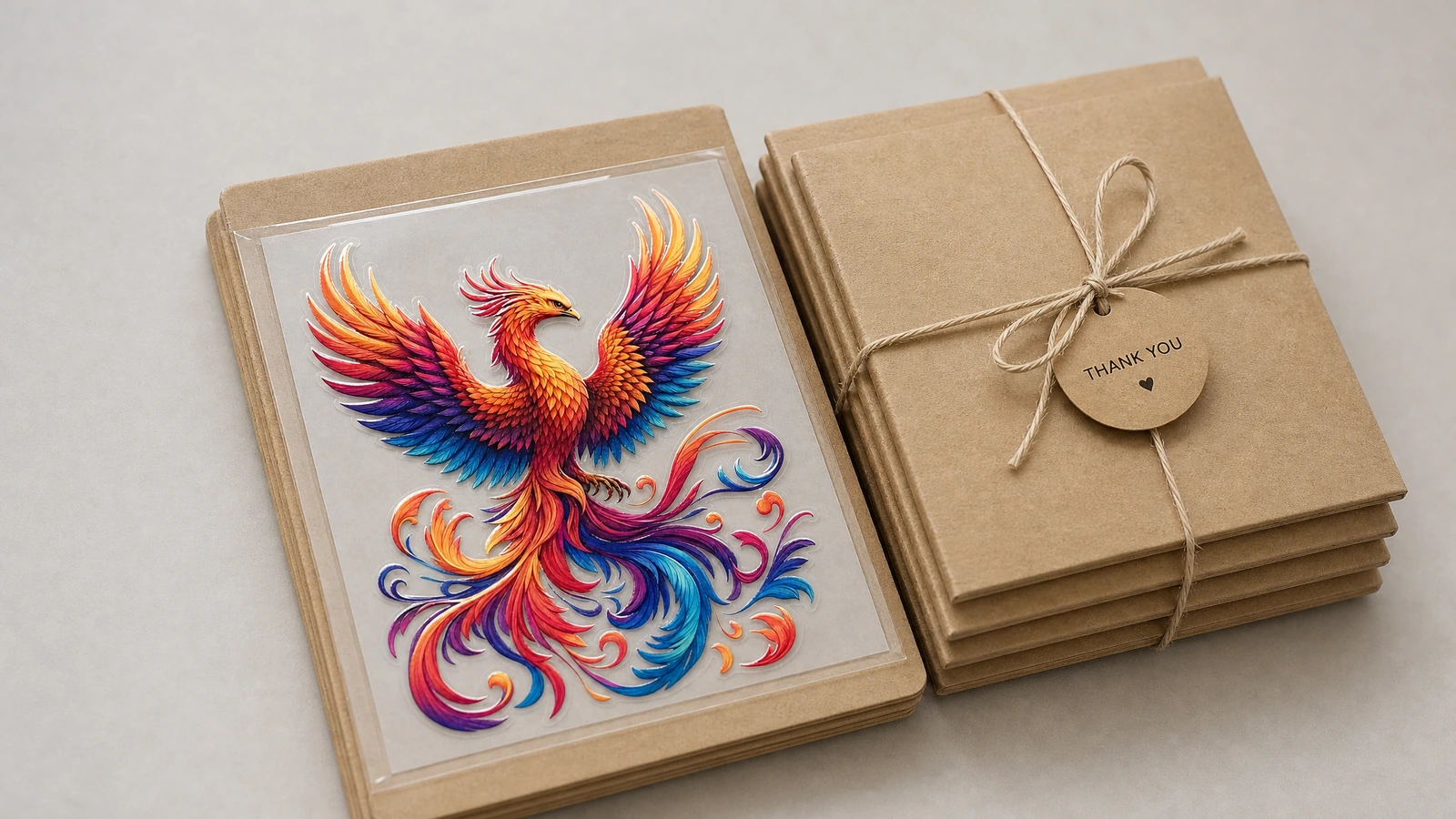
| Option | Best fit | Visible backing | Main limit |
|---|
| UV DTF transfer decals | Many designs, small runs, curved hard goods | None; image only | Hand-wash expectation; rough or flexible surfaces fail |
| Printed vinyl or paper labels | Flat packaging, jars, automated labeling | Yes, film or paper edge | Visible border; edge peel on rough items |
| Direct UV printing | Fixed position, flat or fixture-held items | None | Needs equipment, fixtures and per-item setup |
| Screen printing | Large repeat runs, spot colors | None | Setup per color; poor fit for photo art |
| Garment DTF or heat transfer | T-shirts and textiles | None | Requires heat press; not for hard goods |
When to choose UV DTF. It fits best when you have many designs with low quantities each, when items are curved or already finished, and when no heat press is available.
When to choose direct print. Choose it when the mark must bond like paint. Practitioners call UV DTF "promotional in nature" and note that some customers paying a custom premium dislike receiving what looks like a sticker[17].
When to choose labels. Choose labels when you need regulatory text panels or automated application.
Compliance is a separate check. Some ink makers publish compliance announcements. Lawson, for example, states that its UV DTF inks gained CPSIA and California Proposition 65 certification[20]. A statement like that covers a specific ink only. It does not cover your finished decal, your surface or your use. Buyer guides list the rules to check: REACH, RoHS, EN 71-3 for children's items, and FDA 21 CFR 175.300 for indirect food-contact coatings[21]. They also advise requesting SDS files. Make no compliance claim for this decal unless the documents match the ink batch and the end use. Never place decals on inside surfaces that touch food. Licensed characters need permission from the rights holder.
What Should You Confirm About Packaging, Lead Time and Reorders? ↑
Packaging. Before application, UV DTF sheets are sensitive to heat, light and folding. Packaging should keep sheets flat, shaded and cool in transit. Include care instructions for the end user: wait 24 hours, hand wash, no dishwasher, microwave or abrasive pads, and not for fabric.
Lead time. For comparison, US print services that charge by the square inch publish fast turnarounds. One says UV DTF orders are typically produced and shipped within one business day[22]. Cross-border production usually adds weeks of transit. For NSKU-615-02, production time, MOQ, unit weight and packaging format are set in the written quotation. Check them against your launch or event date before approving the sample.
Reorders. Keep three things fixed between orders:
The approved file version, including its white layer.
The approved applied sample.
A note of the surface and coating batch it was tested on.
If a tumbler supplier changes its powder coat or a candle jar changes its glass, re-run the peel and edge tests before releasing a new batch.
Key Takeaways: What Matters Before You Order ↑
- The UV DTF market is growing from a small base — US$247 million (2025) to US$483 million (2032), 10.2% CAGR per QY Research (Source)
- Buyers compare many low-priced listings — about 14,800 monthly Etsy searches; 75% of listings under $10 (Source)
- Durability is a range, not a promise — about 3–5 years indoors and 2–3 years outdoors, from seller experience (Source)
- The first wash must wait — 24 hours after application, then hand wash only (Source)
- Compliance statements cover specific inks, not finished decals — CPSIA and Prop 65 announcements apply only at the ink level (Source)
- Order terms depend on your quote — MOQ, production time and unit weight for NSKU-615-02 are set in your written quotation
Ready to Validate Your Design on Your Own Item? ↑
Custom UV DTF transfer decals give small brands, print shops and event teams full-color, weed-free branding on tumblers, jars, bottles and acrylic signs, with no heat press. That only works when the surface, artwork and care expectations are set honestly. The reliable path is the one laid out above: screen the surface, check the white layer, test a sample on the real item, and write pass criteria into the order.
Send your artwork, target item, quantity per design and intended use to request a quotation and sample test for NSKU-615-02.




The information below is required for social login
Sign In
Create New Account