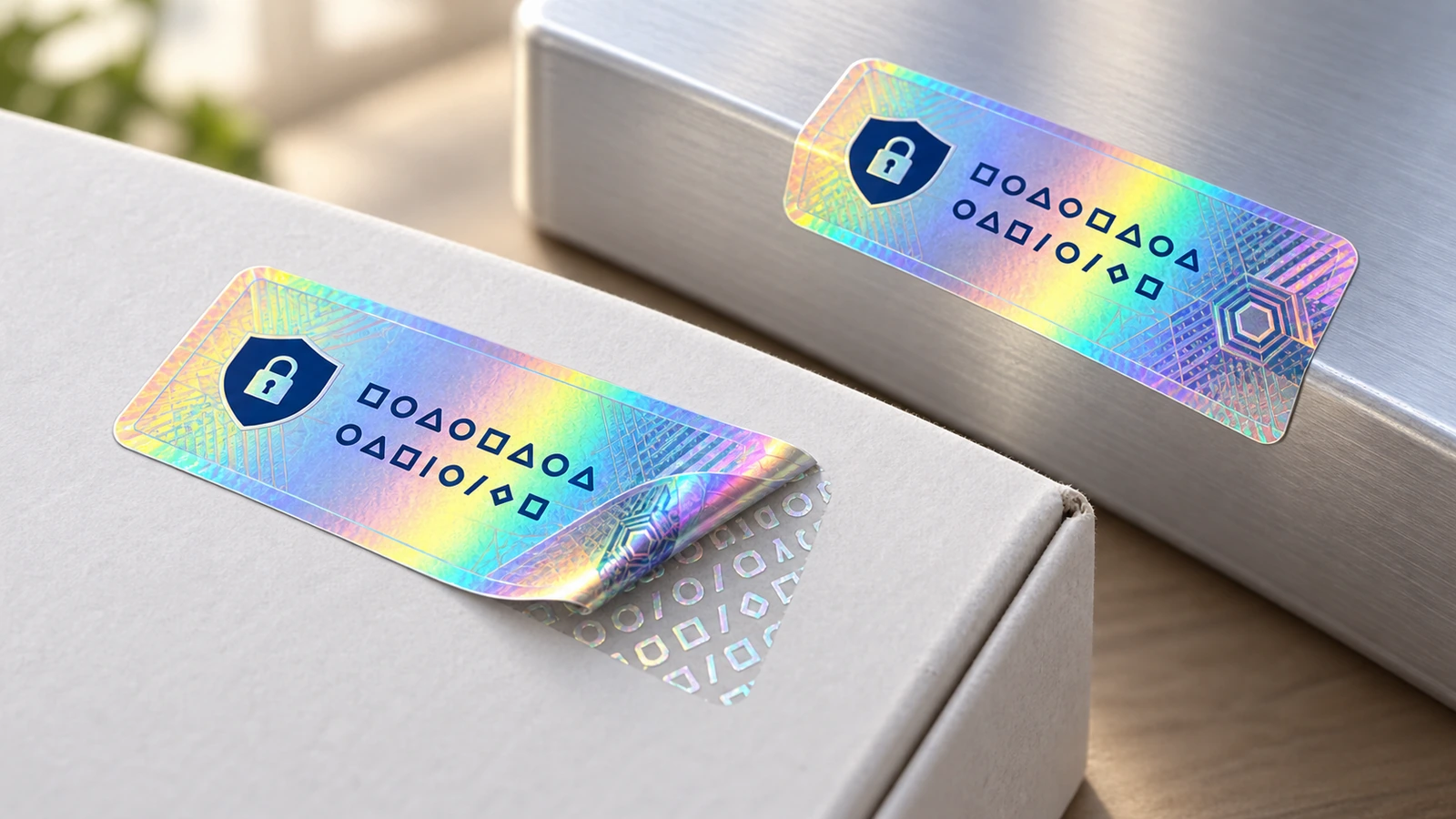
Custom VOID hologram labels combine a brand-specific optical hologram with a patterned release layer. When someone peels the seal, a "VOID," "OPENED," or brand message transfers to the surface and the label destroys itself. This gives warranty, quality, and packaging teams visible evidence of opening that can be photographed, as long as the construction matches the substrate and passes testing on real packs.
Who Uses These Seals, and Where Do They Earn Their Place? ↑
The people who order VOID-transfer hologram security labels are rarely end consumers. They are brand-protection managers, packaging engineers, quality and regulatory staff, and procurement leads. Each of them has to answer one question at the receiving dock or the returns bench: has this product been opened since it left our line? The decision usually crosses several functions. Marketing wants a distinctive optical look. Quality sets the substrate and peel specification. Procurement compares samples and lead times.
Typical placements include laptop cartons, screw covers and battery doors on electronics, where a returned unit showing VOID supports a claim review. They also include caps and cartons for supplements, cosmetics, and over-the-counter products, control modules and diagnostic ports on auto parts, and logistics cartons or evidence bags. In the US drug channel, 21 CFR 211.132[1] requires most retail OTC human drugs to use tamper-evident packaging. Under that rule, an indicator or barrier must provide visible evidence when breached or missing, and it must carry a distinctive feature such as a pattern, name, registered trademark, logo, or picture. The regulation does not mandate holograms. A custom optical image is one practical way to satisfy the "distinctive and hard to reproduce" expectation.
Scope note: these labels are intended for your own products, packaging, assets, and documents. We do not produce overlays that imitate government IDs, driver's licenses, passports, or payment cards.
Why Do Cheap Tamper Seals Fail Exactly When You Need Proof? ↑
The problem is real and growing. The OECD–EUIPO study Mapping Global Trade in Fakes 2025[2] estimates global trade in fakes at USD 467 billion in 2021, or 2.3% of world trade. In 2024, EU customs and enforcement authorities detained about 112 million counterfeit items[3] worth an estimated EUR 3.8 billion. Fraudulent returns, swapped contents, and grey-market diversion all exploit the same gap: packaging that cannot show whether it was opened.
The agitation comes from seals that only look secure. One US buyer of a low-cost hologram VOID sticker wrote that the labels were hard to peel from the liner and stuck to fingers[4], triggering VOID before application. Even when applied, they "can be completely peeled off with no evidence." Other reviewers report remnants on plastic bags "so small and barely noticeable" that the same sticker could be pressed back down unnoticed. A materials overview from Triton Store[5] explains the mechanics. Labels fail on low-surface-energy plastics such as PE and PP, on oily metals, and on textured, curved, dirty, or humid surfaces. Determined attackers can also use controlled heat, cold, or solvents to lift generic, low-spec labels without triggering the VOID effect. Add reused serial numbers or a stock rainbow foil that anyone can buy, and the "security" seal becomes decoration.
The solution is to treat the label as an engineered component. Choose the transfer mode for where the evidence must appear. Match the adhesive to your real substrate. Use a brand-specific hologram with controlled, non-repeating serials. Approve production only after peel tests on your own packs. The rest of this page walks through each decision.
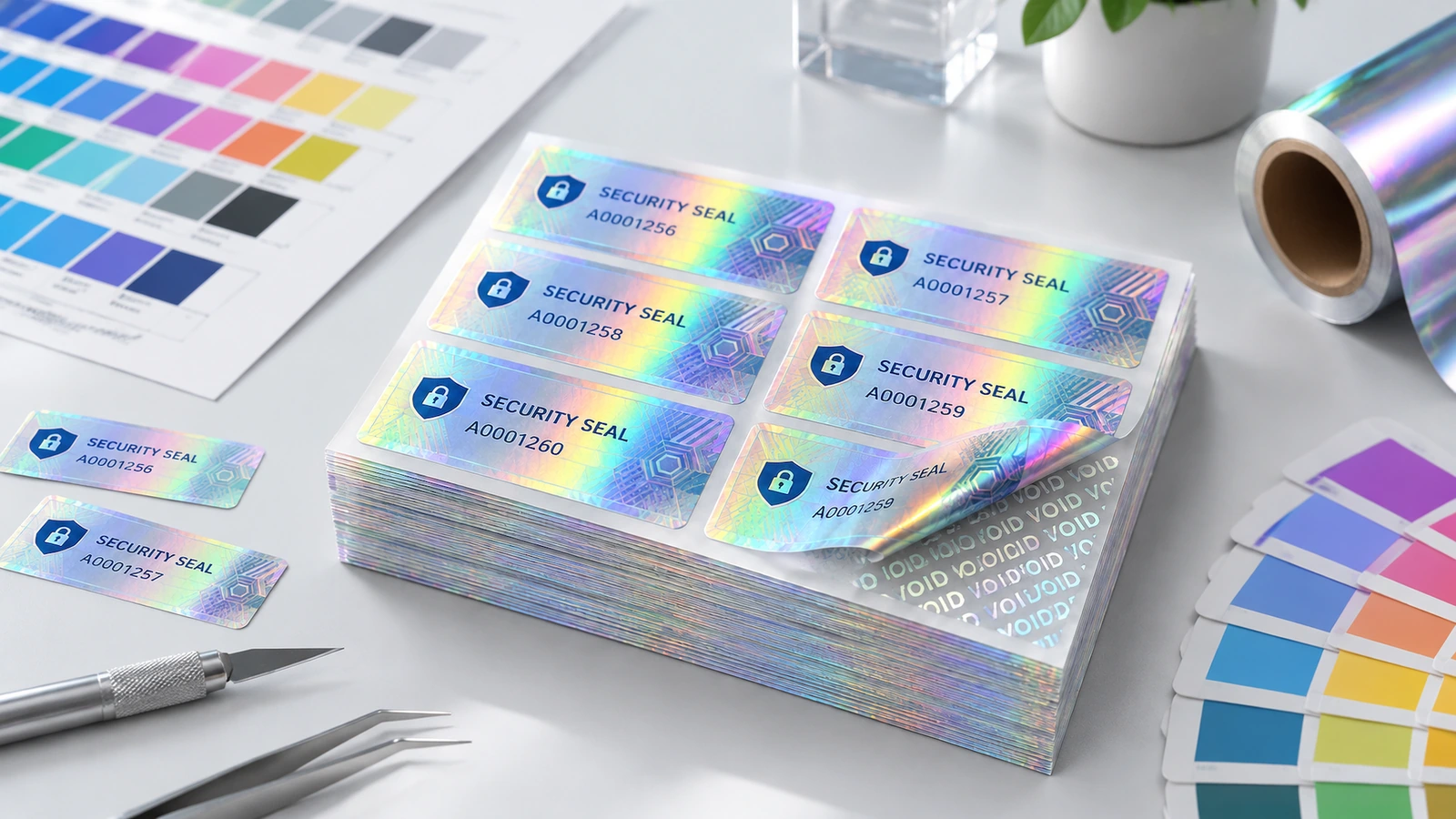
Table of Contents
What Exactly Is a VOID-Transfer Hologram Security Label? ↑
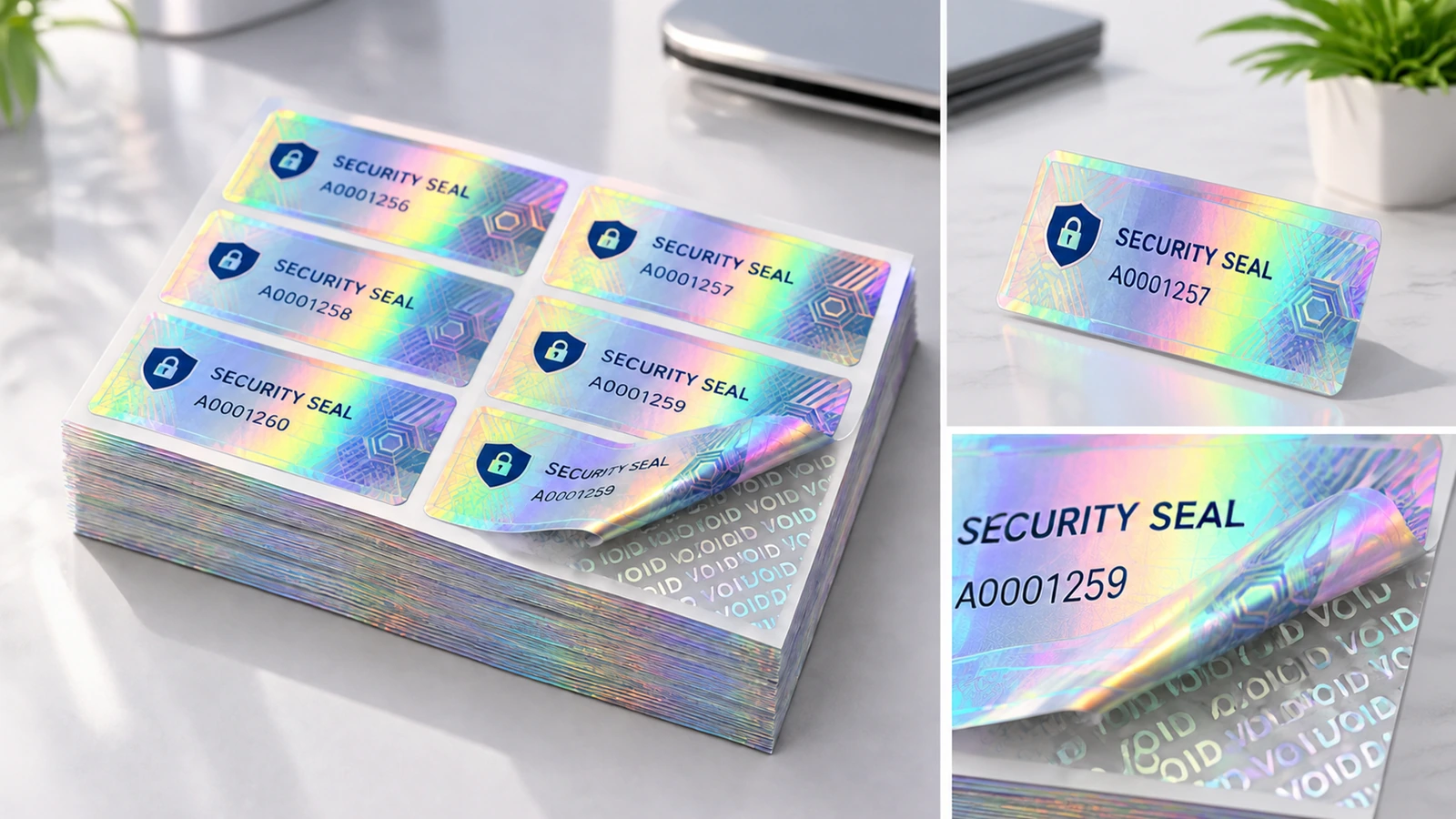
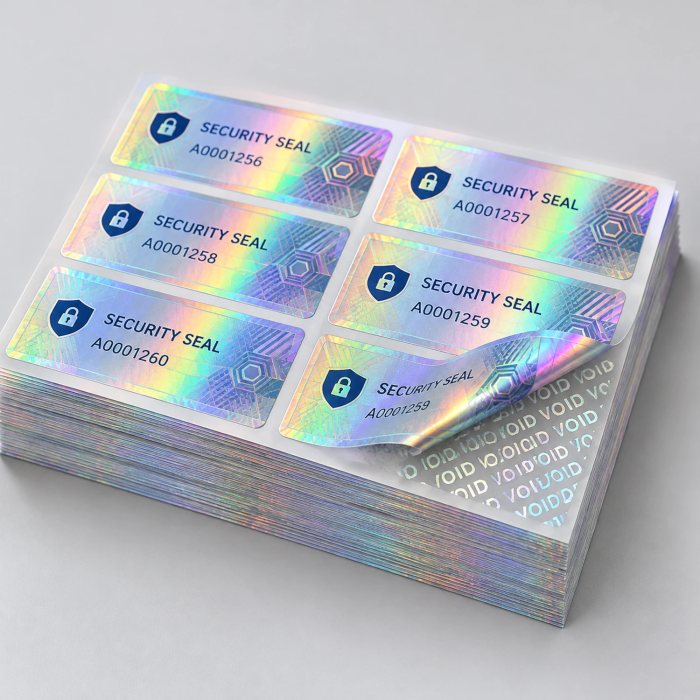
A VOID-transfer hologram security label is a multi-layer construction. From top to bottom, it has a holographic polyester facestock, a hidden pattern-printed release layer that carries the message, an aggressive pressure-sensitive adhesive, and a silicone release liner. The adhesive is designed to bond to your substrate more strongly than the label's own internal layers bond to each other. When someone lifts the label, the release layer fractures along its preset pattern. Part of the metallized layer stays on the surface as "VOID," "OPENED," a checkerboard, or a short brand word, and the hologram on the facestock is destroyed.
The EUIPO Anti-Counterfeiting Technology Guide[6] describes the same principle. Once the film is removed, the label's integrity "cannot be restored." If someone wipes the message off the product, the alert still shows in negative when the label is re-affixed. EUIPO also lists warranty goods, rentals, items under repair, and supply-chain integrity monitoring as core uses, and notes that costs rise with the level of customization.
The two layers do different jobs, and buyers often merge them. According to Protego Seal's technical explainer[7], the laser-originated hologram deters copying with standard printers or scanners, while the pre-patterned release layer provides the opening evidence. A decorative hologram sticker has the first function without the second, so it peels off cleanly. A plain VOID label has the second without the first. Your specification should state which outcome you need from each layer.
How Do You Specify, Proof, and Approve a Custom Order? ↑
The sequence below follows a typical request-for-quote path. MOQ, production time, unit price, and unit weight for this SKU (NSKU-689-01) are not published. They are confirmed in a written quote after artwork review, and lead time depends heavily on whether a new holographic master is required. Use the table to make sure your inquiry is complete on the first pass.
| Field | What to specify | Why it matters |
|---|
| Target substrate | Coated carton, PE/PP film, glass, painted or powder-coated metal, textured plastic | Adhesive choice depends on surface energy and texture |
| Transfer type | Full, partial, or non-transfer | Determines whether evidence stays on the product, the label, or both |
| Message | VOID, OPENED, SEAL BROKEN, or short brand word | Character limits scale with label size |
| Hologram | Stock pattern or brand-specific master | Exclusive imagery raises the copying barrier |
| Variable data | Serial numbers, barcode, QR; numbering rule | Non-repeating ranges preserve traceability |
| Size and shape | Dimensions in mm, corner radius, seam it must bridge | The seal must span the opening with adhesive on both sides |
| Format | Rolls (core, direction) or sheets | Matches manual or automatic application |
| Environment | Indoor/outdoor, cold chain, heat, solvents | Defines the peel and aging tests |
| Annual volume | Forecast and first-order quantity | Drives master, tooling, and pricing decisions in the quote |
Treat this table as the minimum content for a purchase order. Missing substrate or transfer-type details are the most common cause of a sample that looks right but fails on the line, because those two fields decide whether the VOID effect activates at all.
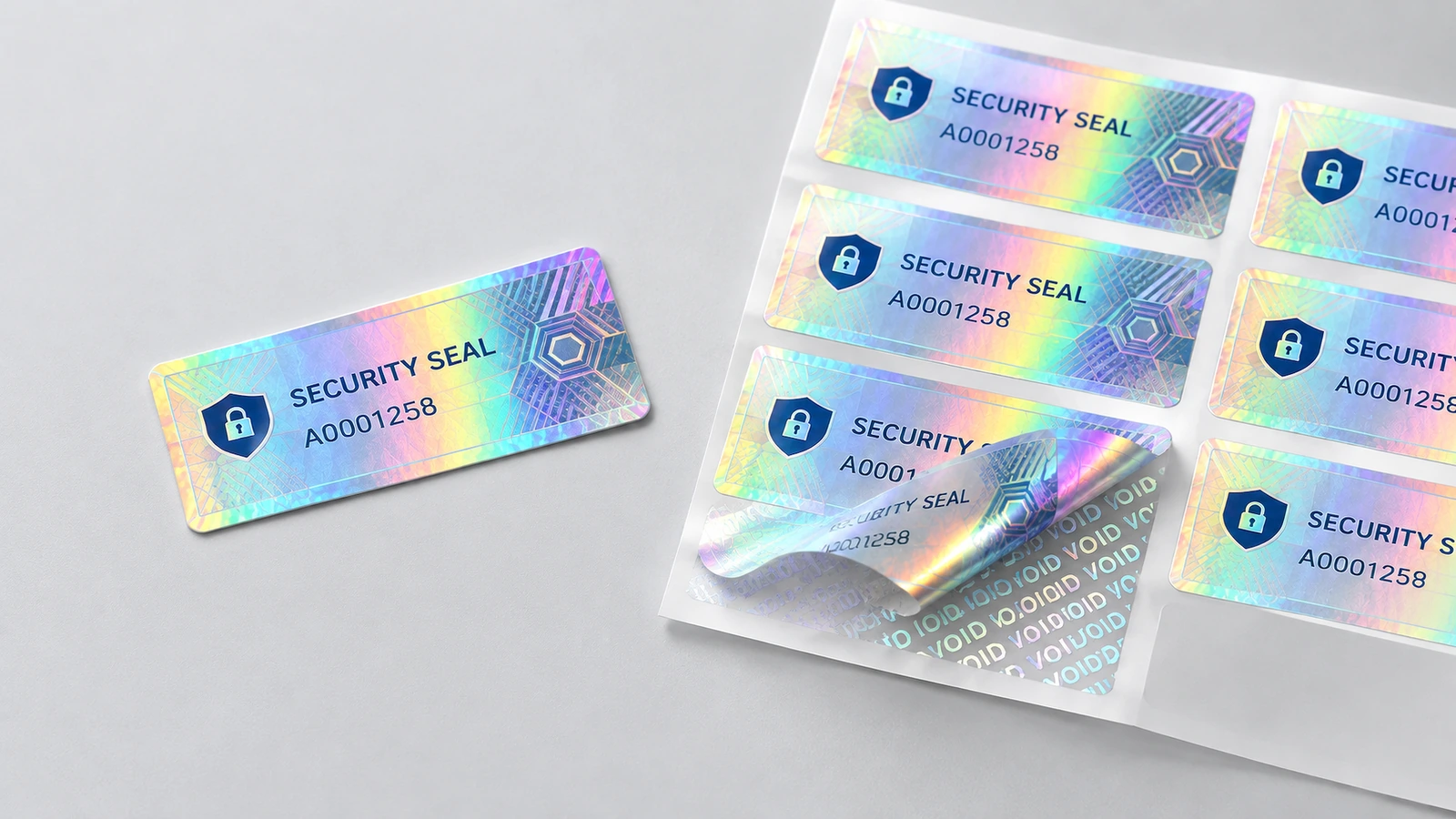
Step 1: Size the seal and message for readability
Readability matters because the evidence will often be judged from a customer photo or a returns-desk snapshot. The label has to bridge the actual opening, such as a lid-to-body seam, a screw head, or a carton flap, with enough bonded area on each side to force a fracture rather than a clean lift. Message height and repeat frequency must leave a legible fragment even if only part of the label is disturbed. As a published reference, Holoseal's VOID hologram specification[8] lists 23 or 36 micron PET films and custom VOID text of roughly 10–15 characters depending on label size. Those figures are one supplier's values. The film, character count, and minimum legible size for your order are fixed during proofing.
Step 2: Match surface, adhesive, and backing
Low-surface-energy plastics, oily metal, texture, curves, contamination, and humidity are the failure triggers described above. Clean, dry, and press each label firmly, then allow dwell time before judging performance. Spanish label converter Lit-Off[9] notes that the VOID effect can take up to 24 hours of adhesive cure, and that early removal weakens it or stops it from appearing. Lit-Off also points out that a VOID seal proves opening but cannot stop someone from swapping contents and applying a new label, which is why serialization matters. The liner must release cleanly. Handle labels by the edge or with an applicator, because finger contact with the adhesive side can trigger VOID before the label ever reaches the product. In cold rooms, condition packs to the agreed application temperature first.
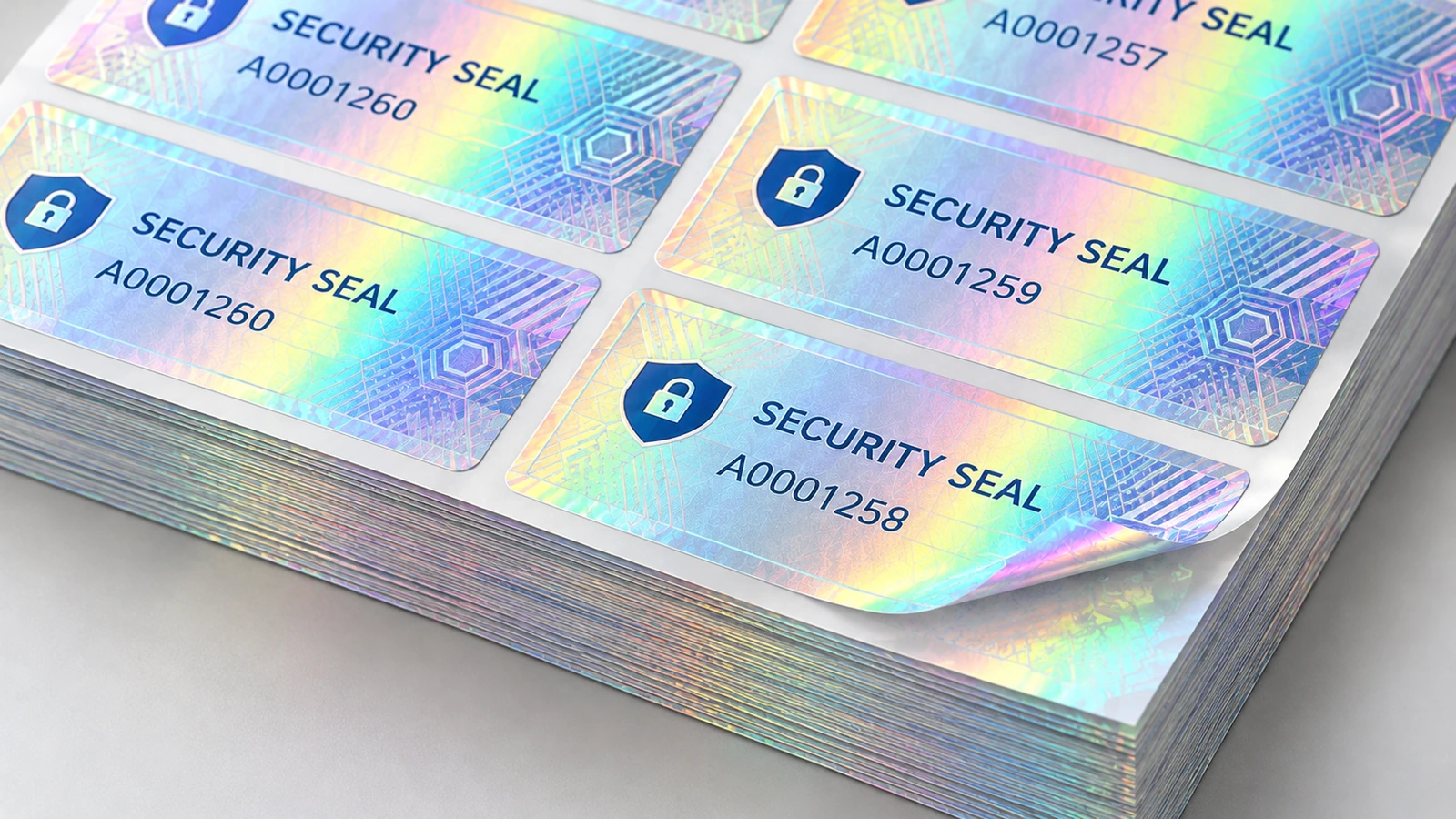
Step 3: Preflight artwork and security features
Supply vector logos, the exact VOID wording, and a written numbering rule covering start value, prefix, check digit, and QR destination. Keep covert features such as microtext or UV elements on a separate restricted list rather than in widely shared source files. If exclusive imagery matters, ask whether the hologram can be registered. The IOTA Security Image Register[10], renamed from the Hologram Image Register in January 2024, is run by the ICC Counterfeiting Intelligence Bureau and aligned with ISO 14298 security requirements. Registration helps prevent two customers from unknowingly sharing the same optical image.
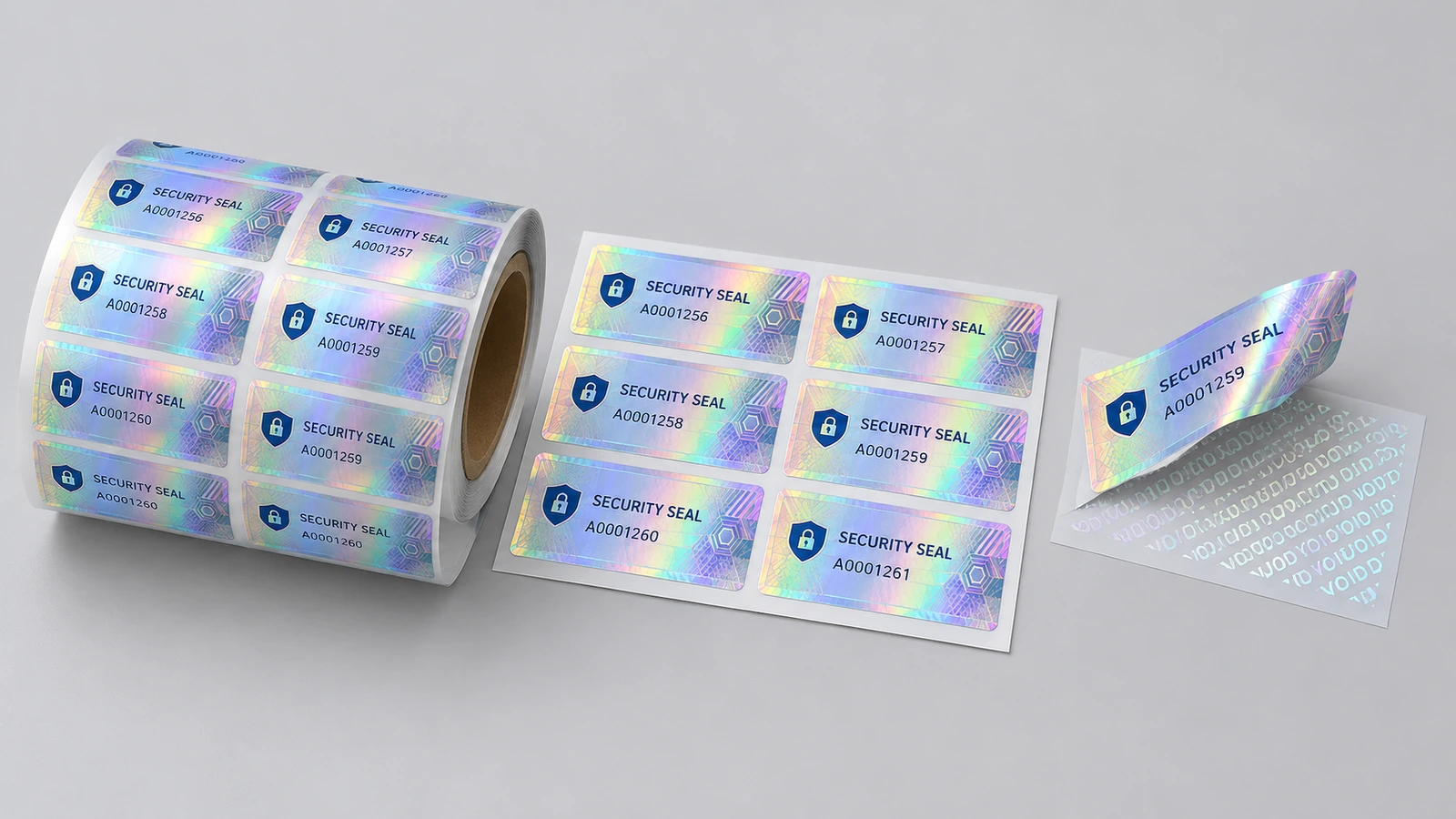
Step 4: Understand the production route
A true security hologram is not rainbow ink. The usual route is optical origination, then a nickel shim, then embossing onto PET film. After that comes metallization or selective demetallization, then the patterned release coat and adhesive, and finally die-cutting into rolls or sheets. A brand-specific master is what adds lead time, so ask who holds custody of the master and the shims. ISO 14298:2021[11] sets requirements for a security printing management system, covering how masters, materials, waste, and deliveries are controlled. It does not define optical quality. If any supplier claims this certification, check that the certificate scope covers hologram origination and VOID materials, not only general printing. Certifications for this SKU are not asserted here; request current documents with your quote.
Step 5: Inspect and accept on your own packs
Laboratory flat-panel results do not predict behavior on a coated carton corner. Specialist printer Securikett[12] describes requesting the customer's original packaging and testing under defined conditions before release, and that is the right model. Send real packs and run the checks below on first samples and on each new lot.
| Check | Method | Pass criterion |
|---|
| Dwell | Apply, press, wait the agreed cure time | No edge lift before testing |
| Peel | Slow and fast removal at several angles | Agreed message visible on surface and/or label |
| Re-apply | Press removed label back in place | Disturbance still obvious to an untrained viewer |
| Stress attempt | Controlled warm or cold removal on retained samples | Evidence documented; results inform layering decisions |
| Serial audit | Compare printed ranges with the issued list | No duplicates or gaps outside the agreed rule |
| Optics | View at multiple angles against the signed sample | Visibility and diffraction direction match the approved proof |
| Finish damage | Inspect painted or cosmetic surfaces after removal | Residue type matches the chosen transfer mode |
Record substrate photos, before-and-after peel images, and lot numbers for each test. Agree on rejection criteria in writing, covering hologram visibility, rainbow direction, and VOID character height. That way, a sample that looks bright online but performs poorly in hand is caught before mass production rather than after delivery.
Step 6: Pack, ship, and control reorders
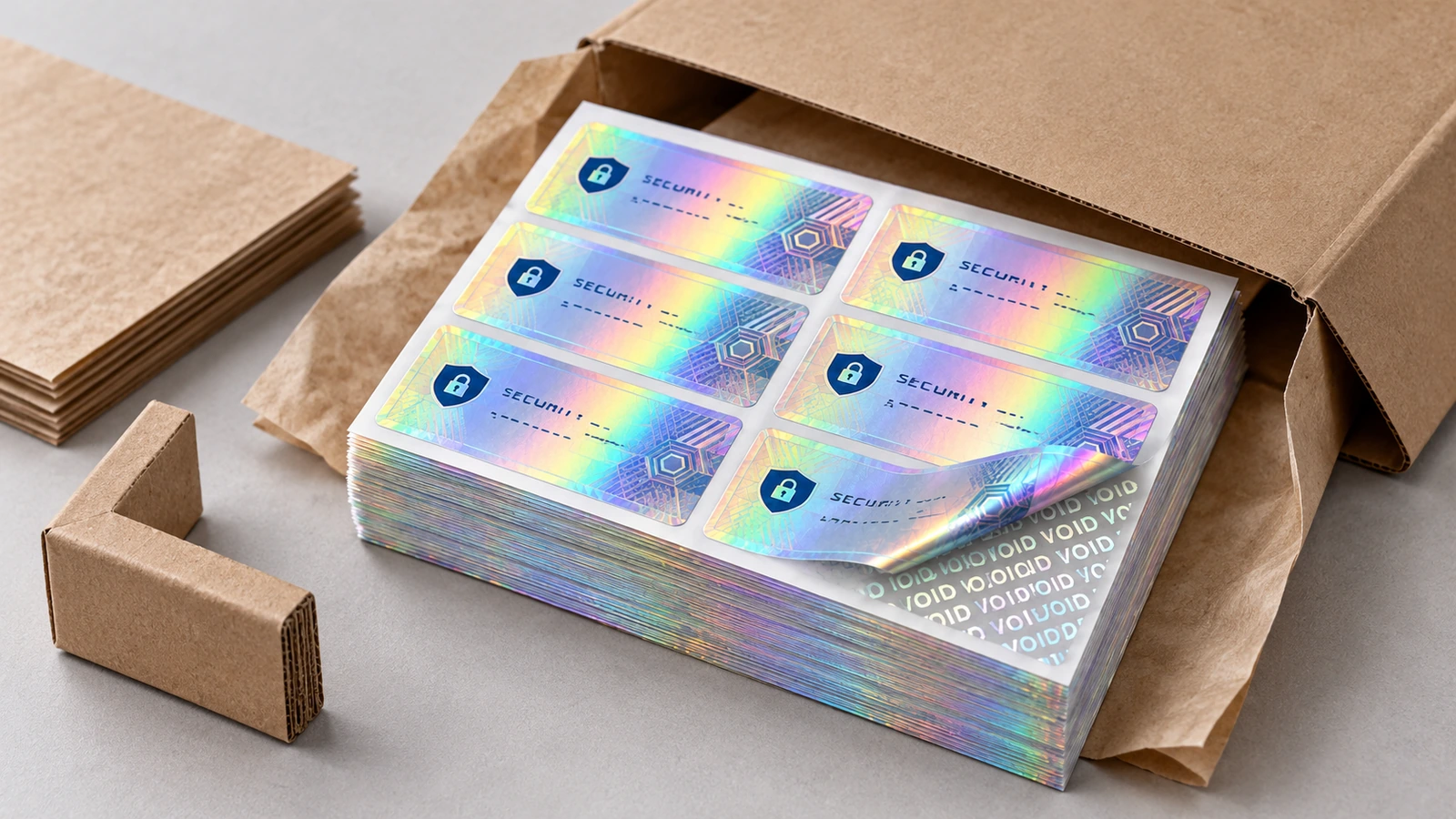
Genuine labels in the wrong hands are harder to detect than fakes. UL has published notices of lost holographic labels[13], including 1,000 gold labels reported missing in 2018, which would pass routine visual checks if used without authorization. Ship labels with serial-range manifests, keep unused stock under sign-out control, and destroy rejects with a record. Store rolls cool and dry. On reorders, reference the same master ID and continue numbering from the last issued value, so that reorders never repeat a range.
Which Transfer Type Fits Your Surface and Evidence Needs? ↑
| Option | Where evidence appears | Best for | Watch-outs |
|---|
| Full transfer | Message and adhesive stay on the product | Cartons, export boxes, one-time warranty seals | Residue can mark premium or painted finishes |
| Partial transfer | Split between label and surface | Retail cartons, test kits | Some cleanup still required |
| Non-transfer | Mainly on the label film | Electronics housings, devices, reusable containers | The removed label must be kept as evidence |
| Decorative hologram (no VOID) | None; peels cleanly | Branding and shelf appeal | No opening evidence at all |
| High-spec polyester seal | Self-destructing hologram with high residue | IT and lab assets | Higher cost; ratings are supplier- and surface-specific |
Start with where the proof must live. If inspectors check the product surface, choose full transfer. If the surface must stay clean, choose non-transfer and train staff to keep the removed label. Temperature claims do not carry across suppliers. NovaVision's application notes[14] list 0.002-inch polyester, release coverage over 90% of the label area, and service from about −50°F to +240°F for one product and up to +300°F for another. Those figures come from lab tests on stainless steel, and NovaVision states that its customers' FIPS applications still require independent lab testing. Use figures like these only as a prompt for your own tests on your own painted or powder-coated surfaces.
What Can You Safely Claim About Standards and Warranty Wording? ↑
No single product standard certifies a "VOID hologram label." ISO 22383:2020[15] provides guidelines for selecting and evaluating authentication solutions across a product's life cycle, starting from a risk analysis. It does not rank holograms or VOID patterns. In the EU, Delegated Regulation (EU) 2016/161[16] requires prescription medicine packs to carry both a unique identifier and an anti-tampering device. A VOID seal can serve as the anti-tampering element, but it cannot replace serialization. NIST FIPS 140-3[17] covers cryptographic modules, not consumer seals. Never describe a label as "FIPS certified" or "FDA approved" on its own.
Warranty wording carries legal risk in the US. In 2018 the FTC sent warning letters to companies including Microsoft, Nintendo, and Sony over warranty terms of the "void if removed" type, as reported by The Verge[18]. For US consumers, messages such as OPENED, SEAL BROKEN, or TAMPER EVIDENT are safer than WARRANTY VOID IF REMOVED. Keep warranty terms in documents reviewed by legal counsel. Finally, avoid "impossible to copy" or "cannot be removed" claims. VOID seals deter casual tampering and work best as one layer alongside exclusive optics, unique serials, and an inspection procedure.
What Are the Key Takeaways for Buyers? ↑
- Counterfeit pressure justifies opening evidence on high-value goods — USD 467 billion in fake trade in 2021, 2.3% of world trade (Source)
- Enforcement volumes keep rising — about 112 million counterfeit items worth EUR 3.8 billion detained in the EU in 2024 (Source)
- US OTC drug packaging must show visible evidence and carry a distinctive feature — 21 CFR 211.132 (Source)
- Test only after the adhesive has cured — VOID effect may need up to 24 hours (Source)
- Message length is limited by label size — roughly 10–15 characters on one supplier's 23/36 micron PET labels (Source)
- Temperature ratings are supplier- and surface-specific — −50°F to +240°F on stainless steel for one product line (Source)
How Do You Start a Sample and Quote? ↑
A reliable tamper-evident seal depends on choices made before printing: the right transfer mode, an adhesive matched to your real surface, a brand-specific hologram, controlled serial numbers, and peel tests on your own packaging. MOQ, production time, pricing, and certifications for this SKU are confirmed in writing after artwork review and sampling, not assumed from catalog figures. Send your substrate type, seal dimensions, VOID message, numbering rule, and annual volume to request a sample and written quote for your custom VOID hologram labels.




The information below is required for social login
Sign In
Create New Account