Custom temporary tattoo stickers are water-transfer decals printed from your own artwork, such as logos, names, photos, or illustrations. The design moves onto clean skin when you wet the backing, and it usually fades within days. Results depend on four things: file resolution, compliant colorants, where the tattoo is placed on the body, and a skin-tested sample before full production.
Who Orders Custom Temporary Tattoos, and for Which Moments? ↑
Most orders start with a fixed date. A 2025 market study[1] attributes about 64.8% of temporary tattoo market value to personal consumption. It puts adult applications at 38.2% and children aged 5–14 at 36.1%. Custom sheets therefore lean toward adult celebrations and branded moments more than generic kids' packs.
Four buyer groups dominate:
- Party and milestone organizers, such as bachelorette hosts, birthday planners, and couples making wedding favors. They turn save-the-date art, pet portraits, names, and inside jokes into a few dozen to a few hundred pieces that must photograph well on the day.
- Parents and school volunteers. They want designs that apply fast, peel cleanly, and come with ingredient information they can check.
- Brand, sports, and event teams. They need logos, slogans, or mascots for festivals, game days, launches, and sampling. One liqueur brand produced 50,000 tattoos for a European summer festival[2] so its design would spread across skin, photos, and social feeds.
- Illustrators, bands, and market-stall sellers. They order short runs to bundle with stickers and pins.
A newer request comes from athletes who sell sponsor spots. They need the logo on their arm by race day, and it has to survive the race.
Why Do Custom Tattoo Orders Disappoint, and How Do You Prevent It? ↑
The most common failure is not a tattoo that refuses to apply. It is the gap between the promise and the result on skin. One Trustpilot reviewer[3] was told a design would last 9–15 days. They applied it on Monday morning, and by Tuesday it was peeling and rubbed away. The same review page records a custom order that took almost a month to arrive.
A buyer from another brand got prints in a "very light grey/blue" with little detail, yet the same design worked on a friend[4]. Skin chemistry, skin oil, and placement all change the outcome.
For an organizer, each of these problems hits an immovable date. A late shipment cannot be fixed after the party. A blurry photo cannot be reprinted on site. A guest with irritated skin turns a novelty into a safety question. The U.S. FDA[5] says it has received reports of adverse reactions to some decal temporary tattoos. It notes that ingredients helping the decal stick may cause problems for some people.
The fix is a step-by-step approval process, not bolder marketing claims. Each step must pass before the next starts: check the artwork file, approve a digital proof, test a physical sample on the planned body placement, collect colorant and adhesive documents, then release production.
This page has not yet verified the minimum order, lead time, sheet format, or wear time for these sheets. Each of those is treated as a quote or sample item, not a promise.
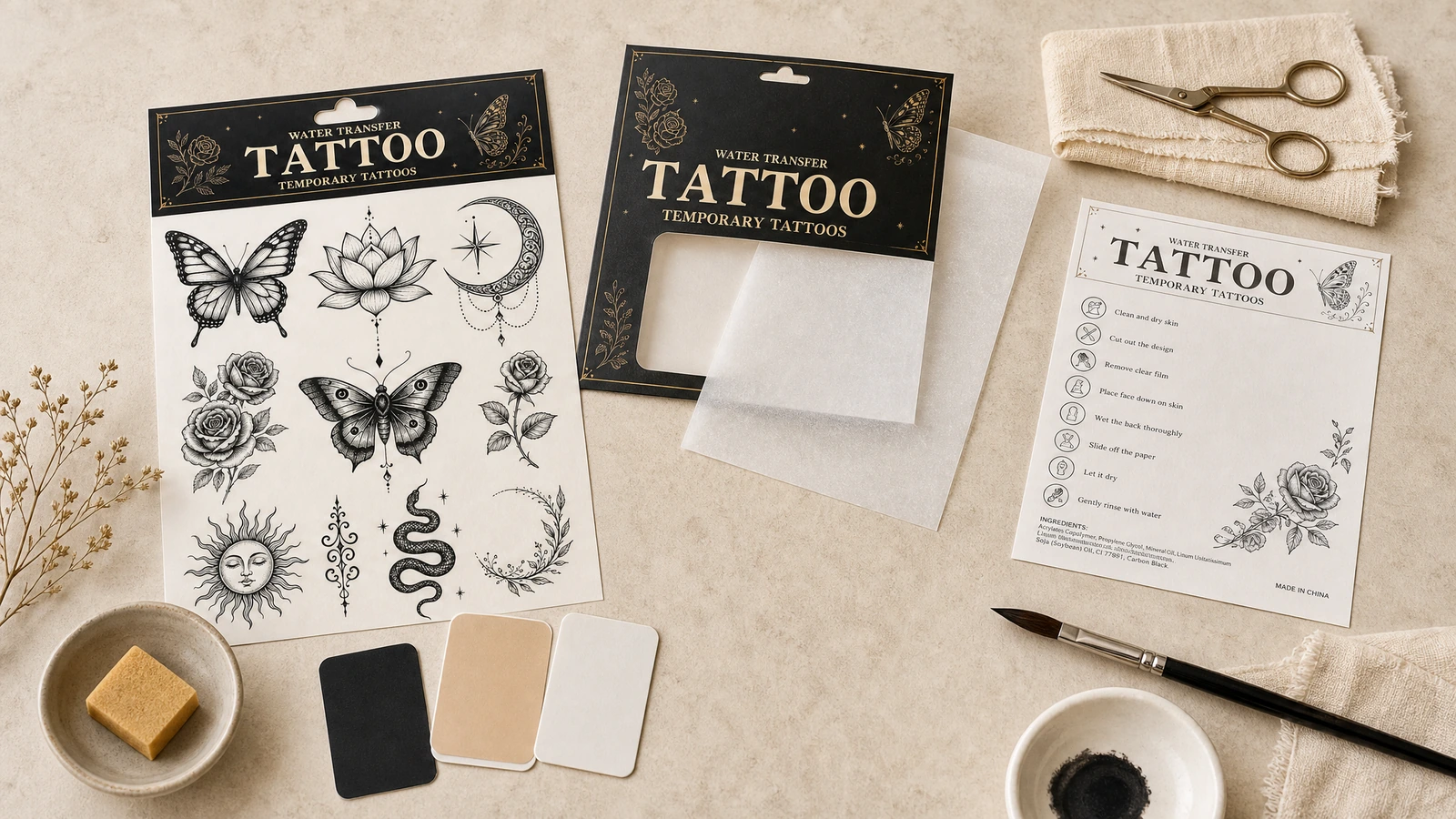
Table of Contents
What Exactly Are Custom Water-Transfer Temporary Tattoo Sheets? ↑
A water-transfer tattoo is printed in reverse onto a release-coated backing paper. A skin-contact adhesive layer and a clear protective film sit on top. To apply it, you remove the film, press the design face-down onto clean skin, wet the backing, and slide the paper off. Only the ink layer stays on the skin. FDA describes decal temporary tattoos as lasting "for a day or up to a week or more." That is the honest planning range for this format.
In the United States these products are regulated as cosmetics, not as needle tattoo inks. Every color additive must be approved for its intended use on skin. A temporary tattoo that breaks the color-additive rules is considered adulterated and cannot legally enter interstate commerce.
FDA does not pre-approve the finished product. As one supplier FAQ[6] puts it: "The FDA does not approve temporary tattoos. The FDA approves the color additives used in temporary tattoo products."
Labeling rules also apply. Retail units need an ingredient declaration under the Fair Packaging and Labeling Act, and 21 CFR Part 701[7] requires the name and place of business of the manufacturer, packer, or distributor. FDA keeps an import alert on certain foreign-made decals for unpermitted colors, missing ingredient lists, or labels that read "FDA approved."
Two other products are often confused with these sheets. "Black henna" often contains p-phenylenediamine (PPD), which FDA does not permit in cosmetics applied to skin and which is linked to serious skin reactions. Jagua semi-permanent kits stain the skin over several hours and fade over one to two weeks; they are a different product, and this page does not promise their look.
How Do You Size Artwork So It Stays Readable on Skin? ↑
Low resolution causes most "blurry" complaints. StickerGiant's waterless tattoo specification[8] recommends vector files (AI, EPS, or PDF). Raster files should be 300 DPI at final size, in CMYK color mode. A Sticker Mule photo guide[9] sets the same 300 PPI floor for non-vector files and sends every order through a digital proof. Screenshots and social-media downloads are usually compressed below that level, so flag them before proofing, not after printing.
Text size and spacing need the same care. StickerGiant requires text of 10 pt or larger. It leaves 0.25 inch between designs and 0.1875 inch from the sheet edge, and it does not support full bleed on its film. Treat these as market reference points only. The minimum text height, line weight, and spacing for these water-transfer sheets will be confirmed on the physical sample.
Color is the other variable. One reviewer reported that white ink came through clear[10] instead of opaque. Another buyer received a sample specifically to check colors on different skin tones. Proofs are judged against CMYK process color, never against the RGB colors on a phone screen.
Finish and backing options
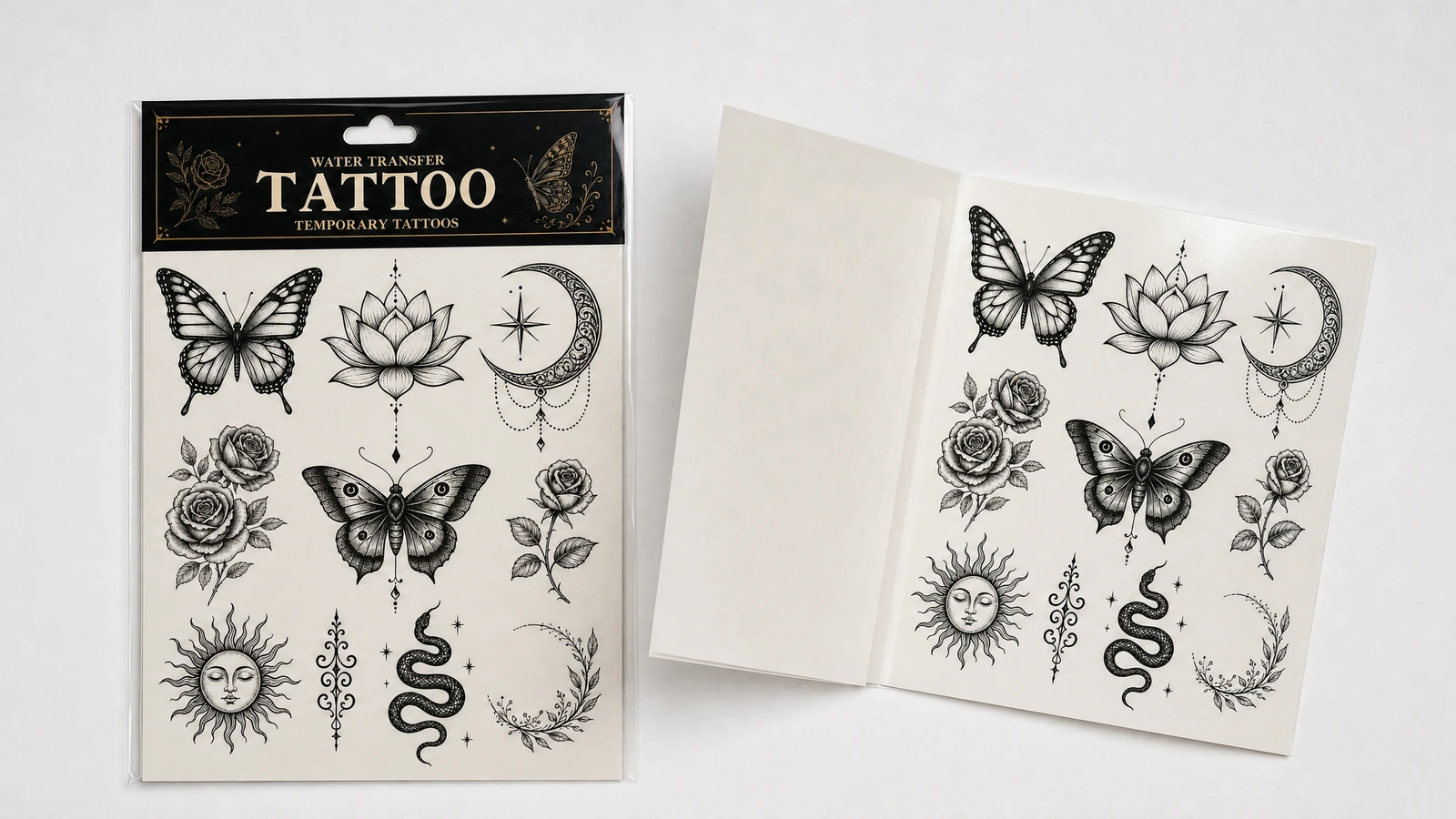
Two constructions dominate. Water-transfer paper leaves only ink and adhesive on the skin and is the low-cost route for full-color giveaways. Waterless cosmetic film presses on for about 30 seconds and leaves a thin film on the skin. FDA notes that an adhesive backing can act as a barrier between skin and dyes, but other ingredients may still bother some users, so both routes need adhesive documents.
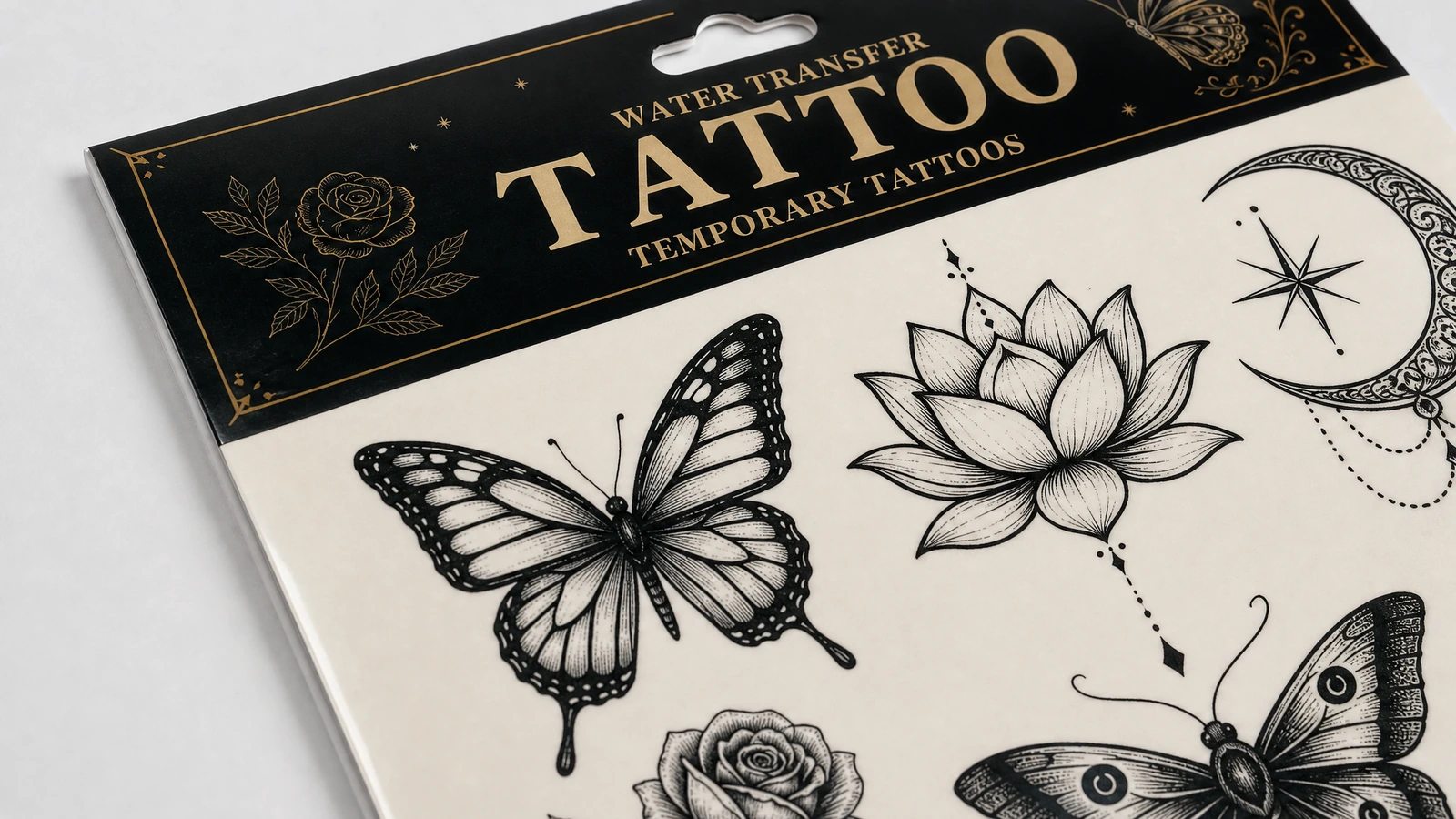
Gloss is the most frequent look-related complaint. "Looks like tape" appears often in reviews, and many buyers dust baby powder over a set tattoo to give it a matte finish. Rounded corners reduce edge lift. Metallic foil, glitter, glow, and scent add cost and raise extra ingredient questions. Each one needs its own colorant and adhesive file before approval.
| Placement | Friction level | Market-reported wear (water transfer) |
|---|
| Shoulder, upper back | Low | Upper end, around 4–5 days |
| Upper arm | Low to moderate | Within the 2–5 day range |
| Inner forearm | Moderate | Mid range; shortened by washing and sleeves |
| Wrist, hands, fingers | High | Lower end, around 1–2 days |
These ranges come from a temporary tattoo maker's wear-time guide[11]. They describe the format in general, not this product. Sweat, oily lotion, body hair, and sleeves all push results toward the low end. One Amazon reviewer saw a sleeve tattoo start peeling within four minutes on a forearm with moderate hair. Wear time for these sheets will be recorded on the buyer's own target placement during sampling.
How Does an Order Move From Upload to Finished Sheets? ↑
- Brief: event date, quantity, placement, audience, and destination market.
- File check: resolution, color mode, text height, line weight, and rights to the artwork.
- Digital proof: layout, cut lines, and spacing, kept to two revision rounds.
- Skin sample: applied on the real placement and rechecked after sweat and several hours of wear.
- Documents: colorant and adhesive declarations, ingredient list, and label draft.
- Production and inspection: printing, adhesive, film, die-cutting, and batch checks.
- Packing: flat packing, labels, and archived files for reorders.
Most disputes are prevented at the file check. Low-resolution uploads should trigger a written confirmation from the customer before proofing. Celebrity faces and licensed characters need proof of rights, because copyright problems surface after printing, when nothing can be undone. The approved proof then becomes the acceptance standard for the finished sheets.
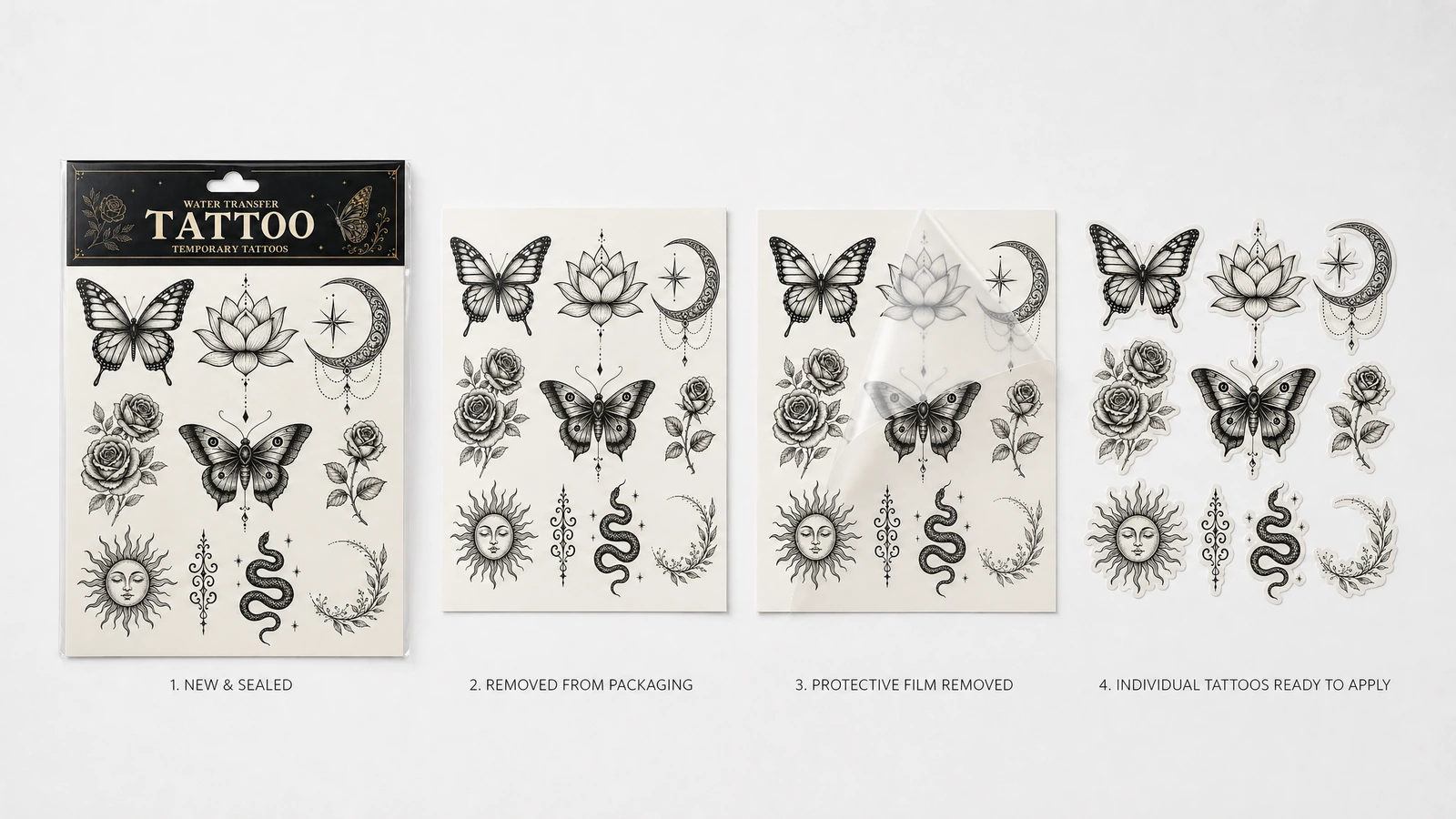
A published manufacturing sequence[12] runs in this order: plate-making, printing skin-friendly ink on transfer paper, applying skin adhesive, drying, laminating the film, die-cutting, and packing. White underlays and foil effects add drying and cutting time. Short inkjet runs are acceptable only with water-based inks made for skin. Office cartridges and solvent inks are excluded.
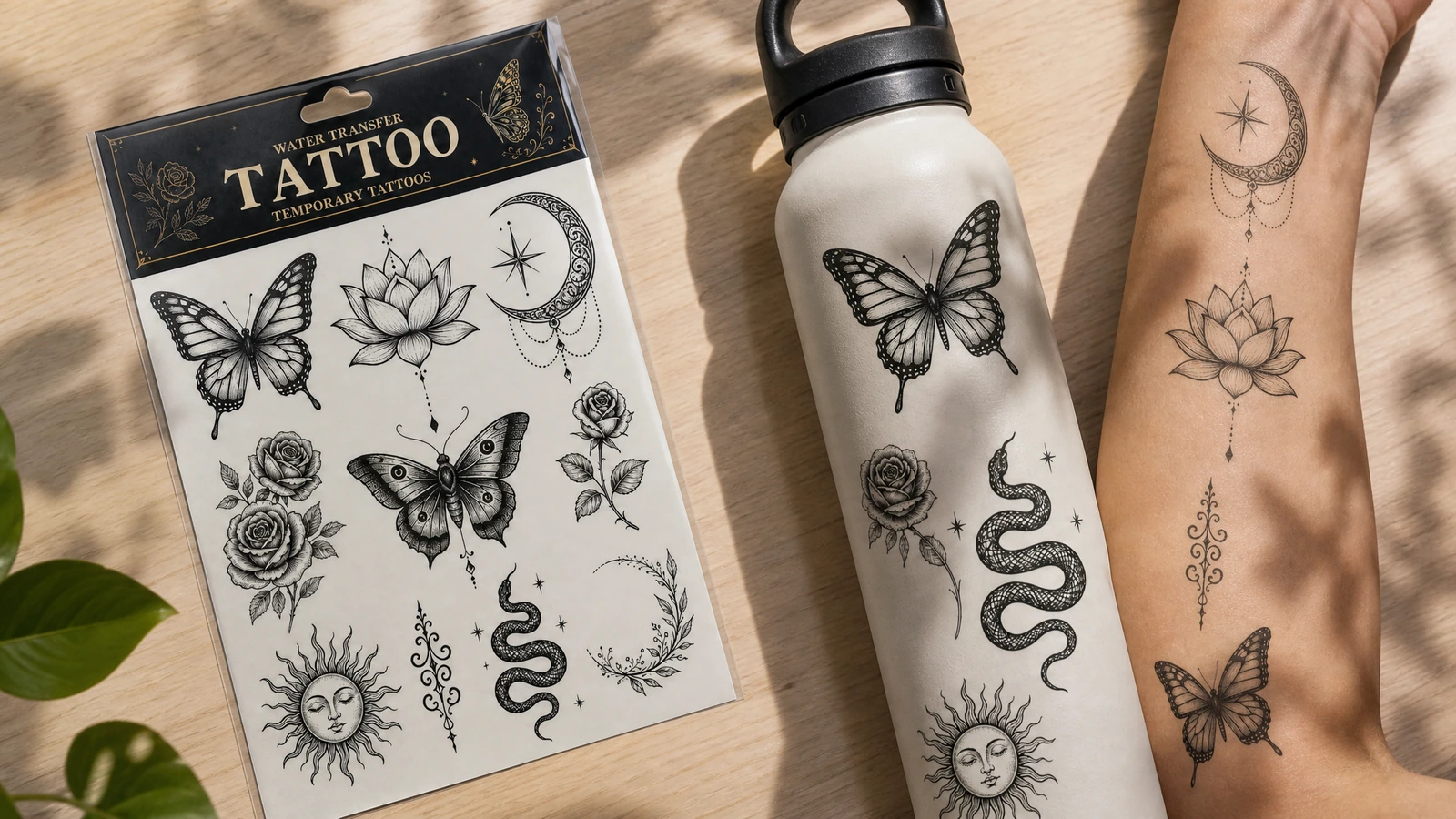
Inspection covers color registration, even adhesive coverage, clean release from the backing, die-cut burrs, white opacity, and odor. Odor matters more than it sounds. One Amazon reviewer reported a gasoline smell after an apparent formula change, with black ink fading to green in under a day. No skin-contact material should be printed without documents on file, such as a certificate of analysis or safety data sheet. ISO 22716 cosmetic good manufacturing practice is a useful benchmark, but it is voluntary and is not a certification of the tattoo itself.
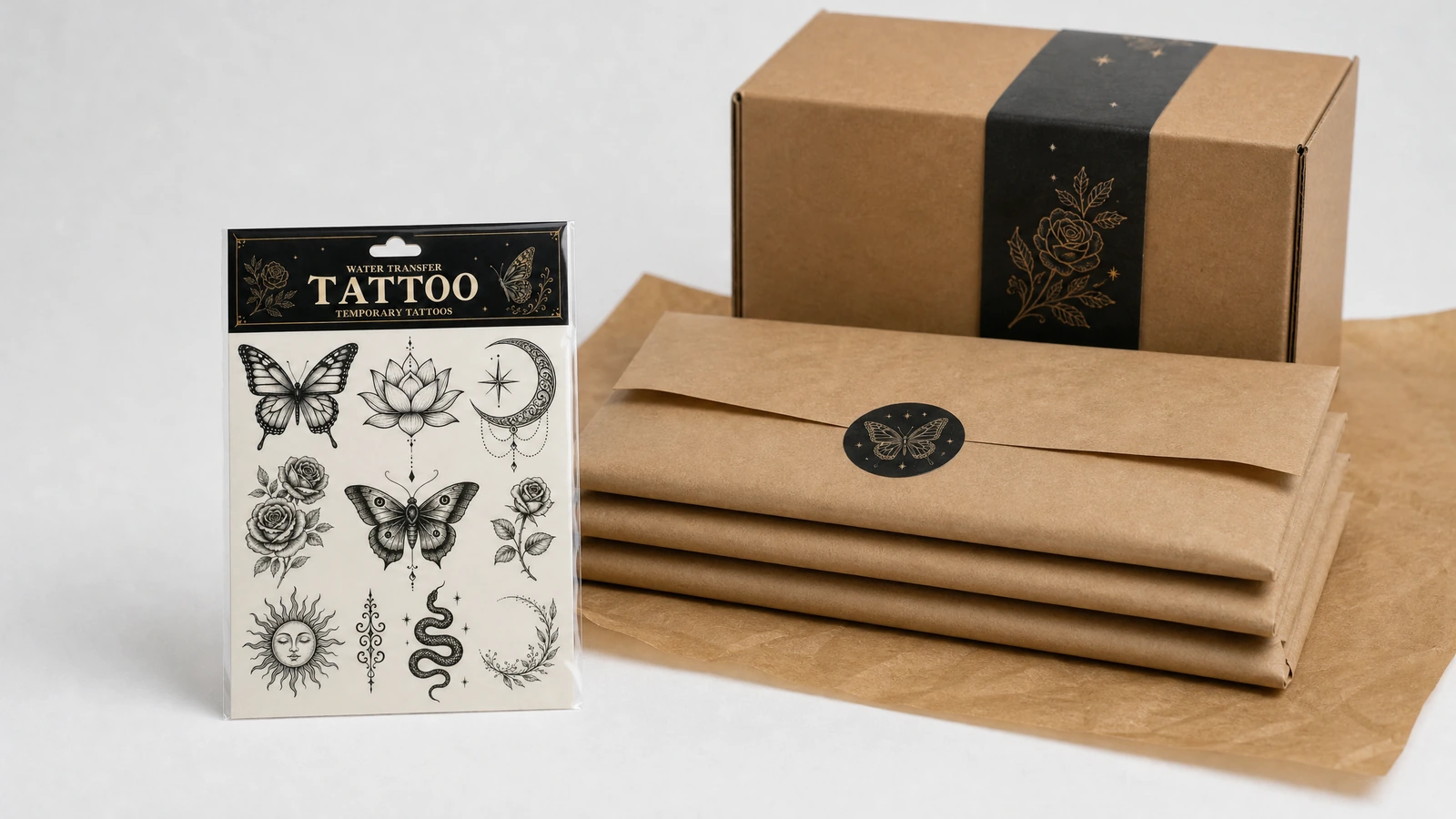
Application and removal: One U.S. printer[13] tells buyers to apply with a wet cloth for about 30 seconds, says its tattoos last 1–3 days, and recommends baby oil for removal. A verified buyer elsewhere[14] found that soap and alcohol did nothing, while coconut oil worked. Print oil-based removal steps on the pack. Patch-test on a less visible area before facial use, as FDA advises. Avoid broken, sunburned, or freshly shaved skin.
Which Temporary Tattoo Format Fits Your Project? ↑
| Format | How it works | Typical price | Claimed wear | Best fit |
|---|
| Water-transfer decal | Ink moves from wetted backing to skin | About $0.10–$0.25 per piece in volume | 1–3 days; some claim 3–7 | Parties, giveaways, promotions |
| Peel-and-stick | Pressure-sensitive adhesive on skin | About $0.35–$0.75 per piece | 3–5 days | Kids' events, quick handouts |
| Metallic foil | Metallic pigment on polymer film | Above standard transfer | 3–10 days (vendor claims) | Festivals, photo shoots |
| Jagua semi-permanent | Plant-based stain develops over hours | About $7–$35 per piece | About 1–2 weeks | Tattoo trials, travel |
| Home DIY paper | Home printer plus transfer film | Low material cost | About 1 day (inkjet) to 1–3 days (laser) | Personal tests only |
The water-transfer and peel-and-stick prices come from a sourcing guide[15], which puts retail packs of 10–20 at about $3–$8. The other figures are brand claims, not lab tests. Two U.S. benchmarks show how wide supplier terms can be: Sticker Mule lists five 1 × 1 inch tattoos for $19 and 100 for $68, with free shipping in four days, while StickerGiant requires 500 per design, quotes about 3–4 weeks after proof approval, and offers no rush service.
DIY paper fits private tests only. Home inkjet inks are formulated for paper[16], and the film tends to micro-crack at bends within about 48 hours. For these sheets, unit price, minimum order, and lead time are quoted per artwork after proof. They will not be published until confirmed.
What Should You Confirm Before Approving Production? ↑
| Checkpoint | Why it matters | Status for these sheets |
|---|
| Colorants approved for skin use | Unapproved colors make the product adulterated | Documents pending quote |
| Adhesive and ingredient list | Retail units need an ingredient declaration | Label draft pending quote |
| Children's positioning | Toy rules may apply on top of cosmetic rules | Testing pending, only if sold as a toy |
| Wear on target placement | Closes the gap between promise and skin | Pending sample test |
| Text, line weight, white ink | Fine detail and white vary by process | Pending sample |
| Sheet size and designs per sheet | Drives unit cost and waste | Pending quote |
| Minimum order and lead time | Must fit the event date | Pending quote |
| Packaging format | Rolled sheets curl and crack | Flat pack, to be confirmed |
"Pending" means the item is confirmed in writing at quote or sample stage. Until then, nothing in this table should be read as a factory commitment. Buyers should keep the signed proof, sample photos, and supplier documents together as one acceptance file.
Compliance also covers the supplier. Under MoCRA[17], facilities that make cosmetics for U.S. distribution must register with FDA and renew every two years. A responsible person must list each product with its ingredients and update the listing annually. FDA began enforcing these rules on July 1, 2024. Small businesses are exempt from some of these duties, but the exemption does not cover products that change appearance for more than 24 hours when removal is not part of normal use. Long-wear formulas therefore need case-by-case review.
Children's sets raise the bar further. The CPSC[18] explains that CPSIA Section 106 made ASTM F963 mandatory for children's toys. Toy positioning can bring in lead-in-coating rules (16 CFR 1303), phthalate limits, and third-party testing. In the EU, a regulatory review[19] places tattoos for children under 14 under Directive 2009/48/EC and EN 71-3. It notes that the GPSR has applied since 13 December 2024. Adult cosmetic sheets should not claim ASTM F963 compliance without testing.
Copy needs the same discipline. Avoid claims such as "FDA approved temporary tattoo," "Hypoallergenic for all skin," or "Waterproof all day," and any wording that blends these sheets with henna. Also do not cite rules written for injected tattoo ink, such as EU REACH limits or FDA's 2024 ink-contamination guidance, as standards for transfer stickers.
Packaging decides the first impression. Several Amazon reviewers of a large sleeve set complained that the sheets arrived tightly rolled, curled during application, and cracked within about 10 hours. The recommended format is flat sheets with interleaf paper and a printed ingredient label, to be confirmed in the quote. For reorders, archive the approved proof, color notes, sample photos, and batch record so the second run matches the first. Clear country-of-origin and tracking information also prevents "is this a scam" doubts on long cross-border shipments.
What Are the Key Takeaways Before You Order? ↑
- Demand is driven by personal celebrations. — 64.8% of market value comes from personal consumption (Source)
- The category is still growing. — US$1.11 billion in 2025, up from US$1.03 billion in 2024 (Source)
- Shoppers decide on marketplaces. — About 4,701 weekly Amazon US searches for "custom temporary tattoos," week of July 12–18, 2026 (Source)
- Wear time depends on placement. — 1–3 days stated by a major U.S. printer (Source)
- FDA approves colorants, not finished tattoos. — Products labeled "FDA approved" can be detained at import (Source)
- Supplier terms vary widely. — 500 per design and about 3–4 weeks at one waterless-film printer (Source)
Ready to Turn Your Artwork Into a Tested Tattoo Sheet? ↑
Successful custom temporary tattoo stickers come from discipline, not slogans. That means a clean file, a proof you sign off, a sample tested on the real placement, documented colorants and adhesive, and flat packaging that arrives before your date. Send your event date, quantity, placement, and artwork, and every open item (price, minimum order, lead time, and wear time) will be answered in writing before production starts.
Request your custom tattoo sheet quote and skin-test sample today.




The information below is required for social login
Sign In
Create New Account