Custom canvas tote bags are woven cotton or cotton-blend bags decorated with your logo by screen print, DTF, DTG, or embroidery. Choose 6–8 oz canvas for one-day giveaways and 10–12 oz or heavier for bags people carry every week. Before releasing bulk, approve a numbered physical sample and inspect the order against written criteria.
Who buys custom canvas tote bags, and what must the bag achieve? ↑
Most commercial demand comes from corporate marketing, HR onboarding programs, event planners, university offices, and retail gift-with-purchase campaigns. In a Custom Ink survey reported by ASI[1], 67% of more than 1,000 corporate end-buyers judged a campaign by whether recipients voluntarily used the items, and 45% ranked longevity as the most important feature. That makes fabric weight, handle construction, and a print that survives washing the specs that matter most.
Gift buyers want names, monograms, and short phrases. CNBC[2] quoted a Lands' End senior vice president saying monogramming makes the bags unique, and reported that L.L.Bean Boat and Tote sales in the first half of 2025 rose 75% over the same period in 2024. Small creators and print-on-demand sellers care whether heavy canvas accepts DTF transfers and whether unit cost still leaves a margin.
The value case holds only while the bag stays in circulation. ASI's 2026 Ad Impressions Study on bags[3] estimates that a branded tote earns nearly 5,000 lifetime impressions at roughly 1/10 of a cent per impression. In the same study, 86% of consumers said receiving a sustainable bag would improve their view of the advertiser. Bags are one category in a channel that PPAI[4] estimates reached $27.1 billion in U.S. distributor sales in 2025. These are category averages, not guarantees for any specific bag specification.
Why do branded tote orders disappoint, and how can you prevent it? ↑
Most failed orders looked fine on screen. A small JPEG or screenshot enlarged onto fabric can print blurry or pixelated; Tote Bag Factory[5] lists this among the most common printing failures, along with choosing the wrong print method. On open-weave 6–8 oz canvas, Elandmake's sourcing guide[6] notes that ink can fall into the gaps between yarns, leaving a speckled, washed-out logo with unreadable small text.
Construction failures usually cost more. A quality inspector writing for Imperial Dade[7] reported rejecting about 15% of first-run samples in a Q1 2024 audit, and described a 5,000-bag batch whose handles began detaching after light use, costing more than $22,000 in reprints. One BBB customer review[8] describes all 24 canvas totes in an order arriving damp and mildewed; other reviewers report water-spot stains and dye bleeding. Short claim windows make this worse, because cartons often stay sealed until event week.
The fix is a spec-first process: define the end use before choosing a bag, match fabric weight and decoration method to the artwork, approve a numbered physical sample, inspect bulk production against written criteria, and count lead time from artwork approval, not from the order date.
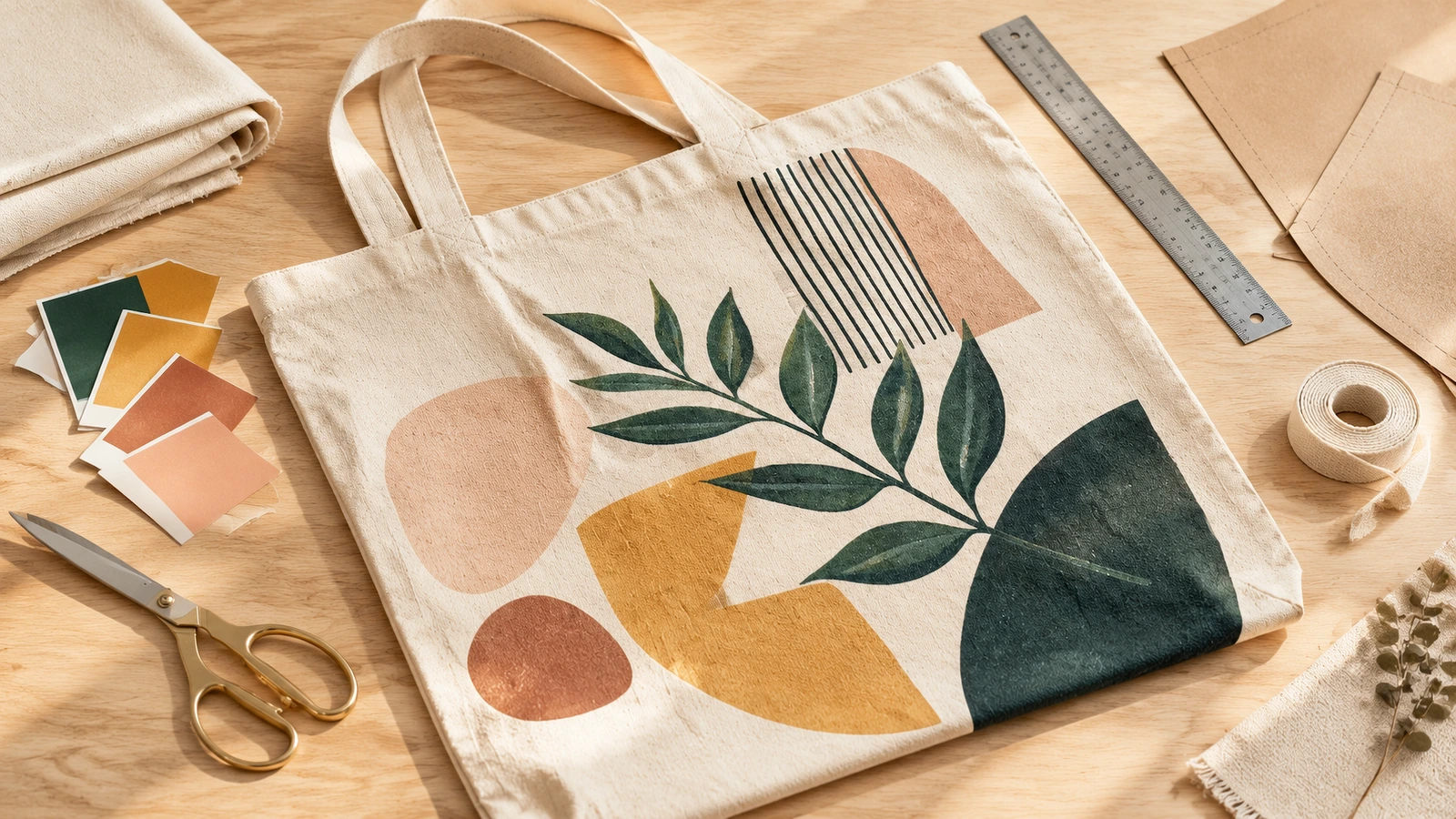
Table of Contents
What exactly counts as a custom canvas tote bag? ↑
A canvas tote is a plain-weave or duck-weave bag made from cotton or a cotton blend. "Canvas" describes a denser, heavier weave than an ordinary cotton shopping bag. It is not a different fiber.
Fabric weight is stated in ounces per square yard (oz/yd²); one ounce per square yard is roughly 33.9 GSM, and the figure describes the cloth, not the finished bag. According to Pamusan[9], regular cotton totes typically weigh 3–6 oz, while canvas starts around 8 oz and can reach 24 oz. Its in-house test of 14×16-inch bags recorded a maximum static handle load of about 40 lb for 10 oz canvas, versus about 15 lb for 4 oz cotton. Treat these as supplier data, not a rating for your bag; actual capacity depends on dimensions, loading, and what your own sample proves in testing.
"Custom" covers two very different services. Stock decoration adds your logo to an existing blank bag; it is faster and has lower minimums. OEM development changes the bag itself (dimensions, gusset, handle length, pockets, lining, or fabric) and requires pattern work and at least one sampling round.
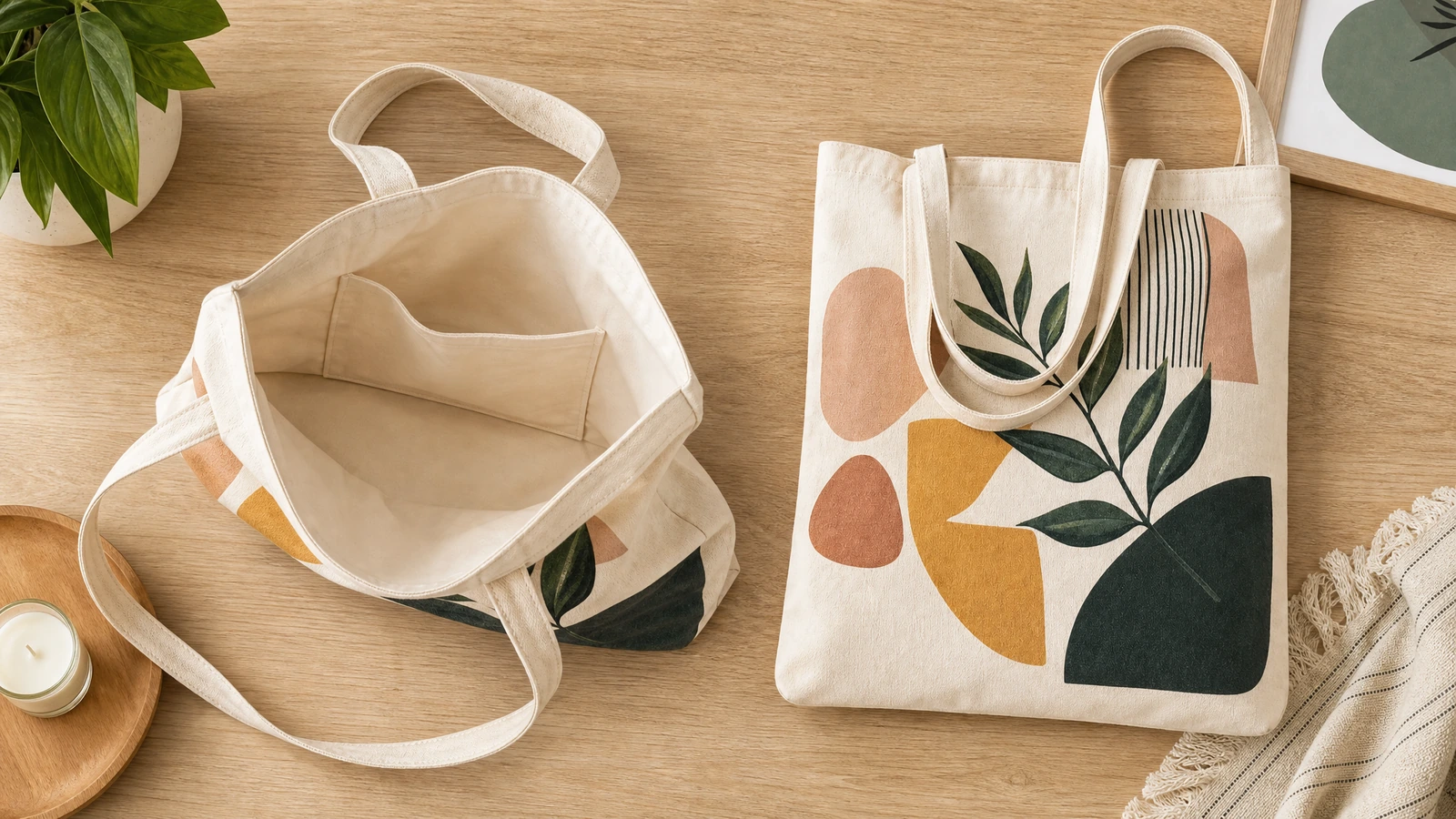
The imprint area must sit inside the flat panel, clear of seams and handle attachments, and text must stay legible at arm's length.
Shrinkage can change the printed size. Initi[10] warns that unshrunk cotton canvas can shrink about 5%–8% on its first wash, so a 12-inch print area may end up close to 11 inches. If the bag will be laundered, specify pre-washed or pre-shrunk fabric. The same source describes 12 oz as the working weight for most custom printing, because 8–10 oz weaves are open enough for fine lines to bleed.
Embroidery has its own limits. ToteBag-Factory[11] notes that embroidery cannot reproduce tiny text, fine lines, or photographic gradients, and needs 10 oz or 12 oz canvas to avoid puckering or tearing.
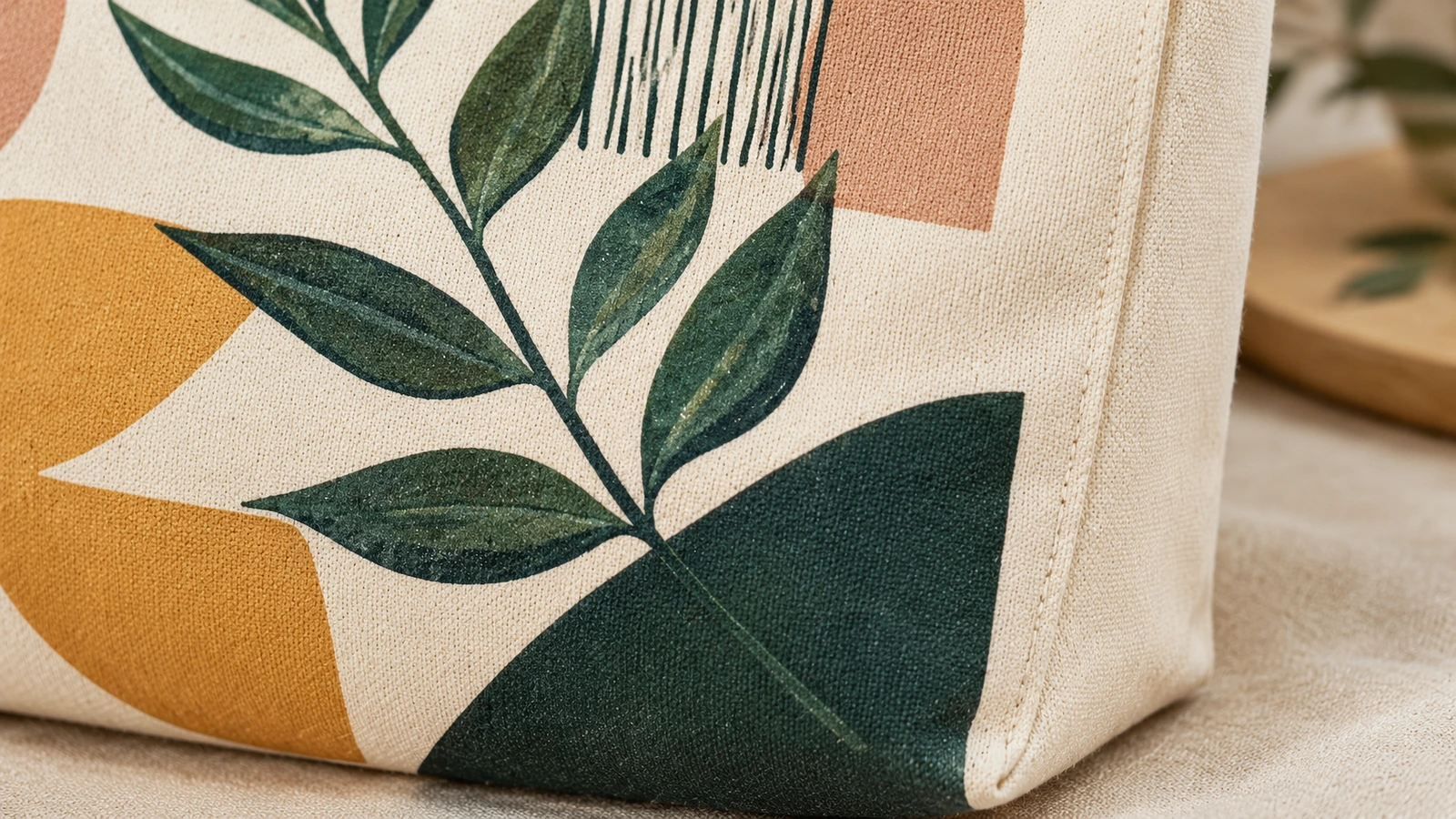
Natural, undyed canvas gives the most predictable print contrast; dyed canvas needs dry and wet rub colorfastness testing, because deep reds and blacks can bleed or show water spots. Whether handles are self-fabric or webbing, the attachment method (box stitching, X-stitching, or bar-tacks) matters as much as fabric weight. Zippers, snaps, and inner pockets add usefulness but also failure points, so give each its own check in sample and bulk inspection.
How do you order custom canvas tote bags without costly mistakes? ↑
Step 1: Choose stock decoration or OEM development
Confirm in writing what the supplier can change. Omaska[12] cautions that a supplier promising "no minimum" is almost certainly decorating stock bags rather than manufacturing them.
Minimums exist because setup costs are fixed. 4imprint[13] explains that preparing screens and the press takes the same effort for six bags as for 600, and notes that many styles start around 25 pieces, while single custom pieces are rarely practical.
Step 2: Lock the fabric spec in the RFQ
Your request for quotation (RFQ) should state each of these items:
• Fiber content, plus fabric weight in both oz/yd² and GSM
• Whether the fabric is pre-shrunk, and its color
• Bag dimensions including the gusset
• Handle length, width, and attachment method
• Decoration method, number of colors, and print position
• Quantity and Incoterms (EXW, FOB, or DDP)
• Target in-hand date
Match the fabric weight to how the bag will be used. Mary's / Flour Sack Towels[14] recommends 6 oz for decorative bags or one-time event giveaways, and 12 oz for bags people will carry every week, because a bag that stays in use longer earns more impressions from the same printing cost. Thin fabric chosen only to cut cost can tear under light loads, wasting a promotional budget faster than a higher unit price would.
Step 3: Preflight artwork before locking the method
Screen printing needs vector files (AI, EPS, or PDF with text converted to outlines) plus Pantone color references. DTF and DTG need high-resolution raster art at final print size, commonly around 300 dpi, saved as a PNG with a transparent background. Check the minimum line weight and text height against the weave of your chosen fabric.
For timing, Mary's screen printing vs. DTF guide[15] quotes a free digital proof in 1–2 business days, followed by 10–14 business days of production after approval. The same guide recommends washing printed totes inside out in cold water, tumble drying on low or air drying, and never ironing directly on the print. Include these care instructions with gift orders.
Step 4: Approve a numbered pre-production sample
Approve a physical sample, not only a screen mockup. On the sample, check:
• Dimensions
• Handle length and position
• Logo placement
• Pantone match under D65 light
• Stitch density
• Reinforcement at stress points
Use published tolerances as a starting point for your own criteria. Elandmake cites a logo position tolerance of about ±0.5 cm. Aitebag[16] uses these acceptance thresholds:
• At least 12 stitches per inch
• AATCC 61 wash testing with a gray-scale rating of 3 or higher
• A light-fastness color difference of ΔE ≤2.0
These are one supplier's criteria. Write the values you agree on into the purchase order rather than assuming an industry default exists. Each extra sample round adds calendar time, so schedule at least one revision.
Step 5: Inspect bulk production against written criteria
Promotional bag suppliers commonly sample bulk orders under ISO 2859-1. Ruixing[17] and several other sourcing guides cite AQL 2.5 for major defects and AQL 4.0 for minor defects.
The inspection should cover:
• Fabric weight
• Seam allowance and seam slippage
• Handle reinforcement
• Print registration and color variance
• Odor or dampness
• Carton count and packaging
Classify a missing handle as a critical defect. Ruixing's FAQ also claims handle pull testing to 20 kg or more; ask for the test method and report before relying on that figure. If your marketing will state a load rating, confirm it with a third-party lab.
Step 6: Plan delivery backward and protect reorders
Count lead time from artwork approval, not from the date you place the order. Pamusan's fast-shipping guide[18] lists these typical timelines:
• Blank bags from U.S. stock: ship within 48 hours
• Simple 1–2 color custom orders under 500 pieces: 5–7 business days
• Complex orders, or quantities above 1,000: 2–3 weeks
Overseas OEM production takes longer. Pamusan's producer overview[19] puts first contact to U.S. delivery for about 1,000 pieces at typically 6–10 weeks, including sampling and air freight.
For sea freight, pack bags in moisture-resistant cartons with desiccant. Open and photograph cartons within 48 hours of arrival, and write a claim window of 15–30 days into the purchase order. Archive the screens, embroidery files, and Pantone numbers from the first run so reorders match it.
Which fabric weight, decoration method, and supplier model fit your budget? ↑
Price depends on fabric weight, number of colors, number of print positions, quantity breaks, and freight. The figures below come from supplier publications; use them as budgeting ranges and rely on your own quote for the final number.
Fabric weight
| Fabric | Best fit | Decoration fit | Supplier price band, 1-color screen, ~500 units (Cubit, 2026[20]) |
|---|
| 80 GSM non-woven | One-day trade show handouts | Simple screen print | $0.50–$2 |
| 6–8 oz cotton canvas | High-volume event giveaways | Bold 1–2 color screen print, DTF | $2–$4 |
| 10–12 oz cotton canvas | Retail bags, onboarding kits, weekly carry | All methods; embroidery viable | $3–$6 |
| 14–16 oz cotton canvas | Premium gifts, heavier contents | Screen print, embroidery | $5–$10 |
The same Cubit guide prices a standard 15×16-inch, 12 oz tote with 1-color screen printing at about $3.00–$4.50 per unit for 500 units. It rates non-woven bags as lasting 6–12 months and canvas as lasting multiple years; these are experience-based tiers, not lab certificates. Choose the weight from how long and how heavily the bag will be used, and the unit price second.
Decoration method
| Method | Best for | Artwork needed | Watch-outs |
|---|
| Screen print (water-based preferred) | 1–4 spot-color logos, mid to large runs | Vector file + Pantone | One screen per color; setup cost dominates small runs |
| DTF / heat transfer | Photos, gradients, small runs | ~300 dpi transparent PNG | Film-like feel; can crack when flexed |
| DTG | Full-color short runs on light 100% cotton | ~300 dpi raster | Higher unit cost; fades faster than screen print |
| Embroidery | Small premium logos, monograms | Digitized stitch file | Priced by stitch count; fine text blurs; needs 10–12 oz |
Setup cost is what makes screen printing expensive for small runs. Elandmake puts screen making at about $30–$50 per color, so a $50 setup adds $0.50 per bag on 100 units but only $0.05 per bag on 1,000. If a design needs more than four spot colors, switching to DTF or reducing colors is usually cheaper than adding screens.
Supplier model
| Model | Typical minimum | Typical timing | Best for |
|---|
| U.S. stock decoration | Many styles from ~25 pieces (4imprint) | 5–7 business days for simple runs under 500 (Pamusan) | Events, onboarding, short deadlines |
| Small-run DTG / on-demand | Quote-dependent; often very low | Quote-dependent | Samples, gifts, creator tests |
| Overseas OEM | 50–500 pieces (Pamusan) | 6–10 weeks, contact to delivery | 1,000+ pieces, custom construction |
Overseas pricing looks lowest on paper. For a 15×16-inch, 10 oz tote with single-color printing, Pamusan lists FOB prices of $2.80–$3.80 at 100 pieces and $1.70–$2.40 at 1,000. FOB prices exclude freight, duties, warehousing, and inspection, which can erase the gap with U.S. decorators. Compare landed cost for each option, and weigh the extra schedule risk against your event date.
Which compliance and sustainability claims can you support?
Ordinary tote bags are not covered by the mandatory fiber-content labeling in the FTC's textile rules. However, FTC guidance[21] says any fiber claim you make must be truthful. Claims such as "100% cotton," "12 oz," or "recycled" must match your invoices and test records.
| Claim or use | Evidence to request | Boundary |
|---|
| "Organic cotton" | GOTS or OEKO-TEX ORGANIC COTTON certificate | Since April 1, 2025, STANDARD 100 no longer covers organic claims (Fibre2Fashion[22]) |
| "Recycled" | GRS scope and transaction certificates | Conventional canvas cannot be called recycled |
| Children's tote (age 12 and under) | Third-party testing and a Children's Product Certificate | Total lead above 100 ppm in accessible parts is banned (CPSC[23]) |
| Sold in California (PFAS) | Compliance statement covering coatings and finishes | Regulated PFAS banned from Jan 1, 2025; limit drops to 50 ppm total organic fluorine on Jan 1, 2027 (AB 1817[24]) |
| Sold in California (Prop 65) | Exposure assessment for inks, coatings, and hardware | Short-form warnings must name a chemical from Jan 1, 2025 (P65Warnings[25]) |
| "Eco-friendly" | A durable design and a realistic reuse expectation | Danish EPA 2018 LCA: ~7,100 reuses for conventional cotton on combined indicators (Bene Bags[26]) |
Whether each rule applies depends on the market and the intended user. An adult conference tote is normally not a children's product. A Prop 65 warning is required only when exposure to a listed chemical is above the safe-harbor level; it is not automatic for every bag.
The Danish EPA reuse figure combines many environmental indicators and is not carbon-only; other models produce very different break-even counts, so never present a single number as settled. The defensible sustainability claim is a bag durable enough that people keep using it, not an "eco" label.
What are the key takeaways for buyers? ↑
- Corporate buyers judge totes by real use. — 67% measure success by voluntary use; 45% rank longevity first (Source)
- Branded totes are a low-cost impression channel. — nearly 5,000 lifetime impressions at about 1/10 cent each (Source)
- Setup costs shrink quickly with quantity. — a $50 screen adds $0.50 per bag at 100 units but $0.05 at 1,000 (Source)
- Lead time starts at artwork approval. — 5–7 business days for simple runs under 500; 2–3 weeks above 1,000 (Source)
- Skipping sample checks is expensive. — one handle defect across 5,000 bags cost over $22,000 in reprints (Source)
- California PFAS limits tighten again soon. — the threshold drops from 100 ppm to 50 ppm on January 1, 2027 (Source)
- Organic claims need the right certificate. — OEKO-TEX STANDARD 100 stopped covering organic cotton on April 1, 2025 (Source)
Ready to scope your custom canvas tote order? ↑
A tote that people keep using starts with clear decisions, not a catalog photo. Decide the end use, fit fabric weight and decoration to the artwork, approve a numbered sample, inspect bulk against agreed criteria, and plan backward from your in-hand date. Pricing, minimums, lead time, and any load or wash performance must be confirmed through a written quote, an approved sample, and testing, not assumed from category averages.
Send your artwork, target quantity, and in-hand date to request a sampled quote for your custom canvas tote bags.




The information below is required for social login
Sign In
Create New Account