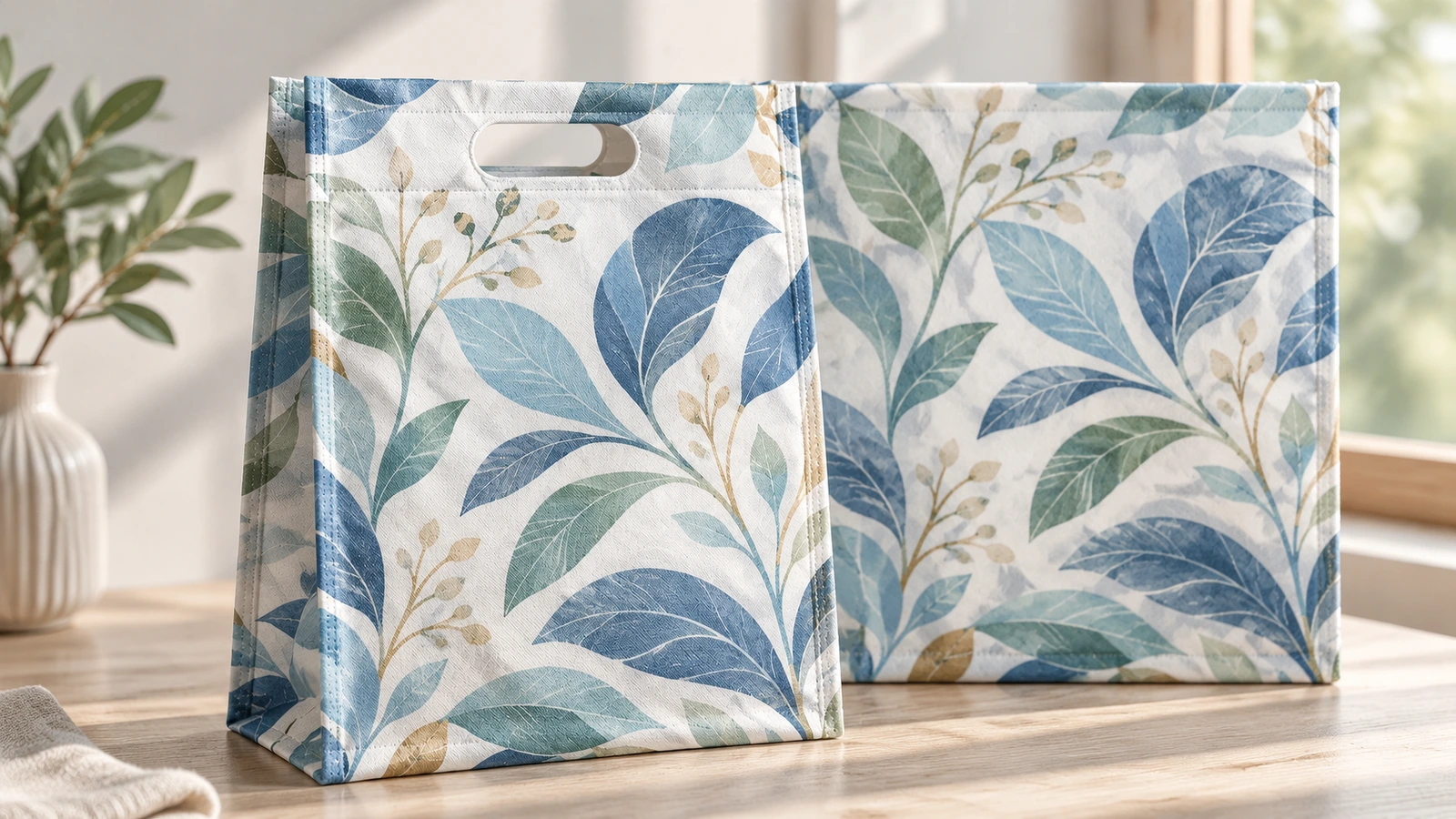
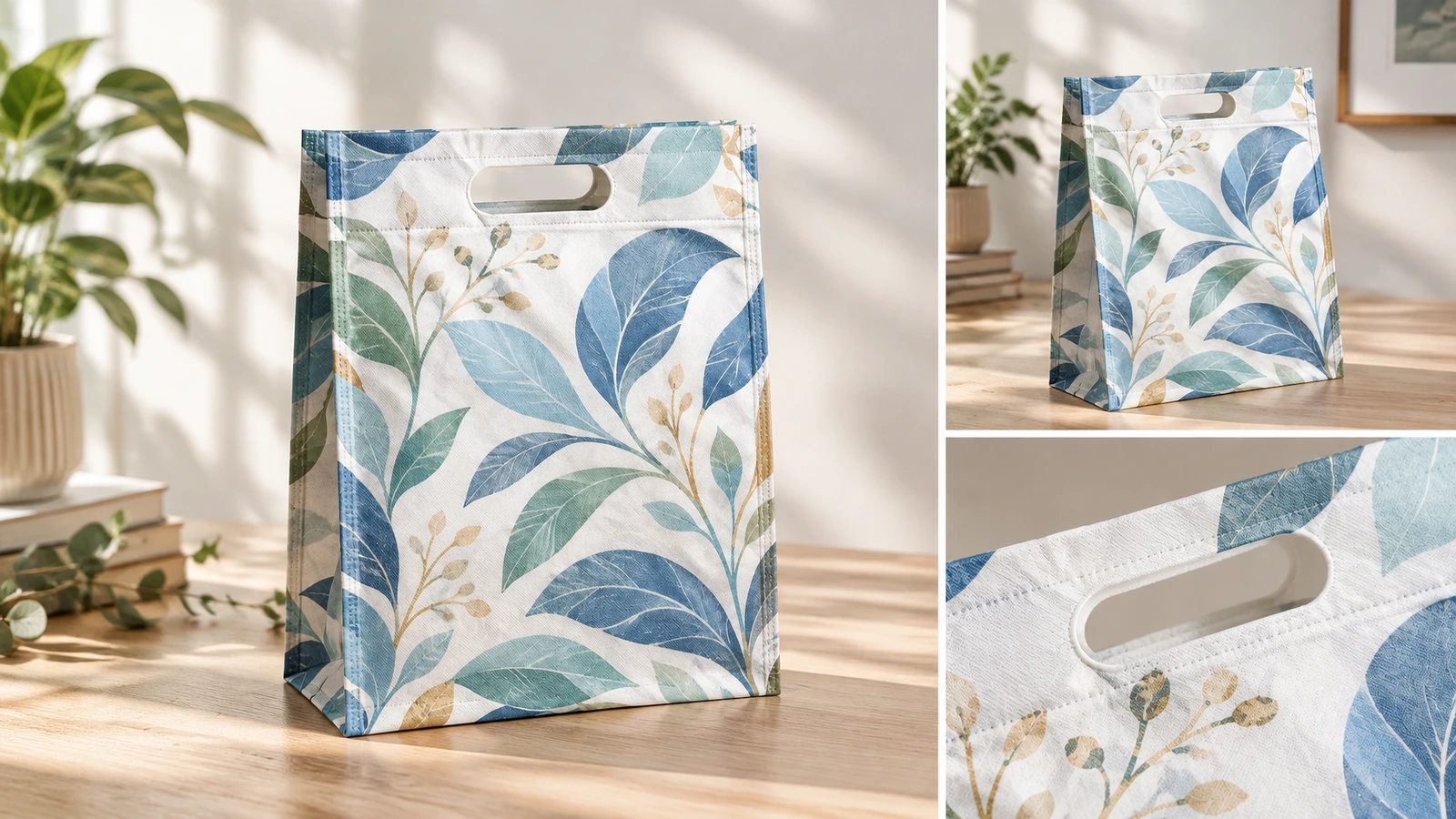
Custom D-cut non-woven bags are flat PP spunbond bags. The D-shaped handle is punched directly into the bag body, and the edges are joined by heat or ultrasonic sealing. At about 70–80 GSM with one- or two-color screen printing, they work well for light retail checkout, trade show handouts, pharmacies, and salons. Prove the handle strength on a loaded sample before you order bulk.
Who Orders Custom D-Cut Bags, and for Which Jobs? ↑
End consumers rarely order these bags. The buyers are usually businesses. Retail and chain purchasers need a branded checkout bag. Marketing and event teams need something to hand out at a booth. Smaller operators, such as pharmacies, salons, beauty counters, and schools, want a clean bag in their brand colors. The US wholesaler Blue Nile Bags[1] positions die-cut bags as lightweight branded takeaway bags for clothing, cosmetics, or accessories. It also describes them as "ideal for handing out marketing materials, samples, or swag" at events.
The jobs differ, but the buying criteria overlap. A boutique wants a checkout bag that looks deliberate rather than generic. One salon owner reviewing nonwoven boutique bags on RacetopPrint[2] wrote that the custom bags "look much nicer than the generic bags we were using." An event team cares less about how the bag feels. Its main question is whether a few thousand bags with a two-color logo will arrive before the show opens. Both buyers need three things: a logo that stays sharp, a unit cost that fits the budget, and a handle that does not fail in front of a customer.
Why Do Cheap D-Cut Bags Fail, and How Do You Prevent It? ↑
The most common sourcing mistake is pushing fabric weight down to save a fraction of a cent. A D-cut bag has no sewn strap to spread the load. The handle is a hole in the same sheet of fabric, so stress concentrates on the punched edge. The packaging manufacturer HAPLAST[3] reports that "more than half of real-world PP non-woven bag failures occur at the handle—not the body." It adds that bags with adequate GSM still tear, because stress gathers in specific zones rather than across the whole fabric.
These problems usually appear after the order is paid. LeeLine Bags[4] documented a 120 GSM bag whose cheap heat-sealed seams ripped at about 12 lbs of force. It also recorded a 5,000-unit run rejected for color rub-off after the curing tunnel dropped to 140°C. Buyer reviews quoted in an Alibaba buying guide[5] describe the same failures: "Handles ripped after first use—must have been thin material" and "Color mismatch between proof and final batch." A bag that splits at the register or rubs ink onto a coat turns your logo into a liability.
The fix is a written specification, not a marketing slogan. Kete Group's GSM guide[6] marks anything below 50 GSM as the point where the D-cut handle hole tears. Take three precautions. First, write a GSM floor into the contract. Second, for heavier loads, ask for a reinforced patch or a wider heat-sealed band around the handle. Third, test the pre-production sample dynamically, with the real merchandise inside: lift it, swing it, and pull it from one side. We quote every order against your written specification. MOQ, lead time, and unit price are confirmed at quotation, and bulk production starts only after you approve the sample.
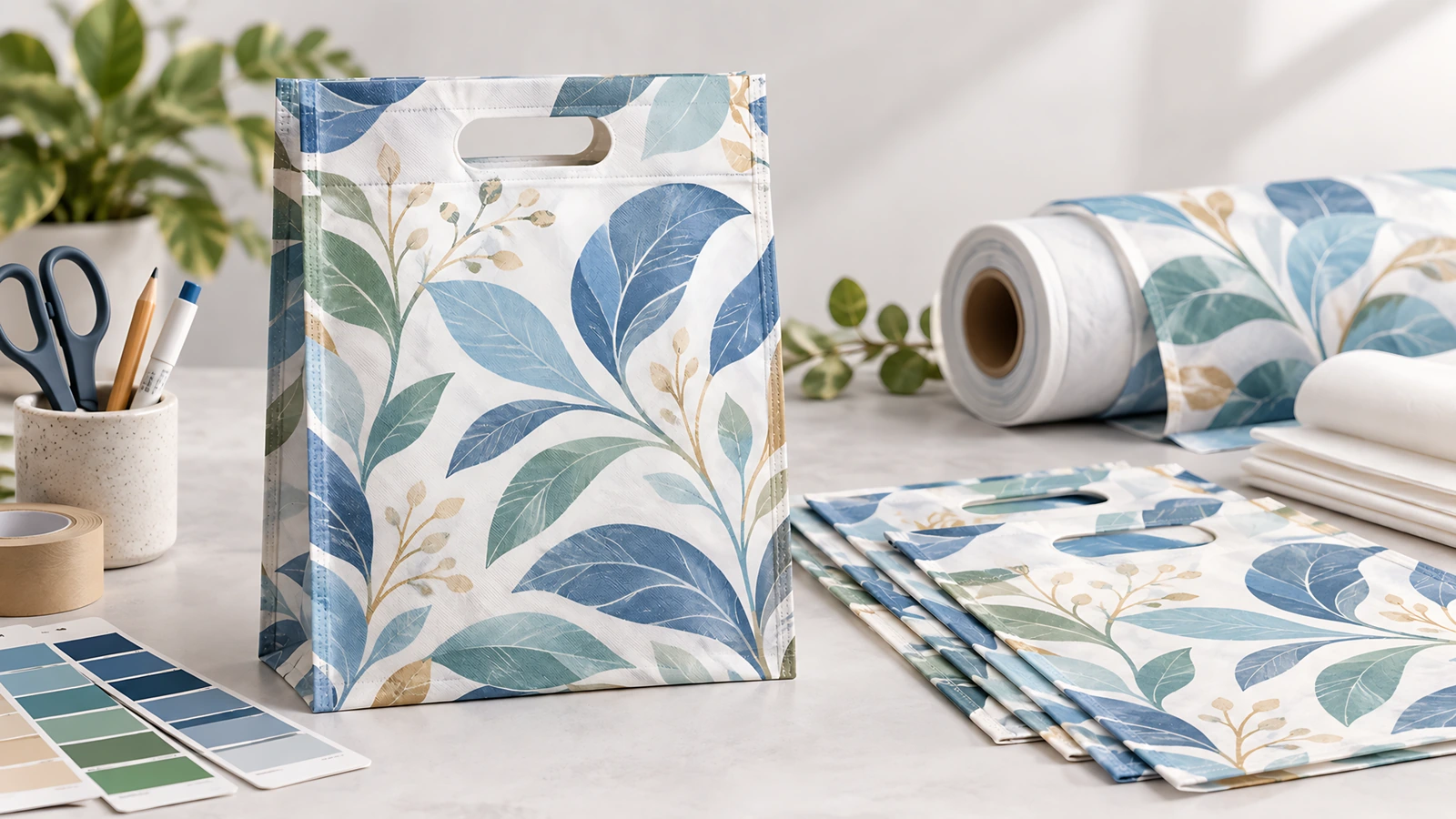
Table of Contents
What Exactly Is a Heat-Sealed D-Cut Non-Woven Bag? ↑
The bag is cut from 100% polypropylene spunbond fabric. ShoppingBagCo[7] lists "100% Virgin Polypropylene Non-Woven Fabric" as its standard material. NoWoBag[8] describes the typical D-cut build as a die-cut handle made from a single fabric piece, at 60–80 GSM, used for pharmacy, grocery, and retail. Production follows a short route:
1. The fabric rolls are printed.
2. The side edges are fused by ultrasonic heat-sealing instead of stitching.
3. The D-shaped handle is die-cut.
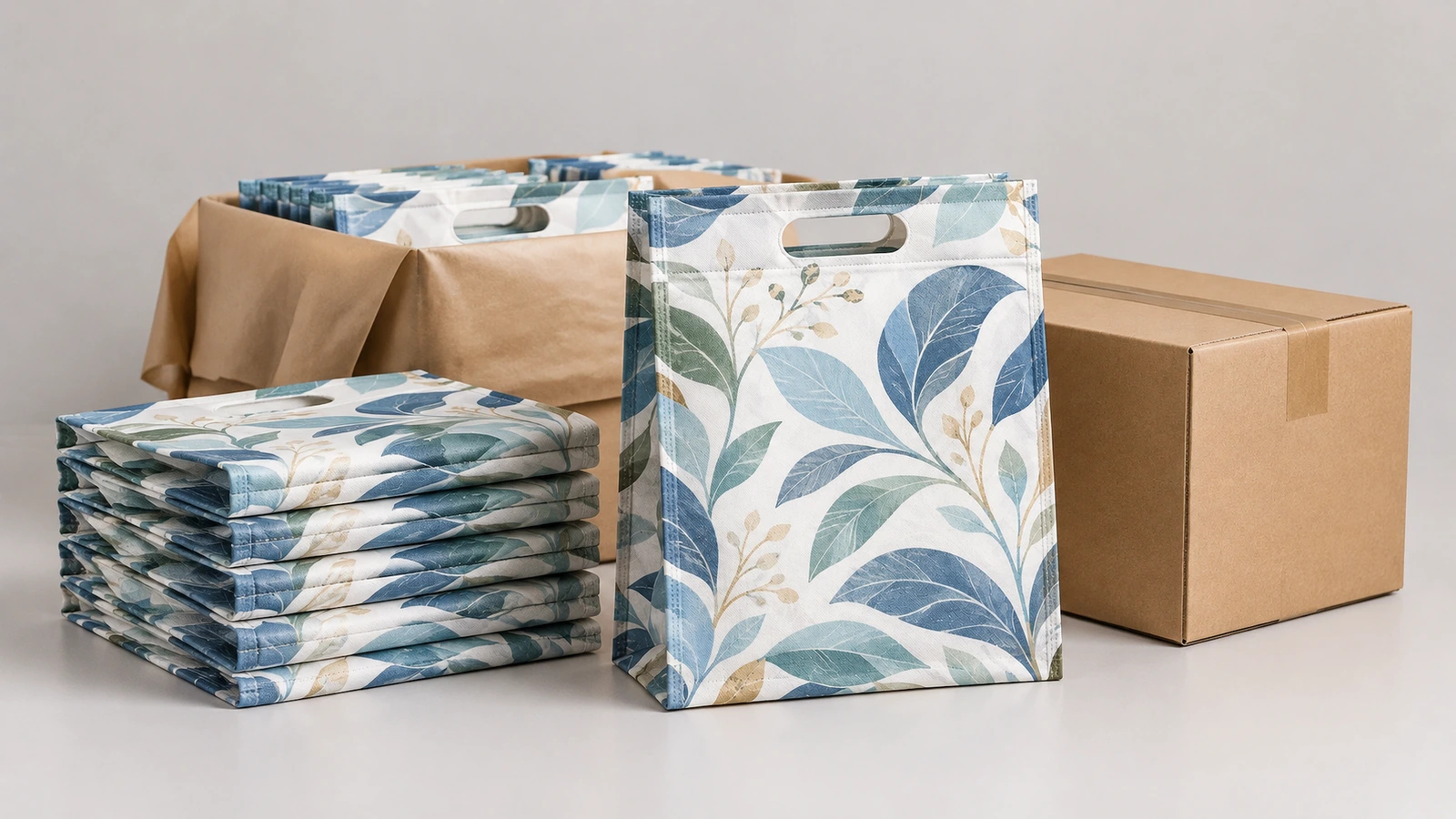
4. Finished bags are counted, bundled (commonly 50 or 100 per bundle), and cartoned.
Because no handle is sewn on, a D-cut bag is faster and cheaper to produce than a sewn tote of the same size. The trade-off is lower load capacity and less comfort under heavy weight.
Fabric weight is expressed in GSM (grams per square meter). When a quote says "80 GSM," ask how the figure was measured. ISO 9073-1:2023[9] specifies the test method for the mass per unit area of nonwovens. China's industry standard FZ/T 64035-2014[10] for nonwoven shopping bags requires labels to state the main material, size, and maximum load to the kilogram. That standard applies to the supply chain; it is not US law. No single global standard sets a mandatory load for D-cut bags. Base your acceptance on three documents: the signed sample, the pull and drop test records, and the specification printed on the proforma invoice (PI).
Two boundaries matter before you write any marketing copy. First, PP can be recycled where facilities accept it, but it is not biodegradable or industrially compostable by default. Second, a standard promotional bag is not food-contact packaging. Treat it as food-contact only if the supplier provides written compliance documents covering that use for your batch.
How Do You Specify and Order D-Cut Bags in Six Steps? ↑
Step 1: Match fabric weight to the load
Published guidance places most D-cut bags between 50 and 80 GSM and reserves heavier fabric for specific needs. Aquaholic's bag-type guide[11] calls 70–80 GSM the standard. It adds that "going above 90 GSM for a D-cut is usually unnecessary," because a punched handle gains less from extra fabric weight than a sewn handle does.
| GSM band | Typical use | Buyer caution |
|---|
| Below 50 | Not recommended for D-cut | The handle hole edge is the first point to tear |
| 60–70 | Event giveaways, light retail | Confirm the handle on a loaded sample |
| 70–80 | Default retail and branded checkout bags | The usual anchor for supplier quotes |
| 90–100+ | Heavier goods, laminated full-coverage print | Consider a W-cut or loop handle instead |
This table combines guidance from Kete Group and Aquaholic. Supplier load claims vary widely. ShoppingBagCo lists 3–8 kg depending on GSM and size. An export supplier page quotes 5–8 kg for standard bags and 8–12 kg for reinforced bags. Treat every load figure as a supplier claim. Actual capacity depends on the bag's dimensions, what goes inside, how it is carried, and how your own sample performs in testing.
Step 2: Choose a size that keeps the logo readable
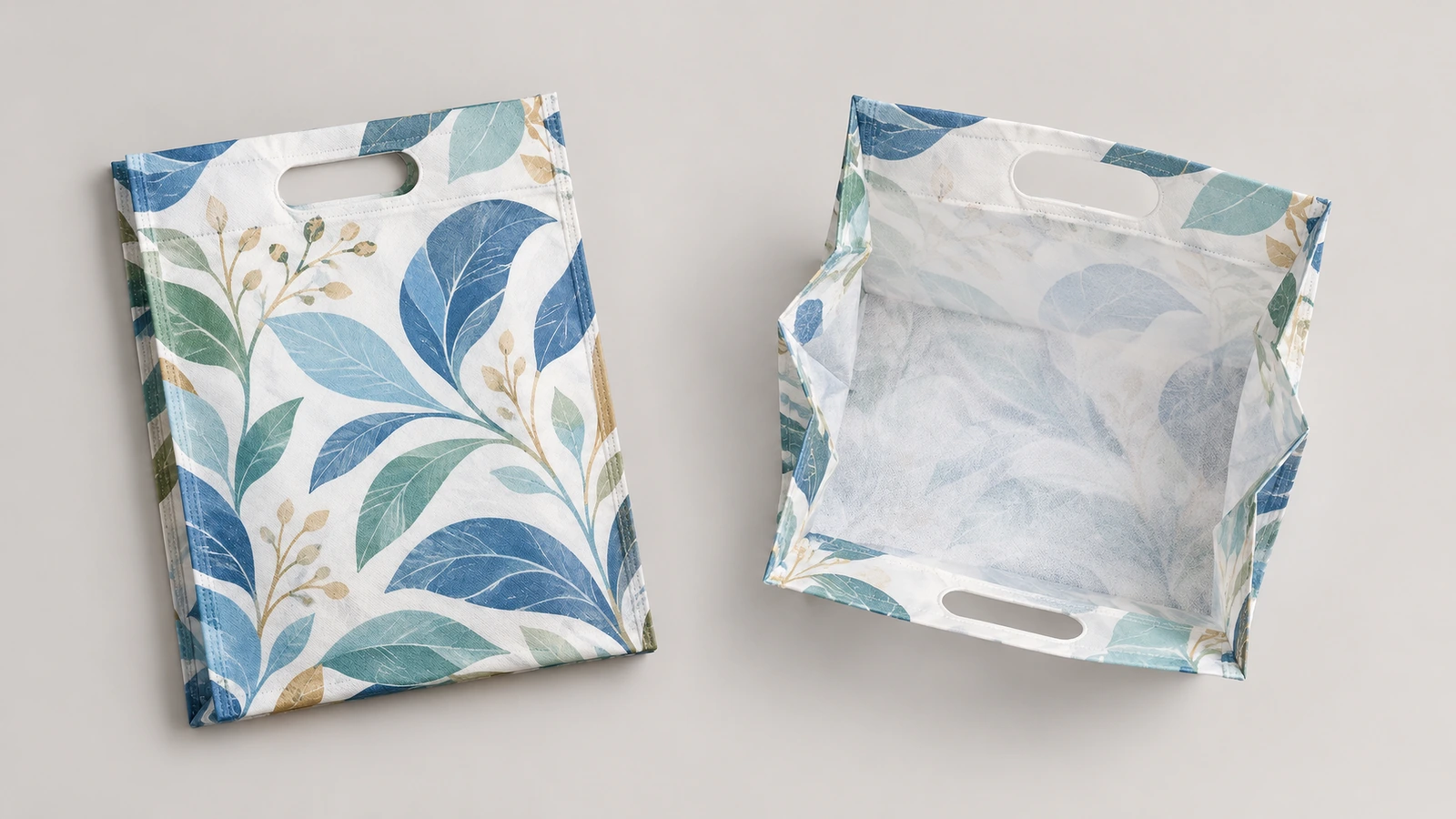
Common flat sizes include 25×30 cm, 30×40 cm, and 35×45 cm (ShoppingBagCo). Aquaholic lists W26×H33, W32×H40, and W38×H42 cm. US promotional catalogs also stock an 8×12 in format in 80 GSM. Custom dimensions are usually possible, but Aquaholic notes that a new size can carry a one-time tooling or die charge and a higher MOQ. Keep text and fine detail away from the punched handle area and the side seals. The center panel stays flattest when the bag is carried, so place the logo there.
Step 3: Select the print method and surface finish
| Method | Best for | Trade-off |
|---|
| Screen print (spot colors) | Logos, clear text, Pantone matching | Fine lines and gradients lose detail |
| Heat transfer | Full-color images, gradients | Higher unit cost, longer proofing |
| Flexographic | High-volume repeat runs | Color drift if curing is uncontrolled |
| BOPP lamination | Photo-quality print, splash resistance | Stiffer bag, more complex recycling |
According to Favourite Hub, screen printing on white 60–80 GSM spunbond is the standard workflow for branded B2B bags. Digital printing suits sampling or artwork that changes frequently. Kete Group estimates that lamination adds roughly 20–40% to material cost. An OEM sourcing guide from tiiocti[12] reports that flexographic printing at low price points can drift about ±8–12% from the target Pantone color. Specify the ink system and curing conditions in writing. Under-cured ink sits on top of the fibers instead of bonding to them, and it rubs off.
Step 4: Preflight your artwork before proofing
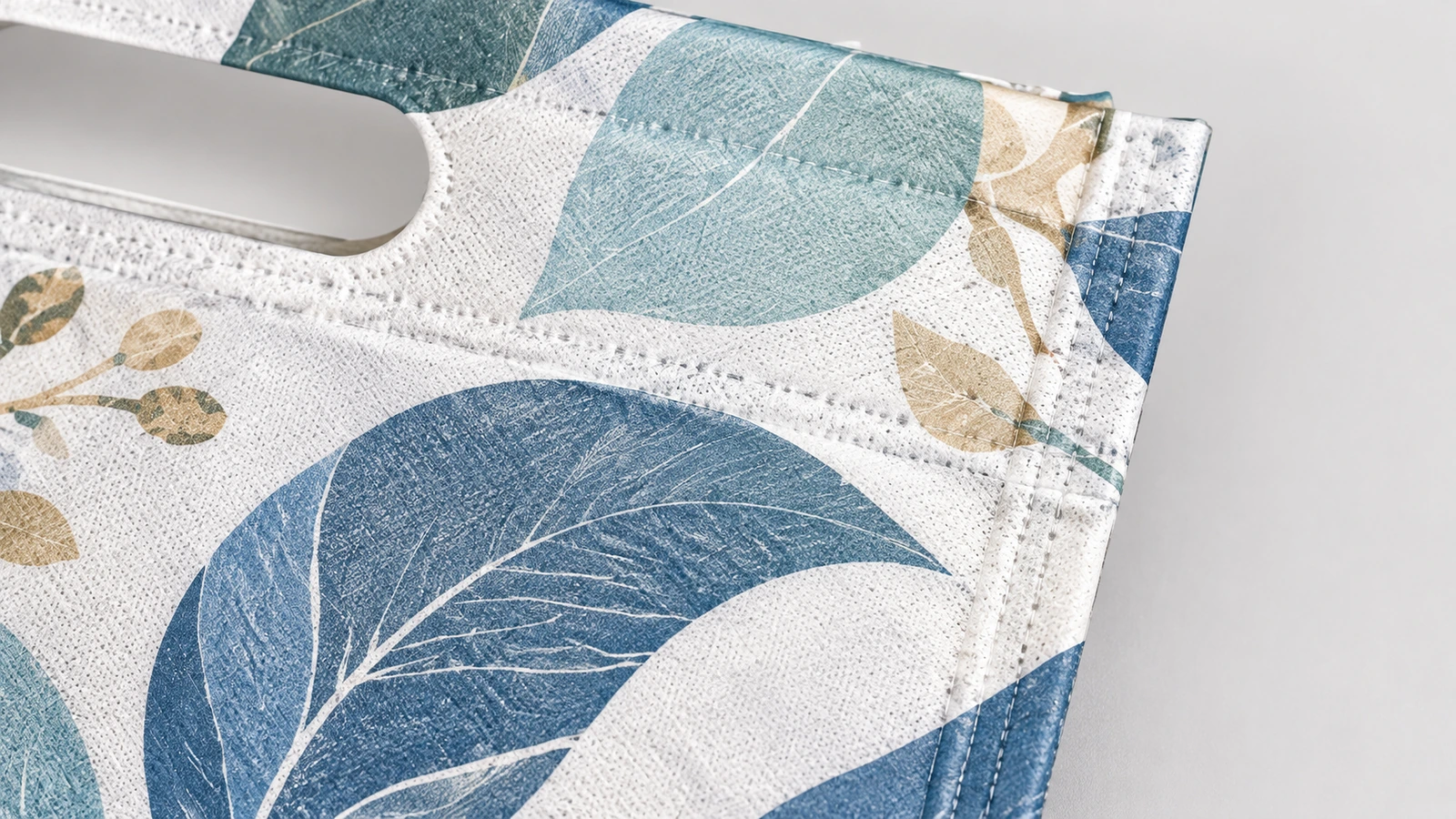
Send vector files with Pantone references and state the number of colors per side. Non-woven fabric is porous, so ink soaks in. printingbag.net[13] estimates that color saturation is about 20–30% lower than on paper or canvas bags. It also notes that mainstream screen printing runs 1–4 colors and struggles to hold fine lines and gradients. Before the proof is made, thicken hairlines, convert gradients to solid tones for screen printing, and confirm whether the logo prints on one side or both.
Step 5: Lock terms on the proforma invoice and release production
Every quote should state these items:
- Flat dimensions (width × height × gusset)
- GSM and its tolerance
- Virgin or recycled PP
- Seal method
- Print colors and printing process
- Handle reinforcement
- Test method
- MOQ, sample time, and bulk production time
- Incoterm (for example, FOB Ningbo or Shanghai, or DDP)
- Whether plate fees are included
Payment is often a 30% deposit, with the balance due before shipment, but this is not a fixed industry rule. Also write the quantity tolerance and the reprint terms for wrong artwork into the order. Production then follows the print, seal, die-cut, and bundle route described above.
Step 6: Test the sample and inspect the bulk order
NoWoBag allows 3–5 days for sample review before scheduling production. Use that time to run four checks:
1. A dynamic lift test with real merchandise inside.
2. Dry and wet rub tests, plus a fold test, on the print.
3. A GSM check against the quoted figure.
4. A smell check as soon as the carton is opened. Odor complaints are commonly traced to recycled PP content and non-eco inks, according to Weifang Shuntai.
For the bulk order, check sizes, handle position, print registration, and quantity against AQL sampling, and keep the first-off and last-off samples. Aveco Baggie[14] notes that defect rates below about 2–3% are often treated as acceptable in bulk runs. Agree on your threshold before production starts, not after delivery.
How Does D-Cut Compare with W-Cut, Loop-Handle, and Laminated Bags? ↑
D-cut is the lowest-cost structure, but it is not the strongest. The right choice depends on how heavy the contents are, how far customers carry them, and how often you expect the bag to be reused.
| Attribute | D-cut | W-cut | Loop handle | Laminated D-cut |
|---|
| Handle build | Punched from body | Punched, with bottom gusset | Separate, sewn or sealed | Punched, BOPP-coated |
| Supplier-stated load | 5–8 kg | 5–10 kg | 10–15 kg | Not stated; verify by sample |
| Supplier-stated reuses | 30–40 | 40–50 | 50–100+ | Not stated |
| Relative cost | Lowest | Slightly higher | Highest | Higher than plain |
| Best fit | Promotions, pharmacy, light retail | Grocery, mid-weight goods | Boutiques, conference gifts | Cosmetics, premium retail |
The load and reuse figures come from Go Green Non Woven Bags[15]. They are a supplier's experience values, not ISO or ASTM test results, so use them to rank the options rather than as a warranty. The same source warns that if someone carries about 8 kg for more than ten minutes, the D-shaped holes "can dig into fingers." If your customers carry heavy groceries, switching to a W-cut or loop handle solves the structural problem better than adding GSM to a D-cut.
Sourcing benchmarks: MOQ and lead time
| Source | Published MOQ | Published lead time |
|---|
| Seemrich | 5,000 pcs | 10–12 business days production |
| NWFabric | 5,000 pcs | Samples 3–7 days after confirmation |
| NoWoBag | 8,000 (flexo); 15,000 (BOPP) | 7–14 working days (1–2 colors); 21–30 days if complex |
| Blue Nile Bags | About 1,500–2,000 | 6–8 weeks from sample approval |
| Pochette Pack | 10,000 pcs | About 30 days; ±10% quantity |
The figures above come from Seemrich[16], NWFabric, NoWoBag, Blue Nile Bags, and Pochette Pack. They show that no single industry MOQ exists. A factory lead time of 7–14 working days covers production only. A US-facing channel that quotes 6–8 weeks from sample approval covers more of the supply chain. Add ocean freight and customs clearance separately instead of treating factory time as arrival time.
Published prices are just as scattered. NWFabric lists $0.30–$0.50 per bag with a 5,000-piece MOQ. An Alibaba product-insight page puts standard 70–80 GSM bags at $0.20–$0.50 for orders of 1,000+ units and print-enhanced versions at $0.50–$1.80. A US promotional site lists an 8×12 in bag at $1.30 with a 275-piece minimum. Before comparing quotes, normalize them for size, GSM, number of colors, Incoterm, and plate fees.
Flat D-cut bags also pack densely. TLP Packaging[17] estimates that about 50% more D-cut bags fit in a container than loop-handle bags, using 30–40% less warehouse space. This is a supplier calculation, so verify it against your actual carton specification. For reorders, keep the approved sample, the Pantone references, and the carton count on file so the next run matches the last one.
Which Eco Claims Can You Safely Print for the US Market? ↑
Environmental marketing in the US is governed by the FTC Green Guides. Under 16 CFR 260.12[18], you may make an unqualified "recyclable" claim only if recycling facilities are available to a "substantial majority" of consumers or communities where the item is sold. The rule defines that as at least 60 percent. LeeLine Bags notes that municipal centers often reject PP non-woven bags. "Reusable" is therefore the safe default wording, and any recycling claim should be qualified.
Do not print "compostable" or "biodegradable" on standard PP. ASTM D6400[19] covers plastics designed to compost in municipal or industrial facilities, and ordinary spunbond PP does not meet that path. Reuse claims also need care. printingbag.net reports that a PP non-woven bag may need about 11–14 reuses to offset its carbon footprint compared with a single-use plastic bag. Check that figure against the original life-cycle study before you quote it.
California changed the context in 2026. A CalRecycle bulletin[20] confirms two points. The SB 270 reusable grocery bag program ended on December 31, 2025. Since January 1, 2026, stores may only distribute recycled paper bags at the point of sale, at a minimum charge of ten cents. A branded D-cut bag in California therefore works as a reusable bag the customer owns or as a promotional item. It is not a certified checkout bag. Avoid reusing the old SB 270 wording "designed for at least 125 uses," described in the Attorney General's summary, as if it were current certification. Finally, store bag stock away from direct sunlight. Aveco Baggie notes that PP non-woven is photodegradable and can turn brittle within 6–12 months of prolonged sun exposure.
Key Takeaways for Faster, Safer Sourcing ↑
- Most failures start at the handle, not the bag body. — more than half of real-world PP non-woven bag failures (Source)
- D-cut handles tear when the fabric is too light. — below 50 GSM, the handle hole tears (Source)
- Extra fabric weight brings limited benefit to a punched handle. — 70–80 GSM is standard; above 90 GSM is usually unnecessary (Source)
- Factory time and US-channel lead times are not interchangeable. — 7–14 working days for 1–2 colors versus 6–8 weeks from sample approval (Source; Source)
- An unqualified "recyclable" claim requires broad facility access. — at least 60% of consumers or communities (Source)
- California checkout bags are now paper-only. — since January 1, 2026, with a minimum $0.10 charge (Source)
- Market size estimates depend on how each report defines the market. — one report: $4.395 billion in 2025 to $6.878 billion by 2031, at a 7.7% CAGR (Source)
Ready to Specify Your D-Cut Bags? ↑
A good D-cut bag order starts with a clear specification. Set a GSM floor that matches the load, choose a print method that suits the artwork, sign off a proof, and approve a sample that has passed a loaded lift test and a rub test. Keep your environmental claims within FTC and California rules. Then compare quotes only after normalizing size, number of colors, Incoterm, and fees. MOQ, production time, and unit price for your order are confirmed at quotation, and bulk production follows sample approval. Send your bag size, GSM, print colors, quantity, and destination country to request a quotation and a pre-production sample.




The information below is required for social login
Sign In
Create New Account