Custom lightweight cotton tote bags are 4–6 oz/yd² cotton totes printed with your logo for events, retail handouts, and giveaways. They fold flat and cost less than canvas. They hold up only when fabric weight, pre-shrink status, print method, handle stitching, and inspection are written into the order and proven on a physical sample.
Who Buys Lightweight Cotton Totes, and for What? ↑
Most buyers are ordering for an organization rather than for themselves. Marketing teams, event planners, admissions offices, and nonprofits use 4–6 oz bags for registration kits and trade-show handouts because the bags fold flat and carry flyers, notebooks, and samples. Boutiques, bookstores, and DTC brands use them in place of paper bags. As 4OVER4 puts it, a custom shopping bag is "one of the few marketing pieces a customer carries in public for you, by choice."[1]
Creators and community organizers buy smaller runs, often blanks they decorate themselves. This group includes Etsy sellers, DTF and heat-transfer studios, potters, teachers, churches, and wedding couples. Their main constraint is quantity. One seller wrote that every large supplier she found had a high MOQ when she only needed 5–10 bags[2]. Each group needs different answers on custom cotton tote bags: fabric weight, print method, minimums, and how much schedule slack the event date allows.
Why Do Cheap Lightweight Totes Backfire on Brands? ↑
Light fabric is not the problem. The problem is that nobody writes down what "light" means. Team Sunday's 2026 guide describes the cheap, ultra-light cotton shopper as "exactly the throwaway bag that gave the whole category its commodity reputation."[3] When a recipient sees a see-through panel or a crooked handle, they conclude the brand cut corners.
Delivery and washing failures make it worse. In one Better Business Bureau complaint, a school ordered 240 bags for a fundraiser and received only 108[4]. A 100% cotton tote without pre-shrinkage can shrink up to 10% in the first wash[5], which distorts a centered print. Amazon reviews of a popular bulk blank canvas pack show the same failures at smaller scale. Buyers report uneven handles and loose threads. One buyer measured about one inch of shrinkage after washing and drying, and others received "white" bags that were actually khaki.
The fix is to buy a specification instead of a catalog photo. Before production, lock measured GSM, pre-shrink status, print method, handle stitching, sampling, and inspection levels. This page publishes no tested factory data. MOQ, production time, and unit weight for our Custom Lightweight Cotton Tote Bags are therefore confirmed in your quote and verified on a physical sample.
Table of Contents
What Counts as a Lightweight Cotton Tote? ↑
The ounce figure on a tote listing describes fabric areal density in oz/yd². It is not the weight of the finished bag. One oz/yd² is roughly 33.9 g/m², so 4–6 oz cotton works out to about 136–203 GSM. Suppliers do not all use the same conversion. Bagmasters lists its 4 oz recycled-cotton tote as 120 GSM[6] and shows $1.96 per piece at 5,000+ on that page. Ask every supplier for measured GSM in writing, and compare suppliers on that figure rather than on the label.
| Tier | Nominal oz/yd² | Approx. GSM (×33.9) | Realistic job |
|---|
| Ultra-light conference | 3.5–4 | ~119–136 | Flyers and one-day handouts |
| Lightweight standard | 5–6 | ~170–203 | Trade shows, registration kits, book fairs |
| Reusable everyday | 8–10 | ~271–339 | Repeat carry and member or staff bags |
| Retail canvas | 12+ | ~407+ | Rigid retail merchandise (outside the lightweight range) |
The table shows why fabric weight is the first decision. 4OVER4 advises going "down to 5 or 6 ounce cotton only when the bag is a conference handout"[7] and choosing 8–10 oz for bags people will reuse. A lightweight tote suits one event, one season, or light contents. It is a poor choice for groceries, books, or repeated machine washing. Any capacity or load figure depends on the actual dimensions, how the bag is loaded, and sample testing.
Fiber claims are regulated separately from print quality. Under FTC guidance, a product should not be labeled "100% Cotton" unless it contains only cotton[8], and covered products must list each fiber that makes up 5% or more of the weight. A blend such as 70% recycled cotton / 30% cotton has to be described that way. Some handbag-type items are exempt under 16 CFR Part 303, so check with your importer whether fiber, origin, and care labels (16 CFR Part 423) apply before the bags reach consumers.
How Do You Spec a Lightweight Tote Step by Step? ↑
Step 1: Choose stock decoration or cut-and-sew
Decorating a stock blank keeps the size, weight, and handles fixed and changes only the print. Cut-and-sew lets you set every dimension, but it adds pattern, sewing, and sampling time. Team Sunday puts typical minimums at about 50 pieces to decorate a ready-made tote and about 100 to build one from scratch[9]. Orders of 5–15 usually go to local DTF or heat-transfer printers at near-retail prices. If a stock shape does the job, avoid opening a new pattern.
Step 2: Fix size, print area, and readability
Bag size limits what the logo can do. Totally Promotional's 6 oz gusset tote lists 15 × 16 × 3 in with a 9 × 11 in imprint area[10] and a stated 11.8 L capacity. That capacity applies only to that SKU, so check your own bag's usable volume on the sample with real contents. The same page charges $50 setup for one color on one side and $0.50 per bag for a second side. Keep critical artwork at least 0.25 in from seams. A bold single-color logo with open space reads better than a dense slogan, because thin fabric and loose weave soften fine lines.
Step 3: Choose fabric surface, handles, and closures
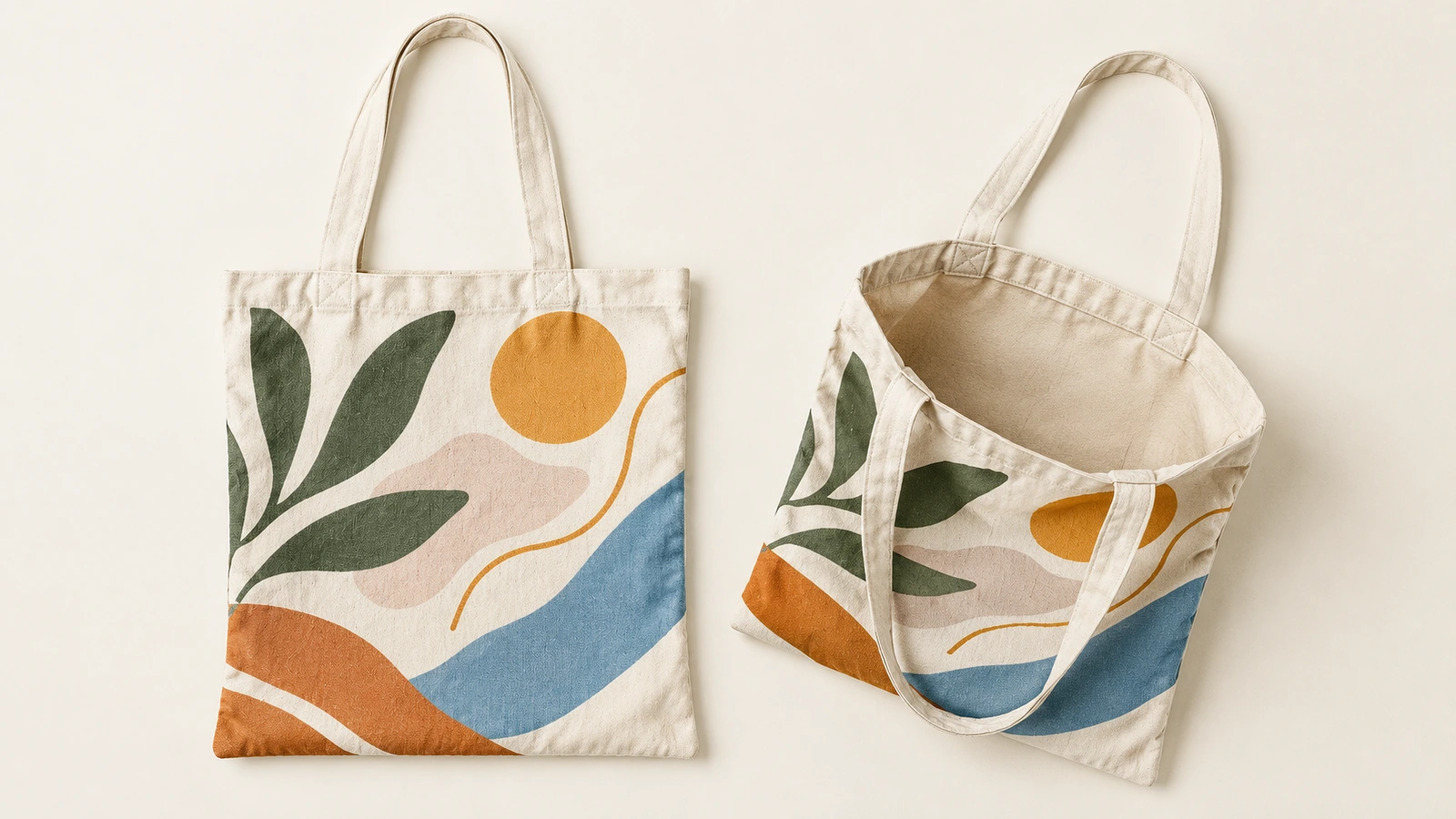
Natural undyed cotton is the cheapest and fastest surface to order. Dyed fabric, closure hardware, inner pockets, and gussets each add cost and lead time, and custom-dyed cloth usually raises the minimum. Self-fabric handles are standard. Specify handle length and width, and state whether stress points get bar-tack or box-X stitching. Snaps or buttons are optional upgrades. They should appear on the spec sheet and on the sample, not only in conversation.
| Method | Fit on 4–6 oz cotton | Cost behavior | Caveat |
|---|
| Screen print | Default for 1–2 spot colors | Lowest unit cost at volume; setup per color | Heavy solid blocks crack on folds |
| DTF / heat transfer | Photos, gradients, short runs | No screens; higher unit price | Thin blanks press unevenly; test first |
| Embroidery | Small premium marks | Digitizing fee; slower output | Needs stabilizer backing on light fabric |
| Sublimation | Not suitable | Not applicable | Requires polyester or high-poly blends |
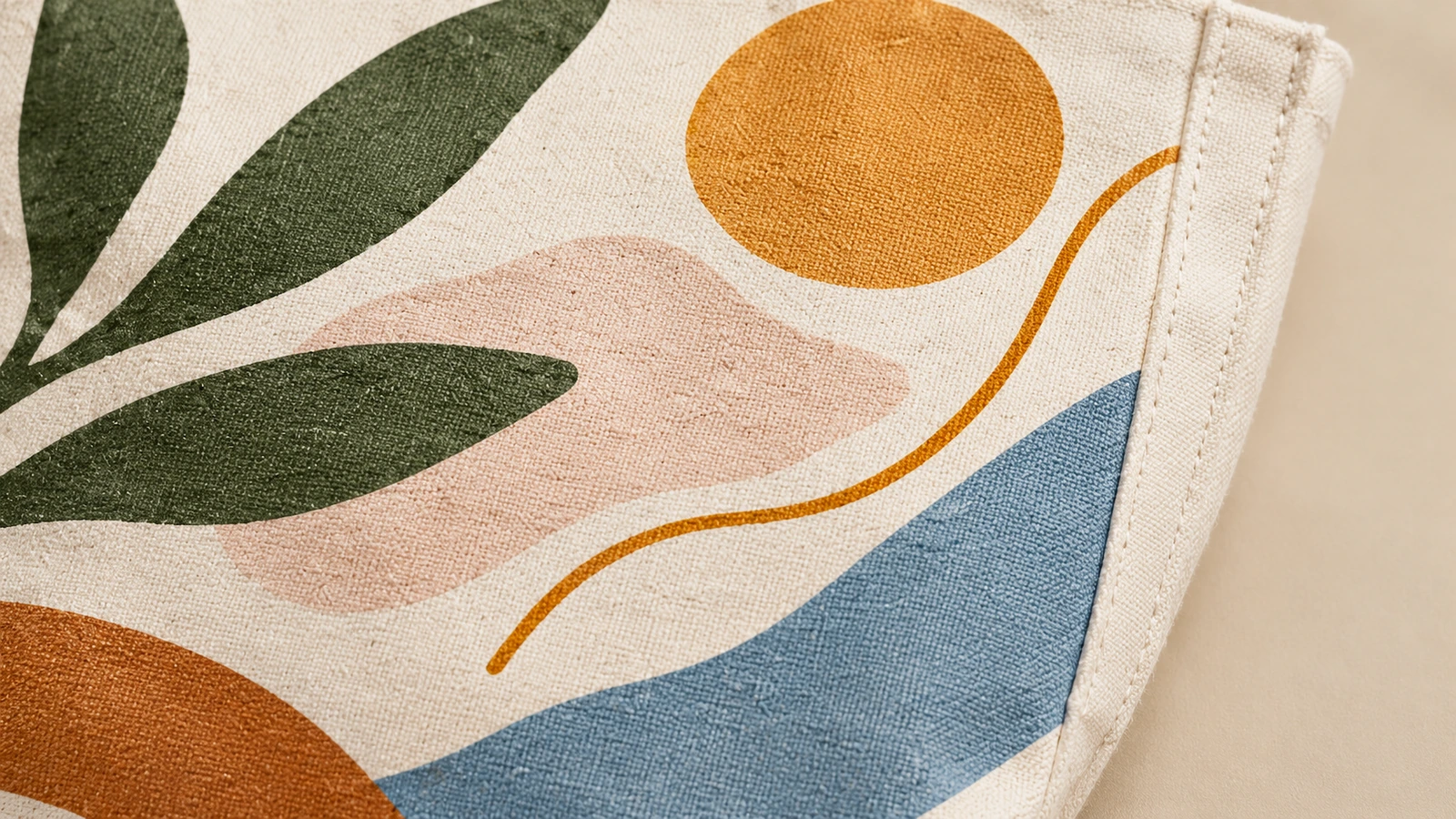
Sublimation does not work on pure cotton. It suits "synthetic blends only, not pure cotton."[11] For heat transfers, one DTF practitioner notes that "heavy canvas bags usually press much better than thin budget totes"[12], so order spare blanks and test your time, temperature, and pressure. For screen printing, 4OVER4 explains that plastisol cracks when the ink layer is too thick or the bag is folded hard along the print, and calls a heavy solid rectangle across a gusset "the classic failure."[13]
Step 4: Preflight the artwork file
Send vector AI, EPS, or PDF files with all fonts converted to outlines. Raster images need 300 DPI at actual print size[14]. Give Pantone references for spot colors, and expect ink on natural cotton to look warmer than it does on screen. State the print placement in inches from the top hem, and attach a mockup on the exact bag size. This prevents a common proof dispute: a logo that looked right on a generic template but sits wrong on the real bag.

Step 5: Approve a physical sample, then schedule production
An e-proof checks layout only. A physical sample shows hand-feel, ink coverage, color on the actual cloth, and stitch quality. Szoneier states that custom tote production usually takes about 30–45 days from sample confirmation, and sampling often takes 5–10 days[15]. Printing usually happens on flat cut panels before sewing. Handle reinforcement, inspection, and packing follow. Allow one sample revision round, and add transit time on top of production.
How Should You Inspect and Accept the Bulk Order? ↑
Use attribute sampling under ISO 2859-1, which belongs to the same family as ANSI/ASQ Z1.4, instead of spot-checking a handful of bags. Promotional bag suppliers commonly quote AQL 2.5 for major and 4.0 for minor defects[16]. These levels are a commercial agreement, not a legal requirement, so write them into the purchase order.
| Check | Method | Acceptance written into contract |
|---|
| Fabric weight | Cut and weigh a swatch | Measured GSM within agreed tolerance |
| Dimensions | Measure width, height, gusset flat | ±1 cm or ±3%, as agreed |
| Handles | Count, stitch type, pull test | Bar-tack or box-X; load set by sample test |
| Print | Placement, Pantone, rub test | No smudge or transfer to other fabric |
| Shrinkage | Wash sample per AATCC 135 or ISO 6330 | Target ≤3–5% warp and weft |
| Count and condition | Cartons vs packing list | Short-ship cap ≤1%; dry and odor-free |
Ink that rubs off is usually a curing failure, not a design problem. On Reddit, a printer looked at a tote whose print was "coming off on everything" and diagnosed plastisol that "wasn't cured right"[17]. Photograph and count cartons within 48–72 hours of delivery. Tie the claim window to your event date rather than the delivery scan, and require the seller to pay return freight on defective goods. Handle load ratings are contract targets verified on the sample, not universal capacities.
Which Buying Path Fits Your Quantity, Budget, and Date? ↑
| Buying path | Fabric | Quantity fit | Main watch-out | Best use |
|---|
| Decorated lightweight stock blank | 4–6 oz cotton | Dozens to thousands | Thin feel, shrinkage, per-color setup | Trade shows, registration kits |
| Mid-weight upgrade | 8–10 oz cotton | Hundreds and up | Higher unit and freight cost | Member, staff, retail reuse |
| Overseas cut-and-sew | Any spec | Usually hundreds per style | QC and transit fall on buyer | Recurring retail programs |
| Small-run local DTF/DTG | Stock blanks | Single digits to dozens | Near-retail unit price | Prototypes, weddings, pop-ups |
| Premium structured canvas | 18–24 oz | Single or small lots | Price far above promo totes | Executive and client gifts |
Unit price depends on fabric weight, quantity, and number of colors. Pamusan's 2026 reference table, based on production cost plus typical shipping to the continental US, lists a 4 oz 14 × 16 in cotton tote at $1.80 (100 pcs), $1.40 (500), and $1.20 (1,000)[18]. The same table lists 10 oz canvas at $4.20, $3.50, and $3.00, with standard production of 10–15 business days after artwork approval. Small runs cost much more. One distributor quoted $7.15 per piece for 50 bags of 6 oz cotton with a four-color imprint[19], including setup and shipping. Use these figures as budget anchors only. Your quote depends on spec, colors, and destination.
Plan the reorder when you place the first order. Lightweight totes fold flat and pack densely, but repeat batches can drift. One Amazon reviewer's second order of the same blank tote arrived smaller, in a different color, and with different strap stitching. To prevent this, keep a signed golden sample and record the fabric lot and measured GSM. Put the folding method, inner polybag, and carton count on the spec sheet, and require written approval before any change of mill or material.
Which Eco and Compliance Claims Can You Actually Make? ↑
Regulation is pushing shoppers toward bringing their own bags. CalRecycle states that beginning January 1, 2026, California stores may only distribute recycled paper bags at the point of sale[20]. It names cotton totes as a washable, reusable option shoppers can bring with them. This supports branded retail and gift totes. It does not make a giveaway tote a compliant checkout bag.
Certification claims require paperwork. GOTS version 8.0 was released in March 2026 and takes effect for certified entities on March 1, 2027[21]. Under it, an "organic" label requires at least 95% certified organic fiber, and each shipment needs a transaction certificate. OEKO-TEX STANDARD 100 rules tightened on June 1, 2026[22]: uncertified wet processes such as printing are now accepted only for initial certifications. Availability of GOTS, GRS, or OEKO-TEX material is quote-dependent. Before you print any claim, request the certificate numbers and confirm the scope covers fabric, thread, and ink.
Avoid "carbon neutral" promises. A 2026 summary of the Danish EPA analysis says a conventional cotton tote must be used at least 7,100 times[23] to offset its impact across all indicators, compared with a single-use plastic bag. The climate-only threshold is much lower. The defensible message is durability and reuse: a bag that lasts through its intended use supports a sustainability story better than an "eco" label does.
Key Takeaways for Lightweight Tote Buyers ↑
- Lightweight cotton is a handout spec, not a grocery bag. — 5–6 oz for conference handouts; 8–10 oz for reuse (Source)
- Unshrunk cotton distorts prints after one wash. — up to 10% first-wash shrinkage (Source)
- Reference pricing falls steeply with volume. — 4 oz tote: $1.80 at 100 pcs to $1.20 at 1,000 (Source)
- Schedule from sample approval, not from inquiry. — about 30–45 days production plus 5–10 days sampling (Source)
- California checkout rules favor bring-your-own totes. — recycled paper only at point of sale from January 1, 2026 (Source)
- Reuse, not material alone, decides environmental value. — about 7,100 uses for a full-indicator breakeven (Source)
Ready to Order the Right Lightweight Tote? ↑
Lightweight custom cotton tote bags work when the job is clearly defined, such as a handout, a book fair, a registration kit, or light retail carry. They fail when fabric weight, shrinkage, print curing, stitching, and carton counts are left unspecified. Put measured GSM, pre-shrink status, print method, and AQL levels in writing, approve a physical sample, and count back from your event date with transit time included. Send your artwork, quantity, and event date to request a quote and a physical pre-production sample.




The information below is required for social login
Sign In
Create New Account