Custom nylon shopping bags are lightweight, foldable reusable totes printed with your logo for retail checkouts, events and corporate gifting. Their real performance depends on denier, weave, coating, seam construction and print method. Specify each order on a tech pack, prove it with a pre-production sample and inspect it against written acceptance criteria.
Who Orders Custom Foldable Nylon Shopping Bags, and Why? ↑
Most people who source this product are buyers rather than end users. They include promotional distributors, corporate marketing teams, grocery and private-label buyers, event agencies and growing D2C brands. All of them need the same things: a printable brand surface, a bag that folds into a small pouch, and minimums that fit a campaign budget. The business case rests on repeated exposure. A B2B tote sourcing guide[1] cites the ASI 2026 Global Ad Impressions Study, which found that a promotional tote costing roughly $6 earns close to 5,000 impressions over its life. The same guide sizes the US promotional products market at more than $27.8 billion.
Grocery retail runs on the same habit. Future Market Insights[2] values reusable grocery totes at about $2.7 billion in 2025 and projects about $4.6 billion by 2035, a 5.4% CAGR. Supermarkets and hypermarkets hold roughly 44.3% of channel share.
The end user decides whether your logo stays in circulation. One verified Amazon buyer[3] explained why a foldable bag lives in her purse: "whenever I go to Aldi's, I tend to never have my bags with me or in my car." A bag that feels heavy, stains or tears at the handle gets taken out of the purse, and the brand impressions stop with it.
Why Do Branded Nylon Bags Fail Before the Campaign Ends? ↑
The problem: Failed nylon bag programs rarely fail because of the fabric. They fail on print adhesion, handle seams and claims nobody can support. One screen printer described the chemistry plainly in a screen-printing forum thread[4]: "to properly print on nylon you need a bonding agent. No amount of heat or pressure is going to make that adhear."
The agitation: Construction is the second weak point. CBC Marketplace[5] tested 12 reusable bags and 7 failed; every thinner cloth bag failed before 100 trips. Not all of those bags were nylon, but the gap between a "reusable" label and real trip life applies here too. Then there is the run where the sample looks good and the bulk order does not. One bag sourcing guide[6] calls this "the #1 complaint we hear from new brand clients." Together these problems can end a campaign with peeling logos, short-shipped cartons and refund disputes.
The solution: The fix is a process. Write fabric and seam requirements as measurable values. Choose a print method suited to nylon's coated surface. Approve a pre-production sample built from bulk materials, then inspect the bulk order against a written defect list. The sections below cover each step. MOQ, production time, unit weight and load performance for your specific bag are confirmed through quotation and sampling, not stated in this article.
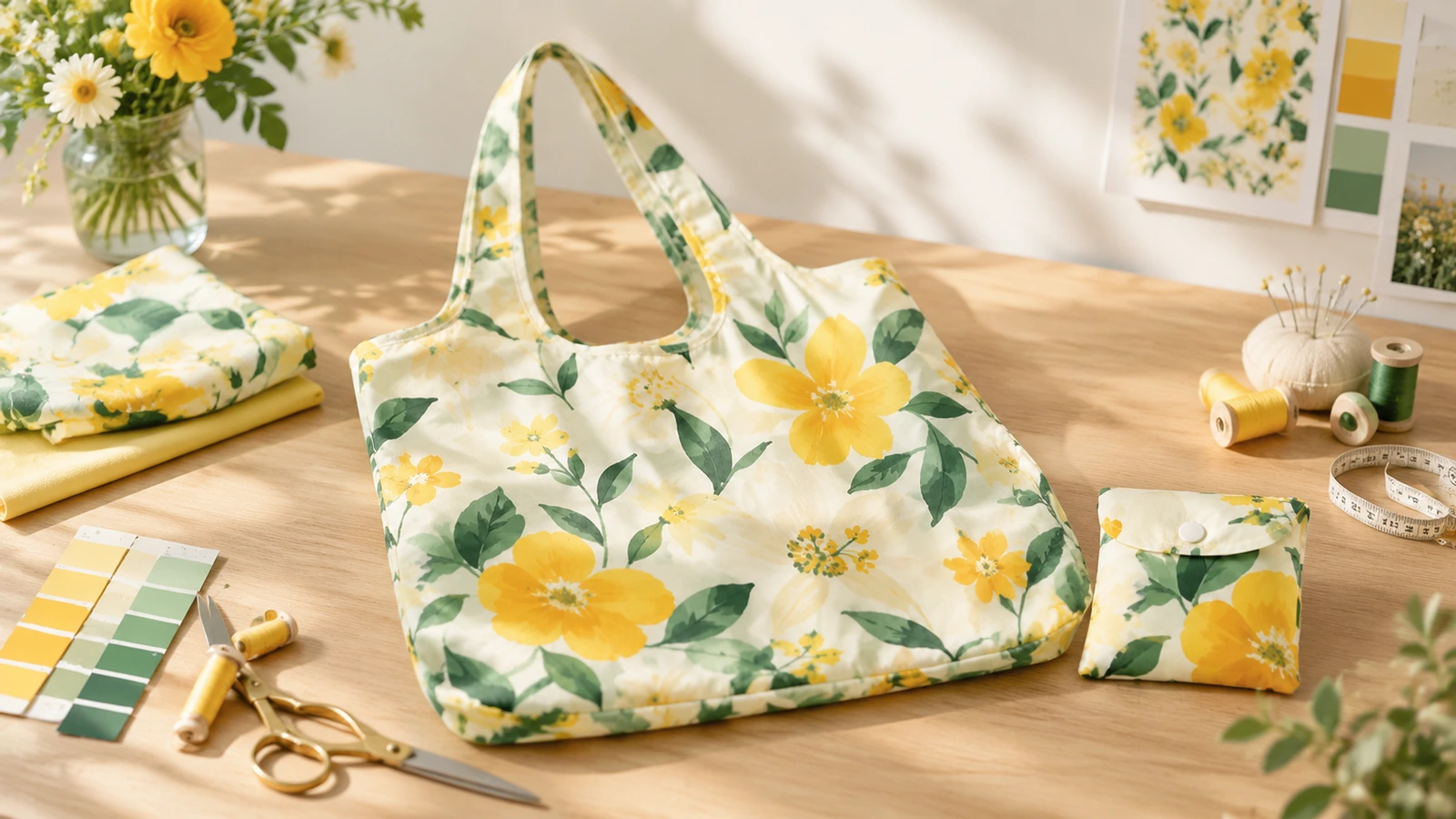
Table of Contents
What Exactly Is a Custom Foldable Nylon Shopping Bag? ↑
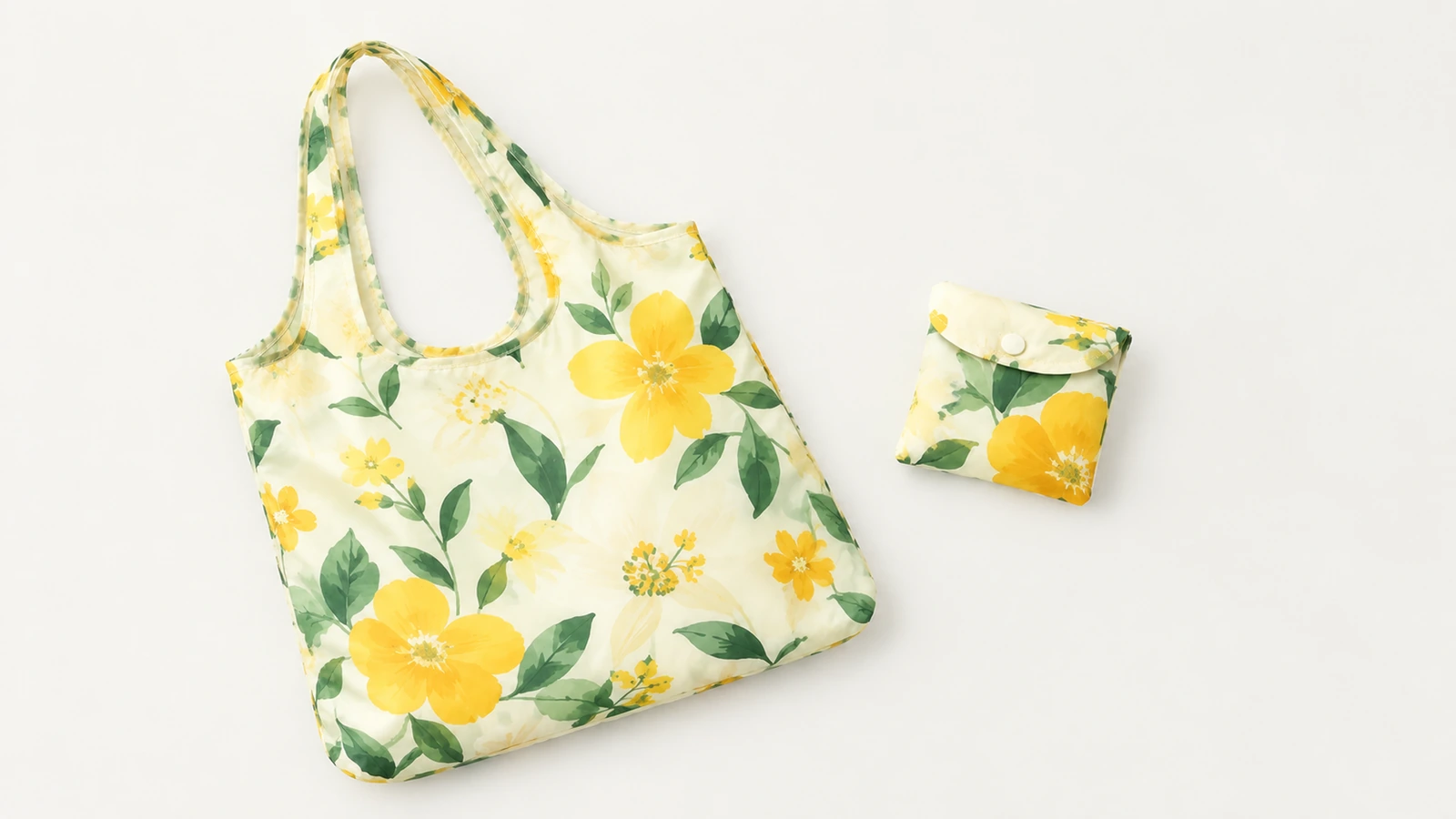
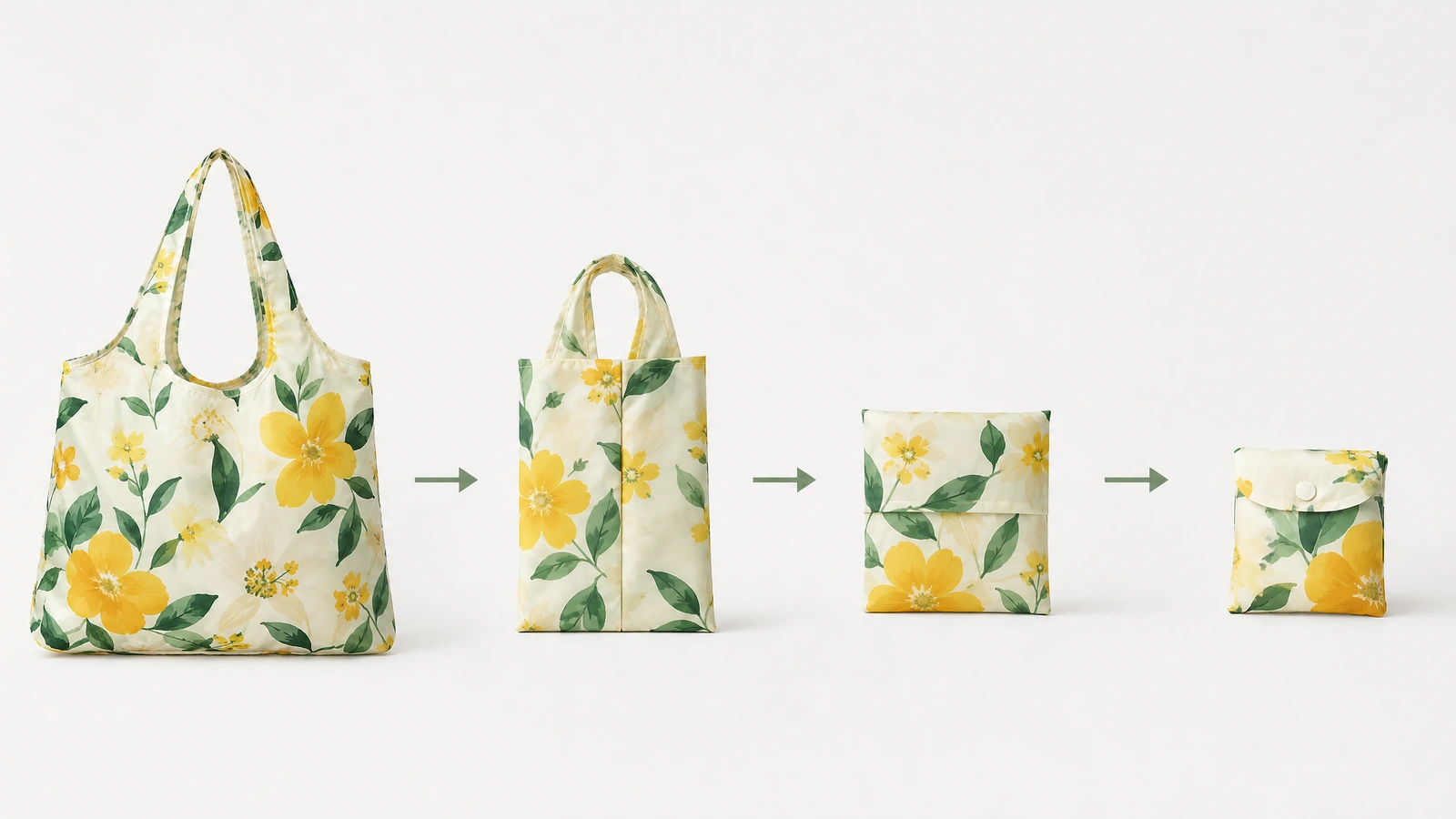
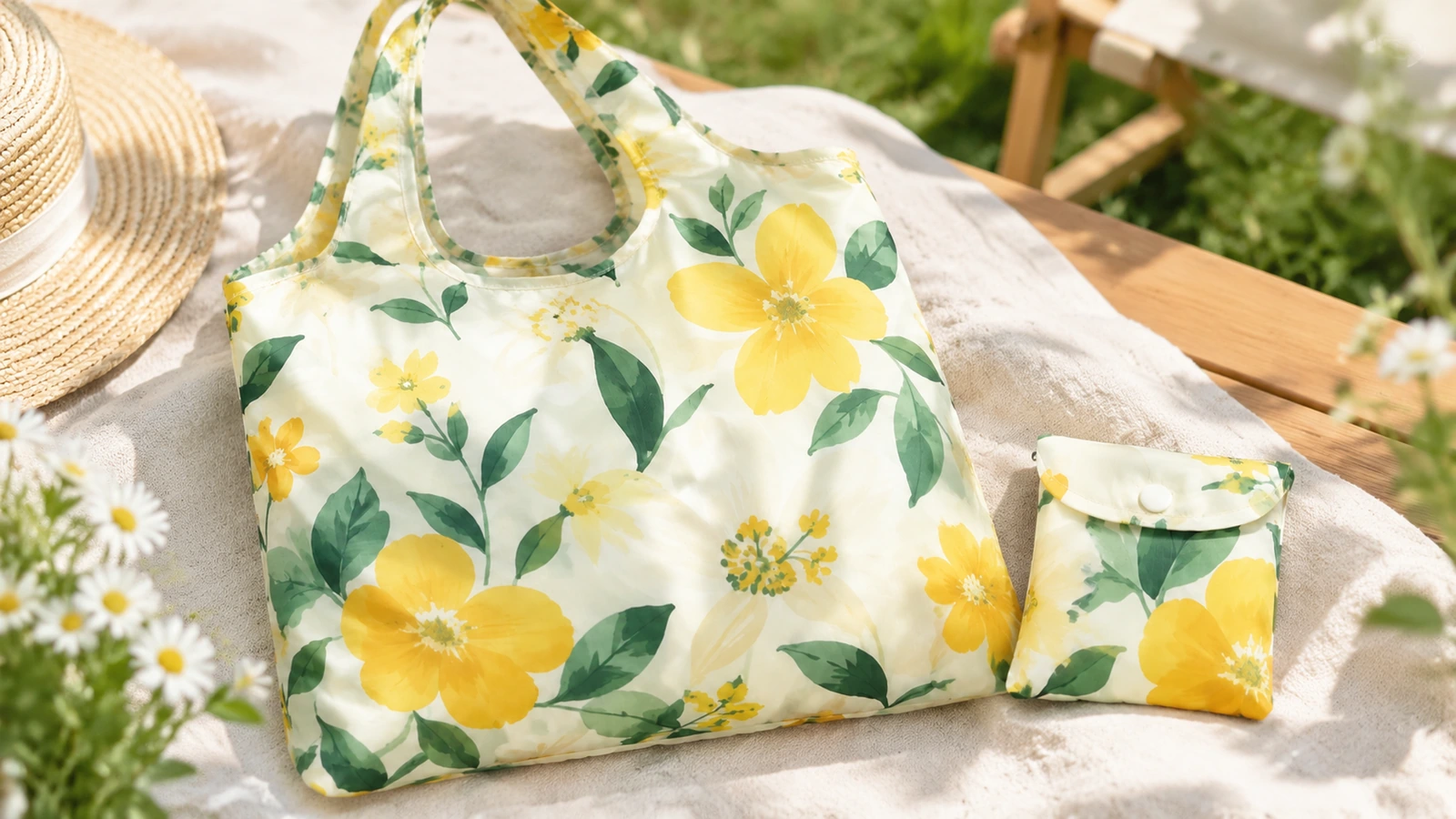
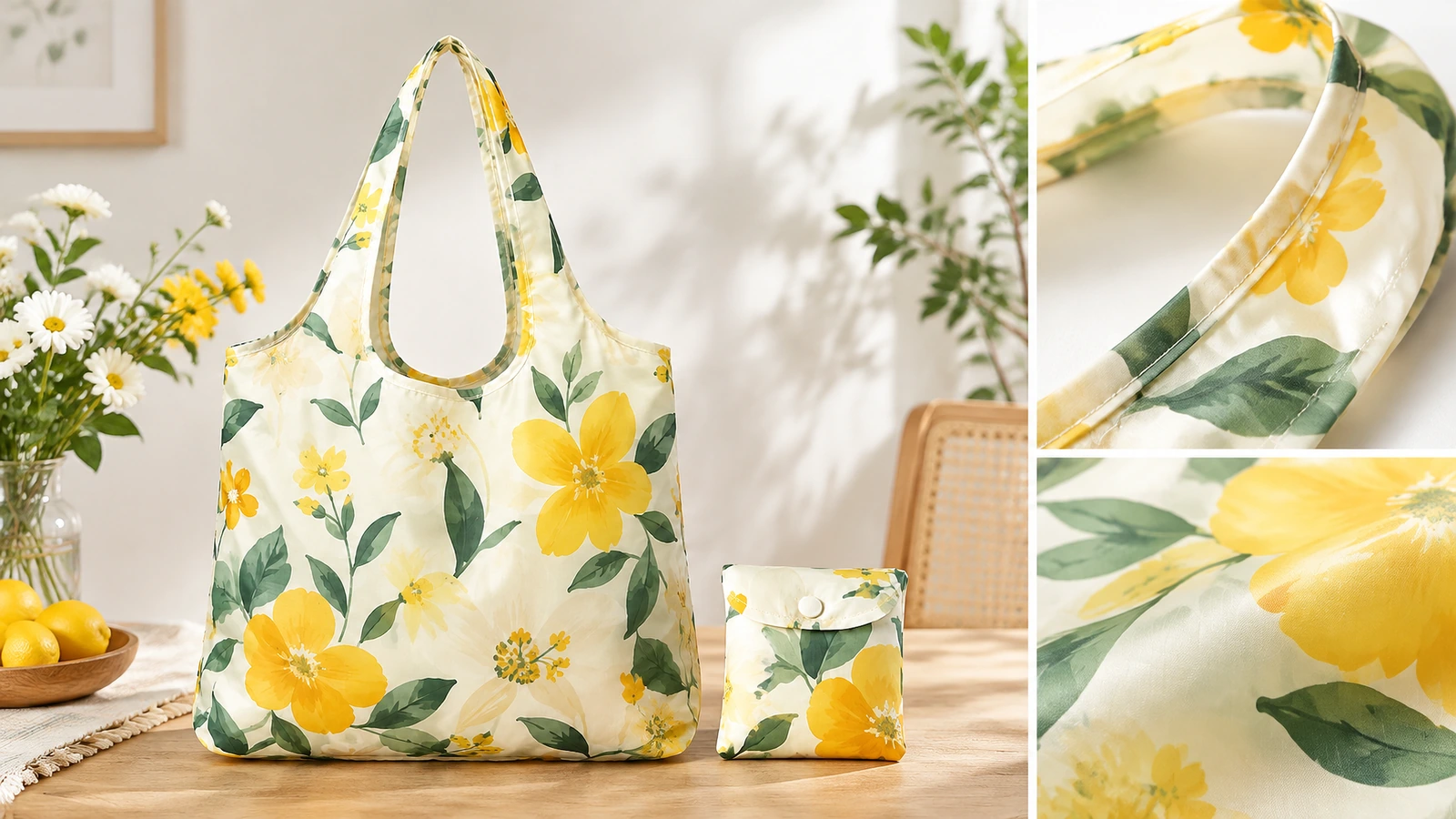
A custom foldable nylon shopping bag is a sewn polyamide tote, usually with an attached pouch, that folds into a compact package and carries a printed, transferred or embroidered brand mark. The word "nylon" on its own is not a specification. In the words of one nylon bag materials guide[7], "the construction, denier, weave, and finishing determine its weight, performance profile, surface aesthetic, and cost." Four variables define the product. The first is denier (D) or thread count (T). The second is the weave: plain, oxford or ripstop. The third is the coating, which can be none, PU, TPU or DWR. The fourth is fabric weight in g/m².
As a practical guide, the Taiwanese printer EEWIN[8] describes 70D–100D as light and soft, suited to foldable bags and event gifts. It describes 150D–210D as stiffer and better at carrying weight, suited to premium brand totes. Water behavior depends on the finish, not the fiber: Fieldtex[9] notes that neither nylon nor polyester "is waterproof without coating." A coated, sewn shopping bag still has open stitch holes, so describe it as water-resistant rather than waterproof.
Legal definitions can also apply. California Public Resources Code §42281[10] names woven or nonwoven nylon explicitly. Under that section, a fabric reusable grocery bag must be sewn, must carry 22 pounds over 175 feet for at least 125 uses, and must have a fabric weight of at least 80 g/m², along with handles and at least 15 liters of capacity. Weigh ultra-light foldable fabrics before using that label. A fabric under 80 g/m² cannot be marketed in California as a statutory reusable grocery bag, however well it is printed.
How Do You Specify, Sample and Approve an Order? ↑
Step 1: Lock the use case before you request prices
Quotes only compare fairly when they price the same bag. Style Sourcing[11] warns: "If one quote assumes lightweight cotton, another assumes heavy canvas, and a third excludes labels or retail packing, the prices are not comparable." Put the program in one of three tiers before writing the spec. Event giveaways need to be light and foldable. Daily grocery bags need load capacity and washability. Brand merchandise needs good hand feel and a clean logo.
| RFQ field | What to state | Why it moves the quote |
|---|
| Open and folded size | L × W × gusset; pouch size | Fabric consumption and freight volume |
| Fabric | 210T / 210D / 420D; plain or ripstop | Main driver of unit cost and hand feel |
| Fabric weight | g/m², verified on the sample | Stops a thinner cloth being sold under the same denier |
| Coating | None / PU / TPU / DWR (PFAS-free confirmation) | Splash resistance, stiffness and chemical compliance |
| Print | Method, Pantone count, print area, placement | Screens, setup fees and per-unit run cost |
| Handles and closure | Width, length, bar-tacks; pouch snap or zipper | Labor and trim minimums |
| Quantity | Units per style and per color | Price tier and dye-lot minimums |
| Documents and terms | GRS TC, test reports, EXW/FOB/DDP | Certification cost; whether freight and duty are included |
The table leaves out carrying capacity and item-fit counts on purpose. Those depend on the bag's actual dimensions, how it is loaded, and verification on the approved sample. Add them to the PO only after the sample has been tested.
Step 2: Choose the fabric, surface finish and closure
Kingsons describes 210T ripstop as "extremely lightweight, packable," with grid threads that stop a tear from spreading, and 420D as a balance of low weight, abrasion resistance and surface finish. For recycled nylon, remember that a certificate does not measure performance. LantaoBags[12] puts it this way: "GRS certification only tracks recycled content and social compliance. It does not measure physical strength." Require a Transaction Certificate for each order, and test strength separately. For the pouch, specify the snap or zipper type (YKK or equivalent) and the reinforcement at its attachment seam, because pouches go through a stress cycle every time the bag is folded.
Step 3: Preflight the artwork and match the print method
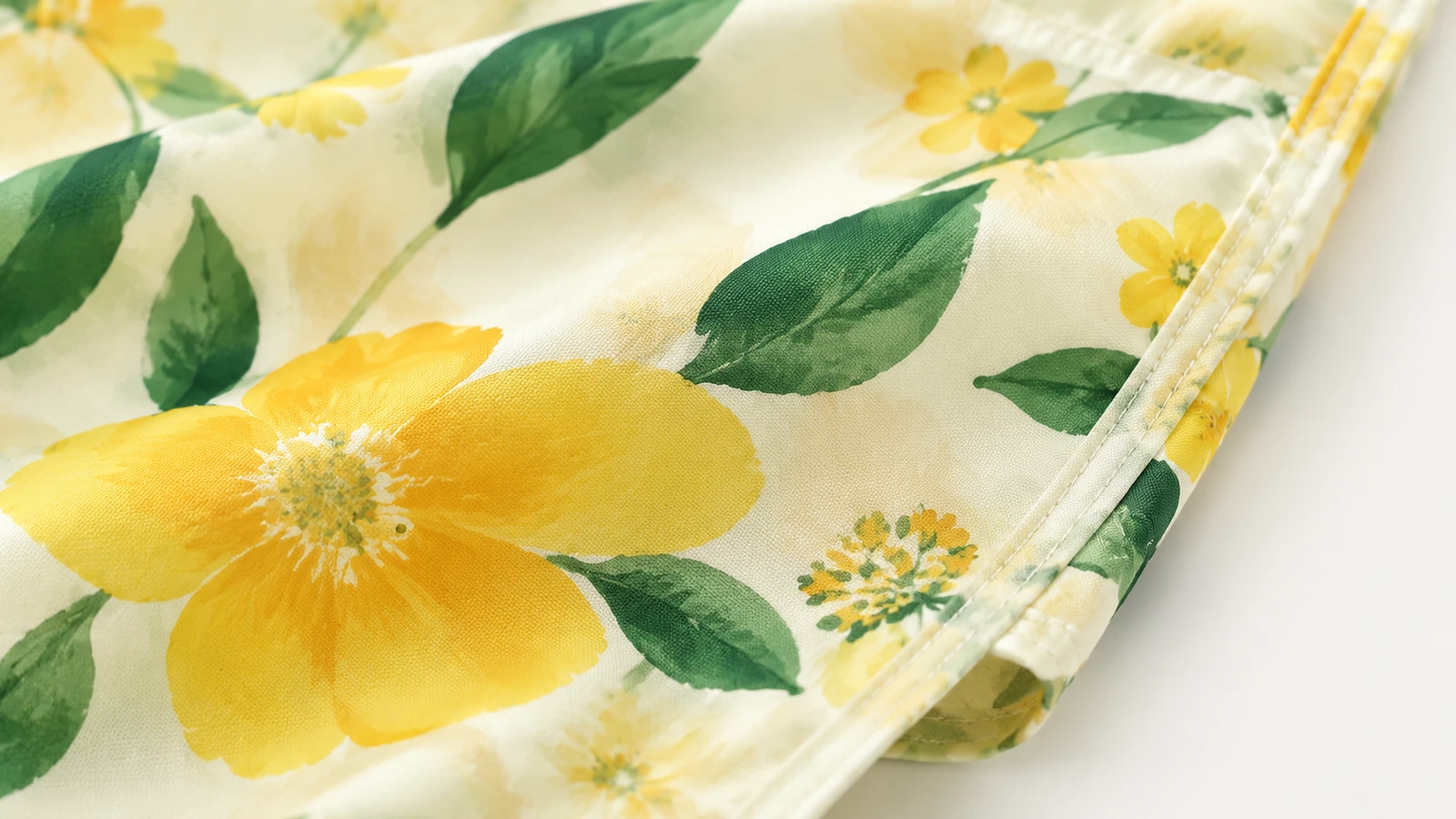
Nylon's smooth, coated surface determines which print methods work. OSGW[13] states: "You cannot sublimate Nylon (it melts). You must use Screen Printing or Heat Transfer Vinyl," and adds that these surface prints "can crack or peel, especially on a flexible bag." Kingsons recommends heat transfer over screen printing for complex or photographic graphics on lightweight nylon. Before files go to the decorator, run these preflight checks. Send spot colors as Pantone references, not RGB screenshots. Confirm a minimum line width. Ask whether light ink on dark nylon will use a white underbase or a transfer film. Keep the artwork away from handle roots, where friction is highest. Avoid large full-bleed transfers, which stiffen the fabric and work against foldability.
Proof timing varies by supplier. As one published example, Kore Create's distributor FAQ[14] lists free virtual proofs, usually within 24 hours, and production 10–20 days after proof approval. That is one US decorator's policy, not an industry norm. Your schedule is confirmed in your quotation.
Step 4: Request comparable quotes and treat MOQ as an output
Style Sourcing is blunt about minimums: "There is no useful universal MOQ for custom tote bags from China." According to Jundong[15], minimums really rise because of fabric dye-lot quantities, custom zipper pulls, special transfer films and retail packaging. Stock colors, standard trims and fewer SKUs are the lower-risk way to bring them down. Your MOQ and unit price are quoted after the spec is locked. Ask every supplier to itemize the same lines: fabric and coating, stitch density, setup and revision fees, whether the sample fee is credited against the order, labels and polybags, cartons, inspection standard, Incoterm and quote validity.
Step 5: Approve only a sample that can be mass-produced
Limit approval to three rounds. First comes a virtual proof covering size, placement and color codes. Second is a material and process sample covering hand feel, coating, seam allowance and handle comfort. Third is a pre-production sample made with bulk fabric and the bulk print method. For each sample, record the measured dimensions against the tolerance written into the contract, the handle lift result, stitch density, logo position deviation, color difference, odor and folded volume. Production time is confirmed only after the pre-production sample is signed and fabric is booked. A realistic in-hands date adds up proofing, sampling, revisions, material booking, sewing, inspection and freight, rather than relying on a single headline number.
Step 6: Inspect against a written defect list
| Check | Method | Acceptance basis |
|---|
| Handles and seams | Loaded lift cycles agreed in the PO | No seam opening; bar-tacks intact |
| Fabric strength (optional lab) | ASTM D5034 grab; ASTM D2261 tongue tear | Values fixed from the approved sample lot |
| Print adhesion | Fold, tape and agreed wash or abrasion test | No edge lift, cracking or peeling |
| Colorfastness | AATCC 8 crocking; AATCC 61 laundering | Grade agreed at sampling |
| Size, count, packing | Measure; count per carton | Within tolerance; matches packing list |
Nylon shopping bags have no dedicated AQL standard. Export contracts commonly use ISO 2859-1 general inspection level II, with AQL 2.5 for major defects and 4.0 for minor defects. Critical defects, such as a detached handle, a wrong logo or an out-of-tolerance size, should be accepted at zero. Lab values vary from lot to lot. One supplier's single-lot test[16] reported 600D PU-coated nylon at 255 GSM with 152 lbf grab strength and 18 lbf tongue tear. Treat those figures as a reference for format only. Values for your fabric remain pending until your bulk lot is tested.
Step 7: Pack, ship and plan the reorder
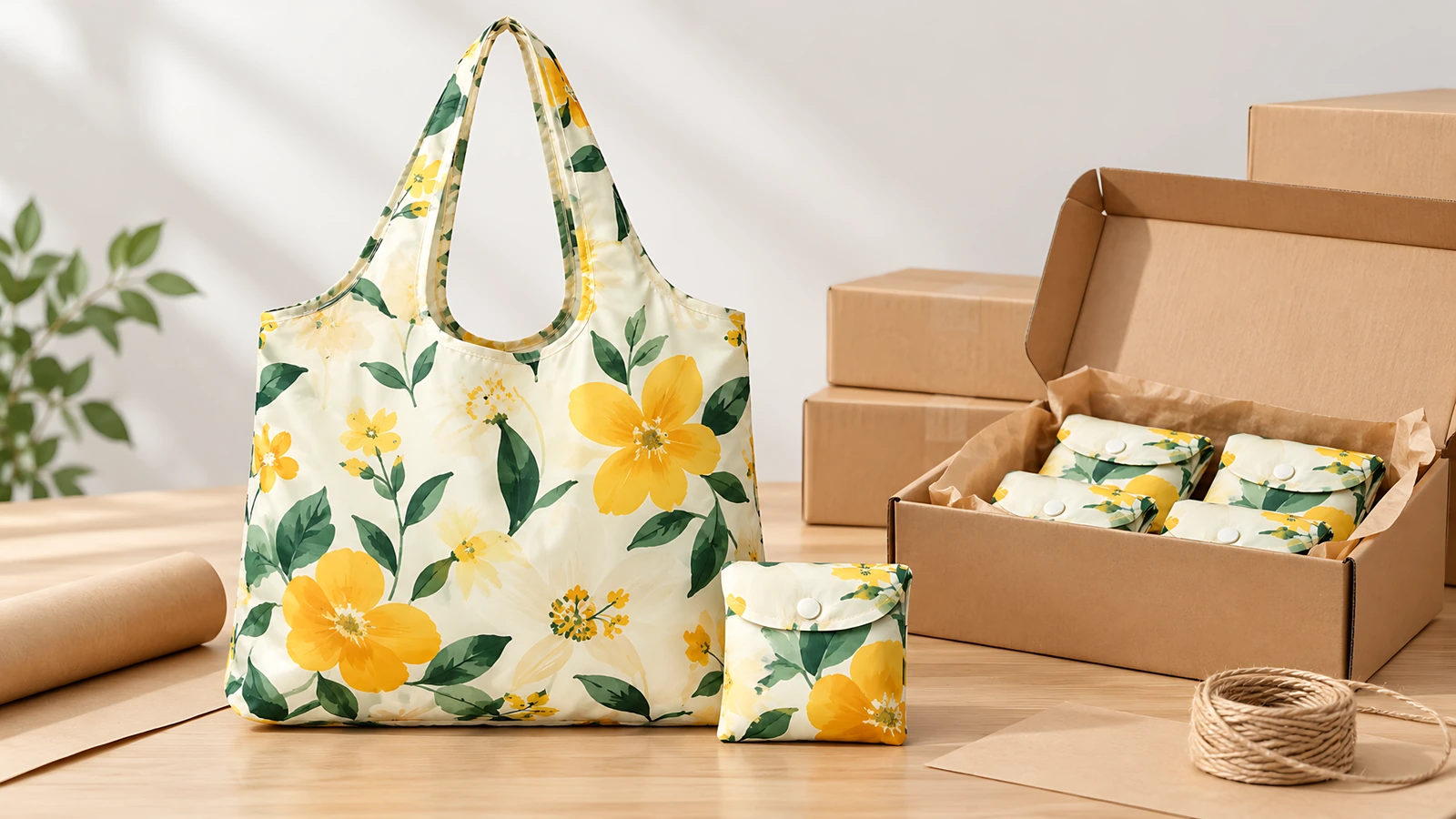
Specify the units per polybag, the carton marks and the gross and net weights, and ask for photos of each carton at sealing. Short shipments are a real risk. A BBB complaint against a tote supplier[17] reads: "we only received 108 of the bags and we ordered 240 bags." Write replacement deadlines and freight responsibility for shortages into the contract. Keep a reorder file containing the signed sample photos with dates and version numbers, the test reports and the Transaction Certificate. A repeat order on the same fabric lot and print method can reuse the approval. Changing the fabric or the print method requires a new sample.
Which Nylon Grade or Alternative Fits Your Program? ↑
| Option | Best use | Print fit | Main trade-off |
|---|
| 210T / 210D light foldable nylon | Events, member gifts, travel spares | 1–2 color screen; heat transfer for detail | Thin; friction points and seams wear first |
| 420D–600D ripstop nylon | Retail branded totes, daily groceries | Screen, heat transfer, embroidery | Heavier and costlier; less pocket-sized |
| GRS recycled nylon | ESG gifting; recycled-content channels | Same as virgin nylon | Price premium; TC required for every claim |
| RPET polyester (alternative) | Photo-quality, full-color promotions | Sublimation and transfer are stable | Weaker lightweight, tear-resistant story |
| Non-woven PP (alternative) | Single-day giveaways | Screen or transfer | Not water-resistant; seams fray with reuse |
The table follows the materials guidance from Kingsons and Jundong. On the trade-off between nylon and polyester, OSGW reports that nylon withstands more abrasion cycles than polyester of the same weight, while polyester has better UV stability. Initibag[18] adds that RPET "generally provides more flexibility for full-color and sublimation-based printing." Nylon is a defined but modest segment. Dataintelo[19] estimates nylon at about 12.3% of a reusable shopping bag market worth $12.6 billion in 2025, favored for ultra-compact foldable designs.
| Quantity (pcs) | 210T (USD/pc) | 420D (USD/pc) |
|---|
| 100–500 | 3.00–6.00 | 5.00–10.00 |
| 500–2,500 | 1.50–3.50 | 3.00–7.00 |
| 2,500+ | 0.75–2.00 | 2.00–5.00 |
These tiers are a market reference published by Hangzhou Initi[20] in October 2025 for basic drawstring bags. They are not our quotation. The same source lists add-ons of $0.3–1 per unit for waterproof coating and $50–150 per screen for screen setup, and puts recycled nylon at 10%–20% above virgin. Synberry[21] gives a wider recycled premium of 10–30%. A shopping bag's size, handles and pouch change the cost, so your price is confirmed in a quote based on your spec.
Which Compliance and Claim Rules Should Shape the Spec? ↑
California checkout rules. The CalRecycle bulletin on SB 1053[22] confirms that the SB 270 certification program ended on December 31, 2025. Since January 1, 2026, stores may hand out only recycled paper carryout bags, at a minimum charge of $0.10, and customers may still bring their own reusable bags. A corporate nylon tote is not a checkout bag. However, a retailer that wants to sell it at the register as a reusable grocery bag still needs to meet the §42281 thresholds described above.
Public procurement. New York's GreenNY reusable bag specification[23], approved December 11, 2025, limits eligible materials to recycled PET, non-woven or woven PP and natural fiber. It also requires 80 GSM, 50% recycled content and no Prop 65 warning. Nylon is not on that list, so do not claim that a nylon bag "meets government specs" without checking the specific buyer's rules.
Labeling and chemicals. Compliance Gate[24] notes that 16 CFR Part 303 exempts textiles used in handbags but found no equivalent exemption for other bags. Plan for fiber-content and country-of-origin labels, and confirm the requirement with a US advisor. Prop 65 enforcement already reaches reusable totes: notice 2024-03819[25] named a "Patriotic Reusable Tote" over DEHP. Ask for material declarations covering inks, coatings, trims and zippers. Get written confirmation that any water-repellent finish is PFAS-free. CPSIA testing applies only to bags designed for children aged 12 and under.
Care and environmental claims. According to the American Cleaning Institute[26], only 3% of reusable bag users surveyed cleaned their bags regularly. ACI recommends hand-washing nylon in warm, soapy water and line-drying it, so print "machine washable" only if wash testing supports it. On sustainability, a peer-reviewed LCA[27] found that reusable bags need at least 3–10 uses to beat single-use bags, and that figure depends on the system studied. For EU buyers, Directive (EU) 2024/825 restricts generic "eco-friendly" claims from 27 September 2026, as The Baltic Times[28] reports. Textile Exchange[29] states that GRS 5.0 replaces version 4.2 from December 31, 2026. Write "designed for repeated use" and state certified recycled percentages, not "100% eco."
Key Takeaways for Buyers ↑
- Retail demand for reusable totes keeps growing — about $2.7B in 2025 to $4.6B by 2035 (Source)
- Nylon is a focused segment for compact foldable bags — about 12.3% share (Source)
- California sets measurable thresholds for fabric grocery bags — 22 lb, 175 ft, 125 uses, 80 g/m² (Source)
- Print nylon by screen or heat transfer, never standard sublimation — two viable decoration routes (Source)
- Generic eco claims face EU restrictions — from 27 September 2026 (Source)
- Reuse must actually happen to pay off environmentally — at least 3–10 uses in one LCA (Source)
- Order-specific MOQ, production time and unit weight — confirmed in your quotation and pre-production sample
Ready to Turn Your Spec Into a Sample? ↑
A successful nylon shopping bag program comes down to a few written decisions. Choose a fabric grade matched to the use case, a print method that bonds to coated nylon, a pre-production sample built from bulk materials, and an inspection plan with clear acceptance limits. Add claims you can document, and the bag keeps carrying your logo long after the event. Send your artwork, target open and folded size, preferred fabric and estimated quantity to request a quotation and sampling plan for your custom foldable nylon shopping bags.




The information below is required for social login
Sign In
Create New Account