Custom printed polyester tote bags are woven polyester totes, usually 210D for foldable giveaways or 600D for structured daily carry, branded by screen print, sublimation or DTF. A successful order depends on fixing denier, GSM, coating, handle construction, print method, tolerance and inspection terms in writing before production begins.
This page is for the person who hands out bags at a trade show, open house, onboarding kit or store event and wants them carried again next month. Typical buyers are marketing coordinators, event planners, association staff and small-business owners who place one or two orders a year. The people who receive the bags range from conference attendees to employees and customers. That means one tote may need to hold files, product samples, groceries or gym gear, and a good-looking render is not enough.
The problem: the word "polyester" on a quote covers a wide range of specs. A see-through 210D giveaway and a structured 600D carryall can share the same product name. Some catalogs also list non-woven polypropylene in the same tote category. The cost: a vague spec tends to fail at the worst moment. Public complaints describe an order of 240 bags where only 108 arrivedBBB complaint records[1]. Another describes a 46-bag order where every bag smelled strongly of mildewverified buyer review[2]. Event dates do not move, so a reprint is rarely possible. The fix: treat the tote as a written specification rather than a catalog picture. The sections below cover fabric and coating choice, matching the print method to the fabric, artwork preflight, a realistic timeline and acceptance tests in the order. We quote MOQ, lead time and unit price per project once the spec is confirmed. Nothing on this page is a blanket promise.
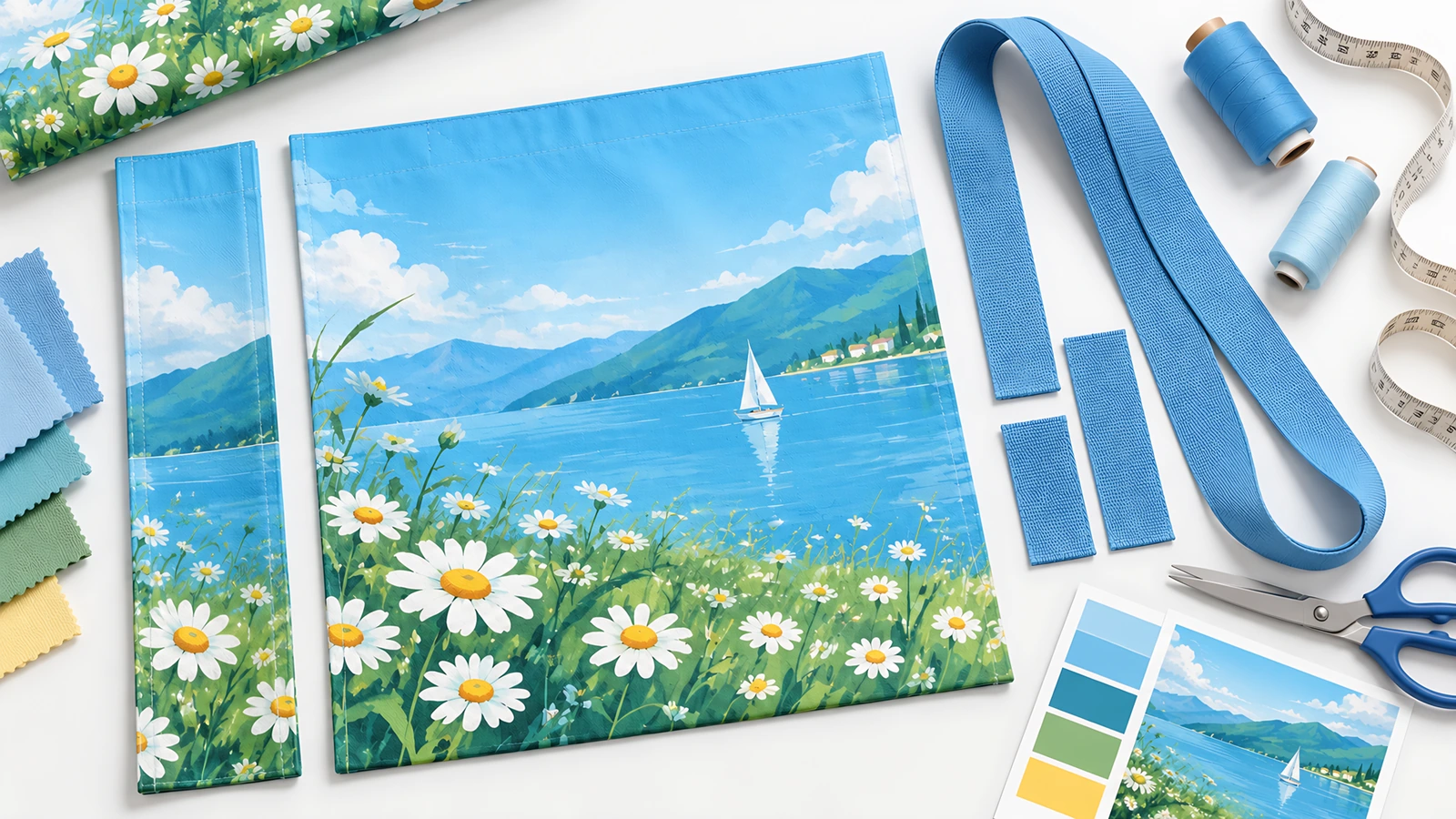
Table of Contents
What are you buying with a custom printed polyester tote? ↑
A custom printed polyester tote is a sewn bag cut from woven polyester filament fabric, usually oxford or canvas weave, and branded with your artwork. There are two ordering models. The first is decorating a stock blank, which changes only the imprint, because color, size and pockets are fixed by the SKU. The second is structural customization, which changes fabric, dimensions, handles, gusset and pockets. Structural work needs sampling and usually carries higher minimums and longer schedules.
A public U.S. catalog listing shows what the first model looks like. It offers a medium 210D tote at 16" W × 12" H × 6" D with an 11-3/4" × 9" imprint area and 28" polypropylene web handles. The listing states 3–5 production days and $3.80 each at 100–249 unitscatalog listing for a 210D tote[3]. These figures describe one SKU at one point in time. They are not an industry average.
Denier measures yarn thickness. It is not fabric weight and it is not a load rating. A tightly woven, high-GSM 420D oxford can be heavier and more abrasion-resistant than a loosely woven, low-GSM 600Dfabric denier guide[4], so ask for both denier and GSM on every quote. Usable volume and safe load depend on the actual dimensions, how the bag is loaded and verification on a sample. We confirm both on the pre-production sample instead of printing a generic weight rating.
Which fabric tier fits your use: 210D, 600D, rPET or coated? ↑
| Tier | Reference fabric weight | Best fit | Limits |
|---|
| 210D polyester | About 110–180 gsm | Foldable giveaways, conference bags | Not suited to heavy loads or frequent washing; can look see-through |
| 420D–600D polyester | 600D about 280–360 gsm | Daily carry, onboarding kits, outdoor events | Heavier cartons and higher freight |
| 600D rPET | Confirm GSM on quote | ESG programs, retail merchandise | "Recycled" claims require order-level documentation |
| PU- or PVC-coated | Request hydrostatic head in mm | Rain exposure, extra structure | Stiffer and heavier; coatings can crack in humid storage |
The GSM ranges come from the mill guide cited above, and they shift with weave density. Uncoated polyester is water-resistant at best. A PU coating keeps the bag foldable, and PVC gives stronger waterproofing at the cost of weight and stiffness. Request a hydrostatic head rating in millimeters rather than accepting the word "waterproof"polyester bag ordering guide[5]. The same guide says most polyester complaints are not about the fabric. They are about the handle join, or a print that cracks along a fold line. Without a bar tack or box-X stitch, a handle can rip out under load.
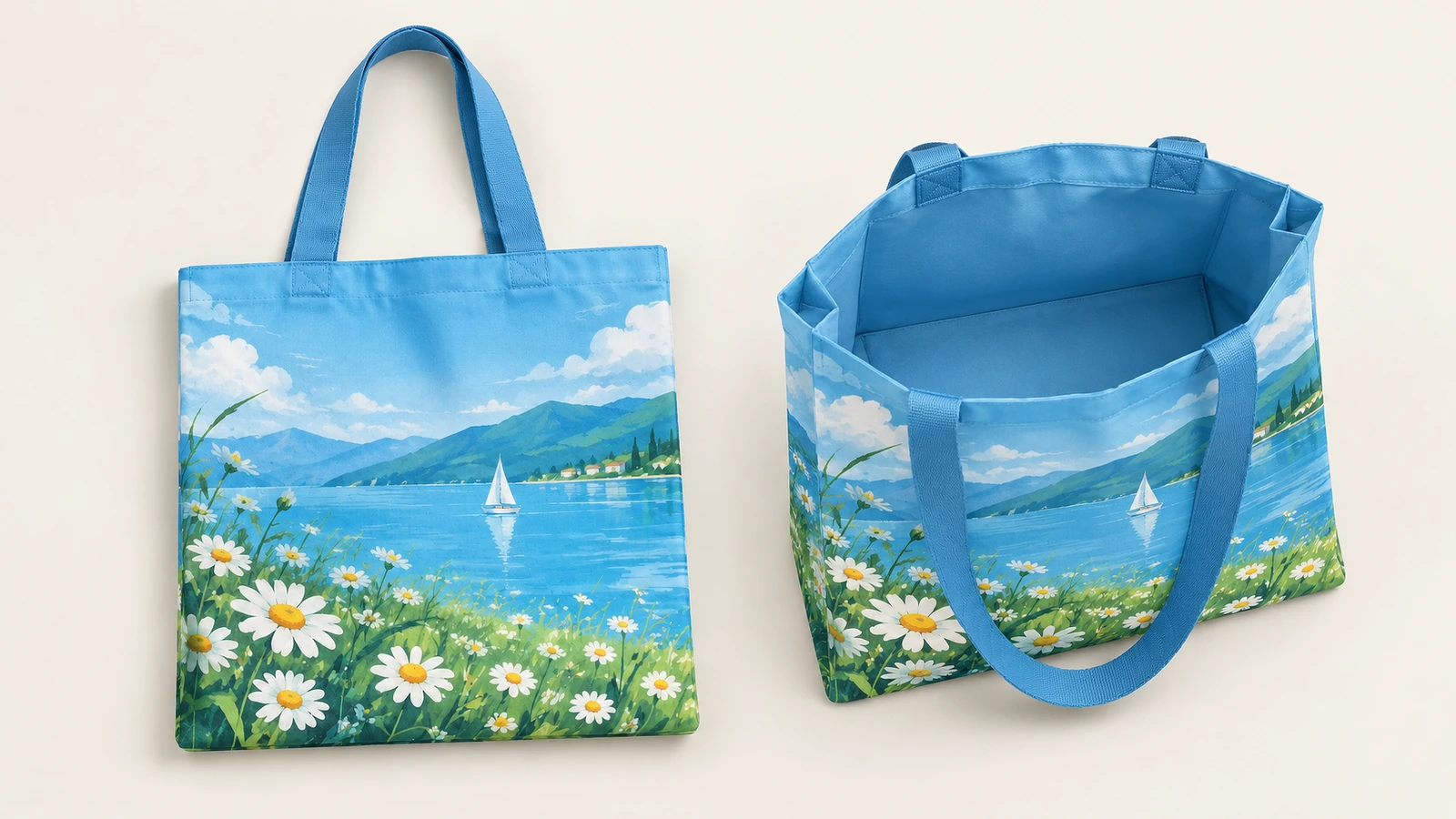
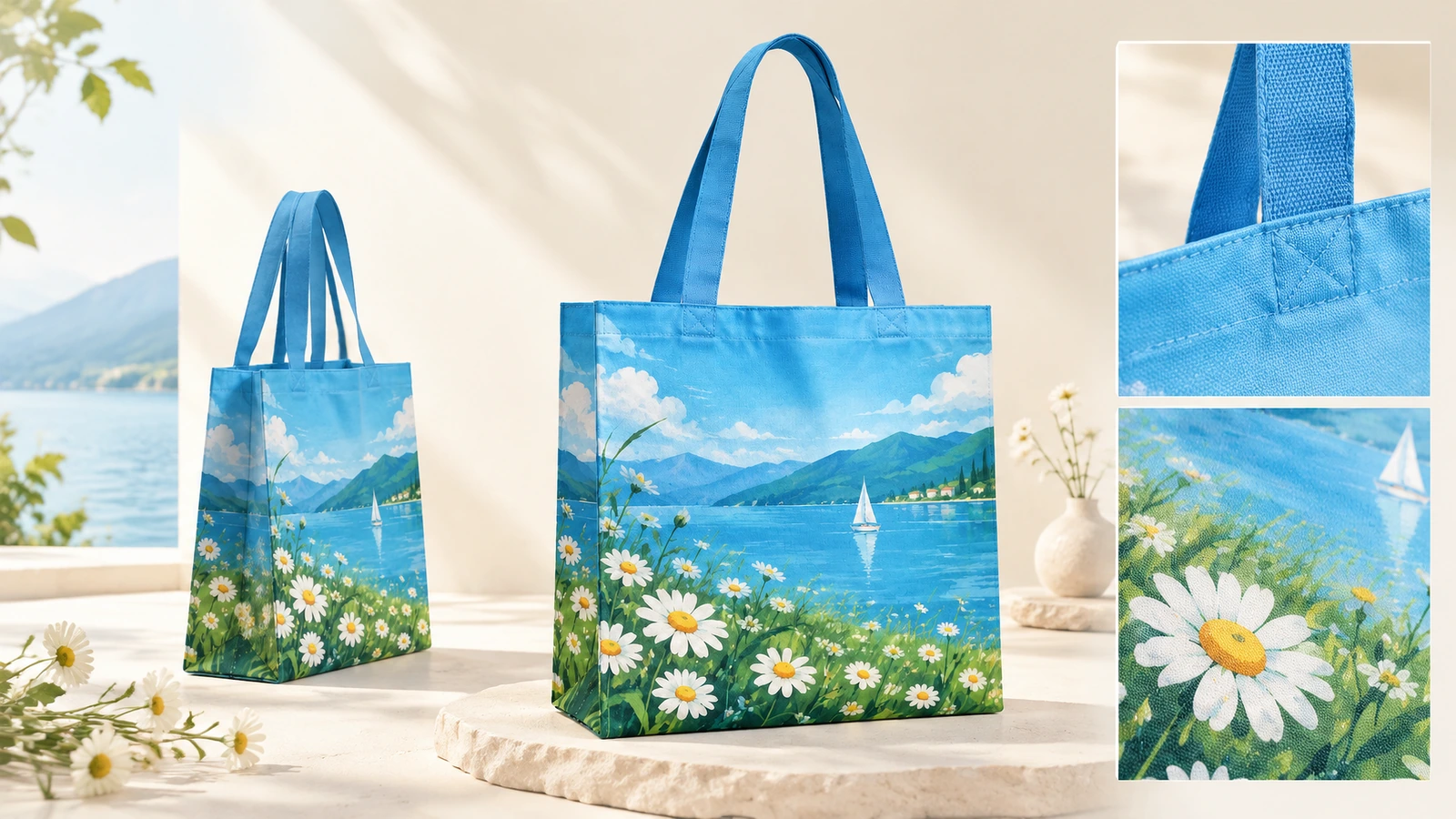
Decide bag size and imprint area together. Pockets, seams and gussets shrink the printable zone, so a large bag can still end up with a small logo. Measure the flat front panel clear of seams and handles. Then check that the logo reads at the distance people will actually see it, which is usually across a booth or aisle and not on a screen.
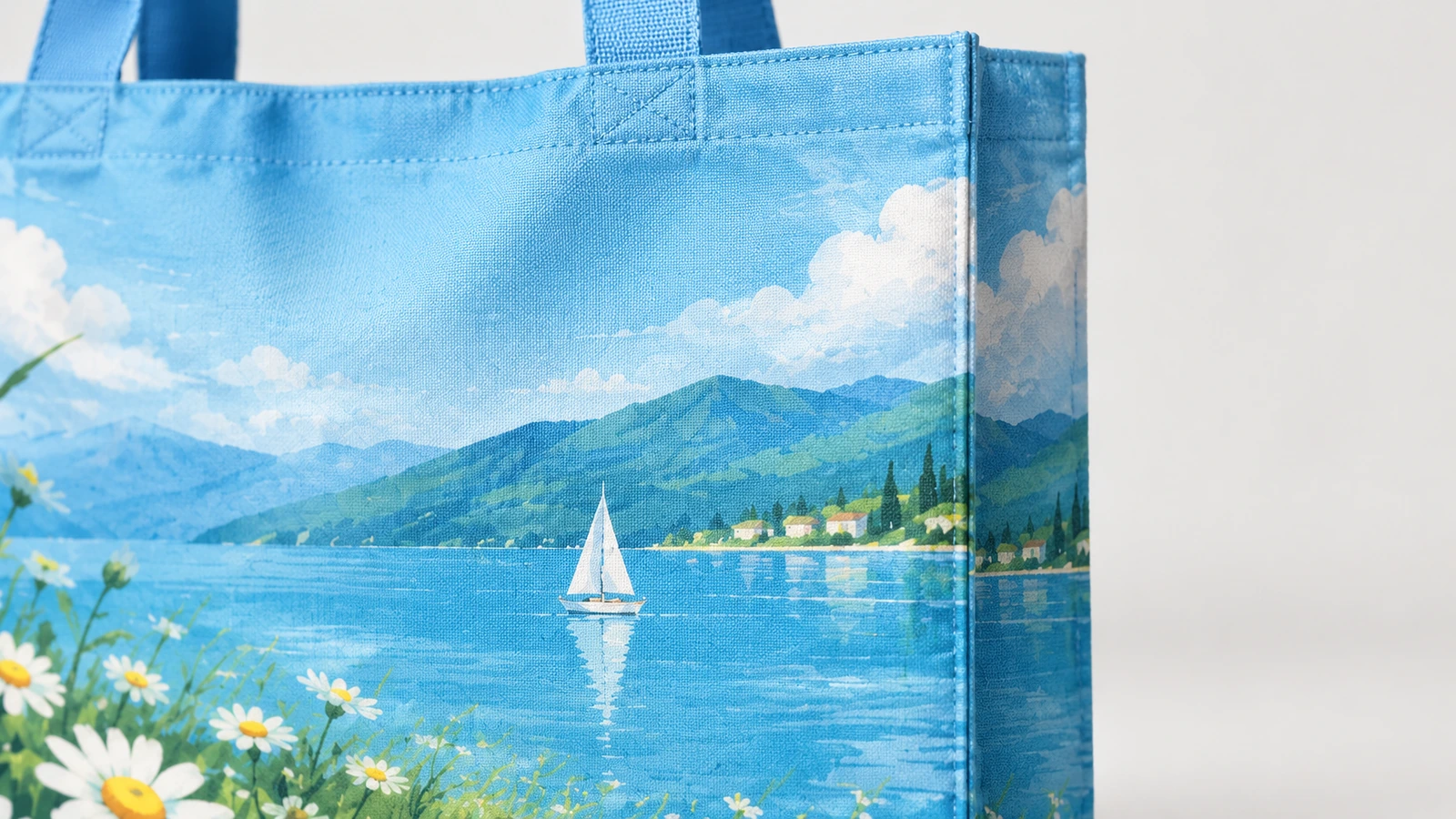
Surface finish and handle attachment are where cheap totes usually fail. Coated fabrics stored in hot, humid warehouses can turn sticky or delaminate. Lock the coating supplier for the whole batch and rule out substitutions mid-run. For handles, specify webbing width, stitch type and reinforcement at each join, and approve them on the physical sample before bulk cutting starts.
How do you pick a print method that will not crack or fade? ↑
| Method | Colors | Dark fabric | Best for |
|---|
| Screen print | 1–4 spot (Pantone) | Yes, light inks need a white underbase | Logos and solid brand colors |
| Dye sublimation | Unlimited | No | Full-bleed images on light, high-polyester bags |
| Heat transfer / DTF | Unlimited | Yes | Small full-color marks on dark bags |
| Embroidery | Thread colors | Yes | Small logos away from zippers and thick seams |
Sublimation needs a polyester body. One print guide states that 100% polyester is the only body that takes dye sublimation for a full photo on a white totetote printing guide[6]. If a blank does not state its fiber percentage, treat sublimation on it as untested. For washing, a decorator's 2026 guide estimates that screen prints on 600D polyester canvas last about 30–40 washes and recommends spot cleaning. It puts machine-washable 10 oz cotton canvas at 50+ washes, assuming standard conditions and a proper curedecorator's material guide[7].
The bag sets the imprint area, not the artwork. One 600D cationic oxford tote in a U.S. catalog allows only a 3" × 3" print, by silkscreen or transfer, with 7–10 business days of productionoxford tote listing[8]. On dark 210D fabric, a light screen print needs a white underbase, which adds a pass and cost.
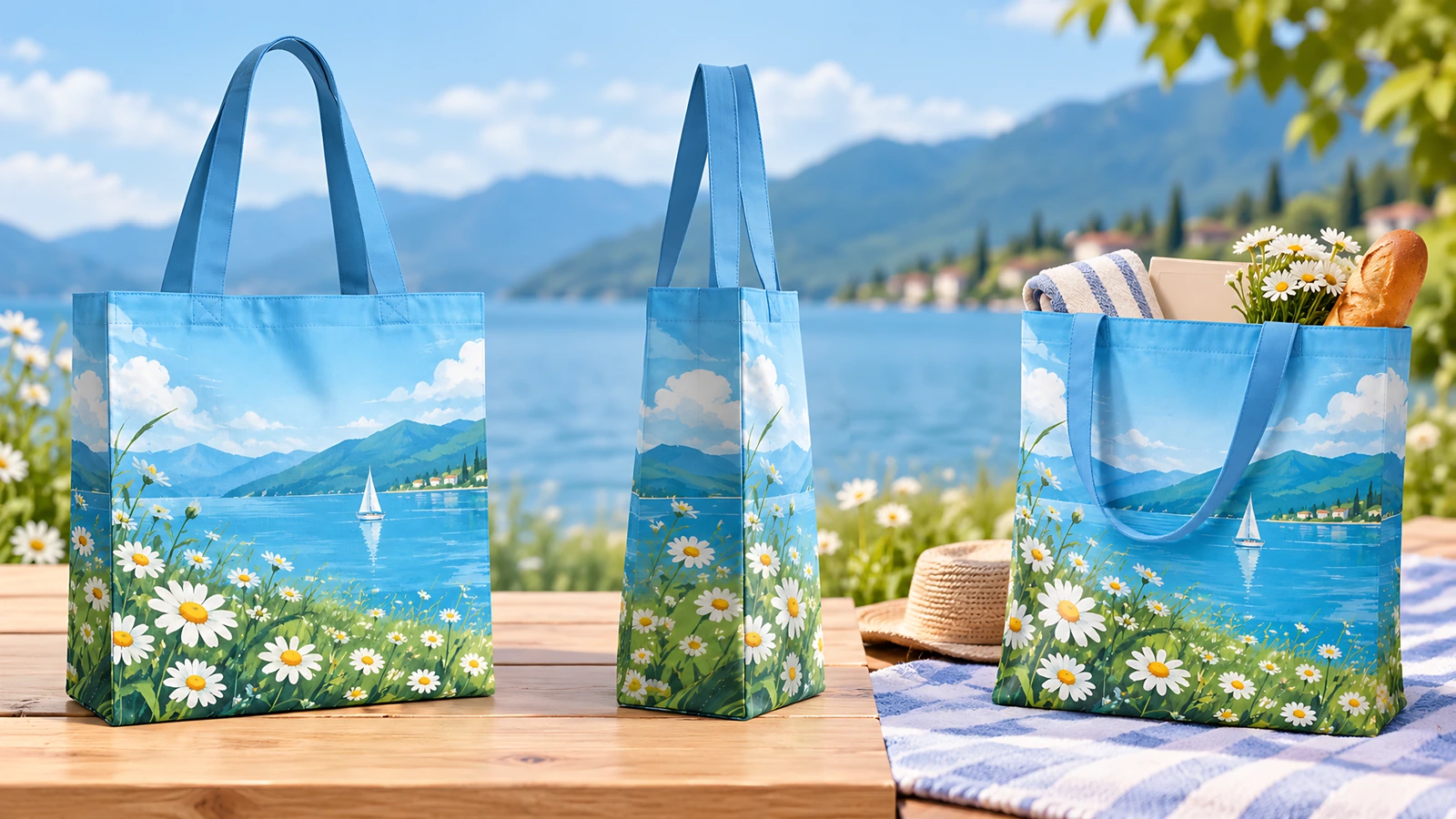
Run this preflight before you request a proof:
- Vector files (AI, EPS or PDF) with all text converted to outlines.
- A Pantone reference for each spot color.
- Imprint location and maximum size measured clear of seams, pockets and handles.
- No lines thinner than about 1–1.5 pt, and artwork kept about 15 mm from seams.
- A written choice of spot color or full color, and front only or both sides.
- Agreement that the signed proof becomes the production reference.
How does an order move from quote to delivered bags? ↑
Step 1 — Brief and quote. Send quantity, in-hands date, delivery address, fabric tier, bag size, handle style, print method and number of colors. The quote should list unit price, screen or setup fees, sample cost, freight and inspection as separate lines so you can compare quotes on equal terms.
Step 2 — Digital proof. The proof shows imprint position, size and Pantone colors on a template of the actual bag. Count lead time from proof approval, not from the day you first inquired.
Step 3 — Physical sample. This step is required for any new fabric or construction. Photograph the sample in daylight next to the render, and run a wash and rub check if the bags will be laundered. The signed sample fixes dimensions, stitch density, handle position, logo registration and hardware.
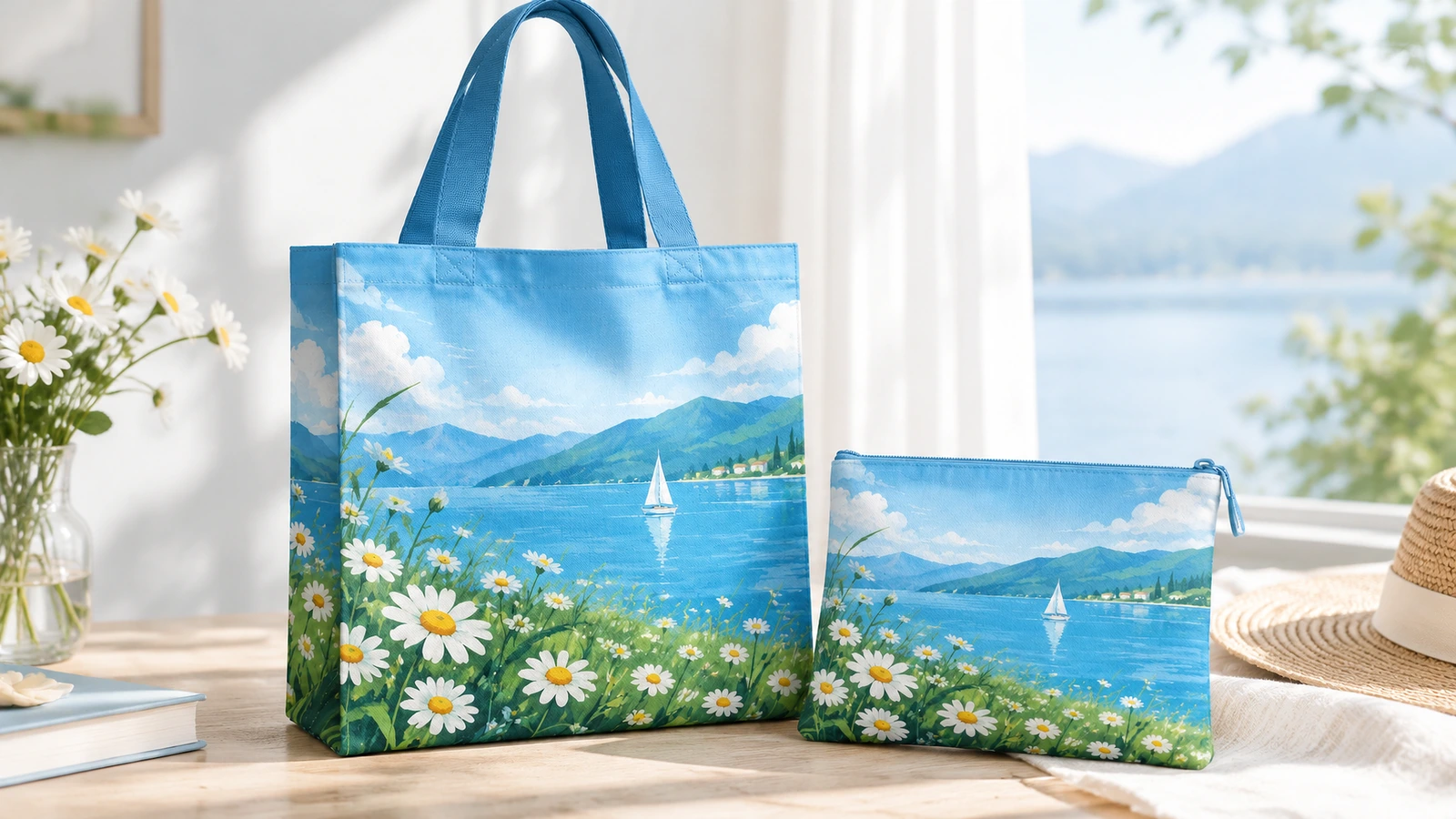
Step 4 — Bulk production. Production follows the signed sample, with in-line photos of cutting, printing and sewing. Step 5 — Final inspection happens before the balance payment (see the next section). Step 6 — Shipping is chosen by event date: domestic courier for decorated stock blanks, and ocean, air or express for overseas production.
| Sourcing route | Typical MOQ seen | Typical timing seen | Best fit |
|---|
| U.S. catalog imprint on stock blank | 25–150 pcs | 3–10 production days after proof, plus transit | Events under three weeks away |
| Stock color plus print, overseas | 100–300 pcs | 15–25 days, plus freight | Planned annual giveaways |
| Full custom fabric, size and hardware | 1,000+ pcs | 40–55 days plus 20–30 days ocean | Retail and private label |
The overseas rows come from a B2B marketplace's 2026 guidance on promotional totesmarketplace MOQ guide[9]. The U.S. row reflects catalog listings for 210D, 600D and oxford totes at 3–5, 5–7 and 7–10 days, including a 600D convention tote at 5–7 working days600D convention tote listing[10]. Small brands feel the gap between these routes. One owner who needed 50–80 bags found that most suppliers wanted 500+ pieces, and print-on-demand pricing climbed quickly beyond samplessmall-business buyer thread[11]. If your event is less than three weeks away, decorate a stock blank and do not start a structural change. Our own MOQ and lead time are quoted per order once the brief is complete.
A 2026 factory price guide lists 210D polyester drawstring bags at $0.90–$1.30 for 100 pieces and $0.55–$0.80 for 1,000, FOBfactory price guide[12]. FOB prices exclude ocean freight, duties and U.S. delivery, and a drawstring bag uses less fabric than a gusseted tote. Use these figures only to sanity-check quotes, never as a target price for 600D.
What should inspection look like before you pay the balance? ↑
Sample with ISO 2859-1 / ANSI/ASQ Z1.4 at General Inspection Level II. Allow 0 critical defects, AQL 2.5 for major defects and AQL 4.0 for minor ones. Bag inspection checklists classify a detached handle, an open seam or a reversed logo as majorbag AQL guide[13]. AQL 2.5 is a sampling acceptance limit. It is not permission to ship 2.5% defective goodsAQL sampling explainer[14].
For dark or fluorescent colors, put colorfastness in the PO. Washing should meet ISO 105-C06 or AATCC 61 at grade 4 or better for color change and grade 3 or better for staining. Rubbing should be tested to ISO 105-X12 or AATCC 8colorfastness testing guide[15]. A single-cycle pass is a much weaker result than a multi-cycle pass. Water repellency can be checked with the AATCC TM22 spray test[16], which measures resistance to wetting but proves neither waterproofing nor machine washability. Fabric strength can be specified with the ASTM D5034 grab test[17]. We have not run any of these tests for this page. Each one is a sampling or third-party test item agreed per order.
U.S. catalogs commonly state an approximate 0.5 inch tolerance in fabric sizing. That is a seller's contract term, not a standard. If you need a tighter tolerance, write it on the proof. A size tolerance never excuses a misplaced imprint, uneven handles or the wrong logo color.
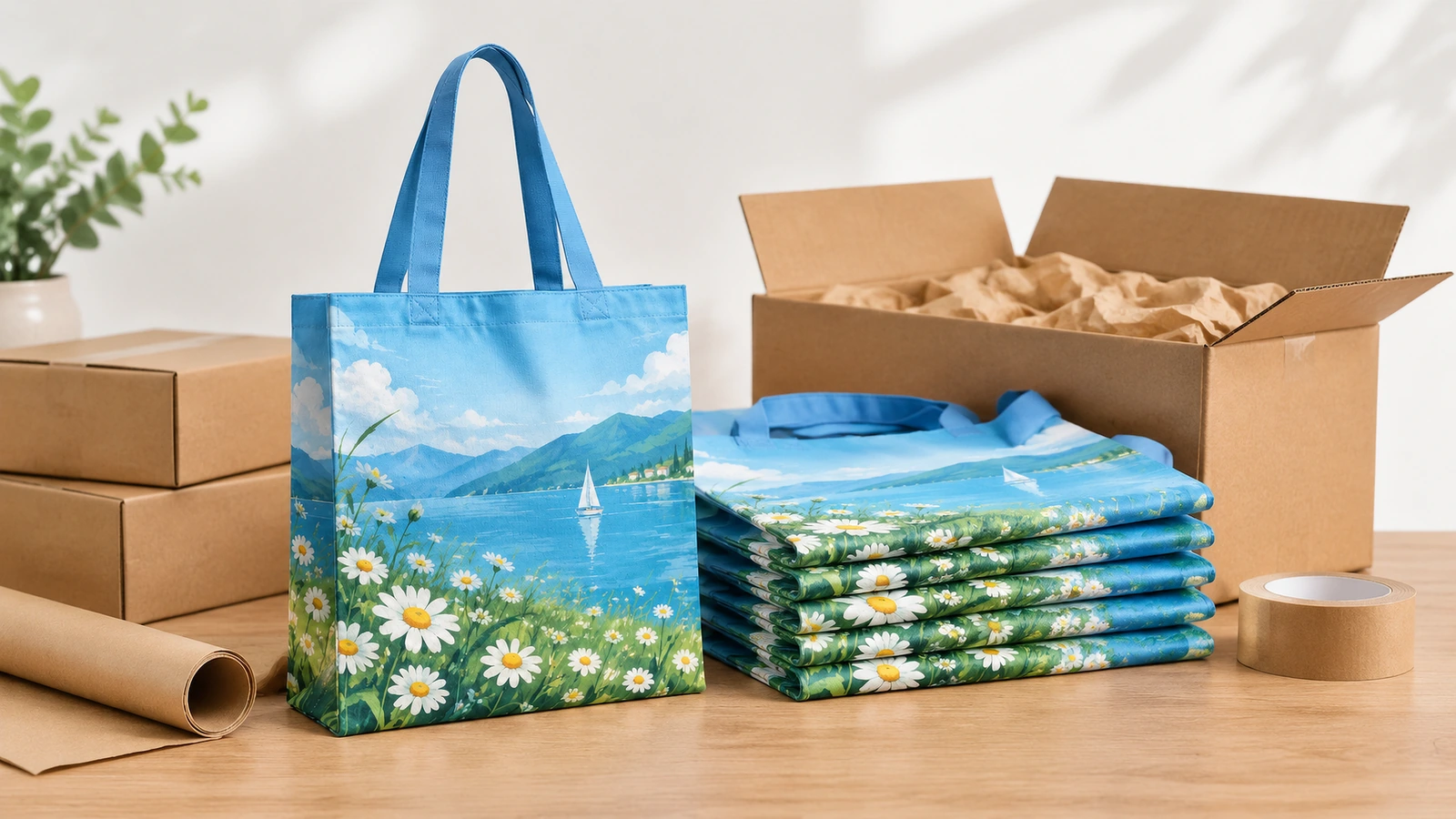
- Carton count checked against the PO and packing list before event week.
- Odor and moisture: a brief new-fabric smell can air out, but damp or mildewed cartons are a rejection.
- Handle joins pull-tested and compared with the signed sample's reinforcement.
- Imprint position, size and Pantone match, with no pinholes or flaking.
- Dimensions measured flat and within the agreed tolerance.
Specify units per inner bag and per carton, a carton weight limit and carton labels, so event staff can hand out bags without sorting them first. Set the acceptance window at 7–15 working days after receipt rather than a few days after shipment. The seller should pay freight for major defects such as missing handles, batch-wide color bleed or a wrong logo. Keep the signed sample, approved proof and Pantone list on file so next year's reorder matches this one.
How does polyester compare with canvas, cotton and non-woven? ↑
| Material | Print strengths | Care | Feel | Best scenario |
|---|
| 600D polyester | Sublimation, transfer, smooth surface | Spot clean | Structured, water-resistant | Daily outdoor use, onboarding |
| 210D polyester | Screen, transfer | Spot clean | Light, foldable | High-volume giveaways |
| 10 oz cotton canvas | Screen print, embroidery | Machine washable | Heavier, absorbs water | Retail merchandise |
| 4–6 oz cotton | Screen, DTG | Limited reuse | Soft, deforms | Short campaigns |
| 80 gsm non-woven PP | Low-cure screen | Not washable | Budget feel | One-time mass distribution |
The print and care columns follow the decorator's material comparison cited earlier. Prices are left out because quotes move with spec, print colors and freight terms. Choose polyester when water resistance, foldability or full-color sublimation matters most. Choose canvas when perceived value and machine washing matter most. Choose non-woven only when unit cost and volume outrank reuse. Polyester has a synthetic hand-feel, so avoid canvas-texture renders that set the wrong expectation.
Which labels and recycled claims are safe in the U.S. and EU? ↑
Under 16 CFR 303.45[18], the Textile Act covers listed products such as apparel, bedding and towels and excludes other textile products. Tote bags are not on the list. Any fiber content you do state on packaging or a listing still has to be truthful.
The FTC Green Guides[19] require partly recycled items to clearly state the amount or percentage of recycled content by weight. A claim like "made from recycled bottles" therefore needs a GRS transaction certificate for that specific PO, and handles or coatings that are not recycled limit what you can claim for the whole bag. Textile Exchange reports about 9.7 million tonnes of recycled polyester produced in 2025, 97% of it from plastic bottlesmaterials market report[20]. Any "textile-to-textile" claim needs separate proof of feedstock.
Since January 1, 2026, covered California stores may only provide recycled paper carryout bags, at a minimum charge of $0.10CalRecycle rules[21]. A promotional polyester tote does not automatically qualify as a compliant checkout bag, so get a retail legal review before using one that way.
In the EU, unsupported generic claims such as "eco-friendly" became prohibited in consumer marketing on 27 September 2026EmpCo analysis[22]. From 10 October 2026, PFHxA in clothing, accessories and footwear is limited to 25 ppbPFAS restriction overview[23], so water-repellent finishes need batch tests. In California, a 2026 Prop 65 notice alleged DEHP in tote bagsProp 65 notice[24]. That notice is an allegation, not a ruling, but it is a reason to screen PVC trims, coatings and inks. Bags made for children 12 and under also fall under CPSIA testing and tracking-label rules.
What are the key takeaways for your next order? ↑
- The promotional channel is large and still growing slowly — U.S. distributor sales of $27.1 billion, up 1.3% (Source)
- Sustainable products are a meaningful share of promo spend — $3.69 billion, or 13.8% of 2024 sales (Source)
- Recycled polyester is still mostly bottle-based — 9.7 million tonnes in 2025, 97% from bottles (Source)
- Catalog decorating of stock blanks is fast but fixed-spec — 210D tote, 3–5 production days, $3.80 at 100–249 units (Source)
- Promo totes are not automatic California checkout bags — recycled paper only, minimum $0.10, from January 1, 2026 (Source)
- Generic "eco-friendly" claims are risky for EU buyers — prohibited without proof from 27 September 2026 (Source)
- Write AQL levels into the PO — Level II, 0 critical, 2.5 major, 4.0 minor (Source)
Ready to turn your brief into a signed spec? ↑
A good order of custom polyester tote bags is decided before production starts. That means denier and GSM on the quote, a stated coating, reinforced handle joins, a print method matched to the fiber, a signed proof and sample, and AQL and colorfastness terms in the PO. Send us your quantity, in-hands date, artwork and intended use. We will reply with a written quote and a digital proof, and we will list which items still need sampling or testing.
Request your quote and digital proof




The information below is required for social login
Sign In
Create New Account